← Front Burner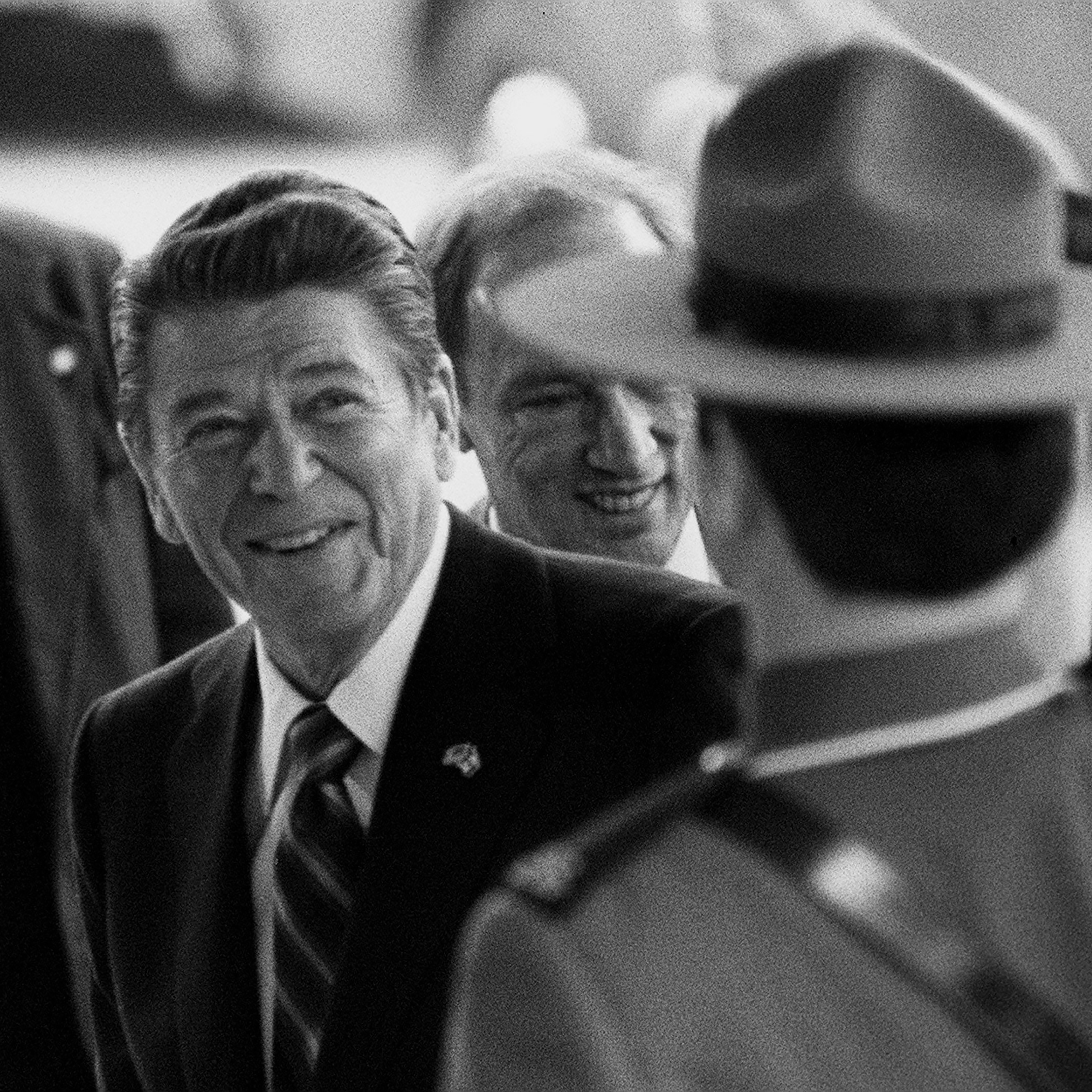
Front Burner
What did Reagan really believe about tariffs?
00:33:34
<p>Why has U.S. President Donald Trump suspended trade talks with Canada? Why did the U.S. ambassador to Canada level an expletive-laced tirade at Ontario's trade representative, in front of more than 200 people? Why is Trump's treasury secretary accusing the Ontario government of running a psy-op?</p><p><br></p><p>Because of a 60-second ad, featuring clips of former president Ronald Reagan explaining why he thinks tariffs — Trump's self-professed "favourite word" — are bad economic policy.</p><p><br></p><p>Rick Perlstein has written extensively about the history of American conservative politics, including the book Reaganland: America's Right Turn 1976-1980. He breaks down what Reagan actually believed about tariffs and free trade, and why bringing up the spectre of Reagan — one of the most sacred figures in American conservatism — has caused so much chaos.</p><p><br></p><p>We'd love to hear from you! Complete our <a href="http://www.cbc.ca/FrontBurnerSurvey" rel="noopener no...
Loading summary
Transcript75 lines
- [00:00]
Rick Perlstein
When everything is moving all at once, your workforce, your tech stack, your business, you don't need more tools, you need one solution. That's why Paylocity built a single platform to connect hr, finance and IT with AI driven insights and automated workflows that simplify the complex and power what's next. Because when everything comes together in one place, growth comes easy experience. One place for all your HCM needs. Start now@paylocity.com 1 this is a CBC podcast.
- [00:36]
Jamie Poisson
Hey everybody, I'm Jamie Poisson. So if you were about 1 of 200 people invited to this event for the Canadian American Business Council in Ottawa this week, it sounds like you had a very good chance of witnessing the U.S. ambassador to Canada absolutely ripping into Ontario's trade representative in what has been described as an expletive filled tirade. Why was he dropping F bombs? Well, because of the now infamous ad put out by the Ontario government quoting former US President Ronald Reagan. The ad that was, according to Trump, fraudulent and some kind of foreign interference. The ad Trump blamed for blowing up the trade talks.
- [01:23]
Rick Perlstein
Canada lied.
- [01:24]
Ronald Reagan (archive audio)
I mean, what they did was terrible. They made up a fake statement by President Reagan. A deal right now that's very good for us.
- [01:33]
Rick Perlstein
Any deal that would have been made.
- [01:35]
Ronald Reagan (archive audio)
Would have been better for them than the one they have right now. That's why I was surprised they did this.
- [01:40]
Jamie Poisson
Look, I think we all know that these negotiations may have been blown up, ad or no ad. But today we wanted to look at what it was about. The ad that apparently set the President off. Why does it matter what Ronald Reagan believed or didn't believe about free trade? How is Reagan's legacy looming over or at odds with the modern Republican Party? I can think of few people better to do this with than Rick Perlstein. He is the author of a number of books on the history of the conservative movement in the United States, including his most recent book, Reagan America's Right Turn, 1976-1980. Rick, it is so great to have you on front burner.
- [02:32]
Rick Perlstein
Yeah, this is a really great subject. It brings a lot of very, very important things together.
- [02:37]
Jamie Poisson
So let's start with this ad that the government of Ontario ran and I'll just give people a little bit more info on it if they haven't seen it yet. It is edited together from this radio address that Reagan gave on April 25, 1987. It's just Reagan's voice and he's making the argument that imposing tariffs on foreign markets is not the right for America and American jobs.
- [02:59]
Ronald Reagan (archive audio)
Long term High tariffs inevitably lead to retaliation by foreign countries and the triggering of fierce trade wars. The result is more and more tariffs, higher and higher trade barriers, and less and less competition. So soon, because of the prices made artificially high by tariffs that subsidize inefficiency and poor management, people stop buying. Then the worst happens. Markets shrink and collapse, businesses and industries shut down, and millions of people lose their jobs.
- [03:28]
Jamie Poisson
When you saw the ad, which Trump has flagged as fraudulent, what did you think?
- [03:34]
Rick Perlstein
Well, right off the top, that, you know, Trump can kind of plead ignorance. Right. He's not a very learned man. But that it is absolutely, fundamentally true that this is what Ronald Reagan believed. And it's not only the case that Ronald Reagan believed it. It's what, you know, 99% of responsible, you know, economists believe. Right. Donald Trump has an economist named Peter Navarro, the guy he relies on for these policies. He's such a fringe figure that in the book he wrote making these arguments that tariffs are the most important thing for a nation's prosperity, he literally made up a source that was kind of scrambling around the letters of his name to quote as his authority. So there's no intellectual justification for Donald Trump's position. And Reagan was known as the Great Communicator, and he communicated quite brilliantly, something that was very near and dear to him because he was someone who was profoundly affected. His family was profoundly affected by the Great Depression. Right. His dad was wiped out. And one of the causes of the Great Depression, you know, most economists would agree, was a punitive trade war, the Smoot Hawley Tariff.
- [04:53]
Jamie Poisson
Mm.
- [04:53]
Ronald Reagan (archive audio)
The memory of all this occurring back in the 30s made me determined when I came to Washington to spare the American people the protectionist legislation that destroys prosperity. Now, it hasn't always been easy. There are those in the Congress, just as there were back in the 30s, who want to go for the quick political advantage, who risk America's prosperity for the sake of a short term appeal to some special interest group.
- [05:18]
Rick Perlstein
And, you know, not only that, but his intellectual background in economics, he basically believed in. I mean, it's almost not even libertarian economics, it's just mainstream economics that, you know, countries do different things well. Right. That countries have to be able to trade with each other in order to achieve a shared prosperity, that trade is a win, win. There are ins and outs that involve, you know, sometimes there are bumps in the road. Right. We might get a little more deeply into the context for that particular speech that was quoted in the commercial. But then along comes Donald Trump, and then along Comes even more disturbingly, the Ronald Reagan Foundation. Right.
- [06:00]
Jamie Poisson
Which is the group.
- [06:01]
Rick Perlstein
Do you want to talk about that?
- [06:02]
Jamie Poisson
I do want to talk about the foundation, but first let's talk a little bit more about the context of the speech. Because, you know, I think the kernel of truth here that people are pointing at is that when the speech was made, it was made because Reagan had actually just slapped duties. So tariffs, in another word, on Japanese semiconductors. At the time, he was worried about the rising power of Japan.
- [06:26]
Ronald Reagan (archive audio)
Now, imposing such tariffs or trade barriers and restrictions of any kind are steps that I am loath to take, that over the long run, such trade barriers hurt every American worker and consumer. But the Japanese semiconductors were a special case. We had clear evidence that Japanese companies were engaging in unfair trade practices that violated an agreement.
- [06:49]
Jamie Poisson
So I think this is what people are talking about when they're saying that the speech was taken out of context and selectively edited because he was using tariffs.
- [06:59]
Rick Perlstein
Yeah, that's intellectually irresponsible in the extreme. Right. There are times in limited circumstances when again, most economists and most policymakers who believe in, you know, what's known as free trade, which is a complicated thing, but let's call it free trade for the purposes of this discussion, say that sometimes tariffs can be useful and called for, you know, in cases where both countries have factories that produce the thing that's being argued over and one side believes the other side is acting unfairly. You know, whether it's, you know, kind of manipulating supply, supply or currency or all sorts of things. And that is this one time intervention. You know, you can kind of do a shot across the bow and everyone can emerge from this without the kind of escalation that Reagan talks about in the commercial.
- [07:51]
Ronald Reagan (archive audio)
When someone says, let's impose tariffs on foreign imports, it looks like they're doing the patriotic thing by protecting American products and jobs. And sometimes for a short while it works, but only for a short time.
- [08:06]
Rick Perlstein
This is very, very different, you know, really just, you know, chalk and cheese, completely different situation from how Donald Trump and his policymakers think about tariffs, which is that you can use them all the time in order to achieve a zero sum advantage for your country, and that it can happen in industries where America does not have industrial capacity. Right. So kind of tactically speaking, if we say Canada is flooding the market with widgets, but we don't have any way to make any widgets, if we just place a tariff on Canadian widgets, all we're doing is increasing the price of widgets with no advantage whatsoever. For the United States. So there's kind of a technical economic argument that shows that, you know, the ad, generally speaking, both for what Ronald Reagan believes and what most responsible economists and policymakers believe was accurate. And by claiming that it was out of context and distorting, that is the kind of thing that we see in, you know, authoritarian dictatorships. Just lie after lie after lie.
- [09:17]
Jamie Poisson
Just before you and I started talking, I was scrubbing through the entire speech and I just probably worth noting here, you know, he, he does basically frame it as these duties being a step that he was loath to take. Yes. And, and he was doing it because at the time he said that Japan was not enforcing a trade agreement on semiconductors specifically, and that it was like an unusual case of leveraging trade policies to the point that you were making earlier.
- [09:46]
Rick Perlstein
So if it's an out of context quote, if you see the full context, it only makes Reagan's point stronger, not weaker.
- [09:53]
Jamie Poisson
But let me push back a little bit because there are other arguments that people are making that, like beyond this semiconductor stuff, Reagan's actual policies were more complicated than his rhetoric. For example, that he also put tariffs on motorcycles from Japan to just protect Harley Davidson, and that he also pushed the Japanese, as I understand it, to set up factories in the US Instead of exporting from Japan. Robert Lighthizer, a Reagan trade official who served as Trump's trade negotiator from 2017 to 2021, wrote in his memoir that, quote, president Reagan distinguished between free trade in theory and free trade in practice. And how would you respond to that?
- [10:33]
Rick Perlstein
That's certainly true. He was a very practical politician. I could take up all the time allotted for this segment to explain ways in which Ronald Reagan often, you know, honored his principles in the breach, for example, both as governor and president, instigating high tax hikes. Right. But that doesn't take away from the fact that this is an argument about what Ronald Reagan believed as an ideal. He believed that tariffs were a necessary evil, or he was a hypocrite. Sometimes that's fine. You know, if this is an argument about hypocrisy, that's a different kind of argument. If it's an argument that Ronald Reagan's beliefs are being distorted, that's just not true.
- [11:30]
Jamie Poisson
Let's do the foundation now. Right, so that you mentioned before, this is the Reagan foundation, which is a non profit created by Reagan himself with the stated goal of advancing his legacy and principles. And they come out and they say in a statement that the ad used selective audio and video and Quote, misrepresents the presidential radio address. They even went so far as to suggest legal action. What do you make of the foundation's response here?
- [11:59]
Rick Perlstein
Yeah, this is where this particular technical discussion opens out into something that's much more profound enough concern to all of us, Canadians, Americans, citizens of the world, people who care about decency and truth. Right. So the way something like the Ronald Reagan foundation works is each president basically has a library, museum, you know, often in their birthplace. In Ronald Reagan's case, it's in a town called Simi Valley. And the National Archives runs the kind of public function and a foundation runs the museum that is dedicated to elevating their image in the eyes of history. Right. So it's, you know, not particularly objective sort of organization. But what is fascinating about this is that these people whose job it is supposedly, I presume, they have a fiduciary value as board members. Right. To uphold what Ronald Reagan stood for and believe are lying. So Ronald Reagan said what he said in the commercial and believed it at the bottom of his heart. And they're saying he believes something the opposite of what he actually believed in the service of a President of the United States who clearly aspires to be a dictator. Right. Right. Now we have a case before the Supreme Court and whether he's even allowed to unilaterally impose these tariffs. And it completely betrays the fundamental point of our Constitution, which is that taxation happens, initiates in the House of Representatives and is controlled by the legislative branch. Right. So that's fantastical. What Donald Trump believes is not true. The Ronald Reagan foundation, by saying that Ronald Reagan would have disagreed with Ronald Reagan, is doing something that's not true. And the fact that they're kind of trimming their sails towards a lie presented by the aspiring dictator really is a pretty powerful emblem of how Donald Trump and the MAGA movement have completely consumed all canons of truth and decency for all these important institutions within the Republican Party. It really is something out of George Orwell's 1984.
- [14:19]
Jamie Poisson
Do you think that they are worried about what could happen to them if they didn't respond like that or.
- [14:26]
Rick Perlstein
Well, I mean, I don't know who the people running the foundation are individually, but a name that comes to mind is Ed Meese, who was called, you know, Reagan's brain. He was his Attorney general, he was his cabinet secretary when he was governor, is someone who is completely all in for Donald Trump and the MAGA movement, even at times when they go against, you know, what Ronald Reagan said and believed. So what they're doing is they're willing to sacrifice their duty as legatees of Ronald Reagan's legacy in order to serve the power of the guy who's in charge now. Right. Why are they doing this? Why does anyone, you know, trim their sails towards powerful forces as against the principles they're sworn to uphold? I mean, we see it every day. This is the story of liberty versus tyranny. And, you know, they're basically taking the side of tyranny.
- [15:22]
Jamie Poisson
You mentioned that Supreme Court case. Trump has also blamed us, blamed Canada in One Truth Social Post for running the ad to interfere with that U.S. supreme Court decision.
- [15:35]
Rick Perlstein
Well, and, you know, to make an argument about a Supreme Court deliberation, in fact, is not interference. It's an argument. It's speech. And in America, we're supposed to believe that you can make any argument about any judicial proceeding, and that is not only legitimate, but encouraged. Canada is making an argument, possibly they are trying to influence the Supreme Court. That's fine. That's their prerogative. Right. And the fact that Donald Trump would respond this way maybe on some level, suggests a guilty conscience that he knows he's intellectually and politically in the wrong. But that's a very scary part of this entire situation, too, in which it's one of these many, many test case that have made it up to the Supreme Court, in which the Court that's supposed to say what the Constitution says and what it means is willing to bend every previous intellectual principle towards a monarchical conception of what the President can and can't do. Like this is very, very basic. Congress has the power to tax the President. Right. Has seized that power. He is directly defying the spirit of the Constitution. He is claiming the power to do so by inventing a national security emergency. And factually wrong. In fact, if anything, the national security of America is profoundly harmed by sundering the ties between the United States and Canada and weakening the American economy as his tariffs will do. So, yes, this will be a very carefully watched case. And many of these cases so far, the conservative majority, 6 to 3 majority in the medium court, have underwent the most astonishing gymnastics to let Trump be able to exercise prerogatives that the people who wrote the Constitution directly did not want the President ever to be able to do so, the stakes being so high, you know, you can see why he was so defensive in this case.
- [17:44]
Jamie Poisson
Yeah. Accusing us of foreign interference. I think Scott Besant, the Treasury Secretary, called it a psyop. A psyop.
- [17:50]
Ronald Reagan (archive audio)
This is a kind of propaganda against US Citizens. You know, it's, it's psyops. Why would the government of Ontario, I'm told that they've spent $75 million on these ads to come across the US border.
- [18:04]
Rick Perlstein
So what, what was the purpose of.
- [18:06]
Ronald Reagan (archive audio)
That other than to sway public opinion?
- [18:10]
Jamie Poisson
And the other argument that I've heard people make in their attempts to try and explain why they've gone so nuts over this advertisement is that it's Reagan, right? This is a figure who was, has long been very beloved in the conservative movement. I feel like you are the perfect person to explain why, using Reagan's words, against the administration centerpiece policy tariffs, could be considered such a slap in the face rhetorically.
- [18:37]
Rick Perlstein
Right. It's a really interesting historical, political, cultural discussion because, yes, Ronald Reagan has always been, you know, the towering figure in the Republican Party who, you know, brought the party back from ignominy, you know, after Watergate and set the terms for the American political discussion for the next several generations.
- [19:02]
Ronald Reagan (archive audio)
It is no coincidence that our present troubles parallel and are proportionate to the intervention and intrusion in our lives that result from unnecessary and excessive growth of government. It is time for us to realize that we are too great a nation to limit ourselves to small dreams. We are not, as some would have us believe, doomed to an inevitable decline.
- [19:28]
Rick Perlstein
And you get into some very tricky waters when you point to the fact that Ronald Reagan and Donald Trump fundamentally differed on some very big questions about the relationship between different states when it came to trade, and also different states when it came to immigration. And in my book, Reagan Land, one of the things I did was I researched the speech that he gave when he announced his presidential run in November of 1979.
- [20:04]
Ronald Reagan (archive audio)
We live on a continent whose three countries possess the assets to make it the strongest, most prosperous and self sufficient area on earth.
- [20:12]
Rick Perlstein
And one of the big features of the speech at its center was his impassioned advocacy for some kind of trading union between Mexico and Canada and the United States.
- [20:26]
Ronald Reagan (archive audio)
A North American accord would permit achievement of that potential in each country beyond that which I believe any of us, strong as we are, could accomplish in the presence or the absence, I should say, of such cooperation. In fact, the key to our own future security may lie in both Mexico and Canada becoming much stronger countries than they are today.
- [20:51]
Rick Perlstein
And it was, you know, the exact same kind of rhetoric we heard in the commercial that basically we should sunder these barriers between our three countries. And it was a very fascinating document because not only does he talk about free trade, and in fact, this vision was realized in the form of nafta. But he also talks about the free movement of peoples across borders. Right. And he's talking about immigration. And, you know, it's important not to go too far to this and make Ronald Reagan seem like this, you know, great universalist humanitarian, because many of his immigration policies, for example, involving Haitian refugees, were quite cruel and restrictive. But when it came to what we're talking about now, which is, you know, poor Mexican families coming to America to experience the bounty that America had to offer, he loved that. Right. I mean, he fetishized that when he talked about America as a shining city on a hill, that was what he was talking about.
- [21:54]
Ronald Reagan (archive audio)
These visitors to that city on the Potomac do not come as white or black, red or yellow. They are not Jews or Christians, conservatives or liberals or Democrats or Republicans. They're Americans awed by what has gone before, proud of what, for them is still a shining city on a hill.
- [22:16]
Rick Perlstein
So, you know, when he talked about kind of the Free Trade area of the Americas, he was talking about, first of all, he was speaking to his business constituency that frankly, wanted, you know, cheap labor and wanted to be able to not only locate their factories where it was most economically efficient for them, but to have people coming to work in their factories in the United States who, you know, were hungry for, you know, wages that might be a little lower than Americans would enjoy. But he also was very idealistic about it. Right. And when he, you know, gave that speech, I mean, it was literally the center of his presentation of the nation about why he should be president.
- [22:51]
Jamie Poisson
Yep.
- [22:52]
Rick Perlstein
And it was precisely the opposite of everything Donald Trump believes when it comes to the relationship between the United States and Canada.
- [23:01]
Ronald Reagan (archive audio)
I've spoken of the shining city all my political life, but in my mind, it was a tall, proud city built on rocks stronger than oceans, windswept, God blessed, and teeming with people of all kinds, living in harmony and peace. A city with pre ports that hummed with commerce and creativity. And if there had to be city walls, the walls had doors, and the doors were open to anyone with the will and the heart to get here. Narvel Morso is one of the most.
- [23:43]
Rick Perlstein
Famous indigenous artists ever. Looking at his paintings, it's easy to see why. Colors are intense, color is medicine. But look a little closer, and you'll see something else. Fakes. We believe it's the world's biggest art fraud. There are thousands of fake Norval Morisot paintings beneath some of these forgeries. Assaults, abuse, and even an unsolved murder.
- [24:05]
Ronald Reagan (archive audio)
I want my paint back. I Know you killed that boy.
- [24:09]
Rick Perlstein
Forged available now wherever you get your podcasts.
- [24:16]
Jamie Poisson
I wonder if you could just compare and contrast these two leaders and their administrations a little bit more. For me, I'd be curious to hear how, like, where you would even take it, right?
- [24:27]
Rick Perlstein
I mean, obviously my, my book is part of a four book series and the Reagan book is a thousand pages. You know, it's a complicated subject, but I would say that there are continuities. You know, it's like history 101. History is a study of continuity and change. And I think the continuity is Reagan could have very monarchical ideas about what he was allowed to do as president. I mean, the whole point of the Iran Contra scandal was that Congress passed a law saying America could not send money or arms to the anti communist rebels in the nation of Nicaragua. And the White House did it anyway, you know, with, with off the books money that they earned selling, illegally selling arms to Iran. So it was a serious scandal. And you know, it was never directly tied to Ronald Reagan personally, partially because a guy named Oliver north shredded stacks and stacks of documents. So we'll never really know what he knew and what he didn't know. But it certainly was in the spirit of what Ronald Reagan believed, which that he should be able to fight against the communists who are going to be in Texas any day now. It was equally as fantastical as the kind of things that QAnon believes, right? So Ronald Reagan was not the same guy and Donald Trump is the crazy guy, right? They both had insane aspects and they both believed they should be able to do whatever they wanted about the things that were most passionate to them. Now, on the other hand, the conservatism that Ronald Reagan represented was not quite as fanatically nationalist as Donald Trump. And of course, they had a very different feeling tone associated with their politics, right? Ronald Reagan was associated with, you know, kind of this bright, shining, smiling optimism.
- [26:16]
Ronald Reagan (archive audio)
Let us begin an era, national renewal. We have every right to dream. Heroic dreams, right?
- [26:26]
Rick Perlstein
We shall be as a city on a hill. And Donald Trump is associated with this apocalypticism, right, that the enemy is at the gates and we're suffering American carnage and we have to destroy our enemy.
- [26:38]
Ronald Reagan (archive audio)
We must protect our borders from the ravages of other countries, making our product, stealing our companies and destroying our jobs. This American carnage stops right here and stops right now.
- [26:59]
Rick Perlstein
And you know, Ronald Reagan also had that in his politics too, especially in the 1960s and the 1970s when he took on student protesters. So when I was at a Donald Trump rally in New Hampshire in 2016. And he was just kind of entering the scene. I saw a guy walking around with a T shirt which. Which had an actual photograph of Ronald Reagan on it, giving the finger to a bunch of student protesters. Right. So this kind of like American carnage f you did the enemy thing was, you know, part of Reagan is in, too.
- [27:31]
Jamie Poisson
Yeah, right.
- [27:31]
Rick Perlstein
There was a joke. What. You know, what. What'll Tehran be like, you know, 10 seconds after Reagan's inauguration? It'll be green and it'll glow. Right. He's going to nuke Iran for taking American hostages. So it's, you know, not as simple as he was the nice guy and Trump was the mean guy. But then you get into the complex situation of where does Ronald Reagan sit? Right. Within the Republican culture of today.
- [27:56]
Jamie Poisson
Yes.
- [27:57]
Rick Perlstein
And.
- [27:57]
Jamie Poisson
And in this. Met in maga.
- [27:59]
Rick Perlstein
Yeah. And within maga. And, you know, my sense is that for many years now, kind of the cult of Reagan within the Republican Party has faded into the background, much in the way, you know, after 30 or 40 years, the cult of John F. Kennedy kind of faded into the background, you know, for. For. For the Democrats. And, you know, I mean, like, just for an example, you know, Bill O'Reilly, who's definitely a figure, American broadcaster associated with Fox News until he was run out for improprieties there, you know, once wrote a book in which he pointed out that Ronald Reagan, in his second term was probably suffering from dementia. Right. So that was kind of like a straw in the wind. You know, you can now criticize Ronald Reagan. Right. And, you know, now you hear a lot of people pointing out that, you know, I noted that, you know, Reagan was very impassioned about immigration from Mexico. This was a fascinating moment in the 1980 primary campaign in Texas. Texas, where him and George H.W. bush were kind of competing to say who could say nicer things about families coming from Mexico. In exchange, in response to a question about why are all these, you know, illegals from Mexico invading Texas schools? And, you know, they both kind of talked this kid down and said, no, this is great. In fact, you know, we should be giving more money to Mexico. That's the way to keep less people from coming here.
- [29:25]
Ronald Reagan (archive audio)
Rather than making them or talking about putting up a fence, why don't we work out some recognition of our mutual problems, make it possible for them to come here legally with a work permit, and when they go on to go back, they can go back and they can cross and open the border both ways. And I think we could have a friend, a fine relationship. And it was.
- [29:44]
Rick Perlstein
Right. So it wasn't exactly, let's build a wall and make, you know, Mexico pay for it. And then in 1986, very famously, Reagan signed an immigration reform that gave amnesty to millions of Mexicans who were here illegally and said, look, you know, you're contributing to the society, practically speaking, you are Americans in the same way that I, Ronald Reagan, am an American whose ancestors came here from Ireland because they were starving. And, you know, you hear people in the Trump orbit who know about that saying, we love Reagan, but that was his biggest mistake.
- [30:17]
Jamie Poisson
Yeah. That's so interesting. I know he has not been around, obviously, to watch the rise of Trump and his political career, but just as someone who's written a thousand page book about Reagan, what do you think he would have thought about all of this? Not just the free trade stuff, but all of it?
- [30:38]
Rick Perlstein
Yeah. So Reagan was very different from Donald Trump in the following way. He was very aware that his views that he held in his heart of hearts were too extreme for kind of mass consumption. Right. And he always had the wisdom to keep people around him to kind of edited what he said. Right. And, you know, when I wrote my book, another fascinating document I found was, you know, a set of letters that his aides wrote for him when he was preparing his presidential campaign that he would sign, and they would always be to these kind of mainstream figures, like New York Times columnists and, you know, history professors. And they were basically designed to make him sound as mainstream as possible. And I found another set of letters that were the ones that he dictated to his secretary, that were to his friends. And he would often sound crazy, right? He would sound, yeah, like a, like a, like, like a QAnon supporter. Right. There was one in which he said, oh, well, if you actually read the Bible, Armageddon is coming soon, so this is what we have to do in the Middle East. Right. So what would he think of Donald Trump? I think that presidents do not just get to kind of choose the positions and policies that they want from a catalog and then force them on the nation. They have to work within a political context. And I think in many ways, the Republican Party and the political culture has become so accepting of a far right extremism that Ronald Reagan would have been absolutely, you know, delighted. I think he would be, you know, absolutely delighted by the aggression with which, you know, a Mike Johnson and a Donald Trump are, you know, shutting down programs that he considered violating the basic freedom of Americans. And, yes, I'm talking about programs like food stamps, you know, Which. Which Ronald Reagan considered a great fraud. He was the guy who said, well, when you go to the grocery store, you see these big strapping bucks paying for sirloin steaks with food stacks. That's practically a quote, right? So what would he say about Donald Trump? In some ways, I think he would. It's. It's so interesting. Everyone. Everyone wants to kind of go into a time machine and go into the past. I think it'll be much more interesting to bring figures from the past into the present. I'd be fascinated by what they would be baffled by. And I think, you know, he would be disgusted with, I think, Donald Trump's cruelty and gauchness, but he would kind of admire his ability to achieve aims which were his. I mean, in his inaugural speech, you know, January 20, 1981, he, you know, looks the nation in the eye and.
- [33:29]
Ronald Reagan (archive audio)
Says, government is not the solution to our problem. Government is the problem.
- [33:35]
Rick Perlstein
And seeing Donald Trump and his legatees like Russell Vogt and Elon Musk, you know, just absolutely eviscerating the function of activist government to, you know, make America a freer and fairer place, they would. I think Ronald Reagan would be pretty impressed. He'd be pretty impressed by his guts.
- [33:59]
Jamie Poisson
Rick, that was such an interesting answer to that question. Thank you so much for this. It was such a pleasure to talk to you today. Thank you.
- [34:07]
Rick Perlstein
Thanks, Jamie.
- [34:17]
Jamie Poisson
All right, that's all for today. I'm Jamie Poisson. Thanks so much for listening. Talk to you soon.
- [34:33]
Ronald Reagan (archive audio)
For more CBC Podcasts, go to CBC CA Podcasts.