
Podcast
Functional Relations
Hosted by Zachary Bird, PhD, BCBA-D and Caleb Davis, PhD, BCBA-D · EN
An ABA podcast where Dr. Zachary Bird and Dr. Caleb Davis set aside time to have engaging conversation with experts in the field of behavior analysis to explore topics like ethics of functional analysis, effective supervision practices, translating research to practice, and others.
BACB, IBAO, and QABA CEUs are available for listeners. To purchase, visit www.functionalrelationspodcast.com
To deliver social praise or aversive stimulation, you can email us at functionalrelationspodcast@gmail.com
10episodes
Episodes
Newest firstAll episodes

#44 - Leveling Up the Respondent-Operant Distinction w/ Dr. Michael Domjan
4w ago01:22:08Tap to summarizeIn this episode, Zach and Caleb discuss the distinction between operant and respondent behavior with Dr. Michael Domjan. 1.5 General CEU (BACB, IBAO, and/or QABA) is available for this episode. You can purchase them at https://www.functionalrelationspodcast.com Become a member to get access to our entire library of CEs and access exclusive behind the scenes content for $79/yr. https://www.functionalrelationspodcast.com/subscription/membership Things to check out from the episode: Dr. Domjan's Youtube channel: Introduction to Learning and Behavior: Key Concepts Dr. Domjan's textbooks discussed during the episode: The Essentials of Conditioning and Learning, Fifth Edition Amazon.com: The Principles of Learning and Behavior: 9781285088563: Domjan, Michael P.: Books References: Brown, P. L., & Jenkins, H. M. (1968). AUTO‐SHAPING OF THE PIGEON'S KEY‐PECK 1. Journal of the experimental analysis of behavior, 11(1), 1-8. Domjan, M. (2016). Elicited versus emitted behavior: Time to abandon the distinction. Journal of the Experimental Analysis of Behavior, 105(2), 231-245. Skinner, B. F. (1965). Science and human behavior (No. 92904). Simon and Schuster. Skinner, B. F. (2019). The behavior of organisms: An experimental analysis. BF Skinner Foundation.
Transcribe →
#43 - Analyzing Complex Teacher-Student Interactions w/ Dr. Corey Stocco and Molly Dwyer
Jun 101:19:09Tap to summarizeIn this episode, Zach and Caleb discuss analyzing teacher-student interactions with Dr. Corey Stocco (BCBA-D) and Molly Dwyer (BCBA). 1.5 General CEU (BACB, IBAO, and/or QABA) is available for this episode. You can purchase it at https://www.functionalrelationspodcast.com Become a member to get access to our entire library of CEs and access exclusive behind the scenes content for $79/yr. https://www.functionalrelationspodcast.com/subscription/membership Things to check out from the episode: Learn more about the Nurtured Heart Approach Nurtured Heart Institute | Nurtured Heart Approach training References: Athens, E. S., & Vollmer, T. R. (2010). An investigation of differential reinforcement of alternative behavior without extinction. Journal of Applied Behavior Analysis, 43(4), 569-589. Patterson, G. R. (2002). The early development of coercive family process. In J. B. Reid, G. R. Patterson, & J. Snyder (Eds.), Antisocial behavior in children and adolescents: A developmental analysis and model for intervention (pp. 25–44). Washington, DC: American Psychological Association. Sidman, M. (1989). Coercion and its fallout. Boston: Authors cooperative. Stocco, C. S., & Thompson, R. H. (2015). Contingency analysis of caregiver behavior: Implications for parent training and future directions. Journal of applied behavior analysis, 48(2), 417-435. Vollmer, T. R., Peters, K. P., Kronfli, F. R., Lloveras, L. A., & Ibañez, V. F. (2020). On the definition of differential reinforcement of alternative behavior. Journal of Applied Behavior Analysis, 53(3), 1299-1303.
Transcribe →
#42 - The Status of Radical Behaviorism w/ Dr. Bill Ahearn
May 101:09:51Tap to summarizeIn this episode, Zach and Caleb discuss a recent publication on the status of radical behaviorism with Dr. Bill Ahearn. 1 General CEU (BACB, IBAO, and/or QABA) is available for this episode. You can purchase it at https://www.functionalrelationspodcast.com Become a member to get access to our entire library of CEs and access exclusive behind the scenes content for $79/yr. https://www.functionalrelationspodcast.com/subscription/membership References: Johnston, J. M., & Ahearn, W. H. (2026). The status of radical behaviorism. Perspectives on Behavior Science, 1-16. Skinner, B. F. (1984). Selection by consequences. Behavioral and brain sciences, 7(4), 477-481.
Transcribe →
#41 - Student Episode: 7 Dimensions of ABA
Apr 100:40:56Tap to summarizeIn this episode, Zach and Caleb have a discussion to help students understand the 7 dimensions of applied behavior analysis from the 1968 article "Some Current Dimensions of Applied Behavior Analysis" by Baer, Wolf, & Risley. This covers A.5. of the BCBA Test Content Outline (6th ed). No CEs are available for this episode. Become a member to get access to our entire library of CEs and access exclusive behind the scenes content for $79/yr. https://www.functionalrelationspodcast.com/subscription/membership References: Cooper, J. O., Heron, T. E., & Heward, W. L. (2020). Applied behavior analysis (3rd ed.). Upper Saddle River, NJ: Pearson. Baer, D. M., Wolf, M. M., & Risley, T. R. (1968). Some current dimensions of applied behavior analysis. Journal of applied behavior analysis, 1(1), 91–97. https://doi.org/10.1901/jaba.1968.1-91
Transcribe →
#40 - Rethinking How We Teach Tacts w/ Dr. Judah Axe
Mar 101:08:38Tap to summarizeIn this episode, Zach and Caleb discuss rethinking how we approach teaching tacts w/ Dr. Judah Axe. 0.5 Ethic/0.5 General CEU (BACB, IBAO, and/or QABA) is available for this episode. You can purchase it at https://www.functionalrelationspodcast.com Become a member to get access to our entire library of CEs and access exclusive behind the scenes content for $79/yr. https://www.functionalrelationspodcast.com/subscription/membership Things to check out from the episode: Making meaningful book Essentials for living References: Axe, J. B., & Laprime, A. P. (2017). The effects of contingent pairing on establishing praise as a reinforcer with children with autism. Journal of Developmental and Physical Disabilities, 29(2), 325-340. Bahry, S., Gerhardt, P. F., Weiss, M. J., Leaf, J. B., Putnam, R. F., & Bondy, A. (2023). The ethics of actually helping people: Targeting skill acquisition goals that promote meaningful outcomes for individuals with autism spectrum disorder. Behavior Analysis in Practice, 16(3), 672-695. Barosky, C. (2023). Antecedent variables influencing tacting with children with autism [Unpublished doctoral dissertation]. Simmons University. Clements, C. C., Zoltowski, A. R., Yankowitz, L. D., Yerys, B. E., Schultz, R. T., & Herrington, J. D. (2018). Evaluation of the social motivation hypothesis of autism: a systematic review and meta-analysis. JAMA psychiatry, 75(8), 797-808. Dozier, C. L., Iwata, B. A., Thomason‐Sassi, J., Worsdell, A. S., & Wilson, D. M. (2012). A comparison of two pairing procedures to establish praise as a reinforcer. Journal of applied behavior analysis, 45(4), 721-735. Dube, W. V., MacDonald, R. P., Mansfield, R. C., Holcomb, W. L., & Ahearn, W. H. (2004). Toward a behavioral analysis of joint attention. The Behavior Analyst, 27(2), 197-207. Dudley, L. L., Axe, J. B., Allen, R. F., & Sweeney‐Kerwin, E. J. (2019). Establishing praise as a conditioned reinforcer: Pairing with one versus multiple reinforcers. Behavioral Interventions, 34(4), 534-552. Lovaas, O. I. (1987). Behavioral treatment and normal educational and intellectual functioning in young autistic children. Journal of consulting and clinical psychology, 55(1), 3. Cengher, M., & Fienup, D. M. (2020). Presession attention affects the acquisition of tacts and intraverbals. Journal of Applied Behavior Analysis, 53(3), 1742-1767. Moher, C. A., Gould, D. D., Hegg, E., & Mahoney, A. M. (2008). Non‐generalized and generalized conditioned reinforcers: Establishment and validation. Behavioral Interventions: Theory & Practice in Residential & Community‐Based Clinical Programs, 23(1), 13-38. Skinner, B. F. (1957). Verbal behavior. New York: Appleton-Century-Crofts. Sundberg, M. L. (2008). VB-MAPP Verbal Behavior Milestones Assessment and Placement Program: a language and social skills assessment program for children with autism or other developmental disabilities: guide. Mark Sundberg. Sundberg, M. L., & Partington, J. W. (1998). Assessment of Basic Language and Learning Skills (ABLLS). Pleasant Hill, CA: Behavior Analysts, Inc.
Transcribe →
#39 - The Science of Positive Culture Building w/ Dr. Bruce Tinor
Feb 101:08:46Tap to summarizeIn this episode, Zach and Caleb discuss practices that support building positive cultures within educational settings with Dr. Bruce Tinor. 1 Supervision CEU (BACB, IBAO, and/or QABA) is available for this episode. You can purchase it at https://www.functionalrelationspodcast.com Become a member to get access to our entire library of CEs and access exclusive behind the scenes content for $79/yr. https://www.functionalrelationspodcast.com/subscription/membership Things to check out from the episode: Book on four hats of leadership: Positional Authority Ain't Leadership: Behavioral Science for Navigating Bull$hit, Optimizing Performance, and Avoiding A$$ Clownery: Gavoni, Dr. Paul: 9798989798100: Amazon.com: Books References: Skinner, B. F. (1984). Selection by consequences. Behavioral and brain sciences, 7(4), 477-481.
Transcribe →
#38 - Can I Take That $11 Gift Card? w/ Dr. Paula Kenyon
Jan 101:06:15Tap to summarizeIn this episode, Zach and Caleb discuss the BACB ethics codes related to giving gifts, accepting gifts, and multiple relationships with Dr. Paula Kenyon. 1 Ethics CEU (BACB, IBAO, and/or QABA) is available for this episode. You can purchase it at https://www.functionalrelationspodcast.com Become a member to get access to our entire library of CEs and access exclusive behind the scenes content for $79/yr. https://www.functionalrelationspodcast.com/subscription/membership Things to check out from the episode: Link to book Daily Ethics: Amazon.com: Daily Ethics: Creating Intentional Practice for Behavior Analysts: 9798988654858: Sellers, Tyra, Patrizi, Emily, Lichtenberger, Sarah: Books Link to Functional Relations Podcast Episode #1 where we first discuss this topic: S1E1- CAN I TAKE THAT GLASS OF WATER? Link to Functional Relations Podcast Episode w/ Dr. Tyra Sellers: S3E1 - THE SUPERVISOR EXPERIENCE: BECOMING AN EFFECTIVE SUPERVISOR W/ DR. TYRA SELLERS References: Ethics Code for Behavior Analysts - codes 1.11, 1.12
Transcribe →
#37 - Pavlovian Conditioning for the Applied Behavior Analyst w/ Dr. Michael Domjan
Dec 101:24:59Tap to summarizeIn this episode, Zach and Caleb discuss respondent concepts such as habituation, sensitization, and Pavlovian conditioning with Dr. Michael Domjan, and how these processes are relevant in applied clinical practice. 1.5 CEUs (BACB, IBAO, and/or QABA) are available for this episode. You can purchase them at https://www.functionalrelationspodcast.com Become a member to get access to our entire library of CEs and access exclusive behind the scenes content for $79/yr. https://www.functionalrelationspodcast.com/subscription/membership Things to check out from the episode: Dr. Domjan's Youtube channel: Introduction to Learning and Behavior: Key Concepts Dr. Domjan's textbooks discussed during the episode: The Essentials of Conditioning and Learning, Fifth Edition Amazon.com: The Principles of Learning and Behavior: 9781285088563: Domjan, Michael P.: Books References: Breland, K., & Breland, M. (1961). The misbehavior of organisms. American psychologist, 16(11), 681. Groves, P. M., & Thompson, R. F. (1970). Habituation: a dual-process theory. Psychological review, 77(5), 419. Skinner, B. F. (1965). Science and human behavior (No. 92904). Simon and Schuster. Weinert, C., Maier, C., Laumer, S., & Weitzel, T. (2022). Repeated IT Interruption: Habituation and Sensitization of User Responses. Journal of Management Information Systems, 39(1), 187–217. Wolpe, J., Brady, J. P., Serber, M., Agras, W. S., & Liberman, R. P. (1973). The current status of systematic densitization. American Journal of Psychiatry, 130(9), 961-965.
Transcribe →
#36 - Did Skinner Meditate? Behaviorism Meets Contemplative Living w/ David Roth
Nov 101:32:29Tap to summarizeIn this episode, Zach and Caleb discuss a behavior analytic interpretation of contemplative practices with David Roth. 1.5 CEUs (BACB, IBAO, and/or QABA) are available for this episode. You can purchase them at https://www.functionalrelationspodcast.com Become a member to get access to our entire library of CEs and access exclusive behind the scenes content for $79/yr. https://www.functionalrelationspodcast.com/subscription/membership Things to check out from the episode: David Roth's Podcast w/ Dr. David Palmer: Dialogues on Verbal Behavior - Podcast - Apple Podcasts Consider checking out the work of the B.F. Skinner Foundation: B. F. SKINNER FOUNDATION – Better Behavioral Science for a More Humane World Link to BF Skinner Foundation bookstore to purchase Reflections on Behaviorism and Society: Behaviorism and Society: https://www.bfskinner.org/product/reflections-on-behaviorism-and-society-extended-edition/ Link to pdf for Mindfulness in Plain English: https://cdn.bookey.app/files/pdf/book/en/mindfulness-in-plain-english.pdf David's ResearchGate publication profile: https://www.researchgate.net/profile/David_Roth11?ev=hdr_xprf Link to Skinner's article What Religion Means to Me: https://secularhumanism.org/1987/04/what-religion-means-to-me/ David Roth gifted 50 of our listeners 3 free months of Sam Harris's Wake Up meditation app. Promo code: WU7A-6C28129A2A Redeem: wakingup.com/redeem This unlocks full access to the Waking Up app, including: 28-day introductory course Robust library of guided meditations In-depth talks on philosophy, science, and more Conversations with leading scholars and teachers References: Gunaratana, B. H. (2010). Mindfulness in plain English. ReadHowYouWant. com. Hanh, T. N. (2012). Old Path White Clouds: The Life Story of the Buddha. Random House. Skinner, B.F. (1980). Notebooks, B.F. Skinner. Englewood Cliffs, NJ: Prentice-Hall, Inc Skinner, B. F. (1987). What religion means to me.
Transcribe →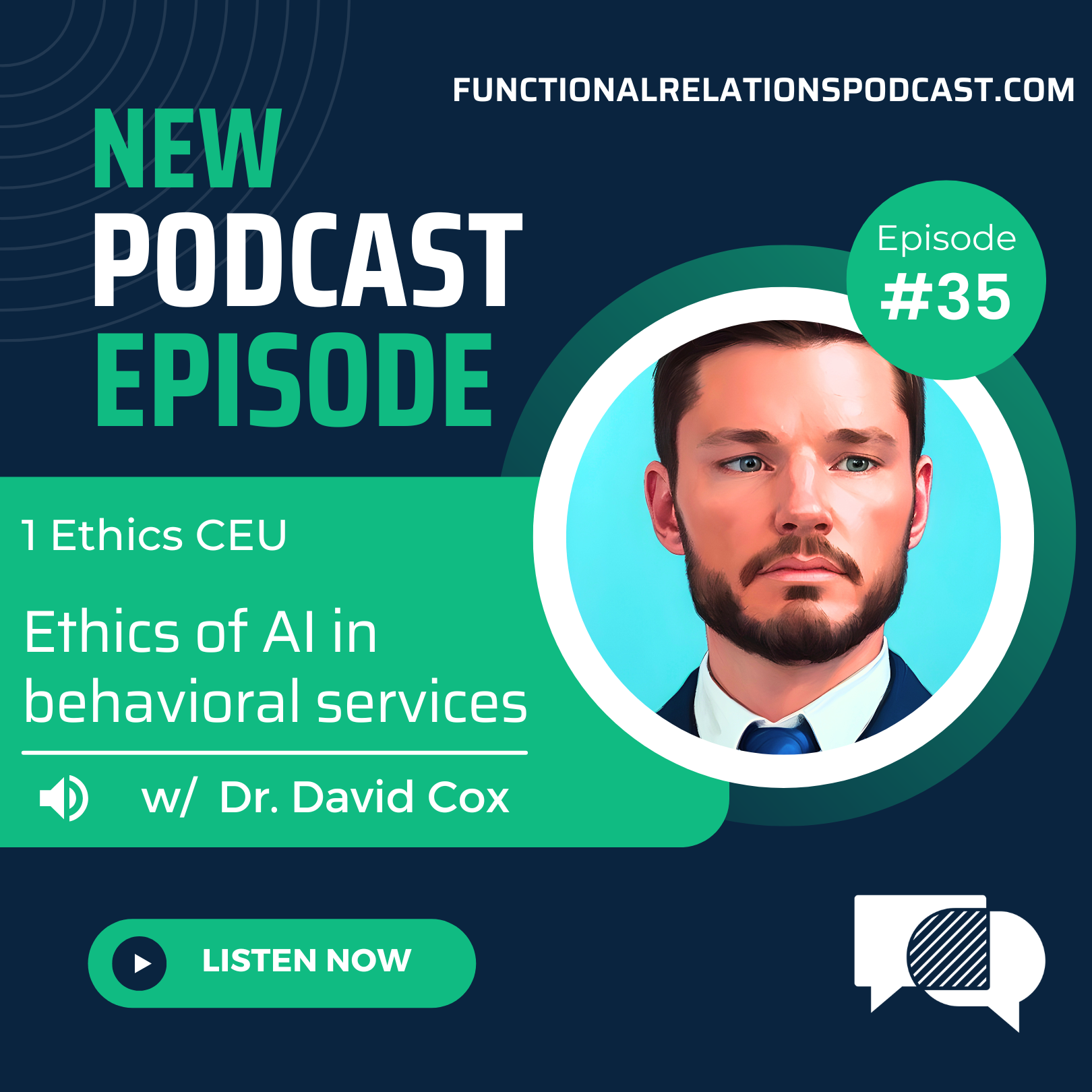
#35 - Ethics of AI in behavioral services w/ Dr. David Cox
Oct 201:07:32Tap to summarizeIn this episode, Zach and Caleb are joined by Dr. David Cox and discuss the ethics surrounding the use of AI in the delivery of behavioral services. 1 Ethics CEU (BACB, IBAO, and/or QABA) is available for this episode. You can purchase it at https://www.functionalrelationspodcast.com Become a member to get access to our entire library of CEs and access exclusive behind the scenes content for $79/yr. https://www.functionalrelationspodcast.com/subscription/membership Things to check out from the episode: Dr. Cox's podcast: The Behavioral Data Science Podcast - Podcast - Apple Podcasts How Stanford Teaches AI-Powered Creativity in Just 13 MinutesㅣJeremy Utley - YouTube References: Cox, D. J. (2025). Ethical Behavior Analysis in the Age of Artificial Intelligence (AI): The Importance of Understanding Model Building while Formal AI Literacy Curricula are Developed. Perspectives on Behavior Science, 1-11. Cox, D. J., & Jennings, A. M. (2024). The promises and possibilities of artificial intelligence in the delivery of behavior analytic services. Behavior Analysis in Practice, 17(1), 123-136. O'neil, C. (2017). Weapons of math destruction: How big data increases inequality and threatens democracy. Crown.
Transcribe →