Podcast
Future Commerce
Hosted by Phillip Jackson, Brian Lange · EN
Future Commerce is the culture magazine for Commerce. Hosts Phillip Jackson and Brian Lange help brand and digital marketing leaders see around the next corner by exploring the intersection of Culture and Commerce.
Trusted by the world's most recognizable brands to deliver the most insightful, entertaining, and informative weekly podcasts, Future Commerce is the leading new media brand for eCommerce merchants and retail operators.
Each week, we explore the cultural implications of what it means to sell or buy products and how commerce and media impact the culture and the world around us, through unique insights and engaging interviews with a dash of futurism.
Weekly essays, full transcripts, and quarterly market research reports are available at https://www.futurecommerce.com/plus
58episodes
Episodes
Newest firstAll episodes
Daily Harvest is Fighting the Wellness Hype Machine
Feb 2000:26:26Tap to summarizeIn just one year, Daily Harvest was acquired by Chobani, dropped its subscription requirement, and launched a campaign calling out the wellness hype machine. CEO Ricky Silver joins us to talk about the facts in an industry dominated by fiction. Selling Food, Not Fiction Key takeaways: The wellness hype machine is exhausting consumers. Daily Harvest's "Eat Food, Not Fiction" is its counter-punch. Subscription was a business convenience, not a consumer demand, and removing the gate unlocked growth. Consumer sovereignty and business autonomy are in tension with one another. The brands that resolve it will win. LLMs are the new discovery layer. Brands must build authoritative, trusted ecosystems to surface in AI answers. Fixing the food system requires collectivism, even with rivals. "Some of our best consumers were the ones who engaged with the skipping function. Active management meant they were finding the right cadence for them." — Ricky Silver "Connection is a motive. It is not tech-driven — even if technology is the thing bringing us together." — Ricky Silver Associated Links: Learn more about Daily Harvest Catch up on Future Commerce’s 2026 predictions Check out Future Commerce on YouTube Check out Future Commerce Plus for exclusive content and save on merch and print Subscribe to Insiders and The Senses to read more about what we are witnessing in the commerce world Listen to our other episodes of Future Commerce Have any questions or comments about the show? Let us know on futurecommerce.com, or reach out to us on Twitter, Facebook, Instagram, or LinkedIn. We love hearing from our listeners! Hosted by Simplecast, an AdsWizz company. See pcm.adswizz.com for information about our collection and use of personal data for advertising.
Transcribe →
Every Brand Spent $20M on 30 Seconds. Levi's Bought the Whole Super Bowl.
Feb 1800:52:50Tap to summarizeMost Super Bowl ads failed before they aired. Dr. Marcus Collins explains why. We break down the Super Bowl as a cultural spectacle: the ads, the Bad Bunny halftime show, and the Levi's strategy that no one is talking about.Key takeaways:Why Marcus felt bad for every marketer who ran a Super Bowl ad this yearThe Lay's ad was beautiful. Marcus saw a father handing his daughter a lifetime of debt.How Levi's turned a 30-second spot, a stadium, a popup, and a halftime show into one integrated play"This is not a 32-second ad. This is a constellation of nodes that together tell the story only Levi's could."What Anthropic understood about the group chat that OpenAI and Google missedBad Bunny performed for 120 million viewers at home, not the 70,000 in the stadium, and that was the pointAssociated Links:Catch our Super Bowl ad analysis in our Things We're Overthinking newsletter.Follow From the Culture, hosted by Dr. Marcus Collins and Amanda SlavinBuy For the Culture on AmazonCheck out Future Commerce on YouTubeCheck out Future Commerce Plus for exclusive content and save on merch and printSubscribe to Insiders and The Senses to read more about what we are witnessing in the commerce worldListen to our other episodes of Future CommerceHave any questions or comments about the show? Let us know on futurecommerce.com, or reach out to us on Twitter, Facebook, Instagram, or LinkedIn. We love hearing from our listeners! Hosted by Simplecast, an AdsWizz company. See pcm.adswizz.com for information about our collection and use of personal data for advertising.
Transcribe →
Supply Chain's AI Evolution: Infinite Simulations
Feb 1300:44:15Tap to summarizeLIVE from Manifest 2026: Shipium CEO Jason Murray reveals why AI transformation isn't about making old processes faster but fundamentally rethinking workflows. From turning three-day analytics tasks into minutes with Orca to exploring adjacent areas such as auditing and consulting, Phillip, Brian, and Jason unpack how domain-specific AI creates competitive moats in an era when traditional advantages are dissolving.Some Kid In His Dorm Room Is Coming For Your CompanyKey takeaways:AI works when you rethink workflows, not optimize existing onesDomain-specific AI beats general LLMs through context and reduced hallucinationsSpeed of experimentation matters more than prediction accuracy aloneAdjacent spaces, like auditing, are now accessible through AI-powered digital twinsTraditional moats are dissolving; data and ecosystem relationships become keyIn-Show Mentions:Learn more about ShipiumLearn more about ManifestAssociated Links:Check out Future Commerce on YouTubeCheck out Future Commerce Plus for exclusive content and save on merch and printSubscribe to Insiders and The Senses to read more about what we are witnessing in the commerce worldListen to our other episodes of Future CommerceHave any questions or comments about the show? Let us know on futurecommerce.com, or reach out to us on Twitter, Facebook, Instagram, or LinkedIn. We love hearing from our listeners! Hosted by Simplecast, an AdsWizz company. See pcm.adswizz.com for information about our collection and use of personal data for advertising.
Transcribe →
Why Gap is Back: The Mattel Playbook for Brand Reinvigoration
Feb 600:35:27Tap to summarizeJoin us at SoCom 2026, the Social Commerce Conference. February 26 in Venice Beach and save 20% with code FCSC2026Damon Berger, Head of Consumer Digital Engagement at Gap Inc., joins the show to share the strategy behind the brand's comeback. He unpacks the playbook for rebuilding an iconic brand, why it worked for Barbie, and why creator capital is the new north star. Plus, he reveals how Gap moved from "chasing relevance” to driving it, and why brand distinction is the new survival strategy against the sea of AI slop.Gap is Back, Baby.Key Takeaways:Creators are the cultural conduit, building conversational capital through authentic audience relationshipsGap's KATSEYE campaign sparked participation, not just viewership, enabling fans to own the momentPurpose-driven brands live their values quietly rather than preaching them publiclyBrand distinction becomes a survival strategy when 50% of internet traffic is botsGet Blue partnership scales Gap's influence to address global water access for 200M peopleDamon Berger [03:33]: "Creators are the conduit to what is kind of cool out in the world...the idea for us is that we have a variety of relationships with them."Damon Berger [12:14]: "That was really why one of the reasons that it was so popular and shared and viral...people started taking that video and doing all their own dances and doing their own interpretations to it and expressing themselves and joining a larger conversation."Damon Berger [15:14]: "We were just being ourselves. We were just living our own brand values, where we believe in the value of diverse voices. We believe in people being themselves no matter what."Damon Berger [29:26]: "In the sea of sameness and the sea of AI slop and all of these worlds of not really knowing who you're buying from…[brand distinction] is what people care about, and that's how we've won over the last couple of years."In-Show Mentions:Gap's "Better in Denim" Campaign - Viral campaign featuring "Milkshake" by KelisGet Blue Initiative - Partnership with Gap Inc., Amazon, Starbucks, and EcolabAssociated Links:Check out Future Commerce on YouTubeCheck out Future Commerce Plus for exclusive content and save on merch and printSubscribe to Insiders and The Senses to read more about what we are witnessing in the commerce worldListen to our other episodes of Future CommerceHave any questions or comments about the show? Let us know on futurecommerce.com, or reach out to us on Twitter, Facebook, Instagram, or LinkedIn. We love hearing from our listeners! Hosted by Simplecast, an AdsWizz company. See pcm.adswizz.com for information about our collection and use of personal data for advertising.
Transcribe →
How Brands Become Publishers In the Age of Distrust
Jan 3000:57:32Tap to summarizeAndrew McLuhan (The McLuhan Institute) and Paulo Ferreira (co-founder, Baroes Brand Publishing) join us to dissect the seismic shift from persuasion to publication. As institutions crumble and audiences demand transparency, brands are discovering they don't need platforms—they need publishing strategies. From Brazil's brand publishing revolution to venture capital as the ultimate gamble, this conversation explores how commerce and culture collapse into a single, trust-driven narrative where every brand becomes its own campfire.Content Is Dethroned, Context Is KingKey Takeaways:Brands must shift from persuasive advertising to informational publishingBrand publishing empowers direct audience relationships, cutting out middlemenContext and transparency build trust, but objectivity is increasingly seen as a mythWell-informed consumers strengthen brands, while fear of knowledge signals weaknessStorytelling is the new sales department and remixability drives cultural powerKey Quotes:"A good brand doesn't fear a well-informed client. A good brand wants a well-informed client." — Paulo Ferreira [00:58:52]"With our new media, people have the freedom to find it themselves. Brands are becoming their own campfires, allowing people to crowd around and exchange stories." — Andrew McLuhan [00:10:11]"‘The medium is the message’ was telling radio people to calm down about TV. Being obsolete doesn't mean death, it means rebirth." — Andrew McLuhan [00:23:53]"Trust is built through transparency. The scroll is infinite now. The stakes have never been higher for laying our cards on the table." — Andrew McLuhan [01:00:22]Associated Links:Learn more about The McLuhan InstituteLearn more about Baroes Brand PublishingCheck out Future Commerce on YouTubeCheck out Future Commerce Plus for exclusive content and save on merch and printSubscribe to Insiders and The Senses to read more about what we are witnessing in the commerce worldListen to our other episodes of Future CommerceHave any questions or comments about the show? Let us know on futurecommerce.com, or reach out to us on Twitter, Facebook, Instagram, or LinkedIn. We love hearing from our listeners! Hosted by Simplecast, an AdsWizz company. See pcm.adswizz.com for information about our collection and use of personal data for advertising.
Transcribe →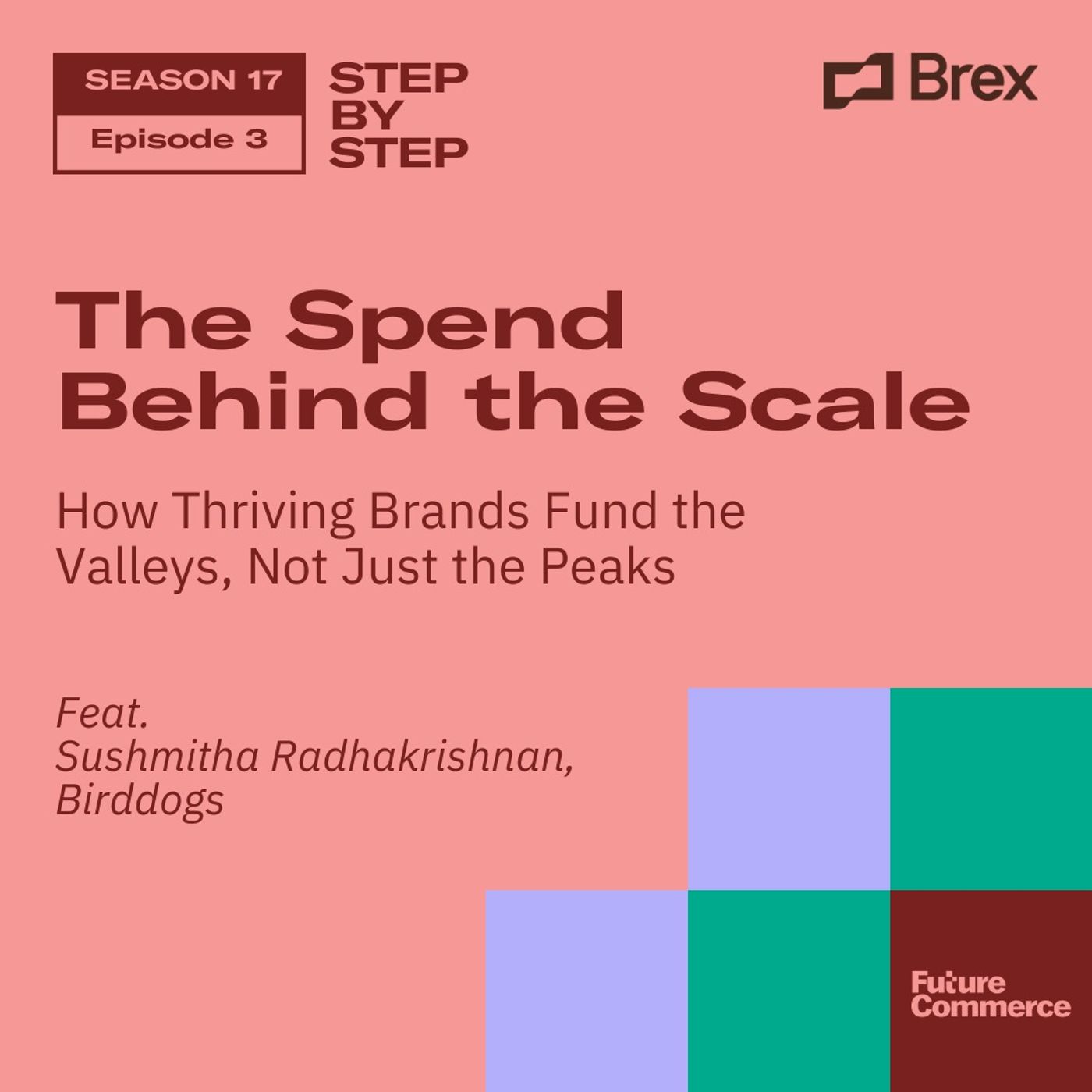
[STEP BY STEP] The Spend Behind the Scale
Jan 2900:30:18Tap to summarizeTheory meets tarmac. Sushmitha "Sushi" Radhakrishnan runs finance and operations at Birddogs, the men's apparel brand born from a Shark Tank moment that's now selling through Dick's Sporting Goods. She breaks down what cash flow actually looks like when summer—not holidays—is your Super Bowl, tariffs hit mid-growth, and every trend cycle could make or break a season.Key takeaways:Seasonal brands need capital access during revenue troughs, not just peaksMulti-channel operations demand different buying cycles—wholesale plans months ahead while DTC converts in hoursSpeed separates winners in apparel—trends change faster than traditional finance approval loopsSmall teams need executive-level spend control with rapid scalability for growth momentsKey Quotes:Sushi Radhakrishnan [00:14:49]: "Because we are a seasonal business, having access to credit cards like a Brex where we have charge cards—in those situations when we're in our cash flow troughs, having that extra flexibility is really critical to us. There's a six month period where we have to have really good months because that's what funds the business in the lower months."Sushi Radhakrishnan [00:20:28]: "This is my first foray into apparel and selling it online and trends change so quickly. A winning product—it's definitely a very dynamic environment to operate in."Sushi Radhakrishnan [00:18:12]: "We move really fast. Getting that feedback loop shortened is really important when we're managing cash. That's been refreshing with Brex—the support we're getting from a credit card provider. I don't have that same level of one on one service with American Express."Sushi Radhakrishnan [00:23:22]: "People buy apparel based on emotion, not just because they see it come across their Instagram reel. It's really important that we continue to appeal to our buyers in a way that's more than just selling the value prop of our product."Associated Links:Learn more about BrexLearn more about MelioCheck out Future Commerce on YouTubeCheck out Future Commerce Plus for exclusive content and save on merch and printSubscribe to Insiders and The Senses to read more about what we are witnessing in the commerce worldListen to our other episodes of Future CommerceHave any questions or comments about the show? Let us know on futurecommerce.com, or reach out to us on Twitter, Facebook, Instagram, or LinkedIn. We love hearing from our listeners! Hosted by Simplecast, an AdsWizz company. See pcm.adswizz.com for information about our collection and use of personal data for advertising.
Transcribe →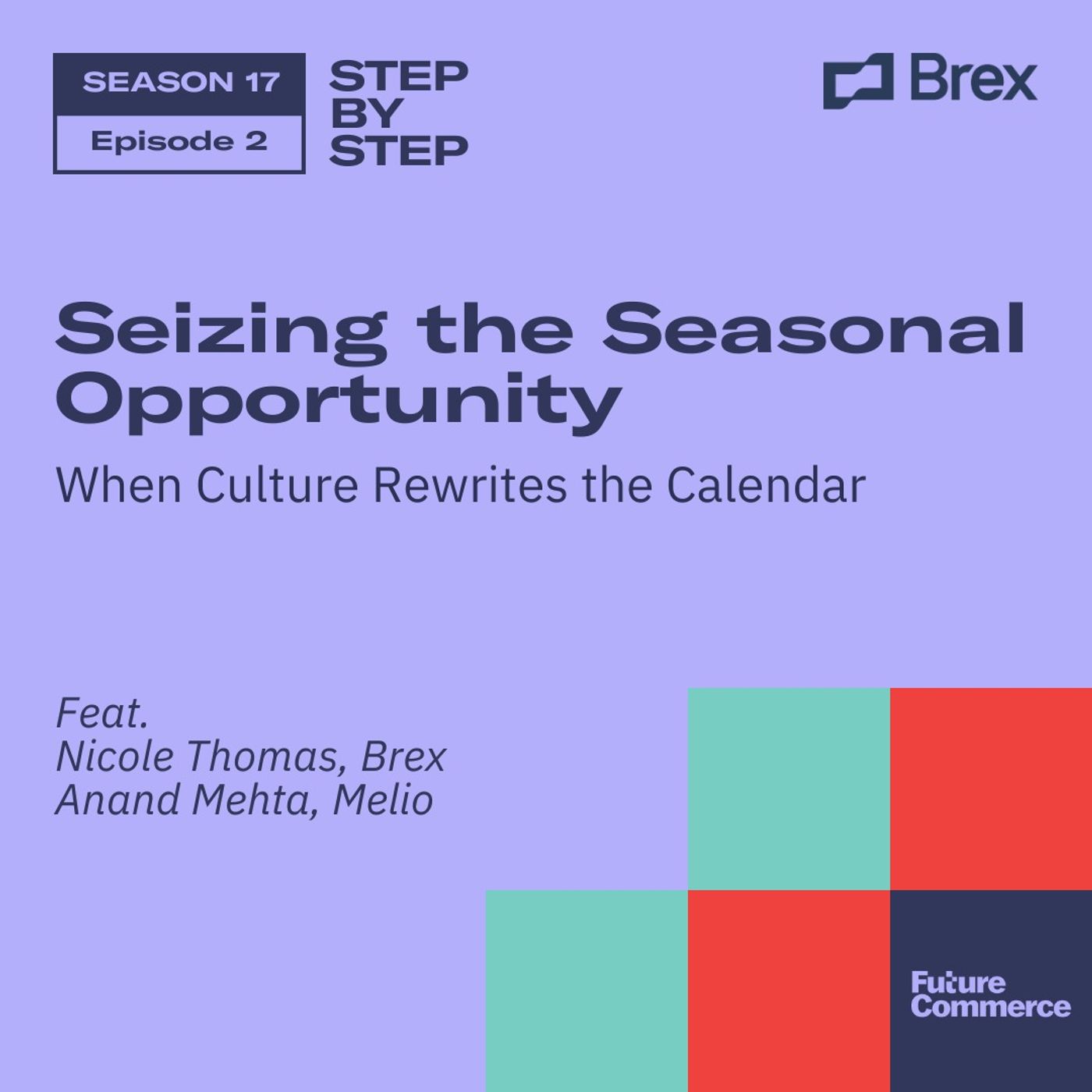
[STEP BY STEP] Seizing the Seasonal Opportunity
Jan 2800:40:49Tap to summarizeThe old retail calendar is dead. Between TikTok virality, celebrity sightings, and ChatGPT-powered discovery, brands face a new reality: commerce runs on culture’s clock. Nicole Thomas (Brex) and Anand Mehta (Melio) break down how this shift from predictable peaks to perpetual possibility demands radical financial agility.Key takeaways:Retail shifted from twice-yearly peaks to monthly cultural spikes brands can't predictCash conversion cycle reveals hidden supplier payment leverage beyond inventory optimizationCredit card float extends working capital without compounding traditional loan debtLiquidity separates trend leaders from trend chasers regardless of business sizeKey Quotes:Nicole Thomas [00:06:27]: "Seasonality is kind of taking shape in the way that it's less of like these ebbs and flows maybe twice a year to maybe once a month. If your product goes viral or if a celebrity endorses something, your consumers are now expecting to get those products when they want it."Anand Mehta [00:22:17]: "Costco managed to have a very low, if not negative cash conversion cycle because their store is the warehouse. They've already sold and converted their inventory to cash before they even have to pay it out."Nicole Thomas [00:37:06]: "Commerce is definitely making a big shift to flattening out, but not flattening out enough to where you can actually predict those peaks and valleys. We're definitely shifting from a calendar economy to more of a cultural economy."Anand Mehta [00:32:14]: "This use case of extending cash flow isn't just for businesses who are struggling. If you're a brand that is very liquid, having that cash buffer allows you to be a brand that's jumping in on a trend in the early stages of the trend, not chasing a trend."In-Show Mentions:Learn more about BrexLearn more about MelioCheck out Future Commerce on YouTubeCheck out Future Commerce+ for exclusive content and save on merch and printSubscribe to Insiders and The Senses to read more about what we are witnessing in the commerce worldListen to our other episodes of Future CommerceHave any questions or comments about the show? Let us know on futurecommerce.com, or reach out to us on Twitter, Facebook, Instagram, or LinkedIn. We love hearing from our listeners! Hosted by Simplecast, an AdsWizz company. See pcm.adswizz.com for information about our collection and use of personal data for advertising.
Transcribe →
The Next Wave of Marketers: Curious, Collaborative, Chaos-Embracing
Apr 11, 202500:35:47Tap to summarizeLive from Optimove Connect, Brian sits down with Optimove CEO Pini Yakuel and Nikolas Badminton, Chief Futurist at Futurist.com, to unpack the philosophical and practical implications of 'positionless marketing'—a radical rethink of organizational roles in the AI era.Mind Over MechanismKey takeaways:Positionless is Power: The most innovative organizations won't be flatter—they'll be fluid. Roles dissolve; talent flows where it’s needed.AI Is the New Intern: It drafts, it preps, it gets you started—but the genius still has to come from you.Old Process ≠ New Potential: Layering AI on legacy workflows just speeds up your inefficiency.Control is a Creativity Killer: Let go of silos, turf wars, and micromanagement. The next gen of leaders will trust, not gatekeep.The Kids Are Alright—and in Charge: Within 10 years, new mindsets will lead. Curious, collaborative, and chaos-embracing.[00:04:48]: “Startups get stuff done because you're positionless. One day you're marketing, next day you're writing code. That’s how you beat the big guys—speed and fluidity.” – Pini Yakuel[00:08:03]: “We create the tools, and the tools create us.” – Nick Badminton[00:14:44]: “New tech + old process = expensive old process.” – Nick Badminton[00:11:50]: “Friction is what makes life life.” – Brian LangeAssociated Links:Check out Future Commerce on YouTubeCheck out Future Commerce+ for exclusive content and save on merch and printSubscribe to Insiders and The Senses to read more about what we are witnessing in the commerce worldListen to our other episodes of Future CommerceHave any questions or comments about the show? Let us know on futurecommerce.com, or reach out to us on Twitter, Facebook, Instagram, or LinkedIn. We love hearing from our listeners!
Transcribe →
The Marketer’s North Star is Myth
Apr 9, 202501:19:35Tap to summarizeBrian goes live from Optimove Connect in London to explore how the idea of “positionless marketing” is revolutionizing the way we think about team structure, agility, and creativity in marketing. He chats with endurance swimmer and environmental activist Lewis Pugh, as well as DAZN’s Ria Chin-You and Optimove’s Paul O’Shea, about marketing’s future and how AI is shaping it.Strive for EpicKey takeaways:[12:25] Lewis Pugh shares how emotional drive and preparation fuel extraordinary feats—like swimming across the North Pole—and what brands can learn from that level of purpose.[20:29] “Epic” vs. “great”: Pugh discusses how to distinguish good work from game-changing campaigns.[33:42] Environmental justice, consumer justice, and the universal value of doing what's right—and what this really means for global brands today.[46:05] DAZN’s Ria Chin-You discusses managing CRM across 200+ markets with a team of nine—and the challenges of scaling personalization with limited resources.[50:48] Integrating GenAI into real-world workflows is still a challenge, especially for resource-strapped teams—but the potential is there.[58:24] Paul O’Shea explains Optimove’s vision for creating “super workers” through native AI integration and simplifying marketers’ jobs.[1:01:08] Cultural nuance is key—global messaging isn’t just about translation, it’s about resonance.[1:07:49] In fast-moving industries like sports, being agile isn’t optional. AI could be the key to real-time, reactive marketing at scale.“Practice until you can’t get it wrong, not until you get it right.” — Lewis Pugh“We need tools that help us scale personalization without sacrificing cultural authenticity.” — Ria Chin-You“AI isn’t replacing you, it’s your new teammate.” — BrianIn-Show Mentions:Learn more about Optimove’s positionless marketing platform at Optimove.com/futurecommerceDiscover Lewis Pugh’s environmental work at lewispughfoundation.orgFind Ria Chin-You’s work via DAZN and LinkedInAssociated Links:Check out Future Commerce on YouTubeCheck out Future Commerce+ for exclusive content and save on merch and printSubscribe to Insiders and The Senses to read more about what we are witnessing in the commerce worldListen to our other episodes of Future CommerceHave any questions or comments about the show? Let us know on futurecommerce.com, or reach out to us on Twitter, Facebook, Instagram, or LinkedIn. We love hearing from our listeners!
Transcribe →
*TEASER* Twizzlers and Tariffs
Apr 8, 202500:04:34Tap to summarizeGet ad-free episodes and bonus content, including the full recording of this podcast, by joining Future Commerce+ at futurecommerce.com/plusAccess to our new Word of Mouth Index with Fairing, a brand new member benefitSave 15% on Future Commerce print journals and merchExclusive invites to physical events, dinners, and priority invites to industry events (SXSW, Art Basel, VISIONS)Ad-free episodes and bonus content!
Transcribe →