Podcast
Game Economist Cast
Hosted by Phillip Black · EN
What does the new wave of open economies mean for monetization? Will negative externalities overcome cosmetic economies in the long run? What exactly does a game economist do?
Game Economist Cast is a roundtable discussion of the latest developments in mobile, HD, and crypto games, through a bunch of people figuring it out using the economic toolkit.
10episodes
Episodes
Newest firstAll episodes
E49: The Economic Game Theory of All Games
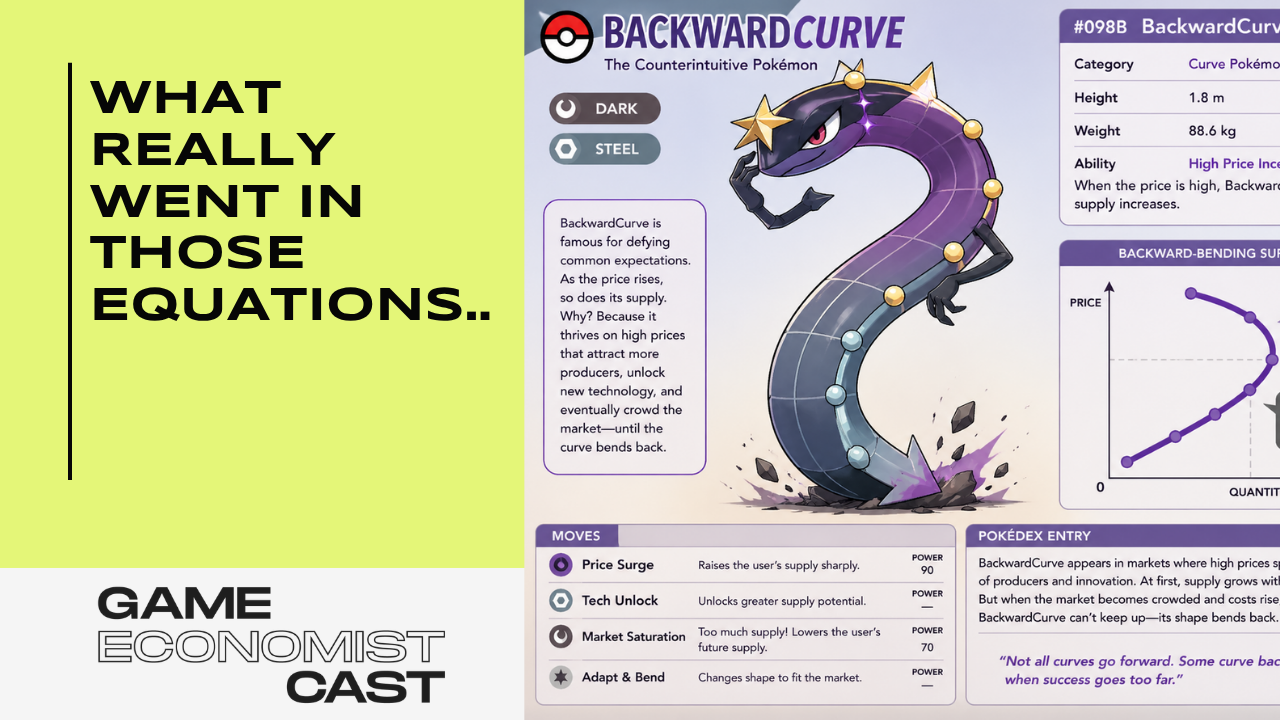
Apr 2801:18:21Tap to summarizeThe entire theory of games is underpinned by this one theory, but how far can it's explanitory power be pushed? Phillip Black, Christopher Kaczmarczyk-Smith, and Eric Guan talk cozy Pokemon habitats, merge-game economics multipliers, AI labor-market irony, and Edward Castronova's foundational work on virtual worlds. We talk: Pokopia as the Pokemon cozy game: short production chains daily-quest systems without free-to-play monetization pressure Multipliers as the key merge-game innovation: a gas pedal on spend per hour faster energy drain faster story progression a new way to price acceleration Narrative as reward subsidy or tax: story can make the next meta milestone worth chasing story can also break flow for players who just want the core loop AI and the game-industry labor market: layoffs look more like a post-2021 correction longer unemployment spells in information work may be the cleaner AI signal AI may suppress hiring before it shows up as direct separations Castronova's virtual-world economics: challenge labor-leisure tradeoffs property rights platform dictatorships price controls why MMOs looked like the future in 2003 The player contract: games rarely grant formal property rights players still behave as if they own skins, items, and progress developers often compensate players even when the legal right is weak
Transcribe →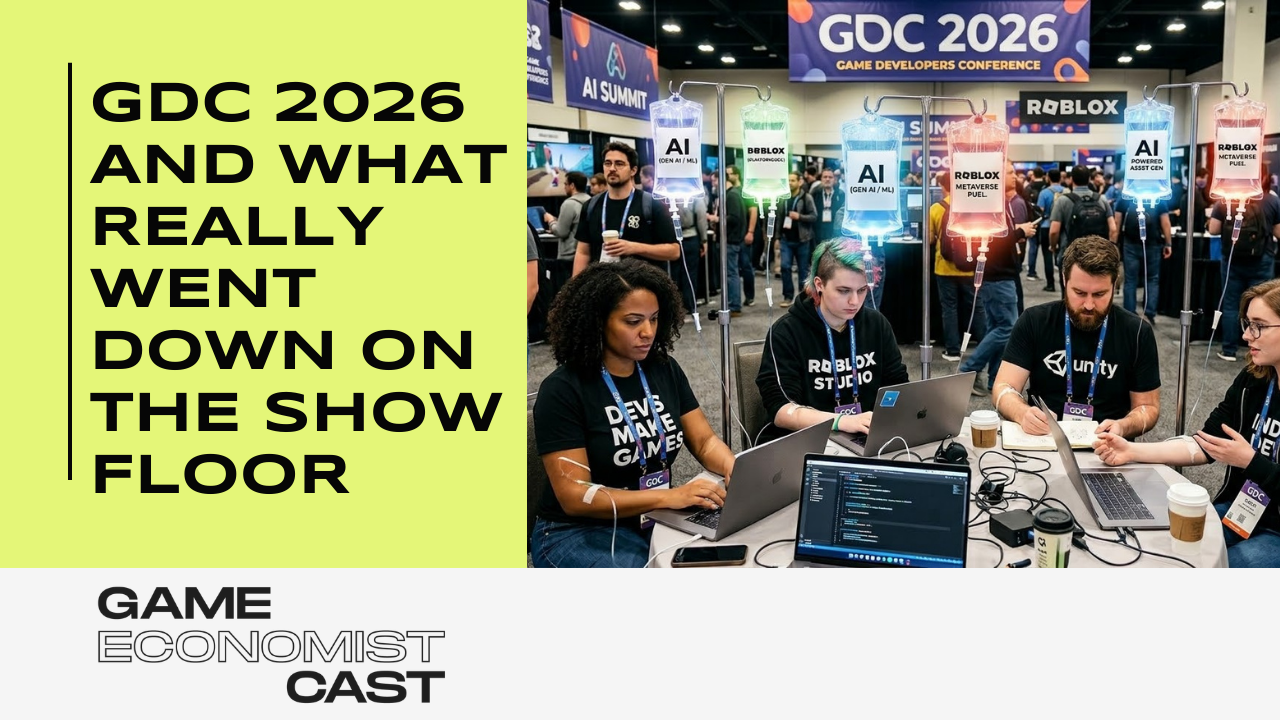
GEC BONUS EP: What's up at GDC 2026?
Mar 1800:38:41Tap to summarizeTakes so hot that they were recorded late at night after a long day on the GDC floor, and couple whiskeys. Phil, Eric, and Chris crew unpack what actually mattered at GDC 2026, and what didn’t. We discuss: A sharper critique of industry thinking Too many taxonomy talks, not enough opinions Why game talks should behave more like economics seminars AI’s role on the show floor and conference Shift from generative art hype to code generation and workflows Why survey data understates actual usage and masks revealed preferences AI present but muted, Web3 effectively gone Novelty hardware, indie creativity, and a clear tech pullback The collapse of production costs and what replaces them Near-zero fixed costs leading to infinite content supply Discovery, marketing, and CAC as the new binding constraints Why incumbents may strengthen, not weaken Ad spend and distribution advantages widening the moat Counterpoint: new channels still create pockets of disruption Hardware, interfaces, and “convergent evolution” Why controllers standardized and what that says about optimal design Failed alternatives and the persistent friction of interaction
Transcribe →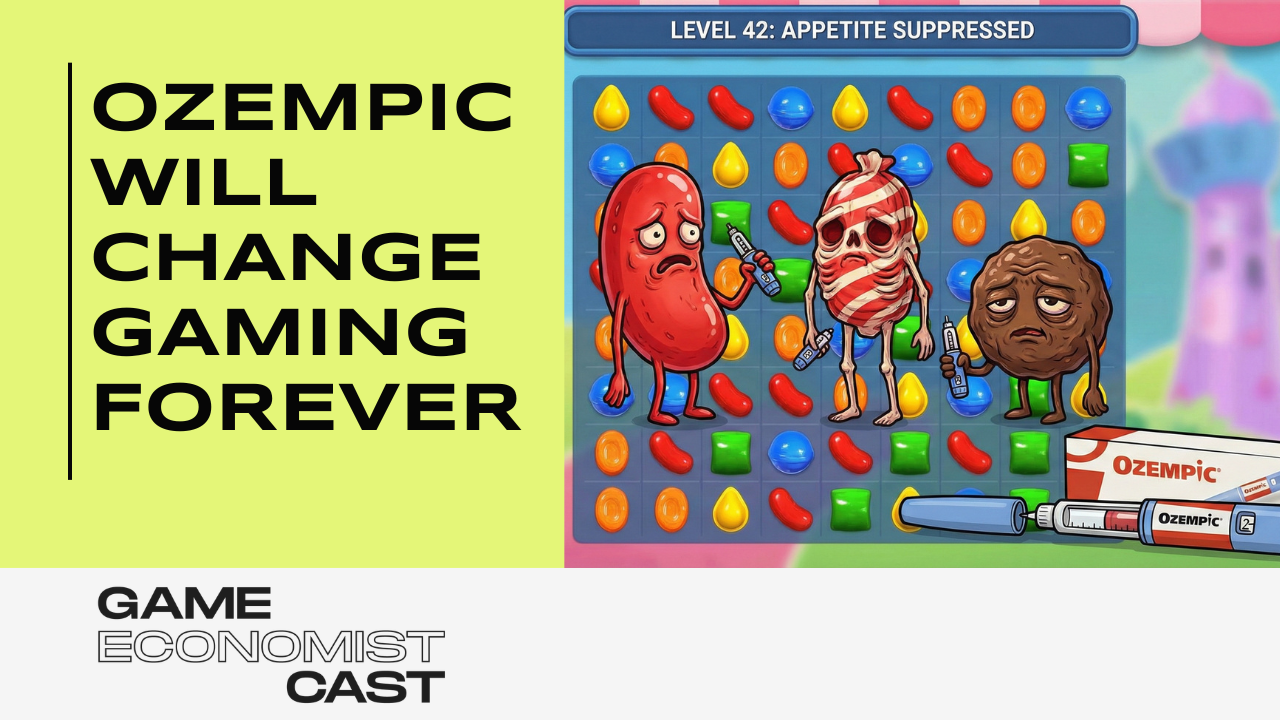
E48: Ozempic, 2XKO and ARPDAU For Wild Takes
Feb 1501:01:19Tap to summarizeIf the majority of mobile casuals' target audience takes Ozempic, what effect does that have on games? No one's asking these questions, so welcome to the Game Economist Cast. Weight loss drugs, AI copilots, and gambling apps dominated the most expensive media real estate on earth, and games were barely in the frame. In this episode, we unpack what that signal means for interactive entertainment, Eric uncovers Riot’s 2XKO downsizing to Google’s Genie 3, and the future of engines. Phil previews his GDC talk on the economics of a billion-dollar cosmetic economy, Chris breaks down his attempt to design and publish a trading board game, and we ask a harder question: in a world of Ozempic and infinite AI supply, what actually happens to gaming demand? We discuss: • The 2XKO reset and the economics of niche within niche genres • Team size, burn rate, and why a 160-person fighting game team changes the break-even math • Free to play cosmetics versus box price DLC in a capped DAU genre • Why betting apps can out-monetize most games on ARPDAU • How appetite suppression might reallocate time, spending, and loop sensitivity • Genie 3 and the cost curve of game production • Engines as rule governance layers in a probabilistic content world • Cosmetic economies as foundational theory • Scarcity, signaling, and equilibrium pricing in digital status markets • Price discovery, private information, and turning trade into tabletop play Listen now!
Transcribe →
E47: Iterated Prisoner’s Dilemma, Social Norms Go Astray, and Why Game Economy Needs Math
Jan 2601:11:01Tap to summarizeChuck E. Cheese is still alive, and so is the analytics-to-product pipeline. @Amanda Cesario analytics lead turned product leader, joins @Phillip Black, Eric, and @Christopher Kaczmarczyk-Smith argue for embedded analytics, sharper language, and game systems that actually produce cooperation instead of a cosplay community. We discuss: • The missing vocabulary for economy design in live service, and how it's harmed the entire industry• Why office ball pits best start-up ping pong tables • The analyst’s real job: explaining “why,” then realizing the only way to fix it is to own the lever • Embedded analytics vs centralized service orgs; who beats who • Roblox as a laboratory: aspirational visibility, server “neighborhoods,” and system norms that communicate more than art • Iterated Prisoner’s Dilemma, Axelrod’s tournaments, and why tit-for-tat is a design principle • Monopoly Go partner events as rare, genuine, cooperation-through-repeated-interaction design • Why Discovery Zone died, but Chuck E. Cheese prints money anyway
Transcribe →
E46: Economics of Sweepstakes, Vertical Word Game Progression, and UXR Failure
Dec 1400:55:41Tap to summarizeIs fair matchmaking actually bad design? And how exactly did gaming companies fumble the bag when it came to the army of PhD psychologists they employ? We talk: • Sweepstakes, social casino, velocity, and why most players never cash out • Why Wordle feels flat to some designers and why elegance is not the same as progression • Surveys as UX, not truth machines, and how to extract signal without lying to yourself • Compensating differentials, handicaps, and why 50 percent win rates kill progression • Bots, deception, and whether games are magic shows or fraud
Transcribe →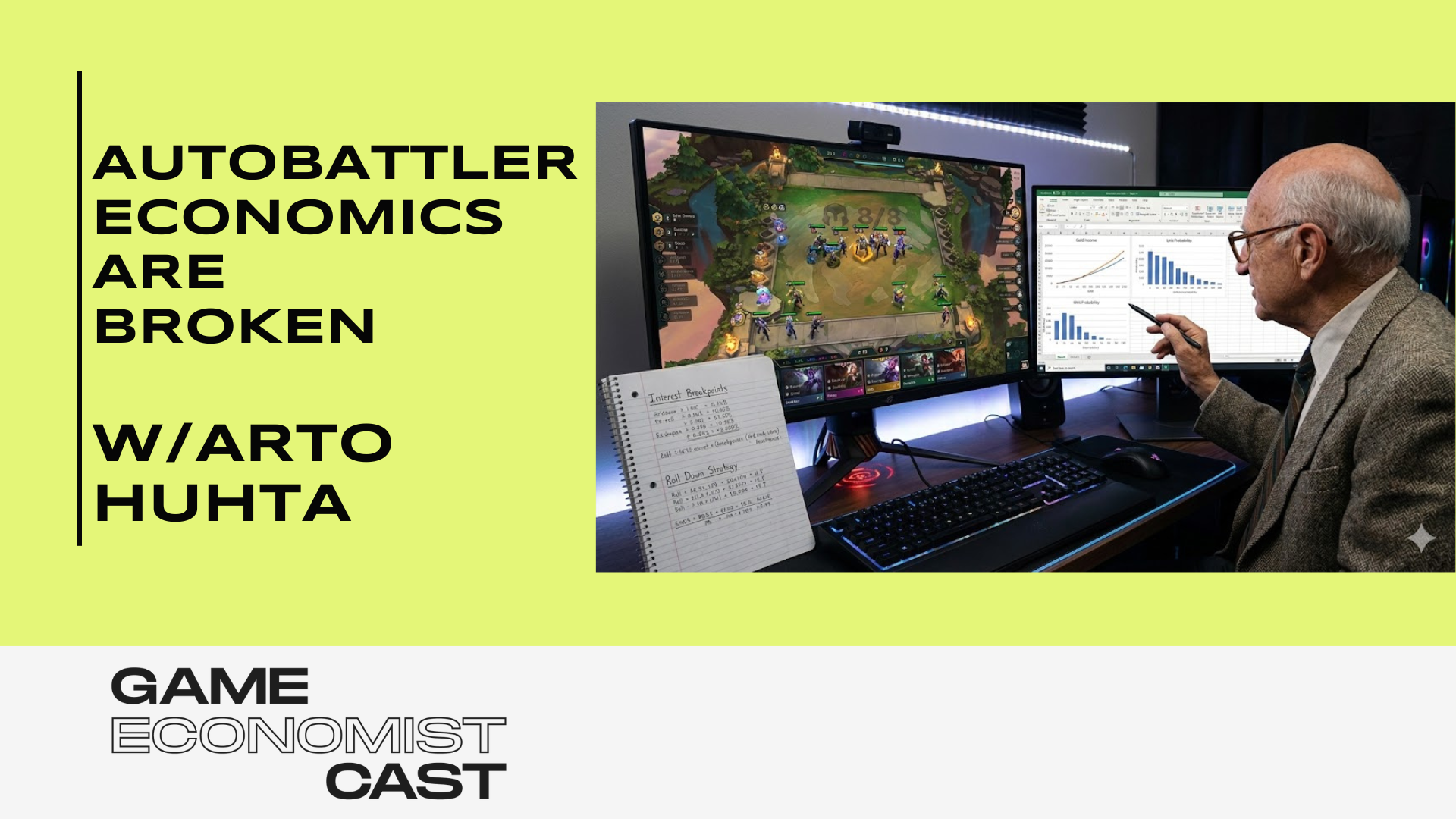
E45: Autobattler Econ, WILD UGC Algo & A Currency Debate for the Ages (w/Arto Huhta) Autobattler Econ, WILD UGC Algo & The Big Currency Question (w/Arto Huhta)
Nov 2301:13:44Tap to summarizeWhat happens when autobattlers fail to monetize? We pull Arto Huhta into the cast and chat about Telegram’s pseudo-WeChat ambitions. Eric releases a distrack on Game Designer's obsessed social spaces, and Phil wants more blood from psychologists' nonsensical F2P "choice overload." Chris enleashes a model-meets-UGC experiment: a three-algorithm simulation that shows how recommendation systems distort consumer welfare and creator inequality. \We discuss: How Arto sees the split between economy design, product management, and classical economics (hint: it's not what you think) Pets as permanent progression, and the design logic behind Nonstop Knight’s monetization turnaround Why creator inequality explodes under bad reinforcement A brewing debate on regulation that is just getting started... Chapters 00:00 Journey to London: A Game Developer's Path 00:49 The Role of Economy Design in Gaming 01:20 From Academia to Game Development: Bridging the Gap 03:16 Experimentation in Game Design: Lessons Learned 05:22 The Intersection of Game Design and Economics 10:07 Understanding Game Development Roles 11:00 Monetization Strategies in Game Design 11:55 The Evolution of Publishing Models 12:42 Transitioning to Web 3: New Challenges 13:54 The Economics of Game Spending 18:27 Introduction to Game Economist Cast 19:06 Current Gaming Trends and Preferences 20:51 Game Modes and Player Engagement 22:03 The Future of Game Monetization 27:33 The Social Hub Experiment in Fighting Games 28:26 Street Fighter VI and Social Interaction 30:28 The Rise of HTML5 Games on Platforms 32:37 The Trend of Casual Games in Tech Companies 34:42 Telegram Games: A New Frontier 37:21 Challenges in Game Discovery on Telegram 38:52 User Engagement and Retention in Web3 Gaming 39:43 Consumer Welfare and Content Creation Dynamics 43:04 The Impact of Algorithms on User Experience 49:31 Heterogeneous Goods and Their Effects on Engagement 57:35 The Impact of Algorithms on Content Quality 59:04 Understanding Algorithmic Risks and User Retention 01:00:16 Exploring Algorithm Design in Gaming Platforms 01:01:54 The Role of User Choice in Content Discovery 01:04:29 The Future of Pricing Strategies in Free-to-Play Games 01:08:10 The Debate on Standardization and Market Forces
Transcribe →
E44: Incentive UGC Determinism for the Future of Gaming (w/Alex Seropian)
Sep 2900:45:55Tap to summarizeUGC is about to change forever. In the same way all technologies govern and enable the creative, MTX will do the same for Fortnite. Or will it? Alex Seropian (Look World North, The Forth Curtain) joins the cast to discuss UEFN's ability to enable creators to monetize islands directly. We discuss: What new games will emerge with MTX? Is UGC IP defensible? What exactly is the endgame for UGC studios? What's the maximum a Roblox studio earns? Chapters 00:00 Introduction to UEFN and Guest Background 03:48 UEFN's New Features and Developer Impact 07:22 Comparing UEFN with Roblox 10:23 The Future of IP in Gaming 17:47 Epic's Strategic Vision and Development Tools 21:04 The Evolution of UGC Platforms 22:53 Challenges in User-Generated Content 26:27 Monetization Models in Gaming 28:01 The Joy of Game Development 30:46 The Future of Fortnite's Economy 39:16 China's Role in UGC Development 41:40 Feedback Loops in Game Development
Transcribe →E43: Bentham's Body, Hypothesis Testing & Marginal ROAS (w/Eric Seufert)
Sep 1401:18:12Tap to summarizeEric Seufert joins to dissect AI hype, marginal ROAS, Jeremy Bentham's legacy, and managing a multi-million-dollar marketing budget that falls empirically short. WE discuss:How do you evaluate an “AI startup” in 90 seconds without being duped?Can LLM-driven hypothesis testing replace the Monday creative meeting and outperform it?If marginal ROAS is the real constraint, why do teams still optimize to averages?When should a Battlefield-scale launch actually spend less on day one and wait two weeks?Why did free-to-play economics conquer games but stall on platforms like Twitch or Spotify?Will AI-driven volatility make electricity markets funky?
Transcribe →E42: Vertical Progression Is Gaming's Sex & Finally A Web3 Hope
Sep 101:06:22Tap to summarizeForget the endless autopsies on why Web3 gaming flatlined, @Chris gets past the clichés and gets into the real pathology: a misdiagnosis of what “play-to-earn” was ever good for. @Eric & @Phil on vertical progression is the most important retention driver for several specific reasonsThe “market for lemons” problem in developer <> publisher relations: why developers can banbooze publishersSub to Eric and Chris' Substack here:https://substack.com/@ericguanhttps://substack.com/@chriseconomics00:00 Introduction and Free Trials in Drug Dealing00:28 Economics of Drug Dealing02:11 Personal Experiences and Data Collection03:24 Car Dealerships and Market Monopolies04:57 Gaming Industry Insights: Clash Royale19:08 Battlefield 6: Gameplay and Strategy27:11 Rollerblading Adventures28:36 Rollerblading Economics30:16 Web3 Gaming Struggles34:54 Understanding Play-to-Earn Mechanics43:42 The Market for Lemons52:24 Conflicting Data on Gen Z Spending56:51 The Importance of Reliable Economic Data01:05:43 Conclusion and Future Topics
Transcribe →E41: Karl Marx as a 5* Character & Ukrainian Drone Economy Design
Aug 4, 202501:02:19Tap to summarizeEric covers the economy and the system’s design of Ukraine’s Drone squadron. What does economy balancing look like in the face of war? Phil can’t stop gushing about Heroes of History, but there's one economy design piece holding it up. The crew descends into a John Maynard Keynes debate as a 4* or 5* character. Chris covers the economic impact of the UK’s new obligation for internet providers, potentially transforming UGC as we know it.https://ericguan.substack.com/p/ukraine-gamified-drone-warfare
Transcribe →