Loading summary
Transcript212 lines
- [00:01]
A
Get Sleepy is a production of Slumber Studios and is made possible thanks to the generous support of our sponsors and premium members. If you'd like to listen ad free and access weekly bonus episodes, extra long stories and our entire back catalogue, you can try out premium free for seven days by following the link in the episode notes. Now, a quick word from our sponsors.
- [00:29]
B
Close your eyes. Exhale. Feel your body relax. And let go of whatever you're carrying today.
- [00:36]
C
Well, I'm letting go of the worry that I wouldn't get my new contacts in time for this class. I got them delivered free from 1-800-contacts. Oh, my gosh. They're so fast.
- [00:44]
B
And breathe.
- [00:45]
C
Oh, sorry. I almost couldn't breathe when I saw the discount they gave me on my first order. Oh, sorry. Namaste. Visit 1-800-contacts.com today to save on your first order.
- [00:57]
B
1-800-Contacts.
- [00:58]
D
Every holiday shopper's got a list. But Ross shoppers, you've got a mission. Like a gift run that turns into a disco, snow globe, throw pillows and PJs for the whole family, dog included. At Ross holiday magic isn't about spending more. It's about giving more for less. Ross, work your magic.
- [01:15]
E
Welcome to Get Sleepy, where we listen, we relax, and we get sleepy.
- [01:26]
My name's Thomas. Thank you so much for being here.
- [01:32]
I hope you're keeping well and that you're feeling comfortable and cared for.
- [01:39]
And of course, I hope you're ready to enjoy a nourishing rest.
- [01:46]
If you're new to the show, a very warm welcome to you.
- [01:52]
As always, we start off with a short introduction and wind down. Then we'll enjoy a peaceful, sleepy story together. Written by one of our wonderful team of writers here at Samba Studios.
- [02:10]
Our stories are designed to gently grasp your attention without being too interesting or exciting or making you feel like you need to hear the end. We are more than happy for you to miss the ending. You can always come back and listen again tomorrow after all.
- [02:33]
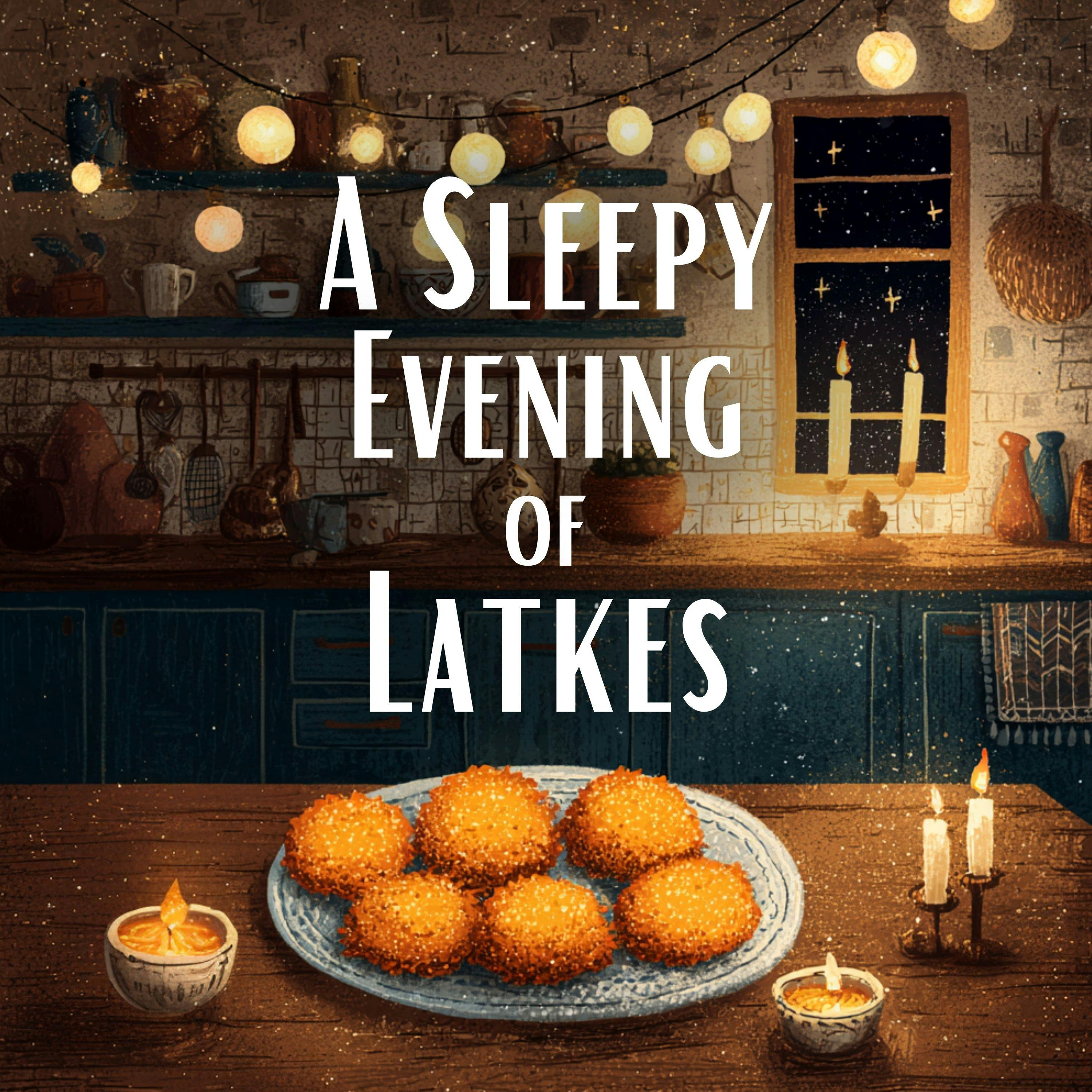
So tonight's story is about latkes, a kind of potato pancake or fritter traditionally eaten at Hanukkah. Will join Adina as she prepares latkes with her grandmother and learns all about the history of this savory treat.
- [02:56]
Thanks so much to Kayla for writing this one and to Vanessa, who will be reading it for us.
- [03:08]
So let's prepare to listen with a bit of mindful relaxation.
- [03:16]
Make yourself as comfortable as can be.
- [03:21]
And when you're ready, let your eyes drift closed.
- [03:30]
Notice how you are feeling in both body and mind.
- [03:37]
Is there Any leftover energy from the day or lots of thoughts floating through your mind?
- [03:48]
If so, that's perfectly okay.
- [03:55]
Allow yourself a little time to think back over the day just gone.
- [04:03]
And without judgment, let each memory receive its moment of acknowledgment.
- [04:16]
It's easy to fall into a trap of repetitively going over standout moments, whether they felt good or bad, and it can be rather disruptive to our sleep.
- [04:32]
So with intention.
- [04:35]
Just calmly allow your mind to process the day just gone.
- [04:45]
And then let each of those moments drift away from your attention.
- [04:58]
Though it may still feel fresh in your mind. The events of the day are now in the past.
- [05:08]
You are living in the present.
- [05:11]
And the present moment is all we really have.
- [05:18]
So spending energy dwelling on the past is rather unnecessary.
- [05:25]
Much like thinking ahead and worrying about a hypothetical future.
- [05:31]
Just let it all be.
- [05:38]
Right here and right now. You're ready to relax and recharge.
- [05:49]
So as you leave the past in the past.
- [05:54]
You can invite your imagination to tune in.
- [06:00]
Simply listen along to Vanessa's soothing voice as we begin our charming story.
- [06:33]
B
Potatoes whisper against a metal grater as Baba Yehudit grinds the vegetable.
- [06:42]
Her granddaughter Adina feels a slight sting in her eyes as she chops the onions and garlic.
- [06:52]
Together they pour the grated vegetables in a bowl with egg and flour.
- [07:01]
Idina mixes it all together.
- [07:06]
Soon the pan will sizzle with oil and the potatoes will turn brown and crispy.
- [07:15]
Everyone will gather round the table to dip them in applesauce or sour cream and share in the joy of Hanukkah.
- [07:28]
Idina loves this spirit special Hanukkah treat and asks her grandmother why she can't eat latkes all the time.
- [07:39]
Baba Yehudit laughs and says, we eat foods fried in oil on Hanukkah to remember the miracle of the oil lamp. Many hundred years ago, there was a group of of Jewish rebels called the Maccabees. After a battle, they reclaimed their temple. While the Maccabees wanted to light the temple menorah and to keep it burning, they only had enough olive oil to keep it lit for one night.
- [08:20]
But miraculously, the oil lasted for eight whole nights.
- [08:29]
That's why we eat food fried in oil, says Baba Yehudit. And that's why we light the Hanukkah candles for eight days, adding one more each night.
- [08:45]
Adina moves the spoon in a circular motion, the wooden handle gently dinging against the side of the metal mixing bowl.
- [08:57]
Right now there's a bit of a harshness to the smell of the mixture with so much onion and garlic. But once the potato pancakes are cooked, they'll smell delightful.
- [09:14]
Baba, says Adina, how did you learn to make potato latkes?
- [09:22]
The recipe came from my own Baba, her grandmother replies.
- [09:29]
And her baba before that. Adina wants to know.
- [09:35]
I'm not sure about that, Baba Yehudit says with a twinkle in her eye.
- [09:43]
We've always eaten fried festive treats on this holiday. But latkes weren't always made with potatoes.
- [09:54]
Dairy products like milk, cheese and cream like the sour cream some of us eat with. Our latkes were another important food group in the Hanukkah tradition.
- [10:09]
So how did this latke recipe come to be? Adina asks.
- [10:17]
Her grandmother replies that the history of latkes is long. Emigration, culture and famines dictated the way the holiday was celebrated.
- [10:32]
As they continue to grind and mix the latkes, getting ready to make a big batch for all of their family and friends, Baba Yehudit begins to tell the tale to her granddaughter.
- [10:50]
Our story begins with a heroine, Judith.
- [10:57]
Judith lived in Israel thousands of years ago.
- [11:03]
She saved her people from foreign invaders by tricking the general of the army.
- [11:12]
Some say that Judith fed him pieces of salty cheese to make him thirsty.
- [11:21]
He then drank wine, which made him sleepy.
- [11:27]
Potatoes wouldn't make their way to that part of the world until many years later.
- [11:35]
But perhaps it was there that the idea for cheese latkes was first born.
- [11:45]
Adina thinks about this.
- [11:49]
When she eats a lot of latkes. She does get sleepy, but she still isn't sure why Judith is related to Hanukkah.
- [12:01]
Isn't the Hanukkah story about the Maccabees and the oil lamp?
- [12:08]
Stories with a long history aren't always so straightforward, says Baba Yehudit.
- [12:18]
With so many stories intertwining over so many years, we don't know exactly why the two stories became related in Jewish history.
- [12:32]
Perhaps Judith was meant to be the heroine equivalent to the hero Judah the Maccabee.
- [12:41]
Both are famous for saving their people from neighboring empires.
- [12:47]
Or maybe it was because the midwinter holiday needed a heroine, just like the spring holiday of Purim was the heroine Esther.
- [13:01]
Perhaps. As the Jewish people moved across Europe, the Middle east and North Africa, their stories changed and grew, depending on the culture they were living in.
- [13:18]
For some reason, the scribes and scholars in medieval Europe connected the tales.
- [13:26]
We may never know for sure, says Baba Yehudit, but it's probably because of this brave woman that many people in the Mediterranean celebrated Hanukkah by eating fried cheesecakes.
- [13:46]
Why didn't they use potatoes? Adina asks, thinking of the delicious crispy potato latkes she ate every year.
- [13:58]
She can't think of anything tastier than that.
- [14:04]
Potatoes come from the Americas, says Baba Yehudit.
- [14:11]
It was farmers in Peru and Bolivia that first started started planting potatoes thousands of years ago.
- [14:22]
Today, There are over 4,000 varieties of potatoes in Peru.
- [14:30]
These hardy vegetables can grow under a lot of different conditions.
- [14:36]
And over the course of human history, they have become an important food, helping people survive.
- [14:47]
But potatoes didn't make it to Europe, the Middle east, or Africa until much later, when Hanukkah had already been celebrated for a long time.
- [15:03]
Spanish explorers went to South America in the 16th century.
- [15:11]
It was only then that they got to taste potatoes and brought them back to Europe.
- [15:21]
Idina thinks about this as they start to scoop up handfuls of the latke mixture and roll the gooey potatoes between their palms, making little balls.
- [15:37]
They pile the balls on a big platter, placing one next to the other.
- [15:45]
Meanwhile, Baba Yehudit continues her story.
- [15:52]
There were no potatoes in the ancient near east or Mediterranean, but cheese was a very popular food.
- [16:06]
Archaeologists who've studied the region have found evidence of cheese from many years ago.
- [16:16]
Traces of the cheese making process were found in ancient pottery on the coast of Croatia.
- [16:26]
The pottery is thought to be over 7,000 years old.
- [16:33]
It's the oldest evidence that's been found of cheese making.
- [16:40]
Similar finds from up to 5,000 years ago have been found in the Mediterranean, the Middle east and North Africa.
- [16:54]
Goat's milk cheese was especially popular in this region because the climate of the Mediterranean is ideal for raising goats and sheep.
- [17:08]
Just like we're doing with our potato latke recipe tonight, says Baba Yehudit. Throughout history, there have been many small, special recipes and traditions around cheese.
- [17:25]
In some traditions, fried cheese was eaten on Hanukkah.
- [17:33]
But cheesy treats would also be served during other holidays and wedding ceremonies.
- [17:41]
While we know cheese and fried foods were part of the Hanukkah tradition, we don't know exactly what people were eating during Hanukkah until the Middle Ages. Records suggest that by this time, pancakes were sometimes an important part of Hanukkah feasts in Europe.
- [18:07]
Thinking about the history of so many of the foods she loves, Adina pours a thick layer of olive oil into the pan.
- [18:20]
She watches it slide around the skillet, completely covering the bottom.
- [18:28]
Baba Yehudit then turns the stove on.
- [18:34]
And as they wait for the oil to start sizzling, she continues.
- [18:42]
When Jewish people emigrated to different parts of the world. They developed unique cultures and foods in those places.
- [18:54]
The Jewish community in Rome, Italy, is one of the oldest in Europe, and some think they may have had the original recipe for cheese pancakes.
- [19:12]
A special dish called kasola was made with ricotta cheese and fried in oil to celebrate Hanukkah.
- [19:23]
Many Sephardic Jews, those originally from Spain and Portugal, also developed fried dairy treats for Hanukkah.
- [19:36]
After they were expelled From Spain in 1492, Sephardic Jews spread throughout the Ottoman Empire, North Africa, and parts of Europe, bringing their culinary traditions.
- [19:55]
Some Sephardic Jews went to Central and Eastern Europe, where Ashkenazi Jews lived.
- [20:04]
Perhaps the Sephardic Jews introduced the idea of fried cheese pancakes.
- [20:13]
However, it's likely that Ashkenazi communities were already making other variations of fried foods for the holidays. Cheese blintzes, for example, and sufgani, ot which are fried jelly filled doughnuts.
- [20:33]
We don't have detailed records of the foods eaten during that time period.
- [20:40]
So we're not sure if they were making a variation of the latke before Sephardic communities spread the recipe.
- [20:52]
Adina licks her lips. The oil is now sizzling in the pan.
- [21:01]
She picks up the first latke and squishes it between her palms so it flattens.
- [21:09]
Then she drops it in the pan.
- [21:14]
Adina and her grandmother take turns picking up one of the balls, flattening it and dropping it in the sizzling oil.
- [21:26]
Baba Yehudit then picks up the spatula.
- [21:31]
She'll be in charge of flipping the latkes when they're ready.
- [21:38]
But in the meantime, Adina wants to know the rest of the story.
- [21:45]
If the pancake tradition started with cheese, why are they using potatoes now?
- [21:55]
Baba Yehudit says.
- [21:58]
It was Jewish communities from Spain and Italy that brought us cheese pancakes.
- [22:06]
And in a way, it's also thanks to the Spanish Spanish that we have potato latkes.
- [22:16]
When Spanish explorers visited PERU in the 16th century, they noticed that the local people there, the Incans, ate an unusual vegetable which grew underground.
- [22:33]
This starchy vegetable kept them full and strong in the harsh mountainous climate.
- [22:43]
At first, the Spanish were reluctant to even try it.
- [22:51]
But they brought the potato back to Europe and were delighted to find that it could grow in European soil.
- [23:01]
The potato would change the course of much of European history and cuisine.
- [23:09]
When famine struck, the people of Europe found that the potato was a hardy crop and often grew even when nothing else did.
- [23:23]
This made potatoes plentiful and cheap, certainly more affordable than cheese and dairy.
- [23:34]
So communities who didn't have access to cheese during Hanukkah may have started using potatoes to make their fried pancakes.
- [23:47]
They grated the potatoes and mixed them with onion to give the dish more flavor.
- [23:57]
Every family had their own twist on the latke recipe that would get passed down through the generations.
- [24:07]
My secret is garlic, says Baba Yehudit.
- [24:14]
Adina can smell the mixture of garlic and onion filling up the kitchen.
- [24:22]
Part of the fun of the holiday, her grandmother continues, is getting to sample all the different latke recipes from friends and family who have their own twist.
- [24:37]
She flips the latkes in the pan, and they make a satisfying sizzling noise.
- [24:47]
When they've finished frying, Baba Yehudit scoops them onto a plate and Adina presses a towel on top of them to absorb some of the oil.
- [25:02]
And then it's time to make the next batch.
- [25:09]
Adina finds the rhythm of picking up the gooey mixture, flattening it between her palms and dropping it in the oily pan.
- [25:24]
A familiar smell fills the kitchen, one that both grandmother and granddaughter associate with this special holiday time.
- [25:40]
Baba Yehudit continues her story.
- [25:45]
Even though latkes are a traditional food, they still continue to change and grow.
- [25:55]
In Ashkenazi communities in Eastern and Central Europe, schmaltz, or meat fat was often the preferred cooking oil.
- [26:08]
If they used schmaltz, they couldn't make cheese latkes, as meat and milk couldn't be mixed together.
- [26:19]
Traditionally, mixing meat and dairy is forbidden in Judaism.
- [26:28]
Before potatoes became the default vegetable to make latkes, people also used other vegetables like turnips.
- [26:41]
And in the US Many people cooked latkes in shortening, giving them a unique flavor.
- [26:52]
It wasn't until shortening fell out of favor that people started once again using olive oil, the preferred oil in the Mediterranean.
- [27:07]
And they connected the tasty food to the oil in the temple menorah that burned for eight nights.
- [27:18]
A big jar of olive oil stands on the counter, and between each batch, Baba Yehudit pours a bit more in the pan.
- [27:33]
Adina looks at the chanichia sitting in the window, waiting to be lit on this first night of Hanukkah.
- [27:45]
Now there are wax candles in the holders, but before wax was popular, oil was the preferred method of candle burning.
- [28:00]
Baba Yehudit explains that even though potato latkes are now cooked to celebrate Hanukkah around the world, when it comes to toppings, there are different preferences.
- [28:19]
Some people use applesauce as a garnish for latkes, while others prefer sour cream Perhaps a nod to the latke's dairy based origins.
- [28:36]
There's often a debate at the dinner table about what the best topping is.
- [28:46]
I like both, says Adina.
- [28:51]
Her mouth waters at the thought of biting into the crispy, fresh latkes.
- [28:59]
She drops another one into the pan.
- [29:04]
When it's ready, Baba Yehudit takes out a small plate and puts two fresh latkes on it.
- [29:15]
She says it's important for the cooks to try the food before serving it to guests.
- [29:24]
Idina gets the applesauce and sour cream from the fridge and puts a scoop of each on her latke.
- [29:36]
Baba Yehudit eats hers without a garnish.
- [29:43]
They smile at each other as they take a bite.
- [29:50]
With a warm, crispy outside and a soft center, the latkes are perfectly cooked.
- [30:03]
Baba Yehudit has now come to the end of her story.
- [30:10]
Whether you call it a latke or a levivot, as it's known in Hebrew, the foods eaten on Hanukkah will continue to evolve with each generation.
- [30:27]
What's next for the latke might depend on the cultures, climates, local foods and migration patterns of the people who celebrate Hanukkah.
- [30:44]
Adina drops the last raw latke in the pan, listening for the sizzling sound.
- [30:53]
There are still seven more nights to try different variations on this special Hanukkah treat.
- [31:04]
Can we try making cheese latkes tomorrow night? Edina asks her grandmother. Of course we can, says Baba Yehudit. It's never too late to revive an old tradition.
- [31:24]
Together they set the table for the first night of Hanukkah.
- [31:31]
All of their families and friends will be there tonight to celebrate.
- [31:40]
Adina and her grandmother are the first to share their special recipe for latkes.
- [31:49]
But Idina is excited for the other nights, too, when she'll get to try recipes from different members of her family.
- [32:03]
It isn't long until guests start arriving with warm smiles, hugs and stories.
- [32:15]
Before eating, they gather in front of the hanukkiah together, looking out the window into the starry winter night.
- [32:29]
Usually, Baba Yehudit lights the first candle on the first night, but tonight she passes the shamash, the lighting candle, to Adina.
- [32:46]
She's old enough now to take on the tradition.
- [32:53]
Adina holds the candle in her hand and watches the candle for the first night catch fire.
- [33:05]
Baba Yehudit helps her put the shamish back in its place in the center of the hanukkiah.
- [33:16]
And together everyone says the prayers and sings the songs for the first night of Hanukkah.
- [33:29]
Then it's time for the meal.
- [33:35]
Adina, Baba Yehudit, and their guests take their seats at the table and pile latkes onto their plates.
- [33:51]
Some people take applesauce while others take sour cream.
- [34:01]
Some, like Idina, take both.
- [34:08]
And others, like Baba Yehudit, take none.
- [34:16]
All the guests compliment the cooking.
- [34:23]
Adina wonders how many of them know about the fascinating history of the food they're eating.
- [34:36]
Perhaps she'll tell them all the story one day.
- [34:44]
After all, there are seven more nights of celebration.
- [34:52]
But there's no rush. The stories will come out when they're ready.
- [35:03]
Lost in the warm bubble of conversation and laughter, Adina enjoys seeing the light of the candles flickering on the window against the dark night outside.
- [35:24]
Anyone who passes by will see the candles and perhaps hear the laughter coming from inside.
- [35:40]
Adina likes that passersby will get a small taste of the joy they're experiencing within.
- [35:54]
When bellies are full and plates are empty.
- [36:00]
Some of the guests start to leave.
- [36:07]
Others move to the couch to rest.
- [36:12]
But for Idina and her grandmother, it's time to go to bed.
- [36:23]
Together they go up the stairs and change into cozy pajamas.
- [36:35]
Adina climbs into bed.
- [36:40]
One thing she loves about this time of year is the cool weather.
- [36:51]
It's the perfect time to get warm under her soft blankets.
- [37:01]
As Idina drifts off to sleep, she remembers the feel of the gooey latke mixture in her hands.
- [37:14]
The sizzle of the pancakes as they hit the pan, and the warm, hearty tastes of the food.
- [37:30]
Hearing the soft voices downstairs, she thinks about the the long journey latkes have been on for hundreds of years.
- [37:48]
And as she sinks deeper into her pillows, she wonders where the story of the latke will go next.
- [38:05]
She can't predict what the future holds.
- [38:13]
For now, she can only slip away into sleep and dream about it.