Loading summary
Transcript8 lines
- [00:01]
A
Get Sleepy is a production of Slumber Studios and is made possible thanks to the generous support of our sponsors and Premium members. If you'd like to listen ad free and access weekly bonus episodes, extra long stories and our entire back catalogue, you can try out Premium free for seven days by following the link in the episode notes. Now a quick word from our sponsors. So good. So good.
- [00:30]
B
So good Score Holiday gifts Everyone wants for way less at your Nordstrom Rack store. Save on Ugg, Nike, Rag and Bone, Vince Frame, Kurt Geiger, London and more.
- [00:41]
A
Cause there's always something new.
- [00:42]
C
I'm giving all the gifts this year with that extra 5% off when I use my Nordstrom credit card Santa who.
- [00:49]
B
Join the Nordy Club at Nordstrom Rack to unlock our best deals. It's easy. Big gifts, big perks. That's why you rack. This episode is brought to you by State Farm. Listening to this podcast Smart move. Being financially savvy. Smart move. Another smart move having State Farm help you create a competitive price when you choose to bundle home and auto bundling. Just another way to save with a personal price plan like a good neighbor, State Farm is there. Prices are based on rating plans that vary by state. Coverage options are selected by the customer. Availability, amount of discounts and savings and eligibility vary state.
- [01:29]
A
Hey everyone. Welcome to Get Sleepy where we listen, we relax, and we get sleepy. My name's Thomas. Thank you so much for joining us tonight. Shortly we'll hear a true story that will take us back to the rugged coast of New England in the United States in the year 1929. It was written by Elisha Stefan and will be read by Heather. In this tale, one person and one act of generosity will kick off a tradition that will ultimately touch thousands of lives and continue for a century into the future. It all begins with the surprise delivery of a few unassuming packages full of very small gifts. First, though, if you know someone who would love the gift of good sleep this festive season, why not treat them to a Get Sleepy Premium subscription? Or if you've been enjoying the show and would love to listen, ad free? With access to our entire catalogue of over a thousand episodes and our weekly Premium bonus episodes, why not pop it on your own wish list for Christmas? It's pretty simple to do. When you go to getsleepy.com support, you'll see the option to gift a subscription. So in just a few clicks, you'll have the perfect gift all sorted. No trips to busy shops required, no delivery costs or excess packaging to dispose of. For more information on signing up to Get Sleepy Premium or to gift a subscription to a loved one or friend, just go to getsleepy.com support thank you all so much and I'm wishing you a very happy festive season and end to the year. Okay my friends, it's nearly time to hear our story, so let's just ensure that we're suitably relaxed and ready to drift off whenever the time comes. Remember, sleep isn't something to be forced, so all you need to concern yourself with is making space both mentally and physically to just allow sleep to happen. For some of us, this is a pretty simple task and it doesn't take too much consideration to enable that state of body and mind. However, if you're at all like me, you might find that when you come to bed, your body can often feel a bit restless, holding on to the energy from the day. Or more commonly in my case, your mind switches on even more than it had been throughout the day and decides that it wants to do a lot of rather unnecessary thinking or remind you of stuff you need to deal with in the coming days. None of that is very helpful with making space for rest and allowing sleep to happen, So at this moment, just make sure you're feeling as comfortable as can be. Notice the pace and rhythm of your breath. If necessary, just keep your attention there a little longer and try to steady the rhythm and extend the exhales. This will help slow your nervous system and in turn will make you feel calmer. And I just want you to notice the touch points between your body and the surface below. Feel where your body presses into the support of your mattress or whatever you're lying on. Relax into that more and more with each exhale of the breath. Notice how well your head and neck are supported by your pillow. And finally, notice how your body is cocooned in safety and warmth by your soft covers. You are in the perfect place to let everything go, to offer yourself gentle reassurance and to make space for sleep to come without force when the time is right. Now, with your eyes closed, imagine a blank canvas of blue, green and grey. Picture a light snow falling on dark evergreens, landing on rocky beaches and disappearing into crashing waves. This is where our story begins.
- [08:40]
C
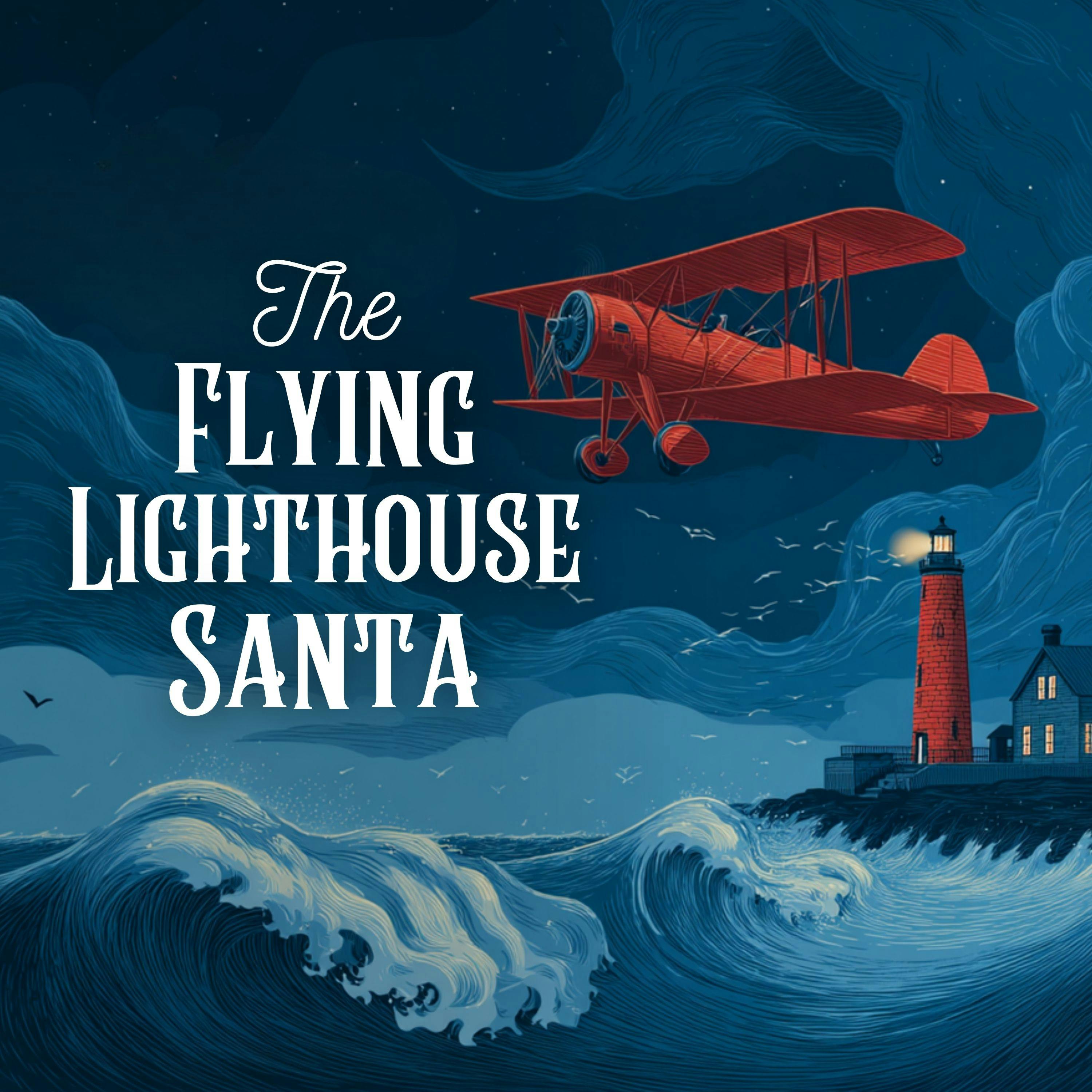
Imagine for a moment that your father is a lighthouse keeper on the rocky shores of New England. You have grown up with a life that revolves around the lighthouse and its environs. As far back as you can remember, you've spent your nights slumbering to the sound of the crashing waves. The cries of the seagulls have created a backdrop to your days. You have never known anything other than the salty air on your face. Meanwhile, you've grown up observing your parents. You know the heavy responsibility the lightkeepers bear. In fact, as a member of the family, you also understand that that everyone must pitch in to keep the beacons glowing at these crucial posts. Morning, noon, evening, night, seven days a week and 365 days a year, the light must be shining. The fog bell or the foghorn must be ready to sound its warning. Your father cannot fail at this task. If he is unable to perform it for some reason, your mother or you or one of your siblings must step in and complete his duties. Otherwise, mariners will be endangered and ships may run aground. It is a sacred duty that you share in small part, even though you are not fully yet grown. If you are lucky, your light station may be attached to the mainland. Many of our most storied lighthouses are perched on rocky outcrops or cliffs close to town, where visitors can walk right up to them and visit, or supplies can easily be delivered. This is always a comfort because while the keepers must never abandon the light, the world can come to them, and forays to obtain supplies can be brief and predictable. However, it's also very possible that your family has taken on a more difficult post. Your lights station may be on a windswept island a mile or more out to sea. In the case of an island light station, your family may be the only people who live on a small piece of land that juts out of the tempestuous waters. Supplies may only reach you periodically throughout the year, and you cannot attend school like children on shore. Visitors will be scarce at such a remote post. A family manning a distant lighthouse must be very self sufficient, keeping each other healthy, happy and well provisioned. Depending on the terrain at your light station, your parents may have been able to supplement their supplies by farming or raising livestock. Many lighthouse families raise goats or chickens. You might have a cow that provides you with milk, grazing on the hardy grasses that survive this climate. If the soil is rich enough, your mother may well have planted a garden. Fresh produce is one of the hardest things to obtain when deliveries are few and far between. As a child in this family, you will have learned to help as much as possible. Even though you are little, you can assist with the daily chores on your tiny rock in the middle of the water. Anything that you can do will ease the burden for your parents. This is good because life can be exhausting and monotonous with so much responsibility and so little help. Lightkeepers do not get to take vacations. Despite the challenges and privations, however, you and your family are part of a proud tradition. Lightkeepers do not complain about their lives because they have chosen it. They gladly accept the honor and responsibility of their posts because they know that their work saves lives. Countless mariners have been spared due to the lights the keeper kept burning or the fog bell they rang, and sometimes it has taken ingenuity to make that happen. As a child of a lightkeeper, you have grown up knowing how to work hard and how to make do. You are also an eager student of creative solutions. Take, for example, the story of the light at Mount Desert Rock, 26 miles off the coast of Maine, which bears the title of the most remote lighthouse in New England. At only 600 yards long and 200 yards wide, this distant outpost is so scoured by the wind and water that no soil will rest there for long. In 1858, a keeper named John Dolliver brought his wife a barrel of soil and a packet of seeds from the mainland. She planted the seeds in crevices all over the island, and those produced flowers and vegetables until they were once again swept away in the fall and winter. The keeper renewed the supply the next year, and it became a tradition, with grateful sailors contributing their own boxes of soil when they passed by. The island became known amongst the seafaring folk as God's Rock Garden, and it was much loved and appreciated by those passing by. It is this fighting spirit and this appreciation for small comforts that you have absorbed from your family, and you have learned a lot about gratitude. You have seen how much your parents work is appreciated, even though you might be aware they feel isolated and unnoticed some of the time. But this is the price they pay for accepting such a sacred duty. Of course, some days are more challenging than others. The isolation may be less cheerfully borne during parts of the year when celebration of family and fellowship are the tradition. Even the staunchest lighthouse families wish for a mainland life around the Christmas holidays. Still, even out there on the island, you sense the rising excitement. Your mother may be using precious stores of supplies to make extra treats. You and your sibling are secretly working on handmade gifts and cards for one another. Your father has hinted that Santa may have since some candy on the upcoming supply boat. You are excited about this festive time of year despite the fact that your parents have not promised a visit from Santa or any parties with friends or family. You know not to ask for these things, but one day something miraculous happens that you will never forget as long as you live. It's Christmas morning and your family has had a festive breakfast together, exchanging small presents. Your mother went to extra trouble making everyone's favorite dish. Later, after your father has tended to the light, you are promised that you will all sing some carols around the fire. In the meantime, your mother has urged you to bundle up and get some fresh air. You know that she wants some time to herself to tidy the small keeper's house so that it will be jolly for later. You and your sibling venture into the gusty chill of late morning. As you clamber aimlessly about the familiar rock and outcroppings of the island, you hear the sound of a seaplane from above. You shield your eyes, observing it with excitement as it approaches the island. Then, as you watch in amazement, you see an object plummet from the airplane, landing safely out of sight sight on your island. In a moment, the plane has passed. The race that ensues between the two of you children is one of good natured competition. Both of you are overwhelmed with curiosity to find out what in the world has just been deposited nearly on your doorstep. Running over sparse grass and clamoring over rocky outcrops, you make your way nearly to the edge of your island where you find that the object is a parcel wrapped in brown paper. This package looks a bit worse for the wear, having fallen from a considerable height, it is not terribly large and weighs no more than £15 or so. The two of you are able to lift it easily and haul it back to the keeper's house, where you burst through the door to show your mother what you have found. She is perplexed at your discovery. You place it on the table and stare at it, trying to discern whence it came and why. After what seems an interminable amount of time, your father finally returns from tending the light, and you know that he will open it. Your suspense will finally be at an end. Inside you find a note of thanks for your service from the local pilot, William Winkapaugh. You know his name because he is often about conducting business via seaplane. He has been known to brave inhospitable conditions on many occasions to ferry sick or injured islanders to medical care. It seems on this Christmas he has dropped you a little care package to brighten your holiday. Your mother glows with happiness at this thoughtful act, and you are silently thankful to this kind man for bringing a smile to her face. The contents of the delivery are not extravagant, but they might as well be lavish gifts. There are recent newspapers and magazines. These are luxuries you normally do not have. Beyond that, there is a precious bag of coffee which makes your father happiest of all for you and your sibling. There's brightly colored candy and chewing gum. Both are quite a rare treat. But the greatest gift of all is the thought he had of sending you this package of holiday cheer. At this moment, your family is warmed by the knowledge that they are not forgotten. On this Christmas holiday, you all know that you are remembered and appreciated. The story you just experienced is an approximation of what a handful of families off of the mid coast of Maine may have experienced on Christmas Day in 1929. That was the day that purely of his own volition, out of the kindness of his heart, a local pilot named William Winkapa took it upon himself to spend the morning dropping care packages from his small travel air a 6000 a plane. He delivered them onto the remote stations of a handful of Penobscot Bay lighthouse keepers. Having done so, he simply circled back and returned to his family, enjoying the rest of the afternoon as he always might. He had no idea that he had just started a movement that would be carried forward into the next century, expanding to reach countless other deserving families. The heartwarming story of that legacy is told by the modern non profit organization Friends of the Flying Santa, which records the history in fascinating detail. As it turns out, in the days by following his first holiday care package deliveries, Winklepaw was taken aback by the outpouring of appreciation he received. Bit by bit, word got back to him that his gesture had made a real difference to the folks he had visited. As a result, he made the decision not to just make it an annual tradition, but to expand his range. In the ensuing years, Winkapaw eventually stretched his Christmas delivery route to cover spots all along the New England coast. By 1933, just a few years later, he had moved his family from Friendship, Maine to Winthrop, Massachusetts. However, even though he had relocated, his deliveries didn't stop. His teenage son, Bill Jr. Began accompanying him on his journeys. Together, they made it to 91 lighthouses that year. The next year, Bill became the youngest licensed pilot in the state at the age of 17. In fact, it was through his son that Winklepaw became acquainted with the man who would ultimately play a crucial role in the future of the Christmas lighthouse deliveries. That man, whose name was Edward Snow, was Bill Jr. S high school history teacher. He became friendly with William Winkapaugh and volunteered to help out with the Christmas deliveries. He was a great addition to the team. In 1936, Bill and Ed took on their own Leg of the holiday lighthouse delivery route, covering 25 stops in southern New England. This turned out to be a very important development because both William and Bill Jr. Were unable to complete their flights a couple of times in the early 1940s due to a combination of remote work and wartime duties in their absence. Whenever he could manage, Ed stepped right in, hiring a pilot to fly him where he needed to go. Accompanied by his wife, Anna Murrell, and supplemented by generous assistance from Wiggins Airlines. The deliveries continued in their absence, although some changes had to be made for the sake of wartime safety. Anna Merle looked back on these flights much later in life, relating how happy the lighthouse flight families were to see their planes fly over. She told a story of the lightkeeper's wife on Ten Pound island in Gloucester, Massachusetts, who nailed down pieces of newspaper on the ground to spell out the words Merry Christmas. Ed was so delighted with the sight that he took a photograph and it ended up in the local newspaper on the mainland. The son of the lightkeeper saw the newspaper while he was on shore at school and brought it back to his unsuspecting parents on the island when he returned home. Thus, the circle of appreciation was complete for everyone involved. At times during the 1940s, Ed and his helpers also began using helicopters for some of the deliveries. One of the first helicopter deliveries revolved around a very special little girl named Simond Ponsart. In 1945, at the age of five, Simond was wishing very much for a doll to arrive for her at the Cuddy Hunk island light in Massachusetts. Mr. Snow faithfully dropped her family a package. However, when he received a letter of appreciation from them soon after, it was revealed that the doll had broken on impact. This type of accident was unfortunately an occasional result of the flyover Santa drops that were necessary. But Ed gathered that the little girl was heartbroken despite her parents efforts to mend the doll. As a result, Ed made it a mission of his to get her another doll in 1946. In the interim, her father had been transferred to West Choplight in Martha's Vineyard. Determined to deliver her new doll in one piece, Mr. Snow employed the use of a helicopter to safely land and hand deliver the replacement to now 6 year old Simond. His kind act turned out to be a defining moment of her childhood. Simond wrote to the lighthouse Santa annually after that, and in an interview later in life, she said, ed Snow made my Christmases last forever. As one would imagine, Simon's doll was not the only thing that sustained some damage due to the imperfect Art of Air Delivery when it came to the Christmas packages, reportedly an effort was always made to safely drop the package away from anything breakable. One lightkeeper related that his delivery would often land out on a ledge at the edge of the island, reachable only at low tide. But there were small mishaps, like the destruction of a fence on Maine's Monhegan Island. Luckily, this type of little accident was not the norm. Ed's dedication to the program was a blessing because William Winkapaugh passed away unexpected, unexpectedly, in the summer of 1947. As a result, the fate of the Christmas lighthouse deliveries was in Bill and Ed's hands. Determined to honor his legacy, they managed to get gifts delivered to 176 light stations in 1947. Furthermore, Wiggins Airlines pitched in by providing some additional aircraft and pilots to cover more routes. Even the Coast Guard began sometimes providing a plane to assist them. Together, with continuing support from Anna Merle, they continued making memories for deserving lighthouse families. By the 1950s, sponsors were getting in on the action. A typical package at that point could include coffee, tea, shaving products, rubber balloons, gum, pen and pencil sets, and even special toys to delight the littlest lighthouse keepers. In addition, a feedback postcard was added, allowing the lightkeepers to let the pilots know if they'd received their packages intact. With the help of these postcards, the team was able to see that they consistently delivered the parcels with an impressive 94% accuracy. Luckily, folks had a great sense of humor about the 6% of deliveries that went awry. There was a particularly humorous story about one year when Ed was a little behind schedule and the children at Ipswich Light were assembled and waiting. The keeper called up to his wife to ask if Santa had arrived, only to hear a package crash through a skylight. Moments later, the story goes, she called down to him directly, saying, yes, dear, we can start the party now. Ed Snow was known to always cover any damage that occurred, and the lightkeepers took the mishaps with great humor, turning them into funny stories that would be told and retold for years. Ed and Anna Merle had a baby girl named Dolly, and she immediately became an additional passenger on the holiday flights. In an interview on a podcast many years later, she talked about her memories of those trips when her father would sit behind the pilot, tossing packages out the window while her mother sat to the right, and she herself was perched in the very back, surrounded by parcels delivering. The annual holiday cheer continued to be very much a family affair. The lighthouse routes had already been covering stations from Canada to Florida. By the late 1940s and the expansion of the routes continued. In 1953, the snows made their morning stops on the east coast and then Ed flew to the west coast and completed a route from Tillamook Rock in Oregon to San Pedro, California. As amazing as this was, he continued to find ways to reach more families. 1954 saw the addition of the Great Lakes and Bermuda. Perhaps most notably that year, Ed made the trek out to Sable Island, 100 miles off the coast of Nova Scotia. He arrived by seaplane, after which he was reportedly pulled pulled by semi wild ponies in a wagon across land. Ultimately, he reached a very appreciative group of three children and 23 adults who were extremely grateful to be remembered in such a remote location. Even though he couldn't land the plane much of the time and see folks in person, Ed still dressed up as Santa Claus. For a few years, he even tried wearing the white beard and whiskers. But he gave up because the heavy winds kept blowing the false beard off his face when he stuck his head out of the window of the plane. Apparently, he once received a package a few weeks after Christmas that contained his fake white beard. With it, a light keeper had sent a note which read, here are your whiskers. Now where's our package? Changing times always require the Flying Lighthouse Santa team to evolve. By the late 1970s, stricter FAA regulations were making it much harder for the planes to make their drops. Additionally, the insurance that the snows had to take out in case of damage was becoming prohibitively expensive. Unwilling to accept defeat, the snows changed up their strategy and switched to more boat and helicopter deliveries. One advantage to this method, in addition to the promise of fewer wayward packages, was that the delivery team got to engage with their grateful recipients more often in person. After decades of service as the Lighthouse Santa, Ed Snow passed away in 1982. Fortunately for the families of the light stations, other non profits and volunteers stepped in to keep the wonderful tradition alive. As more and more light stations became automated, the focus shifted to Coast Guard families. Volunteer and lighthouse Santa historian Brian Tague writes in his history of the organization, of the joy experienced by the children at the remote Coast Guard stations and how Santa was met each year with a bounty of goodies and eager little faces. He adds that it was not uncommon to see powdered sugar on the helicopter controls by the end of the day. In 2003, now a member of the Coast Guard herself, Simond Ponsaert joined the team in delivering the holiday cheer. It was a wonderful full Circle moment that poignantly demonstrated the lifelong impact the effort had on so many children. 57 years after Ed Snow had brought her a doll in a helicopter, Simond returned to the same light station at West Chop to bring gifts to the Coast Guard children who were living there. The very next year, in 2004, William Winklepaw's grandson Bill III flew along with his wife and two children to celebrate the 75th anniversary of the very first Flying Lighthouse Santa deliveries. Afterwards, he convened with his family at Al's Headlight, right near Rockland, Maine, where Winkapaugh had dropped his first few packages on Christmas Day in 1929. With most lighthouses now automated, the solitary existence of the lighthouse keeper has largely faded into history. However, William Winklepaw's gesture of kindness is still a magical part of Christmas that brightens the lives of so many hardworking coastal families. The legacy of the Flying Lighthouse Santa shows us that it's the little things and most of all, the thought that truly counts.
- [52:24]
A
Sa.