← Giving Done Right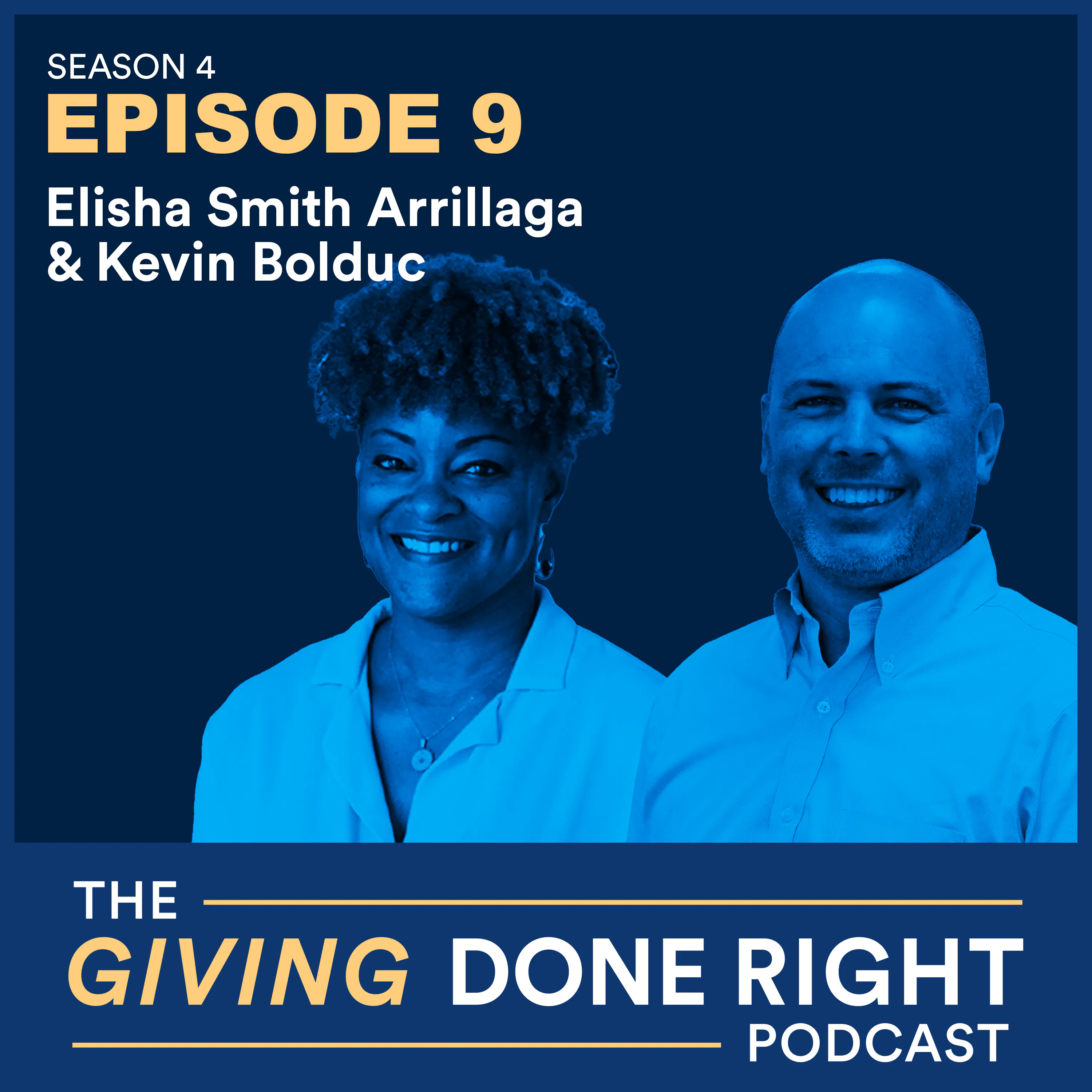
Giving Done Right
Avoid the Myths and Give Smarter with Elisha Smith Arrillaga and Kevin Bolduc
00:58:17
Loading summary
Transcript87 lines
- [00:01]
Alicia Smith Arriaga
Support for Giving Done Right comes from the Fetzer Institute. Are you a program officer who is also a person of faith?
- [00:07]
Grace Nicolette
Join our monthly faith and philanthropy conversation where like minded program officers wrestle with ideas and best practices for funding faith and spirituality. Visit fetzer.orggivingdoneright to request more information. Fetzer.org givingdoneright.
- [00:29]
Phil Buchanan
Choose something you care about, think about making your donation a longer term commitment, and then try to trust the nonprofits you give to until you have a reason not to.
- [00:42]
Grace Nicolette
Welcome to Giving Done Right, a show with everything you need to know to make an impact with your charitable giving. I'm Grace Nicolette.
- [00:50]
Kevin Boldick
And I'm Phil Buchanan. Today we have a particularly fun episode for you because we've got Alicia Smith Arriaga and Kevin Boldick, two of our close colleagues from the center for Effective Philanthropy who have really unique sight lines on what's going on in philanthropy and what donors need to know to be effective.
- [01:17]
Grace Nicolette
Yes, Alicia leads up all of our research efforts, which includes key philanthropy trends and best practices for how donors can best support nonprofits. And before joining us, she had leadership roles in philanthropy, nonprofits, and academia. Alicia, we're so glad you're here.
- [01:33]
Alicia Smith Arriaga
Super excited to be here. Thanks, Grace.
- [01:36]
Kevin Boldick
And Kevin was literally employee number two at the center for Effective Philanthropy. In fact, we worked together in a previous job in a previous life. And so he's been over two decades inside the boardrooms of more foundations than anybody I know, worked with individual donors, families, staff, and just has so much insight on how grant makers can work better with the nonprofits they fund. So welcome, Kevin.
- [02:05]
Phil Buchanan
So glad to be here.
- [02:07]
Kevin Boldick
So I would love to start, and let's start with you, Kevin. Like, how did you get into this? Like, what, what happened that you found yourself working at the center for Effective Philanthropy? It's a story I know, obviously, but our listeners don't, and it's kind of a fun one.
- [02:21]
Phil Buchanan
Well, I think if you'd asked me as a kid, I wouldn't have actually been able to even tell you what philanthropy was. So I think ultimately I'd describe my path as a really lucky one. When I went to college, I thought that I'd be like a doctor or a scientist. And I had a chance to try some of those things and realized that that just wasn't right for me. So I found myself in strategy consulting. And I really loved being a consultant using analysis to help organizations make better decisions. But after paying off some school debt, I really knew that I wanted to make more of a difference. And so this was during the dot com boom, and everyone seemed to be building something new. And, Phil, as you mentioned, I was lucky enough to have met you at this organization, and you offered me the chance to help turn this idea into about effective philanthropy, into the organization that's now cep. And, of course, now that I know philanthropy, I can see that it enriched my entire life. Like, I learned to swim at the Boys and Girls Club, which was maybe the biggest nonprofit in town, and I played by high school tennis matches at the Alphond Courts at Colby College. So I benefited from philanthropy all my life. And I do this work now because I know that philanthropy and nonprofits really did make a difference for me. And to me, that's the point of the social sector. To remove barriers and provide the lift that helps each of us be who we're meant to be.
- [03:39]
Kevin Boldick
Yeah. And I'll just say. And before we get to Alicia and her story, what I remember is that you were, like, this crazy smart analyst at the consulting firm where we worked. And I was under the misimpression that you were super happy there. And so I didn't even think when I got the job at CEP that you might want to join. In fact, I tried to convince somebody else to join. She said, no way. That sounds super risky. I'm not gonna do that. I passed you in the hallway, and you said, hey, Phil, I heard you're leaving. And I said, yeah. You said, you are taking me with you, aren't you? And I said, do you even know what I'm doing? And you said, I don't care. Just get me out of here. So anyway, that's the way I remember. Cause turns out you were working, like, 90 hours a week. Not like, it was so chill once we started working together at cep, But I just remember thinking I hit the lottery, because I didn't even think it was possible that you would want to join. Alicia, your story. We've known you a long time at cep. I've known you a long time, but you've only been with CEP now for a bit over a year. How did you end up in this world, and how did you end up in this role?
- [04:45]
Alicia Smith Arriaga
Yeah, well, similar to Kevin, you know, when I was growing up, I never would have thought this would be where I ended. But it all makes a lot of sense now. I would say, like, my love and passion for this work, like, for nonprofit work, generally started when I was very young. So I'll never forget when I was nine years old, I was sitting in my living room and there was a knock on the door, and Yolanda King walked in, who was Martin Luther King's daughter. And she was what? Yeah, it was pretty. I mean, for me, it was like, the closest thing that I had come to meeting a celebrity because my parents had been really involved in the civil rights movement in Mississippi. And then my mom and Yolanda King went to college together, and they were friends, and so she had just come to visit. But it was also just part of this long legacy in my family of this idea that, like, we're not here just to take up space. We're here to serve. And so that's a thread that I really took to heart throughout my career. Kind of started out my career thinking about using data as a tool to make change. So as a researcher, you know, leading a lot of evaluation programs, and through that journey, came to know the Hewlett foundation and ended up working there as a fellow for quite some time over 10 years ago, which is where I first learned about CEP and the amazing work that happens here. And so it was great then, you know, to get to know folks at CEP and understand, like, the important role that the center for Effective Philanthropy plays and trying to provide data and information for the philanthropic sector so that folks can make better decisions. And so, you know, kind of fast forward. I worked and led several nonprofit organizations, really love that work. And then a year ago, I had stayed in touch with folks, and the role was open for VP of research. And I thought, wow, I've sat on the side of receiving philanthropic funds as a nonprofit, Ed. I've led a lot of research and data work for change. And then cp, this role really brings all of that together. And so it's just been really awesome and a lot of fun to both work with all of you, of course, and then also just to be doing work that is really trying to push important questions in philanthropy around power and change and just impact. And so super excited to be at cp and, you know, I couldn't have dreamed it when I was sitting in that living room at 9. But it all makes sense in this kind of full circle today.
- [07:15]
Kevin Boldick
And I just want to say, like, when we realize that you might be interested in this job, and then when you accept it, there are just a few days in the history of CEP that are as happy as the day that we realized that you were actually going to come join us.
- [07:29]
Grace Nicolette
Because.
- [07:29]
Kevin Boldick
Because we saw you as a superstar, and we felt very fortunate to have you join.
- [07:33]
Phil Buchanan
Thank you for that.
- [07:33]
Grace Nicolette
Yeah. And it's amazing because it Feels like you've been with us even longer in the best possible way. So we're so glad you're here. Alicia, I'm wondering, you know, you lead our research team. Like, what are you seeing in the research as being the most important issues for individual donors to understand currently about nonprofits and for our listeners? Our research has focused now mainly in the US Context. And I know we hope to do more internationally soon. But just share a little bit with us about what is the current state of nonprofits.
- [08:03]
Alicia Smith Arriaga
So we released a report earlier this year, which is one we do every year, on the state of nonprofits. And there were some things that came through pretty clearly there about what some of the things are that are top of mind for nonprofit executive directors. One of the things that was really consistent even from last year, was this theme around burnout. And we know that burnout is not just happening in the nonprofit sector. Right. It's happening across many sectors. That finding alone is not necessarily something that's surprising, just kind of given the state of the world right now. What was surprising and disconcerting is that there was an even higher percentage than we've seen in the past of nonprofit executive directors being concerned about their own burnout. And we know that leadership is super important for running effective organizations. And so I think it just calls into question a lot around why leaders are experiencing this burnout, how donors can be supporting leaders in this moment to really lean into their leadership. And what they're seeing is some of the reasons for these feelings of burnout occurring. We also have some data around some of those reasons, which I'm happy to chat about more later, too, if helpful.
- [09:21]
Grace Nicolette
I'd actually love to hear, like, what are the reasons? I mean, I can imagine, you know, the last five years have been such a complicated time in the world, and as you say, burnout, it seems to be everywhere. But, like, what are the specific nonprofit reasons that leaders are experiencing it?
- [09:37]
Alicia Smith Arriaga
The top reason that leaders gave for burnout was really staffing. So issues with turnover, being able to retain and attract staff. You know, of course, issues around fundraising are always there, but surprisingly, they don't rank as high as some of the issues with staffing. And we know that the issues with staffing, that those are the kinds of things that leaders need a lot of flexibility to solve. Right. So maybe you're having issues with staffing because you need to offer more benefits. Well, you know, you can't get a project specific grant to help with the benefit. You really need, like, some general support for your organization. So you have that flexibility to be able to determine how to use it, especially if there are issues around staffing. You know, maybe it means you need to carve up positions in different ways than you've thought about before. So you just need a lot of flexibility to be able to think about that. And so staffing is definitely top of mind for a lot of leaders right now, in addition to just their own well being and balance as well.
- [10:38]
Kevin Boldick
And for individual donors, I think so often if they're looking at nonprofits, what they're looking at are things like administrative cost ratios or overhead ratios. And actually, if you're fixated on keeping those low, you might be doing exactly the things that contribute to burnout.
- [10:57]
Alicia Smith Arriaga
Exactly.
- [10:58]
Kevin Boldick
In leaders. That's a dynamic as well. Kevin, your perch allows you to see a lot of really wealthy donors as well as the staff of the foundations they create up close. What do you wish that folks knew? What do they need to know to be more effective?
- [11:18]
Phil Buchanan
Yeah, I mean, I'll start, Phil, by saying that, as you acknowledge, right, that making an individual charitable donation is really different than a foundation full of professionals giving full time. And so there are obviously some differences, but I think there are places where any donor can learn from the experience of an institutional philanthropist, like a foundation. So, you know, when I think about what they need to know, one of the things I think I run into again and again is sort of, how do donors access and use and trust the experience of nonprofits on the ground? They're the folks doing the work, providing services, driving change that donors want to see. They have really deep understanding of the issues in the communities that they're working in. So they have a ton of expertise that donors can learn from and be inspired by. And where I see foundations, I think sometimes screwing up is believing that their expertise or their ideas are inherently somehow better than nonprofits ideas and expertise. And I think that's really pretty often the case, especially with new donors thinking that they're, say, like, success in business or technology is somehow more relevant than the expertise of a great leader in the nonprofit sector, and that that success or the ideas they had in those domains will easily translate into the nonprofit sector. So I think donors really need to recognize that they often have a lot to learn from nonprofits and to really be able to open themselves up to that kind of learning, to find the best solutions to the changes that they want to see.
- [12:47]
Kevin Boldick
But is there a place for their expertise and knowledge too? Because sometimes I hear donors say, gee, I feel like they don't even want to Hear from me. They just want my resources. But I want to help. And I could help, or I do have expertise in this area, actually, because I've dedicated a lot of time to it. So it's a balance, right?
- [13:09]
Phil Buchanan
Absolutely, absolutely.
- [13:09]
Kevin Boldick
Or do you think donors are better off dropping the money and running?
- [13:12]
Phil Buchanan
No, no, I don't, I absolutely don't want to overstate, you know, the sort of the, the distance that needs to be in place or that there should be a large distance in place between donors and the nonprofits. I think they provide a lot more than just funding. We see this in our work all the time. That the nonprofits that we are interacting with tell us that they're looking for assistance beyond just charitable donations from the funders they work with. And that can come in terms of advice or in terms of sort of business expertise that they might not have. But I do think it's really important for funders to ask themselves the questions, is this serving a real need for the nonprofit or is this serving a need that I have that I want to be providing?
- [13:56]
Kevin Boldick
Is that the biggest mistake that you see people making, that sort of hubristic sense that like, I know best?
- [14:04]
Phil Buchanan
I think that's one of two big mistakes I see folks making. I think the other one that I'd raise is believing that there's like a single best short term fix to the kind of long term issues that the social sector is working on. And I think that shows up in foundations often making small short term donations rather than multi year commitments or switching ideas or approaches if they aren't seeing the kind of success they expected right away or thinking, as you mentioned, I think that money should only be spent on programs rather than supporting organizations and their staff, the organizations and staff that are needed for long term change. And I don't know, when I think about like, one of the most common questions I get is like, you work in philanthropy, who should I donate to? And I remind folks, the first answer I give is there isn't a right answer. Right. Choose something you care about, think about making your donation a longer term commitment, and then try to trust the nonprofits you give to until you have a reason not to.
- [15:00]
Grace Nicolette
I often also tell folks, it's like, if you find that it's hard to trust that nonprofit or that there isn't like an alignment with your goals and strategies, like, don't give to them. Right. Like, I feel like there's this sense of like, oh, you're telling me to like, give to something that I'm not comfortable with. No, no, actually, we're not. We're saying, find that organization that aligns with your goals and strategies and then really unleash them to do their best. Alicia, what about you? What do you think?
- [15:27]
Alicia Smith Arriaga
Yeah, I think there are two mistakes that I see often. One is making. Making a distinction between the nonprofit and for profit sectors try to make this distinction that they're very different and that knowledge from one translates into the other. And I would actually argue, sometimes I see folks like saying, oh, nonprofits are so different. They're run in these very different ways. And I. I'm like, there are actually a lot of similarities. Right. Like, nonprofits are also raising capital. The difference is that the products. Right. Are not. They're not products. Right. They're human lives that are at stake. I think sometimes trying to either bring business expertise in a way that, like, doesn't realize exactly how high the stakes are on the human side can be really problematic. And then I think at the same time, also kind of downplaying the efforts that nonprofits are making in terms of raising capital or fundraising, right? Like, sometimes we will poo poo fundraising as if for profit. Organizations don't do the exact same thing, actually at a much larger scale in a different kind of way. And so I think, you know, kind of some of these false dichotomies can be really problematic. And then I think the second thing that can really get in the way is making assumptions about where expertise sits. And so what I mean by that is, you know, often folks are like, we want to learn about impact from a researcher who did a randomized control trial of this organization. And, well, one, that's not always the most appropriate way to think about impact, depending on where folks are in the evolution of their program. Right. Like, we know different kinds of evaluation are appropriate for different moments. But then also, you know, I think sometimes we equate education with expertise. And that's not always true. Right. Like, actually, folks who are experiencing the issue can often bring the most straightforward and best solutions. And I think often they're not listened to or pushed aside, or it's assumed that their expertise doesn't matter. And I think that's a problem that can happen everywhere, but also in nonprofit organizations. And so I think really thinking about talking to the folks who are actually receiving services and understanding what they see as the solutions is really key for donors as they think about what kinds of organizations they're partnering with.
- [17:53]
Kevin Boldick
Yeah, that's good. And it makes me think of some of the shifts we saw post 2020, right. So one of them is, I think that there was more attention being paid to exactly the dynamic that Alicia's describing, that we've got a lot to learn as donors from folks in communities. So there was more talk about, like, you know, let's fund in different ways, let's support different kinds of organizations. Can you talk a little bit, Alicia, about what change we've seen in terms of. And in our case, it's mostly tracking foundations, but I think there's some broader implications for philanthropy writ large. What have we seen in terms of shifts since 2020?
- [18:37]
Alicia Smith Arriaga
Well, in terms of actual grant making practice, we've seen a lot of positive shifts. So things like less reporting requirements or thinking about. And when I say less reporting requirements, I mean, you know, thinking strategically about what kinds of reporting you actually need. Like, do you really need 20 pages of text to understand what a grantee did? Or can you have a conversation and record from that conversation how, you know, what were some of the outcomes of that funding? In our data, we see that nonprofits are just spending less time on reporting, which is great because that means they can spend more time doing the actual work of their organizations. The second thing that we've seen, which is also really promising, is our less burdensome application requirements. And notice I didn't say no application. Right. Like, organizations are still sharing with donors information about their impact in different kinds of ways about their services, but the time they're spending on those applications is less. And they're putting that it's more meaningful. Right. Like the application process itself, they're answering questions that actually make sense. We know that there are applications out there that exist that, you know, are asking the same questions of every nonprofit, even though every nonprofit is different. And maybe it doesn't make sense to ask someone who's providing homeless services the exact same questions you're asking of an organization that's providing early childhood services. And so those have been really positive. You know, I think the place where we still. There's a big question mark and we're just continuing to monitor is there were a lot of promises around racial equity that came after 2020 and foundations commitments to racial equity and racial equity grant making. And there are a lot of questions right now in the field around whether those changes are being sustained or not. And so that's something that we're continuing to monitor along with others that seems.
- [20:36]
Grace Nicolette
To reflect kind of the broader conversations in society too. I mean, what I'm hearing you say, and Kevin, feel free to jump in on this is it seems like one I'll say that. Phil, I've heard you say that some of these changes since 2020 have been like the largest that you've seen in philanthropy, Right. So I think sometimes donors ask us about, like, that macro trend, and it really is quite dramatic. And the second is, I just think, reflecting Alicia, on what you just said, that it seems like donors really realized since COVID that the onus of, like the burden of proof or the burden of documentation, that's something that they can take on more rather than the old way of doing things, which was actually having the nonprofit prove their worth. When you want to move money quickly, sometimes you just do the due diligence yourself, and that can be very powerful. Kevin, what do you think? What have you seen since 2020 about how things have changed with the folks that you've interacted with?
- [21:33]
Phil Buchanan
I just think the crisis of 2020 and the racial reckoning that followed really was a moment of major introspection for the donors that I get to work with. While, of course, I'd seen plenty of change in individual institutions that we've been counseling or advising over the years, I've never seen the magnitude of change across so many institutions that has really flowed in the ways that Alicia really, I think, accurately described in these years following 2020 and 21. And I think I admit to having some worry that we would see a real quick backslide to the status quo come 2022, 2023. And we haven't seen that. And so that gives me real optimism and hope. And I wonder sometimes, Grace, whether it's exactly the dynamic that you were describing. Once a funder is taking more of that responsibility on themselves, they really have to grapple with the cost benefit analysis of like, is this time and effort worth it? I didn't have to grapple with that so much when it was the grantee or the nonprofit who was absorbing all of that time and effort. I really have to grapple with it when it's me.
- [22:43]
Grace Nicolette
Don't go anywhere more after this break. This episode is brought to you in part by the Fidelity Charitable Catalyst Fund, which believes that when donors and local nonprofits partner together, communities flourish.
- [23:06]
Phil Buchanan
The fund focuses on elevating organizations that.
- [23:08]
Alicia Smith Arriaga
Engage donors with education and community connections.
- [23:12]
Grace Nicolette
Learn more@fidelitycharitable.org.
- [23:21]
Phil Buchanan
Hi.
- [23:21]
Grace Nicolette
Keeping Done Right, listeners. It's Grace. If you've been enjoying our show, then I'm excited to tell you about no Small Endeavor, a show from Great Feeling Studios and prx. No Small Endeavor is all about exploring what it means to live a good life Each episode, award winning professor Lee C. Camp brings you thoughtful conversations with guests like the actor Martin Sheen, Angela Duckworth, the author of the book Grit, and Special Olympics board chair Tim Shriver about what it means to flourish. So go ahead, follow no small endeavor wherever you get your podcasts and tell them Phil and Grace sent you.
- [24:01]
Kevin Boldick
We were doing all this stuff in 2020 saying, hey, you know, donors make unrestricted grants because the nonprofit that you're supporting needs to be able to pivot, right? And if you had some grant for some in person program and the budget was for that in person program, guess what? They can't execute that in person program because there's a flipping pandemic and they had to reinvent everything. So give them the flexibility to be responsive, to be effective, to do the stuff that they need to do. And we saw funders actually doing that. And I think it was July, the middle of that summer. I was taking one of those little work at home breaks, watering some flowers, and I started getting all these messages because this new donor had emerged. Jeff Bezos ex wife, Mackenzie Scott. Now we talk about her as Mackenzie Scott, but at first it was like, who is this person? Oh, Jeff Bezos ex wife is making massive, massive grants. So, like taking it to a whole new level. So millions and millions of dollars, 5 million at the median, right? Totally unrestricted, not just in terms of what you can spend the money on nonprofit, but when you can spend it. So I was standing there watering the plants, my phone was blowing up because this felt extraordinary in terms of just the size and the kinds of organizations that she was supporting, organizations focusing on equity. So this got a ton of attention. And people said, this is the best thing ever. This is what other donors should learn from. And then other people said, this is going to be a disaster. They said it much more quietly, this is going to be a disaster. These organizations are going to implode under the pressure of these grants. Other funders are going to pull back. There's going to be all kinds of unintended negative consequences. And so we decided to study this and we talked about this in earlier seasons of our podcast, but the research continues. Alicia, you're leading that project. We're in year three now. I think of all the things we've learned. What's most important to you about the effects of Mackenzie Scott's giving on the recipient organizations?
- [26:14]
Alicia Smith Arriaga
One of the most powerful things that we've learned is that when nonprofit organizations receive large unrestricted gifts, they know very well how to effectively use those funds. And they're using those funds to do all kinds of things. Mostly they're using them to start new programs, expand programs that they were already running, serve more individuals. I mean, some of the organizations that we've interviewed in the McKenzie Scott study, you know, we're serving 3,000 to 5,000 folks, and now they're serving 20 to 30,000. I mean, so these are huge impacts. And we're seeing that when organizations make those changes, they are not and they're absorbing that amount of funds. They're not then facing a financial cliff some years later. Right. So they're not ineffective fundraisers. They too, know how to raise capital. They too know how to take in large amounts of capital and then distribute it over time and use it effectively in ways to really build out programs and serve more people. And so what we're learning from the research is that this kind of giving, giving large unrestricted gifts, is super powerful for nonprofits. Not only does it help them serve their communities better, but it also, in our latest data, shows that it helps leaders a lot in terms of just their own leadership and being able to move change in organizations. And so what we've seen from the data so far is that this is a super powerful way of giving. And I personally hope we continue to see more of this on the horizon from others as well.
- [27:51]
Grace Nicolette
Alicia, what do you say, though, to folks who are like, well, of course, I mean, when you're giving away billions of dollars, like someone like MacKenzie Scott, you're gonna see great impact. But, like, I can't give that way, and frankly, like, hardly anyone can. Right. So what can we actually learn when the scale is so different?
- [28:09]
Alicia Smith Arriaga
Well, I would say part of what's super powerful about these gifts that we're seeing from the data is, yeah, sure, the scale is different than any organization has had in the past, but what's even more different or just as equally as different as the scale is the fact that she's giving these grants without any time restriction. Right? So usually when folks receive a donation, you know, they have to show, hey, we spent all these funds in one year, two years, three years. Most grants, right, run on a one to three year cycle. But imagine if you receive an infusion of capital, then you as an organization have the autonomy to decide how you're distributing those funds. You know, that's going to look a totally different way. And so I would say, I think, you know, even if folks don't have $17 billion to do grant making, there's still elements of her approach that are super powerful. You know, Whether it's like thinking really seriously around time restrictions for grants or one of the other things she's doing is what we're talking about earlier, there are few to no reporting requirements. That's also super powerful. One of the other things that's happening with these grants, the ones that she's done through, not this open call process that just happened where folks did a much more intensive grant making process, that's another set of grants. But for the majority of her grants, what mackenzie Scott has done is like used a consulting firm to research the organizations, then contacted them and maybe asked for an annual report or some impact information that they already had existing. And then she made the grant. So she's not asking them right, to fill out an application. And so I think there's a lot that individual donors can learn around like the lack of application and onus that's being put on the organizations themselves, the leanness of the reporting requirements, and then also the lack of time restriction on when the funds have to be spent are all things that are transferable no matter what the size of the grant making that you're thinking about.
- [30:16]
Grace Nicolette
Again, that trend of donors taking upon themselves the responsibility of like the research, the thinking things through. And she seems to really embody that. Kevin, what do you think bringing you into this conversation, like, how have the conversations been with the folks that you work with around MacKenzie Scott?
- [30:35]
Phil Buchanan
It's been interesting to me. There's not a lot of open conversation among big institutional foundations about mackenzie Scott's giving. There's some, some of the critiques quietly offered that Phil mentioned earlier and some folks being inspired by it. And I think the thing that I hear about and talk about the most is the kind of question of then in her model, who holds power. And this is something that foundations grapple a lot with. Who has the power to make the decision about how to use this money or what kind of outcome are we really looking for? And in her model, that's the nonprofit. And I hope people are inspired by that kind of power shifting dynamic that's part of her model. That might be a bit of an implicit critique of the kind of big institutional funders that I often have to work with. And I have to wonder too, when you look at folks like Melinda French Gates now and her Pivotal Ventures organization taking a somewhat similar approach, but even going beyond just giving to organizations, in her model, she's just giving to other people like Alison Felix, the Olympian, or Jacinda Ardern, the former Prime Minister of New Zealand, saying, I trust you, I'm inspired by you. You make decisions. You have the power to decide where this is going. So I think we're in this really interesting moment when we about what a donation means of really grappling with the idea of who holds power and who should hold power.
- [32:03]
Grace Nicolette
I mean, what you're saying reminds me of the fact that trust based philanthropy seems to be really in vogue for donors. I'm asked about it all the time. Like, folks are like, you know, I've heard about this phrase, trust based philanthropy. What does it mean? And many cite Mackenzie Scott's example. Do you all think that she's a good reflection of trust based philanthropy? Maybe you can just define it for our listeners.
- [32:27]
Phil Buchanan
There's a very specific definition of trust based philanthropy that the trust based Philanthropy group has put out. I tend to think of it broadly as providing the kind of no strings attached donations with minimal burden that places real trust in the expertise of the recipients of that funding and laying over all of that sort of an idea that we in the social sector, which I think is true, are generally grappling with issues of equity and disparity. And so how do you trust organizations and influence all of us together to focus on those things? So that I think is the nugget of trust based philanthropy in many ways. And I think the question of whether Mackenzie Scott is a trust based philanthropist is actually a tough one. Right. So we've already talked about some of the things that she does that are trust based around the ways in which she's giving her gifts. But another piece of trust is the relationship that you have with the institutions or the people that you're giving to. And she has no relationship with those folks by design. And so when I think about trust, I kind of think about that as a necessary component. So in some ways she is, and in some ways she isn't. Like, I don't know, I trust my husband because I know he cares about me and he's shown it in his actions for nearly 20 years. But it's also because he tells me what he's thinking about me, about him, about the world. And so I think Mackenzie Scott could be a way better communicator than she is and that she should be that would help us build trust in her and the reasons and motivations for her giving.
- [34:01]
Alicia Smith Arriaga
I agree a lot with Kevin that there are elements of the way that Scott is given that align with some of the elements of, you know, how we define trust based philanthropy. I might argue though that she may have gone one step further. You know, this could Be a controversial statement. I don't know. I'd be interested to see other folks views. But there was an article in the Chronicle of Philanthropy by Leah Hunt Hendricks on philanthropy and solidarity, and it talks about how philanthropy and solidarity is different than trust based philanthropy. And maybe one step further, because the idea there is that you're committed to addressing the root causes of oppression and exploitation and then prioritizing the participation of those most affected. Right. So not just trusting folks or asking for their feedback, but like actually being in solidarity with them to make change. And so, you know, I think it's a newer idea. They just published a book a couple of months ago. But I think it's interesting just that there's so many different models of philanthropy. Right. And I think there's some elements that I see Scott using in her grant making. And I think to just boil it down to trust based would take away some of the complexity of what she's trying to do that's different than what others have done.
- [35:23]
Kevin Boldick
This might be an odd thing for me to say because I work at an organization called the center for Effective Philanthropy, but I really can't stand the adjective, like, whatever it is, because, like really. Yes, I know, because the adjective that is needed for how you're going to approach your philanthropy depends on what you're trying to do and the context that you're in. And so I'll see your controversy and raise you a controversy, Alicia, by saying, like, I don't know that I really like the phrase trust based philanthropy. I mean, I like some of the elements of the things that they're promoting. I like the challenge to the default assumption that we don't trust nonprofits, because I think that's some bullshit. We should definitely change that assumption because actually most nonprofits, I think are worthy of trust. But I don't think you should just hand it over the trust, nor do I think they should hand it over to a donor. Kevin, you talked about you and your husband. I don't think you trusted each other the minute you met. It takes time. It's a mutual thing. And I think we tend to just boil it down to these very simplistic little phrases. And actually, if a donor is interested in supporting programs for which there is evidence of effectiveness that serve a particular population, they should ask some questions about the evidence. They shouldn't just trust that there is evidence. And a nonprofit should expect to be asked those questions. It should be a respectful exchange. But I've kind of had it with the simplification down to a single Word. So while I think there's a lot to learn from what's being promoted by the trust based philanthropy folks, there's a lot to learn from Mackenzie Scott's challenge to our default assumptions. I also think sometimes expertise is really helpful. You know, sometimes we really want to listen to people in communities about what they need and we tend not to do that. And that's a real problem sometimes. Like if you're developing a vaccine, for example, you know, please don't ask me how to do it, even though I'm going to benefit from it, because I don't know how to do it. And definitely don't just give me a grant to do it because I will screw it up. But if I'm a person living in a community and you think you've got the answer to what's going to serve my community or help me, I would hope you would have the humility to ask me first because I have expertise there. But the situations are different. And when we take these adjectives and we blow them up into 40 point font and we say everybody should do it this way, I'm not sure how helpful that is.
- [37:53]
Grace Nicolette
I find that really useful, Phil. I mean, Alicia, to what you were saying earlier, you touched upon this, is that there has been a latest round of giving by Mackenzie Scott in which she's taking a really different approach.
- [38:05]
Alicia Smith Arriaga
Right.
- [38:05]
Grace Nicolette
There is much more of like a process to it, actually. My spouse went through applying for a grant through that process for his nonprofit and it was quite onerous. Right.
- [38:17]
Kevin Boldick
Distrust based philanthropy.
- [38:19]
Grace Nicolette
I mean, it felt a lot more like, you know, kind of traditional grant application. You have hoops that you have to go through. So I'm just so excited to see like, okay, what is the outcome of those grants too? Right. Like. Cause this is sort of like a natural comparison between the two types of grantees. So I don't know what you think of that.
- [38:40]
Alicia Smith Arriaga
Yeah, it's true, Grace. The yield giving process this time, you know, and Scott initiated that process because there was a lot of criticism after the first couple of rounds of grants because this is true not just with Scott, I would say, but throughout philanthropy. That organizations. We know from the data that most nonprofits in the United States have budgets less than $500,000. Right. Like they're small organizations in local communities doing really important work and they know the community really well. But that often means the folks who use their services know about them, but not a lot of other people may. And so they're less likely to be attached to either foundations or to even Individual givers. Right. It's harder to find them. And so, you know, Scott didn't have a lot of those small organizations in her first few rounds. And so this open process was a solution to that. And I would say, you know, along with that solution came all other kinds of complexities. The things that we talked about, longer application, more reporting, you know, smaller grants. What I would argue, though, is that it kind of goes back to what we've been talking about, that it just puts a lot more onus on the donor. Right. Like, if you're in a community and you want to give to an organization, maybe it's a really small organization, but they're doing great work and they only have four staff and a budget of like $300,000. You're going to have to do some legwork to figure out who that organization is. I would argue the solution may not be an open call to all of Tulsa or wherever you are, but that maybe instead is to get really involved in the community and figure out who's doing what where, that are really small organizations that may not come to the notice of other donors and talk to people in the community and understand, like, who's doing the work in really small groups that needs funding. And that's the way to like, really go about maybe trying to crack that nut, which is a hard one. I think that we still have a long way to go on being able to serve small nonprofits, especially those that are led by individuals of color in small communities or even in large communities, but they have small organizations.
- [40:57]
Grace Nicolette
And you mentioned Yield Giving. That's the name of the new program that she's doing. Right. So if. If folks who are listening are interested, you can Google it. It's very interesting just to see how she describes that piece of work.
- [41:08]
Kevin Boldick
Yeah. And on this point, about organizations, who's funded, who's not Candid, did some interesting analysis. So that's an organization that collects a lot of data on nonprofits. And I think I'm getting it right when I say that their basic finding was the bigger the organization, the more likely that the leader is white and male. That's something donors should stop and think about in terms of what organizations get support, get access to capital. And maybe that's a segue to discussing the people who are often the bridge between an organization and access to support, or at least a bridge, which are boards. So let's talk about this issue of nonprofit governance, because when we hear about something that goes wrong at a nonprofit, we often hear it described as a board failing Donors often, of course, serve on nonprofit boards, but they also want to make sure that there is good governance at the organizations that they support. I just wonder about what we know about the state of nonprofit governance or what instincts you each have about boards and how is that part of this sort of nonprofit sector landscape working.
- [42:23]
Grace Nicolette
Especially because we often hear about nonprofit scandals in the news. Right. Unfortunately, that tends to be the lens that folks have the conversation. So I think this is a really important area to chat about.
- [42:32]
Phil Buchanan
Yeah, I mean, it's interesting you bring up the scandal aspect here, Grace, because they often do involve boards or boards who are sort of asleep at the switch when something was going wrong at the nonprofit. But that I just want to start by saying that's really rare. We might hear about it in the news, but it's an exceptionally rare thing, and it sort of crowds out all of the good stories about the really important work that nonprofits are doing. And I think it's important to remember too, that like board service on nonprofits represents tens of thousands of dedicated volunteer hours from everyone across our country and around the world. And so I had the privilege of being on some nonprofit boards and in one of them being the co chair of the governance committee, where we got to think a lot about, like, what creates a good board that can help govern this nonprofit well. And I think that for us, we spent a lot of time focusing on sort of when we were in accountability and oversight mode versus when we were in sort of strategy and generative mode and making sure that that was clear, because both are really important roles of the nonprofit board, but they require really different things. And I think the big challenge that we face, and I think a lot of nonprofit boards face, is sort of getting out of call and response mode.
- [43:49]
Kevin Boldick
Right.
- [43:50]
Phil Buchanan
Like hearing a presentation from the staff of the nonprofit, asking a question, getting a response from the CEO or the staff of the nonprofit, and then that eats up your four hour, your five hour board meeting. Instead of having great materials, a brief summary, and then really spending time debating the big questions that help sharpen ideas and strategy, and knowing that then the CEO and the staff of the nonprofit will take that input, hone it even further, and they'll be the ones implementing it. So thinking really carefully about how to make sure that that dynamic work well and what our role is as individual board members and donors to nonprofits to ensure that that kind of dynamic is really happening.
- [44:32]
Grace Nicolette
Yeah. Not to get overly involved, because board members should also not be the ones in the weeds of the operations, but really advising, I mean, that can be a tough line with really small non profits. Alicia, what do you think?
- [44:47]
Alicia Smith Arriaga
Yeah, I mean, I 100% agree with what Kevin was sharing and what you were just saying too, Grace, about staying at the strategy level. I think, you know, there are also some really helpful tools for thinking about how you're crafting a board and who's on a board and how you're making sure those individuals are really working together for the greater good. You know, whether that's like a board matrix similar to what we use the cep in terms of what roles do you need on the board? Do you have all those, you know, are you asking the right questions? And then I think often the point that you were making around, like, the materials is actually super important. Right. So, like, being super clear about what are the materials we really need to have and that we get to board members in advance so that when we come together, we're not just rereading what we already have, but we're actually engaging in the strategic conversations that need to happen. And so I think those things are really important. And then, of course, just being able to ask the hard questions, like, not the hard questions about the day to day, but about the strategy. Right. Like, hey, we've been moving in this direction for a while. Why, like, why is that the strategy? Is it still the right one? Posing some of those important questions, thinking about some of the things around governance in terms of like, who's on the board and do you have all the roles you need? Are, you know, the same kinds of things that any organization would think about in terms of a board? And I think they're equally as important for a nonprofit organization.
- [46:19]
Phil Buchanan
And it's a real commitment, too. Right. Like when you're asked to be on a board, it's not just an honor, it is like a commitment to do the work.
- [46:29]
Alicia Smith Arriaga
Yes.
- [46:30]
Kevin Boldick
I think those responses are great guidance on how boards can do their job well and that the opportunity for a donor to serve on a board, it's a decision you want to make carefully. But if you have the opportunity to do it and you've vetted it and it looks like a good situation, do it. It will be painful and rewarding. It will be painful and rewarding, but you will learn so much, particularly if you're a donor who hasn't worked at a nonprofit. And of course, every nonprofit is different. But there are some dynamics that you will get new insight on that will actually make you more effective as a donor. As you think about other organizations, just by doing that important work of Serving.
- [47:15]
Grace Nicolette
On a board, Are there resources that we would point to for folks who want to learn about more effective boards?
- [47:23]
Phil Buchanan
Yeah, I mean, I think the most common resource that folks turn to, and they have a wide range of resources, is an organization called boardsource. They're really easy to find. They have really practical tools for individual board members and for organizations to really optimize the work of their board. They have a great self assessment, which is an important component of board service. Asking yourselves the question as board members, are we doing the best job that we can be doing for this nonprofit board? Source is the place to go.
- [47:52]
Alicia Smith Arriaga
There's also an organization in Austin called A New Philanthropist that's been doing a lot of work with organizations to think about their board composition, not only the diversity of their board, but also how the board represents individuals who have the lived experience of the folks the organization is seeking to serve. And I think they also have some really great resources and tools to think about that as well.
- [48:18]
Grace Nicolette
We'll link to all these in the show notes to close us out. Wonder if you can both share what are your hopes for philanthropy that you'd want to share with our listeners Future wise? Like 5, 10, 25, 50 years? Like, what do you hope to see?
- [48:34]
Alicia Smith Arriaga
I would really love to see more of is less thinking that there's one solution to different kinds of issues and really realizing that the issues that nonprofits are trying to solve are complex issues that have been around for a long time. And so as an individual donor, just the humbleness to know you're likely not going to come in with a solution if somebody hasn't solved it in 300 years. But there are a lot of folks who have great expertise who are doing the work every day. So it's really important not only to listen to them, but to partner with them and like making the change you're seeking to make. And so I think, you know, just the humbleness, the partnership is super important. I'm hoping to see more of that and I'm also hopeful that we will not see, even in the moment that we're in a retrenchment of some of the commitments that were made in 2020 around racial equity and grant making. I think if anything, now is the moment to double down on that work. And it's the moment to have courage and to keep doing the work that has been happening. And so I'm hopeful that folks will stick to their commitments and even make new commitments that that we haven't seen before in that area.
- [49:56]
Phil Buchanan
Especially, you know, my hope for Philanthropy is, and donors more generally, is that we continue to recognize the importance of the social sector in these moments of real challenge. It's often been, throughout all of our history, the social sector that has sort of found ways to get us through some of the most challenging moments that we faced and lift up people and voices that otherwise aren't seen or whose voices aren't heard. So, of course, I hope that donors continue to care about results and use intellect and creativity to get those results and to be serious about what it means to be giving. But ultimately, I really hope that, like Alicia is saying, that donors and philanthropy can find sort of commitment and trust and heart that this kind of really hard work deserves.
- [50:45]
Grace Nicolette
Maybe we should answer this question, too. Phil, do you want to go?
- [50:48]
Kevin Boldick
I really agree with all of that, and I believe that we need the independent sector, nonprofits, social sector, whatever you want to call it, supported by philanthropy, because we have ample evidence every day that government and business, left to their own devices, are not going to solve our thorniest problems. Markets fail. Government doesn't always do what's best, particularly for those who might not be in the majority in electoral processes. And so, to me, there's a huge opportunity for nonprofits to help create a more just and equitable world in which the likelihood of your thriving is in no way dependent on where you were born, what you look like, your gender identity, your sexual orientation, that. That doesn't predict outcomes anymore. And we're a long way from there. But I do think it is philanthropy and nonprofits that will help us get there. And so that's my hope.
- [51:58]
Grace Nicolette
Where my mind goes is, you know, one thing I've learned throughout the process of being involved with this podcast and talking to so many individual donors is that oftentimes we think of wealth only from the financial dimension. Right. But as we talk to different folks, we realize that wealth is lots of things. It's community, it's culture, it's many things. And I think that there's a lot of transformation that is possible, both for donors as well as for communities, if we're sharing. So donors sharing their wealth, but communities also sharing all of the assets that they have to offer. I think donors often think, I'm going to go in and I'm going to transform this particular cause or community. But actually, sometimes they are the ones that need to be transformed. And so I think I would love to see more impact in communities, but also more donor transformation, because I think we're all in this together.
- [52:48]
Kevin Boldick
I want to just say a huge thank you to each of you, Alicia and Kevin, and the opportunity to work with each of you, as well as with Grace and our other colleagues at the center for Effective Philanthropy is one of the great everyday gifts of my professional life. So I'm grateful for all that you do and this was fun to be able to talk in this way with all of you.
- [53:11]
Grace Nicolette
Thanks so much for joining us today.
- [53:13]
Phil Buchanan
Thank you.
- [53:14]
Alicia Smith Arriaga
Thank you.
- [53:25]
Kevin Boldick
There are so many resources about effective giving on the center for effective philanthropies website cep.org as well as givingdoneright.org where you'll find all our episodes and show notes.
- [53:37]
Grace Nicolette
You can also send us a note@gdrpodcastep.org.
- [53:42]
Kevin Boldick
We want to thank our sponsors who've made this season possible the Fidelity Charitable Catalyst Fund, Fetzer Institute, the Walton Family foundation, the John Templeton Foundation, Stupsky Foundation, Colorado Health foundation, and Archstone Foundation. If you like the show, please leave us a review on Apple Podcasts or invite a friend to listen.
- [54:02]
Grace Nicolette
Giving Done Right is a production of the center for Effective Philanthropy. It's hosted by me, Grace, Nicolette and Phil Buchanan. It's produced by Rococo Punch. Our original podcast artwork is made by Jay Kuska. Special thanks to our colleagues Sarah Martin, Molly Heideman, Chloe Heskett, Naomi Brefald, Christina Tran, Lauren Chan and Sei Darling for their marketing, research, writing and logistical support.