← Giving Done Right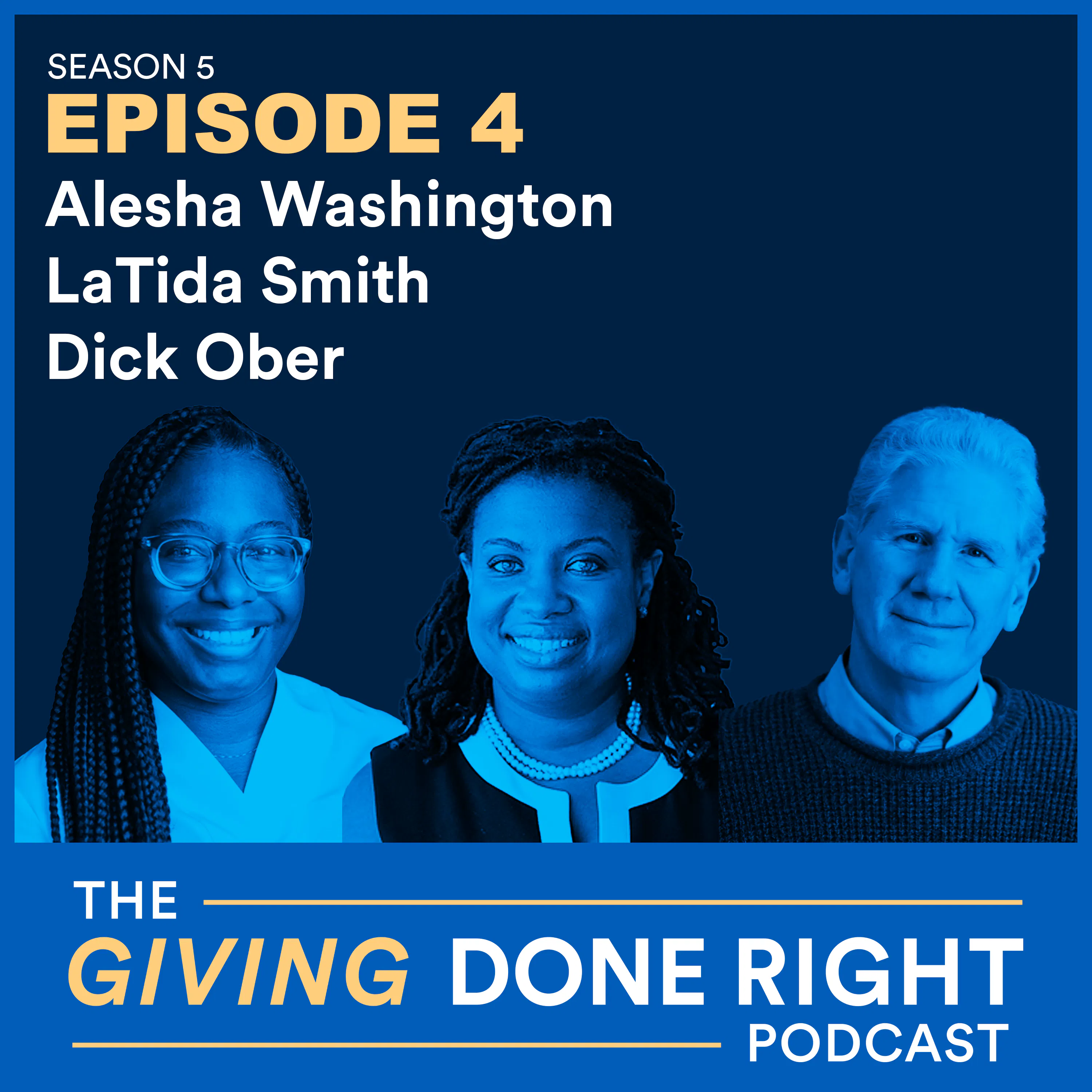
Loading summary
Transcript86 lines
- [00:02]
Alicia Washington
I think that's one of the many values of community philanthropy and the role of community foundations is that as place based institutions, we gain so much knowledge about what happens in our community and the types of organizations doing really important work.
- [00:19]
Grace Nicolette
Welcome to Giving Done Right. I'm Grace Nicolette.
- [00:23]
Phil Buchanan
And I'm Phil Buchanan.
- [00:26]
Grace Nicolette
Today our guests are Letita Smith, President of the Winston Salem Foundation, Alicia Washington, President and CEO of the Seattle foundation, and Dick Ober, President and CEO of the New Hampshire Charitable Foundation. We wanted to have three community foundation leaders for a roundtable discussion of sorts to explore the role and the work of community foundations. So welcome Letita, Alicia and Dick.
- [00:48]
Alicia Washington
Thank you.
- [00:49]
Letita Smith
Thank you.
- [00:50]
Dick Ober
Really good to be here.
- [00:52]
Phil Buchanan
So great to have you each here. And obviously you have long standing ties to Grace and to me and to the center for Effective Philanthropy. Dick was on the board of CEP for nine years and Alicia and Letita are current board members. And I can't wait to just get into all the juicy topics with you. But let's just start with the absolute basics. And I don't know which one of you wants to take this, but what is a community foundation and why does it even matter? Why should it matter to your average donor?
- [01:24]
Alicia Washington
I don't know, Dick. That question begs your answer, given you've been called on.
- [01:30]
Dick Ober
I've been called on. We like to think that community philanthropy is philanthropy of, by, and for the people of a specific place. And community foundations are created by the residents of a community to serve that community, however it's defined. In our case, it's the state of New Hampshire. Alicia's case, it's the city and surrounding area of Seattle. And Letitia's case, it's the Winston Salem area of North Carolina. And the, the other distinguishing factor that I always have to start with is we're not one fund. Community foundations are the democratization of philanthropy. In our case, I'm sure similar to Letita's and Alicia, we have well over 2,000 individual charitable funds. And that's the start of making this a democratization of philanthropy.
- [02:29]
Phil Buchanan
Dick, let's just stick with you for a minute on those funds. So these are then donor advised funds, aka DAFs that we're talking about.
- [02:37]
Dick Ober
Yes. And so in our case, we have several types of funds and we were founded more than 60 years ago. So DAFs are actually a more recent addition to our work. So we have funds that donors have set up, discretionary funds where they've said, the community foundation knows New Hampshire. You guys figure out what the best grant opportunities or in our case, scholarship opportunities are. Then we have a family of fund called field of interest funds where the donor says, I care mostly about kids, so you can make any grant you want as long as it supports opportunities for kids. We also have funds that are designated to specific nonprofits set up by a donor or by a non profit to fund that one nonprofit. And then we have donor advised funds where the donor sets up the fund, a completed gift, but they retain the right to recommend which nonprofits get grants out of those funds. And the mixing and the matching across those different fund types is one of the things that makes this work both complex and really exciting and interesting.
- [03:46]
Grace Nicolette
That's great. I mean, this is part of the reason we've been wanting to have you all on the show for a long time. Because I'm always so shocked by the number of donors that I talk to when I say, oh well, what about your local community foundation? And they're like, I don't know what that is. And so we've been wanting to sort of elevate the role of community foundations. I'm wondering, Alicia, if you could just kind of tell us a little bit about the work that Seattle foundation does. Does like what are some of the things that you all work on and how do you work with your donors?
- [04:17]
Alicia Washington
Yeah, it's a great question, Grace, and it kind of builds on how Dick, I think beautifully described the different ways that we can support a donor with the type of funds that they can have with us. And so we see our role in kind of two parts, but kind of centered in the North Star around fostering a joyful community of shared prosperity, belonging and justice. We do that through supporting our philanthropists that open funds with us around the ways that they want to contribute and give in the Seattle community, whether it's through the basic needs or childcare or healthcare issues that somehow have meaning to them and they want to support and invest in that. In community. We also think about as we look at what our donors do across the board, how do we help to complement or fill in the gap. And so if they want to invest deeply in programs and services that help people today, we think about the work that we can invest in with organizations that think about policy and systems change that support so many of us long term and into the future. And we try to stay in dialogue with our philanthropists and our donors around. Beyond your own personal interests in giving, what can we help you learn about our community more broadly? Areas where you never thought to give, but you might have interest to expand their Knowledge base of what it takes to get to that joyful community and really importantly, the role that they can play as a partner in driving towards that.
- [05:34]
Grace Nicolette
So it sounds like you all would be the partner for a donor who wants to give really thoughtfully to their community. Maybe they have a foundation that gives in other places or other causes outside of their community, but for their particular community, you all would be the main partner. Is that right?
- [05:53]
Alicia Washington
Yeah, that's right. I mean, I think that's one of the many values of community philanthropy and the role of community foundations is that as place based institutions, we gain so much knowledge about what happens in our community and the types of organizations doing really important work. And for donors, regardless of where they may be entering philanthropy for the first time, or even if they've been seasoned philanthropists investing for many, many years and now teaching their families and their children and their grandchildren how to be engaged, we are a place that they can come to as they're trying to deepen that knowledge. We help them do that based on the insights that we've gained and learned across a variety of issues and opportunities that we see every day.
- [06:33]
Grace Nicolette
Great. And Latita, I want to bring you in. I mean, like Alicia just said, being place based, you all are in a really unique position to respond to the needs of the. I'm curious, from your perspective, how is the current context of the cuts to the social safety net and also some threats to civil society, how has that changed your work and how are you educating donors in this context?
- [06:55]
Letita Smith
It's really been a challenging year. We have seen so many new policies and shifts in funding that are impacting every aspect of the work that we care about and that our donors value, from health care to education, housing, and food security. And so thinking about how to help our donors understand how these shifts that are happening in Washington and for us in the state of North Carolina are impacting nonprofits, but more important, how it's impacting their neighbors. It's really been a responsibility for us to help them understand what these changes mean, what they can anticipate seeing most immediately, and what we anticipate happening down the road as some of the broad changes to issues like Medicaid or to SNAP are going to have rolling effects in our community over time. And so we have where we bring together groups of donors so that they might learn about these issues, so they might connect with local nonprofits who are doing important work in our community, and so they can cut through a lot of the noise that they hear on the evening news or that they might read in the newspaper and really understand how these changes are affecting everyday people in our community, and not only how they're impacting them, but also how we can work together in ways that philanthropy can be particularly helpful to help meet some of these challenges and also help families prepare for the future.
- [08:23]
Phil Buchanan
So it's such a challenging time because of these cuts, obviously, and the climate that we're in. And one of the things that I've noticed is a hesitation among some in institutional philanthropy to speak up about what's going on for fear of being seen in some way as partisan. Community foundations are public charities, so they have a little bit more freedom than private foundation. But we're all nonpartisan at the same time, it seems essential to speak up about what's happening when the fabric of our safety net and other basic sort of tenets of our functioning society seem to be under some threat. But here you are. And Letita, let's just stick with you. You're in North Carolina, you've got a diverse set of donors, I am sure. Like, how do you navigate that and how hard is that?
- [09:25]
Letita Smith
Well, we really consider one of the special privileges of being a community foundation is that we are seen as a trusted institution for members across our community. We are seen as an institution dedicated to helping all of Winston Salem thrive, regardless of political, affiliat or individual perspectives. And so that for us is even more of a reason why we feel the importance of talking about what it means to be in a community where everyone can thrive today. And so I get it. I mean, we would not want to do anything that would compromise our ability to be seen as an institution that values diverse perspectives in our community. We consider that our strength. But at the same time, we still believe that community, that everyone thriving our bipartisan issues. And so we are relentless in our commitment to standing behind those core values.
- [10:20]
Phil Buchanan
I just want to stick on this theme for a second and ask the question whether that means sometimes you have to be prepared to say we don't actually want certain kinds of donors. So I'm thinking, for example, of the fact that, Dick, you have spoken out about trans young people in New Hampshire and about legislation that you thought would put them at some level of risk. As you weighed whether to do that, I imagine you knew that there might be some donors. Maybe I'm wrong. Tell me if I am, who would walk away after they read what you wrote or heard what you said about this issue? So how do you think about those sort of trade offs? And am I right that at the End of the day, you're not trying to have the opportunity to work with everyone. You're looking to work with values aligned, donors. Is that accurate?
- [11:18]
Dick Ober
I wouldn't put it quite like that. I really love what Alicia said. You know, we were founded in 1962, and we have been absolutely clear to our purpose as a foundation since then. It's always been about making our community a place where everyone can thrive and defining who can't thrive and why and doing what we can to fill those gaps and to lower those obstacles. That I think is really a shared perspective. So we will often open a conversation with people who is not able to thrive in your community, define that community however you want, your community of interest, your geographic community. Everyone we talk to might name someone. They might name someone different in our state. They might name deeply poor people living in rural parts of the state, or new immigrants and refugees living in more urban parts of the state, or LGBTQ members of their family or their community. Everyone has an answer to that. And because we support 2000 unique nonprofits a year, the chances are we're supporting a nonprofit and they want to support a non profit that they can find a really good purpose around. We believe we haven't changed. The dialogue has changed. So you can say, people say, oh, philanthropy is shifting left, or you're shifting left. We say, no, the dialogue has shifted. I won't even say right. The dialogue has shifted to a place that still the majority of people in our state really don't understand or support. So we have stayed true. And just because there are certain words and principles and themes that have been so politicized, we're just not going to fall into that trap. We're true to our purpose. We believe in data, and we believe in telling really compelling stories to generous people about how they can join our common purpose to make this data more just and more sustainable and. And a more vibrant community.
- [13:26]
Alicia Washington
You know, I just. I have to add to that, Dick, I love the way that you framed it. I mean, as community foundations, we work really hard to kind of exist in the tensions that are. That live in our communities, right? We sit between sectors, government, the business sector, what individual donors are doing, what nonprofits are doing. And we are structured in such a way that we are skilled at how to hold those tensions. Because while we want to create a big tent for people to join us in advancing our mission, we cannot be all things to everyone. And we may not be everybody's slice of pie, right? But folks may find other entities where they want to host their funds to do their philanthropy. And it may not be us, and that's okay. And the beauty of community is that we don't all agree all the time. And so of course we're going to experience that within the universe where we sit as community foundations, that our missions and our vision guide our work. Not everyone will be in agreement all the time about that. But as long as we are focused on our North Star and understand how to have the kind of dialogues that lead to healthy compromise and ways to think about the ways that we move forward together, then that is progress for us at the end of the day. But being all things to everyone, there's no business or brand that can do that. But having clear values and mission that guide you, folks that want to be on that journey will find you.
- [14:46]
Phil Buchanan
Yeah, and I think that's what I was trying to get at is that you can't be everybody's slice of pie. And I would just say I've been in a boardroom of a community foundation in which I ended up in an argument with the CEO about exactly this question where the CEO literally said, we have to be all things to all people. And I'm like, well, then aren't you nothing to no one, right? Like, institutions have to stand for something, and donors should look for the right institution that connects to their own priorities and principles when it comes to giving.
- [15:21]
Grace Nicolette
Can I ask a question about that? Like, specifically, how would a donor ascertain whether or not their community foundation is a good fit?
- [15:29]
Dick Ober
I'm happy to answer that, Grace, in one way at least. And I want to go back and really specifically answer Phil's question. There are times when, after a conversation, we absolutely know that our foundation is not the right philanthropic partner for a certain donor for all sorts of reasons. And that's fine. We have a very clear policy that we will not make grants to organizations that we discover to be practicing exclusion, discrimination, or hate in any way. Not only organizations that are on known lists, but based on our own due diligence that we feel they are contrary to our purpose as a foundation. So that covers all of our grant sources. Obviously, our discretionary application grants, that's easier. But we have had to decline recommended grants from current holders of donor advised funds to say, we can't make that grant. And here's why it opens up. They're not easy conversations, but it opens up really great dialogue. And a few times when the donor has said, these are the kind of organizations I'd like to support, we have counseled them to another opportunity for their philanthropy instead of working with us. But it's all based on a lot of dialogue and sharing of ideas and perspectives.
- [16:52]
Grace Nicolette
So they could, like, reach out basically and say, hey, I'd love to just have a chat and see whether our values are aligned and whether your community foundation is a great fit for the kind of giving that I'd like to do. That's very interesting. Tell us more about, like, the work that you all do in communities. Like, how do you come to understand what the needs are in the community? Is it people are always going out there talking to people. You're going to events? Like, those are things that I imagine, but I've actually never had the chance to ask, like, what exactly do you do to make sure you're kind of fully understanding the full picture of both the needs? But also, like the nonprofits in the.
- [17:30]
Letita Smith
Community, it's really important to us to have staff members who are deeply involved in doing the work and advancing our community priorities. So equity in education is a priority for us. So is economic mobility. And so as our nonprofit partners, our public sector partners are working together to shape our school district and determine its policies. As they are working to set an agenda for the community around affordable housing, Our team members are working right alongside of them. Sometimes there are efforts that we lead, Sometimes there are efforts that we support. Sometimes we are just in the room so that we can continue to be aware of the work that is happening. But in all of those ways, we consider ourselves to be an integral partner in the work that matters most to our community. And sometimes we're just out there listening and learning so that we might see what is emerging as a new opportunity or a new area of concern for our partners. And so I think that it requires that we work really nimbly in a variety of ways to really keep a pulse on where activity is happening across our community so that we can be knowledgeable, so that we can share that information, but also so that we can bring the foundation's resources to help community partners do this work together.
- [18:48]
Grace Nicolette
Your comment, the room where it happens just reminds me of. Well, it's from Hamilton and also just reminds me of how I recall that in some cities or even some states, the head of the community foundation is listed usually in Those, the top 50 power players of this city. And sometimes they're listed way up there. I mean, even in one case, even higher than the mayor. And it's interesting to me that a civil society player could actually have that role in a community. I think that's really remarkable.
- [19:19]
Alicia Washington
Yeah, I mean, there's so much of what we learn about different issues in our community comes from the fact that we get to sit in spaces with our mayors and our county executives or whatever form of government may have our business leaders and others to not only learn together, but also be proactive about the ways that we want to collaborate on investing in things that happen in our community. Right. It's the fact that our institutions have been around for a while that means that we've amassed a lot of data and understanding the world, we've moved grants over time, whether through our discretionary dollars or through what our donors have done over time, that we can really start to piece and understand big issues, big opportunities, key data that may drive trends. And that's information that we then get to offer to our public sector partners and others. As we're thinking about how do we address our housing needs, how do we address our childcare needs, how do we address transit needs in our community or community development, we get to be a part of bringing all of that information to bear. And so I think for donors that work with us, there is a confidence in not only our community knowledge that we can help them deepen, but also the way that they get to see us show up more broadly in community and have some excitement around the fact that they are a partner to an institution that is doing so much to help our communities advance.
- [20:32]
Phil Buchanan
Let's stick on this issue of community impact, because that's what it's all about. And you know, I might have to time limit the responses on this because you probably could each talk for half an hour just answering this one question. But if you had to pick today, as we're having this conversation, one thing you're proud of, that the community foundation contributed to. I'm not saying you did it alone, because I'm sure it's always more complicated than that. It's always a variety of players. But one thing in your community that your foundation serves that you feel like is good or is getting better, that the community foundation played a role in. Can you each give us one?
- [21:17]
Letita Smith
The first thing that pops to my mind is we are right now in the process of establishing a housing fund, a fund for the development of affordable housing. This is not something novel. It exists in a number of other communities. But it's something that our community has been wanting to do for some time. So it's been on the mayor's agenda. It's come up in a number of strategic plans. It's something that our county needs to have as part of its solution to affordable housing. And yet, for some time, we hadn't moved from the idea of it to really putting into practice what it could look like in our community. And so, for our foundation, that just meant getting the right people in the room to begin imagining what this was actually gonna look like, so that it would move from being just an idea on paper to really being a living, breathing initiative that we could all contribute to. And I think that having us at that table, bringing together a wide variety of partners, both the folks you would expect as well as others who were unusual suspects, but also committing to getting to a solution that we could all live with, is an example of, I think, the unique contribution that we can make to a community. And it's something that we're doing right now. And what makes me excited about it is that it helps our partners to see that we know very well what's happening at a federal level and the significant, significant challenges that we are facing. And yet there is still so much that is possible at a local level, and that has been inspiring for our partners.
- [22:49]
Phil Buchanan
That's great, Letita. Thank you. Yeah.
- [22:51]
Letita Smith
And.
- [22:51]
Phil Buchanan
And I find myself hungry for those local examples right now, because I think we need to see that good things are still happening in community on important issues. Alicia Dick, do you have examples? Yeah.
- [23:04]
Alicia Washington
I mean, what comes to mind for me, an important approach that Seattle foundation has had for a while now is what are the ways that we can invest to unlock public sector resources? Right. Because for every grant that we can make into a program, an organization that does some good, that's great. Right. But if we can unlock more public resources, we can reach more people at scale and advance change at a greater scale. And so, since 2016, the foundation has had a concerted effort to really think about the ways that either through board endorsement, particular issues, and levies, or through the way that we invest in nonprofits that are pushing around advocacy and education, what are the accomplishments that we then see in terms of public sector dollars inflowing into our community? And over time, we've been able to help unlock $5 billion of resources within the Seattle region through our city's housing levy, through our Best Starts for Kids levy that supports childcare and a variety of other needs, through protecting our Climate Commitment act at the state level that unlocks resources for our ferries and our public transportation. And so the ability to use our civic voice and influence and kind of modest discretionary resources and donor education unlocks so much for our community above and beyond just any one grant that we can make and that's something that we feel really good about.
- [24:21]
Phil Buchanan
Thanks, Alicia. Dick, what would you choose?
- [24:23]
Dick Ober
Oh, I'm going to try to almost combine what Letita and Alicia said. Hard to choose, but the piece of work we've had, the longest period of time to deeply invest in is around mental health and substance use disorders. And this actually started with a donor who came to us in the late 1990s and said, of all the challenges in the community, this is the one that bothers me most. If I set up a fund, significant fund with you, how might you approach it? And what we did at the time was rather than having yet another fund to fund direct service, as critical as that was for prevention, treatment and recovery of substance use disorders and mental health, we actually built a long term public private strategy around it, including founding an organization that in turn does grassroots organizing to bring the voices of people who suffer from these diseases and these conditions into the public policy networks and the public policy setting. This is a really good example where we are far more than a grant maker. We think of the grants as one type of capital. It's usually not the most important. The other types of capital we have to bring to this is social capital, the relationships and the trust that we've built over decades with nonprofits, with the public sector, with donors. And then the third is our political capital. We're a big foundation in a small place. We've been engaging in public policy for a long time. We've earned a lot of political capital and we invest it. So in this case, for example, we have a content expert on our staff who's worked in this space for 20 years, and she serves on two public commissions that influence where public dollars go most effectively. We often will make a grant to something we think is innovative and a new solution or a new way to address these problems, prove it works or doesn't work, frankly, and then asked state government, as Alicia just said so well, to bring it to scale by putting the real money in, which is always going to be public dollars. So that's an area where we constantly calibrate, which of those types of capital do we invest and how for long term change. While New Hampshire was one of the first states in the country to see the rise of opioid abuse and especially fentanyl, we were number one in the country for a while in deaths. We've brought that down substantially because there's a common vision across state government, across the provider networks, across, across philanthropists. We have a common plan, we have a common priority, and we're at the table. As Latita said on housing, we're at the table to help develop those long term solutions.
- [27:28]
Phil Buchanan
Stick with us. We'll be right back.
- [27:41]
Letita Smith
Looking to give with impact Guides to.
- [27:43]
Alicia Washington
Good By Giving Compass is your guide to making smarter, more meaningful donations. Discover trusted nonprofits, timely causes and data driven insights all in one place. Start transforming your generosity today@givingcompass.org.
- [27:58]
Grace Nicolette
You each have described sort of very thoughtful collective action that as a community foundation you identified and you moved on because you saw that there was a lot of leverage and a lot of opportunity for change. Now a donor may ask, so does that happen by me putting the money in a donor advised fund or is that only when I actually have given to one of your community funds? And maybe this gets into like even Dick, you were saying grants that donors recommend, right? Versus like grants that donors are making because actually you all then control the funds right once a gift is made. And so can you parse that a little bit for us? So if folks just want to have a donor advised fund that they designate funds to, that they have their priorities versus the folks who really want to participate in this like large scale change that you're describing, how do you meet each of those folks?
- [28:52]
Dick Ober
As Latita and Lisha know, we talk a lot about these creative tensions that define community philanthropy because we're not just a funder, we're not just a community player, we're not just a convener, we're not just an advocate. We do all those things. And going back to something you asked earlier, Grace, you know, donors don't know about community foundations. I can't tell you the number of times a donor finds us and said, oh, I set up a private foundation. I didn't know the kind of work that you all do. So when donors come to us and they realize we, we have 40 or 50 staff, including 20 staff in our community impact department who are out in the community vetting nonprofits, listening to ideas like I have suddenly a staff of 50 people if I set up my fund here. But to your question, one of the tensions we work in is individual service to a donor who has their own interests and wants to recommend grants out of their donor advised fund for what they care about most. And we can do that up through people who say you're working on housing. Letita, I'd like to recommend grants from my donor advised fund to complement the grants you're making out of your discretionary fund and kind of everything in between. So it can be very hyper individualized philanthropic advice. To a donor trying to achieve their objectives up through long term strategic collective action. The kind of work that Latita and Alicia were just talking about.
- [30:21]
Letita Smith
And often the same donor will change their approach over time. And we find that all the time. And so to some degree, we have a responsibility to make sure that all of our donors know the array of services that we provide and the varying ways that they can work with the foundation. Just last fall, there was a flood in western North Carolina. And so we had a number of donors who might have always been a. A donor who supported their alma mater or had an interest in education, who were really interested in that moment in responding collectively and pooling resources together for a fund to support Western North Carolina. We may never see that donor do another collaborative engagement, but at that moment, the opportunity was ripe and it was something that really met their interest. And so we recognize that individuals will come in and out of those approaches, and sometimes they will continue to have a singular way in which they are committed to working with the foundation. We try to stay open to opportunities, recognizing that different donors have varying appetites for engagement with the foundation.
- [31:25]
Alicia Washington
I think that's another strength of what we do as community foundations, but really just offering sophisticated advisory services for folks that are inclined to be philanthropically engaged in community. So plus one on everything Letita and Dick said, and in our environment, sometimes it's not somebody with a fund that is actually wanting to join us in that work. Right. It could just be a philanthropist or a donor in community that sees the work that we do from a community impact standpoint and contributes to our overall discretionary grant making to help drive that forward. And they may never set up a fund with us to do their own personal philanthropy, or they just want expertise and consulting services around how they build an effective grant making strategy. But their money sits somewhere else. And so I think that spectrum and sophistication of services that we offer to our fundholder base as well as those that are all around us in community. It's kind of the organic part of what community foundations do. And as we think about what does it mean for these entities to have a life that's effective in community for another hundred years? It's the ways in which we continue to upskill our business, so to speak, to be responsive in that way.
- [32:36]
Grace Nicolette
I've also heard that you all are a great source. If a donor has things that are actually a little bit hard to liquidate. So like art or boats or houses, that's a really great way to give back too, because you all have a way of valuing those assets and then liquidating them that they might have trouble doing themselves. I'm curious, what's the most kind of fun liquid asset that your community foundation has had to work with?
- [33:03]
Alicia Washington
I mean, we just supported auctioning off a really fancy sports car that I was kind of bummed we didn't get an opportunity to test drive before it went to auction.
- [33:12]
Phil Buchanan
I think you really needed to do that. Like, you needed to make sure that it was.
- [33:17]
Alicia Washington
Nobody was taking me up on it. Right, right. But that's probably the most extreme beyond just kind of the complex real estate investment sometimes that we get brought into.
- [33:28]
Letita Smith
And we had a donor, I think, about a year ago who had some rare pieces of jade that they were looking to have auctioned off. And I remember the moment in which they were planning to bring them to the office, and we were trying to figure out where we were going to put them. And it was quite a debacle figuring it out, but it was really exciting for us. We hold over a hundred endowments for individual nonprofits, and a big part of that work is helping nonprofits receive gifts they couldn't otherwise receive.
- [33:55]
Dick Ober
I guess ours would be not necessarily the most fun, but the most impactful. We are still in the process of winding down a company that was given to us in 2013.
- [34:07]
Alicia Washington
Wow.
- [34:08]
Dick Ober
To fund a specific charitable fund that supports the most rural part of our state. And they had interests and holdings all over the world, actually. And so as that company has been winding down, it's very complicated. They wanted to convert that company to philanthropy, so we stepped in as their partner. As it winds down, those assets come to us. They are then distributed into the community. And this might take us to a different part of the conversation where there is a committee of residents that make all the decisions about those funds. So when I meant the democratization of philanthropy. When we look at the grants we make every year, we realize they are the collective decisions of literally thousands of people. The people who set up the funds in the first place. The nonprofits, obviously, who bring fantastic ideas to us or that we learn about as we're out into the community. Obviously our staff and our board. But we also have dozens of scholarship and grant committees made up of regular old residents throughout New Hampshire to whom we have delegated the decision making on these funds because they know the ground best. And that particular fund, it's our single largest fund. Our board, our staff, doesn't make decision on those grants. People who live in those rural communities make the decisions closest to the challenges closest to the solutions.
- [35:38]
Phil Buchanan
Let me challenge you a bit on the democratization argument and maybe channel the critics or the cynics and I won't necessarily say if I'm either. But just to say, if we look back 25 years, household rates of giving like 2/3 according to giving USA study in conjunction I think with the University of Michigan on the self reported behaviors of households, it's now well under 50%. There's been massive growth in donor advised funds, but that has been particularly true at commercial providers and there are many who argue that the funds aren't getting out the door quickly enough. Tax policy obviously has a role here. There was a decrease in the number of itemizers because of tax policy change and now as I understand it, in the most recently passed legislation this summer, there is the potential that there's some increase in charitable giving because of a non itemizer deduction, but then some concern about some changes at the high end in terms of the value of the deduction. So there's a lot going on in terms of just the macro trends. And you've each told a great and compelling story about the role that community foundations play in driving change within communities. But the bigger picture of giving and civic participation in this country is not so great. And I wonder if you could sort of speak to that and maybe your thought about some of the critiques or how we turn those trends around?
- [37:25]
Alicia Washington
Yeah, I mean, we're in a really challenging time right now as a society, I think, as you alluded to kind of earlier on, Phil, as we consider all of the macro trends that we're facing. But it's the exact kind of moment where I think institutions like ours get to play a really pivotal role in thinking about what our future looks like across society. Right. And so yes, are there all kinds of tax implications and considerations in the coming years around how people give? Of course. I think the opportunity for us within community is the way that we continue to create more avenues for people, whether they open to fund with us or not, to find ways to be engaged and given locally. Because I think at the local level what continues to hold is a sense of community and how we care for each other. Yes, there are going to be differences across the fray, there are going to be debates and arguments. But when we start to think more local than macro, you still have a sense of I know my neighbors, I may not always agree with them, but I know them Right. And there's some level of respect that is there. We are proximate to the issues that are in front of us. And so what do we do? Right. One of the biggest pieces of feedback that we hear from our donors right now is just like, what do we do right now? Like, how do we show up? How do we engage? Right. And so while the macro trend around how we engage civically as a society is challenging, our power is at the local level and the ways in which we still give people avenues and ways to do that from a giving standpoint, I mean, I think a number of us are experiencing the kind of the macro trend around as people give resources, are they replenishing their funds? Is market performance starting to make them shy away from what does it mean to release more of my dollars? That, again, is our opportunity around continued education and support to folks to still think about the small ways that they can have impact, Even if it doesn't feel like their one grant is going to make an overall difference in what is playing out. It does. And so how do we help people see that and move that giving circles for individuals that may not feel like they have $150,000 to open a fund. Right. But can join with others in community through relationship to still move resources in thoughtful ways. And so I hear you on the challenges that we're facing, and I am by no means dismissive of them as we think about the attacks that have come on the nonprofit sector and what so many of us are bracing for. But what I've not lost hope in is the power of local and the power of place and the hope that people still have. And what does it mean to have strong communities and the pivotal role that we need to play as community foundations to help people find their entry point, regardless of their income, regardless. Right. Of their wealth and how they show up to still make change, at least in Seattle.
- [40:06]
Letita Smith
Yeah, I couldn't agree more with what Alicia just said. And I think that the opportunity that we've seen is to continue to bring more people in our community into philanthropy and to help them see the Winston Salem foundation as a true partner. And so we just a couple of years ago, did a campaign for our black philanthropy initiative, and we saw the number of participants who were contributing to that fund increased by fivefold. We are continuing to do outreach, expanding our women's fund. We also have a youth grant makers program where we look to get high school students engaged in philanthropy for youth serving programs. And so we recognize the macro trends. And we also know that the number of donors are shrinking and wealth is being more concentrated among smaller numbers of donors than there may have been in the Past. However, we see continued opportunity for people in our community who have always given to their church, to their neighbors, to the organizations that they vet, to see the community foundation as being a partner in that. And that is an area where we are continuing to grow.
- [41:14]
Alicia Washington
I think the three of us have experienced what it means to always be conflated with what's happening in the commercial donor advised fund business. Right. We are not the same thing. Right. And so I think I have a lot of respect for the push and dick campaigns around people spending down their daps and spending dollars faster to ensure that they're not just being held up in assets that are someone's tax benefit, but not actually moving into community. By and large, there's a different story in community foundations. Like, I don't know about you too, but I know for us, on average, our funds are spending down over the course of four or five years and they're replenishing and then putting more money back out into community. And so from a community foundation standpoint, our goal is to move money as fast as possible right within to our communities and our donor behavior aligns with that trend. Versus someone opens a fund and then sits on it for 20 years just to kind of collect it, but isn't actually doing any good with it.
- [42:09]
Grace Nicolette
On that note, how do you then incentivize donors to spend down their desk? Because the critics will say you may be conflicted because you know you're getting a percentage off of assets under management. Are you really incentivized to move the funds? Obviously from a community impact perspective, I could see why the incentives are aligned there. But can you say more about why they move the money faster when working with a community foundation?
- [42:33]
Alicia Washington
I would love for my colleagues to jump in on this, but a big part of it for me is really the donor education that goes along with someone that opens a fund with us. Right. To really stay in a conversation with folks around their giving priorities and interests, broader community priorities and opportunities, and making giving plans with someone over the course of a year to encourage them to hit the goals that they set for themselves around giving over time and to always stay attuned to. All right, so you set up a hundred thousand dollar fund, we're going to spend the bulk of it down by X period. What are your thoughts on your next wave of philanthropy if you choose to go that route? So that causes the replenishment of the fund to continue to do work with folks, but that really intentional donor education and advising plays a big part in helping someone know how to Move their resources. But Dick, you know, you've done, you are like my hero in this space for the work that you've done around. Not just the donor education, but really tracking across your funds to ensure that people are active. Right. And having ways to engage them if they're not.
- [43:36]
Dick Ober
Yeah, thanks for that. And boy, between the two of you, you just answered Phil's question in such a thoughtful and contextual way. I just, I just loved hearing that. When it comes to specific policies on donor advised funds, for example, we and most community foundations have really tough policies on inactive funds. So the beauty of a donor advised fund is some donors put money in every year or every five years, they grant it out. So they put 100,000, they're going to grant it out in three years. That's a 33% payout rate. Then they're going to put another 100,000 others. This is the tension about today and tomorrow. We are set as an institution to address challenges today and have a perpetual source of philanthropic capital. Not only money, social, political as well for tomorrow. So some donors actually do want their funds to be perpetual and to make grants every single year and ideally to continue to have that kind of impact for the future as well. But if a fund has not made a grant in a year or two, we call the donors and we say, you got to make a grant. You can't have an inactive fund. And it's usually they forgot. These aren't people who are consciously trying to warehouse money. I also, on a broader point, and Phil, you and I have had a chance to talk about this in the past. I'm just curious why with so many forms of endowed giving in this country and endowed policies, most universities and hospitals, they're going to distribute four, 4.5% a year. Guess who decides that? Eight or ten trustees, community foundations on average. I think our distribution rate out of donor advised funds might be 15, 16% on average. Across community foundations, it's something like that. And those decisions are made by lots and lots of people. You have community foundation staff calling the donors and say, huge need, you might want to increase your spending right now. So I think there are some things about donor advised funds that could be fixed with thoughtful practice and policy changes going forward. But I think it's curious how much attention there's been on this vehicle versus the larger endowed giving when there is nowhere near either the payout rate or the engagement, especially in community foundations.
- [46:01]
Phil Buchanan
Yeah, it's funny how some of the most vocal critics are in fact employed at endowed universities that spend A very low percentage of their endowment. So I have asked them just to have fun, you know, whether that critique applies to their own institutions. And I don't usually get a straight answer. And just to put my cards on the table, I'm a huge fan of community foundations. I think community foundations are vital and underappreciated. And, and I think to the point Alicia made earlier, we perhaps see it at moments of crisis, most of all, when community foundations step up in just unbelievable ways. Natural disasters, the pandemic, and are that bridge between folks who want to make a difference and folks doing vital work. I want to talk a little bit more about the latter part of that, though, the folks doing the vital work at nonprofits because. And you all know this because I've subjected you to my rants over the years. I think we underappreciate staff at nonprofits, especially the frontline community health organizations, the food pantries, the environmental organizations, but just in general, that these organizations are a crucial part of what holds our society together. And I wonder, and maybe we can start with you on this one, Letita, like how you think institutionally about supporting organizations to be most effective. Like, what is your philosophy when it comes to making sure that staff and leaders of these organizations have what they need to do their work?
- [47:39]
Letita Smith
I think that it's so critical and especially today in this moment, when so many of our partners are already stretched and just really considering big cuts ahead, big challenges, sometimes to their own safety, of their institutions, of their staff enough. It's something that's really been top of mind for us. And so the most important thing that we do is try and stay proximate and hear directly from our partners about what they would value most in the moment. It means being really nimble right now with our capacity building support. So being available to provide legal assistance, being available to provide communications assistance or assistance with technology and a range of differing needs that partners are identifying at that time and making sure that we're giving in ways and making resources available in ways that can really be flexible to support our partners, working to do more general operating support so that we can give our partners the resources to make those choices themselves as they see fit, and in really encouraging our donors to do the same. And then we try to think about, you know, what are some needs that we see happening across nonprofit partners so that we might be able to provide collective support. So early on, we provided just some policy analysis because we recognize that we as a staff have a whole lot of time to participate on webinars and read about what's happening at a federal or state level and understand how it impacts our work. But our partners are on the ground doing the work and they don't have that luxury. And so we've worked really hard to bring those resources to them. We have a program coming up later this month where we're helping them talk about how to do effective case making and how they talk to donors and help to make a compelling argument for their work in this really challenging time. So I think it's a range of thinking about how we support and continue to be available for individual organizations and the vast diversity of needs that are going to arise continually and then how we think of at scale providing support for our partners in ways that we can better cover a broader array of organizations.
- [49:52]
Dick Ober
We too the vast majority of our discretionary grants are multi year general operating and also back to the conversation about donor advised funds. The vast majority of our donor advised funds are general operating support. It's relatively rare a donor advised fund holder will recommend a grant for a specific project. And while they're not designed as multi year, these grants often are made every year to these organizations. And it is. That's just the lifeblood. To answer Phil's question, there's something that our team did recently that I'm just so excited about. Based on our outreach to scores of nonprofits, especially those serving the most vulnerable people in our community, and conversation with our local New Hampshire center for Nonprofits, the number one challenge we heard was mental health of frontline nonprofit staff. So we've actually just launched a partnership. We have a really good employee assistance program for our foundation staff. We're now making that available to any non profit in the state with fewer than 10 employees. So those folks who usually can't afford to have that kind of a benefit will have access to mental health counseling, to legal advice, to all sorts of things that our EAP provides for our team. I was thinking people are going to talk about the funding cuts which are real. They're going to talk about the political environment which is very, very challenging. They're going to talk about housing, they talked about all those things. The number one common thread was mental health of their staff.
- [51:32]
Alicia Washington
Such an important point. And both of you raised Letita Dick in your comments. I think is a creative approach that all of philanthropy quite frankly needs to be practicing. But I think as community foundations, and I think especially in our case, given that we have limited discretionary dollars compared to what our donor advised funds move out on an annual basis. What are the other Types of support that we can bring in this moment, especially now, to nonprofits that's above and beyond the money. Right. So we did a survey of our grantee partners that we moved discretionary resources to late last year to get a sense of what needs were that people were starting to see. And then again earlier this year. And money was not the top of the list, similar to kind of what Dick articulated in his setting. It was the support around legal education, risk assessment, technical assistance across operational needs, and really a concern elevating around staff burnout. And what was going to happen to teams that that have put significant work in through advocacy and education and voter turnout around an election. And now we're turning it around to face even harder challenges and never had a chance to breast or breathe through any of that. And so we launched a care and response fund at the start of the year in partnership with United Way to move resources to organizations to support health and well being. We announced that fund at the beginning of the week. By the end of the week, we had like over 80 applications. Right. And we know we're going to run out of the money and we'll have have to get donors to try to help us re up to do it again. But in addition to that, we went through a major enterprise risk management process for the foundation, as many of our peers have done across the country, to try to figure out how do we gird up our institutions in this time. We asked the same consultant to do workshops for our grantees so they would have access to the same types of resources that we just paid for ourselves to go through as an entity to be prepared for. Right. And so that's the meaning of the moment right now. That's more than the dollars. How are you showing up to bolster all the other supports that institutions need right now that they either don't have the space to think for themselves to do it or the resources to do it themselves.
- [53:31]
Phil Buchanan
And we'll put our State of Nonprofits research in the show notes. Three years in a row, the three years that we have done that survey burnout is just a huge issue and headline for nonprofit leaders concerned about their own burnout and the burnout of their staff.
- [53:48]
Grace Nicolette
I'm really curious. I mean, a lot of ink has been spilled about alternative ways that especially young people are giving, like mutual aid networks and particularly like GoFundMe. And GoFundMe recently announced that they're launching a giving fund, which is kind of a version of a daf. And you know, their aim is they want to Teach everyday donors to disperse money quickly, all of that. How do you all view that development? Is that a positive opportunity to raise awareness for DAFs and ultimately maybe community foundations? Or is that competition?
- [54:21]
Alicia Washington
I come from a mindset, and I think the three of us have involved in conversations over the last several years with each other where there's a recognition that community foundations are at this inflection point. Right. The world has changed and will continue to change, and the ways that people want to engage philanthropically will continue to evolve. And so how do we, as individual institutions, evolve in such a way that we're able to continue to be a strong partner to those that want to engage and give back in their communities and not some outdated version of what their grandparents used to do, but it's not responsive to where they want to go. I tend to lean more towards openness around the disruptions that we're seeing in the marketplace and technology, around new ways to support giving through innovative tools and technology. I think it's the kind of thing that we have to open ourselves up to as institutions think about the things that we innovate and create ourselves or in partnership with other entities, because that is the wave of the future. And it's our responsibility to be able to offer the types of tools and support that allow people to show up and move resources in thoughtful and meaningful ways. And so donor advised funds was the first big market disruption. Right. That many of us faced in the 90s. Right. As we move beyond just kind of our endowed structures to finding ways to get people to open funds with us as their place to do their giving, technology and AI is going to be a whole other boom that we're experiencing now. The way that you bring down the wall between organization and donor and create more connecting points through technology for them. I mean, there's so much on the horizon. And so I tend to not want to be territorial about those things. And I actually want to fully open myself up to embracing what that means for the way that our entities can evolve?
- [56:02]
Grace Nicolette
I see both Latita and Dick nodding.
- [56:04]
Letita Smith
Yeah, I absolutely agree. Because ultimately our mission is to create a community where everyone is thriving. And so we welcome all forms of philanthropy and community engagement that move us toward that mission. I mean, and we recognize the challenges that some of these new approaches can bring to our traditional ways of operating. But as we strive to be a resource to our community, it's more than just the dollars that come through our door. It's a matter of our ability to have influence and to help shape building the Kind of community where we believe everyone can thrive. And so we recognize that it's not just through working directly with the foundation, but through being a partner in the work that happens in the community. And we can do that in a variety of ways.
- [56:48]
Phil Buchanan
I channeled the critic earlier, then came out as a big fan of community foundations. And I know and Grace knows a lot of community foundation presidents and a lot of private foundation presidents. And of course, Letita, you've been both. I happen to think, think being a community foundation president is way harder because you're in the middle, you're fundraising, you got to do a lot of stuff that private foundation presidents don't. And I remember early on when I met you, Dick, we went for a walk and we were walking to lunch from your office in Concord, New Hampshire, and you said something along the lines of like, I'm the luckiest person in the state of New Hampshire that I get to do this job. And I know the three of you well enough to know you're all very aware of your own privilege to do this work.
- [57:31]
Alicia Washington
Work.
- [57:32]
Phil Buchanan
But it's also a hard, hard job. It's a tiring job. You're under a lot of pressure all the time. And we talked about burnout for non profit leaders. And I'm sure it's something that, that each of you in your own way has had to combat, particularly in this time, this really challenging time. And I'm talking not just about this year, I guess as we close out here, I'd love to hear from each of you, like, what keeps you, you motivated, or where do you get your strength and inspiration to put all you put into the work that you do.
- [58:07]
Dick Ober
This is not just because Letita and Alicia are on this call, but I am constantly energized and inspired by younger people that I get to meet with all the time that's in my staff, that's in the community running nonprofits. The emergence of a next generation of community foundation leaders truly inspires me all the time. Because this conversation would have been very different when I joined this field 15 years ago. We would have been talking about application grants and sitting back and waiting for nonprofits to prove that they deserve our money. And we are going to dole it out a little at a time. It is an entirely different conversation. Conversation. And though this isn't a direct answer, and I don't think Alicia will mind, Alicia at a meeting a couple of years ago said Seattle foundation is a social change organization that happens to make grants as part of what it does. And in all the conversations we've had about the evolution of the community foundation model into being active participants in civic life, she encapsulated that so well. So, you know, I have all sorts of things I try to do to keep myself, you know, healthy and well and all that stuff, but this field is adapting fast to the realities on the ground, and I see it every day with this incredible staff and board that I get to work with, and I see it with leaders that I've had the incredible honor to get to know, like Alicia and Latita in our field.
- [59:43]
Phil Buchanan
Very nice.
- [59:43]
Alicia Washington
Thanks, Dick. Well, stuff like, I mean, moments like that, I think is a part of what helps me keep going. Right. Because I think, Phil, you captured it well. Like, these are not the foundation jobs of yesteryear by any stretch of the imagination. Right. Like, these are hard jobs. And I think, particularly as a woman of color, as a black woman leading an institution of this magnitude, like, it is even that much more complicated and complex because of all the different types of targets that could be on my back at this very moment. Right. And so exhaustion and burnout is real. And I also think about the time period in which I came into the field and many of my peers in community philanthropy that Dick is alluding to, that we were kind of the last wave being brought in to really push how we operationalize equity and justice in our work. And now we're facing headwinds that are almost taking us on a complete 180 around. How do you stay true to that in this type of environment that's not going away anytime? To say that we are exhausted is an understatement. But my joy comes from folks like Dick and others who kind of help us understand what was and encourage us on what could be. It comes from believing and still having faith in what's possible in our work within place. Right. And the organizations that we invest in and the donors that step up and want to be a part of that. Like, I do believe that we can plant the kind of seeds that leads to a more joyful community for our region. And so that keeps me in the game. And being in a community that values rest and sabbatical programs and investing in nonprofit leaders to step away has forced me to do my own thinking around how do I create that kind of space for myself? Because we're running a marathon, not a sprint here, and we have to be conscious of how we care for ourselves along the way, because this is not the cushy philanthropy job where we just kind of sit on high and make grants for 30 years and then retire like we are well past. Yes. That era of philanthropy, in my opinion.
- [61:38]
Phil Buchanan
Decades ago, I worked for a college president, and he told me that he was going to go to a new institution. He was departing the institution where I worked for him as his assistant, and he said, I'm not ready to be a foundation president yet. I've got one more real job left in me. I didn't really know anything about. About foundations back then. I was like, 25. But that stuck with me and was maybe true in. In one era, but maybe not so much in. In the other. And then part of it, probably, Latita, is this difference between. I'm not saying private foundation jobs are cushy. I'm not saying that. Neither will I. I'll deny it. I'll deny it. But I'm just saying the community foundation role is, I think, uniquely challenging because of the ways in which it is also uniquely valuable, the ways you are in the middle. But, Letitia, what's your take?
- [62:33]
Letita Smith
Yeah, I mean, I would just add to what my amazing colleagues already shared. This is, I think, my 23rd year in philanthropy, which is amazing to me that I've been here this long, although relatively new to community foundations. But for me, the thing that continues to re energize me is that I have never lost sight of what an extraordinary privilege it is to sit in the seats that we sit in, to have the ability to move resources, to help shift policy, to be a voice for people who do not often have a voice, and to have a responsibility to carry their stories, their experience into the rooms that I get the privilege to occupy. And so that is continually energizing for me, even on the days that it is a heavy weight, even in the times where the challenges are significant. That privilege is something that I remain very cognizant of, and every day, it continues to inspire me and give me new energy to bring to this work.
- [63:36]
Grace Nicolette
I want to say a special thanks to each of you for joining us today. This was a really great conversation.
- [63:41]
Dick Ober
Thank you. Thank you.
- [63:42]
Phil Buchanan
Letita, Alicia, Dick. Appreciate it.
- [63:45]
Dick Ober
So good to be with you.
- [63:57]
Phil Buchanan
There are a slew of resources about effective giving on the center for effective philanthropy's website, cep.org as well as givingdoneright.org where you'll find all our episodes and show notes.
- [64:09]
Grace Nicolette
You can also send us a note@gdrpodcastcep.org.
- [64:14]
Phil Buchanan
We want to thank our sponsors who've made this season possible, including the Stubbsky foundation. And a note that any opinions expressed by our guests on the show do not necessarily reflect the views of CEP or our sponsors. If you like the show, please leave us a review on Apple Podcasts or invite a friend to listen, or both.
- [64:32]
Grace Nicolette
Getting Done Right is a production of the center for Effective Philanthropy. It's hosted by me, Grace Nicollette, and Phil Buchanan. It's produced by Rococo Punch. Our original podcast artwork is by Jay Kuska. Special thanks to our colleagues Sarah Martin, Molly Heideman, Christina Tran, Chloe Heskett, Naomi Rafal, and Serena Goosby for their marketing, research, writing and logistical support.
- [65:05]
Alicia Washington
SA.