← Giving Done Right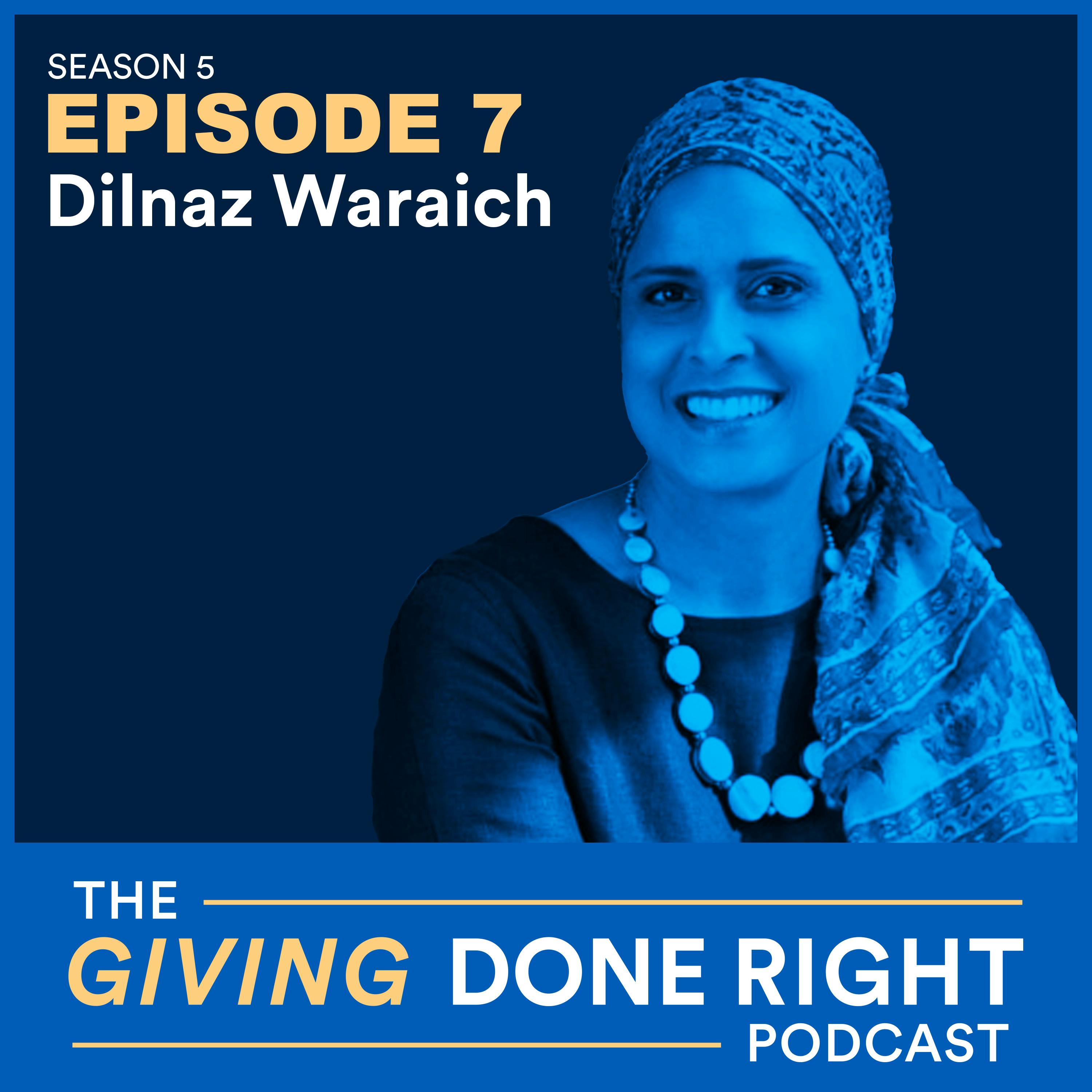
Loading summary
Transcript43 lines
- [00:02]
A
For me, the moment the transfer of wealth occurred, I had a purpose, and I was very driven towards that purpose. I don't think everyone has that purpose. People take a while to figure out where they want to go, what they want to do. But I kept going back to, like, the way my parents raised me, the world that I saw and the world I wanted to change, the world I wanted hopefully built together with other funders.
- [00:29]
B
Welcome to Giving Done Right. I'm Grace Nicollette.
- [00:32]
C
And I'm Phil Buchanan.
- [00:33]
B
Today we're excited to chat with Dilnaz Weirich. Dilnaz serves as the president of the WF Fund, where she's a national leader dedicated to uplifting marginalized communities. Through her work in education, human services, and religious pluralism, she brings over 30 years of experience as a philanthropic advocate, a community organizer, an educator, and an interfaith activist. Welcome, Dilnaz.
- [00:56]
A
Thank you. Thank you, Grace. Thank you, Phil.
- [00:58]
C
So glad to have you here, Dilnaus. And maybe to start, can you just say a little bit about how you ended up in this philanthropy world that you're in? Like, what led you to dedicate your professional life to this work?
- [01:10]
A
So I think it actually was kitchen table conversations. When I was younger, my parents were the working underserved. I came to Chicago when I was two years old in 1972, and it was my mom, my dad, my sister and I. And my parents came here just for a better life. Honestly, my dad realized he had two daughters, and he wanted to make sure his daughters were marrying for love, getting the degree that they wanted. And he just realized being in India in the 70s and 80s was not going to be a great place for his two daughters. So that's why we came to America. We landed in Chicago, and from there, I used to hear regular conversations where my parents thought their backyard was India. Even though they lived and they loved Chicago and the opportunities they had here, they always gave back. And when you think about early philanthropy conversations, I used to hear about, like how my mom needed to give $10 to an aunt that needed a sewing machine, or my dad needed to give a hundred dollars to someone that was potentially having open heart surgery. So as I heard these conversations, I had no idea that was philanthropy happening right in front of me. I just thought that's what parents do. That's what, you know, giving is about. And when I had my own children, when we started thinking about our allocations, our sadhaka, which is giving, we started having those conversations with our own two boys. So my husband and I and the Two boys had these convers about like, where do we want to give? What's our backyard? What does it look like to make a difference? So these are just conversations we had on a regular basis.
- [02:40]
C
So now you're at the WF Fund. What is it?
- [02:44]
A
So the WF Fund is an LLC that we started recently. And with our llc, we think about again going back to our kitchen table. Conversations where we want to give, how we want to give, what impact do we want to make? So we actually have two arms at the WF Fund. We have the grant making arm. We fund national in three buckets, which is civic engagement, religious pluralism and human services. And the grant making arm, we have three year gift agreements. We really want to be in partnership with our non profits. And before we even knew what the word trust based philanthropy was, we were doing this. So that's our grant making arm. And then their other arm at the WF Fund is our narrative change work. So the narrative change work is more recent and it really came through the fellowship through the national center for Family Philanthropy where we started talking, talking about what does it mean to tell the Muslim American story of generosity from the bottom up to someone opening the door for you or giving you a cold glass of water from top down, someone writing really large, beautiful checks and making a high impact investments. So the WF Fund is a catalytic funder. We are definitely not large in the institutional philanthropy world, but we are definitely interested in bringing other funders to the table, making sure we do collective conversations.
- [04:07]
B
That's really powerful. It seems like you have a very clear perspective on how you wanted to approach the philanthropy. How did you get there? The narrative change thing? Yeah, tell us more about that.
- [04:18]
A
Yeah, that's funny that you say. It sounds really focused. And we have a straight line to this, where we are today in 2025, because it was not like that. So basically the transfer of wealth occurred when my just amazing father in law, who was the salt of the earth type of individual, who was an immigrant who came from a very small town from Pakistan to New York City, and then from New York City he met his business partner and then moved to Chicago. And that's another beautiful story. So here is this salt of the earth Pakistani man that came to New York City in 1965, found this Jewish man, Tom Hervis. So Tom Hervis and my father in law, Riaz Worich, created peak antifreeze. It did phenomenal. And then Tom now still owns his shares, but my husband sold my father in law's shares. And so we are out of the business. But my father in law's business partner, Tom Hervis, is still thriving. He only had one child, which was my husband, and that journey went. And then when my father in law passed away, I took over the philanthropic arm. As I took over the philanthropic arm, I really wanted to understand philanthropy. I didn't know the history. I didn't really understand how the Rockefellers and the Carnegie's and JP Morgan, how they played a role in philanthropy. I understood about community foundations. So I wanted to do philanthropy in a manner that was very strategic. So as I was at a lot of philanthropic tables hearing about first gen all the way to sixth gen, I kept coming home and speaking to my own family and discussing what's our backyard, where do we want to give, how do we want to do this strategically? What's the difference between institutional philanthropy versus family foundations versus just small giving? So all these conversations were had at our kitchen table a couple of times a week, and that's how we got to be more focused.
- [06:08]
B
Hmm. How would you describe the difference between institutional philanthropy, family philanthropy and I mean, you could have kept on writing checks or things like that, but it seems like you all coalesced around a vision. And I know a lot of our listeners often think, how do I get from point A to point B? Sometimes, like I see a vision, I want to make it come alive more, but how do I do that?
- [06:29]
A
Yeah, and it's not an easy journey for me. The moment the transfer of wealth occurred, I had a purpose and I was very driven towards that purpose. I don't think everyone has that purpose. Purpose people take a while to figure out where they want to go, what they want to do. But for some reason, I think I kept going back to like the way my parents raised me, the world that I saw and the world I wanted to change, the world I wanted hopefully build together with other funders. And it just came to me. And I think having the knowledge from Indiana University, Lily School of Philanthropy, from the books that I was reading and then sitting at tables and hearing really high net wealth individuals say, you know, this is what we're creating, this is how we're building. I was like, that's what I want to do. But I can't really do that on my own, but I can do that with others. So coalition building was really important right away. So getting other people to the table, asking them questions, being super curious, reading books and just still continuing to read books was very important. So a book that I just finished yesterday was Melinda Frenchgate's book the next day. So just hearing how Melinda Frenchgate talks about her Catholic upbringing, the love to really make a change from tech to what she's doing right now in philanthropy. So I think every day just reading, reading, reading was really important for me.
- [07:51]
C
Can we talk a little bit about Muslims and Muslim giving? So there are three and a half million Muslims in this country. I have read that by 2040, Muslims will be the second largest group in terms of religious identification. You have in some of your work focused on shifting the narrative about Muslim giving. What does that mean? Like, why is that necessary? Help us understand a little bit your perspective.
- [08:21]
A
So since the George Floyd killing in 2020, we've really openly talked about racial justice. We've openly talked about social justice. I am an immigrant, and I never said I was an immigrant until 2016 when, you know, our administration said immigrants are, you know, not worth, we need to deport them. So now we are openly talking about immigration justice. A certain justice that I still don't hear about is religious justice. So when are we going to start talking about religious justice? So when I came into the philanthropic arm and I kept thinking about, like, how come we hear about the word Judeo Christian, like how limiting that term is. How come we hear about, like Christian giving or, you know, other faith based giving, but we don't hear about Muslim giving? Because I know these stories. I live these stories. So to me, I wanted to share stories I heard every single day. I heard him at the mosque, at the playground, when I was, you know, with my children's friends, parents. But I never heard them in the philanthropic surroundings that I was in, in the large conversations that I was in. So I think I wanted to just say, hey, this is what religious justice means. It means bringing conversations about religion and how Muslim Americans are part of the giving circle in the US and Phil, you brought up a statistic. So Dr. Sharuk Siddiqui does a lot of research from Indiana University Lilly School of Philanthropy on Muslim giving. So he says in 2024, especially with the research he's been doing, about $4 billion is giving from Muslim giving. And to be only 1.2% of the population in America, we're really punching above our weight. And as we punch above our weight, how do we tell these generosity stories?
- [10:06]
C
Do you want to explain for our listeners who might not know sort of what some of the roots in Islam are that connect to giving? Because I think people commonly hear stories about Christianity and Judaism and maybe less familiar with the way charitable acts are connected to faith for Muslims.
- [10:33]
A
So the word saga is very similar to the tidings for Catholic traditions and tzedakah for the Jewish traditions. So zakat is a tenant that every Muslim needs to follow. And it's a law that established the rights for the poor and to help those that are less serving. So as a Muslim American family, we give our zakat during the month of Ramadan. And Ramadan is a month of fasting, a month of giving back, a month of remembrance. So during this month, there's eight categories of zakat. And what our family does is we look at our giving and we think about where we want to give. So the eight categories fall under or supporting the poor. And the poor could just be low income individuals. It could be an indigent. It could be supporting someone that's having a difficult time. It could be a difficult time through their marriage or they're having a mental health issue. Number three category that we support with our zakat is those that administer zakat. Number four, it's a person that wants to really help better understand Muslims and the friends that the Muslim community has. Number five, it's helping a person that's in debt. Number six is helping a person that's might be a slave or indentured or in some type of bondage. And number seven, it's really helping someone that's for the cause of God. So if there's a purpose that someone might want to go to the Hajj, which is a pilgrimage, or might want to do something to please God, that might be another category. But the last category is a person that's stranded or is traveling, and that's the refugee or the immigrant. So there's eight categories. And we look at these eight categories of saga and make sure that serving all eight categories, and when we give every year during the month of Ramadan.
- [12:18]
B
Say more about how you as a family make decisions around those eight categories.
- [12:23]
A
Again, this just naturally happened. I thought, you know, we, we've been doing this since our boys were very young. We talked to them about like, oh, is there a cause that you want to give? And the boys would also do a lot of volunteering when they were young. We used to go to soup kitchens and food pantries. And then every time, you know, they may have outgrown some of their cloth, make sure we wash them and iron them and pack them up and drop them off at a shelter, that someone else may be able to use those clothing. So those were just things that we just naturally at home. But I think when our giving got to be a little bit larger. We started talking about discretionary funds. So the boys had to find organizations. They had to find an organization and check out the website and sell it to my husband. And I say, hey, this is where we want to give to. Then we also talked about, like, actually being on boards and making sure that our sons, my husband and I, we were on boards and making sure we understood the importance of civic engagement. Being on a board is so important to really create a thriving city, create a thriving America. So we talked about that with our family as well. So these are things that we kind of naturally did when the boys were younger. And something else the boys did was for 10 years. It started in 2004 when there was a very large flood in Pakistan. Actually, I think it was 2010. There was a very large flood in Pakistan, and we have quite a bit of family in Pakistan. The boys had gone to fundraisers, but they're like, mom, dad, we want to do something fun. We're so tired of, like, boring fundraisers. So they did a bowling fundraiser. And we got like, you know, a good 20 or 30 people together. In that first year, we raised $3,000 for this flood that occurred in Pakistan, where we had a lot of family members. And it just became really infectious. And every year, my boys for 10 years would find an organization, call the organization, raise funds. The least we raised was 3,000 DOL. The most they raised was $21,000. And each year they found the organization, they brought their friends, and they actually learned fundraising through those bowling fundraisers.
- [14:29]
B
That's amazing. It started small and then it grew. And we often hear that. That it's like once you get started, it really is sort of addictive in this really beautiful.
- [14:52]
A
Make a bigger difference. The center for High Impact Philanthropy at the University of Pennsylvania helps you give smarter with executive education and free trusted resources. Learn more or apply at impact. UPenn.edu hey there. I'm Kendra Adachi, and my show, the Lazy Genius podcast helps you be a genius about the things that and lazy about the things that don't. And you get to decide what matters. I'm not here to tell you what to do. I'm here to give you a new way to see. Episodes of the Lazy Genius podcast are full of compassionate time management tips and permission slips to do what makes sense for you. New episodes drop every Monday. Follow and listen to the Lazy Genius podcast on the free Odyssey app or wherever you get your podcasts.
- [15:40]
C
Dylan asked, can you make it a little bit, bit more specific for us in terms of your giving. When you think about key organizations that you're funding right now, or key approaches or strategies, what is the nature of that work?
- [15:55]
A
So when I think about Human services. So Human services, one of our favorite organizations, is an organization located right just outside of Chicago and it helps unhoused individuals. So we went to the organization, we did some service work, and then I just really understood how important it is. It could happen, you know, through just some bad luck or some bad choices, any of us could be unhoused. So what we did is we went to the organization and said, how can we support you for the next three years and how can we make sure that you're bringing in individuals that are going through these difficult times? And that's what we did. We just sat there and during Thanksgiving, I remember this conversation. So there's this phrase that we have that we talk about. The shortest distance between two people is a story. So storytelling is so important and it's actually a quote by Patty Ding who lives in Georgia. So the organization is Connections for the Homeless. And we were sitting at this Thanksgiving table and my son at that point was, my older son was 21 and there was this unhoused individual. He was telling us the story of his 21 year old son coming home tomorrow. And in my brain as an adult, I'm thinking, how is your 21 year old son coming home? You don't have a home. And my son was thinking, I'm 21 and you have a son that's 21. And we were the next day going to go on vacation and it was just like, oh, wow, we're going on vacation. We had great Thanksgiving plans. And I kept thinking, wow, like your story is exactly like our story, but our circumstances are so different. And the moment we walked away from that Thanksgiving event, my son was like, mom, we gotta help this organization even more because they're just like us. Like, I want that 21 year old boy to have a great vacation with his father. I want to make sure that father has, you know, ability to sit and watch football games and do things just like dad has with me. And I thought the reason we really appreciate the work that we do is we're in partnership, we're in community. We're not just writing an allocation and walking away. We are doing this work hand in hand with our organizations. So that's one organization, Connections for the Homeless. Another story that I have is again, right after the George Floyd killing, this is something that I learned so humbly was there was a nonprofit, it's called Muslim Wellness foundation and their executive director is a rock star. She's just to me, like everything I think an executive director should do. I was looking at her budget. It was pretty lean. It was about $200,000. And I just said to her really boldly, how can your budget be so small? You're just a rock star. You totally understand systems. You understand how to do this work of mental health and supporting black Muslim individuals. And she listened to me prob a good five or ten minutes and she just kept quiet. And she goes, so dillness, you want me to walk into a room and just ask someone for $25,000? Guess what? I don't even know anyone that could write a $1,000 check. And you are making me feel like I should just be having a larger budget. How do I get this larger budget? If you don't do the introductions and you don't help me get into those spaces, where do I get that $25,000 check? And I was just like, you're totally right. But I appreciated her saying that boldly to me because otherwise heard that from her in 2020, in 2025, I couldn't tell you how I did so many mistakes and how I've come to this place. To realize as funders we need to be humble and we need to sit quietly and ask questions and listen and listen and listen. Opposed to thinking that we know all the answers.
- [19:36]
C
Absolutely. And it is amazing how many interactions we have. Those of us who run nonprofits, we with funders who both do listen really well and those who don't and who come to the relationship in a much more top down way. I want to go back to your first example of homelessness and just mention that we're recording this mid summer ish 2025 and we have many conversations on this podcast with folks who will say, well, we can't just focus on immediate needs. We have to go upstream and deal with systemic change and, and get at the root cause. Otherwise we're just perpetuating a system that isn't working. I've always thought it's a false choice, right? That you have to have folks who work at the root cause level as well as those who help with immediate suffering. And some will do both. And that's great. But this issue has been more present in my mind the last few weeks as we think about the gutting of what little social safety net at has existed in this country. We're looking at the possibility, well, the certainty of significant reductions in things like nutritional assistance, medical care, for people in poverty. And we're already seeing, even prior to that legislation passing, folks doing direct service work losing federal funding. And I guess my question is how to think about philanthropy in that context, because on the one hand, the needs are going to be so great, and we need to step up, and we need philanthropy to step up. And then on the other hand, by stepping up, we're sort of complicit in the stepping back of government. I don't think there's a choice. I think folks have to step up in the face of the suffering, of course. But I wonder if you wrestle with this question and. And I think there's maybe two parts to it. One is root cause versus immediate suffering, and the other is the role of government and the role of philanthropy.
- [21:44]
A
First of all, none of this work that we do in philanthropy is an easy ask for the people that are funders and people that are partners in this work. So I think there's a heaviness in both sides. That's why I think it has to be a symbiotic relationship. So how do we do this in partnership with both sides? So, number one, when our partners ask us, you know, like, we're interested in this new project or we're aligning ourselves with this new initiative, it's gotta be an allocation that has to be general operating expenses. So rarely do we say it has to be for this purpose, because we really trust this nonprofit, and we want the nonprofit to thrive. And for it to thrive, it just needs general operating expenses, and it needs a lot of trust. So once we've built trust with that nonprofit, we do write that allocation for a general operating expense. The second thing is making sure that we are advocates in this work, and as we're doing advocacy work, as we're really aligning with big A versus small A, and how can we do this for 501C3s? That's a difficult conversation we do have inside, but it is an important conversation to have inside because we want institutional changes. We want systems to change. We don't want just handouts to, you know, like, put a band aid on the system. And. And being in America, there is no reason we should have homelessness. We should not need to have that type of issue in our country, especially. We've traveled to other developing countries, and I think about, like, what homelessness means in those countries and how that would be almost impossible to eradicate because of very, very high populations, because of certain policies. But in the US I've heard so many politicians say this, and I Believe them. Homelessness can be easily eradicated with advocacy, work, housing policies, with just making sure that we have those difficult conversations and we push that forward. So I think it's a top down and a bottom up, and it has to be a combination of both. And as funders, how do we do this with coalitions? I've said that before, not just isolating ourselves and say, hey, this is all I'm going to do, but sit at the table and create a systems approach to a problem that we see in the U.S. you know, listening to you.
- [24:00]
B
I reflect upon how for many donors who are kind of approaching their giving for the first time through a more focused lens, there can be a sense of deep uncertainty or even vulnerability of how do I listen but then not get taken advantage of, or how do I build coalitions but not then kind of disrupt dynamics because I'm the one with the money. And it seems like like you have really like entered in, into some of those tensions over the years. What advice do you have for donors who are starting out where you'd say, you know, I actually would love to be, you know, a really good partner to these nonprofits, but how do I know that they're telling me the truth? How do I know that they're doing the good work that I want to see? What would you say to them?
- [24:52]
A
I think it was around 2018, I took an amazing transformative trip to Birmingham, Alabama and I was able to hear Brian Stevenson talk about his Equal Justice Initiative. I think it's hearing legends like Bryan Stevenson talk about being proximate, getting uncomfortable, living in hope, and lastly, giving other people hope. So those are four principles that I try and follow regularly. Giving other people hope and living in hope myself is really important because there is again, a lot of heaviness in the work that we do and there are definitely people that want to take advantage of, you know, some of the generosity that we might, might be wanting to share. But it's also just saying every morning I get up, I love watching the sunrise. So every time I watch the sunrise, I just say, you know what, what did I do well yesterday and what did I learn from my strengths and my challenges that I have yesterday? What am I going to do better tomorrow and how am I going to make sure this challenges that I had yesterday I'm going to work on for tomorrow? So it's those types of opportunities, having self reflection and making sure those self, self reflective moments are helping me do the work that I do, but also realizing just like I'm on my journey. Everyone else is on their journey, so they are going to make mistakes. They are going to maybe mishandle the funding that we might share with them. But I also will go back and push back and say, oh, I'm curious, where did that funding go? So I'm there asking and being present with them while they're doing the heaviness. But it's never about being accusatory and punishing anyone for their journey or their mistakes. Just like I would never want to be punished for my mistakes because I have made numerous mistakes in my philanthropic journey as well, such as just the question that I asked that individual in her nonprofit world. I was just asking, why. Why do you have a small budget? Why aren't you increasing your budget? And because I'm a fundraiser. I actually think I was a born fundraiser. I have no problem asking people for funding because it's not for me, it's for someone else. And I think the phrase that. That goes, if you ask someone for money, you'll get advice. If you ask someone for advice, you might get money. So I love asking people for advice. I love being curious, because hopefully that way we'll get the funding that we need for whatever we're asking for. But I also think if you don't ask the question, the answer is always no. So I'm kind of constantly pushing people, and I'm, like, always asking, why did this happen? Can I get an appointment? Are you busy today? So constantly, I think it's important for funders and for grantees to always, always ask that question. Otherwise, the answer is no.
- [27:36]
B
I'm curious. So relationship building and the interfaith activism you described are real areas of expertise for you. So tell us about why is bridge building and fostering understanding between different folks important to you? And, like, how is that a value in the work that you do? Because you could have just focused on Muslim communities and. And Muslim work, but there is sort of this inner faith component as well. And so tell us more about that.
- [28:05]
A
Yeah. If I am in spaces where there's, you know, conversation about other faiths, I actually realize I become a better Muslim. I learn about my faith because I can explain to others about why Islam has a certain tenant about giving, why there are five daily prayers. So whenever I'm at synagogues and churches and temples, I actually feel and believe God is present there. And I'm a better Muslim because of those conversations. But I also. I'm not too sure if my mom would be thrilled about this, but I remember my very close Jewish friend said, you make me a better Jewish person because you're constantly encouraging me to go to the temple and question my faith. And just recently, a very good Catholic friend of mine said, wow, I am much better of a Catholic individual because you're constantly pushing me to be a better Catholic, go to church and do all these activities. So I'm really proud that I've got Catholic and Jewish friends, that I'm encouraging them to live into their faith traditions, just as I hope they would ask me to be in my faith tradition and be honest to my faith traditions as well. Because I think as we do this work in the US we want to make sure we see the similarities in each other, but also the differences. And not this Kumbaya type differences, but the difficult conversations of, why are you doing that? Tell me more about that. So these are difficult conversations, but they're conversations that need to be had. Right.
- [29:33]
B
I feel like this has been a really tense and kind of divisive time for interfaith dialogue because of what's happening in the world. And so, you know, because your work is focused on, you know, the interfaith piece, but also the narrative change, like, what would you like to see happen, given everything that's been going on, like, with the narrative change that you hope to see around Muslim giving or kind of the relationship with other faiths in terms of the philanthropists that you work with?
- [30:00]
A
Oh, I'd love to see Muslim Americans able to tell their own story and not an entire industry called, you know, anti Muslim hate or Islamophobia. Tell our story for us. There's so many nuances, there's so many critical stories that are not told about the Muslim American community because someone else decides to hijack them from us. The most common things we hear, unfortunately, about Muslim American communities are how there's terrorism or there's proselytization or there are takers. But how do we tell the beautiful story of the first mosque that was created in the US in the 1750s? Or how do we tell the story of how Muslim black Americans came as enslaved individuals, one third of the Muslim American population is African American, and how African American Muslims have created a better America as they were also fighting for their rights to become unenslaved individuals? So these are important stories. So how do we tell these stories? And there's a great documentary on PBS called American Muslim Stories and making sure that we hear and watch those stories in our curriculum as we grow up. Because I never saw anyone that looked or sounded like me in my elementary school. I never Even knew what a philanthropist from the Muslim American perspective was in my elementary school. But I did hear the word philanthropy, quite a few, especially being raised in Chicago. So it was interesting. In 2018, my sister said to me, why don't you just tell people that you're a philanthropist? And I was like, why is she insulting me? I am a good. I'm a good person. And I had to reclaim that word. And now I say I'm a philanthropic advocate, because as a philanthropic advocate, I am walking in partnership with our organizations. And I'm also a philanthropist that, like, wants to tell good stories, opposed to telling stories just about power. And I think philanthropy has a lot to do with power.
- [32:00]
B
I'm so curious to hear from you, Dilnaz. Like, in my own kind of faith tradition and background, sometimes there can be a really false tension between, like, orthodoxy and social justice. It can seem like if you are very social justice oriented or if you are really like, connected into interfaith type dialogues, that somehow it means that you are less orthodox in your faith. I certainly see that in the Christian world. I think a lot of us see that. But I'm curious what your reaction to that is.
- [32:36]
A
Yeah, that's a great question. Because if you think about the prophet, peace be upon him, 1400 years ago, the work that he did in Mecca, and then he traveled to Medina. And during his travels, he would constantly meet people, people, of course, that were not Muslim. And he would try and help them understand about Islam. And it wasn't grace about, like, sitting down and saying, here's the tenants of Islam. Let me help you educate you. But it's just by role modeling good behavior, by being a truth teller, by being bold, by being humble, by being generous. That's how a lot of our faith traditions talk about, right? And unfortunately, we don't need to do this at our houses of worship. We could do this at our work. We could do this at a restaurant. I just love when someone, as I'm walking and someone opens the door for me and I've got all these packages, I'm like, wow, that was really sweet. Thank you so much. Or again, when I'm at a restaurant and someone just picks up my bill. That happened for me one time. Someone picked up my. I was like, whoa, that was so amazing. You know, Americans are just some of the most generous people. And generosity is the bedrock of America. So how do we keep telling generosity stories of American Muslims, of American Christians and Jews and people of other faith? Faith. That's how we get back to talking about Our faith traditions in a good place, not being like, you know, here's a handout, let me bring you to my church. But just doing it on a regular basis because that's what our faith traditions ask us to do. And that's why we're in America, because again, my dad wanted me to marry for marriage. My dad wanted me to get a degree in anything I wanted to do. And that's why he asked me to come to America with him when I was 2 years old. And I think I said yes because I got on that flight. I don't think I had a. I don't think I had a choice. But he always says, I asked you to come to America. But while I'm here in America, I want to have as diverse friendships, I want to have as diverse conversations. And that only happens when I get uncomfortable, when I go to coffee shops that people don't look and sound like me. And there's a tradition in the Muslim community that talks about bringing people of different minds together, bringing people of different faiths together. So in the Muslim tradition, we're asked to be in different spaces just to talk about each other. And I know that true in other traditions as well. So why do we, like on Sunday become the most segregated country in the world? And why do we, during the lunch table become so segregated as well? So how do we make sure that our community is really challenging itself and getting uncomfortable?
- [35:11]
C
I mean, this leads me to want to ask you, and maybe we can close here about generosity right now. I love your optimism and your belief in other people and your belief in the fundamental goodness of people. I was speaking earlier today, just coincidentally, to somebody I've known for two decades who is an advisor to high net worth individuals. And she said, look, Phil, I don't have the data on this, this is just anecdotal. But what I'm seeing is a lot of pulling back. People are pulling back from giving programs that they had before. And she said, I think it's about economic uncertainty of the moment, but also a fear and anxiety about putting themselves out there, about being targeted in some way. She didn't really know exactly what all the factors might be. I listened to her and afterward I was thinking about if she had asked me, what should I say to them, what would I have said? And so maybe because I couldn't come up with a good answer, I'm going to ask, what would you say to those donors that are hesitating right now? They're worried about market volatility, they're worried about being criticized by their friends or family for what they support. What would you say to them to give them the courage of their convictions?
- [36:35]
A
So I remember when I was younger, people always told me, I'm not enough. I need to do more, I need to change. And I would just tell these donors, you're just enough. You have just enough information. You have just enough courage. You have just enough proximity to the problem. So stop waiting for tomorrow. So go ahead and write that check and do it today, because we don't even know if there's going to be a tomorrow. So I would say you're just enough today.
- [37:00]
B
That is so powerful.
- [37:02]
C
Thanks, Dilnaz.
- [37:02]
B
Thank you so much, Dilnaz. It's been great to have you on the show.
- [37:05]
A
Yeah. Thank you, Grace. Thank you, Phil.
- [37:16]
C
There are a slew of resources about effective giving on the center for effective philanthropy's website, cep.org as well as givingdoneright.org, where you'll find all our episodes and show notes.
- [37:28]
B
You can also send us a note@gdrpodcastep.org.
- [37:33]
C
We want to thank our sponsors who've made this season possible, including the Stubsky foundation, and a note that any opinions expressed by our guests on the show do not necessarily reflective views of CEP or our sponsors. If you like the show, please leave us a review on Apple Podcasts or invite a friend to listen, or both.
- [37:51]
B
Giving Done Right is a production of the center for Effective Philanthropy. It's hosted by me, Grace Nicolette and Phil Buchanan. It's produced by Rococo Punch. Our original podcast artwork is by Jay Kuska. Special thanks to our colleagues Sarah Martin, Molly Heideman, Christina Tran, Chloe Heskett, Naomi Naomi Rafal and Serena Goosby for their marketing, research, writing and logistical support.