← Giving Done Right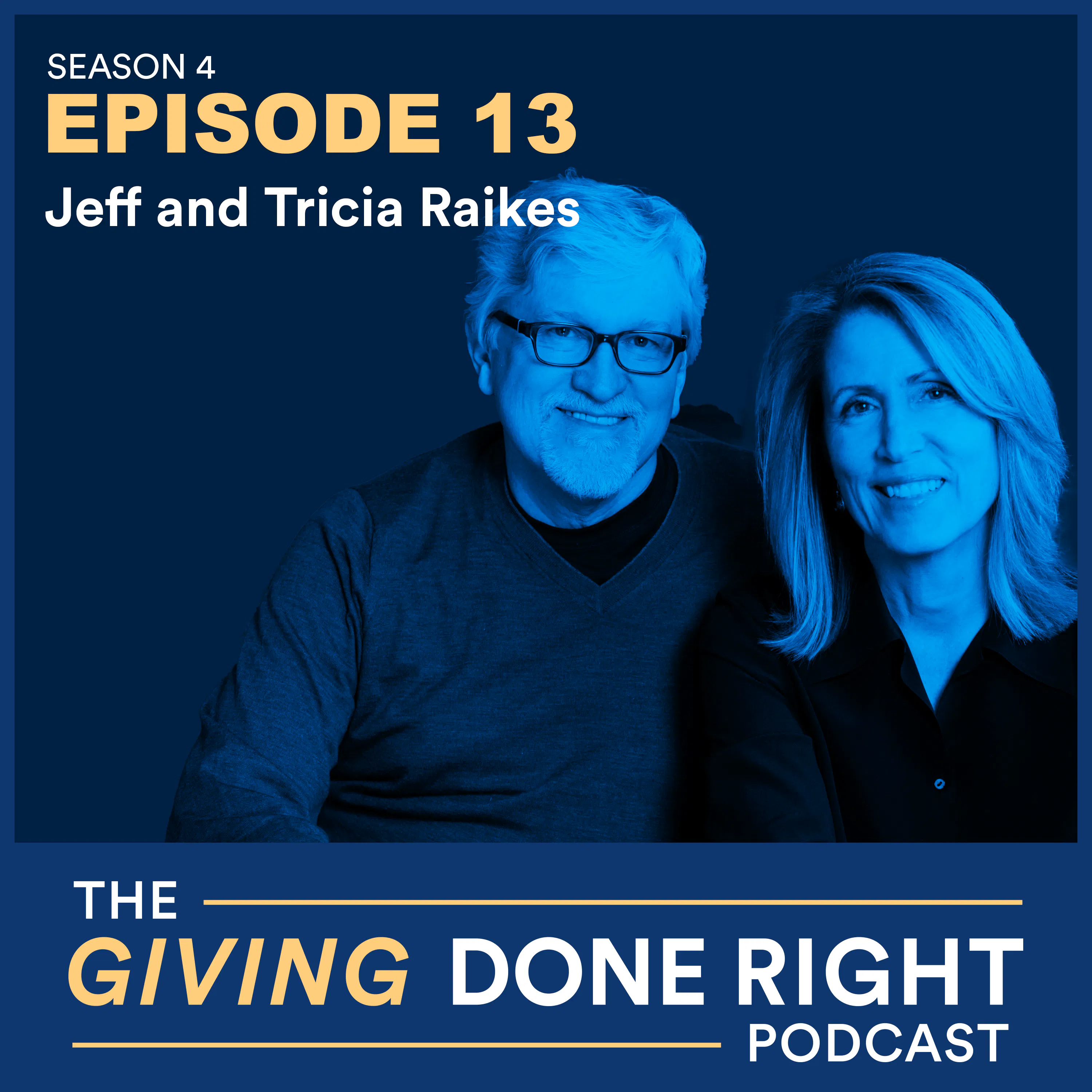
Giving Done Right
Get Curious and Stay the Course: Advice for Donors from Philanthropists Jeff and Tricia Raikes
00:44:20
Loading summary
Transcript54 lines
- [00:01]
Grace Nicollette
Support for Giving Done Right comes from the Fetzer Institute. Are you a program officer who is also a person of faith? Join our monthly faith and philanthropy conversation where like minded program officers wrestle with ideas and best practices for funding faith and spirituality. Visit fetzer.orggivingdoneright to request more information. Fetzer.org givingdoneright.
- [00:28]
Phil Buchanan
We'Re working on some of the toughest problems in society. And if they were that easy to solve, they'd already be solved. They might be easy to Band Aid, but if you really want to solve the issue, it's going to take time and hard work.
- [00:44]
Grace Nicollette
Welcome to Giving Done Right, a show with everything you need to know to make an impact with your charitable giving. I'm Grace Nicollette.
- [00:50]
Jeff Raikes
And I'm Phil Buchanan. Today we're welcoming Jeff and Tricia Raikes of the raikes Foundation. From 2008 to 2014, Jeff led the Bill and Melinda Gates foundation and prior to that was on the senior leadership team at Microsoft for many years.
- [01:11]
Grace Nicollette
And Tricia Raikes is a co founder of the foundation and she served as a board member and advisor to many nonprofits and educational institutions. The foundation is based in Seattle and its work focuses on supporting young people to reach their full potential. Welcome, Jeff and Tricia.
- [01:33]
Tricia Raikes
Great. Thanks for having me.
- [01:34]
Phil Buchanan
Thank you very much. Glad to join you.
- [01:37]
Jeff Raikes
So we wanted you on the show because you're really interesting in your philanthropic approach currently, but also in your background and the path that has led you to where you are now and the work that you do with nonprofits. So before we get into your philanthropy and what the foundation does, can you just tell us each a little bit about your own story, like how did you end up here?
- [02:02]
Phil Buchanan
My journey is perhaps not the obvious one for philanthropists. I grew up on a farm. My family are farmers near a small rural community in Nebraska called Ashland. And my family's been farming there since 1900. And I grew up on the farm. I grew up, learned to drive a tractor at age 7, started working in the fields by age 9. And I would say the thing that I really appreciated about my growing up is just the values in our community. Hard work, honesty, integrity, good sense of humor, all things that were very important. My journey took me to Stanford, where I was really very lucky to meet a lot of influential mentors and friends who exposed me to various issues in society, including racial inequality. I lived in the Black Cultural Theme center at Stanford for three of my four undergraduate years. And I would say those experiences really ignited my commitment to social justice. And then coming out of Stanford. I briefly worked at Apple Computer and then I was given this fabulous opportunity at Microsoft where I learned a lot about problem solving and innovation. I was given the opportunity at age 23 to co lead the creation of Microsoft Office and then went on to help build the worldwide sales and marketing of the company and ultimately as president of the business division. I think, you know, kind of that combination of experiences and the trust that Bill and Melinda had in me led me to an opportunity to lead the Gates foundation, which I oftentimes call my graduate degree in philanthropy. I learned a flavor of philanthropy that I think symbolizes Gates foundation. And a lot of what we try and do at the Raikes foundation, we call it catalytic philanthropy. And those experiences showed me that there are some really good things that are happening in the world of philanthropy and then some things that aren't as good. And it reinforced in me a view that we should put our energy and our resources into addressing issues in society, like racism, you know, how do we create a more equitable society? So these are principles that I've been using throughout my life and learning from those most affected by these, these outcomes. And Tricia and I aspire to build a future where everyone can thrive. So that's part of my journey.
- [04:24]
Jeff Raikes
Tricia, tell us your story.
- [04:25]
Tricia Raikes
Well, I came from a pretty modest background. I am a west coast girl, grew up in Seattle, have a very close knit working class family that very much centered family and community in everything that we did. I was lucky enough to be raised by parents that really instilled a very strong ethos of giving back. What my parents could not do in terms of financial capacity, they more than made up for it in giving generously of their time and talent. So they modeled for myself and for my two brothers the importance of giving back through really regular family activities. Whether it was taking care of our elder neighbors, whether it was volunteering for community activities or collecting donations for local nonprofits, the array of ways of giving back were very common in my family. My mother was really the consummate volunteer. She would raise her hand for just about anything and of course, volunteer her kids to participate as well. So whatever needed to be done, we were there to assist. And she treated everybody, regardless of their circumstances, with a deep sense of dignity and respect. So that ethos was pretty hardwired in me as I entered into my young adult life. After college, I headed to the east Coast. Advertising was my area of focus. And so I had the opportunity to work in New York City for a while, which was exciting for young girl From Seattle, when I returned to the Pacific Northwest, I was recruited by then a very small startup called Microsoft. And my opportunity there was to establish their marketing, communications and corporate brand management function, which was a very exciting opportunity for me. That's where Jeff and I met. So a little known fact, we're the first couple to meet and get married at Microsoft. So that's an interesting part of our.
- [06:22]
Jeff Raikes
History, I'm sure not the last.
- [06:25]
Grace Nicollette
That's true.
- [06:26]
Tricia Raikes
But in addition to the exciting opportunities, obviously, that I had at a young burgeoning software company, I had a strong interest in engaging with community. And I was super lucky to have a number of wonderful women philanthropists mentor me, including Bill's mother, Mary Gates, who encouraged me to get involved in a number of volunteer opportunities. So those boards included things like Boys and Girls Club and United Way. So an early opportunity to cut my teeth, you know, in the philanthropic space. And of course, it was a wonderful early learning for me for what would later become my life work.
- [07:09]
Grace Nicollette
You've alluded to this already, Tricia, but I'm curious. When did your family start its philanthropy? Like, what was the genesis of that, and what was that conversation like?
- [07:18]
Tricia Raikes
Well, you know, given the backgrounds that Jeff and I came from and sort of that deep ethos around giving back, I would say that Jeff and I were already engaged in giving, although be it on a modest basis. When Microsoft went public, obviously, our situation changed pretty dramatically, and we found ourselves with significantly more resources. And so I think at that point in time, Jeff and I really felt a deep responsibility to think more intentionally about our giving. And within a few years, of course, the early years, we were attending a number of nonprofit gatherings, talking to a lot of people, learning a bit more about what it meant to be intentional. And after a few years, we decided to really get serious about our foundation and establish the Raikes foundation. That was in 2002. I took the lead. I was home by then raising our young children. And of course, Jeff was fully immersed in Microsoft at the time. Then about 2008, Jeff made the move from Microsoft over to the Gates Foundation. And so you might say he was almost also learning about philanthropy, but in a different organization and somewhat at a different scale. So I guess for us, the conversation wasn't really about whether we would engage actively in philanthropy. I think for us, you know, because obviously service leadership was really imbued in us from a young age in our families. But I think for us, it was really more about how we would show up in the philanthropic space. I think it was about what Issues we would choose to focus on and the approach we would take to address. Obviously, we were first gen philanthropists, so we didn't inherit a way of doing the work. And so for us, it was certainly exciting and also a challenge for us to really figure out, you know, what that might look like. So we had a lot to learn, I will just say that. But we were very lucky to have many good teachers, some expected and some quite unexpected along the way, who were there to really help us learn both from our successes, but also from our failures.
- [09:34]
Phil Buchanan
Trish and I spent some time with Warren and Susie Buffett in 1991 and 1992, and there were many great things that we picked up from Warren and Susie. One of them was, you want your kids to have enough money that they can do anything, but not so much money that they do nothing. And so that became a guiding principle for us to think about what we should do with our financial resources. We decided that we want to invest in our children, have them have great opportunities, but we also wanted to make sure that we put the majority of our wealth, actually the significant majority of our wealth back into society so that other youth would have those opportunities. And so, you know, that conversation with Warren and Susie Buffett was very influential in our thinking. And that was about 10 years before we got going with the Raikes Foundation. But it certainly shaped a lot of our thinking about philanthropy. That went all the way back to how our parents thought about investing in community. And then, you know, meeting people like Warren and working with Mary Gates and Bill and Melinda, those were all great, influential mentors.
- [10:45]
Grace Nicollette
How did you all then land on the issue with working with young people in your philanthropy? You've alluded to it already. Surely there are, you know, a range of issues you might have considered. And so tell us more about this particular area of your work.
- [11:00]
Tricia Raikes
Well, I think for us, given the stage in life that we were in as young parents, and certainly the encouragement of others that were giving us advice and counsel, I think we started with an issue that we were most passionate about, and that was young people. We were raising our three kids at the time, and of course, seeing a lot of the kinds of things that they were struggling with. In particular, our eldest was struggling with bullying at the time she was in middle school. And so it was really interesting for Jeff. I think we had a moment, kind of a realization of sorts, that if our child, who had access to every resource and advantage and still us as parents and schools, were ineffective in handling an issue of bullying, we really wondered about how the school system was also failing millions of other young people who were less privileged than our child. So it really got us thinking about some of the flaws in the design of our schools and how they really serve all young children well. And so we got curious. We read a lot, we talked to a lot of experts in the field, and we really ended up delving into the science of the adolescent brain development, which was reasonably new about then with Carol Dweck, many of the researchers down at Stanford, Dweck, Cohen, Walton, and I think that early curiosity really led us on a path to understanding the importance of the connection between identity, purpose, and belonging to successful outcomes. It turns out that science reinforces the fact that it's not enough for our young people to just be exposed to quality curriculum. The environment in which they're learning is just as important. And so we really launched our work at those early stages to cultivate that sense of belonging so that all students could feel seen, heard, and valued. And I think that early work, I really have to point to that as profoundly influencing everything else we have done since. It led to our investments in research practices and policy changes, not only in the US Education system, but over the years, we also expanded that work across other systems that serve our young people, like juvenile justice, foster care, behavioral health.
- [13:31]
Grace Nicollette
That's great.
- [13:32]
Tricia Raikes
I think our ultimate goal is certainly to build a multiracial, inclusive democracy with a shared prosperity and a culture of belonging. And we work to certainly achieve that with our philanthropy by focusing on young people, the next generation, and creating those pathways where all of our young people can indeed reach their full potential.
- [13:55]
Phil Buchanan
To underscore what Tricia just said about the importance of our democracy, we have just initiated a new program we call Resourcing Equity and Democracy. And, you know, that extends beyond youth, of course, but the reason we're doing that, and we have great leadership. Dennis Quirin, who leads our foundation, along with Maria Dela Cruz, who's leading this program. We just think it's so important that we understand how to get people engaged in the democracy, and that then creates an opportunity to. To set up the systems where youth can really perform to their potential. And so that's a new program for us that we're starting up. But we're starting up because we passionately believe that we need a multiracial, inclusive democracy and that there are things that we can do in philanthropy to help encourage that.
- [14:45]
Jeff Raikes
I want to connect back to the moment, Jeff, that I first met you, which was shortly after you became CEO of the Bill and Melinda Gates foundation, and Tricia was talking about the importance of sort of hearing from young people about their experience, and it made me think about your commitment to feedback. So the way we met was because you were utilizing our Grantee Perception Report to get feedback from nonprofits. But around that time, slightly before you arrived at the foundation and for a little while after you were there, you also supported an effort that we undertook to hear from young people in schools called Youth Truth, which continues to this day. And we've surveyed 3 million young people in high schools, middle schools, upper elementary schools. And both of those efforts on our part come out of a belief that you can be more effective as a donor if you understand the perspectives of those who are closest to the issues. And feedback is something that I know you've carried forward into your work at the Raikes foundation as well. So can we get a little bit into, like, why that matters to you and the sort of the practice of philanthropy and how you approach it and what you've learned as you've done that, listening over time?
- [16:00]
Phil Buchanan
Yes, that's super important, Phil, and you're absolutely right. I think part of what I saw at the Gates foundation is, you know, some philanthropists, they're well meaning, you know, they've been very successful in life. That's why they have the resources. And they come in thinking that, you know, they're going to have the great ideas to solve the world's problems. And, you know, oftentimes that doesn't work. You know, if you want to build a successful software product, you want to meld both the capability of what the technology can do, but with a deep understanding of what it is that the user of that software wants to do in their life. And if you put those two together, you can oftentimes come up with things that they may not have asked for, but they will actually transform or change a system in a way that's really positive. And so from my experience in building Microsoft Office, I've always had that view that you have to be very, very closely centered to deeply understanding the user. In this case, it's the beneficiary, and it's the people who are on the front lines serving the beneficiary. When I came to the Gates Foundation, I used the word partners to describe our grantees, and I got a lot of pushback on that, which was somewhat disappointing and somewhat frustrating to me. Now, fortunately, that's changed over the years, but my point to the folks there was, you can't treat the grantees like contractors. You have to treat them as partners. In the work, they're the ones who are on the front lines. They're the ones who are closest to those. Those beneficiaries. And so Trish and I like to use the word proximity. It's important to have that depth of proximity. So our work with you and the center for Effective Philanthropy was to understand how the grantees, our partners, were perceiving the work that we were doing, how students were perceiving their experience in schools and giving them voice. And so that's one of the most important parts of philanthropy.
- [18:00]
Grace Nicollette
I think that's really appealing, like channeling our listeners. I think folks are very interested in, you know, getting at root causes, working on system change, learning the landscape, and working with others. But oftentimes they just don't know how to get started. So if someone is listening now and asking in their minds, well, how do I start this journey that. Tricia, you began with the foundation, and, Jeff, you've described so well. What advice do you have for them?
- [18:27]
Tricia Raikes
Oh, boy. You know, when I think back to my younger self, I think about the fact I was very timid about reaching out and asking others to sort of spend time with me. So I did a lot of reading on my own and searching and just didn't realize the amount of resources that were available then. Now, of course, there's a lot of resources. I guess my first piece of advice is don't be timid about getting started. There are so many issues that desperately need the time and the talent and the financial resources of prospective philanthropists, whether they are still in their business careers or whether they are looking for a second career. We just need more people to jump into this space and support the work that needs to be done. I guess I would also encourage them to really reach out and explore a lot of different resources, and there's a lot of people that are willing to help them navigate the process. So whether it's online resources, Giving Compass actually has a really terrific comprehensive resource library online, which is a great initial place for budding philanthropists to look. Obviously, plenty of podcasts, books, and articles. There are also a lot of great organizations. Obviously, the center for Effective Philanthropy is one, but there's Solidaire, there's Women Donors Network, and there's also local community foundations. We really encourage folks to reach out and explore those different opportunities and find the ones that feel right for them so that they can connect with others, who they can learn from and with. I think oftentimes it helps just to work, you know, start locally. And that's what we did we had the opportunity to have proximity to organizations and to individuals that we could learn from. And so giving to issues and places that they can visit and learn from may be an initial way to start. But then we'd also like to challenge them to approach their giving like investing. So think about it in the frame of building a portfolio of organizations and allocating dollars and not only funding charitable opportunities, but also beginning to explore how they can lean into funding change. So, for instance, certainly provide funding to a food bank, but get curious about learning about the root causes that lead to food insecurity and for the individuals and organizations that are working to shift policies and systems or Jeff mentioned our work in youth homelessness. Obviously, there's opportunities to fund youth shelters, but also learn who in the community is working to prevent our young people from. From experiencing the trauma and dropping into homelessness in the first place. So we'd really encourage experimenting on sort of both of those fronts. I think for us, kind of back on the question earlier, weaving through the question about the importance of feedback and grace, your question about who our teachers have been. For us, it's really been the young people who have helped to guide the work because they have experienced the systems firsthand. They know where the systems are broken, and they oftentimes have some of the best ideas for the solutions that need to be put in place. So I would also encourage others to give to organizations that are led by or engage with people who have that lived expertise with our public systems and who are doing the hard work to change them through advocacy and policy reform. The last thing I would say, and this is something that Jeff and I have learned over the years, it's just in our role, it's really important to be good listeners and to be humble learners. I think we are clear that we are in a place of privilege. And I think we have a favorite phrase that we heard years ago, that privilege is invisible to those who possess it. So we are very careful to remain present and aware of the blind spots that we have. And it's really important for us, and time has proved out well that when we work with those who bring the lived experience to bear, the outcomes are just more effective in terms of what we fund and what the results are.
- [22:57]
Jeff Raikes
Stick with us. We'll be right back.
- [23:06]
Grace Nicollette
This episode is brought to you in part by the Fidelity Charitable Catalyst Fund, which believes that when donors and local nonprofits partner together, communities flourish. The fund focuses on elevating organizations that engage donors with education and community connections. Learn more@fidelitycharitable.org hi keeping done right listeners. It's Grace. If you've been enjoying our show, then I'm excited to tell you about no Small Endeavor, a show from Great Feeling Studios and prx. No Small Endeavor is all about exploring what it means to live a good life. Each episode, award winning Professor Lee C. Camp brings you thoughtful conversations with guests like the actor Martin Sheen, Angela Duckworth, the author of the book Grit, and Special Olympics Board Chair Tim Shriver about what it means to flourish. So go ahead, follow no Small Endeavor wherever you get your podcast and tell them Phil and Grace sent you.
- [24:09]
Jeff Raikes
I want to pick up on something you said, Tricia, which made me think of I think they were friendly debates that Jeff and I had when we were doing a lot of work with the foundation shortly after he had arrived, which is you mentioned investing as an analogy, and I have spent years arguing that business and investing are actually not good analogies for philanthropy and nonprofits. My argument is that the measures are different. You can't boil down an roi. There's no universal metric to compare the youth serving organization to the climate change focused organization. And that the investing analogy leads folks to want to push for a certain kind of comparable metric that sometimes can signify a sort of antagonistic relationship with the venture investor who leans on the company that they invested in. And and then also that the nonprofit reality is really different than, say, businesses because it's a collaborative environment, hopefully. I mean, it doesn't always play out that way, but it should be where impact is the goal. And so strategy, as you both have mentioned, is about collaboration, not differentiation like it is in business. Am I wrong or is there a middle ground? I'm curious whether, as you each reflect on your own corporate careers, your successful corporate careers, the degree to which you think what you learned in that world has translated and where maybe it hasn't.
- [25:36]
Phil Buchanan
I think we largely agree with much of what you said about the risk of people coming into philanthropy, you know, trying to do a direct application of business principles. I mean, in life, metaphors are often very helpful in terms of of trying to develop frameworks and think about how to act. So it's really more a question of how literal you take the framework. And if you take the investing metaphor too literally, then I would agree with you there's some real downsides. You can't quantify things in the same way in the nonprofit sector. On the other hand, if you think of it as a little bit more figuratively, the idea that you're not just giving away money, but you're Actually investing back in society in order to improve outcomes in society. I actually think the metaphor in that case is very useful. I'll give you a related metaphor that I often use. Some people like it, some people don't. But in the financial world, you have active investors and you have passive investors. You have index funds. And I think one of the things that we've learned over the last two decades is that philanthropy, to have the kind of impact we're describing is actually really hard work. We have a team of 15 to 20 people who are trying to do the work in education and housing, stability for youth and resourcing, equity and democracy and impact philanthropy. So we're not just kind of giving money away, we're actually really digging in and doing hard work. In that context, we are an active philanthropist. We're an active investor in climate. We're more passive. We are not doing the hard work. But in that case, what I would aspire to is whatever portfolio or allocation we have for that type of work, we want to follow active philanthropists. People are doing the hard work to really understand the issues. So again, there's a metaphor that I like to use because I think it really should help philanthropists decide how they're going to approach their philanthropy. Are they going to be actively involved, or would they rather be passively involved where they follow somebody than institution or a group of other donors who are putting in that hard work? Again, Phil, I would say that, you know, your criticisms of the business metaphor being overdone, I think are actually quite valid. But metaphors, oftentimes you can think of them more literally or more figuratively. And I think some of these things can actually be used to help people who are coming into philanthropy think about what their role is and how they should approach it.
- [28:31]
Grace Nicollette
Jeff, do I sense in your answer just now like an invitation for donors to follow what you all are doing as active donors and investors? Like, if they are interested in education and young people and democracy in the same ways, what are some ways that they can follow what you're doing?
- [28:48]
Phil Buchanan
Grace, that's a great, great question. And I should start out by saying we are incredibly fortunate to be part of a significant group of funders who are collaborating together on the issues related to public education and how we can redesign the public education system. So we have that already under always anxious to have people join in. Now, some of them are active themselves and some of them are more passive. But in each of the areas of work that we do, we actually try and create collaboratives where people can join in so, for example, under Stephanie Gillis leadership with the Impact Driven Philanthropy Initiative, there is an entity called the Impact Driven Philanthropy Collaborative, where there are lots of different leaders, both funders and advisors in the system and others donor support, ecosystem leaders. We bring them together to work together on how to improve the impact of philanthropy in education. We've been very fortunate under Zoe Stem Calderon's leadership to assemble collaboratives that have really pushed back on the attacks of public education that are underway right now. The anti crt, you know, the RUFO followers, I think they're on a trend to try and undermine public education. We think that for society in the future, we have to push back against that. And so that's a collaborative that's more than 30 funders coming together to support that type of work. So, yes, we would invite others. Just send us an email. We'll get you connected.
- [30:33]
Grace Nicollette
Great. Check out the website, Grace.
- [30:35]
Tricia Raikes
I'll add on to that. I mean, there really is very little that we do now that is not in partnership with others. It's given the nature of the issues that we work on and the level of complexity, our financial capacity and our ability to influence at political levels is just not enough. We need to be in collaboration with others and also tap their expertise. So I wanted to mention that. And I think the other thing that we do too, in these collaborations, we create ways that folks can come into the collaborative in the way that it works for them or for the organization that they represent. So oftentimes we do have a pooled fund as part of these collaboratives, which are then the flexible dollars that can be moved in ways to address some of the most important issues. But we also invite others to fund alongside of us and to get to know the field leaders and the organizations that we work with.
- [31:36]
Grace Nicollette
I think I'm just reflecting about how open you both are. You do not have to be out there kind of talking about your journey or lessons along the way or even the way that you think about your philanthropy, but you taking a risk and doing that. And I was reflecting that I've had the privilege of interviewing both of you before at philanthropy events. Jeff, in 2019, you and I were in a conversation with the author Anand Girdardas at the time, whose book Winners Take all was, you know, the talk of everybody in the sector. And it was such a strong argument he was making against philanthropy. Right. That it's just a way for the wealthy to burnish or cover up the way their money was made. And I was struck how you agreed with him that the wealthy needed to be taxed more. But you disagreed with him about donors motivations to do good. Because his whole thing is donors often do good as a cover up for their bad deeds, yada yada. I'm wondering, what do you both say now to those who are still cynical about the role that the ultra wealthy play in our society? Because I think even apart from. Right. The giving that you do, I think the generosity of spirit that you have towards others who are on a similar journey does come through. So I'm curious if you could just speak to that. Like there's obviously some interesting and useful critiques out there and I'm curious how you would address them.
- [32:59]
Phil Buchanan
It's a fun memory, Grace, to think about the panel with Anand. I think he was surprised that somebody would be willing to get up on the stage with him.
- [33:08]
Grace Nicollette
That's right.
- [33:09]
Phil Buchanan
And defend philanthropy. I shy away from these sort of one size fits all analyses. You know, most things in life are a spectrum. And there are some people who are using philanthropy to burnish their image. And then there are others who because of their values, their core principles, their desire to improve society, they shouldn't be painted with that criticism. And so that's why I agreed on some cases with Anon and I disagreed on others. He called me a traitor to my socioeconomic class, which I. Yeah, it was a compliment. I was pleased. I'm sure it was partially tongue in cheek, but I could be fighting for lower taxes and more entitlement, but I actually don't think that's going to help our country. And I think there is a recognition by many people who have accumulated a lot of resources that the current levels of wealth inequality are really unsustainable and unhealthy for democracy. And so I think there are a lot of people who are willing to defy their self interests. And you're kind of seeing that. Traditionally philanthropists have really wanted to stay out of the political fray. But with the increasing threats to democracy, the attacks on some of the most vulnerable populations around the world, there are more and more philanthropists that have recognized the need to leverage their influence and engage in direct advocacy and political giving on behalf of those with less power. I mean, a great example of helping support the voices of people who haven't had the power to use their voice is what Tricia did with the Washington state legislature for the Homeless Youth Initiative. She basically brought a group of youth who had experienced homelessness as young people to the legislature and let them speak. And so Trisha was using her power not for her own purposes, but to support the voices of those who often are not heard. And we're seeing more and more philanthropists do that. And I think that's a very, very good thing. Philanthropists working on policy change that may defy their self interest. We're seeing more philanthropists starting to think that they should spend down their wealth and reject sort of multi generational philanthropy. We also think that is a good thing. That's a model that we believe in, that Warren Buffett believes in, that both Bill and Melinda believe in. And so Anand had some valid criticisms, but it's not appropriate to have a one size fits all analysis.
- [35:59]
Jeff Raikes
Tricia and Jeff, you've both been, as Grace said, very open and you've talked about the fact that you've learned some things along the way. And we've talked about also your hope to influence other donors. So if there's one thing that you look back on and you say, well, I wish I had known this earlier or I wish I had done this differently, one piece of advice based on your own learning or mistakes that you each could give to individual donors, what would it be?
- [36:26]
Tricia Raikes
Well, I guess for me, don't be concerned about. Gosh, I don't know. I guess I want to say don't be concerned about not having impact initially, because I think so often we are wired right to be able to see an outcome. And I think it probably prevents many people from weighing in until they really feel they understand the issue in depth or that they remove themselves from the process if they don't see immediate results. And so I would just say to be bold, to stay the course and to learn from both the successes and the mistakes.
- [37:08]
Jeff Raikes
Yeah, I love that. Because I sometimes wonder how many times donors might have walked away from something impatiently, that if they'd given it more time, they would see that they're really contributing to something. Jeff, what about you?
- [37:23]
Phil Buchanan
Yeah, to the point that we were just making about, you know, learning at the Gates Foundation, I always tried to emphasize that even if our grants and strategies don't fully succeed, we only fail if we don't learn. So if I'm speaking to a new philanthropist and picking up on what Tricia was saying, I think it's very important to understand that these are not easy problems to solve. They might be easy to band aid, you know, just give more money for more beds in youth shelters. But if you really want to solve the issue, it's going to take time and hard work and there'll be successes and there will be failures. We're working on some of the toughest problems in society. And if they were that easy to solve, they'd already be solved because they're important to society. So, you know, I would start out by emphasizing that framework, although I'd want to do it in a way that doesn't cause them to shy away, such that they do nothing. That's important is I really want people to understand that there's a real opportunity to make a difference. But it's not going to just happen overnight, and it's going to be important to stick with it. Think of philanthropy as a journey. That's important. That's great.
- [38:47]
Tricia Raikes
I would add to, I think, remaining curious. So I might say my piece of advice would be certainly to find the joy, but to remain curious, to prepare, to pivot, learn from those with lived expertise, and to stay the course.
- [39:04]
Grace Nicollette
Wonderful.
- [39:05]
Jeff Raikes
Those are great.
- [39:06]
Phil Buchanan
We have a lot of advice.
- [39:07]
Grace Nicollette
No, it's very rich. It's awesome. Well, thank you so much, Jeff and.
- [39:12]
Jeff Raikes
Tricia, thank you both so much for spending this time with us.
- [39:15]
Tricia Raikes
Thank you so much.
- [39:17]
Phil Buchanan
Thank you.
- [39:27]
Jeff Raikes
There are so many resources about effective giving on the center for effective philanthropy's website, cep.org as well as givingdoneright.org where you'll find all our episodes and show notes.
- [39:39]
Grace Nicollette
You can also send us a note@gdrpodcastep.org.
- [39:44]
Jeff Raikes
We want to thank our sponsors who've made this season possible. The Fidelity Charitable Catalyst Fund, Fetzer Institute, the Walton Family foundation, the John Templeton Foundation, Stupsky Foundation, Colorado Health foundation, and Archstone Foundation. If you like the show, please leave us a review on Apple Podcast podcasts or invite a friend to listen.
- [40:04]
Grace Nicollette
Getting Done Right is a production of the center for Effective Philanthropy. It's hosted by me, Grace Nicolette and Phil Buchanan. It's produced by Rococo Punch. Our original podcast artwork is made by Jay Cuska. Special thanks to our colleagues Sarah Martin, Molly Heideman, Chloe Heskett, Naomi Rafal, Christina Tran, Lauren Chan, and Sei Darling for their marketing, research, writing and logistical.