Loading summary
Transcript63 lines
- [00:01]
Grace Nicollette
Support for Giving Done Right comes from the Fetzer Institute. Are you a program officer who is also a person of faith? Join our monthly faith and philanthropy conversation where like minded program officers wrestle with ideas and best practices for funding faith and spirituality. Visit fetzer.orggivingdoneright to request more information. Fetzer.org givingdoneright.
- [00:29]
Dr. Nashley C.
We were wanting to pour into the community that poured into us because they were all looking for tech help and people were lined up at the library door to get tech help. We said, hey, this must be something people really want.
- [00:44]
Grace Nicollette
Welcome to Giving Done Right, a show with everything you need to know to make an impact with your charitable giving. I'm Grace Nicollette.
- [00:50]
Phil Buchanan
And I'm Phil Buchanan.
- [00:55]
Grace Nicollette
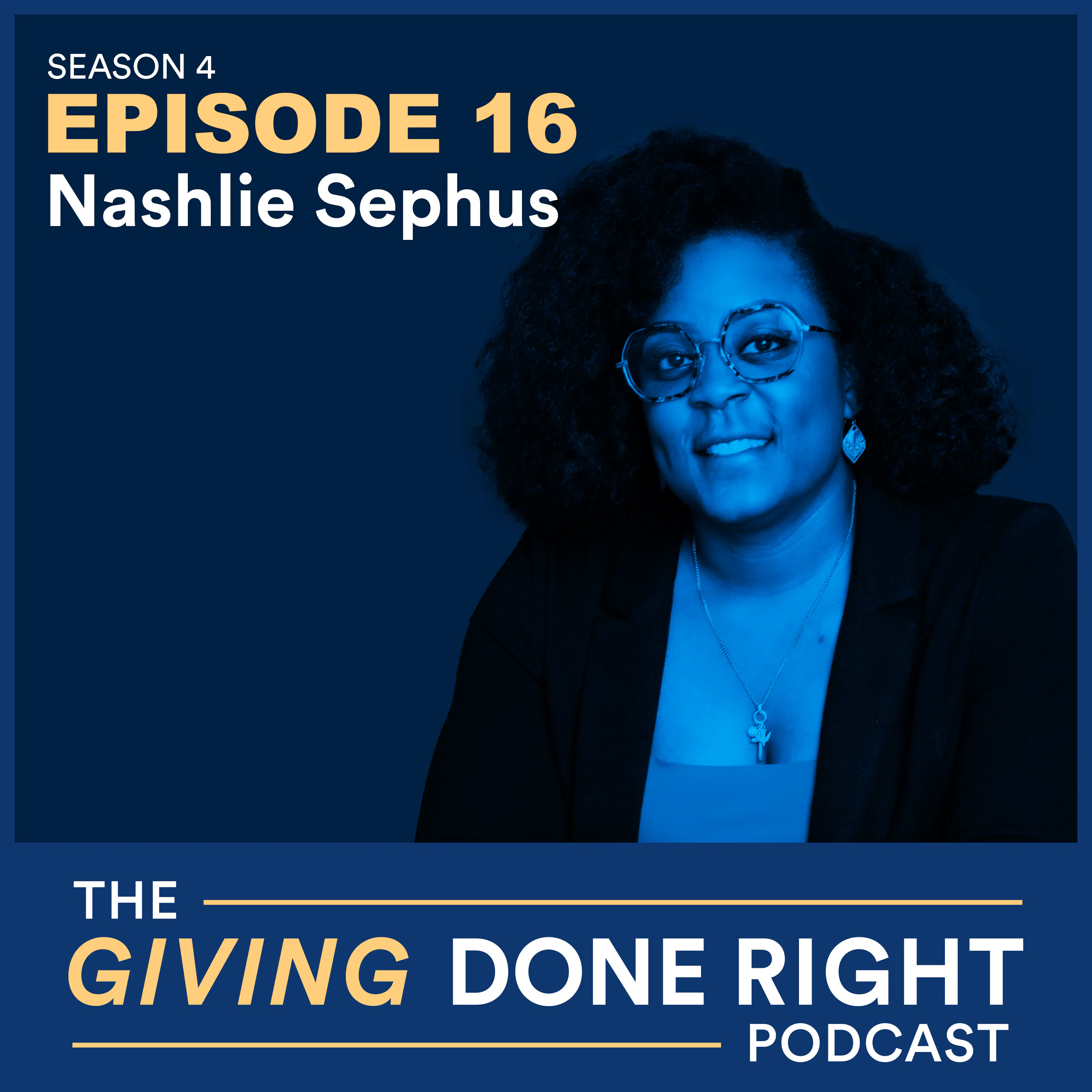
Today Our guest is Dr. Nashley C. Co founder and CEO of Beanpath, a nonprofit based in Jackson, Mississippi that provides technical assistance and guidance to individuals and small businesses. Nashley is a proud native of Jackson and she works as a technology evangelist and AI scientist at Amazon Web Services, where her work focuses on fairness and eliminating biases in AI. Beanpath's programs include a makerspace hosting tech office hours, creating engineering and coding programs for youth, such as youth robotics clubs, and providing scholarships and grants for students and other community organizations. In 2020, she also purchased a large tract of land near Jackson State University, one of the largest HBCUs in the US to create the Jackson Tech District. Welcome Nashley, we're so glad you're here.
- [01:51]
Dr. Nashley C.
Thank you so much. I really appreciate it.
- [01:53]
Phil Buchanan
Nashley, thanks for joining us and your story is so interesting and inspiring and your decision to really make a commitment to Jackson. Can you just walk us through your path? How you got to where you are and how you decided that you wanted to start a nonprofit?
- [02:13]
Dr. Nashley C.
I didn't know I wanted to start a nonprofit. I actually, when Beanpath first started, we had this idea. After being in the tech industry for a while, I was actually a CTO of a startup company that we actually sold to Amazon in 2016. And then around 2017, I was like, hey, there's something more to life. I think I have a good job and I get paid pretty well, but I still feel like there's something more I should be doing. And so I got together with a few friends and we started meeting in the local libraries in Jackson, Mississippi, which is my hometown. Granted, I didn't live in Jackson, I lived in Atlanta at the time. And so I would literally go back home once or twice a month to set up these tech help desks in the local libraries and we would move around to different libraries and just help people with tech questions, whether it be a business that needed help with the website or. Or an individual that needed some guidance and coding, or even a small business owner. And so we were wanting to pour into the community that poured into us because they were all looking for tech help. And for after a while, people were lined up at the library door to get tech help. We said, hey, this must be something people really want around here, so, you know, maybe we can take this a step further. And so we. We call it the bean path. Most people think of bean as a seed. When you put it in the ground, it grows into a vine. It takes its own path. I'm also a gardener, so I plant beans in spring. And on the other end of it, bean is actually a computer programming term. And so it actually is a smaller piece of code that you can extend into other functions as well. It could build off of it. And so we were helping people find their pathway with technology. And so that's what the name bean path means and start the nonprofit. And we've been going ever since.
- [04:13]
Phil Buchanan
That's awesome. And going back even further to your roots in Jackson, I know you got your undergraduate at Mississippi State, but then you ended up going for A Master's and PhD in Computer and electrical engineering at Georgia Tech. When you were a little girl, did you think you were going to work in tech or tell us a little bit about how you got to the line of work that you're in?
- [04:36]
Dr. Nashley C.
Yeah, so when I was younger, we. I grew up with my mom, my grandmother, my sister. Large family, not just immediate, but connected family as well. And so we did a lot of things at the house, mainly because we were a house full of women. So you had to take out the trash, you know, you had to do all the things that people associate with men doing. And we just learned a lot about pulling up your sleeves and just getting in there, fixing the lawnmower, hanging the ceiling fan, and putting up Christmas lights. And so I think that helped me grow into just this curiosity of how things work and always seeing how you pull them apart and you can make them come to life. And I remember my 8th grade science teacher sending me to a summer camp, which was about two hours away. It was actually at Mississippi State, which I ended up going there for undergrad. And it was a summer engineering camp for girls. And it was the coolest thing. I thought I was in heaven. And when we got. They explained all the different types of engineering. When we got to computer engineering, that was mind blowing to me. Because I was like, okay, you can just type in these letters and numbers in this computer and you can control all this stuff around us and the rest was history. So I thought it was great. Not even thinking, oh, this is most of the gadgets and devices in the world would be controlled by computers. Not even thinking that. Just thinking just how fascinating it was to me to learn more about that. And from that point on I was like, hey, I'm going to be a computer engineer. Didn't really even know what that really meant. But from that point on, what I learned from that camp, that's what I wanted to do.
- [06:14]
Grace Nicollette
Tell us about Bean Path now. What is it like? I know there's many different kinds of programs. It really grew from those meetings in the library, it sounds like. So tell us more about the work.
- [06:26]
Dr. Nashley C.
Yeah, so the work started with us setting up a tech help desk and we were helping people with a variety of things. We started tracking metrics and noticed that it was different buckets of things, but the buckets were pretty common. And so we thought, okay. Looked at our demographic. There were parents bringing their kids to get help, whether it be homework or learning how to code. There were senior citizens. Almost 50% were older adults and they didn't know where else to go. Everyone doesn't have a grandchild, they can show them how to use all the devices. And we also noticed business, small businesses that needed the help. And so we crafted our programming and further refined our mission around these three groups. Because I felt like that was where the biggest gap was in terms of educating people on emerging technologies and how it can help them in their everyday lives. Another thing we noticed is that we wanted to be a very non intimidating, safe space where people could come and feel like we're not going to taunt them or make them feel bad for not knowing certain information, even if it's very commonly known. And so we adopted that principle of kind of cultural relevance and cultural responsiveness to the community. We're very community first and so we serve the community in the way that they best receive it. And so we crafted programs moving into our space post Covid that libraries actually closed. And so we had to figure out where to meet, where to go, which, ironically enough, people in the tech industry became even more essential. And those who were not already tech savvy heavily needed to learn how to become more tech savvy in order to continue operating. And so we became an essential business. People still needed help, so we had to figure out something. And so what we decided, even though we could have meetings online, do tech talks online. Most of the demographics we were trying to reach. Didn't even know what a zoom was, you know, at the time. And so I went looking for a space and I found a space downtown, a very famous looking, interesting looking building. It looks like a barn. And we toured the building and the guy said, welcome to the Bean Barn. This is where we used to have our soybean grain. And I said, the Bean Barn where? The Bean Path. And so he was like, oh, okay.
- [09:01]
Grace Nicollette
He was like, it's meant to be.
- [09:03]
Dr. Nashley C.
Yeah. So I was like, okay. So. And then the same guy that owned that building owned majority of the property around it. And so, you know, fast forward, we ended up getting that space. I personally purchased that property. We're now up to 22 acres actually in eight buildings downtown, contiguous space. And the makerspace, the Bean Path headquarters was born. So we have a 6,500 square foot building where we do all of our tech training and classes, all of our events. We also opened our Second Building, Part 2 of the Bean Barn, which we have polished the floors, added lighting in there, insulation, heating, all those sort of things. And we're able to have events over there such as robotics scrimmage games. We're doing things like we had the Jackson Roller Derby practices there. We have food trucks, you know, expos and fairs that we're planning that we have lined up for this year. So it's really exciting time. The Bean Path has just been taking Jackson, Mississippi and surrounding areas by storm. We had over 1,000 people come through our makerspace last year. Overall, through all of our programs, not just at our space, but through all of our contracts and things that we have, we've impacted over 4,000 so far. It's been quite a journey.
- [10:23]
Grace Nicollette
Wow, congratulations. So tell us a bit about Jackson. I've been there once actually, but like, tell us about your community and sounds like you're really meeting an essential need.
- [10:35]
Dr. Nashley C.
Yeah, I would say so. Jackson is in the deep south, as we say. It's actually at the crossroads of two major interstates, I55, which takes you from basically from New Orleans all the way to Chicago and beyond that, and then I20, Atlanta to Dallas and beyond. And so a lot of people come through there. A lot of people originate in Mississippi. Jackson itself is a majority black city and a lot of need. In Mississippi as a whole, over 50% of people live below the poverty line. And then really in terms of being exposed to technology and being progressive in that area, regardless of your social class, we have disparities especially in terms of access to Internet and understanding new technologies like AI and where that can take you, how to use that in your everyday life. And so we just wanted to be that pillar. Hey, we're in the community. We're here if you need help, we're here. We have our robotics clubs, we have makerspace classes or that we do 3D printing, laser cutting, we do pottery, we do sewing. So we also make sure we incorporate the arts because that's very much so technical and technology is very much so an art form as well, especially when you're developing new technology. And then we also have our senior adult program we call OATS Older Adult Technical Services. We partner with AARP and Senior Planet. We're now in our fourth cohort. 25 people each that have taken this class have graduated. They keep coming back. So we had to create a level two class, a level three class. And so that is one of our fastest growing classes, our Bean Path Steamers of the month. We highlight a youth every month that is doing some amazing work. I mean, these folks, they have their own businesses. These kids, they are doing things that I was doing in my freshman year of college in computer engineering, they're doing it in the eighth grade. And so it's really amazing to see just how, you know, when you shine a light somewhere, more people join, more people congregate around you and the light gets brighter and brighter and it's hard to ignore. And so, you know, you can't help but run across us, you know, if you're in that area.
- [12:51]
Grace Nicollette
And I mean, you left Jackson and you have a full time job at Amazon, you're based in Atlanta, but you made a decision to really invest back. I mean, even in the early days, volunteering at the library, that was quite a commitment. And your work is in AI, right? So it's not necessarily on the same plane as like tech help. Tell us more about your motivation for investing in your hometown. Because countless people leave their hometowns and don't look back, right? But you have continued to have really strong ties there as you are on to doing other really big things.
- [13:30]
Dr. Nashley C.
I'm heavily motivated by my family, my support system. Majority of my family still lives in Jackson, Mississippi. Younger cousins all the way to my grandmother, great aunts and uncles. And I just, you know, really love to see, as you mentioned, my world is here. One of the largest AI companies in the world, always on the cutting edge. And then you got some people who don't have the Internet. And so I'm always trying my best to Merge those two worlds and bring them closer together in ways that are fun, innovative, different. I often tell this scenario, if I were to sit on a corner and say, free AI help from Amazon in Silicon Valley, we'd have probably all the startups lined up, needing help or New York or somewhere. But if you do that in a place like Jackson or some parts in Mississippi, you know, they will look at me a little crazy, like, oh, first of all, what is she doing out there? This lady is hot out there, or it's cold out there. And those aren't, you know, household conversations. And so I just wanted to bring that world to these people and what we've seen over, because we've been doing this, we celebrated six years in October. We've seen that this theory of change, as we say it, works. You show up in a way that is familiar to people. You reach them in a different way. They're more inclined to lean in and learn more and keep coming back, and they'll tell somebody else. And the pool of folks gets bigger and bigger. We've been able to help people understand, first and foremost, regardless of what field you're in, whether you're a computer engineer, computer scientist, or if you're in journalism, or even in healthcare. Healthcare is one of our largest industries. You will need to use technology. It'd be better if you understood how it worked. You know, the better off understanding you are, usually the better off you are in this society, as we're constantly moving more towards technology. So that's what we're trying to accomplish.
- [15:36]
Phil Buchanan
Stick with us. We'll be right back.
- [15:47]
Grace Nicollette
This episode is brought to you in part by the Fidelity Charitable Catalyst Fund, which believes that when donors and local nonprofits partner together, communities flourish. The fund focuses on elevating organizations that engage donors with education and community connections. Learn more@fidelitycharitable.org.
- [16:08]
Phil Buchanan
It'S so great and inspiring, and I love the way you work across generations. And obviously you're working with younger people, but also you talked about older adults and the way that a lack of comfort with technology can contribute to their isolation and loneliness. So I imagine by helping those folks, you're helping in more than just the obvious ways. So I think it's amazing. And I guess one of the questions I have for you is how you've built support for this, because there are a lot of folks who have great ideas about something that they want to do for their community, and they can't get funding. They can't convince people that this is worth supporting. What was that process like? For you? How did you make that argument and who is supporting you in this effort?
- [17:04]
Dr. Nashley C.
It took some trial and error to figure all that out. I still feel like I'm learning because my vision is here, which is actually God's vision. I believe God gave me this vision. I could be anywhere right now. I could have bought a yacht or something, I don't know. But this is where I feel like I should be. This is where I feel like my purpose is right now. So I remember trying to figure out, how am I going to get all this done and just trying to say, you know, okay, I have a schedule, I have a full time job, I have to take care of that. That's paying the bills right now. But what time can I allocate outside of this? And then what are those gaps and who can help fill those gaps? So I probably spent the better part of the first three years funding it myself because I already knew, okay, most of the time nonprofits don't get funded. And we're a brand new nonprofit that we're still really trying to figure out what we're trying to do. So I didn't expect to receive much, if anything, the first three years. So I already had in my mind, okay, I'm probably gonna bootstrap this the next two to three years myself. And then sure enough, at that point, about year three, we started gaining attention from some of those foundations. Kellogg foundation has been one of our largest donors. Even corporate sponsors like Amazon and also just local businesses and major donors. We started catching that attention of everyone. Like I said, when you, it's like you have a light shine and more people, they get together with their lights, the light gets brighter. And so I also knew I had to secure a solid team because we started growing so fast, especially after the pandemic. And when we got our space, we needed more help, we needed some full time people. I learned about employment, taxes and health care and all these things that, you know, a real business has to provide. And I never thought I would be doing any of this, but that's what it required. And so we were able to get a solid team and now we're off to the races. Those are my two formulas. You know, if you have the resources, the money, the expertise, you know, and then the capacity, then you can reach whatever goal.
- [19:11]
Phil Buchanan
And how many full time staff do you have?
- [19:13]
Dr. Nashley C.
As of now we have six full time, but total of about 50 between all our instructors and all of our contractors, even from people who clean up for us or manage events for us. So we have A huge team.
- [19:31]
Phil Buchanan
And what's the annual budget, Nashley?
- [19:33]
Dr. Nashley C.
Annual budget is about 750k. Last year we hit our first million dollar revenue year in our sixth year. So we were happy about that. I didn't even realize it until we did the reports. So we're probably likely increase that budget to keep our programs going and of course increase our fundraising that comes along with that.
- [19:53]
Grace Nicollette
Congratulations.
- [19:54]
Phil Buchanan
Yeah. I think one of the things that people sometimes don't understand when they talk about nonprofits is that the overwhelming majority of them are small and community based. Right. People talk about the nonprofit sector and sometimes they think about colleges and universities or big national advocacy organizations, but actually that's not right. Like 90 plus percent, I think it is, have a budget of under a million dollars. And one of the things that's so interesting is people talk about that sometimes like it's a problem. Like what we really need is bigger organizations and let's scale everything because there are too many little organizations and there's too much overlap or redundancy or duplication. And that may sometimes be true. But I think what you're discussing in terms of the ability to create a space in a community in which people come in and feel comfortable and welcome and like they're talking to people who are talking to them in a way that they can hear. That's the beauty of smallness. That's the beauty of community rootedness, you know. So I wonder how you think about size. Like, what's it about to you? Is it about trying to grow or are you trying to just stay right there and go deeper? Like, how do you think about that?
- [21:10]
Dr. Nashley C.
Yeah, well, you know, starting out, I thought it would just be a few of us in the library, a couple of, you know, weekends out the month. But that's kind of really why I wanted it to stay. But, you know, it just kind of grew like the bean does. And so I have always thought, up until a certain point, I always thought that if we could do it in Jackson, we could do it anywhere. And so there are a lot of places like Jackson, Mississippi. You know, the city has a lot of economic challenges, there's a lot of political challenges, and there's not a lot of people moving into the area. That affects things long term. That even affects how you do real estate development. My goal for the real estate vision, as I mentioned, I wanted to do housing, retail. I thought, hey, you know, within the last few years that was achievable. But it's been so difficult even just to get where we are with our Two spaces. And so I do believe wholeheartedly that beanpath can expand. We actually do quite a bit of contract work outside of Mississippi. People that hear about us grateful for this opportunity, even that are people that are outside of Mississippi and outside of the south, you know, ask us to come and do workshops here and there, to put on programming, even to train some of their people. So that's other forms of revenue that helps pour back into our overhead and we're able to see, you know, basically meeting the needs of the community. It'd be great if beanpath didn't have to exist. And you know, the school districts and the local city government already had incentives and things in place for us to always be on top of the cutting edge technology and how it affects us in our everyday lives. But until that happens, I think you can see a need for Bean Path in many places, you know, with the potential for growth.
- [23:04]
Grace Nicollette
Because you have an engineering and business background. I'm curious what surprised you most about starting a nonprofit and the skills that it's required. Like what has translated from the business world and then what has not translated and kind of required a different approach.
- [23:19]
Dr. Nashley C.
So nonprofit life is just like business life to me. I didn't expect that. When you think of nonprofit, you think, oh, okay, you know, just a few people meeting up in the library. But it really made me put on a different perspective, you know, as CEO and we were able to hire folks who were dedicated. We had to create a company culture even as a nonprofit. We assigned, you know, principles and tenets and values to what we do. We incorporate that into everything, actually shout out to praxis. We did several exercises while I was in the nonprofit cohort to establish company culture and environment that was enriching because you think about it like a lot of people, when they get skilled, they leave Mississippi. That's what most people do. That's actually what I did. Because there's not a lot of opportunity there for people especially to make the salaries that you want to make. So we try to make sure we pay on the higher end. We also try to make sure that we create a great, excellent environment, a non stressful environment for our employees. And we want to incentivize them to stay and let them know that they're part of, not just an employee, but like a part of a family and that they see value in the impact and the work that they do. I don't know, I just never thought that a nonprofit would be that involved. But it is. I mean, it's maybe even more so.
- [24:43]
Phil Buchanan
But that's what I always say. I always say it takes everything to run a nonprofit that it takes to run an equivalent sized business. And a ton more is harder, not easier, because you're working on the issues that haven't been addressed by the markets, that haven't been addressed, to your point, by government. But before we continue on that, you mentioned Praxis, and I believe that's the connection here between you and Crazy. You want to explain what Praxis?
- [25:08]
Dr. Nashley C.
Sure.
- [25:08]
Grace Nicollette
I was going to hop in. So Praxis is actually how Nashley and I know each other. It's a nonprofit that helps incubate faith based for profit startups as well as nonprofits. And Nashley and I met because she was in one of the nonprofit cohorts and I was a mentor in that class.
- [25:24]
Phil Buchanan
That's correct.
- [25:25]
Dr. Nashley C.
It was great talking to Grace, as always, and it was a great program. It just really had me thinking about this thing. As you know, this is a legit business and we got to do things a little differently to get to the next step.
- [25:40]
Grace Nicollette
So now, with the benefit of hindsight, what advice do you have for donors like you who want to start their own nonprofits? Like, what do you wish you knew then that you know now as soon.
- [25:51]
Dr. Nashley C.
As you can get a solid team? Because I think it's going to be tempting to try to do everything yourself and save money, but in the end, you're really not and you're getting burned out. And so finding people that believe in your vision, that have good work ethic, that are going to be about the mission, I think is important to think about early on, even before you file all the paperwork. Even most of the time, when people start something new like a nonprofit, they select the board members, like their family members. Some people not saying I did that, but you'll see as years go by, we refine who is it that is a good fit? And because we're evolving as a company, and so that may change over time. And so also understanding that, you know, the people that you started out with, even if they're your friends, you know, sometimes they may not be the best person or the best people to team up with for this venture. And I also say that storytelling part is very important, especially for fundraising. We kind of caught on a couple years in that, hey, we need to increase our marketing budget because, you know, the word isn't getting out like we want it to, and we're doing great work, but, you know, nobody knows about it. And this is helpful for us, you know, raising funding and somehow. Oh, and budgeting financial, just learning about the nonprofit financial world, which is slightly different. I think just educating yourself on that earlier rather than later is better.
- [27:31]
Phil Buchanan
In a similar vein, are there things that you wish donors would keep in mind or practices that have been particularly helpful to you as a relatively early stage nonprofit, or practices that have been frustrating to you on the part of donors or funders?
- [27:51]
Dr. Nashley C.
I think you have to understand your market and your community and who you're marketing to, because the people that we serve with our programming is not necessarily people that we target for major donors. And so there's a difference in how you market that, there's a difference in how you tell that story. I had to learn this as well. Like, people want to invest in something that's going to be sustainable and something that is going to be impactful but measured impact. And until you figure out how to measure your impact, you know, you're going to have some trouble probably fundraising, unless it's just, you know, people that just want to give away money. But I mean, really to this date, we really haven't had a huge Runway for, for spending. It's really just been a year to year, you know, by the grace of God, we are still in this thing and you know, we're trying to figure out how to take it to that next level where we can get a three year Runway or, or even a five year Runway. That's all in the learning curve of things that I had to figure out.
- [28:53]
Phil Buchanan
It just makes me think of like the sustainability question can be so maddening for an early stage nonprofit. Obviously, donors want to do their due diligence. They want to make sure that an organization is for real. And then also you have these unbelievably promising new ideas. And yours is such a great example. Like people had to take the risk and say, okay, yeah, they're not sustainable, quote, unquote. Right. They actually only are going to be able to do the work if we take a risk and fund them, even though they're new. And you got to just have some faith in the leader, some faith in the idea. And then you don't want to be silly about it. You want to make sure that there are some reporting back that you're monitoring how things are going. You know, maybe you don't start with a seven year grant, but you give folks enough running room to see if they can make their idea a reality. And it sounds like there were at least a few donors who were willing to do that for you. But it can be so hard because there's so much creativity and imagination in every community. And it can be hard for the folks who have those ideas to break through and find the people with resources who will believe in them.
- [30:05]
Grace Nicollette
I always cringe a little bit when I hear donors asking about sustainability because basically I just want to say to them, nonprofits will be sustained when donors sustain them. Like, you are the answer to the question that you're asking. And so, and you know, it's interesting, like, listening to you, Nashley, because I do think, like, there's several times you referred to the organization as a business and it's an organization. And there's so many things that are similar, right, between running a nonprofit and starting, like a startup for profit business in terms of, like, the values and the structure and the governance and all of that that you've mention. This piece, I feel like perhaps is quite unique to running a nonprofit is like the whole philanthropic fundraising, which is quite different even than like, private equity fundraising or kind of seed funding that small businesses can seek. And so dealing with that whole arena, I mean, that's the hope right through this podcast, is that we help donors to understand what it's like to run a nonprofit and actually to support nonprofits like yours better.
- [31:08]
Dr. Nashley C.
And I think, you know, sometimes as the leader, you have to figure out, okay, realistically, what do we have to cut back? Because we're not sure if we're going to get this funding yet. And you have to kind of switch from the ideal person to the person who, you know, executes and actually is more of the operator to skim, make things a little bit more scam so that you can be, you know, that Runway can be a little bit longer until you do get that funding. My background is, you know, that startup world. I've been there, and it. And it is different in how you raise capital because we can say, hey, we've proven this business. We have these revenues. You'll get your return, or maybe you won't get your return, but if you invest this much more, we'll be able to point directly to this return. And the nonprofit space is very different. It's actually one of the reasons we tried to incorporate the real estate, because we now have two, essentially two event spaces. Now we make quite a bit of revenues on just renting the space out for events because we're located downtown. Everyone knows about Bean Path, they want to support, so they'll have their gala there or they'll have the baby shower there or something, you know, so, you know, we want to make sure that we're creating these revenue streams to show that, hey, you know, if we keep going at this rate, eventually maybe we will be able to sustain at least our overhead or at least a portion of this and that, and then just bring in programs as we get more funding for specific programs. So it's like, you kind of got to think about it in segments, separating the budgets with the programs, creating sustainability in overhead and adding more revenue streams. One thing I will add is that because we're a tech nonprofit, we have a lot of tech people that come in and they're like the experts that teach the classes. And so we actually have done a couple of contracts with larger companies where we develop software for these companies and we can make a profit that way too. It's really just trying to think about, you know, hey, whatever it takes, we're going to make sure we stay around and serve the people.
- [33:11]
Phil Buchanan
I think that's amazing. And that also I hope that your donors will recognize that if you're doing a good job executing against your mission and you're educating folks about technology and the ways that you set out to do, then they should worry a little bit less about whether at some level your organization is dependent on that philanthropic funding and a little bit more about just being dependable, because dependable supporters of you doing what you do, which is delivering results in the community. And so I've struggled with these same questions leading a nonprofit, which is you want a diversified revenue stream and you don't want to be overly reliant on philanthropic funding. And then sometimes you just want to say, well, we're delivering exactly what you say you care about. Why are you so worried about continuing to fund us to do that thing? Because we're not. Like, in your case, you're not serving customers who are paying. That's not the point. This is different. This is different. This is mission driven work. So I just think it's so helpful just to illustrate challenges that you face that donors at any level need to be sensitive to. Like, this is a hard thing that you're doing and that you have done.
- [34:33]
Grace Nicollette
Yeah. Yeah.
- [34:33]
Dr. Nashley C.
Well, thank you.
- [34:34]
Grace Nicollette
To close, I'm wondering, tell us your hopes for Beanpath and the tech community in Jackson for like, the next 25, 50 years. Like, where do you see the organization going long term?
- [34:46]
Dr. Nashley C.
So I would love to continue developing our whole tech district where we have housing and we incorporate tech programming into the housing. Maybe that spins off as its own revenue stream too, where we scale that program across all, you know, multifamily housing throughout the city. We also would love to impact more people. If we had our third building renovated, we could bring in four or five times as many people as we do now. So we're already at about 1,000 people a year. We could increase that. And I think the program is there. The proof of concept is there. We have results. We have students that receive scholarships in year one that are now working at Fortune 500 companies in engineering and sciences, and they come back and volunteer for the kids that are coming along. And we have testimonials from our older adults. Some of them are still working. Some of them are taking care of the grandkids, and they're able to say, hey, I learned skills at the Bean Path that helped me in my job, and I'm able to be more fruitful and a more productive person because of that. And I think we'd love to be able to say that, you know, we picked Bean Path up and planted it in other cities, too, and we're able to see those fruits in an impact on a much larger scale. But even if that doesn't happen, even if it happens in Mississippi, I think that alone benefits the entire country, and that's what we're hoping for.
- [36:18]
Grace Nicollette
I'm so struck by almost that, like, full circle of, like, you went to a camp run by the Society for Women Engineers. Right. So in some ways, that was probably a nonprofit and philanthropically funded. That changed your life. And now you are impacting through beanpath, the lives of countless young people to pursue their paths and dreams and technology, which is really cool.
- [36:42]
Dr. Nashley C.
Yeah. Thank you. It is a wonderful thing to see, too, and it also makes me realize how much older I'm getting to.
- [36:49]
Phil Buchanan
Thank you so much for spending this time with us, Nashley. This was great, and thank you for the work that you do.
- [36:54]
Dr. Nashley C.
Thank you all. Thank you for the opportunity.
- [36:58]
Grace Nicollette
Wow. So, Phil, with that. That was our last interview of the season of giving done. Right.
- [37:03]
Phil Buchanan
I think it's a great way to end because I think Nashley represents the best of what the nonprofit sector supported by philanthropy in this country can be. And people like her, as remarkable as she is. So I don't want to take anything away from her, because she's remarkable, and there are people like her in every community doing amazing things.
- [37:24]
Grace Nicollette
Yeah. I love just. Yeah. How real she was about her journey and the challenges. And our hope is that this season has brought many different kinds of voices to listeners, and that provide both inspiration, but also really practical things to keep in mind when we're thinking about giving.
- [37:41]
Phil Buchanan
Yeah. I do too. And I don't want to be overly dramatic here, but I am worried about the future of the nonprofit sector in our country, and it feels to me like it was a given 20 or 30 years ago that we valued nonprofits. Nashley talked about bright lights, and it made me think of Republicans like George Bush sr. Talking about 1000 points of light in every community. Or Democrats like John Gardner, who was in LBJ's cabinet, who talked about this sector so beautifully. One of my favorite quotes he says, we have nonprofits that find cures, console the incurable, deal with the ancient impulse to hate and fear the tribe of the next Valley to prepare for tomorrow's crises, preserve yesterday's wisdom. And this is the best part, to pursue the questions others won't pursue because they're too busy or too lazy or too fearful or too jaded. And this notion that there's this broad swath of different ideas, different people, different perspectives, gardner said at one point, if you don't know of a nonprofit that you detest, then something's wrong, right? Like, we all understood this and now I fear that there is this sense of almost politicization and a lack of awareness of how badly we need this diversity of perspectives and ideas and organizations in every community.
- [39:02]
Grace Nicollette
Yeah, that's such a good reminder. Well, listeners, we want to be in dialogue with you. We want to understand what are you thinking in terms of your giving? What questions have we answered this season for you and what questions do you still have that are unanswered that we can address the next season? Please do email us@gdrpodcastp.org, because we love hearing from you. We do listen to your ideas and grace.
- [39:26]
Phil Buchanan
This has been a lot of fun. Thanks for a great season four. Just amazing episodes. Really fun to do this with you always and can't wait for season five.
- [39:34]
Grace Nicollette
Yep. Thanks Phil. So long for now listeners. Thanks again.
- [39:49]
Phil Buchanan
There are so many resources about effective giving on the center for Effective Philanthropy's website, cep.org as well as givingdoneright.org where you'll find all our episodes and show notes.
- [40:00]
Grace Nicollette
You can also send us a note at GDR podcast@cep.org we want to thank.
- [40:06]
Phil Buchanan
Our sponsors who've made this season possible the Fidelity Charitable Catalyst Fund, Fetzer Institute, the Walton Family foundation, the John Templeton Foundation, Stupsky Foundation, Colorado Health foundation and Archstone Foundation. If you like the show, please leave us a review on Apple Podcasts or invite a friend to listen.
- [40:26]
Grace Nicollette
Giving Done Right is a production of the center for Effective Philanthropy. It's hosted by me, Grace Nicollette and Phil Buchanan. It's produced by Rococo Punch. Our original podcast artwork is made by Jay Cuska. Special thanks to our colleagues Sarah Martin, Molly Heideman, Chloe Heskett, Naomi Rafal, Christina Tran, Lauren Chan, and Sei Darling for their marketing, research, writing and logistical support. RA.