Loading summary
Transcript59 lines
- [00:01]
Yolanda Cointro
Support for Giving Done Right comes from the Fetzer Institute. Are you a program officer who is also a person of faith? Join our monthly faith and philanthropy conversation.
- [00:09]
Grace Nicollette
Where like minded program officers wrestle with.
- [00:11]
Yolanda Cointro
Ideas and best practices for funding faith and spirituality. Visit fetzer.orggivingdoneright to request more information. Fetzer.org givingdoneright all leaders want to succeed. I mean, I fundamentally believe that that's true. Nobody's in the seat because they're trying to fail. So figure out how you can help them if you care about the cause that they're working on.
- [00:43]
Grace Nicollette
Welcome to Giving Done Right, a show with everything you need to know to make an impact with your charitable giving. I'm Grace Nicollette.
- [00:50]
Phil Buchanan
And I'm Phil Buchanan. Today we're super excited to welcome someone who is on the front lines of making the talent pipeline for nonprofits just as strong and diverse as it can be.
- [01:11]
Grace Nicollette
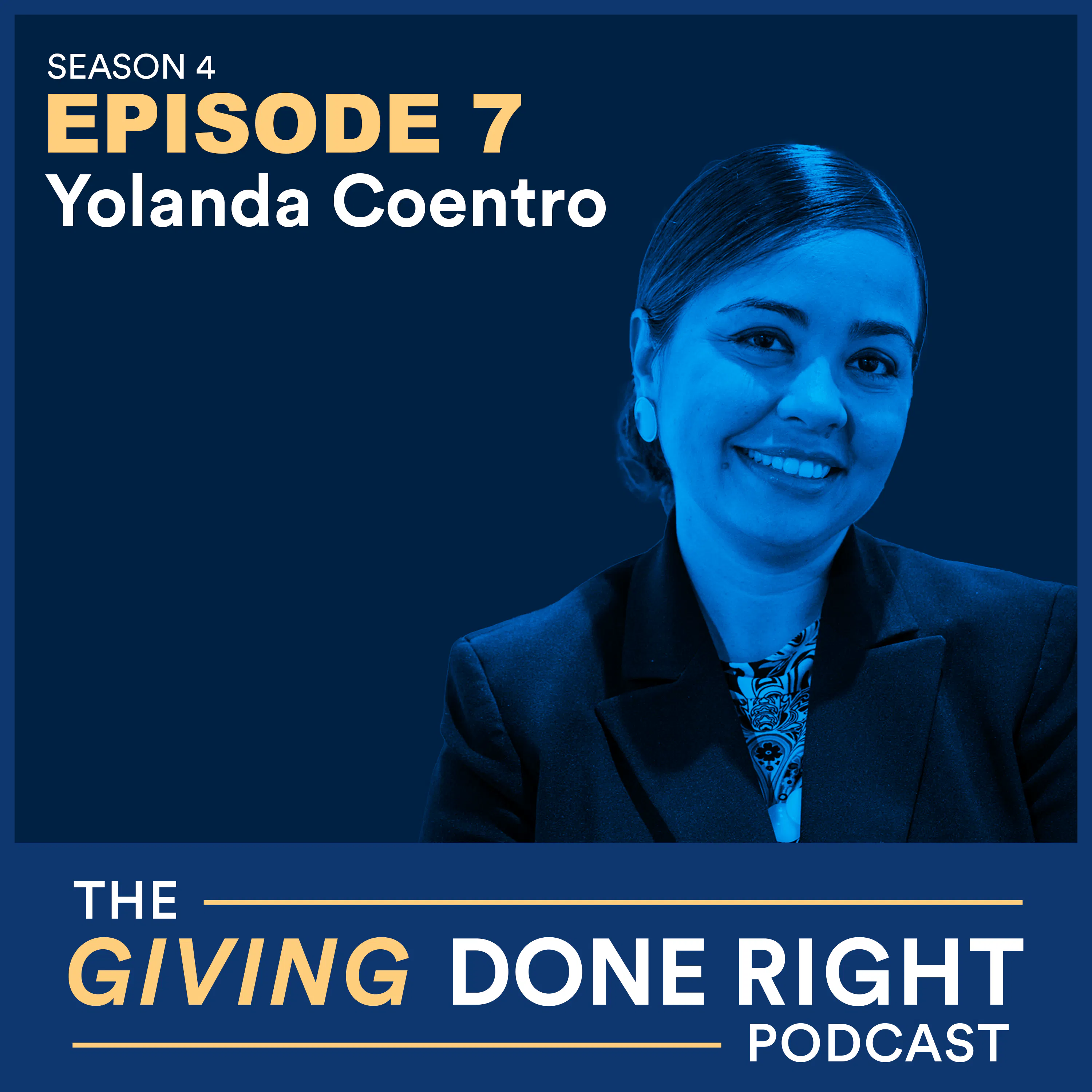
Yolanda Cointro is the president and CEO of the Institute for Nonprofit Practice, an organization that trains leaders for nonprofits, the public sector and social enterprises to make sure they have the skills, networks and resources to tackle the biggest issues of our time. They have great certification and cohort learning programs at all different levels of leadership across the country.
- [01:40]
Phil Buchanan
So full disclosure that I serve on Yolanda's board board of the Institute for Nonprofit Practice. Yolanda also serves on a advisory board for center for Effective Philanthropy. Yolanda, welcome. So glad you're here.
- [01:53]
Grace Nicollette
Welcome.
- [01:54]
Yolanda Cointro
Oh, thanks for having me. It's great to be with you guys.
- [01:57]
Phil Buchanan
Yolanda, you're as I have been able to see firsthand as a member of your board, incredibly talented. You could do any number of things. How did you come to this role? Tell us a bit about your story.
- [02:08]
Yolanda Cointro
Well, to not begin when I was just a small child. I'll fast forward a little bit.
- [02:16]
Phil Buchanan
We care. We care.
- [02:18]
Yolanda Cointro
In all seriousness, you know, I ended up here, I think, through a set of serendipitous opportunities that really aligned for me and my values. I started as a community organizer out of graduate school. I went to school for social work and kind of quickly got into human services after learning about the incident outs of organizing and also what made it really difficult to work within a small activist organization and some of what systems and such were missing that I wanted to learn about. So I went into a large human service organization, kind of the complete opposite of being a community organizer. And I grew up there. I rose the ranks, kind of moved into middle management as a professional. I was doing diversity consulting work back then. That's all it was Just the D. There wasn't any other letter associated with it.
- [03:16]
Phil Buchanan
Right.
- [03:17]
Yolanda Cointro
And I had the opportunity. As I was thinking about, you know, how do you become a CEO? I felt like I hit a roadblock or a ceiling. I didn't have people in my networks and in my life who had risen to the top of leadership in any sector. You know, I didn't have CEOs at my kitchen table. And so I went to the head of HR at the organization I was at at the time, the home for little Wander. She was like, have you thought about grad school and going to get your mba? And I was a little bit like, man, I'm an organizer and a social worker. Like, I have to go get my mba. Like, I have something to offer. I think I've been offering it. But also, how was I going to pull that off? The cost of graduate school? I had a young child, just had a baby. I needed to work full time. And I was like, that's just not in the cards for me right now. And she was like, well, I met this guy, Barry Dim, just last week, and he runs this kind of mini MBA program. Maybe you should go talk to him. And so the rest is history. Barry Dimm's our founder. I met him. He enrolled me in the class. I took it, and it changed my career trajectory and really is what led me here. I felt completely indebted to this place, to this community, and just got involved right from the moment I graduated and have obviously stayed involved. I tell people, like, results not typical. If you come through our programs. Not everybody gets to be the CEO, but it happened for me. That's great. Yeah.
- [04:51]
Phil Buchanan
Let's actually go back even a bit further. Why community organizing? Why not investment banking or consulting? There was an earlier choice you made about wanting to do work that contributed to making communities stronger, to making the world a better place. Can you give us a little insight into why that choice?
- [05:14]
Yolanda Cointro
I watched growing up, how my parents struggled. Both of them immigrated to the U.S. you know, were learning English and trying to kind of navigate the work world and their local community and society. And times were tough for us. And I remember as a kid kind of watching the multitude of injustices that they faced. And I didn't really know how to make sense of it all at the time. You know, what were the words, what was happening? I knew it was wrong. I knew I didn't want those things to happen to other people. But my mom had this opportunity through a good friend of hers to get me into this program called Brown Summer High School. It's at Brown University. And I grew up in Rhode island, and so she sent me to this program. I got it for free. And I was like, oh, my God, I have to go to school in the summer. That sounds like hell on earth. But I went and I took this class, and it was called Whose Dream Is It Anyway? And I read the House on Mango street in this class, and this little girl in this book, Esperanza, everything about her and the stories within that book by Sandra Cisneros resonated for me. And I realized what I wanted to do was to help people realize this American dream, to combat the things that I saw my own family face. And, in fact, my mom still has the paper, but one of the projects was you had to write about what you were gonna do as you grew up. And I wrote a paper about how I was gonna become the first woman president, and I was gonna embody the values of Martin Luther King. And now I'm like, please hide that paper. No one should see it. That's amazing. But. That's Right, but now a few people know about it. Now a few people know about it, but you don't know where to find it. I'm just saying.
- [07:12]
Grace Nicollette
That's amazing. Thank you so much for sharing that. I mean, one of the reasons why we wanted to have you on is because I think that sometimes donors don't really know how to think about the nonprofit sector. Right. They might be familiar with the nonprofits that they themselves support. But, like, what are nonprofits, and how exactly does it all work? And your particular focus is on leadership in the nonprofits, and we really wanted to have you on to just, like, pick your brain about the sector of nonprofits and also the leadership of nonprofits that they support.
- [07:44]
Yolanda Cointro
It's a great question, because it's not the sexy topic. Right. It doesn't pull at the heartstrings in the way that so many causes in the nonprofit space do. We're not feeding the hungry, housing those who are experiencing homelessness. And so it can feel really heady to a donor who really wants to understand what's their direct impact on the work through their giving. But I think the folks who understand our work and where it resonates, and it's probably similar for your work, they understand that investment in the people who lead is a leveraged investment. Right. The first thing we say when an organization fails or they don't realize their goals and objectives for communities is that the leader failed. So if we believe that. If we believe that organizational success and Community change requires a set of leaders who are effective, who are connected, who have values that we espouse to embody as a community and a country. Then why wouldn't we invest in them? You know, you make an investment in the programs, you make an investment in the people. I know folks like Rusty Stahl at Fund. The people talk about that all the time. That's why a donor really should care. Because these are the folks we're counting on to make these changes, and they need support and backing. And this kind of support and investments in the people doing the work aren't big baked in to organizational budgets and strategies because we don't have profit that we can then deploy or resources we can deploy to these kind of extra things. And so we require our donors to pitch in and to help us invest in those areas so that we can be strong organizations and run thriving businesses that really impact the community.
- [09:38]
Grace Nicollette
What would you say though? I mean, like, what is the exact profile of a strong nonprofit leader? Should it be someone with an MBA to your earlier comment, or tell us a little bit more about like, what is unique about the leadership training of a nonprofit leader?
- [09:53]
Yolanda Cointro
You know, we have folks in our programs who have MBAs, and then we have folks in our programs who didn't go to college, you know, and a wide array of people are represented in nonprofit leadership. And I do think what we often look for is content expertise or lived experience and the combination of the two things. And when you to enter our sector, you might be a social worker like I was, or an organizer like I was. In the beginning, you didn't have the business acumen, but you were great at your job. People kept promoting you, and you didn't get resources around training or executive coaching or any of these things. You didn't know how to actually set up a budget or put together or a marketing plan. But there you were because you were talented. You got the work, you connected with the people that you served in ways that no one else could. But maybe you didn't have the business acumen or you didn't know all of the different tools and resources you could access to run your organization. And I think that's where places like us come in, because we want to invest in and deeply value the people who are coming into the work, who deeply get the work, their values aligned. They have the experience and the content expertise on what it takes to create social change. And so what if they don't know how to like yet build a budget and they didn't take finance in undergrad we can fill those gaps. It's actually much harder to fill the other ones. Right?
- [11:27]
Grace Nicollette
Yeah. I mean, it sounds like there's the technical skills, but then there's also just the proximity to the issues that may not be able to be taught. That's really powerful.
- [11:36]
Phil Buchanan
If it were the case that all you needed to lead a nonprofit was what you learned in business school, then I suppose we wouldn't need places like inp. But I remember being a few years out of business school, on a panel at the business school I went to with a nonprofit leader who was asserting to a group of pretty confident, maybe a bit overconfident, MBA students that everything that they were learning in this business school was going to set them up to be a great nonprofit leader. And I said that's a crock, actually, because you learn how to measure performance by looking at the financial statements in business school, you don't learn the really challenging realities of how hard it can be to assess performance when you're a nonprofit working on a complicated issue. You learn about strategy in business school from the standpoint of competitive dynamics and strategy being particular to a company in the nonprofit world, strategies actually have to be shared, and there's collaborative dynamics instead of competitive dynamics. So many things are different. And if I've said it once, I've said it a hundred times, and I've probably said it a thousand times, I really believe that leading a nonprofit takes everything it takes to lead an equivalent size business and a bunch more. It's a harder job, not an easier job. Which is why I think what you do, Yolanda, and what INP does is so important. And, like, I'm curious if you could bring that to life for us a little bit. Like, tell us about somebody, a leader who went through one of your programs and how it affected them and how it ultimately shows up in terms of the work in communities.
- [13:21]
Yolanda Cointro
On your point of this being business school and then some, and the some being so significant around the complexity of running organizations in this field. I just want to kind of double down on that. I've heard you say that very point in other contexts, and I think it's important for folks to understand that. So, you know, it's part of the reason why the way we've modeled our work is that we have leaders who are practicing in the field, teach the leaders who come through our programs, and we don't have, you know, academics or folks who are just kind of professional facilitators running our programs, because the real work is on the ground. The learning is on the ground. The magic of our programs, unlike when you go to school, is that you're with a bunch of people who are already in the work, in the sector with the messiness, and they're teaching each other ultimately, and they're each other's lifelong connections. And I think that's what we see, you know, on larger scale or kind of a community scale, it's the feeling of never being alone. When you enter a room, whether it's with funders where you might be the only person of color, and then you're like, wait, there's an INP friend. I see them. Or it's in big networking events where you're like, man, where are my people? Like, if you've gone through inp, you probably have some of your people in there. And I think, Phil, you've probably seen that in some of our collective rooms. And so I think at the community level, that sense of belonging and network building and power building because you're in the work with others is priceless. And then on the personal level, there are so many stories of folks who've come through the program and gotten promoted, or they've come through the program and really learned how to set up their budgets strategically, not only for the current year, but the next, and so they have a healthy financial outcome in their next fiscal year. We had a student who went to a CEO job interview, and there was another friend that she met through the network who was the other candidate. And they accidentally ran into each other. And what's amazing is, both women of color, in the end, they were like, I hope you get it to each other. One of them got it. The other one showed up at her welcome party and also got another CEO role. And so that's the thing, too. When, you know, the humans that you lead with, you disrupt the competition that we often feel with each other. You lift each other up. And I think in such a polarized and divisive context that we're all working within, you know, politically, but also within our own work. And as we engage in trying to work with funders in philanthropy, that happens so much where we don't see each other's humanity and we compete. And so, you know, I was just with a group of other leaders who have life experience in being in prison and being incarcerated, and they've all done run different organizations now or launch their own thing, and they're sitting in the room thinking, like, how do we work together? And can we. Do we have to compete? Or how could we approach funders together? And so When I see all of that happening just because we're creating the spaces, I love when people are like, yes, I know how to, like, write a marketing plan or institute a diversity and inclusion strategy and implement that into my organization. Love that. But then where we can, like, really break down these, like, polarized and broken relationships, that's where I think you can't do that without intentional spaces, and we need that right now.
- [17:19]
Grace Nicollette
That's so powerful. What would you say, like, for donors who have been working with nonprofits for a long time or even identifying new projects, like, what do they look for in a nonprofit leader? To know that this is a strong leader for the organization? The criteria could be different, that we should be thinking about these local leaders who are close to their issues. So give us some advice for donors who, if they're not already proximate to these communities, it may be hard for them to assess. Is this leader doing a good job?
- [17:49]
Yolanda Cointro
Yeah, it's a tricky question, because what constitutes a good job can vary, right? Organization to organization or cause to cause. And so in some ways, I would say, I don't know that there's like a one size fits all answer to that, but maybe there's an approach at input to train everybody in appreciative inquiry. And it's this approach around, like, asking questions that start not with, like, where are the problems and where are the challenges, but where are the possibilities and where are the bright spots and what are you learning from what's going well? And then, of course, it's not in the absence of understanding, like, where might you be struggling that I can help. But I think the approach is, you know, a leader is successful or that you can kind of trust and count on them if you build a relationship with them and you. You hear their responses and you watch them in the work, and maybe you can actually visit their program and hear from the people being served. But I think it really depends on the type of organization. And I know that's not a particularly helpful answer, but digging deep, like, get to know the person, get to know the team, get to know the work and try to do it in a way that doesn't overburden them. You know, give them a shot and see how it goes. See if they can share with you that your investment in them actually moved the needle somewhere.
- [19:16]
Grace Nicollette
Right. It's not like there's like that one silver bullet. Like, it's not share price or like the bottom line.
- [19:22]
Yolanda Cointro
It's exactly. You're not like, I read your 990. That looks good Check. You're on. You know, you got the gold seal of approval on candid check. You know, like, it's not that easy. Cause I think you'll also meet leaders who maybe are struggling in particular areas of kind of managing the business, but their vision and their engagement with the community is like, superior to anyone you'd ever meet. So maybe there's a way you could help invest in their capacity in those other areas. All leaders want to succeed. I mean, I fundamentally believe that that's true. Nobody's in the seat because they're trying to fail. They want to succeed. So figure out how you can help them if you care about the cause that they're working.
- [20:09]
Grace Nicollette
Don't go anywhere more after this break.
- [20:24]
Yolanda Cointro
This episode is brought to you in.
- [20:26]
Grace Nicollette
Part by the Fidelity Charitable Catalyst Fund, which believes that when donors and local.
- [20:30]
Yolanda Cointro
Nonprofits partner together, communities flourish. The fund focuses on elevating organizations that engage donors with education and community connections. Learn more@fidelitycharitable.org.
- [20:47]
Grace Nicollette
Hi. Keeping Done right listeners. It's Grace. If you've been enjoying our show, then I'm excited to tell you about no Small Endeavor, a show from Great Feeling Studios and prx. No Small Endeavor is all about exploring what it means to live a good life. Each episode, award winning professor Lee C. Camp brings you thoughtful conversations with guests like the actor Martin Sheen, Angela Duckworth, the author of the book Grit, and Special Olympics board chair Tim Shriver about what it means to flourish. So go ahead, follow no Small Endeavor wherever you get your podcasts and tell them Phil and Grace sent you.
- [21:29]
Phil Buchanan
We know that burnout is a problem. You know, we just put out a report at CEP earlier this year. We see in our data high levels of concern on the part of leaders about the burnout of their staff, high levels of concern on the part of nonprofit leaders about their own burnout, and a sense that that is more intense than it was even a year ago. So what do you do to counter burnout? I know you have seen in your own surveys of folks who go through your program, and it speaks to the relationships, combating the sense of isolation that leaders can feel. That actually makes a difference, that folks report lower levels of burnout after being through that kind of program. But donors often, you know, they want to say, well, am I supporting programs? Tell me how many additional folks we reached because of my grant. But actually that can be shortsighted relative to investing in the ability of leaders to develop and grow. Right. And so what's your take on the burnout issue and sort of the state of nonprofit leadership today. How concerned are you based on what you see? Because you have an incredible perch to see across so many different organizations and leaders.
- [22:45]
Yolanda Cointro
You know, we have about 4,000 or so alum around the country at this point, and obviously as we've been scaling, that number is quickly growing. But we do have a kind of a feel for what does our network look like, and then a feel for what's happening in the context of our sector and where do those things kind of align or not? And to your point, we'll be coming out this fall with a white paper that we've put together on well being, and a big portion of that is burnout. I'm always reluctant to use the term wellbeing because I'm sure for some of the donors listening too, it's kind of frustrating. It's become the trendy word and it encapsulates many things. But we're really looking at several factors related to organizational and staff and leadership well being. And one of the things like you said that came out is we saw that our alum relative to the general population were faring better around burnout specifically. And what they were saying in phone and through our surveying is indicating that this is because of a sense of connection. But also I think what donors need to understand today about why investing in leaders, in capacity building, in the talent in the sector is so important now probably more than ever. And I feel like we say this term a lot whenever we're making a pitch, now more than ever. So I'm just. But sometimes it's true, Sometimes it is true. And look, we're coming off the heels of a pandemic, A racial reckoning, inflation, politically polarized times. I mean, have we seen the perfect storm of these things in our recent lifetime? No, we haven't. Organizations literally had to redefine everything they did in a moment's notice and then redefine it again and again, and they didn't have the tools to do it. So part of what my assumption is, and we're studying this more about what people have gotten through our network, what leaders needed to keep their organization healthy through our network. It's a few things. One is the network you could call on a friend, you know, other leaders who are not in your field, but who are leaders in the sector or who are maybe in your field in other cities or states, and you can reach out to them and be like, what are you doing? How are you keeping your theater going in the middle of a pandemic? Right. And you can get resources immediately on how to run the business. I mean, we were running things like how to get a PPP loan, how to work through a crisis and manage an emergency situation, how to create a contingency plan. I mean, all these things that, like, no one got at school because we weren't planning on a global pandemic and all that followed afterwards. And so I also think that people were burning out less because they had tools, they had a community, they had people to be with through this really challenging time. I mean, I remember groups of students in New York gathering and kind of moving through different topics. And they were talking also as we opened up those classes about how they had to go to work because they were feeding kids who needed lunches delivered to them because they wouldn't get fed because they were no longer going to school. And they were walking as they went to work by trucks filled with bodies. And they had to show up and they had to lead and they had to figure out what their business model was and how they weren't gonna lose their staff, some of whom were becoming suicidal. I mean, so it's so complicated. So I think that's why, you know, donors to be thinking now about these organizations and these leaders are in a place they've never been, and we have solutions to help them move through this time in ways that are flexible, adaptable and timely and relevant. Not go get your MBA and learn that finance class, but actually right now, how are you gonna navigate this new moment in time? And wow. I think that's why these investments are so important.
- [26:57]
Grace Nicollette
You know, sometimes when we talk to donors, they have questions about like, the capacity of a nonprofit to like, do the work. Right? And that's always like a very nebulous kind of concept, but real, right? Like the capacity to take the money and also grow or scale. How do you think about nonprofit capacity? And how can donors build the capacity of the leaders that they support?
- [27:19]
Yolanda Cointro
So capacity, it's another one of those words like well being. It has many components, right? And it can mean different things at different times to organizations, but it could be building the capacity of an organization around a functional area. So maybe they need to strengthen and reinforce their fundraising shop. Maybe they need a new message or a new website. Maybe they need their HR department to get some resources to do a compensation study or to look at diversity measures in their organization and do a diversity audit. All of those things cost money that we expect organizations to do and do well and kind of represent our donations and our investments. Well, those are capacity building kind of Projects in terms of building the capacity of people. Then there are investments in their professional development, in their network building, in coaching and mentoring. And so I think about capacity building as really like, what is the organization or the talent within the organization need to remain strong or to move even further in a direction of growth or deeper or expanded success? And they don't yet have the tools or kind of support they need to make that jump. It's not built into their operations. So how can we build it in and build their capacity and invest in that capacity? And it has, like, organizational and kind of talent impact that way.
- [28:54]
Grace Nicollette
Yeah.
- [28:55]
Phil Buchanan
One of the issues in terms of the nonprofit sector, broadly, historically, has been that the leadership is not as diverse as the country and often even less diverse than the communities that an organization might be serving. And, of course, there's great variation. I'm generalizing, but you were talking about the pandemic and the crises and the racial justice reckoning. And we saw this period where it looked like funders and nonprofits alike were really prioritizing racial equity. Dei. And that looked like a lot of different things. And we saw it. We documented the change at cep. We saw funders directing more resources to organizations serving certain communities, in particular black and Latino, less so indigenous and Asian American, actually. We saw more focus on organizations led by people of color. Lots of conversation about that. We saw changes to processes on the part of donors and foundations, individuals, institutions, to try to make sure they weren't just talking to the same people in terms of the network of grantees and potential grantees. And then, of course, we saw an orchestrated backlash societally to the focus on. On racial equity as well as in the sector. Right. And we saw, first it was critical race theory, but now it's actually DEI that has been seized upon, caricatured, and sort of demonized. Right.
- [30:28]
Yolanda Cointro
Yeah.
- [30:29]
Phil Buchanan
So this is creating a lot of challenges for leaders, and perhaps in particular for leaders of color, often reporting to boards that are maybe majority white with all kinds of conflicting signals about, do emphasize dei, but actually don't tell us about your story and your identity in this venue, but maybe not in that one. And I wonder how you see this very fraught feeling moment in our society and in the sector where we literally have folks who are trying to stop us from teaching the history of this country. Right. And the role of structural racism in getting us to where we are. And can you say a little bit about how that shows up for leaders? And then we've got legal cases working their way through the courts. It's like, it's complicated. That was way too long a question.
- [31:24]
Yolanda Cointro
And it's a long question maybe because it's so complicated. I know you and me have talked about this so much in the past, about just as it's evolved over these last few years. I remember when this was, like, not on the table at all. No one talked about race. I mean, we always did. We were kind of, you know, we were founded that way. We're gonna diversify the sector, but we were always gonna be inclusive of all races. And that was our founding. But I remember sitting in foundation meetings in different convenings and being like, everybody cares about diversity and inclusion, but we're not talking about race. So then the movement went into, let's start. Start taking demographic data. And that was a push for, like, years. Then there was a racial reckoning. And then I think the nature of the conversation, combined with just the political polarization we have faced over these last seven years really has resulted in a set of, like, burdens that people have been less open about how they're feeling about these trends in terms of at least the leaders that we serve with funders and even with one another, because the tide is changing so quickly, it's hard to keep up. And then you're afraid that if you put your cause out there in a way that's super clear around anything related to deib, that you could become a target. And how would you navigate that? On the personal level, I think you have. Have leaders who are just both appreciating the philanthropic context, moving towards, let's make sure we're funding communities of color. Let's make sure we're funding leaders of color. Let's not let our bias impact how we fund all really good things. But now we've taken kind of the blunt instrument around how we invest in organizations based on race in a way that's reduced the nuance and complexity so much that now leaders are kind of carrying that burden. And I think feeling, you know, that your race is front and center, your personal identity is front and center, that it is your validator for your work, not your knowledge or expertise. You know, we're the sector that would often make fun of everyone who would tokenize people. And then somehow, I feel like along the way, we've created all these instruments to respond to this moment that may be actually also tokenizing people. Right. And they're carrying that burden. And they can't tell funders and they can't tell community members because they're sitting in this seat. But I know that that's contributing to a lot of people's burnout. White or people of color? White people are dismissed and they're leaving their leadership post. Cause they're concerned that there's no place for them and they shouldn't even be. You've got people of color who are having to use their personal stories so deeply and so often that it's kind of like just putting yourself on blast all the time. If, like, you don't have to do that in other sectors.
- [34:49]
Grace Nicollette
It's extractive.
- [34:50]
Yolanda Cointro
It is, it's like, you know, so I think we're seeing the research is coming out about the effect of that. And then, you know, the other thing we've talked a lot about internally and trying to figure out, like, what's the right answer. So I wouldn't say that I even know what the answer is. But we want to collect data, we want that data to be transparent. But there are real ramifications to having leaders putting their demographic data in places where anybody can access it. And I think we have to start talking about that, you know, for donors.
- [35:27]
Grace Nicollette
Who really care about these issues. And maybe, for instance, serving on boards of nonprofits that are serving communities of color. Like, what advice do you have given what you just described? I mean, it is such a complex and tense place to be. Like, what are some paths forward?
- [35:45]
Yolanda Cointro
You know, we've talked a lot in the trust based philanthropy movement about the importance of conversation and relationship. And different leaders have different perspectives on what, what they want and are willing to do relative to their own personal identities within the work, but then also what they need for their organizations. And so I do think conversation and dialogue is a must right now. And having the courage to just open this conversation up for them, what's their experience in it and what do they need? Do they need privacy and support or do they need a platform and to tell their story? People need to have choice. And we're starting to take some of that away. I do think it's important for funders to collect demographic data and understand it. But if you think about like our demographic data was always like locked up in a file cabinet in hr, right? It's like, that's like super private. That's like your Social Security. I know some of us wear it and we can't hide what our identities are per se. But that doesn't make it okay for employers or, or funders to say, you must put all those things out there about yourself. We have folks in our network. You know, I'm thinking of somebody right now who literally has received death threats if their profile is up on a donor website, they put their. And I won't, you know, throw anyone under the bus here, but, like, they put their information on a website that donors get access to their. Their race identity, gender identity, everything's on there. The cause that they fight for is on there. They become a target, and they have become a target. And so they don't have a website anymore. They don't put their information anywhere. But for some funders, that's like a requirement. And so if you do that, if you require people to have to put themselves or their staff or their board identities somewhere public, when we don't know what's going to happen with AI, what's happening with people in the world who can just access this and then make you a target, what's happening legally around the scene with DEI and what organizations could come up against. We don't realize that our instrument to do the right thing actually can really hurt an organization or the leader. And we have to ask questions of them about that. And I'd really encourage donors to do that.
- [38:16]
Grace Nicollette
Wow. You know, that just speaks to just how bonkers the environment, because the desire to gather demographic data at its core is a great thing. Right. You want to understand whether groups of people that you're giving to are having different experiences than others. And we see in our work that unfortunately, certain groups of people tend to have different or worse experiences than others. But what I hear you saying is that that can be really weaponized. I think that that conversation that you describe of really talking about, how is this data gonna be used, how do you get the benefits without the harm, seems to be a really important conversation for donors to have.
- [38:53]
Yolanda Cointro
Well, and can you collect the data but think about how to do it differently? How do you learn and report on yourselves but not make the grantee report on themselves to the world? Right. So I think we've almost. We tried to fast track it and be like, well, if all of philanthropy and all donors could have access to all data, maybe that would help people get funding and maybe that'll help us drive philanthropy to the communities who need it the most, who've been historically marginalized. But I think what we're hearing, like, behind the scenes, the things that people don't want to say out loud is, thank you for knowing that that's an issue. You need a better tool to do it. Because I don't want to put myself, my safety, my staff safety, their personal information, whether it's their Social Security sock size or their race or gender out there. And there are nuances, right? We don't think about, like, do nonprofits even have the resources? You guys just put something out about Ford and how they actually collect demographic data and what words they use when they serve a global market. Like, such an interesting conversation to have. So what if nonprofits don't have all the right words? What if they capture data for their employees, but don't ask their employees to self identify? Then they put that data into a public profile, and now somebody's identifying me out publicly without even asking me. And what if they got it wrong? So I just think there are all these technical implications that our donors really need to think about. It's just not as simple as it sounds. And it's enhancing this level of burnout, especially that leaders of color and other marginalized groups are facing.
- [40:44]
Grace Nicollette
So, Yolanda, if I'm a donor and I'm listening to this, they're like, all right, folks, I just wanted to write a check. I just want to do good. And now you're telling me there's like, not even like a handful of things that I could just like, totally rest my laurels on to know that it's a great nonprofit, that it's like a lot of time, a lot of relationships, a lot of nuance, a lot of complexity, and then if I don't do it right, I get blamed. And so I'm curious, channeling a donor and on their behalf, what do you say to donors who just like, you know, I just want to do good, but, like, I don't know if I have time for all this.
- [41:23]
Yolanda Cointro
Good question. I think you know what I would say. And you know, as somebody who really appreciates the trust based philanthropy movement, for the simplicity and the specificity of those practices, folks can check out the Trust Based Philanthropy Project. I'm on their kind of group of advisors there as well, or ambassadors. So full disclosure there, but these are a set of practices that help donors think about how to engage in relationship building and investing in ways that best support nonprofits. And these practices are simple, you know, for a donor to consider. How are they building relationship with their grantees? Are they asking leaders what they need in order to realize their missions? And if they're behind the mission, then fund what's needed and the work will get done. It doesn't need to be that complicated. Right? So I know we've brought up all the complications, but we know the organizations who are doing good work. We can make investments and kind of test our investments because we care about those causes deeply. And if you get to know the leader, then you back them to do their work better and better year over year year. And sticking with them for a bit of the longer haul right now, I would say too, is advice I would give. It's a tough time and leaders that you care about, the causes you care about now, need you now as we kind of navigate whatever complexities coming our way over the next few years still coming out of what we've faced in the last few.
- [43:00]
Grace Nicollette
Yolanda, thank you so much for joining us today.
- [43:02]
Yolanda Cointro
Oh, thanks for having me.
- [43:04]
Phil Buchanan
Thanks Yolanda. This was great.
- [43:05]
Yolanda Cointro
Thanks Phil. Appreciate it.
- [43:17]
Phil Buchanan
There are so many resources about effective giving on the center for Effective Philanthropy's website, cep.org as well as givingdoneright.org where you'll find all our episodes and show notes.
- [43:29]
Grace Nicollette
You can also send us a note@gdrpodcastep.org.
- [43:34]
Phil Buchanan
We want to thank our sponsors who've made this season possible the Fidelity Charitable Catalyst Fund, Fetzer Institute, the Walton Family foundation, the John Templeton Foundation, Stupsky Foundation, Colorado Health foundation, and Archstone Foundation. If you like the show, please leave us a review on Apple Podcast or invite a friend to listen.
- [43:55]
Grace Nicollette
Giving Done Right is a production of the center for Effective Philanthropy. It's hosted by me, Grace Nicollette and Phil Buchanan. It's produced by Rococo Punch. Our original podcast artwork is by Jay Cuska. Special thanks to our colleagues Sarah Martin, Molly Heideman, Chloe Hesket, Naomi Rafal and Sei Darling for their marketing, research, writing and logistical support.
- [44:19]
Yolanda Cointro
Sat.