← Glass Half Full with Craig Melvin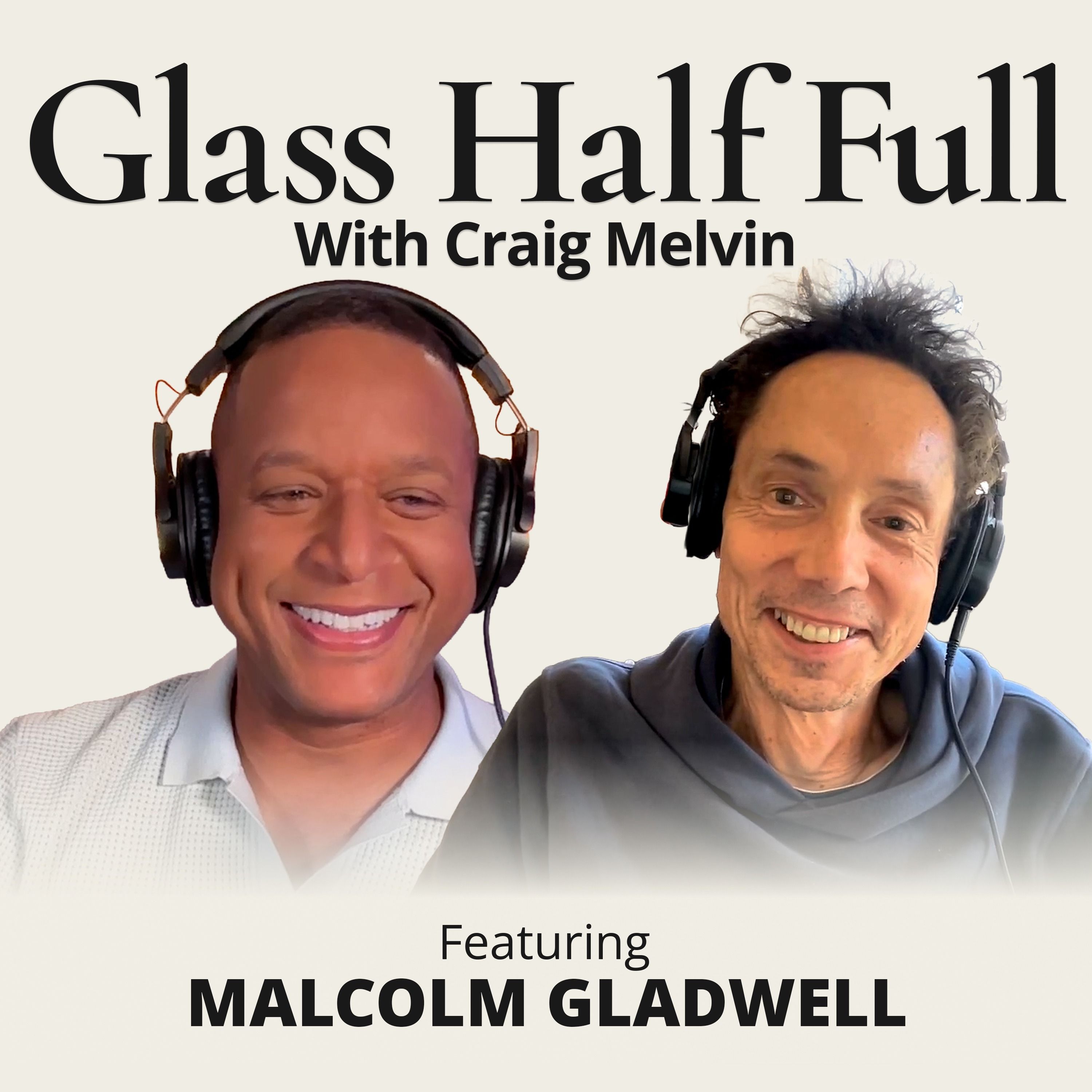
Glass Half Full with Craig Melvin
Malcolm Gladwell on Becoming a Dad at 60 and Why America Won’t Talk About Its Biggest Crisis
00:41:41
Bestselling author and journalist Malcolm Gladwell sits down with Craig Melvin on this week’s episode of Glass Half Full for a conversation about identity, fatherhood, and the courage to change your mind. He explains why he refuses to apologize for rethinking his own ideas and details key insights from his latest book, Revenge of the Tipping Point, including what Harvard’s 40-plus varsity sports reveal about elite admissions. This episode of Glass Half Full originally aired on June 2nd, 2026.
Loading summary
Transcript108 lines
- [00:01]
McDonald's Commercial Voice
Hear that? That's now crispy McCrispy strip meeting creamy Caesar sauce. Sounds extra. Crispy caesar sauce at McDonald's for a limited time. Ba da ba ba ba.
- [00:21]
Craig Melvin
Hey, everyone, Craig Melvin here. Just wanted to let you know that we're taking a short break from new episodes, but we will be back in just a few weeks with some brand new conversations. In the meantime though, we're gonna bring back my conversation with best selling writer Malcolm Gladwell. We went places I genuinely didn't expect. I hope you enjoy it and I'll see you right back here soon with some new episodes of Glass Half Full. Hello there, Craig Melvin here. Welcome to my basement bourbon bar and welcome to our little podcast, Glass Half Full. This is where we, you know, look at the milestones and the moments that really shape people's lives personally and professionally. And I'm really excited about today's guest. I have been reading Malcolm Gladwell for years. He's got a new book out. It's called Revenge of the tipping point. 25 years after the original book, the Tipping Point, but outliers blank. He's been writing books like this for a year where he tries to take complicated issues and really distill them into digestible bits and pieces. We talked about that. We talked about some of the concepts that he has introduced into our sort of lexicon, if you will, in society over the last few decades. But we also talk about him being a father of two in his 60s, and we also address some of the controversies that have surrounded some of his writings and thoughts over the last few years. It was a really fascinating conversation and, and I hope you enjoy it. Malcolm Gladwell, thank you for your time. I think you probably know how we start this show. It's called Glass Half Full. So we start with a toast. I'll be drinking my usual and I believe you're toasting with your cappuccino. Cappuccino. All right, cheers.
- [02:23]
Malcolm Gladwell
Cheers.
- [02:24]
Craig Melvin
Let's start with the tipping point, the original tipping point, because I remember reading it years ago and I walked away feeling hopeful, optimistic even, that, you know, all of this could be changed. Is that, is that how you felt at the time?
- [02:45]
Malcolm Gladwell
I think so. I mean, I think it was, you know, the late 90s are this kind of magical period. Cold war ends, crime goes away. Teenage pregnancy, which was a thing everyone was obsessed with, vanishes. One social problem after another, one geopolitical problem after another. Do we have a balanced budget at some point in that era? I think we did maybe a little bit later. It's like, how could you not have been optimistic in 1999, 2000? The single biggest problem of that era was Y2K.
- [03:21]
Craig Melvin
I remember
- [03:25]
Malcolm Gladwell
the illusory fear that a minor software glitch would cause. You know, I don't even know what. I can't remember.
- [03:34]
Craig Melvin
Worldwide catastrophe.
- [03:36]
Malcolm Gladwell
I know, but like in today's. We would. We would shrug that off in 10 minutes today because we have such bigger things to worry about. That's what we were worrying about back then. It's very different time.
- [03:46]
Craig Melvin
Are you as hopeful and optimistic today as you were when you wrote the original Tipping Point?
- [03:52]
Malcolm Gladwell
Well, I'm more hopeful and optimistic, personally, but less hopeful and optimistic when I think about the world, if that makes sense.
- [04:02]
Craig Melvin
It does. But expand on that. Why are you more optimistic about your own life and not as optimistic about the lives of others?
- [04:11]
Malcolm Gladwell
Well, I'm happier, more settled. I have a family that I adore.
- [04:19]
Craig Melvin
You started late. You started very late.
- [04:21]
Malcolm Gladwell
I know, I know.
- [04:22]
Craig Melvin
By the way, kudos to you for becoming a father in his late 50s.
- [04:28]
Malcolm Gladwell
I know, I know. Kudos is one way of saying that. No, they are actually there. There are many things about being a late father that are. Because I'm so much more. You're more settled.
- [04:41]
Craig Melvin
Yes.
- [04:42]
Malcolm Gladwell
So I don't have, like. I don't have my. When my kids freak out. It doesn't actually freak me out in a way that it would probably would have if I was 25. I like where I'm living. I like people I work with. I don't know. I don't really have any complaints with the way. Whereas in. If you talk to me in my 30s, when I wrote the original Tipping Point, I think I was, you know, I was like a kind of typical mid-30s, not really knowing what was going on with my life kind of person. So I was a lot more unsettled, personally, in that era.
- [05:14]
Craig Melvin
For folks who aren't familiar with the concept at all, in the simplest of terms, a few sentences, what is a tipping Point?
- [05:23]
Malcolm Gladwell
It is. I mean, it is used most frequently in a context of epidemics, and it describes the fact that epidemics do not increase slowly and steadily over time. What happens is they kind of shuffle along at a very low level, and then they hit a kind of critical moment of a moment of critical mass, and they explode all at once. So Covid is this kind of rare, slightly scary thing circulating in, excuse me, central China in December of 2019, and then by February of 2020, the whole world is terrified. That's a very typical trajectory for an epidemic. But goes from central China to everywhere, all at once. That's a tipping point. And that happens whenever you have a contagious phenomenon that follows the principles of epidemics.
- [06:25]
Craig Melvin
We're going to come back to the book in a moment, but the podcast is devoted to taking a look at the moments and in some cases the milestones in a person's life that shapes who they are, shapes who they become professionally and personally. And as you look back on your 60 plus years of living, is there a moment that you look back to and you think, ah, that was when I really started thinking about becoming a writer, becoming a journalist.
- [07:03]
Malcolm Gladwell
I almost feel like if you're really honest with ourselves, we would say that there are pivotal moments that we navigate every week, if not every day.
- [07:11]
Craig Melvin
I would agree.
- [07:12]
Malcolm Gladwell
The one that came to mind was when I was starting out in journalism in my. I was at the Washington Post and I was in my late 20s. I applied for and got. Was awarded the job of European correspondent for the Washington Post, which would have meant I would have moved to Berlin for something like three to four to five years. And I turned it down. And I really think that that was a absolutely crucial moment in my. In everything about my life.
- [07:54]
Craig Melvin
Why? How so?
- [07:55]
Malcolm Gladwell
I don't think I would have come home. I think I would have stayed. I think I'd be in Europe to this day because I'm not an American. I always wanted to move to still want to move to Europe. I mean, I think about all the time. I love Europe. I think I would have gone to Germany and I would have stayed in Germany or somewhere in. I think I would be somewhere in Western Europe to this day, if not somewhere else. Everything I got in, instead of taking that job, I took a job of New York correspondent for the Washington Post. And that's when I started thinking about crime and tipping points and lunch and met the, you know, all the, you know, I went to the New Yorker. And all those kinds of things that I think of as my career stem from the decision to go to New York as opposed to. To go to Berlin.
- [08:39]
Craig Melvin
And before all of that, Malcolm Gladwell grows up in Canada and you're a member of this small Mennonite community. And I've always known that you were mixed race. I did not know that your mother's Jamaican and your father's English.
- [08:58]
Malcolm Gladwell
Yes.
- [08:59]
Craig Melvin
Growing up, did you identify with one race more than the other? And I asked that because I've got biracial children as well, and I have heard that from time to time children do that in their formative. Years.
- [09:14]
Malcolm Gladwell
Yeah. You know, I really didn't. I didn't have. Canada's a very different. The kind of racial politics of the community I grew up in, in southern Ontario were so profoundly different from any thing I've experienced in the United States. That. And race was so kind of. There kind of were. No. There's no history of racial antagonism in that part of Canada. The few black people that are around tend to be recent West Indian immigrants like my mom. And there was a very small number of them. Particularly then there's a big wave of Jamaican immigrants, seniors to Toronto later in the kind of 80s, 90s. But it just never comes up. I mean, I have no.
- [10:07]
Craig Melvin
So you didn't grow up being aware of. Of racism?
- [10:11]
Malcolm Gladwell
No, never thought about it. My mom was welcome with open arms by this community. It was a very religious. A very kind of. It was a Mennonite community. And the Mennonites are exceedingly open in their. They have a. They. They have a. They really do take the idea of tolerance very seriously. It's a central part of their kind of approach to the world. And they are cosmopolitan in the sense that they're very actively engaged with the rest of the world. So my mom was not a. My mom was treated with open arms. She wasn't considered to be a curiosity or an oddity or an object of hostility. She was just because she was. I think because she was such a committed Christian and this was such a Christian community, that that was enough. It's like that's how she was categorized. She was categorized as one of them because she was someone who took her faith seriously. And that was the single most important thing in that community. I just never thought about it. And I remember once my mom had a friend named Joe Kennedy who was a Jamaican who lived in. I think she lived in Atlanta and came to visit my mom. This would have been in the 70s. And I remember overhearing Joe Kennedy say to my mom, you could cut the racism in Atlanta with a knife. I was like, six or seven. I had no idea what that meant. And it was such a kind of weird concept. Like, I didn't really know what racism was. The idea that Joe Kennedy, who's like, friend of my mom's Jamaican, came from a place where black people run the show. It wasn't like, racism isn't on your mind. If you grew up in Jamaica and she's reporting from the United States, which I was very much aware of, and coming back with this kind of verdict that was so shocking and foreign to Me. So. Yeah. No, I never. I didn't think about it until I came to America.
- [12:15]
Craig Melvin
It sounds like that was one of those moments where a seed may have been planted to a certain extent, that there was this foreign concept that was introduced to you at a very early age. Let's talk about the Revenge of the Tipping Point for a moment here, because you start the book and you end the book focusing on the opioid crisis in this country. Why use that topic to bookend it?
- [12:43]
Malcolm Gladwell
Because I felt like. And I still feel like the opioid crisis is one of those. There are certain things in America. If you were to be an alien, a Martian, looking down in the United States, what would you know? What would. What would strike you as being weird and strangest about.
- [13:07]
Craig Melvin
Well, I would. I would maintain that it's the fact that you have human beings walking around with poop bags, and we actually pick up the dog's poop and tie it up and throw it in the.
- [13:24]
Malcolm Gladwell
That would be on the list. That would be on the list.
- [13:26]
Craig Melvin
That would. I think aliens would be like, what the. What is. Who are these strange people? Yeah.
- [13:33]
Malcolm Gladwell
Well, a serious answer would be. I was listening to an interview I did for a podcast episode two years ago with a guy who was an ER doc in. On south side of Chicago, and he grew up in that neighborhood. Guy. Guy's name was Abdullah Price. Extraordinary guy. And he was talking about how many people who he knew, knew well, had been killed over the course of his life. He's in his 30s. And he said people that he would have had, who would have, you know, texted him at some point in the previous six months. He would be 35 and really, really close people, like friends. It would be 12. And I just thought that's the first thing that would be weird to the Martian. Like, wait, that's normal. Like, there can be somebody who's like a highly educated, sophisticated ER doc at a big teaching hospital in the south side of Chicago who is 34 years old and 30 people he or whatever it was, 35 people he knows have been killed over the course of his life. Like, that doesn't make. It makes no sense to me. And I'm. I know all about America. The Martian would be like, what? Just like, are you guys crazy? And the other Marshall thing, Martian thing would be, wait, 120,000 people died of overdoses. Like, last year, maybe in 110. I've forgotten, it peaked at 120. It's come down a little bit, but basically, we've averaged around 100,000 overdose deaths over the last 10 years or so. I think the Martian would look at that and say, wait, this is the wealthiest, most technologically advanced country in the world. Like, what is going on? And why aren't you talking about this every single day? So I wanted to start and end the book with the opioid crisis just because I just don't understand why it's not talked about. More like it just in the things we do care to talk about comparatively are so trivial next to the things we don't talk about. And I've never understood that.
- [15:41]
Craig Melvin
Well, do you think that's because it's easier to talk about certain things that are simpler to understand than it is to talk about things like the opioid crisis, where you're talking about addiction, you're talking about our healthcare system, you're talking about the perception of addiction. And by the way, I live in a family where my wife's cousin struggled mightily with opioid addiction for years and he died two years ago. And in and out of rehab and had resources at his disposal and just he couldn't, as my grandmother would say, he couldn't just get the monkey off his back. I do think we live in a time where we do view addiction differently than we did maybe 25 years ago at least, but it doesn't seem to have necessarily manifested itself into real world solutions.
- [16:47]
Malcolm Gladwell
Well, I would have thought at the very least you would see prominent people, people running for office, people in positions of leadership who would stand up and acknowledge it and say, I'm going to do my best to kind of come up with some better way of dealing with this crisis. I would have thought there was something to be, there would be an incentive for people to say things like that. Not incentive, but a motivation to say that. There doesn't seem to be any great motivation in public life for people to talk about that. And I don't have a good explanation for why that's the case to your point.
- [17:27]
Craig Melvin
I am interested as to why. I don't know. I mean, I think some of it's shame. I do. I think there are a lot of families where it happens and everyone blames themselves and they don't want to talk about it as a result of that. You also write about this idea of the magic third, explain that concept.
- [17:48]
Malcolm Gladwell
It's an extension of this sort of tipping point idea. And there's a lot of research that suggests that when we talk about social epidemics, the movement of ideas, the way that changes in behavior, what real dramatic differences start to happen when, when a, when a group reaches about 30% of the total. In other words, if you want to change the minds of Americans on gay marriage, you don't need to have 51% of Americans being in favor of gay marriage. You need to have about a third. And when you have a third of the population that is thinking about something and articulating their position and speaking up, that's enough to move the, you know, not a lot, not, not everyone else, obviously, but to kind of create a systemic change. And this has been. There was millions of examples of this about how group dynamics shift dramatically when you hit a third. It's why it has. I talk about this in the context of applicability to. What do we mean when we say we want to have diversity in an organization? And there's a big difference between having 5% of your organization not look like everybody else and having 25% not look like everybody else. Right. And the difference is when you got 5%, the people in that 5% cannot be themselves. They are other. They are stigmatized, scrutinized, also weirdly ignored, stereotyped, whatever. When you're 25% or 30% doesn't happen in the same way. You could be normal. We've seen this with, and I talk a lot in the book about all the research that was done around women joining the workforce in the 70s and how, how important, like how, how, how crucial this process was. You had to hit critical mass because it makes you realize that all too often when we talk about diversity, we settle for symbolic diversity, tokenism, even. Tokenism. Yeah. And it, it really kind of radicalizes you to. When you sort of understand that there, it's a, this is a numbers game. You want to have real diversity. You can't just, you can't just bring in two people and call it a day. And I think that that's what we like to do. We like to bring in two people and call it a day.
- [20:10]
Craig Melvin
I connected to, to that part of your book and I also connected with another part of the book where you talk about, you talk about Ivy League schools, you talk about Harvard specifically and some of the back doorways into some of America's most prestigious institutions. Why do you think Harvard has more varsity sports than just about any other
- [20:40]
Malcolm Gladwell
school then any other school? They're the most in the country. I know because. Well, they, most of those sports are country club sports and they give massive admissions preferences for athletes. And it's a nice way to get lots of rich kids who aren't that Smart in your school.
- [20:57]
Craig Melvin
But conversely, though, Malcolm, when you. One could contend that going back to your previous point, if you are serious about creating a legitimately diverse work environment, school environment, then that's one way to do it.
- [21:16]
Malcolm Gladwell
No, but that's not what they're using it for. So we think of sports as a way of diversifying because we think. We think, oh, it's football and basketball. And you get, you know, lots of young black kids in New York school that way. They are a tiny fraction here. Harvard's not playing that game. It's rowing and fences and lacrosse and rugby there and tennis. There are no. There are no. There are no black kids. They're all, like, young. Like black kids from the inner city playing lacrosse. Right. No one's. Those are. There's a reason they have those sports, because those are sports played in private schools. And this. This allows them to tap in preferentially into the products of private education in this country. I have a whole thing in there about tennis. The only way you can play D1 tennis in America right now is if you play junior tennis. And the only way you can play junior tennis is if your parents are willing to shell out at least 100 grand on your tennis every year. So you tell me what having spots for tennis players does to your undergraduate population.
- [22:26]
Craig Melvin
And, oh, by the way, those kids, they don't need financial aid.
- [22:29]
Malcolm Gladwell
No, they don't need financial aid. They're like. They're like. But the idea. Where did it come from that somehow we think tennis is so important that we are reserving spots in exclusive universities with massive preferences for kids who have a good backhand like that just. I just find that it's just absurd. Like, if you really believe, as I do, that elite schools are incredibly important. They are places where brilliant people work and teach and do research, and they turn out people who will transform our country. Why are we squandering spots on kids who just want to play tennis? That's not what. That's not what an elite education's for. Plenty of places to go and play tennis.
- [23:11]
Craig Melvin
You devote a fair amount of ink in the book to that. I would maintain for me, at least personally, the part of the Revenge of the Table point that I found most fascinating. And I was actually somewhat embarrassed by the fact I didn't know this. As a society in this country, we did not use the term Holocaust to describe what happened to Jews until the 70s. I didn't know that. And I don't think most people who read your book probably knew it either. Explain how that. How that could happen.
- [23:49]
Malcolm Gladwell
Yeah. So first of all, it doesn't make any sense because we all assume, oh, the Holocaust was such an extraordinary, horrific event. It must have been talked about constantly after the war. It was not. And there was a considerable amount of scholarly literature devoted to verifying this. But I did all kinds of things. The book went back and read the college textbooks that were most widely in use in America in the 50s and 60s in their discussion of the Second World War. How much do they talk about the Holocaust? And the answer is almost not at all. Like two sentences. The word Holocaust is never used. They talk about concentration camps or they don't even. There's one, one of the most widely used college history textbooks, European history textbooks, talks about Anne Frank in like two sentences, doesn't mention that she's Jewish and misspells her name. It's like, it's crazy. It's just like that's what. And I think it was. And not only that, it is also the case that. That many people in the Jewish community didn't want to talk about it. There was a. I talk about this in a book, a kind of considered strategy by the American Jewish community. They felt that they were inviting further anti Semitism by describing what they were thinking of in that moment as a kind of a shameful or moment of weakness in their history. And so they were. They were early attempts to build some Holocaust memorials that were scuttled by the Jewish community, didn't want them. And in fact, we don't get a major Holocaust. There's only one Holocaust museum in the country which I talk about until the 70s, this one in LA that started in the 60s. There's nothing else. Every single other Holocaust organization, memorial museum happens after 1979. It's just. And I. The moment, the shift comes when there is this television, famous television miniseries called the Holocaust.
- [25:58]
Craig Melvin
On NBC.
- [25:59]
Malcolm Gladwell
On NBC, yeah. Which in a way that would be impossible to understand today. Just overnight shifts. The way it gives permission for people to talk about what happened. And also not just permission, it gives them a language to talk about what happened. You know, we sometimes make this mistake, Craig, that when people don't talk about something, we say they're in denial. That is certainly one condition of silence. But there are also other conditions where people don't know. Don't talk about something because they don't know how to talk about it, or people don't talk about it because they don't think they are being. Are allowed to. It's a verboten subject. And these are three completely different states. Don't believe it. Don't think I can talk about it. Don't know how to talk about it.
- [26:53]
Craig Melvin
You're right.
- [26:53]
Malcolm Gladwell
And every, you know, every time we have this issue, I think we need to be very clear about which of those categories we're talking about.
- [27:02]
Craig Melvin
More with Malcolm Gladwell after the break.
- [27:14]
Nurtech/Nurtac Commercial Voice
This podcast is supported by Nurtech, ODT remedyapant. We know you didn't ask for an interruption, but migraine doesn't wait for the right moment to interrupt either. It just barges in, takes your time and throws everything off. So when migraine takes your time, take Nurtac. It's for the acute treatment of migraine with or without aura. In adults, Nirtek can provide pain relief in two hours, which can last up to two days. Ask your healthcare provider if Nirtec is right for you because your time is for you, not migraine. Don't take if allergic to Nirtek. Odt. Allergic reactions can occur even days after use. Get help right away for trouble breathing, rash, swelling of face, mouth, tongue or throat. High blood pressure and Raynaud syndrome can occur. Get help for high blood pressure, numbness, coolness, pain or color changes in fingers and toes. Common side effect is nausea. For full prescribing information, call 1-8334 NERTEC or visit nyrtac.com alright, back to your podcast playlist or whatever's keeping you going.
- [28:12]
Malcolm Gladwell
Today, it's like math.
- [28:14]
McDonald's Commercial Voice
McDonald's is now introducing all new Caesar sauce, plus an even crispier McCrispy strip. This all equals a creamier creamy snack wrap. Try the new caesar sauce at McDonald's.
- [28:29]
Craig Melvin
I would take it a step further. I, I think you could, you could probably blame some of modern society's ills on, on, on what you just described. People who aren't. Their intentions are pure. They, they just, they avoid topics because they, they don't want to get canceled. They, they don't want to offend, they don't know how to talk about it, they don't feel like they have agency to talk about it. And it, it leads to, it leads to a lot of important conversations just simply not being had.
- [29:07]
Malcolm Gladwell
In smaller, more cohesive cultures, there tends to be more agreement on the rules of discourse. Right on. How should we talk about this? But we in this country right now are struggling to find a common definition of the rules of discourse.
- [29:23]
Craig Melvin
And we have struggled for some time and at some point, hopefully there's a resolution on at least deciding how we can engage in civil debate. I do this segment on the podcast, it's called the Redo. And this is where I ask you about some things that you would, if you could do them all over again, if you would go back and change something. So I want to ask you about one thing in particular, because I read about this a while back. You introduced this concept years ago, and I honestly forget which book. It may have been outliers, but Broken Window Policing.
- [30:03]
Malcolm Gladwell
Tipping first. The first tipping point.
- [30:05]
Craig Melvin
It was the first tipping point and you introduced this concept, and then years later, you sort of change your mind about that to a certain extent. Would you. Would you redo introducing the concept altogether?
- [30:21]
Malcolm Gladwell
Well, I would. You know, first of all, I don't have any problem with changing my mind.
- [30:29]
Craig Melvin
I know.
- [30:30]
Malcolm Gladwell
I think it's what normal, healthy thing for people to do.
- [30:34]
Craig Melvin
You're one of the few, by the way.
- [30:35]
Malcolm Gladwell
I know. Turns out I'm one of the few. But I don't feel bad about it. I feel like. And a lot of times when I make an argument, I like to think out loud. So a lot of times when I think about my books, my books are like having a conversation with someone at dinner and you say. I say, blah, blah, blah, blah, blah. The other person goes, yeah, but what about this, this, this, this, this? And I go, oh, that's interesting. And then that's my whole life. My whole life is me saying stuff, people responding, and me kind of like. Or me meeting someone who's smarter than me and realizing, oh, I didn't know that. That's super interesting. Right? That's my whole life.
- [31:18]
Craig Melvin
What changed your mind about that in particular?
- [31:21]
Malcolm Gladwell
We got data. So what happened was there's two things that were going on with broken windows. There was the observation, which I think remains true, that, and there is good evidence to support this, that disorder in the environment invites crime. That, and there's a credible thing that's been going on in Philadelphia where they've been going around and they've been cleaning up vacant lots of. It's been going on for a couple years now. They've cleaned up thousands of vacant lots in, like, I think, west Philly. And they. They have documented how they go into a vacant lot, they clean the trash, they. They clear the grass, they plant lawn, put a chair in there and keep mowing the lawn. And then they document over time how the neighborhood changes. And that makes a appreciable difference in all manner of crime, right up to homicide. People are happier, they're calmer. There's no question that makes a difference. What happened, though, was that under Giuliani in New York City, that idea was interpreted to say, and it is also the case that if we deploy the police really, really aggressively to crack down on even the smallest crimes, misdemeanors, what have you, that will also bring down the crime rate. And I believe that part of the argument. And that part of the argument, in other words, the interpretation of broken windows as a law enforcement strategy as opposed to a social strategy, that part of the argument, we now realize was probably false. Because New York, the policy was called stop and frisk, where they were just basically, if you were a young black kid, the streets of New York, the cops on hundreds of thousands of occasions would stop and frisk that kid on the theory that that was proving a deterrent to crime. The courts declared that policy illegal, the police stopped doing it, and crime fell even further. So if you observe that, you have to change your mind, like, you don't have any choice, right? The argument that you were a party to was put to the test empirically, and it failed. So what options? My point is, what options do I have? There's only one intellectually honest option to have, and that is to say, you know what? I was wrong to have endorsed that portion of the argument, because we know better now.
- [33:51]
Craig Melvin
So that's a redo for Malcolm Gladwell. Let me see if you would redo something else that, as you probably know, made some news recently. Malcolm Gladwell, on trans athletes. Would you redo what you said years ago initially about trans athletes competing in sports?
- [34:09]
Malcolm Gladwell
Well, so this is a case where I didn't. Everything that was said in that controversy was so a million miles to what I actually did that I, I. Well, it was so it became hilarious. Here's what I said, and you tell me whether I should redo this. Four years ago, I was the moderator on a panel about whether trans women should be able to compete with biological women in elite professional sports. I was the moderator. There was one guy who said no, and there were two people who said yes. My job was to moderate the discussion. And I was told beforehand, this is a hot button issue. Don't get us in trouble. Just present both sides. It was a big crowd. Everyone was. So I did my job, moderating. It was really, really hard. That, first of all, why did I say yes? But I did it. And then four years pass and I'm on a podcast with this guy, one of the guys, the guy who was in against trans women participation. He has a very, very, very niche podcast out of Johannesburg. He talks about track and field and rugby and cycling. And I'm on the panel four years later and I say to him, at the one hour mark in our two hour conversation, we have a one minute reminiscence about the panel. And I say to him, you know, there was this moment on the panel when one of the elder panelists said something and it was one of those moments in the conversation where what she said really crystallized the whole argument. And I should have said to her, I should have jumped in and said, okay, tell me more about that follow up on that. And I didn't. And I wish I had. And I thought, I think about that a lot. And then we went on and discussed the 800 meters and all kinds of other subjects. That's all I did. And then I wake up like two days later and this whole thing has exploded and people saying that I said stuff I didn't say. Like, I was just, I was the moderator on a panel and I had, as I like to do, and I, I refuse to redo it because I refuse to be someone who does not revisit the things that they do. I believe that everything I've ever said and done should be open to self reflection. I should be able to go back four years to a role I played on a panel and say, I think at that moment I wasn't a good moderator. I should be able to say that like, what kind of crazy world do we live in when we don't want people to engage in that kind of self reflection?
- [36:39]
Craig Melvin
You know, it's interesting you, you raise that point because I listen, I agree with you and, and, and I, I contend that if we had more people who self reflected or who just self, aware, period, but who certainly self reflected, that would be better for society at large. But we live in a time where it's, you know, it's, someone says something in 1994 and if in 2024 they say something else, it's oh my God, he's changed his, oh my gosh, he's changed your mind. And to your point, if, if I think Oprah once said, when you know better, you do better. And I find myself sometimes now I'll go back and you know, I'll watch an interview that I conducted some years ago and, and I'll say, gosh, you know, I wish I would have asked it this way and I wish I would have asked this follow up, but sometimes I find that I'm doing that through the lens of today, knowing what I know now, but that happened to me a couple years ago and it's you know, it's tricky for journalists to ever admit when we have made a mistake or when we would have done something differently. But I interviewed the vice president some years ago. At that point, it was Vice President Harris and I. The way that I framed a question and the moment I, I was like, this is. This is fine. And then after the interview, I caught a lot of flack from a lot of different corners. And so I called up my very first news director, whose opinion I value and trust. And I said to, I said, hey, I'm catching holy hell about this, this particular, this, this question. And she said to me, she said, you know, I've known you for a long time. You made the question about you. And looking back on it, you know, maybe you could have phrased it this way or that way. And it stung. It did. And then I went back and I watched the interview, and I realized she was right. She was right. But I just feel like that's something that's. It's so uncommon now. Malcolm Gladwell, like, it's very difficult to. To admit that, yes, I changed my position because I have new information or I changed my opinion because I've been exposed to new things.
- [39:09]
Malcolm Gladwell
Yeah, I don't think it's funny. I think there's a distinction. So I was not enormously. This recent controversy I was a part
- [39:16]
McDonald's Commercial Voice
of,
- [39:19]
Malcolm Gladwell
it didn't affect me that I didn't get all worked up about it, because I think there's a big distinction between the way most people think and the way the extremely online people think. I don't think the average thoughtful person in America has any problem whatsoever with someone revisiting. In fact, I think the average person in America does it all the time. I don't think you can be a parent and not have to admit that you were wrong about something. Every day, every day, every single day, you are reminded about how you blew it that morning when you correct, this is why I'm. This, you know, these kinds of things. This is like a tempest in a teapot.
- [39:57]
Craig Melvin
More with Malcolm Gladwell when we come back.
- [40:05]
Land Rover Defender Commercial Voice
Every bold journey starts with a decision to go. And if you're ready, the Defender is, too. This is a vehicle built for more, whether you're heading off the grid or just getting out of town for the weekend. Defender is a true icon, reimagined for a new generation. Its rugged exterior is built from durable materials and tested in the toughest conditions. Inside, it's modern, functional and refined, with smart storage and premium touches that keep you comfortable wherever the road leads. It's packed with tech like 3D surround cameras, ClearSight, ground and rear views, driver assist features, and an intuitive infotainment system. With three models, the Defender 90, 110 and 130, there's a Defender for every kind of adventure. From city streets to remote trails. This is a vehicle that, like you, is capable of great things. Explore the full Defender lineup@land roverusa.com
- [41:00]
Stamps.com Commercial Voice
this
- [41:01]
Nurtech/Nurtac Commercial Voice
podcast is supported by Nurtech ODT Remedyapant. We know you didn't ask for an interruption, but migraine doesn't wait for the right moment to interrupt either. It just barges in, takes your time and throws everything off. So when migraine takes your time, take Nurtac. It's for the acute treatment of migraine with or without aura. In adults, Nirtac can provide pain relief in two hours, which can last up to two days. Ask your healthcare provider if Nirtek is right for you because your time is for you, not migraine. Don't take if allergic to Nirtek. ODT allergic reactions can occur even days after use. Get help right away for trouble breathing, rash, swelling of face, mouth, tongue or throat. High blood pressure and Raynaud syndrome can occur. Get help for high blood pressure, numbness, coolness, pain or color changes in fingers and toes. Common side effect is nausea. For full prescribing information, call 1-833-4NYRTAC or visit nyrtac.com alright, back to your podcast playlist or whatever's keeping you going.
- [41:58]
Malcolm Gladwell
Today, it's like math.
- [42:01]
McDonald's Commercial Voice
McDonald's is now introducing all new Caesar sauce plus and even crispier McCrispy strip. This all equals a creamier creamy snack wrap. Try the New caesar sauce.
- [42:14]
Craig Melvin
At McDonald's, we like to end the show with moments that you're still chasing. What's one moment you hope people remember you for?
- [42:25]
Malcolm Gladwell
Well, I hope that the things I'm remembered for are private things, not public things. I hope that at my funeral it will be people who come because they've been personally touched by me, not because or not because they admired some public thing that I had done.
- [42:42]
Craig Melvin
That's an excellent answer. All right, well, the show is called Glass Half Full. Is Malcolm Gladwell a half glass full guy or your glass half empty guy?
- [42:55]
Malcolm Gladwell
I am half full all the way. Half. You know what the engineer says?
- [42:59]
Craig Melvin
What?
- [43:01]
Malcolm Gladwell
The optimist says the glass is half full. The pessimist says the glass is half empty. The engineer says the glass is twice as large as it needs to be.
- [43:11]
Craig Melvin
That's good. That's good.
- [43:13]
Malcolm Gladwell
I might be the engineer.
- [43:15]
Craig Melvin
I'll take that. Cheers to you Malcolm. Cheers to your success. Cheers to our conversation and cheers to the future.
- [43:23]
Nurtech/Nurtac Commercial Voice
Good.
- [43:23]
Malcolm Gladwell
Thanks, Craig.
- [43:27]
Craig Melvin
Well, there you have it. Malcolm Gladwell, the Revenge of the Tipping Point is out now. A big thanks to Malcolm for his time and a big thanks to him for also sharing his perspective on the way we have conversations in our country right now. Now especially. So anyway, I enjoyed my time with Malcolm. I hope you did as well. And as you know, the corporate overlords who run this podcast really want me to encourage you to like subscribe and share this episode. You can also comment on this episode as well. We that's where you leave your your thoughts and your your concerns and any advice advice that you might have on guests moving forward. Anyway, I digress. Thank you so much for joining me for this episode of Glass Half Full. And remember the class. It's half full. This episode of Glass Half Full is produced by Sadie Bass and Jared Crawford along with Kate Saunders. Additional production support by Ann Legamaya, Tyree Noble, Bailey Coronis and Megan Sarnacki. Our editors for this episode are Ali Strom and John Paulson. Sound design and mix by Jessica Finton, who is our head of audio production with additional production support by Juliana Masterilli. Ashley Domagola is our production manager. Ariana Davis Santana is our Executive editor. I'm Craig Melvin and this has been Glass Half Full, a production of the Today Show. See you next week.
- [45:22]
McDonald's Commercial Voice
It's like math. McDonald's is now introducing all new Caesar sauce plus an even crispier McCrispy strip. This all equals a creamier creamy snack wrap. Try the new caesar sauce at McDonald's.
- [45:37]
Stamps.com Commercial Voice
Still waiting in line again. That's time you'll never get back. Save time and money with stamps.com over 4 million businesses have skipped the line with stamps.com. join them to save up to 90% off carrier rates from your computer or phone right now. Print postage for certified mail, registered mail and packages in the seconds. Then schedule a pickup right from your home or office for a limited time. Go to stamps.com and use code podcast for a free welcome gift. Taxes and fees apply.
- [46:07]
Nurtech/Nurtac Commercial Voice
Soma Intimates presents Boob Therapy with model Candace Huffine.
- [46:11]
Candace Huffine
The biggest problem is no one's wearing the right size. For years I thought I'm a 38 double D. Turns out I'm a 40 double D and it makes all the difference in the world. Get in your chat and be like ladies, when was the last time we all got like a fresh profit in it's time because it matters they might be like, girl, what's gotten into you lately? And you're like, my bra fits. I'm Candace Huffine, and this was my Soma boob therapy session.
- [46:31]
Land Rover Defender Commercial Voice
SiriusXM listeners get an additional 20% off.
- [46:34]
Nurtech/Nurtac Commercial Voice
Use code SIRIUS20 in stores and soma.com traditional home security only alerts you after a break in. And that's too late. SimpliSafe is changing that.
- [46:45]
Craig Melvin
Stop. This is Simplisafe.
- [46:46]
Malcolm Gladwell
Police are on the way.
- [46:47]
Nurtech/Nurtac Commercial Voice
We don't just alert, we stop crime before it starts. Simplisafe plans starting around a dollar a day, save 60% on a new system with professional monitoring during our 20th anniversary sale at SimpliSafe.
- [46:59]
McDonald's Commercial Voice
Com.
- [47:00]
Craig Melvin
SXM outdoor deterrence requires a Simplisafe Active Guard Outdoor Protection plan starting at 49 99amonth.
- [47:04]
Stamps.com Commercial Voice
Visit simplisafe.
- [47:05]
Craig Melvin
Com licenses for alarm license information. Tennessee2012.