← Glass Half Full with Craig Melvin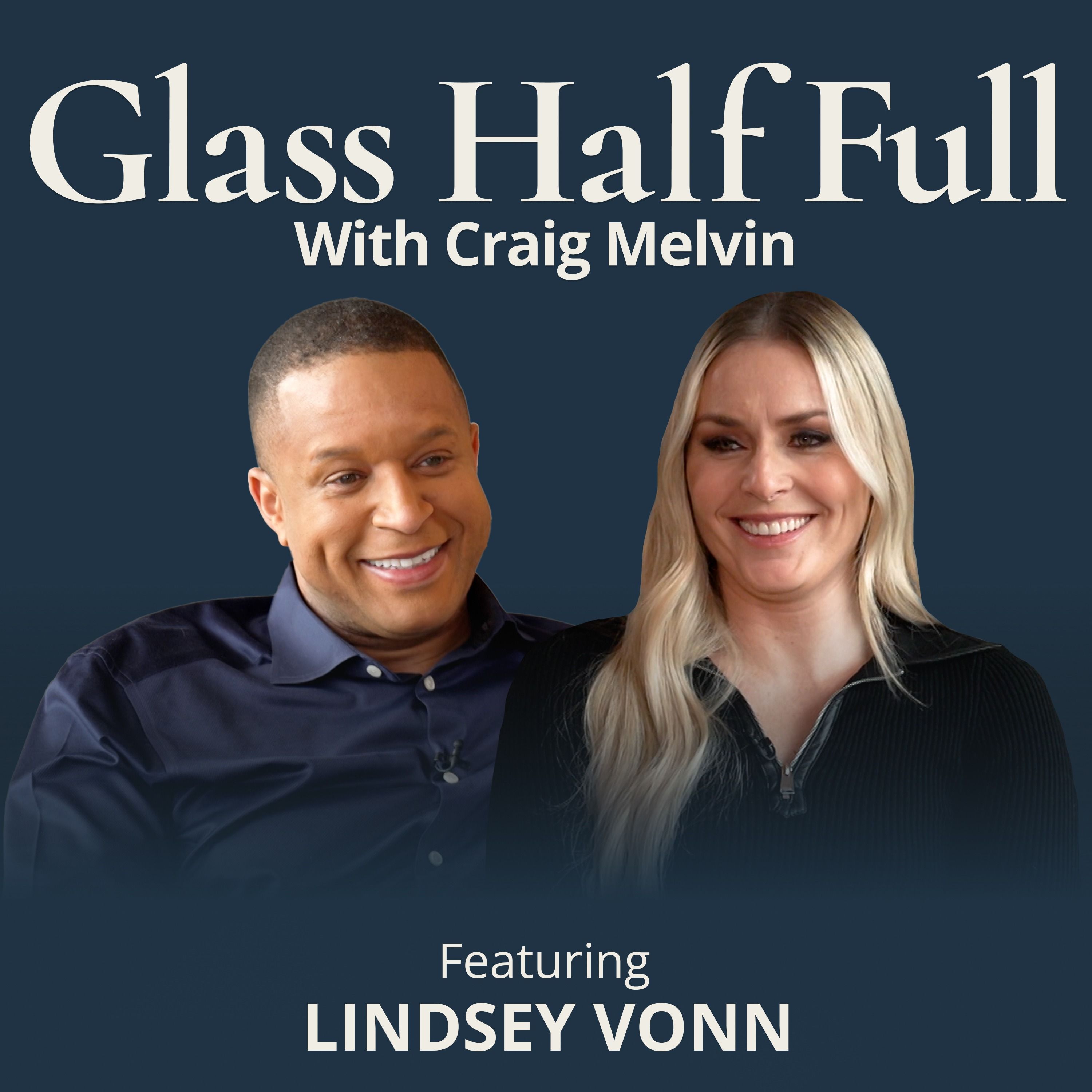
Glass Half Full with Craig Melvin
Lindsey Vonn on Nearly Losing Her Leg, Olympic Crash & Possible Skiing Comeback
00:33:56
In this special edition of Glass Half Full, Craig Melvin shares his full TODAY interview with Lindsey Vonn for an inside look at her recovery and what comes next. From the Olympic crash that shocked the world to her grueling road back and unfinished dreams of a comeback, Vonn opens up about the moment that changed everything. Plus, she shares how Mariska Hargitay visited her in the hospital and how Law & Order: SVU has become part of her recovery.
Loading summary
Transcript207 lines
- [00:00]
Liberty Mutual Spokesperson 1
For adults with Crohn's disease or ulcerative colitis symptoms, every choice matters. Tremphya offers self injection or intravenous infusion from the start. Tremphya is administered as injections under the skin or infusions through a vein every four weeks, followed by injections under the skin every four or eight weeks. If your doctor decides that you can self inject Tremphya, proper training is required. Tremphya is a prescription medicine used to treat adults with moderately to severely active Crohn's disease and adults with moderate, moderately to severely active ulcerative colitis. Serious allergic reactions and increased risk of infections and liver problems may occur. Before treatment, your doctor should check you for infections and tuberculosis. Tell your doctor if you have an infection, flu like symptoms or if you need a vaccine. Explore what's possible. Ask your doctor about tremphya today. Call 1-800-526-7736 to learn more or visit trempharadio.com
- [01:02]
Liberty Mutual Spokesperson 2
and Doug, there's nowhere I wouldn't go to help someone customize and save on car insurance with Liberty Mutual. Even if it means sitting front row at a comedy show.
- [01:12]
Lindsey Vonn
Hey, everyone.
- [01:12]
Liberty Mutual Spokesperson 1
Check out this guy and his bird. What is this, your first date?
- [01:15]
Liberty Mutual Spokesperson 2
Oh, no. We help people customize and save on car insurance with Liberty Mutual together. We're married. Me to a human, him to a bird.
- [01:22]
Liberty Mutual Spokesperson 1
Yeah, the bird looks out of your league.
- [01:24]
Liberty Mutual Spokesperson 2
Anyways, only pay for what you need@libertymutual.com Liberty.
- [01:28]
Liberty Mutual Spokesperson 1
Liberty. Liberty. Liberty.
- [01:38]
Craig Melvin
Hey there, everyone. Craig Melvin here. And this is a special edition of Glass Half Full. I've actually left the basement bar for this one. Came out to Utah to catch up with Lindsey Vonn. Lindsey Vonn, of course, one of the greatest athletes in modern sports history. And. And she was on the verge of one of the greatest comebacks in modern sports history. Then February 8th, 13 seconds in, she crashed. Her Olympic dreams dashed. The comeback dashed. We talked about all of it. We talked about the crash. We talked about how she doesn't want that to really define her entire legacy. We talked about the recovery and yes, the possibility of another comeback. Hope you enjoy this one. Well, first of all, thank you. Thanks for inviting us into your lovely home.
- [02:31]
Lindsey Vonn
Thanks for coming.
- [02:32]
Craig Melvin
Good to see you in person. Would Lindsey Vaughn consider herself a glass half full person or glass half empty person?
- [02:38]
Lindsey Vonn
Does anyone answer? Half empty.
- [02:41]
Craig Melvin
Oh, yeah.
- [02:42]
Lindsey Vonn
Really?
- [02:42]
Craig Melvin
Oh, you'd be surprised.
- [02:44]
Lindsey Vonn
Wow. Okay. No, it's like it's always half full, always has been. Yeah.
- [02:50]
Craig Melvin
No matter what, without hesitation. You're what? I can't Believe someone ever said this.
- [02:55]
Lindsey Vonn
I couldn't process it. Anyone would say half empty.
- [02:57]
Craig Melvin
Yeah.
- [02:57]
Lindsey Vonn
Why.
- [02:58]
Craig Melvin
Why are you so. Glass half full?
- [02:59]
Lindsey Vonn
I mean, it's all about perspective. Life is about perspective. And, you know, what seems bad to you is no matter how bad it is, it could always be worse. It could always be worse. So you have to appreciate what you have. Like, I could be in a much worse place than I am right now, and so I'm very thankful for what I have. The glass is 100% half full. So I just think it's perspective. You gotta appreciate life.
- [03:27]
Craig Melvin
It's been about two months now since the accident.
- [03:31]
Lindsey Vonn
It's been a while.
- [03:32]
Craig Melvin
Two months since the accident. As we sit here right now, how do you feel?
- [03:36]
Lindsey Vonn
I feel okay. I mean, I'm at home, so that obviously makes me feel a lot better than being in the hospital. But it's definitely been a very slow, slow road. I'm someone that loves to work hard and make progress, so that's a little bit frustrating for me. But, I mean, I'm doing as well as I could be.
- [03:57]
Craig Melvin
What's been the hardest part?
- [03:58]
Lindsey Vonn
I mean, I think the hardest part was the pain and the surgeries. And then, yeah, probably the first three weeks, those were really the hardest. And then once I kind of was able to move and get in a wheelchair and kind of be a little bit more independent, I felt better. But I'm really, really looking forward to being able to walk on my own.
- [04:18]
Craig Melvin
You don't strike me as somebody that can sit still for too long.
- [04:21]
Lindsey Vonn
No, no, no. I'm not a sedentary person.
- [04:24]
Craig Melvin
Have you been a good patient?
- [04:26]
Lindsey Vonn
I don't know if I'm ever a great patient. At least you're honest about it. I always feel like it's a negotiation because it's always about how my body feels and how it's progressing. And I do go slow and step by step. But if I'm making progress and it feels good, I want to keep doing that, keep moving forward, so. So sometimes people get a little nervous, but Dr. Haggit's fully behind me and is happy with where I am, so
- [04:52]
Craig Melvin
it's good these days. What's your typical day look like?
- [04:56]
Lindsey Vonn
I do two hours of therapy in the morning, 9 to 11, take a little break. I drive down to Heber city and do two hours in the hyperbaric chamber, drive 30 minutes back, take a little break, go back to the gym, do another hour, hour and a half, maybe get some soft tissue, work. After that, dinner and bed. Every day on repeat. Every day.
- [05:20]
Craig Melvin
Every day.
- [05:21]
Lindsey Vonn
The only day it's different is Sunday. I don't have anyone come to the house, and I just kind of do my exercises on my own.
- [05:27]
Craig Melvin
But what are they saying about how long you're going to have to continue that routine?
- [05:33]
Lindsey Vonn
I'm almost done with that. You know, my bone's healing really well. I got some X rays and progress is good. So, I mean, the main problem, I'm not. The reason why I'm not on crud is because my right ankle is also broken, so that's healing well. So I should be on crutches full time here pretty soon. And then by the end of April, I'll hopefully be walking.
- [05:54]
Craig Melvin
Let's go back to February 8th. You are coming off this incredible comeback, and we're about 13 seconds into the downhill. What happened?
- [06:07]
Lindsey Vonn
Yeah, bib 13. 13 seconds. I caught my arm, the gate, and it twisted me and I crashed. It was really not very complicated, but it's not something that happens very often, at least not to me. I came in there with the perfect mindset. I was so ready. Even without my acl, I felt really strong. You know, I was third in the last training run the day before, and I knew that turn was a turn that I could ski more clean than anyone else. And I came in there aggressive, and normally you drift a little bit to the left. And I didn't drift because I had such a strong angle and was a few inches too far to the right. Caught my arm, and that was that.
- [06:51]
Craig Melvin
Did you know immediately how bad it was, or.
- [06:55]
Lindsey Vonn
I knew. I knew it was a tib fib, and I was hoping it wasn't a compound fracture. And I just kept telling them, don't let me get compartment syndrome. The whole time I was saying that, and I still did.
- [07:11]
Craig Melvin
So explain why that's so dangerous.
- [07:15]
Lindsey Vonn
I mean, compartment syndrome basically is when there's too much blood in a certain compartment of your body and there's no more space, so it just crushes everything. So you can kill basically your nerves, your muscle, and you lose control of your leg. And then, of course, it needs to be amputated. That's the worst case scenario. And it's happened to an Austrian skier a few years ago in Norway, he lost his leg. But, you know, fasciotomy, which is what releases the pressure and allows you to not have any permanent damage, is what was done. And that's, I would say, relatively common, like compound compartment syndrome is. Well, it's not amazing. It's definitely not uncommon.
- [08:05]
Craig Melvin
How worried were you while you were lying there in the snow that you were gonna lose the leg.
- [08:13]
Lindsey Vonn
I wasn't worried about it at first. I mean, I. I mean, I kept repeating it to everyone. You know, I just. And Tom was there, and he. You know, he said he's got it. He's got his eye on it. He's not gonna let that happen. The unfortunate thing is that no one can control how much my body's bleeding from the damage that's inside. So no one could control that. So it just happened. And thank God that Tom was there, and he got the doctors back into the hospital, and they did the second surgery, which saved my leg. Tom is Dr. Hackett. Sorry.
- [08:50]
Craig Melvin
Yes, I know who he is.
- [08:51]
Lindsey Vonn
But I work with Tom for so long, and he's such a big part of my journey.
- [08:57]
Craig Melvin
And you've kept him in business, my friend. You've kept him in business.
- [09:01]
Lindsey Vonn
We're close now.
- [09:02]
Craig Melvin
So four surgeries in Italy and then one surgery back here in the States.
- [09:09]
Lindsey Vonn
Yep.
- [09:09]
Craig Melvin
You had five surgeries in two months.
- [09:12]
Lindsey Vonn
Yep. And I need another one. So in probably the fall, I'll. My bone will be healed. We'll take all the metal out, and then we'll fix the acl. So I still have no ACL right now.
- [09:28]
Craig Melvin
Oh, that's right. Yes, that's right. That's right. That little thing I forgot about the acl.
- [09:33]
Lindsey Vonn
Yeah.
- [09:33]
Craig Melvin
Let's go back to that decision, too. The decision to still compete. I think it was nine days after you torn the acl. Do you regret that decision at all?
- [09:43]
Lindsey Vonn
No.
- [09:44]
Craig Melvin
Not one bit.
- [09:45]
Lindsey Vonn
No. I was ready. I was physically 100% ready to be able to compete. I tested it in the training runs in the gym. You know, I worked diligently with my physio and my acupuncturist, and I was literally, up until I got to Olympics, I was doing 12 hours a day of work. You know, we were trying to get all the inflammation out of my body, get all my muscles working, and we did a great job. It was there. It was ready. My leg was ready to go. I was not concerned about it at all. And honestly, when I raced in my last race last time in 2019, I was in much worse shape. My knee was so swollen, and I had three huge fractures and no lcl, and I still got a bronze medal. So, you know, I know myself and what I can do and what my body can tolerate, and it wasn't even close to being a question of whether I could or not.
- [10:40]
Craig Melvin
So when you go down, you know immediately how bad it is, what happens
- [10:45]
Lindsey Vonn
after that it was pretty complicated. I mean, we went from helicopter to the bottom of the hill. They tried to take all my equipment off. I was there for about an hour. Ambulance to the other clinic. They did some CT scans, and then I got in another helicopter, 45 minutes away to Trevisio, went into surgery, got the X fix on that giant, you know, metal contraption that kind of stabilizes the leg. And then a few hours later, back into surgery to do the fasciotomy. And then at about midnight, I woke up.
- [11:22]
Craig Melvin
How intense was the pain? Or were you completely out of it?
- [11:25]
Lindsey Vonn
No, I remember everything. It was very severe, and I've never been in so much pain before. I couldn't breathe. It was just. I was screaming a lot. And, yeah, it was incredibly brutal. And they kept giving me medication and it wasn't taking away the pain. You know, it's a. I feel like I would rather have my ACL any day of the week. You know, breaking your bone like that is not something I ever want to do again.
- [11:56]
Craig Melvin
More with Lindsey Vaughn after the break.
- [12:02]
Morgan Stewart
Hey, everyone, it's me, Morgan Stewart, and I have a new podcast called the Morgan Stewart Show. Join me each week as I talk about pop culture, fashion, my personal life, and just a warning, I'm gonna be giving my opinion on everything. I'll also have some really fun guests to join in on the fun. The Morgan Stewart show is out now. Listen and follow wherever you get your podcasts or watch full video on YouTube.
- [12:25]
Liberty Mutual Spokesperson 2
And Doug, there's nowhere I wouldn't go to help someone customize and save on car insurance with Liberty Mutual. Even if it means sitting front row at a comedy show.
- [12:34]
Lindsey Vonn
Hey, everyone, check out this guy and his bird.
- [12:36]
Liberty Mutual Spokesperson 1
What is this, your first date?
- [12:38]
Liberty Mutual Spokesperson 2
Oh, no. We help people customize and save on car insurance with Liberty Mutual together. We're married. Me to a human, him to a bird.
- [12:44]
Liberty Mutual Spokesperson 1
Yeah, the bird looks out of your league. Anyways.
- [12:47]
Liberty Mutual Spokesperson 2
Only pay for what you need@libertymutual.com Liberty.
- [12:50]
Liberty Mutual Spokesperson 1
Liberty. Liberty. Liberty.
- [12:52]
Morgan Stewart
Hiring isn't just filling a role. It's about finding people who can drive results. Indeed. Sponsored Jobs helps you match with the right candidates faster. Target candidates by skills, certifications, or location.
- [13:04]
Craig Melvin
Join the 3.3 million employers worldwide that use Indeed to connect with quality talent that fits their needs.
- [13:10]
Morgan Stewart
And listeners of this show will get a $75 sponsored job credit to help
- [13:14]
Craig Melvin
get your job the premium status it deserves. Indeed.com podcast terms and conditions apply. Hiring do it the right way with Indeed. How was this during all of that? How was the mental I Mean, I
- [13:31]
Lindsey Vonn
was in so much pain that I. All I was thinking about was getting through it and figuring out, you know, do I need what. What kind of surgery do I need? You know, how do I prevent compartment syndrome? What's the plan? What hospital are we going to like? Those are the kind of logistical things that I'm thinking about. And also, obviously, it's the Olympics and my Olympic dream's over, so it was a lot to process. And I think once I woke up that night, that was, you know, what was mainly on my mind. And then I think the next day is when everything really hit me pretty hard.
- [14:07]
Craig Melvin
What hit you?
- [14:09]
Lindsey Vonn
Everything. My career. Like, the way I want it to end, it is not going to happen. You know, I worked so hard and was having so much fun and was enjoying the sport that I love, and it was. It's now gone. You know, I don't know if I'll ever be able to do it again. I didn't get to say goodbye to my teammates, to my coaches. I just was helicoptered away, never to be seen again. I never saw my teammates after that. I saw a few coaches that came to the hospital, but, you know, everyone kept going with their lives, and I was stuck in the hospital and did not end the way I had hoped it would. And then I lost my dog that night. That was. That was horrible. But at least my siblings were there and they helped make that somewhat bearable. But it was just a lot to process. In a 24 hour time period, you
- [15:02]
Craig Melvin
lose your dog and your Olympic dream, like, the same day?
- [15:06]
Lindsey Vonn
Yep. In 13 seconds, I'm in a wheelchair or I'm in a hospital, you know, and just quite a drastic change.
- [15:16]
Craig Melvin
I read recently that you sometimes, like, have dreams about that run in Cortina.
- [15:24]
Lindsey Vonn
Yeah, I still envision myself, like, when I dream and I think about Cortina, I still visualize myself making it to the finish line and winning. You know, there's a reason why I came back to Cortina is because that place has such a special meaning for me. And I knew exactly what it would take to win. And I just wish I had the chance to do that, you know, such a weird way to crash. And on that gate, it just. Nothing really made sense to me. And, yeah, my Olympics didn't end the way I wanted them to.
- [16:00]
Craig Melvin
You just said something that I want to go back to as well. Because it seems like you also think that when you went down in the days after, the world just kept turning.
- [16:10]
Lindsey Vonn
Yeah, I mean, you know, it was amazing for Breezy that she won. And then the team event, which I was supposed to be in two days later, Jackie and Paula got the bronze and just everything kept going. And it was really hard. All those things that I wanted to be participating in and be a part of that team. And then after that, the World Cups, that came after I was leading the downhill standings. And every day had to watch my lead, you know, get smaller and smaller until the. Until the very last race. And then it was like if they had canceled one race, I probably would have been okay. But yeah, it was. You know, I've been here. I've been here in my home and had to watch everything that I had hoped to achieve drift away.
- [17:07]
Craig Melvin
You, you'd become the oldest World cup downhill skier to your point. You were leading the standings going into the Olympics, having the greatest, greatest comeback story, I would say, in recent, like, sports history. And then this happens. Do you think that all of that got overshadowed by the crash?
- [17:29]
Lindsey Vonn
In some ways I do. I mean, I've been in my home, so I haven't. I don't know what the real world is saying or thinking or feeling. I think there was so much, at least on social. From what I could tell, it was a lot about the crash and it just kind of stayed about the crash. And I don't want that to be my legacy at all because I was having such an amazing season doing things that no one else has ever done. And I was so proud of that. And I don't want that to be washed away. You know, I don't want 13 seconds to define my career because it's so much more than that. But I think a lot of what I've felt is that a lot of people have supported me and said that that's not true. And I try to keep believing them, but it's just a worry that I
- [18:21]
Craig Melvin
have on behalf of all of them in America. That's not going to be your legacy. No one's gonna remember Lindsey vonn for a 13 second grad. No one's gonna remember that.
- [18:32]
Lindsey Vonn
Thanks.
- [18:32]
Craig Melvin
They won't. I think they'll probably remember the 22 years of greatness that you gave us.
- [18:41]
Lindsey Vonn
Thanks.
- [18:42]
Craig Melvin
You don't seem to be taking a lot of solace in that. Right.
- [18:46]
Lindsey Vonn
Well, I think you're biased because we're friends.
- [18:48]
Craig Melvin
So maybe you're just objectively speaking.
- [18:50]
Lindsey Vonn
Objectively, I mean, I know. I mean, I think it's just, you know, I'm insecure. I'm like every person. You know, I have my insecurities and it just wasn't I think I'm. It wasn't the way I wanted it to go and wasn't how I dreamed it would be. And so it's hard to. It's hard for me to look past also the crash myself, you know, and if I can't look past it, then, like, what's the world gonna think?
- [19:17]
Craig Melvin
You haven't gone back to watch it, though?
- [19:19]
Lindsey Vonn
No, I don't need to. I mean, you can't really see much from the crash anyways. And all I really see is, like, when I land and my legs are torqued, and I remember how painful that was. I don't really need to relive that experience again.
- [19:36]
Craig Melvin
Let's go back to this, because I would imagine that when something like this happens to someone like yourself, that it messes with your. You're mental a little bit.
- [19:46]
Lindsey Vonn
Oh, yeah, for sure.
- [19:47]
Craig Melvin
How so?
- [19:49]
Lindsey Vonn
I mean, I've been injured a lot, and this is so far beyond what I've ever had to deal with. Mentally, physically, just every aspect of it. From being in the hospital for two and a half weeks, unable to move to, you know, the. The isolation, being in a wheelchair for as long as I have, you know, I've been isolated before, you know, that I can kind of handle that, but not for such an extended period of time. And I have to thank my friends a lot. Everyone really rallied and kind of rotated and came to visit me, because the only time I ever leave the house is to go to the hyperbaric chamber. So it's not like I'm really out in society, you know? I think I. I was able to go to dinner once when my sister came to see me. She also tore her acl, ironically.
- [20:47]
Craig Melvin
Yeah, that was in my. I was having a. Karen Karn.
- [20:51]
Lindsey Vonn
Yeah. The Vaughan rehab facility. At your service.
- [20:55]
Craig Melvin
So you and Karen are doing some rehab together?
- [20:57]
Lindsey Vonn
Yeah, we did. Well, I was really instructing her on what to do. She didn't. I don't know if she listened to me all the time, but I tried.
- [21:05]
Craig Melvin
How did she tell her? Asia.
- [21:06]
Lindsey Vonn
When we were in Aspen over Christmas, I left and she stayed.
- [21:10]
Craig Melvin
Okay.
- [21:11]
Lindsey Vonn
May have tried to show off, may have tried to do a360. May not have worked out so well.
- [21:17]
Craig Melvin
Yeah, but your Vaughn girls seem to bounce back pretty quickly.
- [21:20]
Lindsey Vonn
Yeah. I mean, she's already off crutches and no brace, and it's only been a couple weeks, so she's crushing it.
- [21:28]
Craig Melvin
Let's talk about the future, because we've been here before. We've been here before. Yeah. Is this finally when you Say, you know what? I had a really good run. I won a lot of medals. I made myself proud, my family proud, my country proud. I can move on now. Are you at that point?
- [21:50]
Lindsey Vonn
I can move on. I mean, it's not a question of can I, or I already have. I already retired for six years. I know what it's like to not be a ski racer anymore. It's just that ski racing is something I love to do and I had so much fun this season that. And I never got to. I never got a final run. I never got to say goodbye. I never got like any sort of closure whatsoever that I think it leaves the door slightly open to. I don't know, maybe I would do one more race to say goodbye or maybe I, maybe I'll race again. I don't know. I don't know the answer to that question because I know I'll be happy if I don't ski race again.
- [22:32]
Craig Melvin
Okay.
- [22:33]
Lindsey Vonn
That's no question. But I don't know, it might be fun to do one more run. We'll see.
- [22:43]
Craig Melvin
You nearly lost the leg like two months ago.
- [22:47]
Lindsey Vonn
A lot of people, like friends of mine that are still ski racing, have had the same thing.
- [22:53]
Craig Melvin
So you're entertaining the idea of maybe another comeback.
- [22:56]
Lindsey Vonn
I mean, much to my family's dismay, yes. I think it's just something that, I mean, I've been, like I said, so isolated and not able to really live life outside of skiing. I'm still kind of trapped in this, like, I didn't have my Olympic dream situation. I need to walk and be out in public and, you know, be living life. And I think that will give me a different perspective. Right now I can't say what the future holds because I can't. My mind can't get there yet.
- [23:31]
Craig Melvin
Your dad didn't hold back?
- [23:33]
Lindsey Vonn
No, he did not.
- [23:34]
Craig Melvin
He did not hold back.
- [23:35]
Lindsey Vonn
Nope.
- [23:35]
Craig Melvin
Sounds like you're aware of what he said.
- [23:37]
Lindsey Vonn
Yes.
- [23:38]
Craig Melvin
This is it. She's done. Never again.
- [23:40]
Lindsey Vonn
He's a lawyer. He's very, very firm in his point of view. But I'm surprised he said that because if you know me, you know that the one way to get me to do something is tell me I can't do it. So my dad might be the tipping point of why I come back one more time.
- [24:01]
Craig Melvin
Did you talk to him after? Did you say, dad, can maybe we not.
- [24:05]
Lindsey Vonn
Oh, yeah. I was like, what were you doing?
- [24:07]
Craig Melvin
What did he say?
- [24:08]
Lindsey Vonn
He was like, I'm just looking out for your well being. And I'm like, okay, well, maybe let's talk about it first next time. But he meant well. I mean, he did mean well. He's just. I think we were all under a lot of stress and there's a lot going on, so it's understandable. But yeah, you probably shouldn't say, I shouldn't do something he probably should not
- [24:30]
Craig Melvin
have more with Lindsey Vaughn when we come back,
- [24:36]
Liberty Mutual Spokesperson 1
day or night, VRBoCare is here 24. 7 to help make every part of your stay seamless. If anything comes up or you simply need a little guidance, support is ready whenever you reach out. From the moment you book to the moment you head home. We're here to help things run smoothly because a great trip starts with the right support. And hey, a good playlist doesn't hurt either.
- [25:06]
Morgan Stewart
Hey, everyone, it's me, Morgan Stewart, and I have a new podcast called the Morgan Stewart Show. Join me each week as I talk about pop culture, fashion, my personal life, and just a warning, I'm gonna be giving my opinion on everything. I'll also have some really fun guests to join in the fun the Morgan Stewart show is out now. Listen and follow wherever you get your podcasts or watch full video on YouTube.
- [25:26]
Lindsey Vonn
We optimize everything about our health routines except the air we breathe. And when your air is off, your body feels it first. The blueair Blue Signature air purifiers quietly remove tiny airborne pollutants and odors, supporting deeper sleep, better recovery, and clearer focus. Visit blueair.com and use code signature30.
- [25:46]
Craig Melvin
The crash, of course, was very public, but your recovery's been somewhat public, too. You've posted some stuff on social media, some videos, some pictures. Why is that important to you?
- [25:57]
Lindsey Vonn
I mean, life is not glitz and glamour and perfection. Like, we all have hardships in our own ways. And I don't think shying away from this process does me any service or anyone else. You know, we all. I want to share my struggle because I think that's one of the big benefits of social media. Like, let's connect. I've had so many amazing messages and people coming up to me and talking about, like, how amazing my recovery is and how it's motivating them. And, you know, their toe hurts and they're not going to the gym now. They are, you know, like there's, you know, it's amazing stories that make me feel like it's meaning something, you know, it's more than just a ski crash, you know, and I hope that does have a positive impact. So I'm not always perfect. I never have been. And this Journey is raw, and it's who I am.
- [26:56]
Craig Melvin
I've always thought that that was one of the things that's perhaps most endearing about you. You're very public, warts and all. You put it out there, and you have been for years.
- [27:07]
Lindsey Vonn
Yeah.
- [27:07]
Craig Melvin
But I think that's one of the reasons that you should probably also take some solace in knowing that America's still in love with Lindsey Vonn. We're with you.
- [27:17]
Lindsey Vonn
Thank you.
- [27:17]
Craig Melvin
We're with you.
- [27:18]
Lindsey Vonn
I appreciate it. I mean, I know. I felt. I really did feel the support.
- [27:23]
Craig Melvin
Okay.
- [27:23]
Lindsey Vonn
I really did. It just. It's my own insecurity that, you know, gets in the way a little bit,
- [27:29]
Craig Melvin
even after all these years.
- [27:31]
Lindsey Vonn
You know, I think that's also what drives me. You know, you can't have one without the other. You know, you can't have comfort without. You can't have courage without comfort. You know, it's just like, I need to be driven by something. There's a reason why I can sit on the bike for three hours at a time. You know, it's not because I love biking.
- [27:51]
Craig Melvin
Right. So you're not like us. You've never been, and you're still not. You're just not like us.
- [27:58]
Lindsey Vonn
I honestly drove home, like, when I got back from the hospital for the first time, and I drove back up the steep hill, coming to my house, and I was like, God, I wish I could bike up this hill again. I was like, what am I thinking about? That's what my first thought is.
- [28:13]
Craig Melvin
But to your point, it's what's driving you when you are done. When you are done, done with professional skiing, what does that look like for you? What does the next chapter look like?
- [28:25]
Lindsey Vonn
It's a lot of business. I'm involved in a lot of investing, and I'm an advisor to a few funds. I invest a in women's sports. I have two soccer teams, the Utah Royals and lafc, that I have invested in. And that's kind of been a lot of what I do. I do a lot of public speaking. I still have my ski clothing line. I still have all my sponsors. You know, I have a life that's very busy and full, and I have amazing friends and I got to go to amazing places in the world. There's no lack of challenge or excitement, but it'll never be ski racing, and I'm totally OK with that. I have so much that fulfills my life without ski racing. It's just something that I really love doing.
- [29:14]
Craig Melvin
You're a paid spokesperson for InVivid there's a campaign called Antibodies for Anybody. What's that about?
- [29:22]
Lindsey Vonn
It's really about national education, awareness, and teaching everyone about antibodies and what they do for you, what they protect your body against germs, toxins. And I've always been about health and wellness. And this is just another way for me, I think, to help educate people and get behind this campaign with Envivid, antibodiesfor anybody.com is they have a wellness assessment. It's really easy and you can kind of go and see what things you can improve upon and what antibodies do for you. It's just again, I think health and wellness is so important. It's not just about muscles and strength. That's about taking care of the inside of yourself as well. So that's why I'm really excited to be a partner.
- [30:07]
Craig Melvin
They picked a good one.
- [30:09]
Lindsey Vonn
I mean, I do take care of myself. I only got a silver medal on the wellness assessment, so you have to do the wellness assessment.
- [30:18]
Craig Melvin
Wait a minute, you got a silver medal on the bill?
- [30:20]
Lindsey Vonn
I did.
- [30:21]
Craig Melvin
Wow. But I mean, you're in recovery. Does that have something to do with.
- [30:24]
Lindsey Vonn
I think it was because the question about stress. I am a little stressed out.
- [30:30]
Craig Melvin
Just a little. Just a skosh.
- [30:32]
Lindsey Vonn
Yeah. I was like, dang it, I can't win everything. But
- [30:36]
Craig Melvin
how else have you been passing the time besides the rehab? Any new hobbies? Aren't you watching? Aren't you binge watching things?
- [30:44]
Lindsey Vonn
I mean, Law and Order, obviously.
- [30:46]
Craig Melvin
You're still watching a lot of Law and Order.
- [30:48]
Lindsey Vonn
Yeah. SVU or Mariska's been. She came to the hospital to see me. She was at my race and like, I love Mariska. She's amazing. Her and her husband are just salt of the earth, good people. And she's always like FaceTiming me and checking in, and almost every night I'm watching svu. I'm like, new episode coming up.
- [31:09]
Craig Melvin
Good. Well, thanks for supporting the family.
- [31:12]
Lindsey Vonn
Yeah.
- [31:13]
Craig Melvin
But just Law and Order. You don't watch other.
- [31:15]
Lindsey Vonn
I mean, I've kind of binged a lot of series, so if there's any, like murder mystery that's on streaming service,
- [31:24]
Craig Melvin
they were actually a little bit more like us than I realized.
- [31:27]
Lindsey Vonn
Well, my parents are both lawyers, so Law and Order was always like the classic, you know, we watch it as a family, which I don't know if that's a family show, but I think
- [31:34]
Craig Melvin
in your family it worked. Clearly.
- [31:36]
Lindsey Vonn
It did.
- [31:37]
Craig Melvin
If you could go back and talk to that 17 year old Lindsey Vaughn now, what would you tell her?
- [31:47]
Lindsey Vonn
Nothing.
- [31:48]
Craig Melvin
Nothing.
- [31:49]
Lindsey Vonn
Mm.
- [31:49]
Craig Melvin
Mm.
- [31:49]
Lindsey Vonn
I've always said that I never want because I have to. You have to fall and fail to be able to appreciate the success and to get to where you are, you have to learn. The best way to learn is to fail. And it's really not a failure unless you never get back up. Like you just have to keep moving forward. So all the crashes and the lessons I've learned along the way got me to where I am. If I had didn't have those, I wouldn't be here and I wouldn't appreciate it either. And life's not perfect. So you just gotta live your life. I don't need any advice. I just gotta go.
- [32:22]
Craig Melvin
Just literally keep getting back up.
- [32:24]
Lindsey Vonn
Just do you, do you, girl.
- [32:26]
Craig Melvin
By the way, that's been your mantra for 20 years. It's served you well.
- [32:29]
Lindsey Vonn
Yes, it has.
- [32:31]
Craig Melvin
Is there a moment, a singular moment that you can look back on now and point to and say, that's it. That's when I became the Lindsey Von that the world knows.
- [32:45]
Lindsey Vonn
I mean, in my racing career it was definitely the Olympics. Winning the Olympics in Vancouver, I think I got to that point for me as a racer much earlier than that. But I think most people remember me from Vancouver and I think that's one of the coolest things about being an Olympic champion is you're always an Olympic champion. So no matter what I knew, like, no matter what happened after that, no one can ever take that away from me.
- [33:09]
Craig Melvin
So is there a moment that you're still chasing?
- [33:13]
Lindsey Vonn
No, I'm not chasing anything. I've gone so far beyond what I ever thought was even remotely possible. Even remotely possible. Of course, like, I'm a competitive person. I would always want more. Like if you let me go out there and do it, I would, you know, I would never be satisfied. But I couldn't dream of anything better. I mean, I've worked really hard and I have an amazing life and I'm very thankful for all of it. And if you would have told me as a 9 year old kid after meeting Peekaboo that I would do all of these things, I would say that would be the most amazing thing I could ever dream of.
- [33:53]
Craig Melvin
So as we sit here, you seem, you seem content.
- [34:00]
Lindsey Vonn
I am. I mean, I'd love to be walking around right now, but I'm okay, you know, and I was okay before, you know, I'm in a good place, I'm happy, I'm fulfilled, I'll always look for more challenges. That's just who I am. I'm always going to keep moving Forward, but I'm good.
- [34:23]
Craig Melvin
How has all of this changed your perspective? Or has it. Has it changed your perspective at all?
- [34:30]
Lindsey Vonn
I mean, I kind of had moments in the season where I thought this is honestly too good to be true. Like, I am always on the podium. Every time, no matter what the conditions, no matter where we go, I'm on the podium. I was like, am I? Like, am I? I don't want to look the gift horse in the mouth, but, you know, this is going really well, and I have to. Had to really kind of stay focused at times. But, yeah, it was an amazing season, so I'm very thankful, and it hasn't shifted my perspective, necessarily. The injury, I think, gives me more perspective of, you know, people who have been injured and the pain, the type of pain you can be in. It's all relative. You know, you can't compare anyone's injuries to one another, but I think this gives me a higher level of empathy and understanding, and I think that's always good to have.
- [35:28]
Craig Melvin
When were you at your lowest?
- [35:34]
Lindsey Vonn
I mean, in the. Italy was really hard. I would say probably after the surgery when I was in Vail and I needed a blood transfusion and I could barely keep my eyes open, and I was supposed to leave the hospital that day, and I couldn't. And I was like, am I ever gonna get out of this place? You know, am I ever gonna feel better? And, like, I'd like to go to the bathroom on my own, you know, like, things you really take for granted. I was. I was struggling, and I mean, thankfully, the transfusion worked, and I started to eventually get my. My strength back and get out of the hospital, but very tough. My brother is worried, you know, you should be worried. He's never worried about anything.
- [36:28]
Craig Melvin
Well, we love you.
- [36:29]
Lindsey Vonn
Thank you.
- [36:30]
Craig Melvin
America loves you. The world loves you. Take it easy. We'll be here when you're back.
- [36:35]
Lindsey Vonn
Thank you.
- [36:37]
Craig Melvin
There you have it. Lindsey Vaughn, in her own words, and as she always is, honest, vulnerable, raw, shared it all, warts and all. One of my takeaways here is I would not, under any circumstances, bet against Lindsey Vonn. So hope you enjoyed this special edition of Glass Half Full. Fear not. Next time, I'll be back in the basement bar. But if you enjoyed this, the corporate overlords always like for me to encourage you to download, share, like, and comment. See you next time on Glass Half Full. This episode of Glass Half Full is produced by Jarrett Crawford, Sadie Bass and Katie Dissler. Ali Straim is our editor, and Juliana Mastarelli is our audio engineer, Ariana Davis is our executive editor. Additional production support is provided by Guy Hernandez, Carlos Wasano, Corey Liben, Tyreen Nobles, Chloe Leung, Ashley Domagola, Bailey Cronus, and Kate Riley.
- [37:55]
Liberty Mutual Spokesperson 2
And Doug. There's nowhere I wouldn't go to help someone customize and save on car insurance with Liberty Mutual. Even if it means sitting front row at a comedy show.
- [38:05]
Liberty Mutual Spokesperson 1
Hey, everyone.
- [38:05]
Lindsey Vonn
Check out this guy in his bird.
- [38:07]
Liberty Mutual Spokesperson 1
What is this, your first date?
- [38:08]
Liberty Mutual Spokesperson 2
Oh, no. We help people customize and save on car insurance with Liberty Mutual together. We're married. Me to a human, him to a bird.
- [38:15]
Liberty Mutual Spokesperson 1
Yeah, the bird looks out of your league anyways.
- [38:17]
Liberty Mutual Spokesperson 2
Only pay for what you need@libertymutual.com.
- [38:20]
Liberty Mutual Spokesperson 1
liberty. Liberty. Liberty. Liberty.