← Glass Half Full with Craig Melvin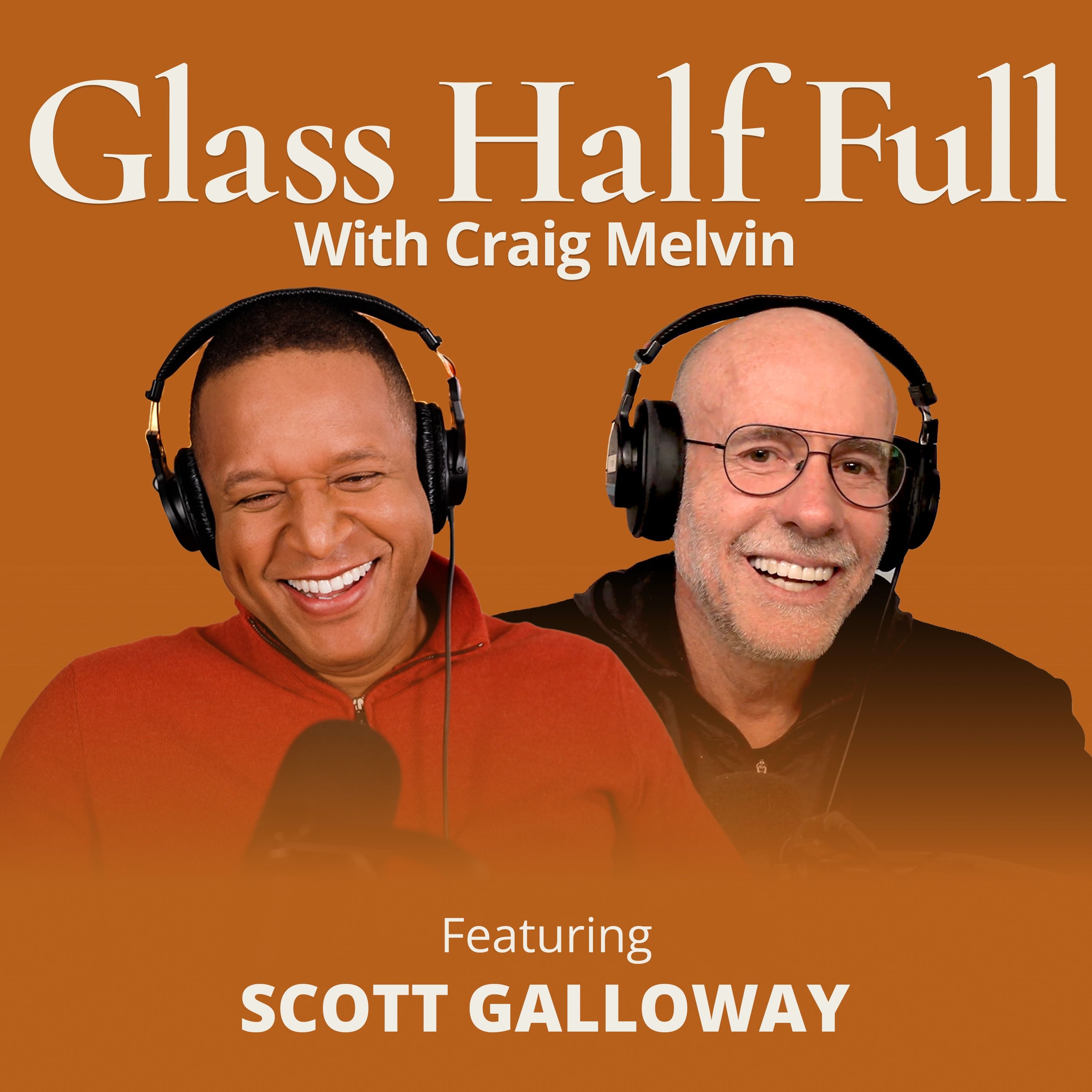
Glass Half Full with Craig Melvin
Scott Galloway: Why 63% of Men Under 30 Are Single| Glass Half Full
00:42:55
NYU Professor, bestselling author, and one of the most influential voices on modern masculinity, Scott Galloway joins Craig Melvin on Glass Half Full to discuss the moments that defined his life and career. Scott opens up about the night his mother became ill, when he had just $700 to his name. It was a pivotal moment that changed everything and fueled two decades of hard work. Scott also dives into the crisis facing young men, from loneliness and screen addiction to why an entire generation has stopped taking the risks that lead to real connection. And he unpacks his bestselling book “Notes on Being a Man,” explaining why he believes we're reaching a turning point in how society thinks about masculinity and young men. This episode is sponsored by the Walton Family Foundation. The study mentioned in this conversation was commissioned by the episode sponsor and conducted independently by Gallup.
Loading summary
Transcript93 lines
- [00:00]
Dr. Horton Home of the Week Announcer
Are you looking for the best deal on a new home? Discover the Dr. Horton home of the Week. With new construction homes now selling in ellensburg from the mid-3002, Dr. Horton has the right home at the best value for you, offering one and two story homes near Central Washington University. Your new home is within reach. So what are you waiting for? Learn more about the Dr. Horton Home of the Week, visit drhorton.com and schedule a tour today. Dr. Horton, America's builder and equal Housing opportunity builder.
- [00:41]
Craig Melvin
Hey there everyone. Craig Melvin here, coming to you from my basement bar. And welcome. Welcome to this edition of Glass Half Full. This is where we really like to talk about the moments that define people's lives professionally and personally. And this episode is sponsored by Walton Family Foundation. Joining me today here on Glass Half Full, Scott Galloway. You probably know Scott, you've at least probably heard that name over the last few months especially he is a famous podcaster, he's a professor, he's an entrepreneur, he's a best selling author as well, and he wrote a book. In fact, full disclosure, it was my favorite book last year. I gave it out as Christmas gifts to friends of mine, especially friends who were the parents of young boys. Scott has spent a lot of time over the last year or so, especially talking and writing about the plight of young men in our modern society. So we talked about that, of course, but we also talked about big tech, we talked about education, we talked about some of the pushback that he's gotten to some of his ideas as well. It is probably going to be the most, I'd say, controversial conversation we've had so far, but I still think you're going to enjoy it. So let's get to it. Scott Galloway, welcome. So the podcast is called Glass Half Full. Generally speaking, would you consider yourself a Glass Half Full guy or Glass Half empty guy?
- [02:22]
Scott Galloway
Oh, 100% glass half empty. And I can't stand. Everybody says they're optimists. I think you need optimists to fly a plane or to invent the plane, but I think you need pessimists for seat belts. So I think there's a role for us. But just being very honest, I constantly have to remind myself and ask myself what could go right? I'm open about this. I struggle with anger and depression, so I have a tendency to see things through dark colored glasses and constantly catastrophize. In a weird way, it's really helped my career because if you're an academic or a thought leader, catastrophizing is much more Compelling or interesting. Because if you were to be honest about history, the narrative would be something along the lines of the following. You know, every day things get just a touch better. That's been the narrative of the west over the last 200 years. But quite frankly, you don't get hired to come speak, do keynotes at conferences by saying that. So there is an economic incentive to catastrophize. So I want to acknowledge that. But in addition to my emotional well being or mental well being or lack thereof, quite frankly, I consistently have to remind myself that one of my favorite sayings is nothing is ever as good or as bad as it seems. And the last half really applies to me. Nothing's ever as bad as it seems because I have a tendency to really see things through a dark, again, dark colored glasses. And a really important question to ask yourself always, especially if you're making money from investing, which is where I make my money now, is what could go right. And if you look at the markets over the last 120, 10 years, the optimists have beaten the crap out of the pessimists. So quite frankly, being optimistic is historically just more accurate.
- [04:16]
Craig Melvin
This is why I wanted to talk to you. I mean, it's your ability to distill is. It's really set you in a class by yourself over the last few years. On that note, we like to talk about the journey, we like to talk about the moments here that really come to define us personally, come to define us professionally. Is there a moment that you look back on, Scott, that shaped you the most in terms of how you turned out and who you are today as we sit here?
- [04:48]
Scott Galloway
Yeah, I think a lot about that and it's the stuff you would expect. It's kind of birth and death. I was raised by a single immigrant mother, lived and died as secretary a lot of my life. And I was kind of sleepwalking through life. You know, I did. I was a mediocre student, didn't work that hard, kind of Woke up at 25. And because I was smart enough to be born in California and had the blessings of California taxpayers in the Regency University of California, I had access to incredible free education, UCLA and Berkeley for graduate school. And they were not only affordable, but they were accessible. I got into ucla with an 1130 on the SAT and a 3.1 GPA. And then get this, I graduated from ucla with a 2.27 GPA.
- [05:32]
Craig Melvin
Wow.
- [05:33]
Scott Galloway
And I got into Berkeley Business School. So things have changed dramatically.
- [05:36]
Craig Melvin
It's a different time.
- [05:37]
Scott Galloway
And then in my Second year of business school. My mom called me and said, you need to come home right away. I'm not doing well. And my mom had gone in for cancer surgery for her second mastectomy. We were underinsured. She was discharged early. I didn't know this at the time, but they want to get you out of the hospital because it's expensive. They discharged her too early. And my mom's not dramatic, so I knew something was wrong. And I went home. And Craig. I walked into a situation that I just didn't know how to handle. And my mom was deathly ill. So it was like, okay, do I try and get her back in the hospital? They said, no, we can't take her. You gotta call an ambulance. They'll take her to County. I called a friend of mine who was a doctor and said, you do not want your mom in County. So I thought, okay, I'll get her a nurse, because there's just some things that San can't do for his mom. And it was 35 bucks an hour for a nurse, and I had $700 in my name. And I thought, okay, I got 20 hours of nursing to take care of the person who's taking care of me her whole life. And it was just. Quite frankly, it was so humiliating and so emasculating that you can't decide to be successful. You can't decide to be economically secure, but you can decide to try really hard. And that was the moment I thought, okay, okay, I'm gonna do everything I can not to again wake up in this vulnerable position for me and my mom. And quite frankly, that's when I got my together and for the next 20 years. And I'm not saying this is the right way, but it's my way. And I'm not proud of this. I did little else but work. I just didn't do anything else. Everything. I took vacations with clients. I woke up early and worked out with employees. I was constantly thinking about work and money because I never. I want to say I was traumatized, but motivated. And I always say kind of snarkily, it cost me my hair. It cost me my first marriage, and it was worth it. I now have a lot of balance. I'm able to take care of everyone in my life. That's important to me, at least on dimensions. But that was the moment that sort of said, all right, boss, you need to grow up. It's no longer about you. It's time for you to start taking care of other people. But that was if you could distill it down to kind of one thing. It was my mom getting sick and me being unable to take care of her at the level she had taken care of me.
- [07:57]
Craig Melvin
Yeah, I told you this when you were on the Today show a couple months ago. I like to read. And your book, and I'm not saying it's because you're sitting here. I'm not blowing sunshine up your skirt. Notes on Being a Man was the best book I read last year. It. Well, it just. Just the thesis itself and not to I. The first few pages, I'm like, huh, wow, this guy's making a case for masculinity in 2026. This is not going to go over well. I was wrong. It went over amazingly well. It resonated with so many people. I gave it out as Christmas gifts to all my buddies. Were you at all surprised, or have you been surprised by just the sheer response to the book, to the themes that you touch on in the book?
- [08:48]
Scott Galloway
Well, first off, you're being generous. Look, it's better to be lucky than good. The conversation around trying to develop a aspirational code or viewpoint of masculinity. The timing was just. Was. Was lucky. It was good. So America wants to have the conversation right now. And I got. I was lucky enough to be put in the middle of it or the book was. There was also some really valid criticism that I'm too focused on money and too focused on, you know, people said, look, Scott, getting a girlfriend and getting wealthy work for you, but that's not necessarily the right path to happiness and fulfillment for everyone. There's been some really, I think, valid pushback. Also, I think on the far left, anytime you start advocating for men, there's a gag reflex that, oh, here's someone. Oh, here's one of those people. So there's been. I mean, there's been a healthy amount of criticism, and some of it's been valid, but on the whole, it's just super rewarding. Whenever someone comes up to me and looks at me, you know, I'm sure this happens to you a lot, but it's a new phenomena for me where people come up to me and recognize me and say nice things. But if someone comes up to me and I can tell they really want to meaningfully say something, I know immediately I go, you have something, don't you? Because I think the conversation. I think we all. You have a daughter and a son, Is that right?
- [10:10]
Craig Melvin
That's right. Yeah.
- [10:12]
Scott Galloway
I think you're gonna find. So your kids are still really Young. But this is gonna happen to you and it happens to most parents. You're gonna have, when your kid is around or one of your daughter, your son is around 13 or 15, you're gonna have a party at your house, a Halloween party, and you're gonna notice that the boys, the 15 year old boys, this just happened. You know, nice kids, but they're dopes. They don't look you in the eye. They just, they're just dopes. And there will be three or four 15 year old girls who look like they could be the junior senators from Pennsylvania. Smart, incredible EQ. They look 25, mature. How are you, Mr. Gallery? What a lovely home you have. I really enjoyed your book on income inequality. I can't believe what you said about the genie ratio. And you're like, who am I talking to? And the boys are like, where's the Xbox? So the difference and also the data is so stark, you know, just to rattle off some of the, some of the key points. Four times more likely to kill themselves. 12 times more likely to be incarcerated. You know, three times more likely to be addicted or homeless than women. And also what it ends up is that while boys are physically stronger, they're neurologically and emotionally much weaker than girls. Boys, prefrontal cortex doesn't catch up until they're 25. And you'll start to see the difference amongst your kids, female and male friends. I mean, it's just striking. These people are the same age. So I think parents really resonate with it. And I think a lot of young men are getting mixed signals and haven't felt seen by certain elements of our political system. So again, I'm proud of the book. It's a good book. I spent a lot of time on it, a lot of energy on it. I got 15, 20 pages of notes. I did my homework. But. But again, it's all timing, Craig. I got lucky here.
- [12:04]
Craig Melvin
Well, two things can be true, but it was this stat early in the book also, Scott, that struck me, this idea that we live in an age where a significant number of young men haven't had to deal with rejection like being rejected by a woman face to face at an early age. When I tell you I spent the better part of my 20s being rejected by a wide variety of woman and it helps you, like, you develop a sort of resilience that you wouldn't otherwise. You wouldn't otherwise develop. Let's talk a little bit about that. And what happens when young men don't get like no to their face repeatedly over a weekend. More with Scott Galloway after the break.
- [13:03]
Scott Galloway
So there's two my colleague Jonathan Haidt and I think her name is Jean Twenge from San Diego State have done a lot of work.
- [13:09]
Dr. Horton Home of the Week Announcer
Are you looking for the best deal on a new home? Discover the Dr. Horton home of the Week. With new construction homes now selling in ellensburg from the mid-3002, Dr. Horton has the right home at the best value for you, offering one and two story homes near Central Washington University. Your new home is within reach. So what are you waiting for? Learn more about the Dr. Horton Home of the Week, visit Dr. Horton.com and schedule a tour today. Dr. Horton, America's Builder and Equal Housing Opportunity Builder now at McDonald's.
- [13:40]
Scott Galloway
A McDouble is 250 so you can
- [13:42]
Craig Melvin
get your gym gains on or just
- [13:45]
Scott Galloway
get lunch for only 250.
- [13:47]
Craig Melvin
Get more value on the under three dollar menu. Limited time only. Prices and participants may vary.
- [13:52]
Scott Galloway
Prices may be higher for delivery on teen depression and we've seen teen self harm and depression skyrocket and they were able to distill it down to two fundamental drivers. First and foremost, when social went on mobile. Since 2012 there's just been a dramatic increase and spike in depression rates. But the second is our fault. And that is as parents we engage in what's called concierge or bulldozer parenting where we clear out every obstacle. Oh, the kid got a B, let's call the teacher, let's get tutoring. Oh, they've had their heart, whatever it is. We clear out the obstacles for them. We make their life as frictionless as possible. There's no bullying at schools anymore. There's a lack of it, I should say. And the result is this princess and the pea syndrome. And that is we use so many sanitary wipes on our kids lives that they don't develop their own immunities. And at NYU we talk a lot about mental health and suicide prevention. And one of the reasons it skyrocketed is that an 18 year old gets to NYU as a freshman and he or she has never had their heart broken. He or she has never gotten a C before and one or both of those things happen and they don't have the skills to deal with it. And the only element if you really want to be successful, if you want to punch above your weight class economically and romantically, then I would say then get out a big spoon and get ready to eat shit. Because the only thing everyone who you admire who has a disproportionate amount of influence, economic security or is with someone higher character and quite frankly, hotter than them. The only thing you know for certain is one, they were either born into exceptional wealth or two, they're comfortable with no. And that is I didn't get into college. When I first applied, I applied to nine graduate schools. I got into one. I applied probably to 30 jobs and I got one because the guy that ran the department had rode crew like me. I didn't even really, quite frankly, get in on my merit. Like you, I've endured a great deal of rejection from women. I ran for 10th grade, 11th grade, and 12th grade class presidents. I lost all three times. And based on my track record, I decided to run for student body president, where I went on to wait for it, lose. But here's the thing. Every time I lost, every time a woman said no to me at 6 to 140 pounds with bad acne to go to the movies, I was upset. And then the next day I was a little less upset. And then the next day, by day three, I'm like, oh, I'm fine, I'm okay. And you develop calluses and you develop the skills to endure rejection. So the key to success is the ability to apply for jobs you're not qualified for, to ask people out on dates who you perceive as being outside of your weight class romantically, to engage in friends or try to be friends with people you perceive are, for whatever reason, cooler than you. Because that's the key to wonderful yeses is just a great deal of no's. And I worry that young men with screens and algorithms are trying to engage in frictionless relationships where they take the easy path. Like, why go through the pecking order of friendship when you have Reddit and discord? Why go through the BS of corporate America when you can trade stocks or crypto on Coinbase or Robinhood? And why would you go through the humiliation, rejection, perseverance, cost of trying to find a romantic partner when you have life like porn? So we've. We're kind of outsourced life. And I worry, and I'll wrap up my word salad here, I'm worried we're evolving a new species of asocial, asexual males who don't take advantage of their testosterone, which is a fantastic substance when it is leverage correctly. And that is to take uncomfortable risks that might have a huge payoff professionally or personally.
- [17:40]
Craig Melvin
And I don't think a lot of people even realized we were doing it as a society for a long time. And to your point, yeah, my son's younger, so I Haven't had to deal with a lot of it yet. That's why I think I read the book and was so freaked out about what was waiting on me in a few years. There's a study I want to ask you about. It's a study from the Walton Family Foundation, Gallup and the Bipartisan Policy Center. Gen Z has more access to smartphones in classrooms than any generation before them. From what you see teaching at nyu, how is that constant, constant connectivity, how is that changing the way that students learn?
- [18:28]
Scott Galloway
Well, their attention span, I think it's harder for our educators in K through 12. I teach second year MBAs. They're in their late 20s, sometimes early 30s. They've kind of regulated. They, they understand the problems there. Where you really see the impact, I think is in K through 12, where kids are so used to, their brains have been wired to expect a constant, a constant stream of dopa stimulation in 30 or 60 second cycles. That, and I see this with my sons, it's almost impossible for my kids to sit through a movie. And so it's just essentially, it's vastly shortened our attention cycle and our ability to focus. And this has been especially, I think, hard on boys in terms of attention who are more kind of antsy, if you will, to begin with. But it's just made, it's made teaching just unbearable for young people or for young teachers. And the problem is it's crowding out what it means to be a mammal. It's crowding out the friction, the emotion and the difficulty of establishing offline relationships. But you're not just avoiding friction, you're avoiding real reward. There's nothing more rewarding than getting to hang out with someone you perceive is just in insanely interesting and hot. There's nothing more exciting than getting a job that quite frankly, you feel imposter syndrome because you'd ever get it. There's nothing like making more money than you thought you would ever, you know, if you ever get to that good problem such that you can take care of your parents or take your spouse somewhere nice, that, that is what victory feels like. And what, what the online world is doing is saying we're going to make everything super easy. There's never any real sense of victory.
- [20:11]
Craig Melvin
You're right, Scott. Do you think the pendulum swings back? I mean, do you think that maybe our kids, at some point they wake up from their slumber with longer attention spans and they look around, they're like, oh my God, our parents, they screwed us up. We gotta fix this. And, and if so if it does happen, then what does that look like? How do they do it?
- [20:38]
Scott Galloway
I think there is reason for optimism. There was a court finding in New Mexico that Meta knew that they were harming or that harm. The Attorney general of New Mexico did something pretty simple, but pretty genius. They created fake accounts mimicking a 13 year old girl. And within hours, if not minutes, the 13 year old girl was being solicited with offers and images from abusers, potential abusers. And if Facebook, with all their technology, I mean, the bottom line is they know what's going on, but they don't want to get in the way of a scalable business model that is probably the greatest toll booth in history. So we are starting to see regulation finally starting to kick in. Young people are actually figuring out that this is not good for them. They're getting, you know, they're trying to regulate themselves. You hear more about kids, about going phone free again. My colleague Jonathan Haidt, his book the Anxious Generation has resulted in entire countries banning phones in schools. It took us about 30 years to figure out tobacco. I wouldn't say figure it out, but at least respond to it. 20 years with opiates usually takes about 20 years. So social went on mobile. That would mean we'd figured it out about 2032. And that timeline feels kind of right. The worm is beginning to turn. People are sick of the Michelle Sandberg, we need to do better or Mark Zuckerberg. I haven't seen that data and it comes out well, you did see that data, but you ignored it. Legislation in I think about half the states now around phones and schools liability. The problem with that court case is they'll get fined a couple hundred million bucks, which is like a parking ticket for most people. It's a nuisance, but not really going to disincentivize your behavior. But I do think there's hope that things have bottomed out, that young people recognize these companies are not their friends and that society is starting to finally regulate these companies.
- [22:38]
Craig Melvin
And there's also a tidal wave of other lawsuits that they're facing now too. So to your point, yeah, I guess it could very well be a watershed moment. I want to go back to that survey that I mentioned because Gallup's latest data also shows only about 39% of Gen Z adults say that they are thriving. 39%. The numbers for young women have dropped nearly 10 points in the last year. And you've talked a lot about loneliness and economic pressure on young people. What do you think is driving that decline?
- [23:07]
Scott Galloway
Or do we know some of it is real and some of it is perception. The data actually shows that relative to the past, they're not doing as poorly as you would think. I mean, Jimmy Carr, who's one of my new kind of intellectual Yoda, says if, if you have access to Novocaine, Netflix, cheap calories and a hot shower, you're living better than the wealthiest person was just 100 years ago. So the actual lifestyle and well being of young people objectively is as good or better than it's been in a long time. Now the problem is that's not how the human brain works. The human brain goes on four or five hours a day. If you're a teen brain, unfortunately, and has other people's amazing faux life vomited in their face 110 times a day through notifications and that is okay. Don't tell me that because I have access to health care and Novocaine and Netflix that my life is better than any 15 year old in history. All I know is I'm not on a jet to St. Barts, my boyfriend doesn't have a six pack, and I have not made a million dollars trading eth in the last 48 hours. So you have a constant attack of FOMO on young people. You have incentive not to get outdoors. You have less third places for them to connect, to meet, to drink, to make out, to spend. The number of teens who sees their friends every day has been cut in half just in the last 10 years. Men aged 20 to 30 are spending less time outdoors than prison inmates. And, and this is slowly but surely eroded their among girls, it's eroded their self esteem, specifically Instagram. And among boys, it's taken them into this other world where they start blaming women for the romantic problems, they start blaming immigrants for their economic problems. They get way too into video games, way into porn, quite frankly, way too into conspiracy theory. And I'm making huge generalizations here, but there is a lot of evidence that a lot of young men are spending way too much time alone and we're mammals. If you want to see an orca go crazy, put it in a tank alone. I don't know if you have pets, but leave your dog alone for an extended period of time and see what happens. So their anxiety and their depression and their obesity is skyrocketing. So it's a nuanced picture. On a straight economic level, an economist will say things are not that bad and maybe even a little bit better for young people. But on a mematic level or on a psychological level, they are really struggling. They're having a tough time with this constant benchmarking against an unreasonable set of expectations built on Instagram and other platforms.
- [26:01]
Craig Melvin
Their frame of reference is off. You spend a lot of time writing and talking about what I call the crumbling community. This idea that, sure, we're divided politically, but more than that, we're divided physically. We don't get together as often as we did just a generation ago. You make a good argument for alcohol and young people, and you write about, you know, your fraternity life and how much that helped form the Scott Galloway that we've come to know. This idea that we should be sitting around more often having drinks together.
- [26:46]
Scott Galloway
Yeah, I've gotten some valid pushback. So I need kind of a land acknowledgement here. If you have addiction in your family, you need to be constantly conscious of whatever substances you're putting in your body in terms of your health and whether it's taking away from other productive activities. So I'm not suggesting that alcohol is the answer. There's three movements I really hate that I think are damaging young people. The first is remote work. Young people, especially young men, need the guardrails of work. If I hadn't been forced to get up at, oh, dark hundred hours when I was 22, right out of UCLA and put on a tie and commute downtown to Morgan Stanley, I would have been walking my dog all day. I probably would have been smoking pot in the afternoons. I wouldn't have developed this. My boss used to pull me out of conference rooms, Carter Corner. A wonderful guy, died of bone cancer. He used to pull me out of conference, out of meetings, and take me into another room and go, don't say that. I mean, he would say, like, don't ever say that. Occasionally he would say, that was good. But mostly it was like. It was. Mostly it was like, dude, what are you thinking?
- [27:46]
Craig Melvin
Why are you being such an idiot in the meeting?
- [27:49]
Scott Galloway
Yeah, yeah. And I needed to hear that. And I needed to shower every day and I needed to put on a tie, and I needed to look nice and I needed to proof things and make sure they were perfect. I needed the guardrails of a job. And by the way, one in three relationships. HR directors hate to hear this. One in three relationships begin at work. Men are losing all the venues to demonstrate excellence. It's being distilled down to online dating, where it comes down to a couple very anodyne features. How tall you are in your ability to signal wealth, what school you went to, where you live, if your Rolex accidentally ends up in the profile picture. So the mating dynamics have been totally upended. And also there's just so many things getting in the way of these kids hooking up. Housing prices are a form of birth control. For every 10% housing prices go up, the birth rate goes down 1%. Because buying a house, you start saving for a house together, you move into a house together. Housing prices accelerating has actually hurt people. People connecting. 40% of the bars and pubs have closed down in the uk. And I'll come back. I hate the remote work movement. I hate the anti alcohol movement. If you do an honest appraisal of the most important thing in your life, it's two things. It's relationship with your friends, relationship with a romantic partner, and what I ask most people is be honest. Did alcohol play a role at the early stages of those relationships? I'm not talking about doing massive amounts of shots. I'm talking about, you're out on a date, it's a little uncomfortable, you like each other. Does a glass of wine help things
- [29:30]
Craig Melvin
or does it help meet up after work for happy hour? And that's how, you know, for us, that's how our relationship blossomed.
- [29:36]
Scott Galloway
I think a certain amount of social drinking is actually a good thing now. Unless again, if it's not for you, it's not for you. I respect that. And then the third thing I can't stand is the incel movement. And I don't know if you're familiar with this, Craig, but it's almost. It's a community of young men who've given up on dating because they think it's hard and they're involuntarily celibate and they almost wear like a badge of honor young men who feel, who feel rejected by women. It's the whole, women aren't interested in me because I'm not rich or attractive and they sort of just give up.
- [30:10]
Craig Melvin
They wave the white flag.
- [30:12]
Scott Galloway
They just given up. Incel movement. It's huge. 62% of men under the age of 30 are not trying to date. 42% of men between the ages of 18 and 22 have never asked a woman out in person. Now some of that, there's some legitimacy to the notion that it's too dangerous to ask a woman out at work or I don't want to be that guy. I sort of get that. I'm not that sympathetic to it. But here's the bottom line. 99% of men through 99% of history have been involuntarily celibate. I was involuntarily celibate for the first 19 years of my life. I was dying to be in celibate, but no one would participate in my program. So this is what I did. I leveled up. I got a plan. I went to ucla. I started working out. I took Accutane. My skin cleared up. I started making girl friends so I could understand more about how to behave around women. And maybe when they saw I wasn't a bad guy, they could set me up with their friends. But this notion that you just wave the flag and give up is not an accurate representation of history. Because throughout history, the majority of men have been involuntarily celibate. Only 40% of men have reproduced. 80% of women. But in a Western society, 75% of men have had the opportunity to reproduce. So what I would say to all incels is your agency to find a mate has never been greater. So stop calling yourself an incel. You're a vsel. You're voluntarily celibate. And if you're not willing like the rest of us, to level up, to put in the hard work, to get a plan, to work out, to shower for God's sakes, to endure rejection, then boss, that is on you. That is not society. You have given up because the majority of us have been incels. We didn't call it that. We called it just trying. So I hate that movement. I hate the idea that young men are just giving up. Well, welcome to the work week. It is hard to find a romantic partner. It is important for women to have a finer filter. Women are leveling up. They are ascending economically. They're no longer economically dependent upon men. So their standards are rising as they should, which is a challenge to young men that they need to level up.
- [32:26]
Craig Melvin
I've got to ask you one more question here about teaching and I do, by the way, I love the fact because the reality is you don't have to teach. You're teaching at a point in your life because I gather you find it rewarding. And this notion that you're shaping and forming young minds and actually changing the way that people see the world, that's noble. You don't need the money and I would imagine it takes up time to time that you could be spending doing other things. There's this new research from Gallup and the Walton Family Foundation. 71% of K through 12 teachers now have a side job. Only one in four say they're living comfortably on their income. What does it say about the future of education if teaching is no longer financially sustainable for a lot of folks. My mom was a schoolteacher.
- [33:16]
Scott Galloway
It was a nobility for me. It was something I enjoyed. It's also been just an incredible platform for me from an influence. I'd be some obnoxious commentator, but I think people take me more seriously because of the professor title. And also I do feel an onus and I think I live up to it. I do more fact checking. And when I write a book, I purposely really do a ton of fact checking because I realize that I take that NYU logo seriously. Anyways, the K through 12 folks, we all say this all the time. Anytime you call someone a hero, it means society is treating them like a jerk. We don't call surgeons heroes. We don't call CEOs of private equity firms heroes. Be careful. You don't want to go into an industry where someone calls you a hero because that means. That means society is about to underpay you and then claim you're a hero. Well, fine, don't call me a hero. Just pay me a living wage would be my retort. The K through 12, the reality is supply and demand. There is still an ability to attract teachers while not paying them a lot. We have to have programs that forgive student debt, in my view, and quite frankly, pay them all more money, such that. Going back to young men, we need to get more young men involved in K through 12. 70 to 80% of primary school teachers are female. Now, the downside of that is that there is a bias against boys in school. And this causes controversy. But I have data here. Boys are twice as likely to be suspended for the exact same behavior as a girl. And black boys are five times as likely to be suspended. There is a bias against boys. It is an unconscious bias. But who are you going to champion and relate to in school? Someone who reminds you of yourself at that age. So unless we get more men involved in young men's lives at K through 12, we're going to continue to see a lot of boys come off the tracks. So I think there's a lot of social incentives and rationale for having federal legislation that increases, that provides maybe cheaper mortgages or similar to some of the benefits we provide our great federal employees or our military. But we need to get. The problem is that at my level, we have a line out the door of people who want to say they're an NYU professor. And by the way, it's a great gig.
- [35:36]
Craig Melvin
It's.
- [35:36]
Scott Galloway
It just, you know, I started getting invited on Bloomberg because I was an NYU marketing professor And I kind of started all of it. My books, I think, sell 20 to 30% more because I can have the professor title. So I have massively. I have taken more from. I've gotten more from NYU than I've given. And I've given a lot. I think K through 12. Totally different ball game. That is real work. That is real work. To get up. What, what grade did your mom teach?
- [36:05]
Craig Melvin
She taught elementary school, so a variety of different grades, but did it for three decades. At one point had to take on a second job at a pharmacy because, you know, we were having trouble making ends meet. And then, you know, you'd see her, not you teach the full day, and then after that, you're grading papers, you're meeting with parents. You know, it's. But you make a really good point about. And I never thought about it until you said. Till you said it. This idea that as a society, we like to label people heroes, whether it's a firefighter or school teacher, a nurse. But oftentimes, yeah, it's the people that we know deep down. We're grossly underpaying 100%. More with Scott Galloway when we come back.
- [36:55]
Wells Fargo Autograph Journey Card Advertiser
Picture this. Me, Reese Witherspoon in London, ordering fish and chips so often they might start wrapping me in paper.
- [37:02]
Scott Galloway
Paper.
- [37:02]
Wells Fargo Autograph Journey Card Advertiser
I'm traveling with my Wells Fargo autograph Journey card. So I earn rewards wherever I book travel five times points with hotels, four times with airlines, three times on restaurants and other travel, and one point on other purchases. Imagine getting rewarded for eating a toad in the hole. Wait, what is a toad in a hole?
- [37:19]
Podcast Promoter (Am I Doing It Wrong?)
Visit Wells Fargo.com autographjourney Terms apply.
- [37:25]
Carl Radke
Hey, guys, I'm Carl Radke. You may know me from Bravo's summer house. I'm launching a new podcast called More Life. I want to learn from folks who are doing the work and from friends who've inspired me along the way. We'll talk the good, bad, and the ugly, but most importantly, the healing, reinvention, and self discovery. I definitely don't have it all figured out, but none of us really do. That's why we're here. Listen to More Life on Spotify, YouTube, or wherever you listen to podcasts. New episodes are out now.
- [37:58]
Scott Galloway
When people are meant for each other, they will always find a way back to each other.
- [38:02]
Wells Fargo Autograph Journey Card Advertiser
Your favorite islanders said goodbye, Fiji.
- [38:04]
Craig Melvin
Our lives have all changed. We're all doing great things.
- [38:07]
Scott Galloway
It's like we've known each other forever.
- [38:08]
Wells Fargo Autograph Journey Card Advertiser
And hello, real life.
- [38:10]
Scott Galloway
Everybody has this bad perception of me overnight. Loser. Such a loser. Get out and they're still standing on business. There's a lot of tea that I need to tell you guys. I thought this was gonna be drama free girl. When is it every drama free Love island beyond the Villa.
- [38:25]
Wells Fargo Autograph Journey Card Advertiser
New episodes, Wednesdays only on Peacock.
- [38:31]
Craig Melvin
I've got a section here that's called Craig's Curiosities. These are rapid fire questions.
- [38:37]
Scott Galloway
Great.
- [38:38]
Craig Melvin
Some of them make sense, some of them don't. What's one of your favorite podcasts to listen to outside your own?
- [38:46]
Scott Galloway
Oh, the Daily from the New York Times. I think they do a. I think they do a fantastic job. And also Making Sense with Sam Harris.
- [38:57]
Craig Melvin
Yep. There was a great opportunity for you to plug Glass Half Full and you just decided to walk away from it.
- [39:03]
Scott Galloway
Well, that's a given.
- [39:04]
Craig Melvin
Okay.
- [39:05]
Scott Galloway
That's a given. Good. I didn't. I didn't want to be redundant to the other millions and millions of fans out there.
- [39:11]
Craig Melvin
Yes. Yes. Thank you. Best investment you made.
- [39:13]
Scott Galloway
Well, I want to say something passe. I. You know, I'm. I've finally found purpose. I used to think investments is all right. I want more roi. I want to get more than I've given. What I have figured out as I've gotten older is that to find something that you will invest more in and give yourself to it is the most rewarding thing in life. That's where you find your purpose. And the first time I ever did that, I've invested more in my boys than I think I will ever get back. And it's not that I. It's not that I don't get huge reward for them, but I'm up late at night worrying about them when they're not home. They're not worrying about me at home worrying about them. I think I was more worried about college applications than my son was. There's no way I will ever get an economic or return on the amount of love and concern I've invested in my boys. And that's the whole shooting match. I have finally found something that I can surrender to and give everything to. And now it's my purpose. And as a younger man, I used to look at investments as I want more back. So anyways, my best investment is negative roi. That's where I found my purpose. And that's with sons.
- [40:23]
Craig Melvin
What do you wish? What's one thing you wish you were better at doing?
- [40:27]
Scott Galloway
You know, I wish I was happier. I wish I had more perspective to appreciate. I have blessings of Everest and mood of, you know, a small. A small hill, an ant hill. I have an extraordinary life by any measure. Yet I still find time to feel sorry for myself, to hold grudges, to be depressed. So I'm not great at. I don't have as much perspective as I should have around my blessings. And I still find myself wallowing in self pity. Sometimes I still find myself angry at others. Then I get angry at myself. You know, I struggle, Craig, so I don't. I think I lack the perspective I would hope I would have had at this point. I'm not good at enjoying really registering and enjoying my blessings.
- [41:18]
Craig Melvin
Yeah, I find that to be the case with a lot of hyper successful people. But you do possess something that I maintain a lot of folks unfortunately don't have. Yourself.
- [41:30]
Scott Galloway
I also wish I was a better dancer.
- [41:32]
Craig Melvin
Well, I mean, so do I step when I'm drunk.
- [41:35]
Scott Galloway
I think I'm a good dancer.
- [41:36]
Craig Melvin
But anyway, there you go. There you go.
- [41:38]
Scott Galloway
Yeah.
- [41:39]
Craig Melvin
Lastly, I want to talk to you. It's a delicate topic, but you brought it up, so I feel like it's fair game. On your own podcast recently, you talked about getting some work done and most, most men don't typically speak openly about cosmetic procedures. Why did you decide to go public?
- [42:02]
Scott Galloway
I like to live my life transparency. But I think I screwed up. If I had to do again, I wouldn't have done it because it's become a bit of a meme. It's some funny stuff with me comparing me to Nicole Kidman. You know, I got, look, I got. When I played, I played soccer when I was growing up. I got kicked in the face. My nose always gone to the right.
- [42:20]
Craig Melvin
Yeah.
- [42:20]
Scott Galloway
And I decided to have it fixed. And you know, I'm vain enough to have had it done. I'm not vain enough to really care about it. So I went public with it. I think there's very few men in our business were on camera a lot who at some point post 50 who have money are probably not going to have something done. And then when you get focused on something and you're on 4K camera all day, all you see is that. But yeah, you know, I like to be transparent and open and provocative and try and be as out there as possible. And I generally find if you're pretty transparent, people are pretty forgiving. But I gotta be honest, I probably wouldn't do it again because it just became like a thing and a meme again.
- [43:01]
Craig Melvin
Self aware. You're self aware. Two questions for the road. What's one moment? Scott Galloway is still chasing.
- [43:08]
Scott Galloway
I'm not there yet. I want a moment where I'm certain I've added surplus value where I've noticed more people's lives than have noticed mine, where I've created more economic value for other people when I can give money away anonymously and not need some sort of ego or virtue signaling back. I'm still waiting for that moment of actualization where I think I just know I've checked a box around what it is to be an American man. And that is to know that I've added surplus value. I'm working on it. I'm not there yet.
- [43:42]
Craig Melvin
What's one moment that you hope people will remember you for?
- [43:45]
Scott Galloway
My legacy is I just want. When you think about your tombstone, I want to be seen as generous, a patriot. But more than anything, I want to be seen as a good dad. I just want my sons to just know that I was imperfect and I screwed up a lot. But it would just be impossible for them not to just be 110% certain that, you know, I just love them immensely.
- [44:08]
Craig Melvin
I got a. I got a pretty good feeling. They'll, they'll know that. Scott Calloway I've enjoyed this. I always, I always enjoy listening to you. I enjoy talking to you as well. Thank you for your time.
- [44:18]
Scott Galloway
Thank you, Craig. Congratulations on all your success.
- [44:21]
Craig Melvin
And to you as well, my friend. Cheers. This episode of Glass Half Full was sponsored by Walton Family foundation. And thank you. Thank you so much for joining us for this episode of Glass Half Full. Want to encourage you if you enjoyed the conversation to like, subscribe, share. And the corporate overlords upstairs want me to encourage you to drop a comment as well. You can even suggest a future guest for Glass Half Full. So until next time, my glass always Half Full. See you next time. Today's episode of Glass Half Full with Craig Melvin is produced by Tyree Nobles, Sadie Bass, Miriam Lablands and Jared Crawford, along with Amanda Sidman. Ali Straim is our editor and Juliana Masterilli is our audio engineer. Ariana Davis Santana is our executive producer. Additional production support is provided by Jorge Pujol, Kenny Villalabos, Andy Tavares, Chloe Leung and Bailey Coronis.
- [45:44]
Dylan Dreier
Hey, everyone. I'm Dylan Dreier, co host of the third hour of Today and mom to three wild boys. I've learned a lot in my years as a parent. Parent mostly that I don't have it all figured out yet. And I'm not the only one. This is my new podcast, the Parent Chat. Each week I sit down with someone new for honest conversation and real world advice about parenting.
- [46:04]
Podcast Promoter (Am I Doing It Wrong?)
I am over here, just like Winging it.
- [46:06]
Scott Galloway
Hey, I'm just trying not to screw my own kids up. I'm not giving you advice on how not to screw your ass up.
- [46:10]
Dylan Dreier
Search the parent chat on YouTube and wherever you get your podcasts.
- [46:14]
Willie Geist
Hey guys, Willie Geist here reminding you to check out the Sunday Sit down podcast. On this week's episode, I get together with red hot stand up comedian Nikki Glenn to talk about the long career grind that has brought her to this starring moment hosting the Golden Globes killing at the Tom Brady Roast. And now with another hit special on Hulu. You can get our conversation now for free wherever you download your podcasts.
- [46:41]
Podcast Promoter (Am I Doing It Wrong?)
Hey, it's Raj and Noah. And we're back with a new season of Am I Doing It Wrong? The show that explores the all too human anxieties we have about trying to get our lives right. Each week we're talking about the topics that we could all use a little helping hand with. Whether it's making new friends as an adult, managing our emotions, or even dreaming.
- [46:58]
Am I Doing It Wrong? Host
We'll be talking to experts in their fields who are definitely doing things right so the rest of us can be a bit wiser and a lot better equipped to handle whatever life throws at us.
- [47:08]
Podcast Promoter (Am I Doing It Wrong?)
Subscribe now and listen to new episodes of Am I Doing It Wrong? Dropping every Thursday starting January 1st, wherever you get your podcasts.
- [47:15]
Am I Doing It Wrong? Host
And for the first time ever, we're going to have full video episodes on YouTube. Because as long as there are things to get wrong, we're going to be right here to help you do them better.
- [47:24]
Podcast Promoter (Am I Doing It Wrong?)
Love y'.
- [47:25]
Scott Galloway
All.
- [47:31]
Wells Fargo Autograph Journey Card Advertiser
This week on Meet the Press, the war with Iran heads into its third month as gas prices spike. Is there any end in sight? Plus, we'll dig into the former FBI director's second indictment and the fallout over another assassination attempt this week on Meet the Press. Listen to the full episode now. Wherever you get your podcasts.