← Global News Podcast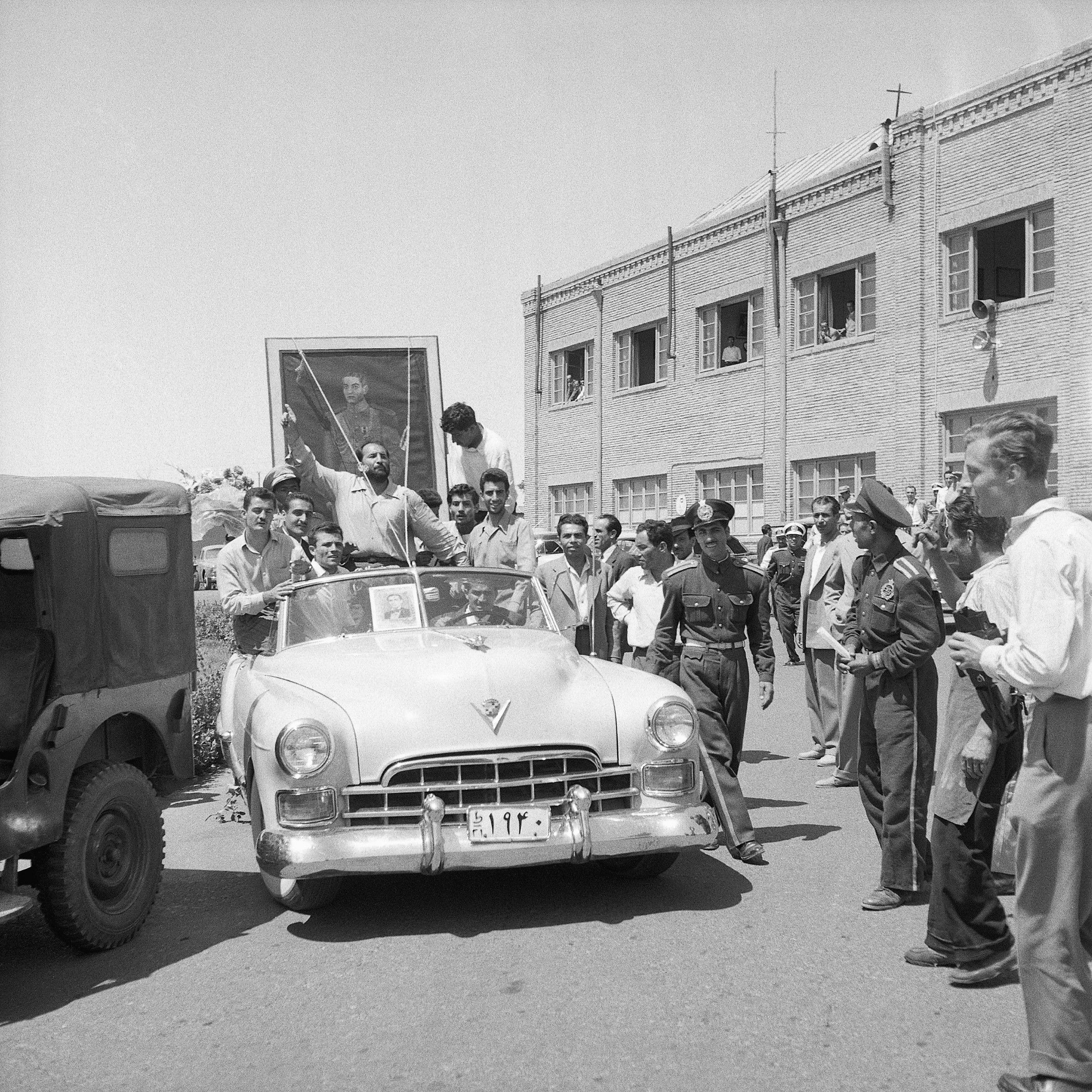
Global News Podcast
The GlobaL Story: Operation Ajax: The CIA’s Iran coup
00:28:13
How the US led a coup to topple Iran’s last democratically elected leader in 1953.
Loading summary
Transcript96 lines
- [00:00]
Tristan Redman
This BBC podcast is supported by ads
- [00:03]
BBC Archive or Narrator
outside the UK
- [00:06]
Asma Khalid
this summer. Don't squeeze in. Spread out. Find homes big enough for your whole guest list on vrbo. From family reunions to trips with friends, VRBO has spacious summer stays for every group size and budget. That's vacation rentals done right. Start exploring on VRBO and book your next day. Now. When you manage procurement for multiple facilities, every order matters. But when it's for a hospital system, they matter even more. Grainger gets it and knows there's no time for managing multiple suppliers and no room for shipping delays. That's why Grainger offers millions of products in fast, dependable delivery so you can keep your facility stocked, safe, safe and running smoothly. Call 1-800-granger. Click granger.com or just stop by Granger for the ones who get it done. Hey there. I'm Asma Khalid.
- [01:10]
Tristan Redman
And I'm Tristan Redman, and we're here with a bonus episode for you from the Global Story podcast.
- [01:15]
Asma Khalid
The world order is shifting. Old alliances are fraying and new ones are emerging. Some of this turbulence can be traced to decisions made in the United States. But the US Isn't just a cause of the upheaval. Its politics are also a symptom of it.
- [01:32]
Tristan Redman
Every day we focus on one story looking at how America and the world shape each other.
- [01:37]
Asma Khalid
So we hope you enjoy this episode and to find more of our show, just search for the Global Story wherever you get your BBC podcasts.
- [01:47]
Tristan Redman
We have really regime change.
- [01:50]
Scott Anderson
You know, this is a change in the regime.
- [01:53]
Tristan Redman
Donald Trump has said many times that he's achieved something like regime change in Iran.
- [02:00]
Scott Anderson
Their first level leaders are dead. Their second level leaders are dead. Some of their third level leaders are dead. I call that regime change.
- [02:08]
Tristan Redman
It's hard to make a watertight case for it, though. There was a Khamenei in charge before the war, there's still a Khamenei in charge now. It wouldn't be the first time the US has attempted regime change in Iran. Back in 1953, the CIA led a coup to topple Iran's democratically elected prime minister, a moment in history that's less well known in the United States but definitely hasn't been forgotten in Iran. It may still be shaping the thinking of the new Iranian leaders the US Needs to negotiate with now. From the BBC, I'm Tristan Redmond. And today on the Global the long shadow of the 1953 coup and why it may have shaped Iran and US thinking on regime change for decades.
- [03:11]
Scott Anderson
I'm Scott Anderson. I'm a nonfiction book writer and journalist. I've written a series of nonfiction books, mostly dealing with war and mostly in the Middle East.
- [03:20]
Tristan Redman
Now, friends, I've been wanting to get on the show the writer, Scott Anderson, for some time now. He's the author of a pretty incredible book that I've been reading called King of Kings, which is a history of US and Iranian relations over the last 75 years. And he's a great person to tell us the story of the 1953 coup, which in some ways is where it all started. So to set the scene, it's 1953, and the Shah of Iran, the king or emperor, depending on how you want to translate it, has been in power for 12 years, but he has to share power with a democratically elected prime minister and also with parliament. Now, this story doesn't start with the United States. It actually starts with Britain, because at this particular moment in time, Britain has a lot of interests inside Iran.
- [04:11]
Scott Anderson
The British had a concession going back in the early 1900s for the oil in Persia at the time. And ever since they discovered oil in 1907, the British had had a complete monopoly on Persian and Iranian oil.
- [04:24]
BBC Archive or Narrator
In Aberd, at the head of the Persian Gulf, is the largest oil refinery in the world, firmly under British protection, a fact which locally they don't seem to resent at all.
- [04:34]
Scott Anderson
This became increasingly a flashpoint with Iranian nationalists in the late 1940s, early 1950s.
- [04:41]
BBC Archive or Narrator
From barren wastes, British enterprise and money won wealth, which Persia shared on a proper mutually agreed contract.
- [04:47]
Scott Anderson
The Iranians were getting a pittance of the money that was being brought in from the oil industry.
- [04:53]
Tristan Redman
When you say a pittance, what do you mean?
- [04:55]
Scott Anderson
Well, they were supposed to get 20 cents on the dollar of the proceeds of the oil, and they were actually getting more like 8 cents on the dollar. The British were pretty shameless in monopolizing and kind of ripping off the Iranian government. Part of the terms of the contract were that the Iranian government was not allowed to look at the ledger books. So this was just a license to steal by the British company that ran it. The British company was also tied to the British government. It was a quasi private, quasi government institution. So in the early 1950s, a kind of a populist nationalist politician named Mohammad Mosadegh became Prime Minister of Iran.
- [05:37]
Tristan Redman
When you say a populist nationalist, is there anyone in the modern day pantheon of politicians that you would compare Mossadegh to?
- [05:46]
Scott Anderson
I might compare him to, say, Hugo Chavez in Venezuela, kind of very charismatic, would give firebrand speeches. One of the secrets of his powers was to have an external enemy that you kind of ride this anti British sentiment, this constant refrain of how we're being taken advantage of by this imperial power. So Mosaddegh, he was usurping the Shah's powers and gradually chipping away at what had been the Shah's powers. And a huge issue at this time was to get back the oil, to break this concession that had been given to the British back in the early 1900s.
- [06:24]
BBC Archive or Narrator
Let us hope that the Persians will not allow themselves to be intimidated by fanatics into a rash act which will lead to disaster for both countries.
- [06:35]
Scott Anderson
And Mossadegh sort of became the chief spokesperson for that. He nationalized the oil industry.
- [06:41]
BBC Archive or Narrator
A nationalization law amounting to virtual confiscation was put into action by Premier Mossadegh.
- [06:47]
Scott Anderson
That put Britain and Iran on a collision course.
- [06:51]
BBC Archive or Narrator
We were forced to evacuate our 500 million pound property.
- [06:55]
Scott Anderson
Britain's hit imperial imposed a blockade on Iran. This continued for about a year and a half. Meanwhile, Mossadegh was not falling, which was of course, the British hope. So the British devised a plan to overthrow Mossadegh and restore the Shah, who was far more pliant to his kingly powers. Figuring that the Shah would cancel the nationalization, give the oil back to the British. But the British didn't want to have their hands seen in this operation because they were already reviled by the Iranian people. So they looked to the Americans to take care of this operation for them. They first floated this idea to the Truman administration in the summer of 1952. It was like, hey, we have this all set up to overthrow Mossadegh. Will you do this for us? And Truman said, no. Why should we overthrow a democratically elected government for you, for your oil? Truman leaves office in January of 1953. The Eisenhower administration comes in as president. He has a rabid, anti communist secretary of state named John Foster Dulles. The British come back to the Americans right after the inauguration of Eisenhower and re pitch the story. And this time the idea of overthrowing Mossadegh has taken on a new shade, which is that waiting in the wings, standing behind Mossadegh are the communists.
- [08:16]
Tristan Redman
So this becomes a classic Cold War dynamic almost.
- [08:19]
Scott Anderson
That's right. And the Reds, of course, will take Iran into the Soviet sphere. Iran having a very large border with the Soviet Union. So this sufficiently spooks John Foster Dulles and Eisenhower. So they sign on to the idea of carrying out the coup for the behest of the British. And that operation becomes known as Operation Ajax.
- [08:40]
Tristan Redman
And what is Operation Ajax? What's the plan?
- [08:43]
Scott Anderson
So the plan is they have a few operatives inside Tehran, in the city. Basically, the Shah has the power to revoke Mosaddegh's prime ministership. And he had tried to do this once before, and it led to massive riots in Tehran. So basically, the plan is, is that they are going to have the military on alert and people loyal to the Shah on standby. They're going to inform Mosadegh that he's been dismissed from the prime ministership. And if there's any problems, people loyal to the Shah will take control of the streets. So the man in charge of Operation Ajax is Kermit Roosevelt, who is a CIA officer, cousin of Theodore Roosevelt. President Kermit Roosevelt goes to the Shah and tells him of this plan that they're going to unseat Mossadegh. The Shah is famously passive figure. He's a man who has always wanted other people to do his dirty work for him. And he vacillates for months, actually. He goes back and forth of whether he's going to approve or cancel the Operation Ajax. He finally says, yes, we're going forward. And then on the very eve in about August 12, 1953, he tries to back out again. The Shah says, no, we're not gonna do it. Kermit Roosevelt sneaks into the royal palace. He hides in the footwell of a car. He gets into the palace, he confronts the Shah and says, look, it's too late. This coup is going forward either with you or without you. But it's too late to cancel it now. So the Shah kind of agrees. But then the Shah takes his own action. The Shah was a pilot. He loved to fly planes. So that night, he and his second wife get on a small plane that the Shah is piloting, and they fly up to Royal Palace, a small royal palace on the Caspian Sea. They get out of Tehran, there was likely to be some unpleasantness. So he wanted to be kind of in a safe spot. What happens is the next day, the coup starts.
- [10:48]
BBC Archive or Narrator
Attention is focused once again on the Middle east, where events in Iran have taken a dramatic double twist.
- [10:53]
Scott Anderson
Mossaddegh has been tipped off it's coming. He has his own loyalists respond to the Shah's loyalist troops.
- [10:59]
BBC Archive or Narrator
Death to the Shah. Statues of the ruler and his father are pelted and desecrated by the fanatic followers of the aged Premier Mohammad Mossadegh.
- [11:08]
Scott Anderson
And there's pitched battles in the streets of Tehran. And this goes on for two days. And during those two days, the Shah first flies his plane to Iraq and then flies on to Rome.
- [11:19]
BBC Archive or Narrator
Forced to flee his palace in Tehran, the Shah and his queen arrive in Rome after an alleged attempt by the Imperial guard to arrest Dr. Mossaddeq.
- [11:27]
Scott Anderson
So on day three, what happens is it looks like the coup has failed in Tehran.
- [11:33]
BBC Archive or Narrator
It looked as if Mosaddegh would soon be named President. And on his orders, troops occupied the Shah's palaces and surrounded Parliament.
- [11:40]
Scott Anderson
The CIA actually was moving to shut down the operation. Most of the CIA's operatives have fled Tehran. And Kermit Roosevelt locks himself in a CIA safe house drinking gin and listening to Broadway show tunes.
- [11:55]
Tristan Redman
That's extraordinary. What's going on there? Tell us more about that.
- [11:58]
Scott Anderson
Apparently he had a passion for Broadway show tunes, but I guess it inspires him because as a kind of a last ditch effort, he decides he's going to rent a mob. And this is actually something of a tradition in Iran that you can rent street tufts to attack your rival company or a rival politician. So Kermit Roosevelt hires a group of
- [12:21]
BBC Archive or Narrator
thugs, loyalists are punched, mauled and kicked
- [12:24]
Scott Anderson
to masquerade as Mossaddegh loyalists.
- [12:27]
BBC Archive or Narrator
Streets are a no man's land as Mossadegh seizes control of the oil rich country.
- [12:33]
Scott Anderson
And to go through downtown Tiran smashing windows, roughing people up, and just being hooligans. But hooligans supposedly in support of Mossadegh.
- [12:43]
Tristan Redman
Just to clarify, the role of the Renter mob is to essentially paint Mossadegh's supporters in a negative light.
- [12:54]
Scott Anderson
That's right.
- [12:54]
Tristan Redman
And hoping that that will turn the tide of support against Mossadegh.
- [12:57]
Scott Anderson
That's right.
- [12:58]
Tristan Redman
So it's a false flag operation basically.
- [13:00]
Scott Anderson
Absolutely. Yeah. Yes.
- [13:02]
Tristan Redman
Yeah.
- [13:02]
Scott Anderson
And it was 11th hour, last ditch idea to try to turn the tide.
- [13:06]
BBC Archive or Narrator
After nine bloody hours, they are in control and are overwhelmed in a startling shift in affection.
- [13:12]
Scott Anderson
And against all odds, it worked.
- [13:14]
BBC Archive or Narrator
Meanwhile, the mob flopped. The streets demanding the return of the
- [13:17]
Scott Anderson
Shah, fueled by djinn, fueled by gin and Broadway shows. Yeah.
- [13:23]
Tristan Redman
What did this CIA make of this operation? Was this. According to the CIA handbook, the CIA
- [13:31]
Scott Anderson
had never really done something quite like this before. You know, it was almost just pure adventurism. It wasn't going to cost much money, the risk level was low and it was kind of, let's just see what happens the backside to this. Prior to the Iranian coup, for the previous six, seven years, the Americans had been trying to foment anti communist revolts behind the Iron Curtain in the Warsaw Pact countries. And they had airdropped anti communist partisans behind enemy Lines. Every one of these operations, it was Ukraine, Albania, Romania, Poland, they were all disasters. So by 1953 you now had a very static battle line in Europe, the Iron Curtain. I think Eisenhower and John Foster Doles were thinking, well, okay, this idea comes to us from the British. Let's try it out, let's see what happens. I don't think it was very much more complicated than that. When it succeeded and the royalists took over, the Shah was having lunch at the Excelsior Hotel in Rome and he learns that the coup has succeeded. So he kind of comes back two days later a little bit shame faced that, you know, I mean, who runs away from their own coup and then takes over and finds Mossadegh guilty of treason, sentences him to internal exile. Mossadegh goes back to his home village and is quarantined there for the next seven or eight years until he dies. And now the Shah has absolute powers and now he's on his way.
- [15:01]
Tristan Redman
But all of this started because of oil. What happens to the oil at this point?
- [15:07]
Scott Anderson
So I think the Americans kind of pulled a fast one on the Brits a bit. So what happens is because the Anglo Iranian Oil Company is so hated, the Americans, with the Shah's collaboration, obviously they create this consortium where most of the oil now goes under the control of American oil companies and a very small part stays with the British. But essentially the Americans take control of the Iranian oil on the economic level. This is really the beginning of the American alliance in Iran, but not politically. And this is the thing that's quite fascinating about the 53 coup is that because of the Shah's behavior during Operation Ajax, the Americans are actually quite askance of him. I mean, again, who runs away from their own coup? So the American government continues to keep the Shah, if anything, at even more of an arm's length for the next 10, 12 years. They think he's a coward, obviously, he's very passive. So there's not this huge political investment in the Shah right after Operation Ajax? Yes, you're starting to see the beginning of the economic alliance, but not so much of the political. And that really comes about 10 years later.
- [16:20]
Tristan Redman
Nevertheless, the Shah and the United States are yoked together at this point, right?
- [16:26]
Scott Anderson
Very much so in the eyes of the Iranian people and in the Shah's eyes. So he was seen as a creation now of the Americans, even though the Americans didn't want to assume that role and did not assume that role for a long time to come. But of course this would come back to haunt the Shah. During the revolution, because anything he did, even when he instituted reforms or promised change, he was still seen as the American Shah.
- [16:51]
Tristan Redman
Is any part of this story contested?
- [16:56]
Scott Anderson
I'll say in two ways. It's quite contested. I think Mossadegh has been kind of knighted as the martyr to democracy, and he really wasn't that. He was constantly usurping not only the Shah's authority, but also Parliament's. If things had gone on, there's a very good chance he would have been a dictator. So I think there's been this kind of whitewashing of Mossadegh in history. The second aspect to this is, ironically enough, really the American role in the coup was quite exaggerated. And it was exaggerated by Kermit Roosevelt.
- [17:29]
Tristan Redman
I'm shocked.
- [17:30]
Scott Anderson
I know.
- [17:35]
BBC Archive or Narrator
Well, it was not difficult at all because the hardcore of the.
- [17:41]
Scott Anderson
The Iranian element was there and ready to move. Kermit Roosevelt, after the coup, comes back to Washington. He's led into the Oval Office and he's there with Eisenhower and John Foster Dulles, Secretary of State. And it's like this group of boys sitting around in a clubhouse and they say, tell us what happened. And Kermit spins this tale that has him in this heroic role and his people being absolutely instrumental in the coup, and they really weren't. But Eisenhower eats this up. He says, this reads like a dime novel. You know, this is fantastic. And famously, Kermit Roosevelt remembers looking at John Foster Doles while he's telling the story of Operation Ajax. And John Foster Doles has a Cheshire cat smile on his face. And already Kermit Roosevelt can tell his brain is whirling with other possibilities. If we did this in Iran, where can we go next?
- [18:53]
Commercial Announcer
If you work in university maintenance, Grainger considers you an MVP because your playbook ensures your arena is always ready for tip off. And Grainger is your trusted partner, offering the products you need all in one place, from H Vac and plumbing supplies to lighting and more. And all delivered with plenty of time left on the clock. So your team always gets the win. Call 1-800-GRAINGER visit grainger.com or just stop by Grainger for the ones who get it done. Dish has been connecting communities like yours for the last 45 years, providing the TV you love at a price you can trust. Watch live sports news and the latest movies, plus your favorite streaming apps, all in one place. Switch to DISH today and lock in the lowest price in satellite TV, starting at 89.99amonth with our two year price guarantee. Call 888-@dish or visit dish.com today. If you work in university maintenance, Grainier considers you an MVP because your playbook ensures your arena is always ready for tip off. And Grainger is your trusted partner offering the products you need, all in one place, from H VAC and plumbing supplies to lighting and more. And all delivered with plenty of time left on the clock. So your team always gets the win. Call 1-800-GRAINGER visit grainger.com or just stop by Grainger for the ones who get it done. If you work in university maintenance, Grainger considers you an MVP because your playbook ensures your arena is always ready for tip off. And Grainger is your trusted partner, offering the products you need, all in one place, from H VAC and plumbing supplies to lighting and more. And all delivered with plenty of time left on the clock. So your team always gets the win. Call 1-800-GRAINGER visit grainger.com or just stop by Grainger for the ones who get it done.
- [20:57]
Tristan Redman
Well, I have to say I. I find this so fascinating partly because it's so of its time. The story you're telling is of the world emerging from World War II. Britain essentially still believing itself to be a player, very quickly finding out that the United States is the. The big player in town, entering the operation, stealing all the glory and the oil, returning back to Washington and. And back slaps all around.
- [21:24]
Scott Anderson
That's right.
- [21:24]
Tristan Redman
What's the United States learned from this experience?
- [21:29]
Scott Anderson
Well, it becomes kind of the CIA's new playbook. You know, it worked so well in Iran. Let's do it again. So a year later they decide they're going to overthrow the democratically elected government of Jacobo Arbenz in Guatemala, who wants to do agrarian reform. Most of the land in Guatemala is in the hands of a handful of oligarchic families and the Standard Fruit Company.
- [22:00]
Tristan Redman
So similar profile to Mosaddegh in Iran.
- [22:03]
Scott Anderson
That's right, very similar. So the CIA finds this disgruntled ex Guatemalan colonel to get together a ragtag army of about 40, 50, maybe 60 mercenary soldiers. The idea is they're gonna march on Guatemala City. They all bog down within miles of the border. This assault doesn't go anywhere. But meanwhile the CIA has a radio transmitter set up and there's casting these broadcasts into Guatemala. The Liberation army is on the march. And just as what happens in Iran, the loyalist army around Arbenz folds. They collapse. It's another massive bluff and it works again. Arbenz is overthrown. Guatemala becomes a right wing dictatorship. Very pro American, very anti communist. And it stays that way for, you know, for the next 40 years. So now CIA has achieved two bizarre successes back to back at very little expenditure, nothing compared to what had been spent in terms of blood and treasure in Eastern Europe. Now this really becomes the playbook. And so over the next six years of the Eisenhower administration, the CIA tries to replicate this all throughout the world. Like where Congo in Southeast Asia, they try to step in when the French are flailing in Indochina in Yemen, and none of those work, but they have the effect of essentially alienating people in every region or sub region of the world. Then the final kind of carry on from this era of CIA adventurism is the Bay of Pigs. And that's all planned under Eisenhower and John Foster Dulles. As Fidel Castro, who's overthrown the dictatorship in Cuba, he becomes more and more of a leftist. There's a CIA plot to overthrow Castro that becomes the Bay of Pigs under Kennedy.
- [24:06]
Tristan Redman
That's in 1961, right?
- [24:08]
Scott Anderson
1961. And if you look at that, it was an exact replica of what, say, would happen in Guatemala. You know, you throw 1200 anti communist Cubans on the beach of Cuba, tell them to march on Havana, and that's supposed to overthrow Fidel. And instead, of course, it was a total fiasco.
- [24:24]
Tristan Redman
I mean, I have to say we do have a soft spot for the Bay of Pigs story. On the Global Story, it's one that crops up an unexpected number of times. So I feel like you could play a game of Global Story Bingo where every time, every time the Bay of Pigs comes up, you get a prize. So thank you for raising it again today for those playing Global Story Bingo. Okay, so Scott, you've told us, therefore, about how the 1953 coup in Iran shaped things from the US perspective. But recently on the Global Story, we spoke with a woman called Ambassador Wendy Sherman. She was appointed by President Barack Obama to be the US Lead negotiator for the Iran nuclear deal. And when we were talking to her, she told us that in her direct negotiations with Iranians, she was aware that the shadow of 1953 was still present for those Iranian negotiators she was talking to. How does anti American sentiment begin to ferment inside Iran after 1953?
- [25:35]
Scott Anderson
Ms. Truman's. Exactly, absolutely right. So in a way, what happened in 1953 is the Americans took away the role of the British as kind of the Great Satan. It had been the British prior to that, now it was the Americans. And I think that when you go to, say, the Iranian Revolution of 79 it was 53 that really gave it this sort of the catalyst because along with it being this religious counter revolution was a very strong element of kind of anti colonial rebellion. The Shah was the American Shah. They're replying to the bullets with Molotov
- [26:15]
Tristan Redman
cocktail, else it's about the only use they've got now for American Coca Cola bottles.
- [26:21]
Scott Anderson
He was seen as a tool of the Americans and of the continued domination of Iran by the West. And that was something he could not get out from under with his own people.
- [26:33]
Tristan Redman
What are the practical lessons that Iran learned through that experience in 1953 about how to conduct themselves, particularly in their dealings with the United States?
- [26:45]
Scott Anderson
What I think the certainly the Islamic regime was been very adept at was playing that anti American card to rally the people. So, you know, when, when Khomeini takes over, when you set up the Islamic regime, a lot of Iranians don't want, you know, a theocracy, but the opposition to Khomeini and to the far right theocracy could always be tarred as pro American. And I saw this in June during the first round of American and Israeli
- [27:14]
Tristan Redman
bombings of Iran in June 2025.
- [27:17]
Scott Anderson
June of 2025. Right. So I was talking to people in the Iranian opposition and there had been a growing groundswell of dissent against the regime. And what they were saying to me is, you know, if we come out and protest now against the regime, we're tarred as American lackeys and Israeli lackeys. So, you know, it turns out that in general, people don't like being bombed by foreign countries. And so there is this rallying around the flag effect. And I think the regime has been very adept at constantly going back to the beginning of American meddling in internal Iranian affairs going back to 1953. Interestingly, the current regime has never known quite what to do with Mohamed Mosaddegh. He was liberal, he was quasi socialist, he was not Ayatollah Khomeini in Khomeini's camp. So they've kind of presented him as this martyr, but not too much of a martyr. He was kind of the first victim of the American collusion with the Shah.
- [28:27]
Tristan Redman
Scott, I have to ask you, and I didn't realize I was going to be so taken with a character called Kermit Roosevelt. There's a lot of conversation in the modern age about whether the world is shaped by inexorable global forces or by individuals. Is it possible to say that without a gin swilling, show tunes listening intelligence operative called Kermit Roosevelt, we may not be seeing US and Iranian relations as they are today and that he changed the, the course of history.
- [29:03]
Scott Anderson
I think absolutely. I ascribe very much to the, to the latter notion. The so called great man theory of history, this idea that flukish events, the right people or the wrong people at the wrong place at the wrong time can affect history. I think you saw it with Kermit Roosevelt in 53. I think you're seeing with Donald Trump today the power of one person, good or bad, can affect huge change.
- [29:29]
Tristan Redman
And in the case of Kermit, throwing the dice on a wing in a prayer with one last chance to try and make the coup work.
- [29:37]
Scott Anderson
Yeah, yeah. All of history changes on that, that last roll of the dice.
- [29:47]
Tristan Redman
Thank you so much, Scott. It's been wonderful to talk this through with you. Thank you for taking your time.
- [29:52]
Scott Anderson
Oh, my pleasure, Tristan. Thank you. Foreign.
- [30:02]
Tristan Redman
That was the writer Scott Anderson, author of King of Kings, the Iranian Revolution, a story of hubris, delusion and catastrophic miscalculation. As always, our email is the globalstorybc.com Great to hear from Juan Carlos in Cuba. We're so glad you enjoyed our episode on the Internet in Russia with Steve Rosenberg. Thanks for being our, quote, number one Cuban fan, Juan Carlos. Sam, thanks for your message about the impact of the Iran war on India. We're working on an India episode right now, so watch this space. It may not have 100% all the fertilizer focus that you and I both want, but in the words of the US President, let's see what happens. Now, as you know at the Global Story, we bring you one story every day where the world in America meets. For the very latest news headlines, listen to our sister show, the Global News Podcast. You can find it wherever you listen. This episode was produced by Viv Jones and Valerio Esposito. It was edited by James Shield and mixed by Travis Evans. Our digital producer is Gabriel Purcell Davis. Our studio manager was Jonathan Greer. Our senior news editor is China Collins. And I'm Tristan Redman. We'll be back again tomorrow. We look forward to catching up with you then. Cheerio.
- [31:28]
Commercial Announcer
If you work in university maintenance, Grainger considers you an MVP because your playbook ensures your arena is always ready for tip off. And Grainger is your trusted partner, offering the products you need all in one place, from H vac and plumbing supplies to lighting and more. And all delivered with plenty of time left on the clock. So your team always gets the win. Call 1-800-GRAINGER visit granger.com. or just stop by Granger for the ones who get it done.