Loading summary
Transcript108 lines
- [00:00]
Louise Butcher
This BBC podcast is supported by ads outside the uk.
- [00:06]
Martha Stewart
When Kohler, global design leader in luxurious kitchen and bath products, asked me to be their ambassador for timeless, elegant, durable cast iron, I said I'm in. Soon after I was in their Kohler Wisconsin foundry watching molten iron, poured enamel applied by hand and the beautiful finished pieces ready to ship. Since 1883, Kohler cast iron has been crafted by incredible artisans and seeing it firsthand gave me a whole new appreciation for their craftsmanship. Now I am proud to lend my stamp of approval to my favorite Kohler cast iron products for their durability, beauty and enduring style. Shop my curated picks@kohler.com as the Kohler cast Iron Ambassador I say long live cast iron.
- [00:59]
Commercial Announcer
Spring into deals with stay green premium 2 cubic foot mulch 5 bags for $10 plus stay fresh with up to 35% off select major appliances and save an additional $100 on select laundry pairs. Our best lineup is here at Lowes Lowes we help you save valid 3 5, 6 mulch offer excludes Alaska and Hawaii. See Lowes.com for more details. Visit your nearby Lowes.
- [01:30]
Holly Gibbs
This is the happy pod from the BBC world service. I'm Holly Gibbs and in this edition,
- [01:41]
Louise Butcher
even though I've lost my breasts, the scars are there to remind me that I survived a disease that tried to kill me.
- [01:49]
Holly Gibbs
We meet the Topless Runner showing the world her double mastectomy scars with poor pride. Also on this podcast hello mom and dad.
- [01:58]
Louise Butcher
Imagine being able to cross fuel from Jersey City.
- [02:02]
Interviewer/Researcher
When I get home on my furlough, I want you to have a lot of orange. There the girl I told you about in one of my letters.
- [02:07]
Holly Gibbs
We're going out canoeing, preserving voice notes recorded nearly 100 years ago. Why a chip you take from someone else's plate really does taste better. And the woman who's been recognized for her helping to protect endangered bats in Nigeria.
- [02:24]
Ororo Tanshi
Bats plant forests because you're always dispersing seeds. Bats will manage insect populations. Bats are really valuable ecological friends.
- [02:38]
Holly Gibbs
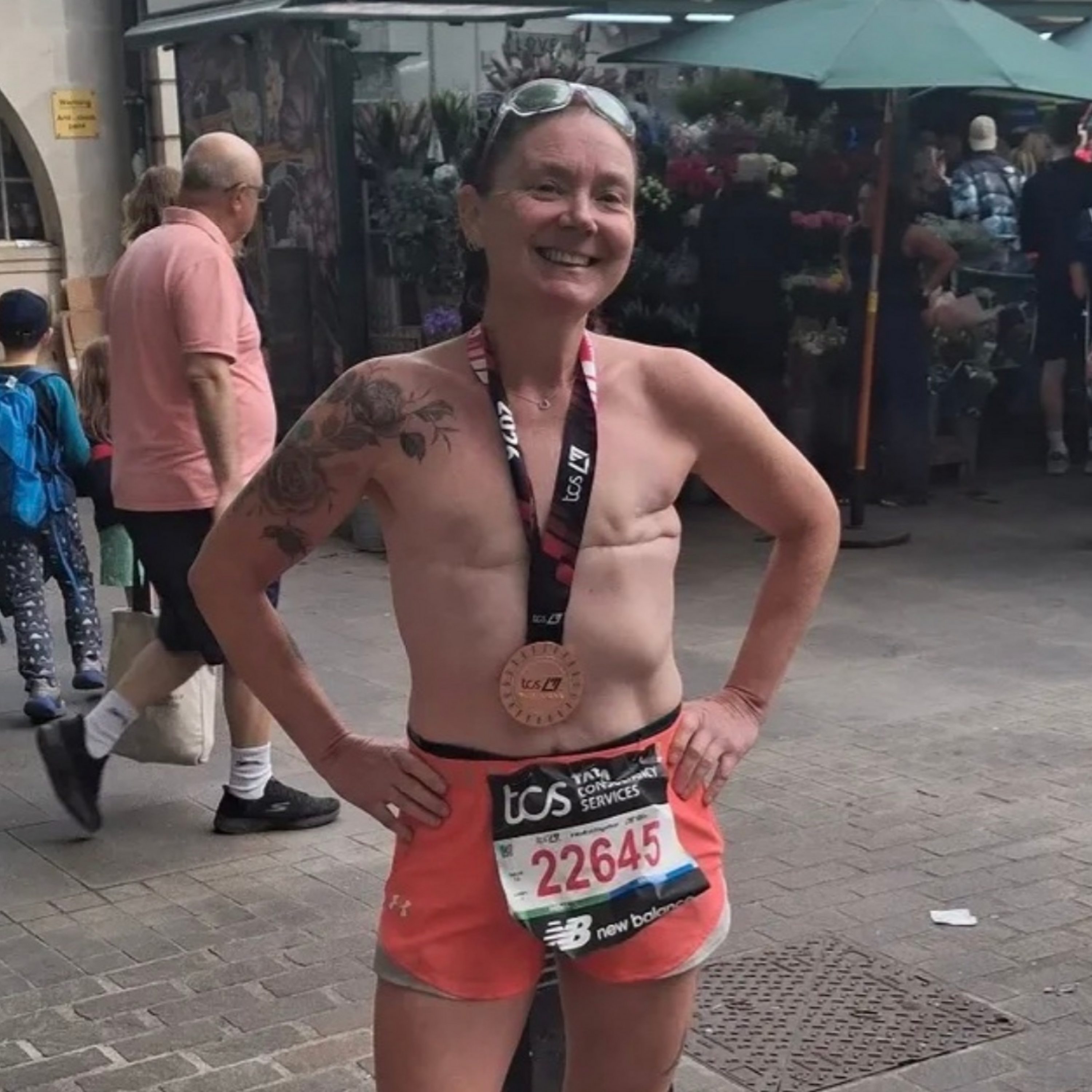
We start with a woman who is trying to inspire others to embrace their bodies, no matter how different they might be. Louise Butcher had both of her breasts removed after having cancer. Although it was only in her left breast, Louise chose to have a daughter double mastectomy. She is now known online as the Topless Runner and runs, as the name suggests, with her scars proudly on display. She's been speaking to the Happy Pods Karen Martin and started with why she decided not to have breast reconstruction at that time.
- [03:09]
Louise Butcher
There's so many things going through Your head that all I cared about was I wanted to get rid of the cancer. And I think all these sort of, like, questions, you're going to have reconstruction. Do you want this? Do you want that? It's just too much to take on. And I kind of thought, I just want to get on with my life. I want to recover quickly, and I don't see the need to put something back which isn't mine. When I first had the left side off, which had the cancer in, I actually said, can I have a double mastectomy? And the surgeon said, we don't take off a healthy breast. And I kind of said, well, how do you know it's healthy when lobular breast cancer, which is what I had, doesn't show up? Well, on scans, I could look in the shower at the scar really easily, but I couldn't look at the other breast because it felt like a killing machine. It worried me. It could be there, it could come in that breast, but it also wouldn't let me move on because I could see what I'd lost. And what was the process of coming to terms with your new body? It took around about six months, and it was kind of like. Which is what I tried to pass on to other women. It evolving into a better version of yourself. So I'd never run marathons with boobs. So I became, without boobs, a marathon runner. And it was kind of like becoming a stronger, better person. So I know that if I'd have stayed the same person, I would have constantly been going, I remember when I had breasts, this is what I was like. But I can't look back at that person now, because now I've become this stronger, better person. And I try and pass that on and. And encourage other women to do that, because just because you lose a part of yourself doesn't mean you can't gain other things. Cancer took away, and it does take away all your control. Everything you had planned, this life that you thought you were going to have, just goes like this. And that's the element that I try to empower other women with as well, is the control. The fact that I'd had that off was my decision. I'd advocated it, which made me feel empowered. Let's talk about your relationship with your scars, like how they make you feel. When I looked at the stigma associated with not having reconstruction, it was a negative narrative around it. It was like, oh, she's lost her breasts, or, poor woman, the pity was there. And I thought the analogy of the shark for me was, you Had a shark attack and you, your leg had been bitten and you came out of it alive. I would be really proud of that scar. If I was bitten on the leg, I'd be showing it off. I'd be like, look what I survived. And that's kind of how I look at my scars, because even though I've lost my breasts, the scars are there to remind me that I survived a disease that tried to kill me. So instead of the negative, I put that narrative on it. And that really helped change my mindset around them. They've still created something beautiful because you're still alive. And that's what I try and pass on from there. You took to running the first time you ran without a top on Talk Talk me through the feeling of. Before leaving the house, even. I'd run the marathon six weeks after my second surgery. And I remember thinking, I've got to do summit with the next marathon. That's quite special. And it had been about a week before. And I thought about this stigma and how I felt and how I'd seen other women had felt. And I thought what would be really amazing would be to show the. The stigma of the pity alongside something that's really strong and determined and the resilience of running a marathon. And that was how the mindset of I'll do it topless came about. And I remember that morning I woke up and, you know when you know you've got a job to do and you're not thinking about it, you're just like, I'm going to do this and this is a job I've got to do. It wasn't really a choice. I woke up like that. There was no anxiety. I wasn't nervous. I was like, no, go do it, and this is what's going to happen. And then I met two of my friends at the start and I took my top off and I just ran. And it was the most liberating, empowering feeling I think I've ever felt. I bought back the control and the choice of what I was doing with my body after cancer. And what was the reaction from people at the start? I would have said 80% positive, 20% negative. A lot on social media is 20% negative. But as I've gone on and on and on, the positivity just keeps rising.
- [07:35]
Commercial Announcer
So.
- [07:35]
Louise Butcher
So I've had messages from all over the world. Women in Japan, there's a lady who ran a topless marathon in Australia, in America. And it's just empowering women in all sorts of ways, not just Running just about their confidence they've got in their body. How has this experience kind of reshaped your relationship with yourself in that way? When I was younger, it was all about how I looked, which I think in many women, that's usually how you feel when you're younger. You care about what people think about you. But when I went through cancer, it changed my mindset because my body became something bigger than how it looked. It was kind of like it healed, it tried to keep me alive. And I had a bigger respect for it than the superficial. And I think that's why I've got the confidence I have, because I don't look at it like that now. And that's why I don't care about the judgment, because I just feel in awe of what it's done, not what it looks like.
- [08:36]
Holly Gibbs
Louise Butcher speaking to Karen Martin. Recording our voices is now pretty common. You might send a voice note to friends and family or to us here at the Happy pod, but nearly 100 years ago, people recorded what were known as speaking letters. And one man is now preserving them in a special digital archive. They offer fascinating insights into everyday life in the 1930s and 40s, as Branka lesser de Sa has been finding out.
- [09:05]
Louise Butcher
Hello, mom and dad. Imagine being able to talk to you from Jersey City.
- [09:11]
Branka Lesa Di Sa
That's Evelyn in New Jersey, sending a message to her parents in Blackpool.
- [09:16]
Interviewer/Researcher
I expect to be going out to Sue Hackes's place. Remember the girl I told you about?
- [09:21]
Branka Lesa Di Sa
And that's Doug in New York telling his sister Mona about his plans for the weekend.
- [09:25]
Interviewer/Researcher
We're going out canoeing, Spend the day out on the beach.
- [09:29]
Branka Lesa Di Sa
Both Evelyn and Doug have passed away, but their voices, recorded close to a century ago, have been immortalized. They're part of a project by Thomas Levine, a professor at Princeton University, who collects what are known as voice letters.
- [09:43]
Thomas Levine
These are small records that people recorded starting in the 20s and 30s in small booths at home in studios.
- [09:53]
Branka Lesa Di Sa
Voice recording technology has been around since the mid-1800s, but it used to be rare and inaccessible. Gramophone discs helped to make the process more mainstream.
- [10:02]
Thomas Levine
You would go in, put a quarter or some small amount of whatever currency into the machine, and then, astonishingly, with nobody else present, you would record, and out would come a record.
- [10:17]
Branka Lesa Di Sa
Thomas first came across audio letters when he found one at a flea market in New Jersey. He became fascinated by how people interacted with what was then a novel technology. Some got nervous and didn't know what to say.
- [10:30]
Interviewer/Researcher
I've a bit more time to stay now.
- [10:32]
Thomas Levine
What can I Say I have about two seconds.
- [10:35]
Branka Lesa Di Sa
Others marveled at the technology. Putting on a bit of a show.
- [10:38]
Louise Butcher
Hi, y'. All.
- [10:40]
Interviewer/Researcher
Wonderful day out here making records for the gi.
- [10:43]
Branka Lesa Di Sa
And there was a lot of singing.
- [10:51]
Interviewer/Researcher
Once there was a little girl who lived down Drury Lane. Her master was.
- [10:55]
Branka Lesa Di Sa
Professor Levine now has an archive of over 5,000 audio letters from all over the world. A lot of the recordings are from American soldiers during the Second World War who were given access, free of charge, to recording booths across the us.
- [11:09]
Interviewer/Researcher
Hello, mother, how are you? I'm just fine. The armies treat me good too. Food is well, but they don't give me enough.
- [11:17]
Thomas Levine
Many of these letters are remarkable documents of, particularly during wartime, of an imagined peacetime quotidian life.
- [11:27]
Interviewer/Researcher
When I get home on my furlough, I want you to have lots of oranges there.
- [11:30]
Branka Lesa Di Sa
Thomas explains that for families whose sons or husbands were away for long periods, the opportunity to hear their voices would have been incredibly special.
- [11:39]
Thomas Levine
These records, unlike the records that we buy in stores, are not multiples. They are unique. So that if you had a recording that you loved to hear of your son, particularly if the recording arrived at home but your child did not, then these things could often be played to the point of almost acoustic oblivion.
- [12:02]
Branka Lesa Di Sa
Nowadays we're used to recording ourselves. At the click of a button, we can send voice notes to our loved ones. Thomas hopes his collection can remind us not to take that for granted and to maintain our sense of wonder about the technology we have available.
- [12:16]
Thomas Levine
An archive of past messages that had to travel, sometimes arduously, through a postal route and sometimes arrived, sometimes didn't, reminds us that what we take for granted today has a history that helps us understand just how magical some of the dimensions of our current technological convenient landscape have.
- [12:42]
Holly Gibbs
Branka Lesa Di Sa reporting here in the UK, an 88 year old is proving that age is really just a number. She's learning how to be a comedian. Mary McLaren is part of a group of people over the age of 50 taking part in lessons which ended with them taking to the stage for live shows. The happy pods. Helena Burke caught up with Mary.
- [13:05]
Mary McLaren
My daughter nominated me. I've always enjoyed jokes and comedy and even at my late age in life, I quite like being happy and cheery. I don't like complaining and moaning. Life's short. She put me in for this and we had to do a wee sort of four week training type of thing. And then we were up in front of an audience to tell a story about comedy. My birthday. And she comes with vouchers.
- [13:37]
Louise Butcher
Oh, yeah.
- [13:38]
Interviewer/Researcher
Beauty Vouchers.
- [13:39]
Louise Butcher
I love vouchers, love my vlogs.
- [13:42]
Mary McLaren
Running about, spending a fortune. Her money.
- [13:44]
Commercial Announcer
Great.
- [13:46]
Mary McLaren
So I opened the vouchers and they're for assisted buying. I said, well, I've even got somebody show me how to spend my money now. So I went along and I looked at them again and I went, there's no assisted buying. That's assisted dying.
- [14:07]
Commercial Announcer
And how was that for you?
- [14:08]
Holly Gibbs
What kind of things did you learn?
- [14:10]
Mary McLaren
Well, we learned how to sort of present a story and the girl that she was an actual comedian herself and she took us for four weeks and trained us and told us different things, what to say and how to say them so that you can hesitate and get a laugh in between, you know, that sort of thing was very, very interesting.
- [14:31]
Commercial Announcer
And at the end of it all,
- [14:32]
Holly Gibbs
you performed at the Social hub in Glasgow.
- [14:34]
Commercial Announcer
What was that like?
- [14:35]
Mary McLaren
Yes, that was lovely. That was a lovely night. Obviously very nervous to begin with, but once I get going with my jokes and my stories, I'm quite vocal in that way.
- [14:46]
Commercial Announcer
And did your jokes go down well?
- [14:47]
Holly Gibbs
Did you get a lot of laughs from the audience?
- [14:49]
Mary McLaren
Yes, and we really did get quite a lot of laughs at the end of the night, which made a day, you know, and it was really good.
- [14:55]
Holly Gibbs
What do you hope that listeners of the Happy Pod take away from your story and your experience?
- [15:00]
Mary McLaren
I hope they take away. Well, that was enjoyable and it makes life happier and a lot more pleasant than constantly complaining and just deal with your law and get on with your life.
- [15:12]
Commercial Announcer
And, yeah, I guess for an older
- [15:13]
Holly Gibbs
person listening who thinks like, oh, I'm too old to pick up a new hobby or a new skill, what would you say to them?
- [15:19]
Mary McLaren
I would say, well, you're never too old. Age is a number. And I've always said, all my life, it's attitude to life and it's how you present it. I've lost a son. He was only 47, but I look at that and say, well, he's not coming back. Make the best of your life and think in all the happy times and do not complain.
- [15:39]
Holly Gibbs
Mary McLaren speaking to Helena Burke. Coming up on the happy pods, the choir helping people get their voices back after a stroke or brain injury.
- [15:54]
Stroke Survivor/Singer
Don't stop the music, don't stop the music. Just don't stop it ever.
- [16:04]
Commercial Announcer
Allergy season always has a way of sneaking up on you. One minute you're listening to your favorite podcast, the next it's non stop sneezing and a runny nose. That's why it's essential to keep Kleenex Ultra Soft Tissues on hand. They're silky soft for up to 100% Irritation Free skin and allergist approved so when allergies hit and they will be ready with Kleenex Ultra Soft Tissues for whatever happens next, grab Kleenex.
- [16:30]
Martha Stewart
When Kohler, the global design leader in luxurious kitchen and bath products, came to me and said, martha, we need an ambassador for our timeless, elegant, durable cast iron products. I said, I'm in. Now. Let me see the factory. Weeks later, I was suited up in coveralls and work boots, walking through their Kohler Wisconsin cast iron foundry. I stood next to the molten iron furnace, saw the hand applying enamel and touched the gorgeous finished products waiting to be sent out into the world. Since 1883, Kohler cast iron products have been forged and finished by the incredible craftspeople right in Kohler, Wisconsin. I'll tell you, I gained a newfound respect and appreciation for for Kohler's cast iron craftsmanship. So now I'm lending my discerning staff of approval to my most beloved Kohler cast iron products for their durability, beauty and timelessness. Shop my Kohler Cast Iron favorites curated on Kohler.com bring the warmth, character and enduring style of these timeless products into your kitchens and bathrooms. As the Kohler Cast Iron Ambassador, I say, long live Cast Iron.
- [17:52]
Commercial Announcer
Hey, this is Danielle Robaix, host of Bookmarked by Reese's Book Club, a podcast where great stories, bold women, and irresistible conversations collide. You know, cotton is a part of so many of life's everyday comforts, from what we wear to what we wrap ourselves in. And it's especially present in the quiet, cozy moments, like reading a book you can't put down. Which brings me to our new segment, the Book Nook, where we explore the rituals that make reading feel just right. For me, that means Cotton everything. I live in la. It's summer, and even when it's warm, I want to feel wrapped up and relaxed. When I'm home, I curl up with this super soft cotton blanket. It's lightweight and breathable and perfect for long reading stretches. I've got my favorite matching cotton lounge set on, too. It's basically my reading uniform and I'm nestled on my couch by the window, iced coffee clinking, book in hand. It's truly my ideal reading setup. Thanks to Cotton for bringing this segment to life and reminding us that comfort and style can go hand in hand. Don't forget to check the tag for cotton. And if you want to learn more, head to thefabricofarlives.com hey, it's Ryan Seacrest For Albertsons and Safeway, Spring is a time to give yourself a refresh, so spend time on self Rejection Rejuvenation. Shop in store and online for great savings on all your favorite personal care Items. Now through May 26, earn four times points when you shop participating items like Pantene Shampoo, Crest Toothpaste, Tampax Radiant Native Shampoo and Secret Yellow Deodorant. Then redeem points for discounts on future purchases of groceries or fuel. Offer ends May 26th. Restrictions apply. Offers may vary. Visit albertsons or safeway.com for more details.
- [19:39]
Holly Gibbs
You're listening to the Happy Pod Whether we admit it or not, we've probably all helped ourselves to food from someone else's plate. And now a new study confirms that we actually prefer the taste of food that isn't ours. My colleague James Kumarasamy spoke to the author of the study, Valentin Scriabin, a psychiatrist based in Moscow.
- [20:00]
Interviewer/Researcher
There is a saying that exists in almost every culture on earth in Italian, Japanese, Spanish, Russian, etc. That stolen food tastes better. Everyone knows it. Everyone's experienced it. Sneaking a chip off someone else's plate, sneaking a biscuit you weren't supposed to have. And it always seems to taste just a little bit better than it should. But nobody had ever actually measured whether that's real or just a charming story we tell ourselves. So that's what we did. We took identical french fries and we gave them to people under different circumstances and we measured whether the circumstances changed how the food actually tasted. And they did.
- [20:40]
Louise Butcher
And when you say different circumstances, you mean them taking it from someone else's plate.
- [20:46]
Interviewer/Researcher
We had four situations. First, your own portion. Second, someone offers you their fries as a gift. Third, you sneak a fry from the plate of someone sitting next to you, but they seem friendly and approachable, so the stakes feel low. And fourth, and this is the interesting one, you take a fry from someone who is stern, unapproachable. Well, someone you really wouldn't want to catch you Same fry, same taste. Completely different experience of eating it, as it turned out.
- [21:16]
Louise Butcher
So the ones that were taken from the person who it was more daring to take it from tasted better. Did they?
- [21:25]
Interviewer/Researcher
Yes. Really. On a nine point scale, the legitimately eaten fries scored about six for pleasantness. The stolen ones, taken from their strict Confederate, scored nearly eight and a half. That's a 39% increase in taste of the same chip. But here's what really surprised us. It wasn't just overall enjoyment. Every single sensory dimension moved independently the stolen fries tasted saltier, even though the salt content was identical. They tasted crispier even though they came from the same batch, and more intense overall. The brain wasn't just saying, I enjoy that more. It was actually recalibrating specific sensory channels.
- [22:07]
Louise Butcher
When you say stern confederates, just explain what you mean by that.
- [22:10]
Interviewer/Researcher
It was a professional actor, one trained to be warm, open, smiley, and the other to be stern, strict, closed off. Participants didn't know that the persons were actors. They thought that they are stealing the food. Indeed.
- [22:25]
Louise Butcher
And was there a correlation between how guilty they felt and how tasty the fries were?
- [22:30]
Interviewer/Researcher
At the trial level, guilt and enjoyment were positively correlated. Higher guilt was associated with greater pleasure. What we suggest is that guilt isn't driving the pleasure directly. Rather, both guilt and enjoyment are responses to the same underlying thing, the perceived social risk of the actual. So the strict confederate condition produced more of everything, more anxiety, more guilt, more excitement and more enjoyment.
- [22:57]
Louise Butcher
This is something, as you say, that exists as a concept, as a saying in many languages. What conclusions do you draw from your research?
- [23:06]
Interviewer/Researcher
The fighting is the brain doesn't taste food in isolation, it tastes the whole situation. Social risk, it turns out, is a remarkably powerful seasoning.
- [23:18]
Holly Gibbs
Valentin Scriabin to Nigeria. Next, and a conservationist who's been recognized for her work to protect short tailed roundleaf bats. Eoro Tanshi worked with locals to set up community fire brigades after realising that wildfires were a huge threat to the endangered animal. She also tackled fear among locals that bats are associated with witchcraft. She's been awarded a prestigious environmental prize for her efforts. Ororo spoke to my colleague Nkechi Obonna.
- [23:48]
Ororo Tanshi
Essentially, people just wanted to deal with the problem of wildfires on their farms as well. But we really just say, you know, bats are really great at all these ecosystem services. Bats plant forests because you're always dispersing seeds, you're always moving far away from, you know, the source of the fruits that they're eating. And so by moving away from that tree, they're planting that tree as much as possible across the forest. Same thing with insects. The bats will manage insect populations just naturally. Bats are really valuable ecological friends. You would have a reduction in populations of mosquitoes, for example, because bats eats insects. You have a reduction in pests on farms because bats eat insects that are, you know, agricultural pests. So essentially you come to see that they play so many critical roles, it's almost impossible to ignore them.
- [24:47]
Interviewer/Researcher
Bats are also vectors of different diseases. Now, when you say they play a huge role in the biodiversity and the ecosystem and all of that. I'm worried about the interaction with humans.
- [24:59]
Ororo Tanshi
That's a really good way to phrase that. And the problem of bats potentially carrying diseases that are harmful to humans, it's not a bat problem, it's a human problem. Bats are on their own. If you don't disturb them, if you don't come in close contact with them, they're living their best lives. Where bats potentially might spill some of their viruses, might be, you know, if they're disturbed at their roosting site, so where they sleep. So in caves, for example.
- [25:27]
Interviewer/Researcher
And your team has identified at least 10 additional bat species. Why is that discovery significant for conservation efforts in Nigeria and beyond?
- [25:38]
Ororo Tanshi
In the past, it used to be more about exploration. Now we're in a mad rush to figure out what species we have because we're losing them before we even get the chance to describe them and know them. In science, we're trying to understand the species that occur on this planet and where they occur. So it's a very important detail to know whether bats, a bat, B, C and D, occur only in Nigeria or only in Kenya or only in South Africa.
- [26:08]
Interviewer/Researcher
You've now received global recognition with the Goldman Environmental Prize. What does this award mean to you personally and how do you hope it will help shape the future of this important work?
- [26:20]
Ororo Tanshi
Personally, it's, it's an incredible honor. There are very few things in this world that signal to you that the work that you're doing has global relevance than, you know, things like this. The first Nigerian to win this award was Ken Sarawiwa. You know, that's freedom fighter for oil and the environment. In Nigeria, that was a big thing and it made a big shift. And so in our case, we're hoping that this will make a big shift for bats in Nigeria and in Africa, but also for wildfire management. So essentially, essentially this recognition means in addition to the work that we get in Nigeria, we get to do in Nigeria, we can now scale up this work across the globe.
- [27:00]
Holly Gibbs
Ororo Tanshi. We end with a weekly choir that's making a difference to stroke and brain injury survivors. It's run at the Medstar National Rehabilitation Hospital in Washington dc. And the Happy Pods, Riley Farrell went along to meet them.
- [27:18]
Louise Butcher
It's Thursday afternoon in one of Washington
- [27:20]
Holly Gibbs
D.C. 's busiest hospitals.
- [27:22]
Louise Butcher
And right now the hallways are filled with singing. Leading the group is Dana Griff, a board certified music therapist at the hospital.
- [27:40]
Dana Griff
Singing has really great benefits, especially for stroke and brain injury survivors. After a stroke, some people might have difficulty with word finding where they Might know what they want to say, but it might not come out necessarily the right way. Some people have difficulty with, like, cognitive fatigue, respiratory endurance. So singing is actually something that can impact all of that. Singing in a choir has shown to increase people's confidence. And then, you know, being in a choir, that particularly is a focus for stroke and brain injury survivors. They're amongst peers who have been through the same things.
- [28:16]
Louise Butcher
This is part of the hospital's music wellness program, where therapeutic music activities are tailored person by person, with goals like speech, language, cognitive function, and movement. There it is.
- [28:28]
Commercial Announcer
Okay, Sorry.
- [28:31]
Stroke Survivor/Singer
My name is Tiffany B. King. V for Victoria.
- [28:35]
Interviewer/Researcher
Right.
- [28:36]
Stroke Survivor/Singer
Caitlin. Before my stroke, I had a lovely singing voice. After the stroke, not so much. But I still enjoy the camaraderie and just being with a group of people who, like me, have some physical limitations or setbacks. But we've all come together to lift our voices, to sing, to come together and fellowship and just enjoy each other. Hello, my name is Susan Robinson. I love music. Oh, no. I grew up playing the saxophone. I was in the marching band in high school and in college. So I'm a saxophone player, really, by nature. I really like R and B. That just fits well with my personality.
- [29:22]
Dana Griff
You all know this song, right?
- [29:24]
Louise Butcher
Does everybody know this song? There's research behind music based rehab.
- [29:29]
Dana Griff
I am trained in what's called neurologic music therapy. So it is a separate clinical system of music therapy that focuses on the neuroscientific approach.
- [29:39]
Louise Butcher
And it's.
- [29:40]
Dana Griff
It stemmed from years of research, but we know that music is activated in all different areas of the brain. So it's easier to sing instead of speak sometimes after a stroke because of the language center that was affected during a stroke. So we have to reroute to a different area. Because singing and music is activated all over the brain, we can use that to our advantage to reroute the language to a different area of the brain.
- [30:09]
Stroke Survivor/Singer
They inspired me to continue to improve, to try and, you know, regain what I lost for my stroke and also gain new things. You know, you lose one thing, you regain and learn to expand yourself in other ways. You know, I've gained a new family.
- [30:30]
Louise Butcher
What would you say to someone who's recovering after a stroke or brain injury, or if they have a loved one
- [30:36]
Stroke Survivor/Singer
who's recovering, I want them to know that it's okay for them to try to sing, listen to music and see sing along. Like, try to remember what that person's favorite song is, and then play that music and sing along with that person. That person may not be able to vocalize or verbalize, but they'll hear it and they'll recognize it. Don't stop the music. Don't stop the music. Just don't stop it. Ever.
- [31:03]
Holly Gibbs
Stroke survivor and choir member Susan Robinson ending that report by Riley Farrel. And that's all from the happy pod for now. We'd love to hear from you. As ever, the address is globalpodcastbc.co.uk. this edition was produced by Rachel Bulkley. The editor is Karen Martin. I'm Holly Gibbs. Until next time. Goodbye.
- [31:36]
Commercial Announcer
Craving something specific? From global flavors to viral snacks, TikTok has it all. If you can dream it, you can make it right at home. Find your next favorite dish on TikTok.