← Global News Podcast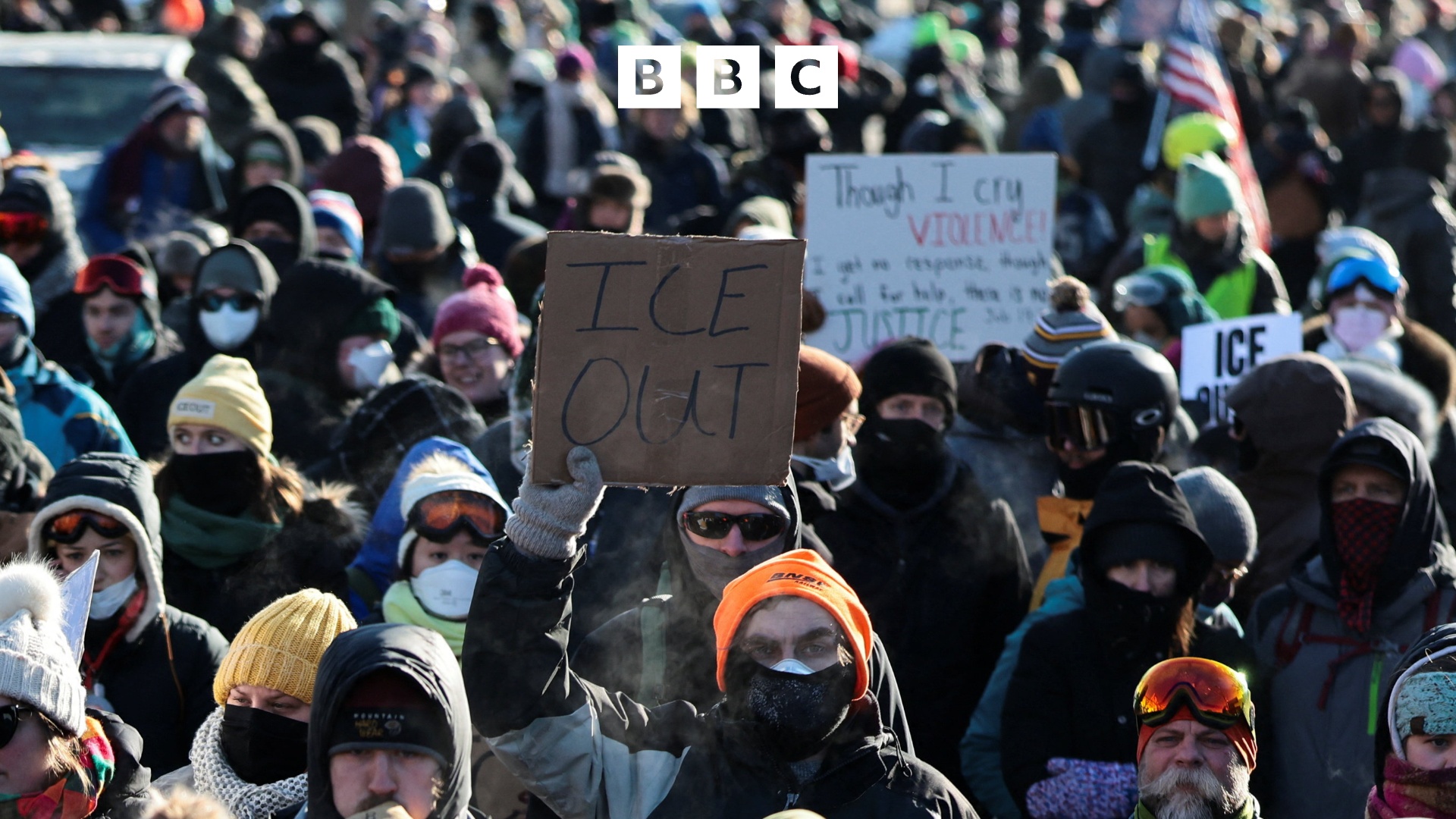
Global News Podcast
700 ICE agents to leave Minnesota
00:30:38
Trump reduces federal force but vows to continue immigration crackdown
Loading summary
Transcript95 lines
- [00:00]
A
This BBC podcast is supported by ads outside the uk. This message comes from Schwab. At Schwab, how you invest is your choice, not theirs. That's why when it comes to managing your wealth, Schwab gives you more choices. You can invest and trade on your own. Plus get advice and more comprehensive wealth solutions to help meet your unique needs. With award winning service, low costs and transparent advice, you can manage your wealth your way at Schwab. Visit schwab.com to learn more.
- [00:34]
B
Support is available 247 with VRBoCare.
- [00:38]
C
We're here day or night, ready whenever you need help because a great trip starts with the right support.
- [00:50]
A
This is the global News podcast from the BBC World Service. I'm Will Chalk and in the early hours of Thursday the 5th of of February, these are our main stories. President Trump speaks of the need for a softer touch on immigration enforcement as hundreds of federal agents withdraw from Minnesota. The last nuclear weapons control treaty between the United States and Russia has expired, raising fears of a new arms race. As Russia and Ukraine take part in the second round of U S led peace talks, the chances of a breakthrough remain slim. Also in this podcast here in the.
- [01:31]
C
UK did the official security vetting he received mention Mandelson's ongoing relationship with the paedophile Jeffrey Epstein?
- [01:42]
A
The Prime Minister Keir Starmer, is facing big questions. Well, it's not traditionally been Donald Trump's style to be conciliatory or to call for a soft touch approach to immigration, but the US President appears to have admitted sending in federal agents en masse to Minnesota to carry out immigration raids. Hasn't worked. Last month, two American citizens were shot in confrontations with masked agents during weeks of protests about the actions of ICE and other officers deployed to the state. President Trump has been speaking to NBC News.
- [02:20]
D
What did you learn?
- [02:22]
C
I learned that maybe we can use a little bit of a softer touch, but you still have to be tough. These are criminal. We're dealing with really hard criminals. But look, I've called the people, I've called the governor, I've called the mayor, spoke to him, had great conversations with them, and then I see them ranting and raving out there.
- [02:42]
A
The U.S. border czar, Tom Homan, had earlier announced the withdrawal of 700 immigration agents from Minnesota after he said state and local officials agreed to cooperate by turning over arrested immigrants. But to put that in perspective, around 2,000 agents will remain there. So what do the people of Minnesota make of this?
- [03:01]
C
The 700 drawdown? Okay, I see it's a positive step, but we need two more steps and get them out of here completely. There's so much misinformation. How can you trust it? Just a step in the right direction. All the volunteers are helping families that won't go out. There's 40% of their population that won't go go to school. We cannot sustain this. It just cannot. The quantity goes down, great, but the quality of the enforcement is still here and they're still using basically the same tactics as they have used. So nothing's really changed.
- [03:39]
A
Well, in terms of what in practice, the removal of some of these agents and also this softer touch approach might mean. It's a question I put to our North America correspondent, Helena Humphrey, who's in Washington.
- [03:52]
E
I think that remains to be seen. In that interview with NBC News, President Trump appeared to suggest that the fact that some 700 federal officers, and that includes those ICE agents, are leaving Minnesota, he said that that was down to him. But on social media, the mayor of Minneapolis, Jacob Fry, said, well, okay, you're left with 2,000 federal agents. That's not what we call a de escalation, essentially was his message. And we also heard today from the White House border czar, Tom Homan, and he was saying that the Trump administration will plan to make body worn cameras available nationwide immediately when it comes to Minneapolis and saying that the failure to use them there had been unacceptable. But I think you have to look at these comments when it comes to a softer touch in the broader context. And in that interview with NBC News, President Trump had said that he wasn't happy with the deaths of Alex Pretty and Renee Good, but he said that ICE agents must be backed. And he praised the Homeland Security Secretary, Kristi Noem, saying that she's doing a very good job. Remember, there have been calls for her to be sacked. Essentially she'd face criticism for referring to Alex Pretty and Renegade as domestic terrorists in the wake of their deaths. So I think we will be watching and monitoring very closely the extent to which this deescalates the situation on the ground.
- [05:10]
A
And then polling for Republicans and Trump not doing as well. And then immigration seems to be a key issue on the polling as well.
- [05:19]
E
Immigration is a really interesting one because it was the leading topic in the past election. And that's unusual when it comes to America because as we know so often it is the economy. So what we're seeing is even if immigration remains a winning issue with Republicans overall, there's this increasing number of Republicans peeling off and they're saying that they're unhappy with how ICE raids are being conducted following the scenes in Minneapolis. And there seems to be this dividing line. So you have MAGA Republicans, for example, more likely to support those raids. And of course, looking at this with the looming shadow of the midterms. And Donald Trump has been encouraged by his chief of staff, Susie Wiles, to get out across the country now to talk about the economy on a weekly basis. That was something he was being told to do in Iowa. But often we find his speeches are far more wide ranging than that.
- [06:10]
A
Helena Humphrey speaking to me from Washington. So whilst this is all going on, criminal cases are continuing against some of the demonstrators in Minnesota. Among them a civil rights lawyer, Nekima Levy Armstrong. She was arrested for taking part in a protest at a church where one of the pastors is also a senior ICE official. Hours after her arrest, the White House posted a picture of Ms. Levy Armstrong in handcuffs on X. You might have seen it. She was visibly distressed with tears pouring down her face. Except it turned out this had never happened. It was an AI fake based on a real image that showed her looking composed. The White House later defended posting it, saying it was a meme. Nakima Levy Armstrong has been speaking to the BBC.
- [06:56]
B
I was in real life, cool, calm, collected and composed as I was being arrested, whereas they presented an image of me with exaggerated features, darkened skin, and tears just flowing out of my face like I was hysterical. I feel that it is prejudicing my case by presenting me in a false light to the public. And it is not unlike the ways in which my ancestors, you know, I'm a descendant of enslaved people, have been caricaturized, you know, with darkened skin and exaggerated features, as well as implications for how artificial intelligence is being used to manipulate reality. It should cause the public to be on high alert from any information that is being disseminated from the White House. They simply cannot be trusted.
- [07:52]
A
Nekima Levy Armstrong. Next. Could this be brought back?
- [07:58]
C
First, you have to know what happens when an atomic bomb explodes. There is a bright flash, brighter than.
- [08:04]
F
The sun, brighter than anything you've ever seen.
- [08:07]
C
If you were not ready and did not know what to do, it could hurt you in different ways. But if you duck and cover like Burt, it will be much safer.
- [08:21]
A
Yeah, slightly chilling. Listen, that it was the public information film widely distributed to US schoolchildren in the 1950s, telling them what to do in the case of nuclear war. Well, now, the last Nuclear Weapons Control Treaty between the United States and Russia, the New START Treaty, has expired, raising fears of a new arms race after the Cuban Missile crisis. When the world seemed at brink of nuclear war, years of negotiations led to the frameworks meant to keep the nuclear powers in check. Georgia Cole is from the International Security Program at the think tank Chatham House and explains the role of these frameworks.
- [09:01]
G
It was designed to increase a minimum.
- [09:03]
C
Sort of level of stability at a very unstable time, obviously during the height of the Cold War. And what newstart did more than any others was introduce these quite detailed verification and transparency measures. So you had things like on site inspections, regular data exchanges, notifications, and then a commission that would meet twice a year to discuss compliance concerns and new systems.
- [09:27]
A
Under the agreement, both countries were still allowed to keep 1550 warheads. So while that is thousands less than what they were estimated to keep during the Cold War, it's still more than enough to destroy the world several times over. So has the treaty been effective in reducing the risk of nuclear war? Pavel Podvig is a Russian arms control expert.
- [09:50]
C
The most important part of the treaty is not necessarily the limits that the treaty established. That system, sort of by just being there, creates a certain atmosphere of certain trust and confidence in each other.
- [10:07]
A
Since the full scale invasion of Ukraine, Russia's stopped providing notifications and also suspended inspections as well. But it's estimated to not have significantly exceeded the required caps. According to the US State Department, as the new START agreement was nearing its end, Russia's President Vladimir Putin proposed to extend it for one year, to which it appears President Trump did not respond. But he's indicated he would like to keep limits on nuclear weapons and involve China in future arms control talks. In terms of how worried we should be now, it's something James Menendez asked Rose Gottemoller, who was the US Chief negotiation negotiator for the new START treaty.
- [10:48]
C
It is concerning that the treaty is going out of force this very night, but I do think it's also worthwhile to consider that we won't fall off a cliff tomorrow. The two countries, Russia and the United States, are not going to immediately start building up. But do you think they might in the years to come? Of course I worry about that because at the moment we don't have any prospect for new negotiations. There's very little communication between Washington and Moscow. It is true that President Trump states he wants to negotiate a new and better deal with the Russians, said that in mid January, speaking to the New York Times. So that's a good sign. He also wants to negotiate with President Xi Jinping, the Chinese leader, which is also good because the Chinese have been rapidly modernizing their nuclear forces and we don't know why. So the President's got the right idea. We just have to make it happen. And with so little communications going on below the level of presidents, it's hard to see how right idea why? I mean, some reports have suggested that the US Wants to increase its nuclear arsenal precisely because China is now so powerful and so much more powerful than it was in 2010. And the US is thinking it needs to take on both Russia and China potentially. Yes, this is the so called two nuclear peer problem because China's had very low numbers of nuclear warheads, historically about 200, 300. Now they're building up to 600. And our Department of Defense estimated that by 2035 they could have 1,500 warheads. So if the US is deploying about 1500 and Russia is deploying about 1500 and the Chinese deploy about 1500, then the US has to deter two nuclear peers and that's a big worry. So for that reason, many in the United States argue that we need to start building up our nuclear warheads. I say we need to plan and prepare. Definitely need to work that problem. Problem. But we should also be thinking about ways to get to new negotiations.
- [12:51]
A
Rose Gottemolo there. Well, for its part, Russia is now into the second round of U. S led peace talks with Ukraine, but the chances of a breakthrough still seem slim. This two day session in the United Arab Emirates is believed to be focused on the future of Ukraine's eastern Donbas region, which is largely occupied by Russia. Moscow is demanding its full control as a price for peace, something Ukraine's President Zelensky has repeatedly said he he can't agree to. So almost four years after Russia's full scale invasion and with no sign of peace in sight, what is the public mood? Sarah Rainsford reports from Kyiv.
- [13:31]
G
For Daniel, diving is a distraction to drown out his darkest thoughts. The soldier lost his foot after he stepped on a landmine in the Donbass. The water helps with the pain he still feels on the leg he no longer has. It's all part of a rehab program for Ukraine's soldiers, those suffering PTSD as well as with physical injuries. Daniil fought in eastern Ukraine, the land Moscow demands. Kyiv surrenders for a peace deal. He doesn't want to cling to the Donbas at any price, but he's also sure Russia.
- [14:15]
C
We all hope they will.
- [14:15]
F
Come to some deal, some peace deal. But everyone who has been to the front will know very well that Russia.
- [14:22]
A
Can put their weapons down, agree to peace, but then Pick them up again at any point.
- [14:30]
G
So further east and deep underground, we went to meet soldiers still engaged in the fight. Drone engineers working to give their troops every chance against an enemy with more men and more resources. You don't hear the word victory so much here now, or taking back territory, but neither do they talk of surrender.
- [15:02]
C
We have preserved our way of life, protected our country and independence, and that is already a victory.
- [15:10]
G
But the cost of that fight has been huge. Natalia is burying her husband for the second time with military honours. Vitaly died in the Donbass three years ago. Now their hometown there is under attack. So Natalia had his body exhumed and moved here to Kyiv. When we buried him, we thought the war would end soon. Now the front line is constantly moving closer, and I was scared Vitaly could end up under occupation. It was hard, emotionally, very hard. But it would have been far harder to have to leave him. Her husband is now close. But the land Vitaly fought and died for could still end up in Russian hands. And for this family, for most people in Ukraine, that is a desperately painful thought.
- [16:20]
A
That report from Kyiv by Sarah Rainsford. Right question for you now. What's this sound? If you said the sound of a Saudi Arabian camel herder using traditional song known as Al Haydah to communicate with his flock, you're right. It's estimated There are around 2.2 million camels in the country. And now each individual creature is to get its own passport. It's something that takes on new significance if you bear in mind that Saudi women were only given the right to have a passport six years ago. So why are the Saudi authorities doing this? Our global affairs reporter, Ambarasan Ethirajan told Keith Adams.
- [17:08]
F
More camels, they play a huge role in the cultural life of in the Gulf region, particularly in Saudi Arabia. So they even celebrated year of the Camel in 2024. But they served a different purpose about 200 years ago. The main mode of transport now it's mainly used for meat, milk and the hide, which is used to make different stuff. In fact, it is regarded as the second most durable leather after crocodile skins. Now, when you have a huge amount of camels roaming around, there's a lot of transaction involved. It's a huge economy. It contributes to nearly half a billion dollars to the Saudi economy. So they now they to regularize the trade. And also when you are buying and selling, you should be knowing from where you are getting it, what kind of breed you are getting it, and what is the, you know, breed quality. That's why the Ministry of Agriculture and Water. Now they're talking about a passport. Wow.
- [18:09]
H
So these passports, will they have, will they have passport photos?
- [18:13]
A
Will they be embarrassing camel passport photos?
- [18:16]
F
That. I'm not sure whether they will have photos, but they will have all the details of the camel itself, including, you know, the blood test. I mean, what category it belongs to. They're all in the desert, in ranches, proof of ownership. That is the main thing where they want to do it. Now, why this is important is also because the camels are also used for other purpose now, like camel racing, which is like multimillion dollar business. And also the beauty pageants. Camel beauty pageants.
- [18:44]
H
Camel beauty pageants.
- [18:46]
A
They're not terribly good looking, are they?
- [18:48]
F
It's all the beauty lies in the eyes of the beholder. Because for those who are living with these animals, they are beautiful and they are highly respected. And that is why people go to any extent to win the competition. Because priced camel can cost you something like $6 million or something. It is a status symbol when you have a beauty queen. So what do they do? Like a couple of years ago, more than 40 camels were disqualified because they tried to make the lips bigger. The jaws or the hump at the back. So they want drooping lips. And so what they do is they do the Botox injections.
- [19:27]
H
Botox for camels.
- [19:29]
F
Yeah. And also hormonal injections to make them bigger.
- [19:32]
H
Well, I'm sad that the listener can't.
- [19:34]
A
See you miming the drooping lips of a beautiful camel. That's considered beautiful. That's not considered beautiful anywhere else, is it? Drooping lips.
- [19:42]
F
But that's a naturally, if it is a drooping lips or if the hump is slightly back towards the back or it is in the right shape. So they were cheating. So that is why many people got disqualified. But it is also a status symbol to have. You know, this is the winner of this contest. That's why it is costing millions of dollars.
- [20:01]
A
Ambarasan Ethirajan still to come in this.
- [20:07]
D
Podcast, we've actually had somebody phone us up this week looking to replace their curling stones that they bought off us 50 years ago.
- [20:14]
A
The answer to a Winter Olympics question that's probably never crossed your mind, where do curling stones come from?
- [20:30]
C
This is the story of the 1. As the purchasing manager at a manufacturing plant, she knows the only thing more important than having the right safety gear is having it there when you need it. That's why she partners with Grainger for auto reordering, so her team members can count on her to have cut resistant gloves on hand and each shift can run safely and efficiently. Call 1-800-GRAINGER clickgrainger.com or just stop by Grainger for the ones who get it done. This is the story of the 1. As an H Vac technician, he and his digital multimeter are in high demand. So when a noisy office H Vac turns out to be a failing blower motor, he doesn't break a sweat. With Grainger's easy to use website and product information, he selects the product he needs to keep everything humming right along. Call 1-800-granger clickranger.com or just stop by Granger for the ones who get it done.
- [21:29]
I
The Interview the Best Conversations from across.
- [21:32]
G
The BBC Today we are spending trillions.
- [21:35]
I
On war and peanuts on peace with the people shaping our world.
- [21:39]
A
You're making decisions that will have long term consequences for the levels of greenhouse.
- [21:43]
C
Gases in the atmosphere. Wind power in the United States has.
- [21:46]
A
Been subsidized for 33 years.
- [21:49]
C
Solar for 25 years. That's enough.
- [21:51]
I
The interview from the BBC World Service. Listen now, wherever you get your BBC podcasts.
- [21:59]
C
America is changing and so is the world.
- [22:03]
H
But what's happening in America isn't just.
- [22:05]
A
The cause of global upheaval.
- [22:07]
H
It's also a symptom of disruption that's happening everywhere.
- [22:11]
C
I'm Asma Khalid in Washington, D.C. i'm.
- [22:14]
H
Tristan Redman in London and this is the Global Story.
- [22:18]
G
Every weekday we'll bring you a story.
- [22:19]
C
From this intersection where the world and America meet.
- [22:23]
H
Listen on BBC.com or wherever you get your podcasts.
- [22:34]
A
This is the Global News Podcast. Wednesday was quite the day for Britain's Prime Minister, Keir Starmer. He faced question after question after question and increasing anger over his handling of Lord Peter Mandelson's appointment as US ambassador in 2024. Swathes of files released in the US have shown the depth of Lord Mandelson's relationship with the paedophile Jeffrey Epstein after he was convicted of sex offences and have sparked a police inquiry into evidence that the former Labour politician gave sensitive information to Epstein. The opposition Conservatives have pressed for details to be made public about what the Prime Minister knew when he sent Peter Mandelson to Washington. The BBC has asked Lord Mandelson for comment. Our political correspondent Harry Farley followed the day's events.
- [23:21]
H
The Epstein files have had a profound effect on British politics. Lord Mandelson, for so long a colossal figure in the Labour movement, has been forced to quit the Lords and faces a police investigation. And attention is now shifting into how much the Prime Minister knew when he made the controversial decision to appoint Lord Manelson U.S. ambassador. It was known at the time that he had remained in contact with Epstein after his initial conviction. But the Prime Minister told the Commons the peer had lied during his vetting for the Washington job.
- [23:54]
A
I am as angry as the public.
- [23:56]
C
And any member of this House.
- [23:58]
A
Mandelson betrayed our country, our parliament and my party.
- [24:05]
C
Mr. Speaker. He lied repeatedly to my team.
- [24:10]
A
When asked about his relationship with Epstein before and during his tenure as ambassador, I regret appointing him.
- [24:18]
H
What questions were asked? Did they go far enough to get the extent of the relationship between Lord Manderson and Epstein? The Conservative leader Kemi Badenoch sought more clarity.
- [24:30]
B
Did the official security vetting he received.
- [24:34]
C
Mention Mandelson's ongoing relationship with the paedophile Jeffrey Epstein Prime Minister?
- [24:41]
F
Yes, it did.
- [24:45]
A
As a result, various questions were put to him.
- [24:49]
H
That answer appears to have increased the feeling of despondency among among some Labour MPs. Catastrophically bad was how one described the situation. Grim, added another the biggest concern for number 10 now is that this saga continues to drag on. That appears likely to happen when the documents on Lord Manelsen's vetting are published. For a Prime Minister already languishing in the polls and facing big questions over his leadership, another drawn out row about judgment is a significant problem.
- [25:23]
A
Harry Farley over the past few weeks, despite the Internet blackout, we've done our best here on the Global News Podcast to bring you updates on the nationwide protests in Iran. And often we've only been able to do it because of the immense help of our colleagues at the BBC's Persian service who work incredibly hard to carefully verify what's going on. Now the BBC has launched a temporary emergency lifeline radio programme for Iran in response to the ongoing turmoil. It will be available on medium wave and shortwave across the country to increase access to news and information. As BBC Persians presenter Majid Afshar explains.
- [26:03]
J
Just before the crisis began in Iran, the crackdown of the protesters, we reached around 33 million Iranians on a daily basis in Iran and you can imagine this is a country of 90 million people and based on the latest reports, one out of four Iranians are now in a way consuming news coming out of BBC Persian that tells you the demand for verified and impartial news. And once Internet is out, the only way people can consume the news and can get our news is either by satellite watching our TV programs. But we also got reports that during the shutdown of Internet, satellite waves were jammed inside the country and people could not watch us either. That is why the BBC thought that this is time for us to launch an emergency radio program on a daily basis so that people can listen to us. People are anxious. They want to know what is happening. So mostly news. A big part of it is going to be news we'll be talking to our correspondents. Presents a different picture, a different narrative compared to what they're getting from the national tv. Insight.
- [27:17]
A
Majid Afshar from BBC Persian. Colombia's largest drug cartel has suspended peace talks with the government in Bogota. The reason given because that very government, in agreement with Donald Trump, was planning to attack their leader. I got more from our South America correspondent, Ione Wells.
- [27:36]
I
The Clan Del Golfo, who call themselves the Gaetanistas, control a lot of territory in the country, particularly in some areas of the north. And until recently, they also made a lot of money, a huge business, out of people smuggling migrants towards the United States, in particular across the dangerous Darien Gap jungle crossing from south to North America. Now, that migrant route has largely dried up, up in part due to Donald Trump's policies, but at the moment, still their biggest industry is cocaine trafficking. And they were engaging in what were essentially sort of peace negotiations with the Colombian government that were being held in Qatar as part of the Colombian President Gustavo Petro's strategy at the moment for tackling drug trafficking, which is to negotiate with cartels like the Clandel Golfo rather than to simply target them with military action. Something which has proved controversial in Colombia, not least because this is very much something which divides opinion across the political spectrum, given that some feel his approach has been too soft at times.
- [28:43]
A
Well, and then you get this agreement, which, what I imagine put quite a big spanner in the works.
- [28:48]
I
Yeah, that's right. And we are still essentially yet to hear more detail about what exactly it is that Gustavo Petro, Colombia's president and US President Donald Trump, agreed in this meeting that they had in the White House that plans to discuss drug trafficking and tackle drug trafficking were discussed at that meeting. After President Petro met Donald Trump, the group, the Clan Del Golfo, posted on social media that it would temporarily halt these talks. And they cited the reason for that being that both countries had agreed to target their group's boss, who is known as Chiquito Malo. That's something which Colombia's defense minister said was the case in an interview with local radio. Now, Tan Del Golfo have reacted very strongly to that, saying that if this is true, it would be what they describe as an attack on good faith. Essentially, they want assurances that the government isn't going to target their boss with military action with the help of the U.S. while these peace talks are still ongoing. From the Colombian government's perspective, they insist that these peace talks have not been suspended, that law enforcement action continues against those who remain illegal, but the agreements reached at the dialogue tables will be respected. But I think it's pretty clear from what the Clan Del Golfo have said that if there was any military action taken against one of their leaders while these talks are ongoing, they would see that as a breach of what has been agreed and certainly, I think grounds to call them off completely.
- [30:15]
A
Ione Wells the Winter Olympics officially get started on Friday in Italy, but one of the fan favourite sports, curling has already begun. If you've never watched it, I'll do my best to describe it. It's basically teams sliding heavy granite stones down a 45 metre sheet of ice and then their teammates get a big broom and brush in front of it. That is apparently to smooth and warm the surface and allow the stone to go further. Well, for a very particular sport, you need a very particular type of stone. And in fact, the stones used for curling at every Winter Olympics and Paralympics since 1998, when it was made an official sport, have come from a small, uninhabited Scottish island called Aylese Craig. Evan Davies spoke to Paul Davidson, chairman of Cays Scotland, the company that makes them.
- [31:04]
D
It's two different kinds of granite. There's a common green granite which makes up the main body of the stone, which is the big that you see when it's sliding along the ice. And then the secret sauce is called the Bluehorn granite, which is the base of the curling stone, which is the bit that touches the ice and slides along the ice. We go offshore in a boat once every few years and we take a very large excavator. We don't blast on the island. All the rock falls down naturally. That's a natural phenomenon that we can pick it up. And we're ideally looking for boulders that are somewhere between 5 and 10 tons each and we bring them back onshore and that's where we process them.
- [31:42]
H
How many curling stones do you make in a year? Is there much demand?
- [31:45]
D
I mean, it's not a massive market. I mean there's about 3 million curlers globally. One of the problems, and it's a kind of first world problem, our products tend to last a very long time. So we've actually had somebody phone us up this week looking to replace their curling stones. That they bought off us 50 years ago. But we do about 2,000 new curling stones a year. We're probably the biggest manufacturer out there just now, so we will have the vast majority of it. But there is a manufacturer in Canada as well. It's a very traditional process. John and Mark, who made the curling stones for this games, that'll be their sixth games that they've done the stones for. I mean, so the difference between a.
- [32:22]
A
Good curling stone and a bad curling stone, I mean, you can botch it.
- [32:26]
D
A bad curling stone would be one that just doesn't curl. And by curl, I mean move on the ice. So if the stone's been used too much and it's too old, there's no grip. So it doesn't grip on the ice and it won't curl, it'll just go straight. So it becomes more like some sort of bowling game or something, I guess, where the ball, it just carries on running all the way through. So that would be a bad curling stone and hopefully we don't make many of them.
- [32:49]
A
Paul Davidson, that is all from us for now. If you want to get in touch, you can email us@globalpodcastbc.co.uk. you can also find us on X@BBC World Service. Use the hashtag globalnewspod. You can also listen to our sister podcast, the Global Story, which goes in depth and beyond the headlines on one big story that is also available wherever you get your podcasts. This edition of the Global News Podcast was mixed by Abby Wiltshire and the producers were Alison Davies and Chantal Hartle. The editor is Karen Martin. I'm will check chalk until next time. Goodbye.