← Global News Podcast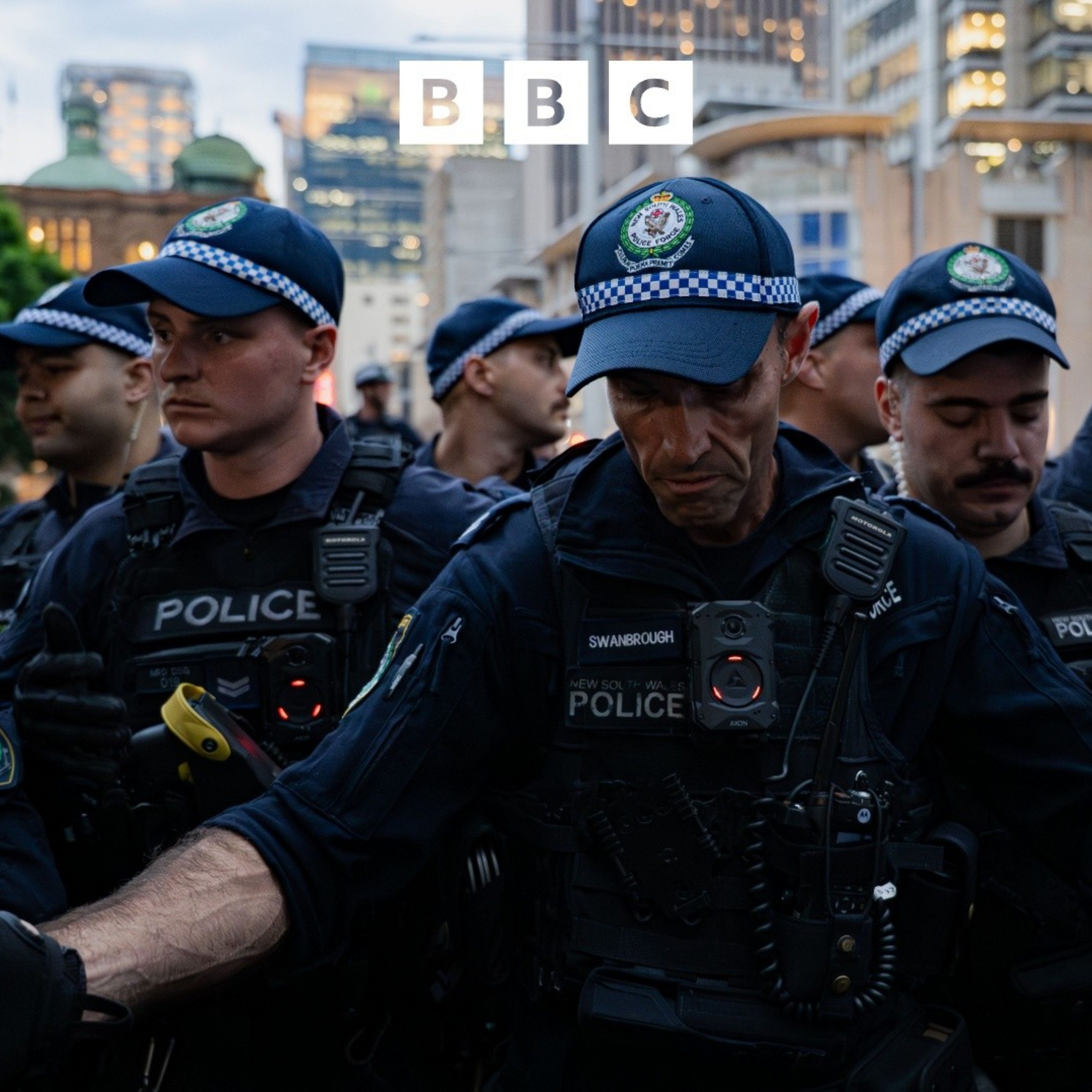
Global News Podcast
Australian police defend handling of Gaza protests
00:29:50
Australian officers under scrutiny after clashes at pro-Palestinian rally
Loading summary
Transcript99 lines
- [00:00]
Charlotte Gallagher
This BBC podcast is supported by ads outside the uk.
- [00:06]
Raveena Shamdasani
Love it's the Beginning of Everything this Valentine's Day, Jared Jewelers invites you to see love through a simpler lens. Quiet gestures, unspoken connections. Beauty that endures. Every relationship tells a story and every piece of fine jewelry reflects this sentiment. From iconic hearts to modern silhouettes. Because in the end, all roads lead to love. Enjoy. 20% off store wide exclusions apply. See jarrod.comradio for details. Jared Love lives in every detail Shop Jared Jewelers.
- [00:37]
Theo Leggett
This is the story of the One as the purchasing manager at a manufacturing plant, she knows the only thing more important than having the right safety gear is having it there when you need it. That's why she partners with Grainger for auto reordering, so her team members can count on her to have cut resistant gloves on hand and each shift can run safely and efficiently. Call 1-800-GRAINGER click granger.com or just stop by Granger for the ones who get it done.
- [01:08]
Narrator/Host (BBC Global News Podcast)
This is the global News podcast from the BBC World Service. I'm Charlotte Gallagher and at 16 hours GMT on Tuesday 10th February. These are our main stories. The Australian police defends its actions during violent clashes with pro Palestinian protesters on Monday. The watchdog Transparency International says public sector corruption is worsening around the world and fears of a new war in Ethiopia. Also in this podcast, Indonesia says it's preparing thousands of soldiers for deployment to Gaza when a peace deal is implemented there.
- [01:50]
Charlotte Gallagher
And I think this is such an important part of our history. Very little survives around the marriage of Catherine of Aragon to Henry viii.
- [01:58]
Narrator/Host (BBC Global News Podcast)
Why the British Museum bought a rare piece of jewelry for more than $4 million. But first, in our earlier podcast, we brought you news of violent clashes in Australia between police and demonstrators protesting against the visit of the Israeli president Isaac Herzog. Now the police have defended their actions after video footage emerged of officers charging and punching protester. The rally in Sydney on Monday night with an MP among those who said they were injured in the clashes. Mel Lanyon is the New South Wales Police Commissioner.
- [02:36]
Theo Leggett
What we saw was a large number of people come out to George street at the end of the protest or.
- [02:40]
Charlotte Gallagher
Certainly at the end of the speeches and march on police. Not once but twice the police did what they needed to do, which was to hold the line and then form.
- [02:50]
Theo Leggett
And move the protesters back with a view to dispersing them.
- [02:54]
Charlotte Gallagher
That was designed to keep the community safe.
- [02:57]
Theo Leggett
Having an angry and violent mob marching on police is not a situation that.
- [03:01]
Charlotte Gallagher
I want our officers in, but Sue.
- [03:03]
Narrator/Host (BBC Global News Podcast)
Higginson, a Green Party member of the Regional assembly, disagrees. What we saw last night was a monumental failure. You only have to look at what took place.
- [03:15]
Katie Watson
The police created a literal pressure cooker.
- [03:20]
Narrator/Host (BBC Global News Podcast)
They surrounded people at Town Hall. There were no safe avenues of dispersal. The government had invited Isaac Herzog to visit Australia after an anti Semitic attack at Bondi beach, saying it would help the Jewish community heal amid objections from pro Palestinian groups. I asked our Australia correspondent, Katie Watson, what happened at the protest.
- [03:43]
Katie Watson
This was a demonstration that was planned within quite a few restrictions, actually, because after Bondi, the New South Wales government imposed quite tough restrictions on public protests to make it a bit more difficult. And people have been very angry about that as a response. But actually there were a few more restrictions put on public protests called major event powers because of the visit by the Israeli president giving police extra powers to close off parts of the city and search people and fines for people not obeying orders. So this was a demonstration that passed off pretty fine for an hour. It was. There were speeches, there was heavy police presence, There were mounted police, there were helicopters circling. But it was after the speeches wrapped up and some in the crowd were calling on people to march. And you could hear people saying, let us march because that is not allowed right now. So the protest itself, the gathering was okay, but because of these extra restrictions, they were saying they couldn't march onto Parliament, which was what they wanted to do. So the police kind of tightened their line, formed lines to prevent people from being able to march through the center of Sydney. And that's when it got really tense. And then the police. I mean, the police really stood firm. There were a couple of scuffles, and then there was some pepper spray that was used to try and disperse the crowd. So it got quite. Yeah, it got quite testy, especially for Australia that doesn't really have these kind of protests. And you could see quite clearly in the faces of some of the police officers. There was a bit of. Kind of clear stroke on how to deal with this because the crowds were big. I think there were about 6,000 people there. The police were outnumbered by the number of demonstrators. So it was a really difficult situation for a good hour, two hours, actually.
- [05:29]
Narrator/Host (BBC Global News Podcast)
Isaac Herzog is still in Australia. Are there more protests planned?
- [05:34]
Katie Watson
So, yeah, so he spent two days in Sydney. He's going to Canberra with the Prime Minister, Anthony Albanese. He's also going to Melbourne. So there are protests that are planned throughout his visit. I think he got particularly bad here in Sydney because of these extra restrictions. So they, you know, they let the protest or the demonstration take place? Well, they didn't let was the marching through the city. And it was worth pointing out that Herzog was actually at a huge conference center not so far away from the demonstration that was organized by the Palestine Action Group. So the police said today they were very cautious making sure that the two events didn't mix. And that was something that was very important. But of course it was quite a secretive event because the security here has been so high over the president's kind of movements because of that feeling of being targeted. So they were trying to make sure that those two events remained very separate.
- [06:28]
Narrator/Host (BBC Global News Podcast)
That was Katie Watson in Sydney. An international watchdog says public sector corruption is worsening around the world. In its annual Corruption Perceptions Index, Transparency International gave the US and the UK their worst social media scores since it began publishing the list 30 years ago. Myra Martini is the group's CEO. She spoke about the global trends in corruption. What we see is actually blurred lines.
- [06:55]
Theo Leggett
Between public and private interests and also very concerning.
- [06:59]
Narrator/Host (BBC Global News Podcast)
What we are seeing in these countries.
- [07:01]
Theo Leggett
That are declining is a crackdown on civil society, on independent voice, on journalists.
- [07:07]
Narrator/Host (BBC Global News Podcast)
Which has a detrimental impact in the fight against corruption. The BBC's international business correspondent, Theo Leggett told me how this group is measuring the perception of corruption.
- [07:18]
Theo Leggett
Well, 182 countries are on the list. And what Transparency International does is it surveys business leaders and other experts around the world for their experience of corruption and problems in public life. And then it compiles all this, gives each country A ranking. 100 is the top ranking, 0 is the bottom. And in this edition, the list is topped by Denmark, which is closely followed by Finland, New Zealand and Singapore. They're the least corrupt countries. At the other end of the list we have the likes of Venezuela, Somalia and South Sudan. And traditionally on this list, the established democracies tend to do a lot better. And it's the more autocratic countries, the ones that have breakdown in civil society, that tend to come down the bottom.
- [08:02]
Narrator/Host (BBC Global News Podcast)
So the US and the uk, two liberal democracies, they've not fared very well at all on this list or they're perceived to be more corrupt.
- [08:10]
Theo Leggett
They've certainly been moving downwards in terms of their score. I mean, the UK is at the same ranking as it has been for the last couple of years, but that's a lot lower than it was for the couple of decades before that. And its score has got worse. And what Transparency International says is that in the uk, the very high level of political donations that we're seeing at the moment, as well as allegations of cash being traded for political influence, is all very worrying. Raising concerns about corruption that risk becoming the new normal. So that's the UK in terms of the United States. It says a lot of what we seen over the past year hasn't actually filtered down yet, but it does highlight things like the undermining of judicial independence and the targeting of independent voices as raising serious concerns. And it says away from the findings of the index itself, there are other things that are worrying. For example, the watering down of the Corrupt Foreign Practices act, things like that. So, yes, two established liberal democracies which are moving in the wrong direction. And Transparency International also says that other established democracies are failing to show bold leadership and that traditionally it is these countries which are least corrupt, which are beacons of integrity, that bring everybody else upwards. And that's not happening in the way it should.
- [09:22]
Narrator/Host (BBC Global News Podcast)
Theo Leggett. The search for the missing mother of the US News anchor Savannah Guthrie has entered its second week with another apparent ransom deadline passing. The FBI and police have not named any suspects in the disappearance of Nancy Guthrie, but believe she was taken against her will. The home of Savannah Guthrie's sister Annie has been searched by investigators. Our North America correspondent, David Willis, spoke to us from outside Nancy's home in Tucson, Arizona.
- [09:51]
Peter Goffin
That ransom deadline passed and Savannah Guthrie said of course, over the weekend that the family was willing to pay it A reported $6 million in Bitcoin. But a short while ago, the celebrity news website tmz, which was one of the outlets, media outlets that received the original ransom demand, said there was no recording of a payment to that particular bitcoin address. So we really don't know at this time whether the payment has been made or not. Now, a previous deadline came and went last Thursday, but this deadline was to be more consequential. And I think the next few hours will be agonizing, really, as the family waits to hear whether there will be any end to their very painful and very public ordeal. So limited has been the contact between the family and the kidnappers, whoever is holding Nancy Guthrie, that neither they nor the FBI have been able to establish for certain whether the people who claim to be holding Nancy Guthrie are indeed doing so and whether, in fact, she is actually still alive. There was a feeling that the original search perhaps wasn't thorough enough. So we've seen a lot of law enforcement officers, sheriff's deputies, members of the FBI, whose numbers have been bolstered from surrounding areas, searching the area around Nancy Guthrie's house And that of her eldest daughter, Annie, who lives about four miles from here. But both the local sheriff's department and the FBI are saying that they have yet to identify a suspect or suspects in this case. And much like Savannah Guthrie, they are appealing to members of the public, both here in Tucson and elsewhere. Any information that might lead to Nancy Guthrie's safe return. We're outside Nancy Guthrie's house, and I've never seen so many news crews in one place at one time. There is a frenzy for information here. And this has come at a time when the local sheriff's department has basically decided to silence its and the FBI, too, leaving this vacuum, really, as far as information goes in this case. And a very, very thirsty public anxious to know any twist or turn in this case.
- [12:26]
Narrator/Host (BBC Global News Podcast)
David Willis. Kenya has announced it will be talking to Russia over growing concern that some of its citizens are being recruited to fight the war in Ukraine. The government has described the practice as unacceptable. The Kenyan foreign minister, Masalia Madavadi, told Peter Mwangangi that the discussion with Moscow would focus on safeguarding Kenyan citizens and curbing illegal recruitment practices.
- [12:51]
Masalia Madavadi
It's a very serious problem. From where we sit, we don't have the exact figures. We can only have estimates of the number of Kenyans involved Because this is a process that has been done clandestinely by the individuals involved and their handlers. All right, so this because they are not through official channels of the government whatsoever. That's why I'm saying we are talking about estimates. We believe that maybe close to 200 Kenyans could be involved. But as things stand now, the government of Kenya has helped to repatriate about 27.
- [13:32]
Theo Leggett
Is this from Ukraine or from Russia?
- [13:34]
Masalia Madavadi
I'm talking about Russia. We have also seen about eight Kenyans who have either died or they are missing in action.
- [13:42]
Charlotte Gallagher
In your engagements with the Russian government, what are you talking about?
- [13:46]
Theo Leggett
Are there likely to be diplomatic consequences?
- [13:49]
Masalia Madavadi
Kenya and Russia have had long relations since independence. Literally. Okay? So this, in my view, becomes a very unfortunate episode of otherwise very positive and cordial relations between our two countries. So in order to stem it, we must work together. For instance, we must start looking critically at ensuring that the issue of visas is clarified. We must also make sure we perhaps even consider working on a proper bilateral labour agreement which would define what are the areas that we can engage in. We can then also ensure that it is very clear that Kenyans should be excluded from such assignments.
- [14:38]
Theo Leggett
The families we have spoken to say that the government is squarely to blame.
- [14:43]
Charlotte Gallagher
They have failed to regulate and criminalize recruitment agencies.
- [14:47]
Peter Goffin
What is your response?
- [14:48]
Masalia Madavadi
You cannot blame the government on this one. Where there are illegal recruitment agencies, we have scrapped them and we continue to scrap them. We have knocked off about 600 recruitment agencies over and above that. We are also looking at amending the Migration law. Father. Okay. Jointly working with the Ministry of Labour and we have also emphasized there's the National Employment Agency. It helps. It guides Kenyans on the integrity of the people they are dealing with.
- [15:23]
Theo Leggett
But how we got here is that there are concerns that the government itself.
- [15:28]
Peter Goffin
Has failed to provide jobs to youth.
- [15:32]
Masalia Madavadi
It is true there's a challenge of unemployment and we must provide opportunities both locally and also be supportive to Kenyans who want to have opportunities outside. Therefore, the position here is that let us move away from a blame game. Let us focus on how can we help Kenyans not to fall into dangerous assignments.
- [15:57]
Theo Leggett
Families that we've spoken to say they have not been able to bury their.
- [16:00]
Masalia Madavadi
Loved ones because they the bodies are.
- [16:02]
Narrator/Host (BBC Global News Podcast)
Still on the other end.
- [16:04]
Masalia Madavadi
It is difficult because remember, it depends on where the body has been found. If the body is brought on the Russian side and then the embassy is notified based on the institution, it can. But if it is now in an area where we don't have jurisdiction, maybe the body, they have been found on the other side of the war. They have somehow been found in Ukraine where it has happened. We are also working with the government of Ukraine to try and get the remains of those people repatriated. So it is a difficult situation. Both sides.
- [16:39]
Narrator/Host (BBC Global News Podcast)
The Kenyan foreign Minister Mosalia Mudavadi. Still to come. In this podcast, researchers find evidence of sea voyages in the northern Arctic more than 4,000 years ago.
- [16:53]
Dr. Matthew Walls
The interesting feature of this is that it requires a significant and difficult journey to travel out there. So you have to cross about 50 kilometers of open ocean. So it tells us a lot about their seafaring skills and abilities.
- [17:15]
Theo Leggett
This is the story of the 1. As the purchasing manager at a manufacturing plant, she knows the only thing more important than having the right side safety gear is having it there when you need it. That's why she partners with Grainger for auto reordering. So her team members can count on her to have cut resistant gloves on hand and each shift can run safely and efficiently. Call 1-800-GRAINGER Click grainger.com or just stop by Granger for the ones who get it done.
- [17:44]
Narrator/Host (BBC Global News Podcast)
If journalism is the first draft of history, what happens if that draft is flawed? In 1999, four Russian apartment buildings were bombed, hundreds killed. But even now we still don't know for sure who did it. It's a mystery that sparked chilling theories. I'm Helena Merriman and in a new BBC series I'm talking to the reporters who first covered this story. What did they miss the first time? The History Bureau, Putin and the apartment bombs. Listen on BBC.com or wherever you get your podcasts. Is Ethiopia about to tip back into war? The signs in the northernmost region Tigray are deeply worrying. There have been renewed clashes between the Ethiopian Federal army and forces allied to the Tigray People's Liberation Front. Raveena Shamdasani is the chief spokeswoman for the UN's High Commissioner for Human Rights who's issued a call for de escalation. She spoke to Tim Franks.
- [18:48]
Raveena Shamdasani
The whole situation in Tigray has been very precarious for a long time now. There were clashes on 26 January that really brought to the surface the concerns that we've had all along that at any point there could be an escalation and civilians would suffer massively, there would be further displacement. Now those clashes luckily have ended. The Tigray security forces withdrew from the area, the celemeti area, on 1 February. But the volatility, the tensions remain and people on both sides are being subjected to arbitrary detentions for perceived affiliation with the other side. So what the High Commissioner is saying is let's de escalate, let's prioritize dialogue. Otherwise you're constantly on the brink of mass conflict.
- [19:35]
Charlotte Gallagher
You say that there have been arbitrary.
- [19:37]
Theo Leggett
Detentions, but there's also, I mean there's.
- [19:38]
Charlotte Gallagher
Been quite heavy use of force, hasn't there?
- [19:40]
Raveena Shamdasani
There has, there have been drones, artillery and many other powerful weapons that have been used by both sides. We have not been able really verified the number of casualties, but heavy weaponry is being used by both sides.
- [19:53]
Charlotte Gallagher
You mentioned this was all unresolved from the major conflict between 2020 and 2022 in which huge numbers of people died. And I know that that was a sort of, that was a very confusing, difficult, multi pronged conflict. And I realize as part of the United nations, you're not going to take sides here. But just for our understanding, is the argument essentially that Tigray wants to. Or those forces, they want to assert more independence, more autonomy against the federal government here embodied by the national military.
- [20:29]
Raveena Shamdasani
It is a very complex situation and there are many forces at play. So you know, there was the Tigray Defence Forces. That was after the peace agreement was signed in 2022, the name was changed to the Tigray Security Forces. Since then there has been another force, the Tigray Peace Force that was established, disgruntled former members of the Tigray Defence Forces, and they are closer to the national army at this point. So it's a very complex situation with many different and sometimes changing loyalties and of course, reports of interference by neighboring countries as well. So it is a very complex situation.
- [21:05]
Charlotte Gallagher
And when you're talking about neighboring countries, I mean, again, I realize that, you know, it's not for you to point fingers, but you're talking about Eritrea, aren't you? And I mean, the extraordinary thing that seems to be happening here, which is that Eritrea, back in that two year long conflict, it basically it intervened on the side of the Ethiopian army and here it's being accused by the Ethiopian prime minister of intervening on behalf of the Tigrayan forces.
- [21:35]
Raveena Shamdasani
Indeed, as I said, very complex situation. There have been a lot of tensions, as you've reported on as well, between Ethiopia and Eritrea and even recent calls by the Ethiopian authorities for Eritrean troops to withdraw. What we are again insisting on is dialogue. We have received reports regarding the presence of Eritrean troops. We are not in a position to be able to verify those reports presently. But what is key is that war rhetoric ceases. Any kind of rhetoric that exacerbates an already serious human rights situation ceases and political dialogue is prioritized.
- [22:10]
Narrator/Host (BBC Global News Podcast)
Raveena Shamdasani Indonesia says it's Preparing up to 8,000 soldiers for deployment to Gaza, the first country to do so as part of phase two of the peace agreement brokered by the US Late last year. The army chief of staff said training for the soldiers had already begun and they would focus on medical and engineering roles in Gaza. Indonesia has joined President Trump's Board of Peace, which was announced last month. Our Southeast Asia correspondent, Jonathan Head reports.
- [22:40]
Charlotte Gallagher
The timing of the Indonesian troop deployment and their exact role in Gaza have.
- [22:44]
Peter Goffin
Not yet been finalized, but it appears.
- [22:46]
Charlotte Gallagher
That President Prabowo Subianto has decided they will go. His decision to join President Trump's Board.
- [22:52]
Theo Leggett
Of Peace has been criticized by some.
- [22:54]
Charlotte Gallagher
Islamic groups in Indonesia, where there's been.
- [22:57]
Theo Leggett
Widespread public anger over the US role.
- [22:59]
Charlotte Gallagher
In Israel's bombardment of Gaza. However, Mr. Raboa has argued that as.
- [23:04]
Peter Goffin
The world's largest Muslim nation, Indonesia should help to stabilize Gaza and has said.
- [23:10]
Theo Leggett
Its involvement would be in pursuit of.
- [23:12]
Charlotte Gallagher
An eventual two state solution. Other Muslim countries like Turkey and Pakistan are also considering sending their troops, but have made it clear they would be peacekeepers only and would not get involved in the Planned disarmament of Hamas. But with Hamas refusing to lay down its arms while Israel continues to occupy.
- [23:30]
Theo Leggett
Parts of Gaza, there's not yet a.
- [23:33]
Charlotte Gallagher
Real peace for the proposed international force to keep.
- [23:36]
Narrator/Host (BBC Global News Podcast)
Jonathan Head. The French president, Emmanuel Macron, has said Europe must urgently establish itself as a world power or risk being swept aside by the US And China. He's warned the EU faces blatant aggression, threats and intimidation. From Washington, our Paris correspondent, Hugh Schofield has been telling me more.
- [23:57]
Charlotte Gallagher
It's of a piece with his, the general tenor of his remarks going back years now, but it gets more and more urgent. And what he's saying is again, that it's time for Europe to wake up, to grow up. It's time to assume its majority. Like talking about, as if it's been a sort of teenager throughout its life so far, the European Union. And it's time now to realize that it's a big bad world out there and therefore it needs to start acting like a power. And this word, puissance, power is what he's trying to urge Europe to become. Europe and the European Union very successful, he's saying, in doing what it's done, which was warding off the threat of conflict between member states and becoming an internal market and becoming and encouraging prosperity internally. But it's time, he's saying, and it's not the first time he said it, of course, to realize that in, in the world, if it wants to survive, it's got to do so the much more assertive way against the, the, you know, the, the threats now of, of America, unstable, as he calls it, and, and China, a commercial tsunami, as he calls it, which is flooding us with its goods. So, yes, more, more of the same, but more urgent, more shrill.
- [25:14]
Narrator/Host (BBC Global News Podcast)
And this is very different to some other leaders who've essentially tried to reach President Trump by telling him how brilliant he is. I mean, is this a sign that some in Europe are just losing patience?
- [25:25]
Charlotte Gallagher
No, I don't think it's that. I don't. I think he would agree with your characterization of some of his colleagues, sort of kowtowing, to use the Chinese expression, to President Trump. But what he is saying, I think, is that there is a risk in France, as elsewhere, of countries and people thinking that because we've got through, for example, the latest crisis over Greenland and it's blown over, it's calmed down to think that it's all over. It's not all over. He's saying it's a new world now. And Europe can't constantly be saying to itself. Oh, it's all right. Everything will get better. We'll be back in the old version again of reality soon. It's not like that anymore. It's time, as you keep saying this interview, to wake up and to grow up.
- [26:10]
Narrator/Host (BBC Global News Podcast)
Hugh Schofield in Paris. It's been said that if you want to understand the present, you have to know the past. And archaeologists have uncovered a bit of ancient history off the coast of Greenland that they say could influence the current debate over the island's sovereignty. A team led by Dr. Matthew Walls from the University of Calgary in Canada has found evidence that indigenous people were making sea voyages to the region more than 4,000 years ago. He says this long standing link to the land reinforces the right of green to determine their own future. He's been speaking to my colleague Rob Young in archaeology.
- [26:47]
Dr. Matthew Walls
We call them the early Paleo units, and they're the first population that we see represented in the Arctic some four and a half thousand years ago. There's probably a series of migratory episodes across the Arctic. The environments in the Arctic would have been fairly recently uncovered by the retreat of the ice sheets. So you have a lot of early formative stages for different animal populations and things like that. So it was sort of a very new and newly opened environment for them to move into and take root in.
- [27:15]
Peter Goffin
And so what have you recently discovered.
- [27:18]
Charlotte Gallagher
Or analysed to come to this conclusion.
- [27:20]
Peter Goffin
That the first visits were four and.
- [27:23]
Charlotte Gallagher
A half thousand years ago?
- [27:25]
Dr. Matthew Walls
Well, the paper this is connected to is related to a chain of small islands off the northwest coast of Greenland. And we found there lots of archaeological features associated with this time period. Basically remnants of ancient campsites, so old tent rings and hearth features and scatters of bone and things like that. But the interesting feature of this is that it requires a significant and difficult journey to travel out there. So you have to cross about 50 km of open ocean that has very difficult currents and strong winds and things like that. So it tells us a lot about their seafaring skills and abilities at the time.
- [28:03]
Peter Goffin
And this is related to the news, isn't it?
- [28:04]
Charlotte Gallagher
Because Greenland has been in the news an awful lot recently. Its sovereignty is a subject of hot.
- [28:10]
Peter Goffin
Debate between the United States, Donald Trump in particular, and the Kingdom of Denmark, which governs Greenland. What new light do these findings shed.
- [28:19]
Charlotte Gallagher
Onto the debate about Greenland, do you think?
- [28:21]
Dr. Matthew Walls
You know, a lot of the kind of common statement on this is that Greenlanders have a right to govern their future and can decide for their own future. And this at least puts some context on that. That this indigenous history that's carried forward in the present goes back many thousands of years into some of the early formative periods for Arctic environments as well.
- [28:40]
Peter Goffin
And so as it comes to the debate about whether Greenland should remain part of Denmark, maybe become independent or join.
- [28:47]
Charlotte Gallagher
The United States, this has bearing.
- [28:49]
Dr. Matthew Walls
Well, certainly I think it emphasizes that it's, you know, really for Greenlanders who have a very deep history in that area to make those types of decisions.
- [28:57]
Narrator/Host (BBC Global News Podcast)
Dr. Matthew Walls. Finally, the British Museum has bought a rare piece of jewelry from the time of King Henry VIII and his first wife, Catherine of aragon, for nearly $4.8 million. The museum had public's help to buy the pendant and more than 45,000 people donated to the bid, as did a British charity and a government funded group. Peter Goffin has been following the story.
- [29:22]
Peter Goffin
I'm in the British Museum and I have just been shown something so exquisite that I want to tell you all about it.
- [29:28]
Theo Leggett
The actor Damian Lewis, who played Henry VIII in the BBC series Wolf hall, lent a bit of star power to the British Museum's campaign to buy the Tudor heart. But the pendant is glamorous enough on its own. 24 karat gold with red and white enamel depicting Henry's Tudor rose entwined with a pomegranate. Catherine's personal emblem. Below it, the word toujour, old French for always. Quite a find for the metal detecting hobbyist who discovered it in a field in 2019, not least because he will split the proceeds of its sale with the field's owner. But why does one of Britain's biggest museums have to pay millions of dollars for a piece of the country's history? The director of the British Museum, Nicholas Cullinan, says the UK has a strict protocol for found treasure.
- [30:16]
Charlotte Gallagher
There's a valuation which is determined by the Secretary of State. There's an independent panel that come up with a valuation, and then a museum, if it belongs in a public collection, have the opportunity to buy it. Basically, it gives museums a chance to acquire these extraordinary objects that otherwise would go into private collections or abroad.
- [30:32]
Theo Leggett
And this piece in particular, he says, belongs in Britain on public display.
- [30:37]
Charlotte Gallagher
I think this is such an important part of our history and, you know, very little survives around the marriage of Catherine of aragon to Henry VIII. I think the fact that 45,000 members of the public have got behind this and, you know, donated money to keep it on public display shows just, you know, the enthusiasm for this object.
- [30:53]
Theo Leggett
It's believed the pendant was made to commemorate the betrothal of Henry and Catherine's infant daughter Mary to a French prince in 1518. That diplomatic marriage never happened. And 15 years later, Henry annulled his own marriage to Catherine so he could marry Anne Boleyn. A sequence of events that led to the creation of the Church of England and decades of religious violence. But when it was made, the pendant was a symbol of harmony in the Tudor royal family, a dynasty at the peak of its power, opulence and romance.
- [31:25]
Narrator/Host (BBC Global News Podcast)
That was Peter Goffin. And that's all from us for now. But if you want to get in touch, you can email us@globalpodcastbc.co.uk you can also find us on XBCWorldService. Use the hashtag globalnewspod. And don't forget our sister podcast, the Global Story, which goes in depth and beyond the headlines on one big story, available wherever you get your podcasts. This edition of the Global News Podcast was mixed by Holly Smith, and the producers were Steven Jensen and Oliver Berlau. The editor is Karen Martin. I'm Charlotte Gallagher. Until next time. Goodbye. If journalism is the first draft of history, what happens if that draft is flawed? In 1999, four Russian apartment buildings were bombed, hundreds killed. But even now, we still don't know for sure who did it. It's a mystery that sparked chilling theories. I'm Helena Merriman, and in a new BBC series, I'm talking to the reporters who first covered this story. What did they miss the first time? The History Bureau, Putin and the apartment bombs. Listen on BBC.com or wherever you get your podcasts.