← Global News Podcast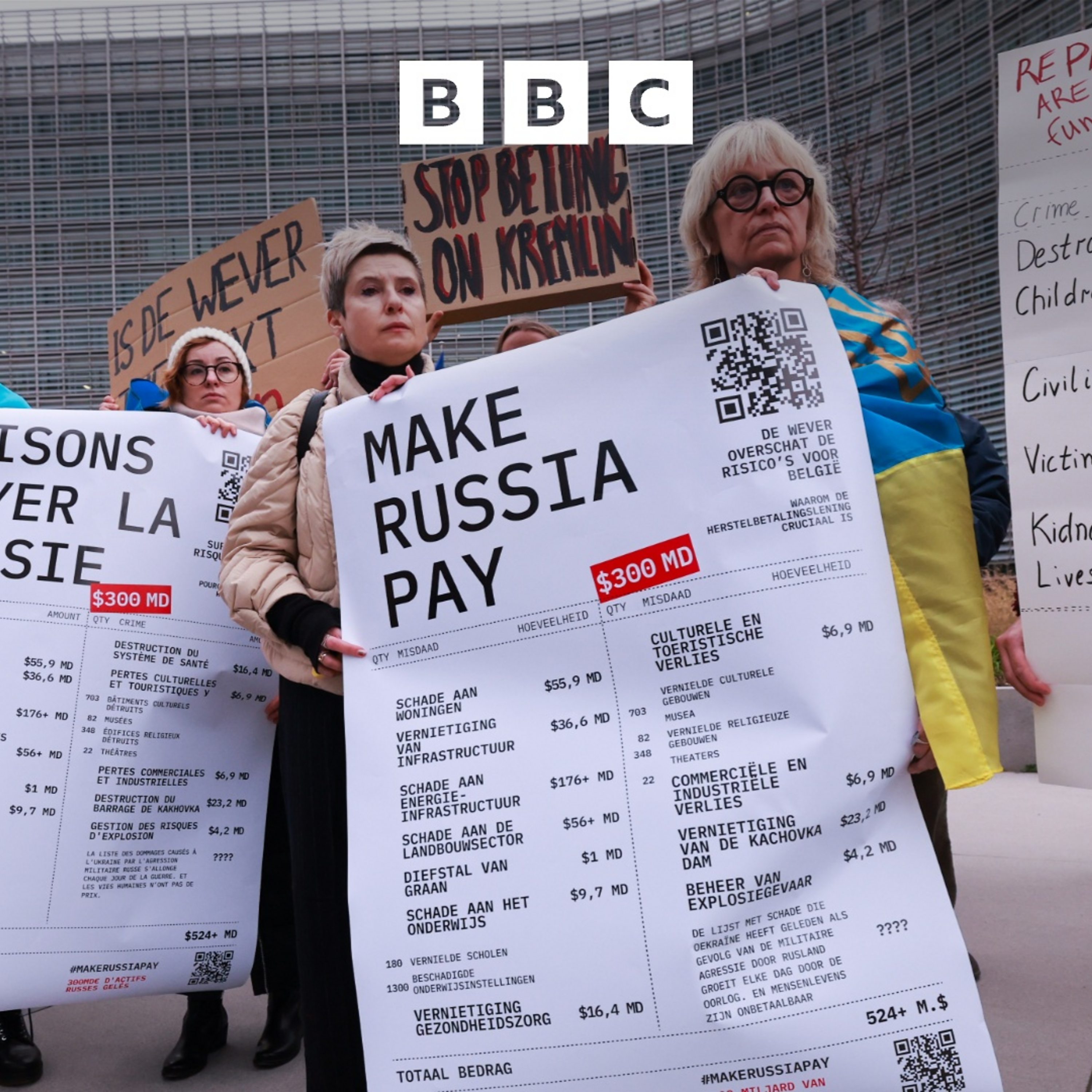
Global News Podcast
Crunch talks in Brussels on Russia's frozen assets
00:29:08
Belgium comes under pressure to drop opposition to Ukraine funding proposal
Loading summary
Transcript1 lines
- [00:00]
A
This BBC podcast is supported by ads outside the uk. You ever feel that deep pull to the land to know it? To build something that lasts, that itch for your own wild country? What ain't just a daydream in 2025, it matters more than ever. Whether you're a lifelong hunter or just starting out dreaming of land to explore, to leave something real. Or there is a trailhead where you can start. It's called land.com the biggest online network for rural property. Find the right agent and explore everything from timber tracks to ranches. Get the tools you need to buy that dream generational property. Stop dreaming about it and head to land.com it's your place to find your open space. Ulta Beauty's big holiday beauty sale is back with up to 50% off. Must have gifts shop irresistible deals like the Shark Beauty Flex Style and Benefit cosmetics. Travel size mascaras with new offers weekly same day pickup or delivery? Delivery. And our trusted associates. We make holiday shopping effortless. Head into Ulta Beauty today. Ulta Beauty gifting happens here. This is the global news podcast from the BBC World Service. I'm Alex Ritson and at 16 hours GMT on Thursday 18th December, these are our main stories. EU leaders are told to choose between money today and blood tomorrow as they debate giving frozen Russian assets to Ukraine. We visit one of Ukraine's secret weapons factories, now said to be making half of the arms used on the front line. Australia marks the funeral of the youngest Bondi beach attack victim, 10 year old Matilda. Also in this podcast. Hello and welcome to the FIFA 23 reveal trailer. Football's world governing body, FIFA, partners with Netflix for a return to the world of video gaming. We begin in Brussels where crunch talks between European Union leaders are taking place. As we record this podcast. Top of the agenda is whether to use frozen Russian assets to help Ukraine's war effort. Belgium, where Most of Moscow's $245 billion worth of assets, opposes the move. And Belgium isn't alone. Italy and Slovakia also expressed their doubts shortly before the meeting began. Hungary's leader, Viktor Orban, who's very close to Russia's Vladimir Putin, gave his thoughts on the proposal. The whole idea is a stupid one to take away the money of somebody. There are two countries which are in war. Yeah, it's not European Union, Russia and Ukraine and somebody. European Union would like to take away the money of one of the worst parties and then to give it to another one. It's a marching into the war. So the Belgian Prime Minister is right. We should not do that. France and Poland led calls to hand the money over to boost Ukrainian resistance. President Emmanuel Macron of France shared his thoughts as he entered the talks. Our willingness here during this council is to deliver a package of financing in order to provide visibility. And it's very important that we find the right compromise. And I'm confident that we will find it. But the position of the Europeans is very clear. We support Ukraine in this war effort. We want to provide visibility to Ukraine, and we do support a robust and solid peace. This is why we will follow up the negotiations in parallel and we will finalize the work as well of the coalition of the winning Polish Prime Minister. Donald Tusk said European leaders had a straightforward decision to make. Now we have a simple choice, either money today or blood tomorrow. And I am not talking about Ukraine only, I am talking about Europe. And this is our decision to make and only ours. Our correspondent James Waterhouse in Brussels explained what's at stake. At its heart is a proposal to unfreeze tens of billions of euros worth of frozen Russian assets to support Ukraine in the form of a loan. Kyiv has a gaping hole in its finances over the next couple of years to the tune of 135 billion euros. Volodymyr Zelenskyy acknowledges that this proposal is crucial for his country's survival. And those in support of it, like Germany, like the European Commission, like the uk, Like France, say this is crucial for Ukraine to survive long enough for a lasting peace deal. But there are growing opposers to this idea, not least with Belgium, where the majority of this Russian money is kept. There are fears of legal reprisals which have been promised by Moscow. So what is clear is that there are going to be some very long drawn out negotiations. Today, a plan B is being touted that could see Europe support Ukraine through its debt, through widening its debt and incorporating it into its budget. But that requires unanimous support, which is almost certainly not going to happen. So this is a crucial juncture if you consider where we are in the peace endeavors to try and end the war in Ukraine. From the European perspective, why is using Russian money? European leaders generally see Russia as the aggressor in this war. Why is that controversial? Because if you are Belgium, for example, and you are hosting 200 billion euros worth of Russian cash, you are worried about being legally compelled to pay Moscow back once the war is in, once war is over. Now, what Europe is saying is, well, there's no legal mechanism for that. You know, it's not going to recognize Moscow's courts And it's also saying that it would spread the risk. But even Euroclear, which is the institution which houses this cash in Belgium, it has its own frozen assets inside Russia. So it's about vulnerability. And to boot, there is also another concern here, which is that America has been lobbying European members to block it as well, because there have been previous proposals leaked that shows Washington wanting to get its own hands on this cash for future investments with Russia. So there are a lot of forces at play here. James Waterhouse and as talks continue in Brussels, the war in Ukraine rages on. Kyiv is making no assumptions about support and is moving to ramp up production of its own weapons. After being heavily reliant on the west, Ukraine now says it's producing more than 50% of the weapons it uses on the front line. That includes long range drones and missiles to hit targets deep inside Russia. Our defence correspondent Jonathan Beale has been given rare access to facilities now mass producing these weapons, which they say are the only way of providing Ukraine with reliable security guarantees. We're being driven to a secret location. It's all a bit cloak and dagger. Been asked to put eye masks on so we can't see where we are. We're going to, to the factory where they produce Ukraine's long range missiles. This is where they're making Ukraine's own cruise missile, the Flamingo. And there is a finished product on a lorry ready to go. It's 12 meters long. It has a wingspan of 2 meters. It's got a rocket up on top of the. And it has a range of 3,000 km. And this is the fuel. It's a sparing fuel tank, not the main one. Main one. Dennis Stillermann is Firepoint's founder and chief designer. And Irina Terah is the company's chief technical officer. Less than nine months. Less than nine months, yes. Has that ever been done before? Does any other company produce missiles that quickly? The V1. The V1. So German rockets in the Second World War and that's what war does, you just have to speed up that process, Correct? Yeah. We are fueled by anger. Dennis says their weapons, which also include long range drones, are already hurting Russia. So it's making a difference what you're doing with the weapons here in the battle. But can it win the war? There's no game changer. The only game changer we have is our will. If we have the will to win, we'll have to tire a day later than Russia. Before the war, Irina was an architecture student. Now she's trying to dismantle the Russian war machine. So your security guarantee is you producing your own weapons? Yes. And do you think that can make a difference in this war? I think that's the only way to really provide security guarantees. Another factory at another secret location is churning out less complex long range drones. They've been behind 60% of Ukraine's deep strikes. They're producing 200 a day. And Irina says they're deliberately trying to avoid foreign components. We have China free policy and we don't use American companies. You don't use American companies. Why? We are on emotional rollercoaster. Tomorrow somebody will want to shut it down and we would not be able to use our own weapons. Ukraine's long range drone strikes, though, are having some success. The head of its armed forces claims that this year alone it's cost the Russian economy more than $21 billion. Ruslan is an officer with Ukraine's special operations forces coordinating strikes. He admits it's been a challenge to match Russia's greater resources. I would like Ukraine to be able to launch as many drones as Russia does. However, we are scaling up very quickly and significantly and I think in any case, the enemy will soon be surprised. It will be an unpleasant surprise for them. Ukraine still needs Western support, intelligence and money. But it has learned the hard way that you can't just rely on others. Jonathan Beale it's not only Ukraine that wants more weapons. Taiwan does too. The Trump administration has just announced a huge arms sale worth around $11 billion to the island which includes advanced rocket launchers, self propelled howitzers and a variety of missiles. China sees self governed Taiwan as part of its own territory and has steadily ramped up pressure over the island with military drills and regular incursions into its waters and and airspace. To tell us more, here's Mickey Bristow. I think the first thing to say about it is the price. $11 billion worth of arms, that's a big deal. And I think you have to go back 20 odd years since the United States sold Taiwan. As many weapons as this included rocket systems, anti tank missiles, drones, medium range missiles, all kinds of things, software, spare parts, a lot of kit. $11 billion worth. And it solidifies the idea that President Trump, who had seemed ambivalent about whether or not to defend Taiwan against China. China believes Taiwan is part of its own territory. President Trump had been quite ambivalent about whether he was going to support Taiwan. So it seems to suggest that he's decided that he does have to show his support. As you say, this is in the end all about Taiwan. Are these weapons defensive or offensive? Well, they're defensive, essentially. I mean, Taiwan is in no way going to threaten China, its biggest neighbor. China over the last few decades, as we've been hearing year after year, has been building up its weapons systems. Also over recent years, it's been targeting Taiwan with gray zone tactics, sort of like buzzing the island with aircraft and ships surrounding it. There have been dozens just near Taiwanese airspace over the last 24 hours. So. So essentially, Taiwan is looking for weapons to defend itself against China because China, as I said, believe the island is part of its territory. It's not renounced the use of force. People believe President Xi Jinping of China is preparing the Chinese military to take Taiwan by force. So these weapons are to help Taiwan defend itself against China. It's publicly anyway, though China is not going to see it that way, is it? No. In fact, China's already come out and said this is a terrible move on the part of President Trump. It essential sees Taiwan as a domestic issue because it believes it's part of its own territory, doesn't like anybody interfering. And so of course it reacts angrily whenever anyone does anything like this might actually affect going forward the relationship between President Trump and Chinese President Xi Jinping. They met just a couple of months ago in South Korea. President Trump said they'd got on well, appeared to have a good meeting. I'm sure this kind of act by President Trump will undermine that bonhomie to a certain extent. Mickey Bristow to Australia, where the youngest victim of the Bondi terror attacks, Matilda, has been buried in a funeral service in Sydney. She was one of 15 people killed on the Sunday when two gunmen opened fire on an event marking the start of Hanukkah. At the popular beachside tourist spot, mourners, including family and politicians, wore bee brooches and stickers as a tribute to the little girl who adored them. Critics have said not enough was done to curb anti Semitism in Australia leading up to the attacks. Now Prime Minister Anthony Albanese has announced that laws to crack down on hate will be strengthened. Matilda's aunt, Lena Czernic, has been talking to the BBC about her niece. She said the child's parents were bereft. I see my brother and his partner absolutely devastated. Absolutely. Like I look on their faces, I don't know if they will be ever happy again. And imagine like lost your kid who just was happy playing around with the other kids and just full of life and smiles and suddenly with shots, you know, suddenly it happened. It's beyond understanding. For any human being full of life happy kid who was always give other people love when you see her she give you happy energy. How someone in Australia can understand if someone tell your kid was shot like you know, I couldn't understand it. I asked few times what I'm here and after the reality hit we definitely will need all support like especially when things slow down, go quiet, you know, after like few weeks people start to live their life and this is when the pain will really hit. As much as I'm in pain, definitely something should be done but I'm not in power like you know, I'm in power. Just spread happiness and love memory for my lovely niece. Our correspondent in Sydney, Phil Mercer told me more about the mood on the day of the funeral. Very sombre. Probably the most poignant day since the shooting here at Bondi beach. The funeral of 10 year old Matilda. And we are at another Hanukkah event just a few meters away from where the attack took place. And the crowd is listening to a rendition of Waltzing Matilda which is a very famous old Australian song. And people holding up their mobile phones and it is a sea of light. And this young girl was named Matilda via her Ukrainian parents to give her a typical Australian name. So great sadness and of course 10 years of age at primary school in the prime of her life, a small girl farewell today who will never see her 11th birthday. Yes, we can hear that commemoration behind you. Phil. What will the Prime Minister's announcement on hate crimes mean? It means that Australia's Prime Minister Anthony Albanese is desperately trying to reassert his authority. He has faced widespread criticism, especially within the Jewish community and the conservative side of Australian politics over an alleged failure to curb rising anti Semitism. His critics say that the measures he's announced today to curb hate and de radicalization should have happened far, far earlier. The Prime Minister said that he's not perfect but that he was determined to stamp out this sort of hate and division. And he said now was the time to end this evil scourge of extremism. Phil, you've lived in Australia for a very long time now. Is the country changed forever by this? I'm not sure. It's a very difficult question to ask. It's certainly been changed this week. But when you spend time here at Bombay beach during the day, the crowds that we're witnessing tonight do thin out. After sun sets, people do come out. When you go to the beach, there are people surfing and playing football. So for many life is getting back into the groove. But of course, Bondi beach will always now be known as this place of an atrocity. Eventually life will get back to normal, but not for the people directly affected by the shooting. Phil Mercer still to come in this podcast, we were in the middle of the most intense of actions and it's become a landmark for journalism ever since one of the all time great war correspondents, Peter Arnett, has died. You ever feel that deep pull to the land to know it? To build something that lasts, that itch for your own wild? Well, it ain't just a daydream. In 2025 it matters more than ever whether you're a lifelong hunter or just starting out, dreaming of land to explore, to leave something real. Or there is a trailhead where you can start. It's called land.com the biggest online network for rural property. Find the right agent and explore everything from timber tracks to ranches. Get the tools you need to buy that dream generational property. Stop dreaming about it and head to land.com it's your place to find your open space. Hear that? It's holiday cheer arriving at Ulta Beauty with gifts for everyone on your list. Treat them to fan favorite gift sets from Charlotte, Tilbury and Peach and Lily. Go all out with timeless fragrances from ysl, Ariana Grande and Carolina Herrera and you can never go wrong with an Ulta Beauty gift card. Head to Ulta Beauty for gifts that make the holidays brighter and even more beautiful. Ulta Beauty gifting happens here. If you have young kids, you know how important it is to find screen free activities that actually hold their attention. The Story Dream Machine does just that with simple kid friendly controls and a magical way of bringing stories to life. It projects words while a narrator reads aloud, helping your child develop early reading skills and word recognition. The colorful lights and sound effects make every story feel like an adventure. Kids can follow along, recognize sight words and build confidence with every tale. Parents love how easy it is to swap stories and customize the experience for different ages. And when the story's over, it transforms into a white noise nightlight to help your child drift off to sleep, you can collect a growing library of stories, including many you loved as a kid. It's a bedtime game changer and a daytime learning tool all in one. Find the Story Dream Machine at Amazon, Target, Costco, Walmart and LittleTikes.com bring story time to life with the Story Dream Machine Owning a home is full of surprises. Some wonderful, some not so much. And when something breaks, it can feel like the whole day unravels. That's why HomeServe exists. For as little as 499amonth, you'll always have someone to call, a trusted professional ready to help, bringing peace of mind to four and a half million homeowners nationwide. For plans starting at just 499amonth, go to homeserve.com that's homeserve.com not available everywhere. Most plans range between $4.99 to $11.99 a month. Your first year terms apply on covered repairs. Now to France, where a French doctor known as Dr. Death has been sentenced to life in prison. I After he poisoned dozens of his patients, Frederic Peschier worked as an anaesthetist in the eastern city of Besancon and was found guilty of poisoning 30 patients and killing 12. Our Paris correspondent Hugh Schofield has the story. In 2017, doctors, fellow doctors, began to become suspicious. There was an incident in which a young woman was found to have had emergency procedures required during an operation because something had gone wrong. They looked into it and found that there was an excess of chemicals in her infusion bag or a certain chemical. And then they started looking further and found a pattern of events like this going back over nine or ten years. What was doubly suspicious was that Dr. Pescier had moved to another clinic for a time and then come back and the pattern of problems like this had followed him. So they'd been at this one clinic, you know, at a high rate of these troubling events. They'd stopped and then moved to this other clinic where he was at. And then he'd come back and they resumed at this first clinic and then stopped when, in 2017, he was. He was disbarred from acting pending this trial. And in the trial they've established that, yes, the charges against him were true. In 30 cases, he was found to have put chemicals in the infusion bags of patients that. Patients who have been looked after not by him directly, but by fellow anaesthetists. And then he was able to intervene in many of them as the kind of saviour. He was the first responder when things went wrong and said, I know it's this, this is the problem, here's the antidote. His prestige was boosted, that of his fellows was gravely damaged and that, the prosecution said, was his motivation. He protested his innocence. The defence said there was no tangible proof of any of this, but. And obviously it was quite hard to establish exactly what had happened in cases which were so old. But the court believed that he was responsible in all these cases, 30 overall, 12 of them resulting in deaths. And they've given him this very stiff punishment of imprisonment for life, basically. Hugh Scofield Major cities in Sudan, including the capital Khartoum and its main seaport Port Sudan, are without power after drone strikes hit a key power plant in the east of the country. Government forces have been fighting the paramilitary Rapid Support Forces, or rsf, for the last two and a half years, which has plunged Sudan into a massive humanitarian crisis. I heard more from our global affairs reporter, Richard Kegoy in Nairobi. A military source has just told the French news agency that the paramilitary Rapid Support Forces, the rsf, carried out large scale attacks in the east of the country targeting three cities. So the accusation has been coming from the army that this is the rsf, because if you. Additionally, the RSF has been carrying out drone attacks targeting civilian infrastructure. It's quite a thing to take out power to the capital and to other major cities. Yeah, that's really quite devastating because if you look at Khartoum, that's the capital city and Port Sudan, which is the seat of the military government, this is quite disruptive and very devastating because residents in parts of Sudan say that they've been without power since 2am on Thursday morning. And this particular drone attacks did target a particular key power station in the city of Atbara, which is really responsible for redistribution of power across many parts of Sudan. So this is really quite disruptive to the populations there. This rather suggests that the Rapid Support Forces in this civil war which has been going on for a long time, they are moving forward, aren't they? Yeah, they have. And if you look at the trends for the past nearly one year, since they lost control of the capital Khartoum, they've been using drone attacks, you know, just targeting areas around the capital and March, even as they have been directing their focus towards the southwest part of the country. So they've really been, you know, intensifying attacks and stepping up pressure on the military. That's the Sudanese army, and particularly in areas which are controlled by the Sudanese army. Are we any closer to knowing exactly where the RSF are getting their weapons from? The UN has accused the RSF really of getting support from the United Arab Emirates, which Abu Dhabi has really denied the accusations, but it's just indicating that possibly based on open source investigations, that they have been receiving equipment or logistical support from the uae and that's really helped them to be able to advance and, you know, counter the army and even push forward. In the territories where they've been operating in Richard Kigoi Peter Arnett, the journalist who spent decades dodging bullets and bombs to bring the world eyewitness accounts of war, has died at the age of 91. Born in New Zealand, he won the Pulitzer Prize in 1966 for his reporting for the Associated Press news agency from Vietnam. And in 1991, he was one of the few Western correspondents to remain in Baghdad during the first Gulf War. Richard Hamilton reports. Peter arnett joined the AP Bureau in Saigon in 1962. Four years later, he was with a battalion of American soldiers seeking out North Vietnamese snipers and was standing next to the commander when he paused to read a map. As the colonel peered at it, I heard four loud shots as bullets tore through the map and into his chest a few inches from face, arnett said. He sank to the ground at my feet. He stayed in Vietnam until the fall of Saigon in 1975. In those final days, AP ordered him to destroy the bureau's papers and photos, but he shipped them back to his apartment in New York. Here he is in 2015. Looking back on that time, we were in the middle of the most intense of actions, so there was very dramatic print and photo coverage remarkable in its quality and quantity, and it's become a landmark for journalism ever since. After the war, Peter Arnett remained with AP until 1981, when he joined the newly formed CNN. He became something of a household name 10 years later when he broadcast live updates of the first Gulf War, and his reporting of US Missiles striking Baghdad heralded a new era in TV news. He also secured interviews with Saddam Hussein and later Osama bin Laden. He was covering the second Gulf War for NBC in 2003 when he was fired for criticizing U.S. military strategy. In 2007, he took a job teaching journalism in China, and he finally retired to California seven years later. Richard Hamilton, and for our final story today, we're kicking off with one of the world's most popular gaming franchises. Hello and welcome to the FIFA 23 reveal trailer. Well, you can really feel the sense of anticipation as the players warm up for their big moment on the world stage. For years, FIFA was the big football game and one of the most profitable brands in gaming history, with around 150 million players around the world. But then football's international governing body fell out with games developer ea, and they parted ways. Now FIFA, which has been facing criticism from fans over the high cost of tickets at next year's Real Football World cup, is launching its own new game with Netflix, which won't need a console. Ellie Gibson is A games journalist and comedian, she told Nick Robinson about why FIFA fell out with EA in the first place. We haven't had a FIFA game for a few years and it was huge for decades until FIFA and EA had this falling out. Basically because FIFA wanted a billion dollars to allow EA to keep using the World cup branding. And EA said that's a bit expensive, to be honest. We could buy loads of our own footballs for that money, so we'll cancel that. So EA put their own version of the game out. Basically the same game with all their expertise, the same engine, the same game without the FIFA name on it. And it's done really well. So now everyone's going well, okay, FIFA's getting back into gaming. What's this new game going to look like? And the big thing that will look different is no box to play it. You can just play on your telly or on your screen. Yes, that's right. On your. On your phone. I think they're saying it's going to be a mobile game, so. Yes, and that means the gameplay, I think, is going to be quite different because obviously with the EA Sports game, you've got a controller and you, you know, you are, you are the little man kicking the little ball. And this. We don't really know what this one's going to look yet. It could be that it's, again, you're the little man with ball, but on your phone. Or it could be more of a sort of management sort of thing. Sim, like a sort of player's journey type thing. But it's a big. Or it's going to do as well. Yeah. It's a big bet for Netflix, isn't it, the streaming company that we always say is doing so well. But, you know, sometimes the financial figures don't really suggest that is trying to get into this very, very big market. Yes. And lots of other sort of big companies, including companies as big as Google, have tried and failed to get into gaming. You know, with their stadia. Consol lasted about three years because gaming is a really unpredictable, difficult, expensive market to get into. And I think often companies sort of think people who don't know about gaming. Oh, it's just like it's just another pillar of media. And actually games are really complicated, big things and huge business. Yes, absolutely huge business. And indeed, again, the football market is a huge business. Even without the FIFA branding, the EA game sold like 11 million copies in the first couple of weeks. So you can see why FIFA are like, oh, we need to get back into this. But I think they've correctly realized it's not simply a case of slapping the FIFA name on a game that someone else makes. I think hopefully they realize that the FIFA, they are the the fluffy dice in the window of the Porsche. They're not the actual car. EA still own that games journalist Ellie Gibson and that's all from us for now. But there'll be a new edition of the Global News Podcast later. If you want to comment on this podcast or the topics covered in it, you can send us an email. The address is globalpodcastbc.co.uk. you can also find us on X@BBC World Service. Use the hashtag globalnewspod. This edition was mixed by Lee Wilson and the producers were Adrienne White, Michael Bristow and Madeline Lake. The editor is Karen Martin. I'm Alex Ritson. Until next time. Goodbye. What do you think makes the perfect snack? It's gotta be when I'm really craving it and it's convenient. Could you be more specific when it's cravenient? Okay, like a freshly baked cookie made with real butter, available right down the street at a.m. p.m. Or a savory breakfast sandwich I can grab in just a second it at ampm. I'm seeing a pattern here. Well, yeah, we're talking about what I crave, which is anything from ampm. What more could you want? Stop by AMPM where the snacks and drinks are perfectly craveable and convenient. That's cravenience ampm. Too much good stuff.