← Global News Podcast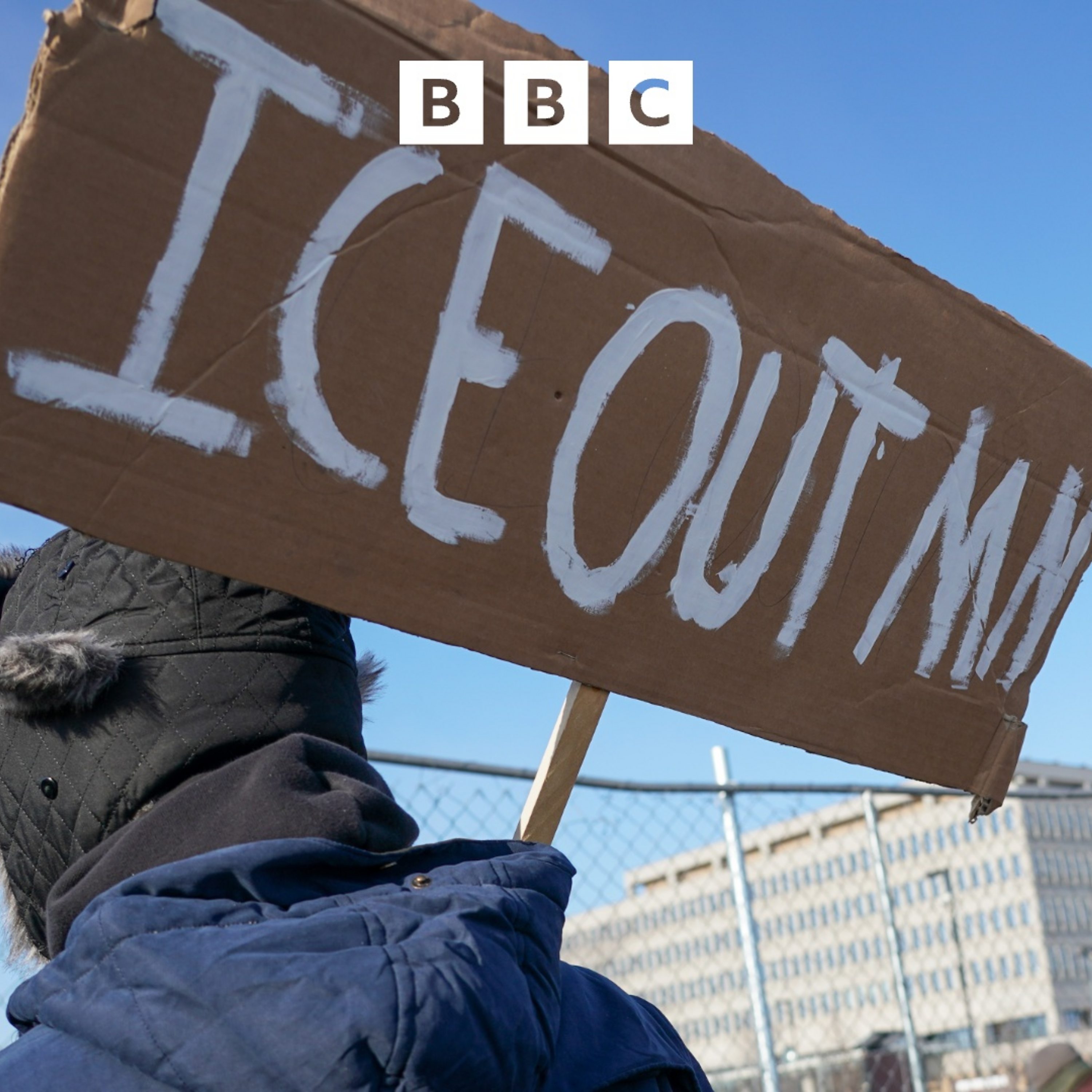
Global News Podcast
Former US Presidents speak out against ICE crackdown
00:26:21
Clinton and Obama urge Americans to stand up for their rights, after Minneapolis shootings
Loading summary
Transcript71 lines
- [00:00]
Oliver Conway
This BBC podcast is supported by ads outside the uk.
- [00:06]
Podcast Advertiser
Feel your best and amplify your everyday look with Thrive cosmetics. Go to thrivecosmetics.com shine26 for an exclusive offer of 20% off your first order. That's thrive Cosmetics. C A U S e m e t-I c s.com shine 26 from walking barefoot in the snow to hiking for miles for a view, it feels good to connect with our simpler side. Simplifying your wellness with Cachava's all in One Nutrition Shake feels good too with 25 grams of protein, 6 grams of fiber, greens, adaptogens and more. No fillers, no nonsense, just the highest quality ingredients. New customers get $20 off an order of two bags or more now through January 31st when they go to Kachava K A C-H-A-V-A.com and use code News.
- [00:53]
Oliver Conway
You're listening to the Global News Podcast from the BBC World Service. Hello, I'm Oliver Conway. We're recording this at 16 hours GMT on Monday 26th January. The former US President Bill Clinton urges Americans to stand up for their rights amid growing pressure over the latest ICE killings in Minneapolis. The Israeli military says it's retrieved the remains of the last hostage from Gaza and can a clean energy pact help wean Europe off off Russian oil and gas? Also in the podcast what John Loki.
- [01:27]
Ellie Groom
Baird achieved, what he managed to do with those demonstrations is proof that it was possible.
- [01:33]
Oliver Conway
Celebrating 100 years of television. It is rare for ex presidents to criticize their successors, but the killing of a second US Citizen during the current immigration crackdown in Minneapolis has prompted two former American leaders to speak out. Bill Clinton called on people to stand up for their rights while Barack Obama said the death of Alex Pretty should be a wake up call to every American, regardless of party, that many of our core values are under assault. The 37 year old intensive care nurse was shot dead on Saturday after being forced to the ground by ICE agents. The killing prompted anger in the city.
- [02:16]
I think it was completely senseless.
- [02:18]
Julia Manchester
It was murder.
- [02:19]
Oliver Conway
He was not threatening, he was not attacking ice and I think the government.
- [02:23]
Julia Manchester
Is lying about what they're doing to cover up. They're killing people in the streets. Needs to stop ICE out now.
- [02:30]
Oliver Conway
But supporters of the immigration crackdown criticized protesters and political leaders who backed them. Kevin Toohey spent 27 years at the Immigration Enforcement Agency.
- [02:41]
Kevin Toohey
The Governor of the State, Tim Waltz has stated to people and of course the mayor to go out there to record and get in their face, get in their business. And when law enforcement professionals are conducting operations, they do not need people around them, harassing them, bothering them, adding to their extra stress. Okay, they're already worried about arresting this person. Is this person going to have a gun? Is this person going to fight me? But when you're surrounded by an additional 50 or 100 people yelling, blowing whistles at you, disrupting everything, that causes extra stress and additional factors to the arrest of that person. If he was a peaceful protester, what is he doing bringing a gun to a peaceful protest?
- [03:27]
Oliver Conway
However, police said Alex Pretty held the weapon legally. And the Gun Owners of America issued a statement saying the second Amendment protects Americans right to bear arms while protesting a right the federal government must not infringe upon. The government claimed Alex Pretty had threatened the ICE agents with his pistol, but footage of the incident appears to show that he never drew his weapon and was shot multiple times after it had been taken away from him by one of the agents. The killing of Alex Pretty and Rene Nicole Goode a few weeks earlier has led to disquiet among some Republicans just nine months before the midterm elections. The the president himself appears to have softened his hard line on deploying agents to Minneapolis, saying in an interview published on Sunday, at some point, we will leave. Julia Manchester is a political reporter at the Hill. She's been telling Laura Maxwell about the fallout.
- [04:20]
Julia Manchester
Reaction from across both sides of the political spectrum, Republican and Democrat, has been one of shock and a lot of deep concern and horror. To an extent, of course, you have administration officials like Kristi Noem, for example, the Homeland Security secretary, saying that Alex Preddy was brandishing a weapon. From the multiple angles of video that we've seen, we can't see that as the case. So we understand that there could be an investigation into this. Also you have President Trump, for example, very much unlike the Renee Goode shooting just a few weeks ago. He's not coming out and defending the ICE officer who shot Alex Preddy. Instead, he is saying, we're gonna try to find out everything. We're going investigation. But at the same time, you have the administration continuing to dig in somewhat, demanding that Congress abolishes or gets rid of sanctuary cities across the country for immigrants or migrants. So that's been, I think, the political issue. And one thing to watch this week is the threat of a potential government shutdown over this issue of funding the Department of Homeland Security. In particular, ICE senators have until Saturday to fund the government. But you have growing of Democrats coming out and saying they won't vote for this in the wake of the shooting, if this funds ice. And it's not just Republicans who have been normally critical of President Trump, of course, Senator Bill Cassidy, for example, from Louisiana, who voted to convict Trump in impeachment during his second term. He came out against this very early. But you also have Oklahoma Governor Kevin Stitt, for example, who is very conservative. You have House Oversight Committee Chairman James Comer, very conservative from Kentucky. He's coming out in questioning this. And you know, these comments are being made on conservative platforms. It's not like they're just being reported. These are public comments. So I think the administration is very aware of this and how maybe the optics have slipped away from them.
- [06:28]
Jonathan Head
You have former Presidents Obama and Clinton.
- [06:31]
Helena Merriman
Coming out to question the fate of democracy in the states.
- [06:34]
Kevin Toohey
Does that sway people?
- [06:36]
Julia Manchester
You know, I think their voices make a difference when it comes to their Democratic bases. Remember, this is an election year. You have the House and the Senate up for reelection. You know, it could make a difference, particularly with Obama. He's a pretty popular figure, more popular than Clinton, I would say, with Americans across the board, particularly maybe Democrats and independents. But in general, I think those statements more serve to galvanize the left's political base.
- [07:02]
Oliver Conway
Julia Manchester, political reporter at the Hill. And we have more on the U.S. immigration and Customs Enforcement agency in our latest YouTube explainer, Bernda Busman in Washington tells Andrew Peach all about ice, its powers and what it's doing in Minneapolis. Search for BBC News on YouTube and find global news in our podcast section there. Israel says it has recovered the remains of the last hostage in Gaza, a key condition of its ceasefire with Hamas. Ran Gvili was a police officer who was killed in the massacre of 7th October, 2023. Israel earlier said it would reopen the Rafah border crossing between Gaza and Egypt after it had retrieved his remains. Our correspondent in Jerusalem, Dan Johnson, has more details.
- [07:46]
Rangavilli was 24 years old, a member of an elite Israeli police unit who was actually off work recovering from an operation when the October 7 attacks happened. He answered the call, put himself back on duty, and we're told that he was killed defending a kibbutz when the Hamas attacks were unleashed. His body was believed to have been taken to Gaza and he was the last of the 251 hostages to be released. It's never really been clear why his body had not been returned at the end of last year with the last of the remaining hostage bodies that were returned by Hamas as part of the initial phase of the Gaza ceasefire. His family had held out some hope first that he may be alive, or at least that they may get his body returned. His mother has been staging protests every week. She's the last of those families to do that. So this is significant for that family. They now have that closure, that news, and his body is on its way back to his family for burial. But this does have a wider significance. There will be Israelis celebrating the fact, despite this is a dead body that is being returned, that the operation, the ambition to return all the hostage dead or alive to their families in Israel has now been completed. And you get that message in the statement by Prime Minister Benjamin Netanyahu saying this is an extraordinary achievement for Israel. He said, we promise and I promised to bring everyone back, and we brought everyone back to the very last one. There will be questions about exactly how long this took, why it took so long, and why it's been so difficult to get all those hostages back, and why in particular Rangavilli's body was the last remaining. There seemed to be uncertainty about exactly where it was. That's why the Israel Defense Forces said it was able to clarify some extra intelligence and mount a wider search of a specific area. And that's where they've made this discovery and been able to confirm that the remains are indeed those of Rang Cavilli. But this has a wider significance because it now opens up the possibility of the ceasefire negotiations, a ceasefire deal moving into the next phase.
- [09:54]
Dan Johnson Meanwhile, Israel's Supreme Court has heard an appeal from foreign journalists to be allowed unrestricted access to Gaza. International reporters haven't been able to report freely from the territory for more than two years. Our Middle east correspondent, Yoland Nell was in court in Jerusalem.
- [10:11]
Helena Merriman
It was the Israeli Supreme Court hearing our appeal as foreign journalists asking for unrestricted media access to the Gaza Strip. Because, you know, during these last two years, the deadliest ever war in Gaza, international journalists have basically been barred from independently entering into the territory. We've only been allowed to go to Gaza on these limited and quite restricted visits accompanied by the Israeli military. So over the past two years, the Foreign Press association, which includes BBC staff like me, who are based locally, and we have been pressing for greater access. And in response to the petition of the Foreign Press association, the Israeli government said this month the media ban should remain. That's despite the Gaza ceasefire that is now in place. And we've been hearing here at the Supreme Court from Israeli military representatives saying that there's a risk to Israeli troops and journalists if we're allowed into Gaza. And a lawyer Representing the foreign press has been saying that this is an absurd situation and saying that there's, you know, important factors here like press freedom, the public right to know. And it's not clear at the moment when the Supreme Court's going to issue its, its ruling in this case.
- [11:27]
Oliver Conway
Yolandel in court in Jerusalem. The Ukraine war highlighted just how much Europe has relied on Russia for oil and gas. But could that change as a result of a new clean energy pact between 10 European countries? The agreement, which includes the UK, France, Germany and Norway, aims to generate electricity for millions of homes via a network of offshore wind farms in the North Sea. The EU's energy commissioner is Dan Jurgensen.
- [11:55]
Kevin Toohey
This is a historic decision. It means that we will no longer allow for Putin to blackmail us, for.
- [12:03]
Oliver Conway
Putin to weaponize energy against us.
- [12:06]
Kevin Toohey
And of course, it also means that we will no longer indirect help to finance Kremlin's war.
- [12:13]
Oliver Conway
That enthusiasm for clean energy is in stark contrast to the attitude of the US President, who's been vocal in his criticism of wind power. But Jess rolston from the UK's Energy and Climate Intelligence Unit says the new agreement sends a clear message that the future of the North Sea is, is green.
- [12:31]
Helena Merriman
As we know, the North Sea is.
- [12:32]
Oliver Conway
Running out of gas.
- [12:33]
Helena Merriman
And having those interconnectors means we just.
- [12:35]
Julia Manchester
Have more diverse energy sources.
- [12:37]
Helena Merriman
And when we need power, we can import it. When we have an excess of power.
- [12:41]
Ellie Groom
We can export it.
- [12:42]
Oliver Conway
But it won't be an overnight thing.
- [12:43]
Helena Merriman
You know, it is going to take.
- [12:44]
Ellie Groom
A few years to get this up.
- [12:46]
Oliver Conway
And running, but it's definitely positive for the UK as well as those other countries involved. So how significant is this deal? Justin Rolatt is our climate editor.
- [12:54]
Jonathan Head
The signing was at a Future of the North Sea summit in the German city of Hamburg. And 10 energy ministers from European countries agreed to deliver by 2050, 300 gigawatts of power. When you think that about 14 gigawatts of power is enough to power 10 million European homes, you realize this is an absolutely extraordinary commitment to renewable power. The initial agreement was actually signed three years ago. This declaration will put the kind of flesh on the bones. And really, interestingly, one of the initiatives that they want to introduce is they want the wind farms to be connected to multiple countries so that the electricity can be directed to whichever country needs it most. And they say this will smooth peaks in demand when also should reduce prices across the continent. But there's been some discomfort within Europe about the ability to sell electricity to multiple countries. There was an issue in Norway where there was a feeling that power generated in Norway, which could be used in Norway, was being sold off to other countries where higher prices could be achieved and therefore pushing up prices in Norway. And in fact they were going to put another interconnector between Norway and Scotland, and the Norwegian government decided not to go ahead with it. So these things can be controversial, but obviously the more power you've got, the more flexibility to sell it overall across the continent should result in lower prices. At least that's what energy economists, the UK national grid, the UK government says. So there are definitely positives. But yeah, I mean, there is a certain controversy around the creation of energy through these huge offshore wind farms.
- [14:31]
Oliver Conway
Our climate editor Justin Rolatt still to come in this podcast, we all often.
- [14:38]
Matthew Silk
Follow different monkeys and form different kind of subgroupings depending on who knows about which fruit trees have food available right.
- [14:44]
Oliver Conway
Now, how spider monkeys share insider knowledge about where to find food.
- [14:57]
Podcast Advertiser
Whether you're walking barefoot in the snow, escaping for a walk on your lunch break, or trekking halfway across the world for a lush view, it feels good when we unplug and connect to our simpler side. If only our everyday nutrition were that simple. It's time to simplify your wellness routine with Cachava. Getting the nutrition we need from that graveyard of supplements in our cupboards is often overcomplicated. Just two scoops of Cachava's all in One Nutrition Shake and you've got 25 grams of protein, 6 grams of fiber, greens, adaptogens and so much more. Plus, it actually tastes delicious. No fillers, no nonsense, just the good stuff your body craves. So instead of adding to your backstock of supplements that over promise and under deliver, keep it simple with just two scoops that have the highest quality ingredients. Simplify your nutrition@kachava.com and use code NEWS. New customers get $20 off an order of two bags or more now through January 31st. That's Kachava K A C-H-A-V-A.com code NEWS.
- [15:57]
Helena Merriman
If journalism is the first draft of history, what happens if that draft is flawed? In 1999, four Russian apartment buildings were bombed, hundreds killed. But even now, we still don't know for sure who did it. It's a mystery that sparked chilling theories. I'm Helena Merriman and in a new BBC series, I'm talking to the reporters who first covered this story. What did they miss the first time? The history Putin and the apartment bombs. Listen on BBC.com or wherever you get your podcasts.
- [16:35]
Oliver Conway
This is the global news podcast. Five years after the latest military coup in Myanmar, the country has held elections. Widely dismissed as a sham, the military is sure to hold on to power. The nation's former de facto leader and Nobel Peace Laureate, Aung San SUU Kyi is still in detention and her party was barred from taking part in the vote. Our Southeast Asia correspondent, Jonathan Head has been following the month long elections and reports now from Shan State in eastern Myanmar.
- [17:09]
Kevin Toohey
A small truck with a very large speaker reminds residents in the lakeside town of Nyongshui that it's time to vote. The people are joining together to build a new nation, goes the song. And indeed, inside the town's main secondary school, voters are guided by officials to where they can cast their ballots in what looks like a model democratic exercise. Except it isn't. A climate of fear hangs over this month long three stage election organized by the military clique which seized power five years ago. Though that suggestion did not please Senior Election Commissioner Kim Mong Woo.
- [17:47]
Jonathan Head
We conduct the election free, fair credit, fair and transparency.
- [17:52]
Kevin Toohey
People I've spoken to are very scared, frightened. They feel they are forced to vote. They say they cannot say anything about the election that makes it seem like it's not.
- [18:02]
Oliver Conway
No, no, no, it is not true.
- [18:04]
Jonathan Head
You can ask everyone.
- [18:06]
Oliver Conway
You can ask the question, everyone.
- [18:09]
Jonathan Head
It is not true. That is, you are the false news.
- [18:12]
Kevin Toohey
But we found you can't just ask everyone. Few dare say anything after seeing hundreds of people charged under a law criminalizing any criticism of the poll. It didn't help that everywhere we went in Shan State, we were constantly followed by military, police and other officials. Every restaurant where we ate, every hotel we stayed in got a visit. And they were clearly terrified by this. There was almost no campaigning and we found we were not allowed to see it anyway. So we're on a really tiny road winding through the Shan Hills, trying to find a village where the Pao National Organization is holding an election event. We've been through two checkpoints. We've actually been chased down by what appear to be might be police officers. And they're now checking every aspect of our car and our documents. Very nice to meet you, sir. We have permission. Yeah, yeah. The local army commander introduced himself.
- [19:25]
Matthew Silk
Then.
- [19:26]
Kevin Toohey
Questioned all the documents we'd been given by the government authorizing us to cover the election in his area. He could not be persuaded to let us through. In an effort to shake off the surveillance, we took a boat out onto Inle Lake, but soon found we were being followed even there by a military intelligence officer. So We've been trying to talk to these ethnic inter fishermen who work on the lake about the election, what their hopes are for the future. But our military intelligence escort is just behind us and to be honest, they're too scared to say very much at all. One said the political situation is not good. The rest of them don't really want to comment. On reaching a lakeside temple, it seemed the right place to confront our unwanted escort. Can I ask why have you been following us all the way across the lake? It's for your safety, he said. As an officer, it's my duty. Because you're foreigners. There is no sense that the people of Myanmar are being offered a choice in this election. They know that what they'll get will be continued military rule in civilian costume and with a parliament of sorts, but still with the repression, violence and intimidation which have blighted the five years since the coup.
- [21:00]
Oliver Conway
Jonathan Head In Myanmar, the price of gold has hit a record high, passing $5,000 an ounce for the first time. It comes amid worries that the stock market is overvalued. Our business correspondent Nick Marsh told me.
- [21:14]
Nick Marsh
More for the best part of a couple of years now that gold has been increasing in value. Two Years ago in January 2024, an ounce of gold was worth about $2,000. Now it's worth over $5,000. So more than doubling in value, a really staggering increase for gold. Before that, prices were kind of flat. The very simple explanation to that is that people buy gold in times of uncertainty. It's known as a safe haven. Ass the world has been a very uncertain place, not just this year, but for the past couple of years. So people have been turning increasingly to gold.
- [21:55]
Oliver Conway
We've had a lot of uncertainty over the past year in terms of policies changing from the US Why does it just keep going up and up and up though?
- [22:07]
Nick Marsh
Because the world seems more and more uncertain. If you think just in the first three weeks of this year you had US intervention in Venezuela, protests in Iran, which is a major oil producer, so that has a knock on effect on oil prices. You had the row over Greenland and then the threatened tariffs on US allies and then the retraction of those threats from Donald Trump. And if you're an investor, you basically look at the stock market going up, going down, going up, going down, not really knowing how things are going to pan out. And you say, well, I'm not going to put my money so much in the stock market, I'm going to hedge it, so I'm going to minimize my risk and buy gold. Instead, and it's not just private investors, you know, it's not just me and you or even commercial entities, investment funds, it's countries. You know. China has bought a huge amount of gold, added it to its reserves and it's focused less on assets which are in US dollars, which by the way is another factor in the increase in price of gold because the US dollar has been going down in value. So if you buy stocks and bonds and things in US dollars, you're not going to get as much of a return on your money. So it's this combination of factors which has meant gold has just seen this st rise over the past couple of years.
- [23:15]
Oliver Conway
Yeah, as you were saying, more than doubling since January 2024. Can it keep rising?
- [23:22]
Nick Marsh
It can, yes, because the world, and we're talking geopolitically here, but we're also talking in terms of the markets. Those two things very, very linked, of course, looks increasingly uncertain. You've also got the role played by interest rates by the way. Interest rates are probably going to come down this year. We don't know exactly when. But when and if they do come down, that means that bonds are less appealing because your rate of return, the yield that you get will be less because the interest rate is less. So that's another reason to go on and invest in gold. So I mean, even in the course of today, even in the course of this conversation now I've just noticed, Oliver, the price of gold has gone up. It doesn't mean it's going to go up and up and up forever, but, but it doesn't look like it has any signs of abating.
- [24:12]
Oliver Conway
Business correspondent Nick Marsh. New research has revealed fascinating details about the social lives of spider monkeys. A seven year study in Mexico's Yucatan Peninsula found they hang out in different social groups and share insider knowledge about where to find the best fruit trees. I heard more from ecologist Matthew Silk.
- [24:31]
Matthew Silk
These spider monkeys, they live in groups, but they don't spend all of their time together. And so each of them has different kind of core ranges in the forest and so encounters and knows about different fruit trees which are their main kind of source of food. They will form these kind of subgroups and they often will follow each other to fruit trees that particular individuals know about. And so what we were really interested in is, was understanding the structure of these groups and how they pull their kind of collective knowledge of all the fruit trees within their group home range. So they will often follow different monkeys and form different kind of subgroupings depending on who knows about which Fruit trees have food available right now.
- [25:13]
Oliver Conway
So say there's one monkey who's found a particularly abundant fruit tree, they're joined by some others who have never been there, and then they in turn can pass that information on to others.
- [25:25]
Matthew Silk
Yes, and so this is often why these kind of monkey groups and potentially groups of other animals, kind of have central areas that the whole group might use and kind of overlap their ranges so that they have opportunities to share this knowledge and kind of have this complementary knowledge through the group.
- [25:42]
Oliver Conway
And is this quite a surprising finding? And how did you track them all?
- [25:47]
Matthew Silk
So this study was conducted by collaborators of mine in Mexico, and they largely conducted observations of the monkeys, so followed them through the jungle and recorded where they were and which other monkeys they were with.
- [26:01]
Oliver Conway
And what does this tell us overall about how animals in the wild cooperate?
- [26:06]
Matthew Silk
So that's a really interesting question. I think it suggests that in these kind of groups, where you're consistently interacting with the same individuals, there can be real advantages to kind of sharing or pooling this information and being able to potentially gain from your groupmates in one situation and provide knowledge or information to them further down the line, especially when groups kind of stay together for a long period of time or potentially are grouped with their relatives as well.
- [26:34]
Oliver Conway
Matthew Silk of the University of Edinburgh. Today marks 100 years since the inventor John Logie Baird gave the first ever demonstration of a working television in his lab here in London. Before long, the first TV sets were being sold to the public and the world has not been the same since. Ellie Groom is a TV curator at the British Film Institute's National Archive.
- [26:57]
Ellie Groom
When I think about what John Logo Baird achieved with those first demonstrations to a select gathering of engineers and the Times journalist in Frisch street, what he managed to do with those demonstrations is prove that it was possible. Something that seemed like science fiction and television went from that small demonstration to just 11 years later came the televising of the procession of George vi. And that in itself is only a year after the BBC started its British Television Service. So when you think about, like, the trajectory of growth in technology, but also in just kind of viewership and kind of it becoming a part of people's homes and a television set suddenly becoming a part of everyone's living room, it's astonishing how quickly it grew. And now here we are, from my work at the BFI National Archive, and we hold the National Television Archive, so we have decades and decades worth of TV recordings in all different size and scales and formats. Things like the Queen's Coronation and it just shows that TV is truly a gathering place. It's always been something for people to come together and to debate, to enjoy. People say that TV is a passive medium, and that's something I fundamentally disagree with. It is a social medium. It is an emotional medium, and it is something that's very important to people. It's such a deeply embedded bit of our lives.
- [28:32]
Oliver Conway
Ellie Groom, and that is all from us for now. But the Global News Podcast will be back very soon. This edition was mixed by Chris Kouzaris and produced by Pete Ross and Stephanie Zakrison. Our editor's Karen Martin. I'm Oliver Conway. Until next time. Goodbye.
- [28:55]
Helena Merriman
If journalism is the first draft of history, what happens if that draft is flawed? In 1999, four Russian apartment buildings were bombed, hundreds killed. But even now, we still don't know for sure who did it. It's a mystery that sparked chilling theories. I'm Helena Merriman, and in a new BBC series, I'm talking to the reporters who first covered this story. What did they miss the first time? The History Bureau, Putin and the apartment bombs. Listen on BBC.com or wherever you get your podcast.