← Global News Podcast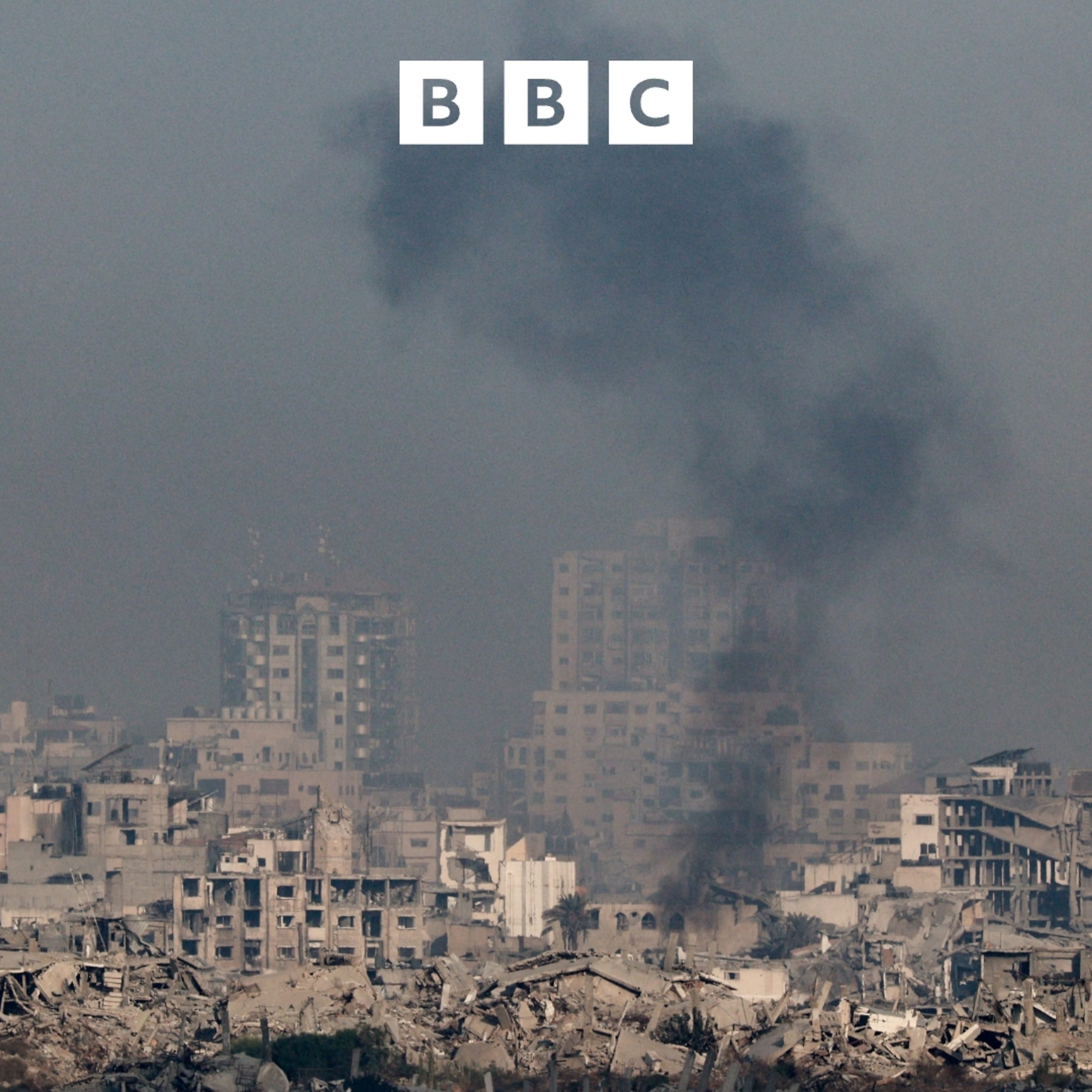
Global News Podcast
Gaza Conflict: Two years on
00:31:58
A special episode to reflect on the war in Gaza and the future of the Middle East
Loading summary
Transcript27 lines
- [00:00]
A
You're joining us on the balcony of the BBC's Jerusalem bureau high up, so we've got a great view. The occupied west bank is just about a kilometer behind me over those hills, and we're about 100km away from the Gaza Strip, where Israel is carrying out its air and ground offensive. But as international journalists, Israel does not allow us into Gaza to report independently, and we do a lot of our journalism from here. On October 7th, two years ago, Hamas crossed the border from Gaza and attacked Israel, killing over 1200 people at a music festival in their homes or their places of work. The Islamist group also took 251 people hostage, taking them back to Gaza, where many were held for months on end. Some are still there. Almost two years on, there have been short ceasefires and hostage release deals, but they have quickly collapsed. Negotiations for a new deal driven by President Trump are ongoing. At the time we're recording this, around 20 living hostages remain in Gaza and more than 60,000 Palestinians have been killed by Israel. The conflict has dominated the news agenda, sparking protests across the world. And to mark two years of this conflict, we have gathered questions from BBC listeners to put to a panel of our correspondents. I'm John Donison, and this is the global news podcast on the BBC World Service. Well, I used to be the BBC's correspondent in Gaza for four years between 2009 and 2013. And I'm joined for this program by three people who know the region very well. I've got Rushdie Abu Alouf, who's joining us from Istanbul. I've got Jeremy Bowen, who's joining us from London. And here with me in Jerusalem, Joran Nel.
- [01:55]
B
So, yeah, I'm a BBC Middle east correspondent. I've been working in this region for more than 15 years now. And I would say that the last two years have definitely been the most challenging of my whole career.
- [02:07]
C
And I'm Rushdie Abalov, BBC Gaza Correspondent. I've been covering this conflict for over 23 years for the BBC.
- [02:17]
D
I'm Jeremy Bowie and I'm the BBC International Editor. I was Middle East Editor for years, and I was based in Jerusalem in the 1990s. I did my first reporting trip, in fact, to cover the conflict in 1991. So going back a long way, I have been very busy with it in the last couple of years as well.
- [02:37]
A
Okay, so we've got literally decades of experience here. Yoland, I'm going to start with you. I mean, you were working on October 7, 2023, when you woke up that day and heard the news. What was your reaction? A busy day, I imagine. And did you think we'd be where we are today?
- [02:57]
B
Well, it was a Saturday, so I was on call. It was the end of the Jewish holidays, and I came rushing into the office pretty early. And I have to say, from the beginning, it was clear that this was something very different from what we'd experienced before, because as soon as I arrived here, there were rockets on course for Jerusalem. I was rushing into the safe room where our air raid shelter is when the sirens were going off around Jerusalem. And my main memory of that day is my own real disbelief as the words were coming out of my mouth, telling people the news. And it was a very strange experience because we have covered wars before, we've covered rocket attacks, we've covered hostage crisis, even together. And this was, you know, immediately clear that it was on a whole new scale. And the kind of rule book that we'd been sort of operating on here had to be ripped up. And I was very worried, too, because there were friends of mine that I was working with that day who had their friends at the Nova Festival. And there were immediately going to be sort of repercussions for people in Gaza, where we have our dear colleagues and know many people that I know in Gaza as well.
- [04:04]
A
And Rushdie, for you, that morning was.
- [04:07]
C
Just normal Saturday morning. And, you know, Saturday is a normal working day in Gaza. So I was about to drive the kids to school, I remember, and suddenly there was rockets flying from all over Gaza. And I was looking from the balcony and never went to my mind that this is, you know, Hamas is crossing the border into Israel. I thought, people, maybe Israel did kill one of the Hamas commanders and Hamas is responding. And that was the view or the initial thought from not just me, all of the journalists that have been contacting me and the people. And, you know, within 10, 15 minutes, I realized that this is big. When I received the first picture from one of the Hamas people in Gaza showing the Hamas militants crossing or close to the border, I realized that it is big. I just say to the kids, don't go to school, stay. And I took the car and drove very fast to the office because, you know, our office is in central Gaza in the middle of the Rimal street, which some of the area, some of the roof near us is overlooking the border with Israel. So I was in a high up position watching almost rockets flying and all of the noises, you know, around this October 7th day, which something that will never forget all my life, we're going.
- [05:37]
A
To talk to you more, Rushdie, in this program about how it's changed your life and the life of your family. Jeremy. I mean, you've witnessed many big moments in the Middle east in those early days. You spent a lot of time down in southern Israel in the communities that had been hit. I mean, are you like Yoland? You recognized immediately that this was a big deal.
- [05:59]
D
I think it was clear from the first couple of hours I was in Ukraine, actually, I was in Kyiv when it all started. And I woke up and I reached my phone, as millions do, first thing in the morning, and the first thing I saw were texts on our office group chat, WhatsApp, from Rushdie, saying hundreds of rockets are being fired into Israel. It wasn't clear what else was happening beyond that. And within an hour or so, it was clear that we were in the wrong place. And we set off on a journey then to Poland and onwards. Took a couple of days. By the Monday morning, with my team from Ukraine, we arrived in Ashkelon, which is the Israeli town, which is just at the very north of the Gaza Strip. And we were basically there most of the time between then and the end of the year until Christmas, more or less. And, yeah, by then it was clear that. I mean, as we were driving through Poland, I was looking at the videos coming out and realizing that Hamas had done this big push over the border and that there was a lot of fighting going on. Clearly it was something that was going to be very, very different. And then when we got to Ashkelon, within a few days, the Israeli military, the idf, allowed us to join various convoys into some of those border communities which had been hit by Hamas. I was in Kabutskva Aza when the Israeli military, the paratroop brigade, was still in offensive combat positions, dug in around it. There was still shooting going on. They were clearing buildings in the site or around it with gunfire. They were still looking. They had only just started really looking for the dead residents of the kibbutz. And they were putting them in body bags and bringing them out. There were people there doing that, and there were a lot of dead Hamas operatives there. It was like nothing I'd seen in this conflict.
- [07:57]
A
And after two years, Rushdie, I mean, no one has been more impacted by this than the people of Gaza. I think you left the strip in November, December 2023. Just give us your assessment of people's situation in Gaza two years on and maybe your own personal situation.
- [08:22]
C
It's very hard to imagine that they are still alive. You know, they are still surviving. Every time I talk to my father back in Gaza or my brothers or my friends, I don't know what to say to them. I mean, every day is a struggle. You know, they struggle to sleep because of the sound of the bombs. They struggle to find clean water. They queues like. My father moved recently from Gaza City into Khan Yunis. It took him 22 hours to drive about 20 km in the back of a truck with some of his belongings or what is still left of of his house. And he moved to almost like halfly destroyed building in Khan Younis. My father is 76 years old. He was born in a tent back in 1949 in Khan Younis because his mother was pregnant when they left Jaffa about 75, 76 years ago. And now he's lived like a year in a tent. Now he lives in a like half a destroyed building. This is just a story of one person reflecting 2 million people who have the same situation. Some of them were displaced 10, 15 times. Some of them, they died. In the road reaching Khan Younis, there's a woman I know, she walked 30km and as soon as she arrived to Khan Younis, she was taken to the hospital, then to the intensive care unit for about two or three hours and she died overnight. So this is just simply the situation in Gaza for me. I live with guilt all the time. I feel that I was pushed to leave because of my family. I could have stayed more because it's worth. I mean, it's the biggest story I have ever. Not only covered, but I have ever seen in this place. There was always something happening in Gaza. For the last 25 years, there was five major wars and few small battles in between. Eyewitness Many things. The first intifada, the second intifada, the killing of most of the Hamas leaders. Yasser Arafat died. And I was like there covering this story, the Israeli disengagement. I never ever expected to cover a story such big like this. When the 7th of October happened, I realized from the first, you know, 10 minutes, maybe 20 minutes, just one hour maximum, I realized that this is going to change the way that we feel about this conflict and it is going to be huge. I try to push my family to leave Gaza as soon as possible so I can do my job. Because it's very hard to be a journalist in Gaza looking for safety, running for safety every like hour and then covering the story.
- [11:20]
A
And Yoland, it's also, I mean, it's difficult to state how great the trauma was for Israel on October 7th. I mean, where would you say public opinion is now here in Israel regarding the war? Because it has divided the world and it's divided Israel too. In some ways that's true.
- [11:39]
B
I mean, Israel's a small country and I would say it's still extremely raw, the grief and the pain from that day two years ago. And, you know, just remember how it was. It was the deadliest day for Jews since the Holocaust. And there is now still a widespread feeling, many Israelis will tell me this, that they believe the world has moved on and that they have forgotten to some extent the atrocities of 7 October that triggered such a brutal war. Gaza and Israeli media coverage is very much focused on the plight of the hostages and their families. There are 48 hostages still being held in Gaza, of whom 20 are believed to be alive, evidently in very bad conditions. We have the testimony of the hostages who've come back, and it's clear that some of those, at least some of them who are being held are in Gaza City. And there have been videos from Hamas that have just added to the distress of the families. Most of the hostage families, you know, they have been opposed to the government's new military offensive expanding the war to try to occupy fully Gaza City. They say this will put the remaining hostages lives in danger and that the bodies of hostages, that they may never be found, basically.
- [12:57]
A
And Jeremy, I mean, one of the big differences I found covering this war between Israeli and Palestinian opinion is that Israelis feel that Hamas started this on October 7th. Palestinians feel that this goes way back to the creation of the State of Israel in 1947, when hundreds of thousands of Palestinians were forced to flee their homes. The war in 1967 where Israel captured Gaza, the west bank and East Jerusalem. So for Palestinians, they feel it didn't just start on October 7th. And Israelis feel entirely differently.
- [13:37]
D
Yeah, I mean, not all Israelis, clearly, but there is a deep rooted conflict here, an unresolved conflict that doesn't just go back to the independence of Israel in 1948 when they won their independence war. And the Palestinian conflict catastrophe, the Nakba, as they call it, the conflict over who controls the land between the River Jordan and the sea and the Mediterranean Sea, started when Zionist Jews came from Europe to Palestine, which in those days was, well, at the very beginning was still being run by the Turks and then the British. And so it goes back more than a century. If you read accounts of. I mean, I recently was reading an account in a memoir by a journalist who was in Jerusalem in the 1920s, the late twenties, when there was quite a lot of violence. It is extraordinary reading it because it feels a lot like now. And that is a hundred years ago. And you can see the similarities and the issues. Just after the 7 October attacks, I spoke to. Well, he's a writer, but he used to be, in fact, for a while, he was the speaker of the Israeli parliament, the Knesset, Avran Berg. And he said to me, I said to him, look, assess the level of trauma for Israelis on this thing. He said the Jewish state, as he put it, was our vaccination against our history. The history in Europe of pogroms leading up to the Holocaust. Six million Jews dead in the Second World War, killed by Nazi Germany. And we thought that we had a vaccination against the past, which was the state. And now we found out this was like three weeks after it started. He said this to me. He said, we've suddenly realized the vaccination isn't working anymore. And that, I think was for him was the root of this enormous trauma that people were suffering. And on the other side, on the Palestinian side, you know, on both sides, these ghosts of history were raised. Rushdie has said that his dad was born in a tent and he found himself in his 70s, back living in a tent. So many Palestinians see what's happening at the moment, and they look at the very inflammatory statements about removing Palestinians not just from the Gaza Strip, but from the west bank by hardline, ultra nationalist, extremist Israeli politicians, some of whom are in the Cabinet, and they see a continuation, a desire to finish the job that was done of removing Palestinians in 1948, when more than 700,000 Palestinians were either fled or were forced out by military force from their territory, including men who ended up in Gaza, like Rushdie's family, and were never allowed back. So the past, the ghosts of the past are being raised and are roaring. And this, I would say the events in the last two years, they are as big a moment in the long history of this conflict as 1948 or when Israel was created, or 1967, when the current shape of the conflict was created, when Israel captured the totality of the Palestinian territory by capturing the west bank, including East Jerusalem and the Gaza Strip. So, I mean, these are historic as well as deeply tragic and dreadful times.
- [17:04]
A
And, Jeremy, right from the beginning of the conflict, there were fears that it could spread to the wider region. And it did.
- [17:13]
D
Yeah, it did and it has. There were right from the start, the Hezbollah movement in Lebanon started a sort of limited. And it became a tit for Tat war across the border into, into Israel, which had a pretty devastating effect on northern communities. They had to leave. Then Israel eventually of course, hit back very hard and caused massive damage to that organization. The Houthis in Yemen got involved and there's been a chain of events. The regime in Syria, the Assad regime fell. And you can connect up the reasons why it fell, not wholly, but partly to what was going on in Gaza and in the wider region. Israel has subsequently bombed, with the decisive help of the Americans, the Iranian nuclear facilities. There's a great deal that is still going on. The whole picture in the region has been transformed by the war. I think Prime Minister Netanyahu of Israel would say that this has been Israel's strength and resolve, has transformed the strategic situation decisively in their favor. The, the contrary opinion to that is that yes, Israel has secured a series of victories by using its extraordinary military forces backed by the Americans and in not just militarily, but diplomatically, politically and so on. But longer term, living by the sword in a region that, that really would be a lot better off if it was at peace. Netanyahu made a speech a week or two ago where he compared Israel to Sparta in ancient Greek, self reliant, strong, quite happy to continue battling its neighbors if necessary to secure its own people. And frankly, that speech didn't go down very well in Israel because it's a country which has had a lot of links with elsewhere in the world. And what they're seeing now, the Israelis, are increased pressure from the outside world, from allies in Europe, a Palestinian state being recognized by Britain, France and numbers of other Western countries which up to now haven't done it. The Israeli Prime Minister and former Defense Minister have had arrest warrants against them issued by the International Criminal Court. There's a genocide case against Israel going on in the International Court of Justice. There's even talk about suspending Israel from sporting activities, from UEFA, from the, you know, the European football authorities, from the World cup qualifiers. There are all kinds of ramifications going on. And of course at the same time as all of that, there is this massive humanitarian catastrophe in Gaza. More than 65000 people, mostly civilians, have been killed and that is continuing. Those figures are from the what we refer to as the Hamas run health Ministry, but whose figures are normally relied upon by international organization as being the best around. And actually some studies, including in the Lancet in London, the medical journal, have said that they're a big underestimate of what's been going on there. We've seen the destruction of the Gaza Strip, pretty much much of it in ruins, and now and a famine. So you, I mean, you name it, terrible things are happening and continue to happen at the moment, two years on.
- [20:39]
A
Okay, I'm going to bring in some questions now from our listeners. The first one from Siddiq in Mumbai in India. And it's a question about language. And I think it's fair to say we all have to choose our language pretty carefully when choosing this conflict. He says, why does the BBC still not refer to the war in Gaza as a genocide after experts have already labeled it as such? Another classic comment we get is why doesn't the BBC refer to Hamas as terrorists? And it's your lucky day, Yoland, because I'm going to throw this one to you.
- [21:14]
B
We stand on this balcony all the time. I stand here and I use all those words, genocide, I use the word terrorist and I use them with attribution, whether I'm talking about the Israeli military or Hamas or, or a UN Commission of Inquiry report or the British government. And that's because the BBC has these editorial policies that, you know, we as correspondents, we can comment on those, we can help to shape those, but in the end we all agree to adhere to those. And that's really with the objective to make sure that our journalism is as impartial, it's as accurate as it possibly can be. And you know, the guidelines are supposed to be for our coverage all around the world where we're catering for a diversity of audiences. Right. So the guiding principle that we have is to use descriptive terms to, for example, describe those who are carrying out violence. So that might be using the word attacker or gunman or bombers, whatever that might be. And then we try to explain the facts of what has occurred and, and what the consequences are. And the idea is that that should be meaningful to our audiences wherever they are, and they can make their own value judgments. And if you look at some particular words that say, you know, terrorism, that is the BBC argument there has been that there is no internationally agreed definition of terrorism, I suppose, and that's why we choose attribution. And we're not taking a political side in conflict. This is a conflict, as Jeremy's been saying. It's so deep rooted, it's so complex and extremely sensitive, as we all know very well.
- [22:56]
A
A question which I think is going to be for you, Rushdie. This comes from Oren in Israel. He sent it in in a voice note and we can hear it now.
- [23:05]
C
How many Palestinians are in favor of Hamas. Today, if there was an election, would Hamas win? Is there any difference between west bank and Gaza Strip in terms of opinions? Yes, definitely there is a difference between west bank and Gaza. I have been to the west bank many, many times and the people there, they do support Hamas. Many of the people that I met, especially in places like the south, like in Hebron, some of the areas like Jenin and other places, there's a great support for Hamas and Islamic Jihad in those especially two areas like the refugee camps. And it's partially because they believe that the Palestinian Authority and Fatah are corrupt and they want some alternative. And this is exactly what happened in Gaza back in 2006 when we believe that not all of the people who voted for Hamas were Hamas people or in favor of Hamas. But it was on the other side trying to punish PA and Fatih for, you know, long standing corruption existing in Gaza. Now, I think by like watching the monitoring the social media and what is people talking About Hamas and 7th of October especially, there is a great division within the people in Gaza. And I could say freely that very little people in Gaza who still support Hamas in public, maybe because they fear of an Israeli reaction or also because the people of Gaza paid a very big price. And from the first moment of 7th of October, maybe the first month, there was many huge number of people in Gaza who were equally accused Hamas of the consequences of the aftermath of the Israeli attack. Because some of them were saying that Hamas did have this jump in the air without, you know, strengthen their backing. There was no preparation at all in Gaza. They were only preparing tunnels to hide their militants. That's what the people in Gaza are saying. There was no enough food, there was no health, a strong health system to deal with the catastrophe that Gaza is facing. There was no food reserved or water or electricity or anything. They just left the people to live this catastrophe without intervening or do anything. So people do publicly criticize Hamas for this. And there is a huge division where there is two pictures when the people inside Gaza who left this and the people outside who are watching the bigger picture. Because regardless of who Support Hamas or October 7th who not support this, the issue of the Palestinian causes became a trend. I mean, I've been traveling around the region for the last two years. You can see that the Palestinian, for example, Kofiyyas became a trend. This traditional scarf that people are wearing is everywhere. You can see Palestinian flag everywhere. This picture, the people inside Gaza, they do not see because they don't have electricity, they don't have Internet and they don't care sometimes about what's going on outside. But for someone who's living outside, who can see the bigger picture, I can see that there is a huge division between Palestinians in regarding to Hamas.
- [26:36]
A
And a question for you Jeremy, from Dan in Washington state in the usa. We've heard a lot of talk actually in the last few weeks about the two state solution, a Palestinian state alongside Israel. He's asking Dan, what are the prospects of a one state solution where there is one secular democracy between the river and the sea. The two state solution has been talked about for decades and there's been little progress in reaching one.
- [27:03]
D
Yeah, there has been little progress and I was living in Jerusalem in the 1990s when the Oslo peace process was going on and there was then genuine hope on both sides. There are also people who are heavily critical of it, very, very violently critical in some cases of it. There was a mass bombing campaign to try and stop it. And of course the Israeli Prime Minister was assassinated by a Jewish extremist who was against the, the ideas of two state solution. But anyway, after all that collapsed, it became really an empty slogan, the idea of it. And now countries like Britain, French are trying to, the Saudis are trying to breathe some life into the idea. We'll see whether or not that actually results in anything. As for a one state solution, there may be a de facto one state insofar as if Israel continues in its occupational, maybe annexes part of the west bank and then it, because now it really controls the entire area, then eventually that would be one state. But then there would be this huge question of do you give the Palestinian population, which is roughly, if you take the 20% of the Israeli population that is Palestinian, half the number of people between the river and the sea are Palestinians. So this has been, Israelis have been well aware of this for a long time, which is if you don't have a Palestinian state, what do you have? They want Israel to be in control, they want it to be a Jewish state. But if you then had a democracy which with half the population not being Jews, being Palestinians, well then they might see oblivion down that road. So I think the chances of a one state solution that is a full democracy are vanishingly unlikely. And I think at the moment a two state solution is also highly unlikely. The Israeli government's against it, the Americans are against it for now. So what are we talking about? I think we're talking about unless there is some kind of diplomatic miracle, a continuing conflict, a continuing occupation and another generation drawn into it.
- [29:12]
A
We're running out of time. So this is going to be my last question. It's to you again, Jeremy. I mean, that was quite a depressing answer. Where's this heading? Are there any grounds for optimism at all?
- [29:24]
D
Well, as we speak, there's a new flurry around a ceasefire in Gaza. I mean, let's hope there is a ceasefire, possibly hostages go home, families are able to grieve and to welcome back the living. Let's hope that the humanitarian catastrophe in Gaza for Palestinians ceases, that aid gets in. But what about politically? What's after that? I hate to be the guy who's always depressing, but I don't see where the political horizon is. I don't see where it's going other at the moment than other kinds of conflict. The radicalization of a generation, not just Palestinians, but also on the Israeli side. Israeli soldiers, young guys have said to me, never mind radicalizing the Palestinians, they radicalized us October 7th, radicalized us. So I really hate to be the bringer of bad tidings, but having reported on this for many, many years, I have not seen a worse time in terms of the prospects for a decent future for people. What gives a lot of the potency of the Israeli Palestinian conflict is that it exports trouble, exports a toxicity, has political impacts elsewhere, has violence is generated elsewhere because of it, well out of the Middle East. And unless things get better, unless there are possibly different leaders who have different attitudes on both sides, on all sides, then I mean, I don't see it getting better. I don't. I'm sorry. About to say that it's a very.
- [31:05]
A
Sobering way to end, but I want to thank our guests on the program today, Yolan Nell, Jeremy Bowen in London, and also Rushdie Abu Alouf, our Gaza correspondent who now is based in Istanbul. You've been listening to a special edition of the Global News podcast with me, John Donnison. If you want to comment on it, you can send us an email. The address is globalpodcastbc.co.uk. you can also find us on X, that is BCWorld Service and you can use the hashtag globalnewspod. This edition was mixed and produced by Isabella Jewell and filmed for YouTube by Anastasia Zlatop Poltovskaya. The editor is Karen Martin. I'm John Donnison. And until the next time, bye.