← Global News Podcast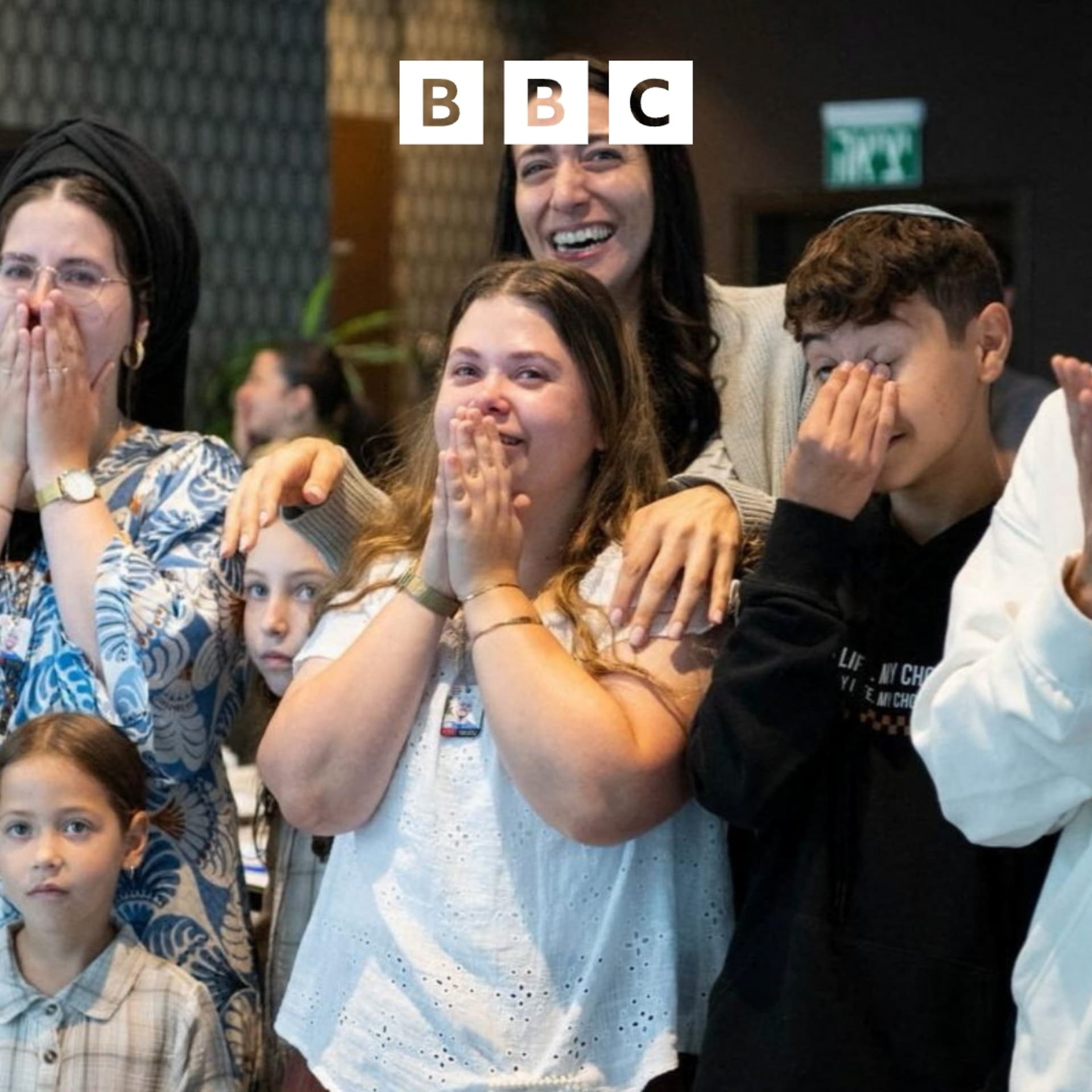
Global News Podcast
Israeli hostages and Palestinian prisoners exchanged
00:18:53
Hamas releases last living Israeli captives in Gaza as Israel frees Palestinian detainees
Loading summary
Transcript21 lines
- [00:00]
A
This is the global news podcast from the BBC World Service. I'm Valerie Sanderson, and at 39 GMT on Monday 13 October, we're covering a major day of news in the Middle East. All 20 of the living Israeli hostages, those taken more than two years ago in the 7 October attacks, have been released. Palestinian prisoners and detainees, around 2,000 in total, are also being freed. And President Donald Trump and Prime Minister Benjamin Netanyahu have both spoken to the Israeli Parliament, celebrating what the US leader called the historic dawn of a new Middle East. A monumental day for Israelis and Palestinians, as people from both sides were handed over as part of President Trump's ceasefire deal. The last 20 living hostages held by Hamas in Gaza are now back in Israel after more than two years in captivity. In exchange for the hostages, Israel is releasing 250 Palestinian prisoners and more than 1700 detainees and the first groups who began arriving in Gaza and the West Bank. In Israel, there was jubilation. Our correspondent Yolan Nel has spent the day in what's become known as Hostages Square in Tel Aviv.
- [01:16]
B
We've been hearing has been about the hostages, mainly focused on that, with people tuned in to the main Israeli TV channels. And then it's been punctuated with music. Moments like this, which are kind of moments of reflection. It's the end of the Jewish holiday of Sukkot and so families are together, children are off school, and you feel like people from all around Tel Aviv have gathered here. It's become a natural meeting point over the past two years to get the news about the hostages. And there were champagne corks popping at the time where the announcement came through that there were no more living hostages for Israel inside the Gaza Strip. All 20 of them were back in Israeli hands. And we've had periodically pictures going up of these reunions. We've had former hostages speaking to the Israeli media, giving their reflections, knowing that those they have campaigned for, who they were held with in underground tunnels in Gaza, are now being reunited with their families. It is, for people, an extremely moving day because many of these hostages, the remaining 48, you see people have them on T shirts, their posters are all around Tel Aviv, in particular with the sign up saying, bring them home. Well, today people have got a banner saying they're coming home. And people have really followed up on news of these hostages. They've come to know so much about their families as they've campaigned, as they've been giving interviews to the media repeatedly over the past two years. So, yeah, very emotional day here in.
- [02:57]
A
Tel Aviv, Yolan Nel Busloads of Palestinian prisoners and detainees have been handed over in the west bank to cheering crowds after the Israeli hostages were returned from Gaza to Israel. Our correspondent Barbara Petasher was in Ramallah in the west bank as the coaches carrying the first released Palestinian detainees arrived.
- [03:17]
C
The first bus has just arrived. We just had the Red Cross vehicles run past us. And now the families and the friends are gathering in front to of the opening of the bus to see people coming off. You can see through the window, the Red Cross monitors and maybe just through the glass there, prisoners coming out, somebody wearing a kafiyeh, a Palestinian kafiyah. Ah, the door is opening now. These, okay, they have started to come up. So 250 Palestinian prisoners released from jail, many of them having served life sentences, only about 100 of them being released to the West Bank. That's these prisoners here. Their families have gathered at the Ramallah Cultural center, which is where we are, to greet them all wearing the Palestinian kathiyeh. As you can maybe see through the glass of the glass. Tremendous amount of excitement and joy as they are being received. As you know, of course, for the Israelis, this is a difficult moment because they see many of these prisoners as terrorists. But for Palestinians, these are sons, husbands, brothers, people who are part of a Palestinian collective culture. Many Palestinians have been in Israeli prisons. Most of them know somebody who has been. And now to have prisoners released is a moment of real joy and excitement. Again, as we were saying earlier, they got this information quite last minute. They thought that some of these people would be in jail for the rest of their lives or certainly didn't have any idea that they might be coming out at any time. And suddenly here they are.
- [05:23]
A
Barbara Plet Usher in Ramallah that's the situation in the West Bank. Let's turn now to Gaza itself. The Israeli authorities aren't allowing international correspondence to operate there. But our Gaza correspondent, Rushdie Abu Alouf is watching developments from Istanbul.
- [05:39]
D
Thousands of people are now in the streets, especially in Khan Younis, the place where about 17 to 1900 Palestinians are supposed to arrive. We're already about 11 buses carrying Palestinian prisoners have arrived to Khan Younis. I mean the festival or the celebration is right next to Nasser Hospital. It's the only functioning medical facility in the south. Are going to make like medical checkup to all of the prisoners as soon as they finish there will be some sort of celebration. Hamas deployed some militants in the place, they said to secure the area, but it is, we feel today in Gaza that there is A sense of celebration and joy. You know, people have been waiting for a very long time for the people for about two years to be released. And others were disappointed because there is still about 1400 Palestinians who were arrested after the Hamas attack on 7th of October from Gaza remain in the Israeli jail. And the people are hopeful by implementing the second stage of the ceasefire, they will be released to more of those who were killed for the last two years.
- [06:58]
A
And is access to aid becoming easier already?
- [07:03]
D
Yeah, much easier. Yesterday, about 430 trucks were allowed, including four, the first time in a very long time. Cooking gas and fuel for the hospital, medical aid, medical equipment for renovating the hospitals will allow. And today they're supposed to have more from today and Tomorrow, up to 600 trucks every day for the next month or as long as the ceasefire hold, there will be 600 trucks, we understand from the mediators, every day to overcome the humanitarian crisis. And the most needed item are now the medical stuff because most of the hospitals were destroyed. People also need some clothes and, you know, fuel is essential to run the hospital. So people are hoping that the flow of aid would change the misery and the difficult situation that they are living in.
- [08:06]
A
Rushdie Abu Alouf. Coming up, we'll have the thoughts of our Middle east analyst, Sebastian Usher. In Israel, President Trump gave an address to the Knesset, Israel's parliament. There, he said the age of terror had come to an end with an historic dawn in a new Middle East. He declared that the ceasefire agreement marked the end of Israel's war on Hamas in Gaza needing leading to peace in the region.
- [08:39]
E
After two harrowing years in darkness and captivity, 20 courageous hostages are returning to the glorious embrace of their families. And it is glorious. 28 more precious loved ones are coming home at last to rest on this sacred soil for all of time. It's the start of a grand concord and lasting harmony for Israel and all the nations of what will soon be a truly magnificent region. I believe that so strongly. This is the historic dawn of a new Middle East. All of the nations of the Arab and Muslim world that came together to press Hamas to set the hostages free and to send them home, we had a lot of help. We had a lot of help from a lot of people that you wouldn't suspect. And I want to thank them very much for that. It's an incredible triumph for Israel and the world to have all of these nations working together as partners in peace. And it's pretty unusual for you to see that, but it happened in this case. This was a very unusual point in time, a brilliant point in time. Generations from now, this will be remembered as the moment that everything began to change and change very much for the better. Like the USA right now, it will be the golden age of Israel and the golden age of the Middle East. It's going to work together. For so many families across this land, it has been years since you've known a single day of true peace. But now, at last, not only for Israelis, but also for Palestinians and for many others, the long and painful nightmare is finally over. And as the dust settles, the smoke fades, the debris is removed, and the ashes clean from the air. The day that breaks on a region transformed, and a beautiful and much brighter future appears suddenly within your reach.
- [10:52]
A
President Trump. Before America's leader addressed the Parliament, the Israeli Prime Minister, Benjamin Netanyahu showered Donald Trump with praise.
- [11:01]
F
Thank you for all you have done for us. I have submitted your nomination to be the first non Israeli recipient of the Israel Prize, Israel's highest award. As to that other prize, just a question of time. You'll get it. But I want you to get the Israel Prize, our highest award. To our greatest friend, when others were weak, you were strong. When others were fearful, you are bold. When others abandoned us, you stood by our side. On behalf of the government and people of Israel, I thank you for your extraordinary friendship. Thank you for helping bring our hostages home. Thank you for supporting Israel's march to victory. Thank you for paving a path to peace.
- [12:13]
A
Benjamin Netanyahu. Well, following his speech at the Knesset, Mr. Trump has gone to Egypt for a special summit of more than 20 world leaders in Sharm El Sheikh. The Egyptian president's office said the purpose of the summit was to end the war in the Gaza Strip and enhance efforts to achieve peace and stability in the Middle East. Neither of the warring parties, the Israelis or Hamas, will attend, but Mahmoud Abbas, the President of the Palestinian Authority, will be there. Among the other world leaders who are definitely attending are the British Prime Minister, Keir Starmer, the French President Emmanuel Macron, and his Turkish counterpart, Recep Tayyip Erdogan. I spoke to our correspondent, Hugo Bechega, who's in Sharm El Sheikh.
- [12:54]
G
I think the event here in Sharm El Sheikh is obviously a victory lap for President Trump. It's because of his personal involvement in these negotiations that we had a deal in Gaza. It also shows huge international support. We're going to have more than 20 world leaders attending the summit here. So huge international support for these negotiations and also support from key regional players, which is quite significant. The Egyptians who have been acting as a mediator in this conflict, saying that the goal here is also to finalize the deal to end the war in Gaza. President Trump is saying that the war is over, but the reality is that we only have the first phase of that 20 point plan that the president announced last month. And we don't have a clear timeline, no framework for, you know, for the future of these negotiations. And we know that key sticking points remain in these negotiations, including the future of Hamas, the scale of the Israeli withdrawal and who will govern Gaza. So these are major questions. Difficult decisions lie ahead. And again, we don't have any kind of indication in terms of negotiations over the next points, the next stage of this plan.
- [14:12]
A
So, Hugo, how important is the president of presence of Mahmoud Abbas there, the president of the Palestinian Authority?
- [14:19]
G
It's quite significant because this presence of Mahmoud Abbas was only confirmed yesterday. There had been some criticism that the future of Gaza and perhaps the future of the conflict was going to be decided without the presence of any Palestinian leader or with any kind of Palestinian representation. And it also symbolic because he will be, you know, the leader representing the Palestinians. The Palestinian Authority obviously being the body that controls, governs some parts of the occupied West Bank. There is, you know, the hope that it will have some kind of role in governing Gaza in the future. So it is very important, but it is also a presence full of symbol.
- [15:02]
A
Hugo Bochega in Sharm El Sheikh, monitoring events throughout the day are Middle east analyst Sebastian Usher.
- [15:09]
H
It's been quite a morning. I mean, one that I think if you go back a couple of weeks, you wouldn't have believed would be happening like this. Everything has gone relatively smoothly. The release of the 20 living hostages has taken place. The release of many of the Palestinian prisoners has also been taking place in Gaza and in the occupied West Bank. And we've seen at the Knesset, we've seen extraordinary amount of ovations for President Trump as he appeared there. A real victory lap for him. We had Mr. Netanyahu heaping praise on Mr. Trump, but also defending once again his strategy, saying that if it hadn't been for the military force that Israel had used, he wouldn't have got to this situation. And he praised Mr. Trump, I think more than anything for being strong where others were weak. And then Mr. Trump rose to speak. And I mean, the excerpts that we saw of a speech before he was going to talk were very highfaluting, quasi biblical language. He had moments of that where he talked about the dawn of a new Middle East. He talked about the guns going silent. He also talked, which we've heard before, which is, I think, pushing things a bit, that this is the end of 3,000 or 500 years of conflict, painting this as if this is some kind of immemorial conflict between two peoples. I think most people would say that it's something very different from that. But this was his moment. He praised also, Mr. Netanyahu said he's not an easy guy. That is his great strength. I think he gave very much the sense that only Mr. Trump could really deal with him in that way and that he persuaded Mr. Netanyahu to stop the war by saying things are getting nasty for Israel, it needs to end now. For Gazans, he presented a vision that would be a new one without terrorism, without jihadism, could present all the kinds of possibilities which he will be discussing at the summit in Sharm El Sheikh with leaders from McGalth, who again, he lavished praise on them, saying that never in one place had so many incredibly rich people gathered together and that they had been instrumental in what's been happening and really saying that they're the ones who can help do the rebuilding, not just of Gaza, but of what he describes as a new Middle East.
- [17:22]
A
Sebastian Ascher. And before we finish this podcast on an historic day, let's return to President Trump's speech to the Israeli Parliament. This is how he ended it.
- [17:33]
E
Israel, America and all of the nations of the Middle east will soon be safer, stronger, greater and more prosperous than ever before. And I want to thank you all once again for this exceptional honor. This has been truly an honor. It's seldom that a president is invited to do this. And I love Israel. I'm with you all the way. You will be bigger, better, stronger and more loving than ever before. Thank you very much. God bless you. God bless the United States of America and God bless the Middle East. Thank you, everybody. Good luck. Thank you very much. Thank you.
- [18:23]
A
And that's it from us for now. But there'll be a new edition of the Global News Podcast later. If you want to comment on this podcast or the topics covered in it, send us an email. The address is globalpodcastbc.co.uk. you can also find us on XBCWorldService. Use the hashtag Global Newspod. This edition was produced by Harry Bly and mixed by Chris Lovelock. The editor is Karen Martin. I'm Valerie Sanderson. Until next time. Bye bye.