← Global News Podcast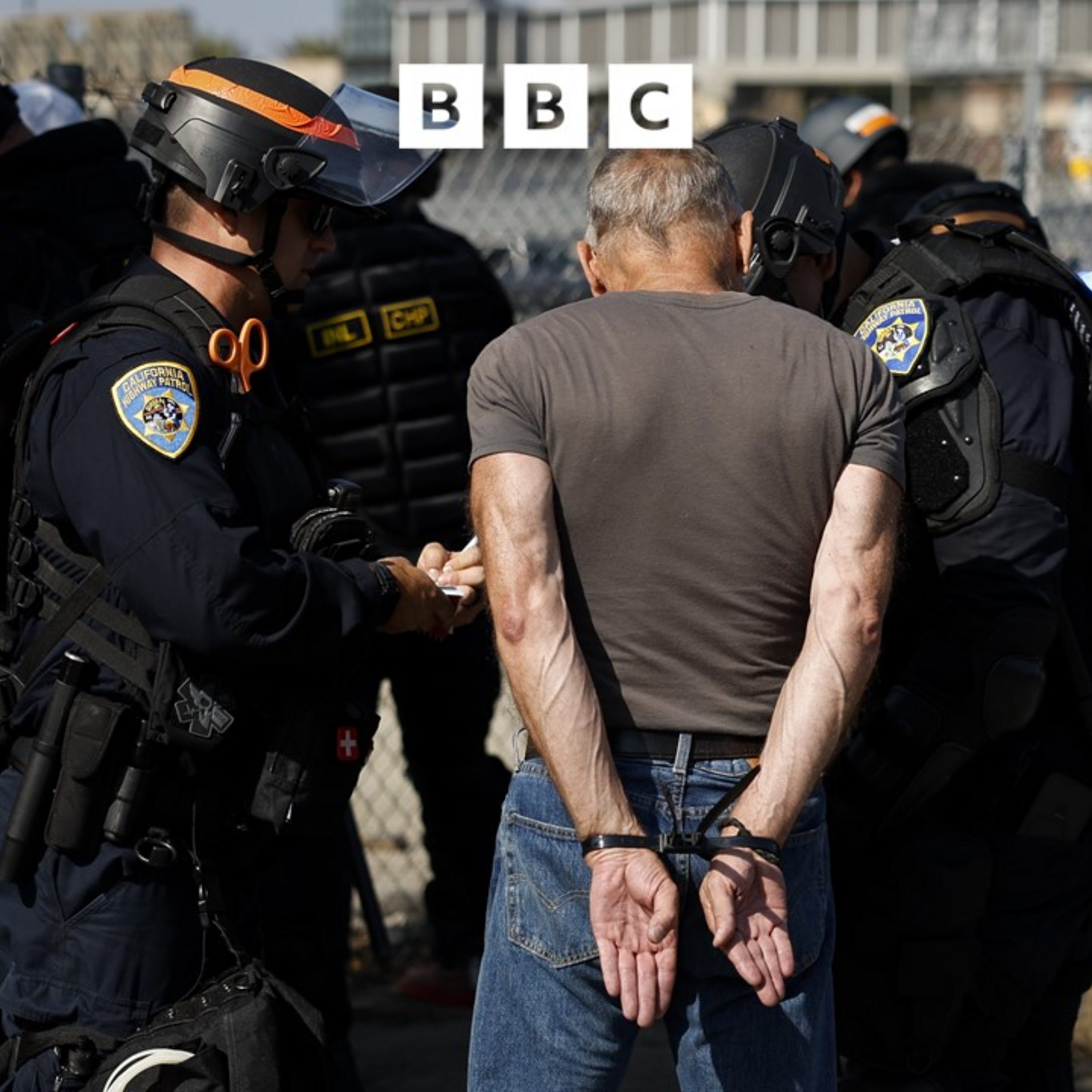
Global News Podcast
Mass arrests after curfew kicks in
00:31:10
President Trump has sent 4,000 National Guard troops and 700 Marines
Loading summary
Transcript1 lines
- [00:00]
Andrew Peach
This is the global news podcast from the BBC World Service. I'm Andrew Peach and at 13 hours GMT on Wednesday 11 June. These are our main stories. Mass arrests and a curfew in LA after days of protests sparked by immigration rates. Dozens more Palestinians are killed trying to get to aid in Gaza. And Austrian police find a non functioning bomb at the home of the man held responsible for Tuesday's school shooting. Also in this podcast, you have two megalomaniac billionaires with narcissistic tendencies. And they don't tend to get along well with other megalomaniac billionaires with narcissistic tendencies. Elon Musk says some of his social media posts about President Trump went too far. Let's start in la, a city facing lockdowns after several nights of unrest and protests against immigration rates. An overnight curfew has been in force and police say they made mass arrests. The Governor of California, Gavin Newsom, said democracy is under assault before our eyes after the White house deployed nearly 5,000 troops, including National Guardsmen and U.S. marines to his state against his wishes. And the anger has been spreading too, with demonstrations in support of immigrant communities in New York City, Chicago and Dallas. The Governor of Texas, Greg Abbott, who's a Republican, has announced he's deploying the National Guard at several locations in his state. My colleague John Sudworth is in Los Angeles meeting people out on the streets. Fight the curfew. So there's a small crowd in the middle of this street, but police on both sides flashing blue and red lights. And that's the baton rounds coming in. We're standing away to the edge here, just ducking inside a car park. Whoa. That's a rubber bullet. Come right in there and just hit the wall next to me. Excuse us, guys with BBC News. What are you doing out here? We're supporting our families. They're firing rubber bullets in now. You're not worried? Why would we be worried? We have papers. We're peacefully protesting. We're not being violent. Beer. We got cold beer. Buzzball, Red Bull. What's up? What's up, Kylie? You're selling beer. Cold beer, guys. Y' all need one right now. Y' all need a beer, bro. That's the bravest piece of entrepreneurship I've seen in time. Yeah. Are people buying them? Yeah, look, it was. It was full. You guys better move your trolleys out the way. That must be about 30 or 40 police cars I've seen come past there. The resources that are being poured into enforcing this curfew are Truly extraordinary. There's a guy here who been hit by a rubber bullet. Wow, that's a massive bruise. In fact, it's bleeding. Does that hurt? Yeah, the heart. Stay safe out there. What are you doing out here? I'm supporting every immigrant, every family that got ripped up. Right now I taking them away from their families, from their kids at graduations. I'm from a Mexican mom and dad, so I'm here to fight for them. Are you worried about being arrested? Apparently I am. So I'm about to go home. I got a lot to lose. I love my freedom. So it's hard to get an overview of how successfully they are clearing this city centre area where I am. They seem to have done a pretty good job. The police came through here 10 minutes or so ago firing rubber bullets as they did. There are still a few disparate groups of people left milling around in twos and threes. A couple of people on bicycles over there, some people still carrying flags. But in terms of large numbers, they seem to have gone. John Sudworth in Los Angeles. For the latest, CBS correspondent Jarrod Hill spoke to my colleague Lucy Hawkins from New York. We've seen these demonstrations happening in New York, in Chicago as well as parts of Texas, Washington, D.C. california, obviously multiple of those here in New York. Yesterday there were hundreds of people, if not more, close to a thousand who were protesting really in one particular part of the city. I think that that's one of the things that's important to keep in mind here with all of these protests that we're seeing is that largely they are pretty isolated to specific part of these cities. There were a couple of dozen arrests here in New York, mostly related to things like disorderly conduct. There is another protest scheduled for today here in New York as well. One of the big questions obviously is going to be how long does this last? How much do we continue to see these protests around this specific issue? There have obviously been constant protests ever since President Trump took office. And this is the latest powder cake. And Jared, what's the status of the Marines and their deployment at the moment? Currently in Los Angeles. From what we have been learning, they are not yet on the streets of L. A for the most part, it seems from what we have learned, they are basically in a staging area not too far outside of the downtown area of Los Angeles doing training until they are given further instructions on where exactly to go. But as we have heard, there are a lot of concerns from Americans about having the Marines deployed, especially in a situation like this. We know that Gavin Newsom, the governor of California is working through the court system to try and block the military involvement in the protest situation as well as in the Immigration and Customs Enforcement activity. There's a hearing scheduled for tomorrow to see if that actually does happen. The National Guard has been deployed in Texas. What's the response? Been there and from their governor. That's right. So the governor of Texas actually is the one who said that he was deploying the Texas National Guard to multiple parts across the state. He said this was to ensure peace and order. It comes ahead of some planned protests this week in Texas, some of those happening in San Antonio as well as other parts of the state. We've already seen those happening in Austin. A lot of these either places that have a sizable immigrant population or places that are a bit more blue or left leaning. Again, Greg Abbott, the governor of Texas is someone who has been very much so at the forefront of utilizing either the military or other political tactics to handle some of the protests that we have seen. CBS correspondent Jared Hill in New York next to the U turn from the world's richest man, Elon Musk, who's been clashing with President Trump on social media after calling a new US tax bill a disgusting abomination, Mr. Musk went on to say that Mr. Trump appears in unreleased government files linked to the late sex offender Jeffrey Epstein. The White House rubbished those claims and Donald Trump said his former adviser had lost his mind. There was also a threat to cancel government contracts worth an estimated value of 38 billion doll. Brian Klaas is a global politics professor and host of the podcast Power Corrupts. He's been talking to my colleague Emma Barnett. I think what he's also sorry about is not just the content of the tweets, but also the impact of them. Because, you know, Elon Musk is heavily dependent on US Government funding. He has also made himself completely toxic to people left of center in the United States because of his alliance with Donald Trump. And so he has basically nowhere to turn. I mean, if he alienates the US Government, that will hurt his. And if he alienates the Trump base, his political involvement, he'll end up being sort of a non factor in US Politics. So I think he just sort of realized that Trump was going to win this fight. Your podcast and what you explore with the idea of power corrupting, is this a case of finally there's someone for even Elon Musk to be accountable to? Yeah, I think at some point, you know, money does talk for Elon Musk and I think this was also completely inevitable, right? I mean, you have two megalomaniac billionaires with narcissistic tendencies and they don't tend to get along well with other megalomaniac billionaires with narcissistic tendencies. So this was no surprise. I mean, it was sort of a question where people were, you know, almost having sweepstakes of how long is this, this relationship going to last? I don't think it's going to be repaired or it's not going to go back to where it was before. I think this was a very big rupture. But I think they both do have some codependencies because Musk's money is very useful to Trump and Trump's, you know, political support is also very useful for Musk. So that structural relations does matter for both of these men who really do care about money and power both. But when you make something as personal as that was, again, an allegation without proof, but saying that the president was listed in these files, which is why they haven't been fully revealed, you are attempting to greatly, in normal human parlance, hurt somebody, aren't you? Yeah. And I think this is the other aspect is, you know, Elon Musk can try to walk back the tweets with a post on X, but he's made a specific claim and a lot of people in the Trump base have been calling for the Epstein files to be declassified and sort of, you know, released and so on. And as a result of that, you know, that's not going to completely go away. So, you know, the tweet that he posted in the middle of the night just recently isn't going to fully, I think, eliminate the political damage that he may have inflicted on Donald Trump. Last week, Professor Brian Klaas. More Palestinians have been killed trying to get to critical aid in Gaza. The Hamas run Civil Defense Agency said 31 people died when Israeli forces opened fire near an aid convoy and distribution center belonging to the US And Israel backed Gaza Humanitarian Foundation. Dozens more are said to be injured. The IDF has said it isn't aware of any gunfire by its troops. Local man Mohammed Abuada says he saw what happened. We struggled so hard just to get to the aid distribution center only to be suddenly shot at. We had no idea who was firing, the Americans, the Arabs or the Israelis. My legs were wounded and I've been bleeding all the way. I don't know where to go. It is not aid, it's death. The BBC and other news organizations aren't allowed into Gaza. So our Middle east correspondent Hugo Bochega told me more from Jerusalem. Another deadly day in Gaza for Palestinians trying to get some desperately needed aid. It seems that we're talking about three separate incidents. One of the incidents happened near an aid convoy transporting flour. There was also another incident near a food distribution center of the Gaza Humanitarian Foundation. The civil Defense agency in Gaza, which is run by Hamas, said Israeli forces opened fire on crowds. There have been reports of people being shot by Palestinians as well. The Israeli military said it was investigating the reports. It also said that Israeli soldiers had fired warning shots earlier today. But what we're seeing here is that every day since this new system was implemented by the Gaza Humanitarian foundation two weeks ago, there have been deadly incidents around these distribution hubs because this is a system that requires people to go to these distribution hubs to receive a very limited amount of supplies. And according to officials in Gaza, more than 160 Palestinians have been killed trying to receive aid. Meanwhile, Benjamin Netanyahu's government is facing a bid by opposition politicians to try and dissolve Parliament today. Now, it's not likely to be successful, but tell me what's happening there. A vote is expected to happen later today and the background of this is that religious parties who are part of the governing coalition, they are threatening to support this bill to dissolve the Knesset because of the failure of the government to pass legislation exempting ultra Orthodox students from military service. For years, these exemptions have been a controversial issue in Israel where military service is mandatory. And this debate has intensified since the war in Gaza started with the military very stretched with reservists having to serve several times. So I think this threat is obviously a way that these religious parties have to put pressure on the government to change this legislation. But we need to see what's going to happen in the next few hours. The vote may not even happen today. But if a vote does happen and the legislation is approved, this could be the first step to dissolve the Knesset. But three further votes are needed before a Snapple action is announced. So this would give plenty of time for negotiations to happen. Hugo Bochecha in Jerusalem. A minute's silence has been held in Austria for victims of a school shooting in the city of Graz. Police said the 21 year old suspect had taken his own life in the school's bathroom shortly after Tuesday's attack which left 10 people dead. Austrian has reported seven of those killed were children. Our Central Europe correspondent Nick Thorpe gave me this update from the scene. The police now are very much focused on what they can find out about the perpetrator and his possible motives. We know now that he left a farewell letter addressed to his family, both a written and a video message. We understand the video message was addressed to his mother, but according to to the police and they haven't disclosed the exact contents of those messages, these were of a personal nature, giving little or no clue as to a potential motive for the killings. But we also know from the police that he had been assembling a pipe bomb which was not well made, it would not have exploded. So it looks like he gave up that attempt. He was clearly wanting to cause maximum loss of life and then went out and bought the two pistols, some kind of revolver and some kind of semi automatic weapon with which most of the people were killed. Nick Thorpe in Austria. Scientists have known for some time that chemicals found in many sunscreens can damage coral reefs. Getting into the ocean through everyday things like swimming or showering or the discharge of waste water. Now, British researchers think they may have come up with a solution. A new sunscreen which not only protects coral reefs, but actually helps them grow. Our reporter Sally Bowman went to meet the team behind it. The team found labels such as Ocean Friendly weren't backed by science. So with partners they set out to develop a system shoppers could rely on. My name is Michael Sweet, I'm a professor in molecular ecology and climate change here at the University of Derby and head of the Nature Based Solutions Research Centre. Originally I didn't think it was going to be so we were hopefully going to find something which was like the least worst on the market and then when it started showing a positive impact we knew we were onto something really big that could ultimately change the whole market of sunscreen. As research progressed, they began to wonder what if the ingredients in your suncream actually helped feed the coral? So I'm Trina Barker and I'm a PhD student at the University of Derby. In the sun cream they've got the cocktail of minerals and things that promote coral growth. What we found was really surprising is it did actually promote coral growth. So we went from having like an 8% increase in linear growth and that expanded out to 29% later on. The university's new science backed standard is branded the Reef Protection Factor Bronze Silver and Coral Positive Gold. The new gold creams are already being handed out on Thailand's beaches. But that's just the beginning. What if the standard applied to to other consumer products that wash down the drain and into the sea? If we can get an organization like the Environmental Protection Agency or even the United nations to make this a mandate aspect of cosmetic manufacturing. Then it will really start to snowball and we'll see that global change overnight. But even consumers can make that difference by looking for that RPF accreditation and they know 100% that this does a positive aspect on reef environments. Professor Michael Sweet ending that report from Sally Bowman. Still to come in this podcast, why a Mobile Game is facing a national security crackdown in Hong Kong. The Sudanese army has suffered a reverse in its war against its paramilitary rivals. It's been forced away from the Libya, Egypt, Sudan border, across which it says arms are delivered to the rsf. On Tuesday, the army accused troops loyal to eastern Libyan military commander Khalifa Haftar of carrying out an attack alongside the rsf. Haftar's forces denied participating in a cross border attack. Here's our Africa Regional Editor Will Ross. This is a big setback for the Sudanese army. It had been using former rebels from Darfur to help it protect the border with Libya, but following fighting this week, they've now withdrawn and the army's rival, the Rapid Support Forces, control the border triangle. This means it will be far easier for the RSF to bring in weapons via Libya and link up with the Libyan military commander Khalifa Hafta's forces. The Sudanese army says the United Arab Emirates is behind all this. Despite denials from Abu Dhabi, there's strong evidence that the UAE has backed the RSF and Khalifa Hafta's forces. Police in Northern Ireland say 17 officers were injured after hundreds of masked rioters attacked police and set homes and cars on fire in the town of Ballymena on Tuesday in a second night of unhappy unrest. It all started when two 14 year old boys speaking through a Romanian interpreter, appeared in court to face a sexual assault charge. Detectives say they're investigating attacks on the homes and businesses of foreign nationals as racially motivated hate crimes. Vincent McEvin reports a second night of disorder, petrol bombs, firewall works and masonry thrown at police in response, baton rounds fired, riot dogs on the scene and water cannon deployed. The scenes on Monday and Tuesday night followed a court hearing. Two teenage boys who spoke through a Romanian interpreter charged with the attempted rape of a teenage girl. Their solicitors said they would be denying the charges. Police say they believe some people were intent on violence. This violence was clearly racially motivated and targeted at our minority ethnic community and the police. It was racist thuggery, pure and simply and any attempt to justify or explain it as something else is misplaced. I want to condemn these attacks in the strongest possible terms it has no place in our society and should be loudly condemned by all right thinking people. Police have called for calm and say a significant presence will remain in Ballymena in the coming days. Sharmore Holland is from Northern Ireland's Centrist Alliance Party. She told the BBC she's been in touch with the police after immigrant families in the town were targeted. As the disorder started to kick off, I started to receive phone calls from members of the Filipino community and also then with an organization that works with interpreters and has been working with a Roma family. And that Roma family were able to tell the interpreter who then passed it on to me that initially they had barricaded themselves into a bedroom in their house and when they heard the door being smashed in, their front door being smashed in, and people entering their property, they then all moved into the attic, including three young children. People think that people who make Northern Ireland their home are the reason that they're not being afforded social housing rising, when actually it's the lack of building, the lack of stock, the lack of investment in our wastewater infrastructure. And then you move on to our healthcare crisis that we have in terms of our waiting list when the reality is so many of these people who have come to make Northern Ireland their home are propping up these systems and they're propping up particularly our healthcare system. So they are contributing rather than taking away or causing a pressure. But it's very easy to blame newcomers rather than looking at the instability at the crisis after crisis that we've had within the storm and assembly and also the lack of investment in community infrastructure. Sean Mulholland Three years after the murder of one of India's best known rappers, the BBC has been investigating the gangland rivalries that led to the killing. Sidi Musala rose to global stardom with his distinctive fusion of Punjabi folk and American hip hop. But in 2022, he was shot dead in his car near his home village in Punjab. Our reporter Islene Kaur questioned the fugitive gangster who says he ordered the hit. Indian hip hop artist Sidhu Musiala exploded onto the music scene in 2017. His hard hitting lyrics and powerful voice caught the attention of people around the world. He's a bad boy. Listen, lyricist, he's an amazing performer and he is none other than Sidhu Musra. But in May 2022, news that's coming in right now firing on Punjabi singer Shubdeep Sidhu Mo he was murdered. Tens of thousands turned out for his funeral. It was a killing that shocked India within hours of his death, a gangster called Goldie Brah claimed responsibility. He's now an international fugitive. Two years ago, I set out to understand why they targeted Sidhu Musiala. Sidhu was a student in Canada when he first became famous. For a while he lived with Jasvir Thandi and his family. Even then, Jasvir says Sidhu was getting threatening calls from gangsters. Everyone got threats in Punjabi industry, I believe. Were you worried about him? As a friend, yeah. We always got worried. We told him, but he said, no, no, no bro, it's okay. Our investigation has confirmed that extortion by organized crime groups is common in the Punjabi music industry. Speaking on the condition of anonymity, one Punjabi gangster told me how it worked. We never threatened on the first call. We just say we need the money. If they pay, everything's fine. If they don't, then we know what to do to get the money. Multiple sources told BBCI that Sidhu Musiala refused to pay. And he increasingly angered the country's most feared organized crime group, the Bishnui Gang. In one incident, Sidhu promoted a sports event organised by by someone associated with a rival gang. It was the start of a downward spiral. Hi Aisling. It's me, Goldie. Brad. After months of searching, Goldie Brar sends me a message. I'm gonna tell you some incidents I know about. Over six hours of voice messaging, he tells me why his gang wanted Sidhu Musiala dead. He was using his political power, his money, his resources to help our rivals, those who killed our brothers. We had no option but to kill him. It was either him or us. As simple as that. He claims Sidhu was somehow complicit in the killing of two people close to the gang. The police say there is no evidence Sidhu was involved in those murders or any gang related crime. I push Goldie Brar. In India, we have a judicial system. We have the rule of law. You took law in your own hands, Ishleen. These things only sound good on paper. Law, justice. There's no such thing. Only the powerful can expect justice. Not ordinary people like us. In the wake of Sidhu Musiala's murder, the Bishnui Gang has gained notoriety and their extortion activities have increased. Koldibra acknowledges the gang relies on fear. We have to extort money to keep the show running. Sometimes we have to do nasty things. And we do it for money. Yes, but also to show authority. To exert influence. The gang's jailed leader, Lawrence Bishnoi is one of those charged with the murder of Sidhu Musiala. A trial process has started, but three years after the murder, no one has yet been convicted. Koldi Brah is still on the run. Ishling Kaur from BBCI for more on that investigation, the full two part documentary the Killing Call can be found on the BBC World Service YouTube channel. Now to South Korea where the authorities have been blasting this from loudspeakers across the border into North Korea. It's been happening for over a year and not to be outdone, North Korea has responded by blasting eerie and unsettling sounds back into the South. South Korea's new leader has decided to stop all this to try to generate some goodwill. So will it. A question I put to our Asia Pacific editor, Mickey Bristow. It's more to do with South Korea internal politics rather than the relations between the north and south of the two Koreas. Essentially what's happened is that we've had loudspeakers on and off broadcast across this border for decades. But last year the conservative leaning president in South Korea, Yoon Suk Yeol, decided after a six year gap to restart these broadcasts again. He did that because the North Koreans were sending over balloons filled with rubbish and dropping them on residential areas in South Korea. So the broadcast began. North Korea followed suit. We've heard a little example of all that. Now what's happened in South Korea has been a change of presidents. Yoon Suk Yeol was impeached because he tried to impose martial law. We have a new president, Lee Jae Myung, and he essentially believes that these broadcasts create unnecessary tension with North Korea, essentially undermine goodwill. What you just mentioned in there. And also the South Koreans who live along the border, they have to endure all these broadcasts from North Korea. So essentially that's the reason why he's now decided to end the broadcasts on the South Korean side. Now you say this isn't really to do with North Korea. Are they likely to respond? Are they going to stop playing those spooky sounds back across the border towards the South? Well, I'm sure South Korean residents living near there will hope so. They have haven't at the moment, but I think they could do because in the past when South Korea has shown goodwill, the North Korea has responded. And it's often left leaning governments in South Korea that try to get on better with North Korea. A previous president a few years ago, Moon Jae in, for example, he met Kim Jong Un, the North Korean leader at one of these periods of the country's getting on well again. So I'm sure the current leader Lee Jae Myung believes the same. He just wants to get on as well as he can with North Korea. But these things tend to go in cycles between north and South Korea. There are periods when they're getting on better, periods when they're not. So perhaps we're going to enter a phase when they're going to get on a little bit better. Mickey Bristow reporting. Now to a virtual world in which players try to topple a communist regime. That's the sound of the mobile app Reversed Front Bonfire. It's the latest victim of a police crackdown in Hong Kong. Anyone found downloading or sharing the game could be published under national security laws that have stifled dissent. But the publicity has actually boosted searches for the app in Hong Kong, as I found out from our reporter Isabella Jewell. So Reverse Front's Bonfire was launched in April, and it's a game that you can play on a mobile phone. It's effectively a really richly animated world in which players can pledge allegiance to different regions, places or ethnicities ethnic groups in East Asia such as Taiwan, Hong Kong, Mongolia, Tibet, or the Uyghur people. And then you can try and overthrow a communist regime. Equally, players can choose to side with the communists and try to defeat their enemies in the app. But you'll note that despite it being a virtual video game, it does use real place names. That's not a coincidence. The game was developed by a group called ESC Taiwan, and on the Reverse Front Bonfire website the game is described as a work of non fiction. It's said that any similarity to actual agencies, policies or ethnic groups in China in this game is intentional. So just give us a bit more on why it's been banned in Hong Kong. So police in Hong Kong have accused the app of advocating armed revolution and promoting secessionist agendas, saying that those who publish it or share it with others online may risk violating national security laws. Similarly, police have warned against providing financial assistance to the app developer, so anyone who makes an in app purchase could be prosecuted. Obviously, the authorities are taking issue with the parallels between this game and real life opposition to the Chinese government, and said that anyone who downloads it may be regarded as being in possession of a publication that has a seditious intention. It's the first time a gaming app has been publicly denounced in Hong Kong, but this is all in the wider context of a crackdown on dissent there. In the wake of the 2019 pro democracy protests, Beijing has been tightening its grip on the city, and many opposition figures have been jailed under security laws that were introduced there following the demonstration. But as I was saying, it's kind of backfired. The fact that they banned it has made it more popular. Yes. So while the game is no longer available to download on various mobile app stores from Hong Kong, the decision to ban it has actually boosted its profile. Like you said, after the ban, it became the most popular search term on Google among Hong Kong residents. And the game's creators have appeared to embrace the news, writing in a post online that the reversed front Bonfire game had been introduced to the entirety of Hong Kong as a result. Results and that was Isabella Jewell. That's all from us for now. There'll be a new edition of Global News to download later. If you'd like to comment on this podcast and the stories we included, drop us a line. Globalpodcastbc.co.uk this edition was mixed by Vladimir Macheca. The producer was Stephanie Prentice. The editor is Karen Martin. I'm Andrew Peach. Thank you for listening and until next time, goodbye.