← Global News Podcast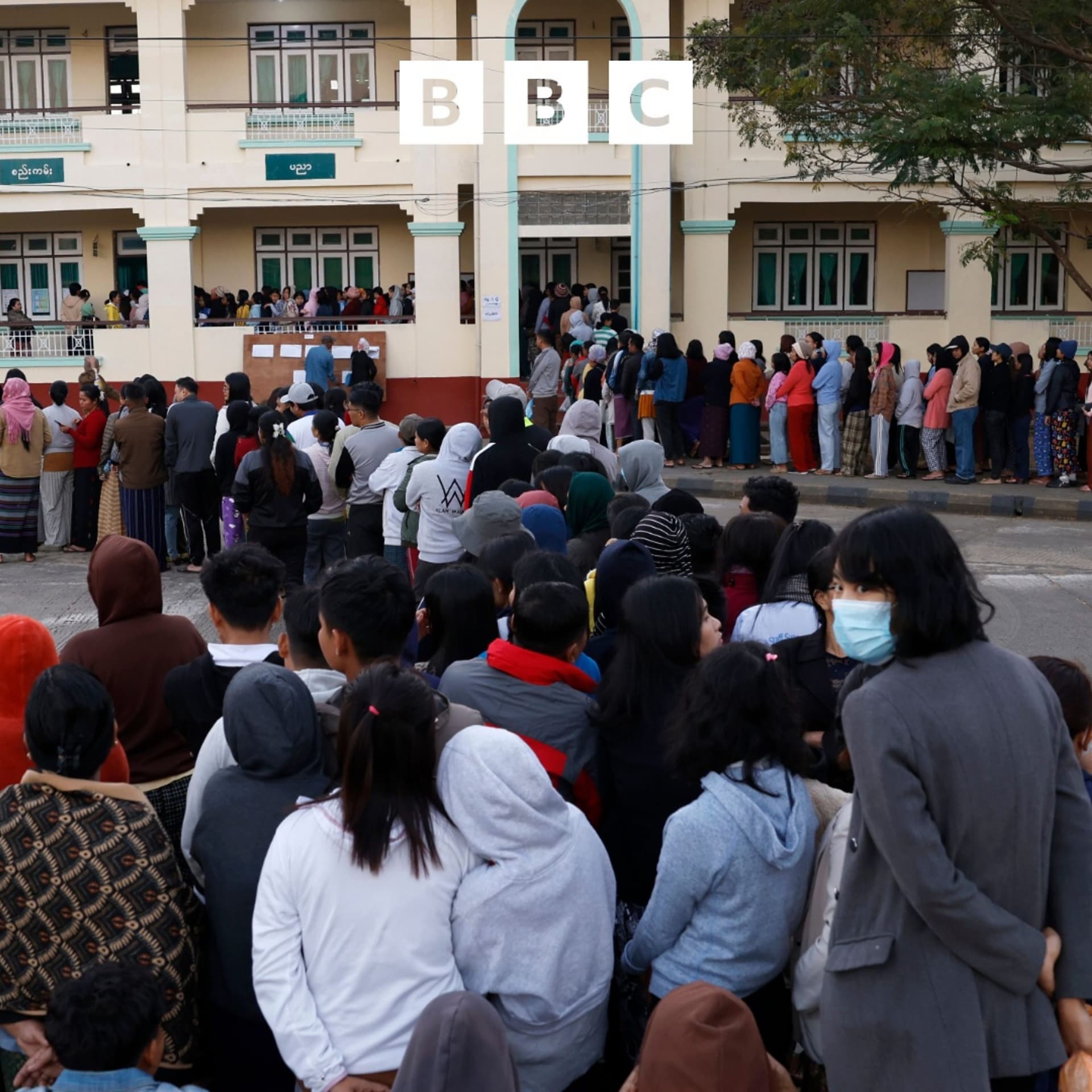
Global News Podcast
Myanmar's military stages controversial election
00:34:08
Polling is underway in the first vote in Myanmar since army seized power
Loading summary
Transcript97 lines
- [00:00]
Narrator/Host
This BBC podcast is supported by ads outside the uk.
- [00:06]
Advertiser/Commercial Voice
The following ad is sponsored by Pet's Best Insurance Services. You knew right away he's perfect. The one for you. Those puppy dog eyes, that cute little button nose. You don't even mind the drool. When you find your perfect match in a dog or cat, the love is unconditional. Your budget, on the other hand, has realistic limits. Help protect your heart and your wallet with pet insurance from Pets Best. With plans starting from less than a dollar a day, you can get up to 90% cash back on eligible vet bills. Pets Best makes it easy to pick a plan that works for you and your bank account. Find the perfect match for your Perfect match@petsbest.com Pet insurance products offered and administered by PetsBest Insurance Services LLC are underwritten by American Pet Insurance Company or Independent's American Insurance Company for terms and conditions visit www.petsbest.com. policy products are underwritten by American Pet Insurance Co. Independence American Insurance Company or Ms. Transverse Insurance Company and administered by Pets Best Insurance Services LLC. $1.00 a day premium based on DOL 2024 average new policyholder data for accident and illness plans. Pets age 0 to 10 looking for a fantasy that will keep you up all night? From Blood and Ash isn't just a story, it's the beginning of an obsession. From Blood and Ash launches you into a world where forbidden desire collides with deadly secrets and every choice could ignite a war. Expect heart pounding romance, fierce battles and a heroine who refuses to be caged. If you crave danger, passion and twists you'll never see coming, start the journey today. Grab from Blood and Ash, available in print and audiobook and enter a series you'll never want to leave.
- [01:39]
Alex Ritson (BBC Global News Presenter)
This is the Global News podcast from the BBC World Service. I'm Alex Ritson and in the early hours of Sunday 28th December, these are our main stories. Voting is underway in the election stage by Myanmar's military leaders amid a civil war and humanitarian crisis. The poll has been labelled a sham. President Zelensky is going to Florida for a crucial meeting with Donald Trump about the Russia Ukraine peace plan and China proposes stricter rules for human like AI systems. Also in this podcast, Hondurans in the US are sending home more money in remittances than ever before. We hear from people in both countries and tennis is set for another battle of the sexes.
- [02:28]
Charlie Eccleshare (Tennis Correspondent)
A lot of people think it's just going to sort of cause division and mirth. It's kind of lose lose for Sabalenka and therefore the kind of women's tennis movement.
- [02:37]
Alex Ritson (BBC Global News Presenter)
Is this the sequel no one asked for? The polls have opened for a general election in Myanmar, the first held in the country since the military seized power in a coup nearly five years ago. It's taking place despite the fact that the country is in the grip of a civil war and humanitarian crisis. The military government has been trying to inspire voters, but the elections have been widely slated as a char intended to rebrand the army's rule. There are 57 parties on the ballot, but most have links to the military that ousted the elected government of Aung San SUU Kyi, who's currently in jail. Our correspondent Jonathan Head spoke to me from a polling station.
- [03:20]
Jonathan Head (BBC Correspondent)
People are voting here. This is quite close to central Mandalay. In fact, it's a very big military base near here. There may be some connection to that. It's possible there are military families, but actually the crowd's pretty diverse, and this is a very diverse city. The numbers aren't huge there compared to previous elections here. The atmosphere is very, very different. It's very quiet. There's really no sign there's an election on when you're outside the polling station. In fact, people didn't even know where the polling stations were until yesterday. I think in this area, quite a lot of people will vote willingly, though some people we've managed to speak to. It's very difficult. People are very frightened when journalists talk to them. There is this dreadful law which effectively criminalizes any kind of negative comment about the election. So people don't know what they can and can't say what will get them sent to prison. Generally, people who just mumbled to us that they feel they have no choice, that they've got to vote. And I think a lot of people will not vote. And of course, the picture I'm seeing here in Mandalay is in many ways deceptive. This is a school. It's very orderly. It's very quiet and peaceful. The military has got electric voting machines for the first time ever. So it's quite a very smooth process. Inside, people are having to work out how to use those. But you only have to travel perhaps 30, 40 minutes from landing now to find villages that are actually controlled by armed rebels. Very, very tense situation there. We've been out close to one. Everyone is armed to the teeth. There are no elections happening there in this first round. There are three rounds of these elections because it's so difficult to hold them because of the civil war. Only perhaps a quarter of the country will be able to vote. Once all three rounds are completed, the general assessment is perhaps half the country will have taken part in the vote. I expect turnout will be low and you know, inevitably large numbers of large parts of the Myanmar population are going to quietly reject this election as illegitimate.
- [05:12]
Alex Ritson (BBC Global News Presenter)
Because there is little doubt about the likely outcome, is there?
- [05:16]
Jonathan Head (BBC Correspondent)
None at all. And you know, think of the irony here. The military's own party, the usdp, it's been around a long time when it had to compete against Aung San SUU Kyi's party. It was pretty much wiped out at the last re election five years ago it got only 6% of seats. Aung San Suu Kyi's party got more than 80%. This time around, the USDP is the only party with full institutional support of the military behind it. There are only five other parties contesting nationwide and they will not do anything like as well. We expect the USDP to get by far the largest bulk of seats in the parliament. So in many ways this is just applying a democratic facade to a military regime. I mean, as some people are saying, look, you do need to look at the small bright side here, which is this country has been trapped in a brutal five year stalemate that's killed perhaps 90,000 people. It's destroyed the economy at least. When they broaden the number of people involved in power, it might, might soften some characteristics of the military regime or bring some element of power, competition at the top. It's a small window of optimism I think for some people who, even some who are deeply opposed to the selection and to the military. Some of them will feel there is, you know, after five years, this is the only off ramp from this dreadful civil war. And perhaps people need to go with it.
- [06:32]
Alex Ritson (BBC Global News Presenter)
Even if the military think this will give them some democratic legitimacy, it's not going to, is it? Because everyone can see what's going on.
- [06:40]
Jonathan Head (BBC Correspondent)
It won't among all those who are opposed to the military. But where I think it will count is it will perhaps give a sense that there is some forward momentum to something else. Also internationally, China is fully backing this election. There's a wonderful irony here. China, which doesn't have elections or multiparty system, is actually giving technical assistance and advice on how to do it. Probably the first time China has done this. But China is worried about state collapse. The anarchy in Myanmar, the fragmented opposition groups is for China, which has a huge border with Myanmar, is so risky. China feels they've got to go ahead with election and support this regime. And I think other Asian countries will somehow reluctantly follow suit. So the military will at least be a little less internationally isolated once this poll is over.
- [07:25]
Alex Ritson (BBC Global News Presenter)
Jonathan Head Donald Trump will later meet Ukraine's President Zelensky in Florida following weeks of intense diplomacy. It began after the release of a 28 point plan which came out of negotiations between Washington and Moscow. Ahead of his talks with Mr. Trump, President Zelenskyy consulted with allies, briefly stopping off in Canada on Saturday to meet the Prime Minister, Mark Carney. At a news conference, President Zelenskyy said the latest Russian airstrikes on Kyiv demonstrated that Russia didn't want peace. This attack is again Russia's answer on our peace efforts. And it's really the showed that Putin doesn't want peace and we want peace and he the man of war, but.
- [08:11]
Advertiser/Commercial Voice
He afraid to speak about publicly. But we see these steps and what.
- [08:15]
Alex Ritson (BBC Global News Presenter)
We need, we need to stop this war. The meeting between the US And Ukrainian presidents is expected to discuss the most politically sensitive parts of a US Peace proposal that would ultimately be presented to Russia. Our correspondent in Washington, Sean Dilley, told us what we can expect from the meeting.
- [08:34]
Sean Dilley (Washington Correspondent)
The key areas that we would expect discussion on is the territory in the Donbas region of Ukraine that Russia would like for President Zelenskyy to hand over. That's not something obviously that has gone down well with President Zelenskyy. Instead, the two men are expected to talk about the possibility of a free economic area or a demilitarized zone where troops from Russia and Ukraine would pull out. But, but, but that's still an area that's going to be controversial with Russia because they've said that they were unhappy with some areas of the negotiations. They say it was unacceptable. And President Putin said just the day before the meeting that if there is not an agreement, then Russia would achieve its military ambitions with force if necessary. That's the one key area. But the other key area is what any security guarantee would look like. What happens if a peace agreement is made and then there would be any reneging technically on anyone's part.
- [09:31]
Alex Ritson (BBC Global News Presenter)
Would it be fair to say that the only way this meeting is going to achieve something is if President Trump comes out of it feeling like he's the winner?
- [09:40]
Sean Dilley (Washington Correspondent)
Do you know I'm going to engage directly on that? Because I don't think I actually know. I think part of the reality with President Trump is that he is very adept at negotiations. People can like him, they can loathe him. He's not going to enter into negotiations unless he thinks there's something in it. For the United States. He said in the past that what it is about is stopping war in Ukraine. But look, let's not forget President Trump can't speak for President Putin. What he might be able to do is to have a very, very good idea of any back channel discussions, any direct conversations with President Putin as to where a compromise can be met. Obviously, we know from President Zelenskyy being kicked out of the Oval Office earlier in the year after a high profile bust up with President Trump and J.D. vance, President Trump's Vice president, that President Trump would certainly want to feel that he's won. But ultimately there is an awful lot riding on this one. And President Trump, who speaks about having ended eight wars across the world, will be very keen to do anything that moves towards recognition for his peace efforts.
- [10:43]
Alex Ritson (BBC Global News Presenter)
Surely the underlying problem here is that essentially the position between President Zelenskyy and President Putin is irreconcilable to a degree.
- [10:53]
Sean Dilley (Washington Correspondent)
I mean, President Trump has spoken about his concerns that Ukraine's elections that would, in the normal run of things, have been held in May of 2024 haven't happened. So we're expecting President Trump to raise the issue of elections in Ukraine. That's something that President Zelenskyy says could happen within months if the security of that process could be guaranteed. But actually, one thing that Donald Trump would be very aware of, you only need to read his various writings on his negotiating tactics. It doesn't matter whether President Putin and President Zelensky like each other. What matters is is there a business deal effectively that could be done that could save lives?
- [11:36]
Alex Ritson (BBC Global News Presenter)
Sean Dilley as artificial intelligence becomes a part of our daily life, countries around the world are questioning how the technology should be regulated. China, which is known for controlling information using state propaganda and censorship, has issued DRAF draft rules to govern the use of human like AI systems. Our reporter Paul Moss spoke to Oliver Conway about the proposed changes, starting with just how important AI is in China.
- [12:05]
Paul Moss (Reporter)
It's huge. You know, I mean, first of all, the numbers. Last year, the number of Chinese people using AI doubled in just six months. It's now more than half a billion. But this isn't just about numbers. I think it's about the role that China thinks it could play with AI. If you could say that the modern tech era began with, you know, companies like Mike, Microsoft and Apple. Well, China's only role there was to provide a low cost labor force to make all the gizmos that these American companies were designing. They're hoping it will be different with AI that China can be a leader. Last year they caused quite a surprise when they launched Deep Seeker, their own AI platform, which they say was faster and cheaper to run than platforms like ChatGPT. And what they're hoping is that this will be the shape of things to come.
- [12:49]
Alex Ritson (BBC Global News Presenter)
Okay, so tell us about the rules that they're planning to introduce.
- [12:52]
Paul Moss (Reporter)
Well, the first kind of rule is to protect people who use AI. And they are things like saying the AI platforms mustn't promote self harm or suicide. They mustn't encourage gambling. They also say that AI platforms should detect if users are becoming addicted to talking to these human like platforms. And this is a phenomenon that has been noticed elsewhere. People are literally becoming addicted to it. It will be up to the companies themselves to detect whether this is happening and if necessary, cut users off to stop them becoming addicted to. But if the first type of rule announced on Saturday was about protecting users, I would say the second type of rule is about protecting the Chinese government. Because I think they're coming around to realize that AI is a double edged sword and could lead to them being criticized in ways they don't like. So one of the rules that's been announced is AI platforms mustn't do anything to undermine national security. Well, we know that can be defined very, very broadly indeed. It has been used in the past to crack down on the free speech. Similarly, the rules say that AI platforms must not spread false rumors. Well, who's going to judge what's false? The Chinese authorities? Once again, I think people who care about free speech, they're going to worry about that.
- [14:02]
Palab Ghosh (Science Correspondent)
Yeah.
- [14:03]
Alex Ritson (BBC Global News Presenter)
In the US the Trump administration has been reluctant to regulate AI. Why are the Chinese authorities doing this?
- [14:10]
Paul Moss (Reporter)
I think it's because, you know, AI is so unpredictable. I mean, you look at the Internet, when that arrived in China, obviously they needed to embrace it to be a modern tech savvy country. But they could easily censor it relatively easy. They could block web pages that mentioned, for example, the Tiananmen Square massacre or Xinjiang prisons. AI is far more difficult because the bots, the platforms generate stuff and they get material from a vast range of sources. So there's no reason why an AI platform might not start talking about how democracy is a great thing with multiple parties. Or perhaps it'll start saying that Taiwan's been a great success as a de facto country. So this I think is about the Chinese government thinking, well, okay, we do need this, but we've got to control it. That said, I think a lot of tech savvy people are going to say you want to start trying to control AI well, good luck with that one.
- [15:01]
Alex Ritson (BBC Global News Presenter)
Paul Moss. According to recent research, a mysterious force called dark energy, which drives the expansion of the universe, might be changing in a way that challenges our current understanding of time and space. Some scientists believe we may be on the verge of one of the biggest discoveries in astronomy for a generation. Here's our science correspondent, Palab Ghos.
- [15:27]
Palab Ghosh (Science Correspondent)
What we see here on Earth and in the stars and galaxies are made of atoms. They account for just 5% of the universe. The rest is mostly something called dark energy. But what is it now? It all started with a big Bang. The universe expanded, and astronomers believe that eventually this expansion would slow down under the force of gravity. Some believe that it would even collapse back in on itself in a big Crunch. Now, in 1998, they made a shocking discovery. Rather than slowing down, the stars and galaxies were actually accelerating away from each other faster than ever. A telescope in Arizona tracked the acceleration of 15 million galaxies. To learn more about dark energy, the astronomers involved, such as Professor Ofa Lehav of University College London, were shocked again by what they saw. It's a very weird scenario. The acceleration of the galaxies had changed over time, Something not in line with Einstein's theory, no less. Now, with this changing dark energy going up and then down again, we need a mechanism, right? We are in search of a mechanism which could be a shake up for the whole of physics. You know, maybe it connects quantum mechanics to gravity. So it's one of these things that you just never know. It may disappear or it may just get amplified and it'll be a whole new theory there. Since then, the Royal Astronomical Society has published research from a Korean team led by Professor Yong Wook Lee of Yonsei University that seems to back this astonishing finding. The fate of the universe will change.
- [17:16]
Narrator/Host
If darker is getting weakened in the future.
- [17:21]
Palab Ghosh (Science Correspondent)
And then this will change the whole.
- [17:23]
Advertiser/Commercial Voice
Paradigm of modern cosmology.
- [17:25]
Jonathan Slat (Wildlife Conservationist)
Established 27 years ago.
- [17:29]
Palab Ghosh (Science Correspondent)
No one really knows what dark energy is or why it might be changing, if indeed it is. But here are three ideas. Number one, phantom energy. Now, this is a force that increases as the universe expands to such an extent. The stars and galaxies get torn apart. This idea is called the Big Rip. Number two, quintessence, this is a gentler form of energy that also expands the universe, but doesn't result it being ripped up. And finally, number three, universal dark fluid, where there's a single substance that changes from dark matter. Invisible particles spread throughout the cosmos. And dark energy. But then it could be Something completely different, involving multiple universes.
- [18:17]
Advertiser/Commercial Voice
One of the ways that people think about resolving the puzzle is that there are many different universes.
- [18:26]
Palab Ghosh (Science Correspondent)
Professor Hiranya Perez is from the Institute of Astronomy at the University of Cambridge.
- [18:31]
Advertiser/Commercial Voice
In most of them, beings like us could not evolve to actually observe a universe because the universe accelerates so fast. There's no time for matter to clump together and make galaxies and make planets and then eventually have life arise.
- [18:48]
Palab Ghosh (Science Correspondent)
Hundreds of scientific papers have been published on the subject, and astronomers are split in what they think is the best explanation, which is no bad thing, according to Professor Robert Massey, who's the deputy director of the Royal Astronomical Society.
- [19:02]
Alex Ritson (BBC Global News Presenter)
Who doesn't want to understand how the.
- [19:04]
Charlie Eccleshare (Tennis Correspondent)
Universe is going to end and how it began.
- [19:05]
Jonathan Head (BBC Correspondent)
You know, it's one of those grand questions.
- [19:07]
Charlie Eccleshare (Tennis Correspondent)
And human beings have always been interested in that. Whether you take it from a kind.
- [19:11]
Jonathan Head (BBC Correspondent)
Of religious perspective and talking about creation.
- [19:13]
Sean Dilley (Washington Correspondent)
Myths and so on, or whether you.
- [19:14]
Alex Ritson (BBC Global News Presenter)
Talk about, about it from a scientific one.
- [19:16]
Jonathan Head (BBC Correspondent)
Having a feel, having an intuitive idea about how it will end, being able.
- [19:20]
Alex Ritson (BBC Global News Presenter)
To think, okay, this is how things.
- [19:21]
Charlie Eccleshare (Tennis Correspondent)
Will end in many, many, many billions.
- [19:24]
Sean Dilley (Washington Correspondent)
Of years in the future.
- [19:25]
Advertiser/Commercial Voice
Wouldn't that be extraordinary?
- [19:28]
Palab Ghosh (Science Correspondent)
So what next? The plan is to have larger telescopes, some in space, to look at dark energy in detail, to get to the bottom of what this mysterious force really is. The results could tell us not only how the universe will end, but but maybe a better idea of how it all began.
- [19:48]
Alex Ritson (BBC Global News Presenter)
Palau Ghosh still to come, a Siberian tiger stuns conservationists with her litter.
- [19:57]
Jonathan Slat (Wildlife Conservationist)
For a female Amur tiger or Siberian tiger to give birth to five cubs and have them survive as long as these five seem to have survived is pretty remarkable.
- [20:15]
Advertiser/Commercial Voice
Healthcare can feel complicated. That's why Optum uses technology to connect the people and processes that make healthcare easier, more affordable, and more effective. We're making it clearer for you to know exactly what your benefits cover and to help you better manage your health. We're coordinating care between your doctors and your technology. We believe better, simpler healthcare is. Is always possible. That's healthy optimism. That's Optum. Visit optum.com to learn more. Protect your pet with insurance from pets best plans start from less than a dollar a day. Visit petsbest.com Pet insurance products offered and administered by Pets Best Insurance Services, LLC are underwritten by American Pet Insurance Company or Independence American Insurance Company for terms and conditions, visit www.petsbest.com. policy products are underwritten by American Pet Insurance Company, Independence American Insurance Company or Ms. Transverse Insurance Company and administered by Pets Best Insurance Services LLC $1.00 a day premium based on 2024 average new policyholder data for accident and illness plans pets age 0 to 10 looking for a fantasy that will keep you up all night? From Blood and Ash isn't just a story, it's the beginning of an obsession. From Blood and Ash launches you into a world where forbidden desire collides with deadly secrets and every choice could ignite a war. Expect heart pounding romance, fierce battles and a heroine who refuses to be caged. If you crave danger, passion and twists you'll never see coming, start the journey today. Grab from Blood and as in print, ebook and audiobook and enter a series you'll never want to leave.
- [21:45]
Jonathan Head (BBC Correspondent)
AI agents are everywhere, automating tasks and making decisions at machine speed. But agents make mistakes. Just one rogue agent can do big damage before you even notice. Rubrik Agent Cloud is the only platform that helps you monitor agents, set guardrails and rewind mistakes so you can unleash agents, not risk. Accelerate your AI transformation at rubrik.com that's R U B R-I K.com.
- [22:19]
Alex Ritson (BBC Global News Presenter)
Many undocumented immigrants in the United States are from the Central American state of Honduras, and they're sending home more money in remittances than ever. During the first nine months of this year, they sent back in excess of $10 billion. That makes up an astonishing one quarter of the Honduran economy. But President Trump's harsher immigration policies mean many of these migrants are being rounded up. Others are being put off from attempting to get to the US in the first place. Our correspondent Will Grant sent this report from Hondiras.
- [22:55]
Narrator/Host
Donald Trump's relentless crackdown on undocumented immigration shows no sign of letting up. Chicago, Charlotte in North Carolina and communities in Minnesota, the latest focal points of raids by the immigration agency ICE authorities say scores of immigrants with criminal records were detained in each city, though ICE was met by protests. Yet even as their numbers dwindle in the US Honduran migrants have been sending more money home than ever. Between January and October this year, there was a 26% rise in remittances to Honduras compared to the same period the previous year.
- [23:37]
Jonathan Head (BBC Correspondent)
Hello. Hola.
- [23:40]
Narrator/Host
I spoke to one undocumented Honduran migrant who I'll call Marcos on the phone. From a major US City where he has lived for five years, working in construction, Marcos said he's currently sending home every spare dollar he has to his wife in Tegucigalpa while he lives on as little as possible in the U.S. this way, he reasons if he is picked up on the streets by ice, at least he'll return to a little money set aside. Marcos has gone from sending home around $500 a month to more like $300 a week, he explains, partly so his family will have funds if he he's held in a detention centre for months. Remittances remain key to honduras, worth around 25% of GDP, but the Trump administration has also begun to target those funds. The Treasury Department has issued an alert to money services businesses like Western Union and others, saying they must file a suspicious activity report for transactions that involve at least $2,000 and which they suspect involves the cross border transfer of funds derived from unlawful employment that could hit many migrants where it most hurts. Sending money home. In conjunction with the ICE raids at schools, churches and at places of work, the Trump administration's aim is to both remove people from U.S. soil and deter others from even trying to reach the US in the first place. In the case of Elias Padilla, it worked. An Uber driver in Tegucigalpa, he says he often makes as little as $12 a day. Elias had planned to make the journey north this year. Now, though, he says the images of his countrymen with their wrists in zip ties being dragged away has made him change his plans, at least for the time being.
- [25:43]
Advertiser/Commercial Voice
I wanted to go to improve my life conditions because here we earn very little in this line of work. For example, an Uber driver in the US is well paid. They make in an hour what I'd make in a day, also so I could send remittances home. But then I see what Trump is doing and it's made me think twice. It's taken away my desire to go.
- [26:01]
Narrator/Host
Elias had even saved funds for a people smuggler, a man like Jimmy, though that's not his real name. For two decades, Jimmy made a living out of taking people across Mexico, considered the most treacherous part of the trip to the U.S. he claims he's given up that life, But he explains President Trump's draconian immigration policies aren't just affecting the legal economy in Honduras via remittances, but the illegal economy. Too many coyotes or people smugglers, says Jimmy, are charging double as much as 25 to 30 thousand dollars per person. Whether it is migrants deported by ICE or self deporting, the Honduran government has a responsibility towards them when they return. The left wing administration of President Xiomara Castro launched a support program called Brother Sister Coming Home, involving some clothes, health checks and a small stipend. One thing is clear, the Trump administration's policies are undoubtedly having an impact in Honduras. And while it's partly in the form of more remittances, the economic boost may only be temporary.
- [27:17]
Alex Ritson (BBC Global News Presenter)
Will grant. Cameras in a national park in China located near the border with Russia have spotted something remarkable. A Siberian tiger family that includes five cubs. It's China's first documented case of a tiger having quintuplets in the wild and comes after careful conservation work to protect these endangered animals. It's thought the litter was born in June. Jonathan Slat is the regional director of the Wildlife Conservationist Society's Asia Program. He told Paul Henley more about the discovery.
- [27:52]
Jonathan Slat (Wildlife Conservationist)
For a female Amur tiger or Siberian tiger to give birth to five cubs and have them survive as long as these five seem to have survived is pretty remarkable. Usually a litter is two to three, sometimes four. And, you know, in order to first of all give birth to any cub, even one, a tigress has to be in incredible physical condition, right? She needs to be at the top of her game. There needs to be enough prey to feed her through the process of the pregnancy and then once, once cubs are born, to then not just feed herself, but also to feed these cubs. And so that there are five of these cubs pitter pattering around northeast China right now suggests that there's sufficient habitat for this family there and there's sufficient prey. Like she's able to actually catch enough deer or boar to feed this large family.
- [28:39]
Alex Ritson (BBC Global News Presenter)
Although given how much roaming territory an adult Siberian tiger needs to survive, the cubs are not out of the woods yet, are they?
- [28:48]
Jonathan Slat (Wildlife Conservationist)
Yeah, that's correct. So a female, like one photographed in the video from northeast China, she requires up to about 400 square kilometers of a home range in order to meet all her needs. And there's all kinds of threats to these cubs. There's brown bears in this area, there's other male tigers who might be interested in breeding this female. So they might come in and try to kill these cubs if they're not the father. And there's humans, right? There's roads, so there can be vehicle strikes.
- [29:14]
Sean Dilley (Washington Correspondent)
Tell us more about Siberian tigers.
- [29:16]
Alex Ritson (BBC Global News Presenter)
They're very rare, aren't they?
- [29:18]
Jonathan Slat (Wildlife Conservationist)
They are. And it's actually a pretty remarkable conservation success story. I mean, these tigers were almost extinct about 100 years ago. It's the only tiger subspecies that was able to show a positive population trajectory throughout the 19th century. So going from a low of just a couple dozen in Russia in about 1940 to a total population about 500, 550 today. And the story in China is even more remarkable. They were written off as basically extinct in about the year 2000. Some surveys have been done that found only about a dozen left, and now today there's thought to be between 70 and 80. So it's a really remarkable turnaround for these cats.
- [29:59]
Jonathan Head (BBC Correspondent)
And what is it about them that.
- [30:01]
Alex Ritson (BBC Global News Presenter)
So draws you to them to concentrate.
- [30:04]
Jonathan Head (BBC Correspondent)
On them for such a large amount.
- [30:05]
Alex Ritson (BBC Global News Presenter)
Of your professional life?
- [30:07]
Jonathan Slat (Wildlife Conservationist)
Well, tigers are considered what we call in conservation biology an umbrella species. So it's a species that garners attention, and if you're able to protect that one species, it protects many other things. Sort of like an umbrella protects a body from the rain. Again, because these animals have such large territories, I mentioned 400 square kilometers for a female. Males require up to 1,400 square kilometers. If you're protecting enough habitat for a functional population of Amur tigers, that means everything else in the whole landscape is essentially also being protected. So it's a really good species to focus on.
- [30:42]
Alex Ritson (BBC Global News Presenter)
Conservationist Jonathan Slat. A controversial tennis match is taking place later in Dubai. On one side of the net, Aryna Sabalenka, the women's world no.1 and current US Open champion. On the other, Australian Nick Kyrgios, a former Wimbledon finalist who's now ranked more than 650th in the world. The one off exhibition match has drawn criticism from some for belittling the women's game by putting the leading female tennis player of the day against a male player well past his prime. The match has been dubbed the battle of the sexes, but it's not the first time such an encounter has taken place. In 1973, when one of the greatest players of all time, Billie Jean King, took on a former men's Wimbledon champion called Bobby Riggs. King won the match. In an interview with the BBC afterwards, she described it as one of the most important wins of her career.
- [31:43]
Advertiser/Commercial Voice
The women who saw it have come up to me and empowered them and gave them self confidence. And the men come up to me and they go, they're the ones that are very emotional and sometimes they'll have tears in their eyes and they'll say, I was 12, 13, 20, 25. I have a daughter now and that absolutely changed my whole outlook on how I'm going to raise my children.
- [32:06]
Alex Ritson (BBC Global News Presenter)
Some of the rules have been changed to balance out the differences between the way men and women play the game. But Irina Sabalenka and Nick Kare have defended the encounter.
- [32:16]
Advertiser/Commercial Voice
Whoever wins, wins, and I think I'm not damaging this fight for equal prize money. And for bringing women's sport on another level. I think this event is going to only help to bring women's tennis on a high level because it's not going to be an easy match for him. And I'm just going to be there competing and showing that women are strong and powerful and actually very entertainment to watch.
- [32:39]
Jonathan Head (BBC Correspondent)
I think it's just amazing for the sport.
- [32:41]
Jonathan Slat (Wildlife Conservationist)
100% gets more eyes on it, and I think it probably will be one of the most watched sporting events this.
- [32:47]
Jonathan Head (BBC Correspondent)
Year, or if not in the last.
- [32:48]
Jonathan Slat (Wildlife Conservationist)
Probably decade, let's be honest.
- [32:50]
Jonathan Head (BBC Correspondent)
So I think this is something moving.
- [32:52]
Jonathan Slat (Wildlife Conservationist)
Forward that will be pretty special in.
- [32:53]
Jonathan Head (BBC Correspondent)
The sport of tennis, but also just in sport in general.
- [32:56]
Alex Ritson (BBC Global News Presenter)
My colleague Joe Pyke spoke with Charlie Eccleshare, tennis correspondent for the Athletic, who began by explaining some of those rule changes.
- [33:05]
Charlie Eccleshare (Tennis Correspondent)
Firstly, each player will only get one serve, so that's kind of designed to mitigate the fact that Kyrgios has a huge serve. So the idea is that that makes it a bit fairer, a bit more competitive. The other. Is that based on some science, apparently, and don't shoot the messenger here, male athletes cover ground about 9% quicker. The women ones, or that may be men and women in general. And so the court dimensions are slightly smaller. And so Kyrgios will be hitting into a court that's 9% smaller than the one Sabalenko will be hitting into. So they'll stay on the same side. They'll still have kind of change of ends and inverted commas where they sit down every couple of games. They won't actually be changing ends.
- [33:44]
Alex Ritson (BBC Global News Presenter)
And how have the tennis world reacted.
- [33:46]
Charlie Eccleshare (Tennis Correspondent)
To this since it was announced past? I'd say it's been divisive, might be generous. I mean, as Nick Kyrios said, it certainly generated a lot of talk and chatter, and I think a lot of people will watch it. But I think there's a sense that it's kind of lose, lose for Sabalenka and therefore the kind of women's tennis movement and women's movement in general. Because, you know, talking about the women's world number one playing against a guy who's been injured for most of the last three years, really ranked 671st. And if Sabalenka wins, then it's kind of like, well, okay, you beat a guy who's basically 700 in the world and hasn't played for years, or she loses and it's, oh my gosh, the world number one loss to this guy who barely plays and is so lowly ranked.
- [34:24]
Alex Ritson (BBC Global News Presenter)
So why is she doing it?
- [34:25]
Charlie Eccleshare (Tennis Correspondent)
Charlie well, I think, you know, she thinks it will be fun. She, you know, she said there, as you heard, that she thinks as well that it could help promote the women's cause by showing that they can compete and that they're entertaining, you know, and she spoke I've spoken to her before in a one on one interview about how how much equal prize money is important to her because that's not the case across the board in tennis. It is at the Grand Slam. But yeah, a lot of people think it's just going to sort of cause division and mirth. And the fact that Kyrgios has made a number of disparaging comments about female tennis players before or kind of female tennis makes people feel pretty uncomfortable.
- [35:02]
Alex Ritson (BBC Global News Presenter)
Charlie Eccleshare of the Athletic it's been described by Prime Minister Giorgia Meloni as Italy's demographic winter. The country's birth rate has been in decline for the past 16 years, despite efforts by Ms. Meloni's right wing government to reverse that trend. On on average, women give birth to just 1.13 children, far below the rate needed to keep the population stable. So perhaps it's no surprise that the birth of a baby girl in a small village in central Italy has become a symbol of hope, even attracting tourists. Carla Conti reports.
- [35:40]
Advertiser/Commercial Voice
There is a place in Italy where cats far outnumber people. Nestled in the mountains of the Abruzzo region, the ancient rural village of Pallara DEI Marsi and its inhabitants had not witnessed the birth of a child in almost 30 years. But everything changed in March of 2025 when a baby girl by the name of Lara Bussi Trabucco was born, becoming the town's 20th resident. Such is the novelty that the whole village turned out for Lara's christening and her mom, Cincia Trabuccio, says news of the birth has even drawn tourists. While baby Lara has brought hope, Italy's demographic crisis extends far beyond the confines of this ancient village. Istat, the national statistics agency, says births hit a record low in 2024 with just 370,000 recorded. Despite Giorgia Meloni's efforts to encourage childbirth and much talk of family friendly politics, her right wing government has been unable to stop what it has described as the country's demographic winter. Meloni's government has introduced cash incentives for parents, such as one off baby bonuses. But many Italians say the bigger barriers are structural insecure, high living costs, insufficient childcare, and young people moving abroad. In regions like Abruzzo the decline is already hollowing out services from nurseries to schools. So in Payara, Baby Lara is a celebration as well as a warning.
- [37:09]
Alex Ritson (BBC Global News Presenter)
Carla Conti and that's all from us for now. But there'll be a new edition of the Global News Podcast later. If you want to comment on this podcast or the topics covered in it, you can send us an email. The address is globalpodcastbc.co.uk. you can also find us on X@BBC World Service. Use the hashtag globalnewspod. This edition was mixed by Rosenwin Dorall. The editor is Karen Martin. I'm Alex Ritson. Until next time.
- [37:46]
Paul Moss (Reporter)
Goodbye.
- [37:55]
Jonathan Slat (Wildlife Conservationist)
Hey, Ryan Reynolds here wishing you a very happy half off holiday because right now Mint Mobile is offering you the gift of 50% off unlimited. To be clear, that's half price, not half the service. Mint is still premium unlimited wireless for a great price.
- [38:12]
Advertiser/Commercial Voice
So that means a half day.
- [38:14]
Palab Ghosh (Science Correspondent)
Yeah.
- [38:15]
Jonathan Slat (Wildlife Conservationist)
Give it a try@mintmobile.com save upfront payment.
- [38:19]
Advertiser/Commercial Voice
Of $45 for 3 month plan equivalent to $15 per month required new customer offer for first 3 months only. Speed flow after 35 gigabytes of network spizzy taxes and fees extra cmt mobile.com.