← Global News Podcast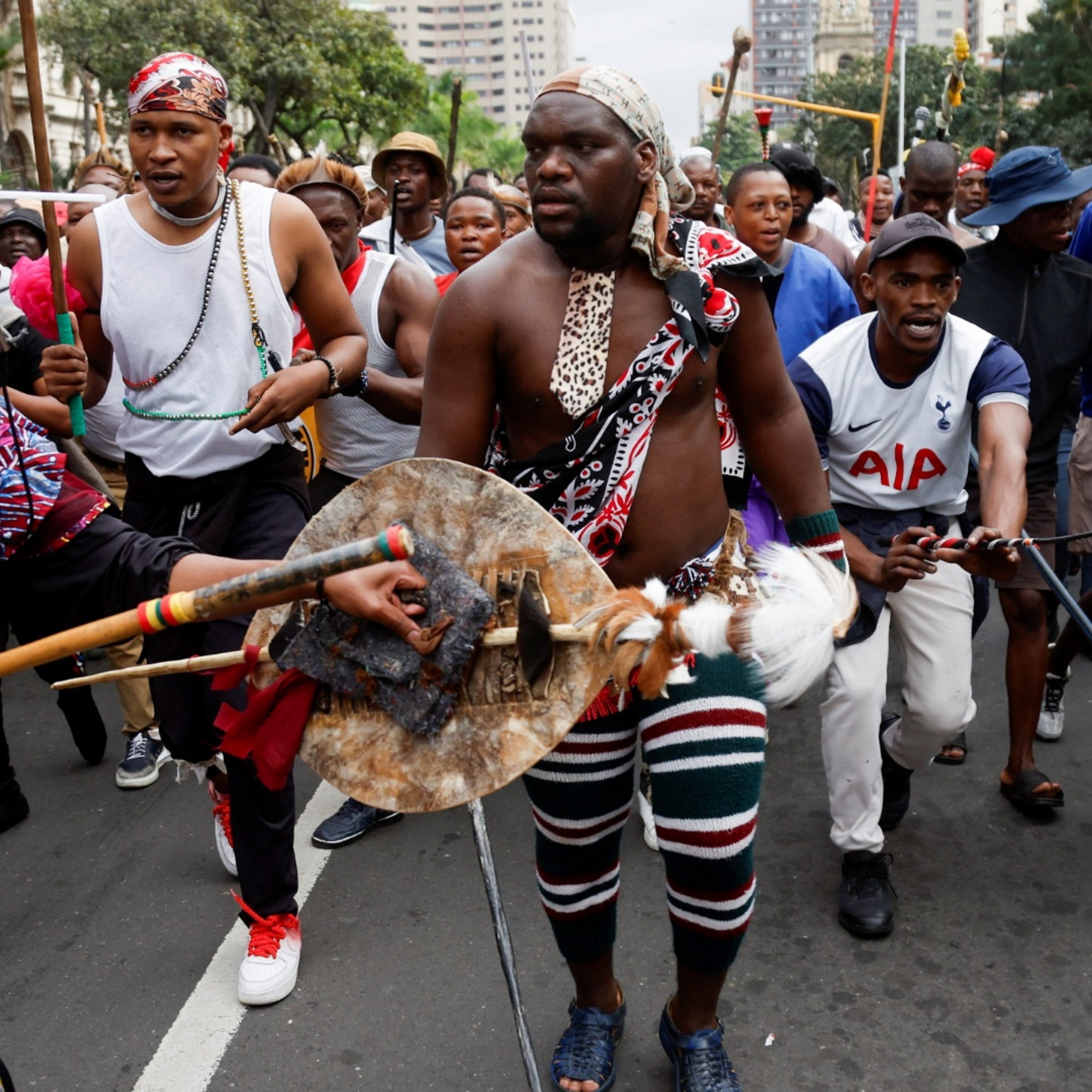
Global News Podcast
South Africans hold protests against migrants
00:28:34
Anti-immigration campaigners call for undocumented foreigners to leave the country
Loading summary
Transcript87 lines
- [00:00]
Paul Adams
This BBC podcast is supported by ads outside the uk.
- [00:06]
Advertisement Voice
Take the leash off your laptop with the processor that gives you long battery life. Work on the go. Jump between back to back calls. Stay locked in from brewing morning coffee to burning the midnight oil. Get maximum performance even when unplugged. Finally, the freedom to move across the room or across the world is here. Snapdragon. That's how if you are currently overpaying on software to run your business, remember this number 10,000. That's the number of new businesses that join ODOO per month. Join odoo today@odoo.com that's O D double O dot com.
- [00:50]
Celia Hatton
This is the global news podcast from the BBC World Service. I'm Celia Hatton and at 15 hours GMT on Tuesday 30th June. These are our main stories. Thousands of people march in cities across South Africa calling for undocumented migrants to leave the country. Angry in Venezuela as many accuse the government of abandoning them after last week's twin earthquakes. The Chinese tycoon sentenced to 30 years in a US prison. Also in this podcast, it will effectively
- [01:24]
Brad Chenko
try to grab hold of Swift in each of these arms and will use its onboard propulsion system to try to push it up to a higher orbit.
- [01:34]
Celia Hatton
NASA hurries to save a falling space telescope. It's been a tense day in South Africa. Extra security was deployed across the country as anti immigration protesters filled the streets in a number of cities. Participants are voicing their anger at the presence of undocumented migrants. The demonstrations have been happening on the day of an unofficial deadline set by anti immigration groups calling for migrants without proper papers to leave the country. Our first report comes from Nomsa Maseko, who was at the gathering of protesters in Durban.
- [02:11]
Nomsa Maseko
Thousands of police officers have been deployed countrywide, but there has been a concentration of maximum security here in Durban because the police believe that this is a possible hotspot where violence could erupt or that the protest itself can turn violent. We are now joined by Felim Duni Kumeta, who is one of the protest leaders. You have promised that this protest is going to be peaceful. He's basically told us that they believe that they have given strict instructions to the people who will be holding these protests here that they should not loot any shops, they should not attack anyone and that they can guarantee that there will not be any violence. But when it comes to the question that I asked him about the carrying of traditional weapons, he has dismissed that. He says that as a Zulu man, there is no way that A Zulu man can walk around the street without holding a stick. He also says that that stick does not. Carrying a stick does not mean that they will be using them to attack foreigners or anyone or even businesses, saying that it is just a symbol of who they are and that they will continue carrying those sticks.
- [03:38]
Celia Hatton
Some South Africans blame workers from outside the country for problems such as high unemployment, long waits at hospitals, and crime. Many migrants have already left the country or are preparing to leave. Correspondent Pumza Fulani spoke to us from one of the protests in Johannesburg.
- [03:55]
Pumza Fulani
So we've just moved to a safe distance so we can speak to. Just moments ago, we saw crowds moving through the city center. This seems to have been a breakaway crowd from the initial group that we'd been following this morning that left from the center of town and were meant to deliver a memorandum to police officials. We're seeing reports that they've broken away into various parts of the city. But the group that we were with, as they were walking down with the police trying to corral them, we saw people throwing stones into residential buildings through people's windows. We've also seen reports that some people were trying to get access into buildings, so police stepped in there to stop that from happening. It's a mixed crowd at the moment of people that one are still participating in what was agreed to the march, which was they were going to march, hand over a memorandum and to speak. But there seems to also be offshoot of people that are upset, feeling like this may not be enough, and wanting really to take things into their own hands. I spoke to a team of police officers who had been deployed in this area to ask them what the plan is. And he said to me that it's fluid at this point because this crowd seems to not be going by what was agreed. But what they're planning on doing is following people and boxing them in as much as possible so they can maintain a heavy presence and make sure that people don't run off into buildings.
- [05:14]
John Bennett
So, Pongsa, when you say you saw people throwing rocks, breaking windows in buildings, are these buildings where they think that they were undocumented migrants inside? I mean, why did they target these particular buildings?
- [05:27]
Pumza Fulani
Exactly. So just for context, the area that we are in is believed to be home to mostly foreign nationals. So whether they are documented or undocumented is a secondary issue for most people. But it's an area that's known to be a community that's usually home to people from various parts of the continent. So those incidents of throwing those rocks, some people were hurting. You need to go home. You need to go home. Inferring, which I can infer, refers to wanting people that they believe are non South Africans to leave the country.
- [05:55]
John Bennett
So protesters angry about, I guess, the pressure that they see undocumented migrants or migrants put on the services that are available to others in South Africa. Punza also, I can imagine they're worried about high unemployment, their crime rates, all sorts of things they cite. What do the actual statistics say about the broader picture?
- [06:18]
Pumza Fulani
Well, the statistics in this country are really broken down by nationality. In fact, they probably aren't broken down by nationality. What you will get is there will be, if they're looking at murder broadly, you will get the stats on what the murder rate in the country at a given time is. So a lot of the sentiment is one anecdotal, from people who say they live within communities where they see crime happening, but the police themselves, when they gather the information, don't release it by nationality. Simply you need to be following a specific case to get a sense of what's happening there. So really the sentiment that you see here in Yeovil and other parts of the country is from people saying they've seen firsthand illegal documentation happening and they've seen businesses running illegally that are not registered and because some of the people that own them should not be in the country.
- [07:07]
Celia Hatton
Pumza Fulani, who was speaking to Lucy Hawkins. Venezuela's interim president Delsey Rodriguez, has described last week's powerful twin earthquakes as the most brutal natural catastrophe in her country's history. That was on Sunday and on Monday. She commended the tireless work that's been done by rescue teams, adding that international help has now arrived from 30 countries. But those comments from Ms. Rodriguez have done little to calm growing anger against the government. Venezuelans say the authorities simply aren't doing enough to help. The official number of dead is now at more than 1,700, but many more people are still missing. The BBC's international correspondent Yogata Lemaye reports from La Guayra, a coastal city that's been hardest hit by the quakes.
- [07:59]
John Bennett
You can hear lots of sounds around me. There are two or three earth movers that are working simultaneously. One that is trying to dig through the rubble, another one that is trying to lift a concrete slab. I'm standing very close to the debris of a collapsed building. Rescue efforts here are ongoing with full intensity because just yesterday they were able to pull some people out of this rock. Trouble alive. Rescuers have turned towards the road, holding their hands up, screaming Silencio. Telling everyone to remain silent because they're waiting, they're trying to listen and see if they can hear any voices of any survivors from the debris. They've motioned to everyone and they've restarted work again. Just trying to dig through the rubble. Just by the collapsed building on the side of the street, I can see there are families who are gathered here, waiting for news of their loved ones. And of course, as the days go by, hopes of finding survivors are growing slim. We've just spoken to Miguel Oscar, whose 34 year old son, Miguel angel lived inside the building. I am here because my son is under the rubble.
- [09:19]
Celia Hatton
Like my son. There are hundreds of others trapped here. We need more support from authorities because
- [09:27]
John Bennett
what's being done just isn't enough.
- [09:30]
Celia Hatton
It's possible that the earthquake hasn't killed my son, but negligence will of not getting help in time.
- [09:40]
John Bennett
We've come to one of the hospitals in La Guayra and what we've been seeing at hospitals here as well as in Caracas are families who are searching for their loved ones who are missing. So they're going to see the list of those admitted. They're going to the morgue to see the list of those who've died. And we've met a mother here, a young mother, Belisabeth Herrera. She's looking for information about her two daughters, Grey Belisa and Grey Delice Phillips, 12 and 13 years old. She believes they were at home when the earthquake occurred, but she can't be sure. And what she's told us is there was absolutely no rescue operation at her building.
- [10:23]
Nomsa Maseko
They are all I have. I just want to find them at any cost. There were no machines or rescue sent. It's like you've been left on your own to search for your loved ones.
- [10:37]
John Bennett
We drove through streets and streets and streets where we saw destroyed houses and buildings on both sides. And now we've just come to one place where we've stopped. We can just see this giant mess of debris in front of us. Two tall apartment buildings stood here. Residents who live here say they were 16 stories high and they basically just continue collapsed into a pile of rubble. People are trying to clear the debris of their homes. They're wearing hard hats. These are not officials, these are not firemen, these are not rescue teams, just local people who are doing it with hammers, tools, in some cases with their bare hands. They estimate that hundreds of people possibly have been killed and their bodies are still under that debris. There are no official numbers, but we've been speaking to one man here, Juan Avendo, who's shown us video of how they managed to find One woman, a 36 year old woman, Hilary Rodriguez, and they were able to pull her out of the rubble themselves.
- [11:44]
Paul Adams
The first few days there was no help from the government. The desperation was overwhelming because we could hear people screaming and there wasn't enough support, either equipment or rescuers. If we've had both, maybe we could have saved more lives.
- [12:01]
John Bennett
When we speak to people here, they're telling us they're angry at their government because they feel like they've been left to their own devices to deal with the aftermath of this massive disaster. There are rescue teams arriving from different parts of the world, from lots of South American countries, from Mexico, from the US from the UK Other European countries, and from further afields like India. But it's just not enough. The next big challenge for this country is going to be how to dispose of all the dead and how to stop the outbreak of disease.
- [12:31]
Celia Hatton
Yogurt Lemaye reporting from the Venezuelan city of La Guayra. Let's focus on the US now, where a Chinese tycoon has been sentenced by a New York court to 30 years in prison. Guo Wengui has been found guilty of financial fraud. The businessman earned his money in China before moving to the United States a decade ago where he lived a lavish lifestyle. He also claimed to have become a democracy activist dedicated to bringing down China's communist government. So what did he do? Here's the newsroom's Mickey Bristow.
- [13:03]
Mickey Bristow
He was convicted of racketeering, money laundering and fraud. Essentially what he did is he took money from thousands of investors, often from the Chinese American community in America. Often he encouraged them to invest because of his supposed democracy activists there, many of those who were opposed to the Chinese government, he took their money. He said he was going to invest it and give them high returns. He didn't. It was used to fund a really lavish lifestyle. We're talking houses, a yacht. He liked expensive cars. He had a red Lamborghini, a white Rolls Royce. He had an apartment overlooking Central park in New York. He liked expensive furniture. This is what the money was used for ultimately. And eventually that caught up with him. In 2023, he was declared bankrupt. The following year he was prosecuted and now he's been sent to prison for a very long time. Those investors are not going to get their money back.
- [13:55]
Celia Hatton
So you' us through a lot of the details of his lifestyle. I mean, he was a very visible character, a very colorful character, wasn't he?
- [14:02]
Mickey Bristow
If this was A film script that probably rejected as too outlandish. He started life in Shandong Province, a village in China. Eight children. He doesn't seem to have done well at school. In fact, one of his teachers said he spent his time fighting, chasing girls and gambling. He left at 13, went to prison. But somehow it was the 1990s in China, the early part of the century that was a time of rocketing real estate deals. And he somehow made contacts in prison, got involved in that, made a ton of money, became incredibly one of China's richest men. And then as you indicated in the introduction there, he moved to the United States. He claimed he was fleeing persecution, but in actual fact, the Chinese authorities said essentially he was just a fraudulent businessman and they wanted him arrested and sent back home to stand trial. That's when he reinvented himself a little bit as a democracy activist. He was on YouTube all the time and that's how he interacted all these small time investors. He even aligned himself with the right in America. Steve Bannon, ex associate of President Trump, launched a media company with him. So that's how he able to present himself as a very plausible character.
- [15:12]
Celia Hatton
And he also presented himself as somebody who had political connections right in China. He said he knew what he was talking about.
- [15:18]
Mickey Bristow
He did. And even people like myself who often follow Chinese politics, he seemed quite plausible. He was handsome, wore good suits, seemed to be well connected. And everyone seemed to take into account what he was saying himself, that he'd been associated with the spy service in China. So a really colorful character where who presented a plausible face until he was brought down.
- [15:38]
Celia Hatton
Mickey Bristow, some space news for you now. NASA is preparing to launch a robotic spacecraft to save an aging space telescope from falling back to Earth. The telescope, known as the Swift Observatory, needs to get into a higher orbit where it can continue its search for some of the biggest explosions in the universe. NASA had planned the launch for Tuesday, but because of weather conditions, it's now been rescheduled for Wednesday. Brad Chenko is a NASA astrophysicist with the Swift Observatory. He's been speaking to Amalrajan about the project.
- [16:12]
Brad Chenko
Swift is in a low Earth orbit. It's currently at an altitude of about 360 km, and because of drag forces with the atmosphere, that altitude is decreasing over time. And if we don't do anything, it will actually reenter the Earth's atmosphere and burn up probably later this year. So NASA looked at this about a year ago and decided that this was a great opportunity to develop really important capability for the commercial space sector and enable all the great science that Swift does. So they hired a company from Arizona called Catalyst Space Technologies to build a new satellite to launch it to try to grab hold of Swift and push it up to a higher orbit where it continue can continue doing its science for another 10 years or more.
- [17:02]
Advertisement Voice
And this robot has kind of, as
- [17:04]
Celia Hatton
I'm just reading about, it has three robotic arms. It's kind of like a giant lobster
- [17:09]
Advertisement Voice
claw giving a kind of helping hand up in space to Swift.
- [17:13]
Brad Chenko
That's exactly right. So that's three robotic arms, two that come off of two of its sides and one from the top of the spacecraft. At the end of each of these arms are a robotic gripper. And so it will effectively try to grab hold of Swift with the insurer like grab in each of these arms. And once it's done that, it will use its onboard propulsion system to try to push it up to a higher orbit.
- [17:38]
Advertisement Voice
What do you know about whether or not what Swift's fate will be whether
- [17:42]
Paraguay Fan
or not this is successful?
- [17:44]
Brad Chenko
So ultimately, even if it is successful, Swift is going to reenter Earth's atmosphere. The large majority of it will burn up. When it does that. The question is just when you know it's still an extremely valuable scientific satellite conducting really important investigations for astronomers all around the world. And so we would really love if we could continue using it for an extended period of time.
- [18:10]
Celia Hatton
Bradchenko is a NASA astrophysicist with the Swift Observatory. Still to come. In this podcast, I feel very emotional
- [18:20]
John Bennett
and I feel very crazy because Far away will.
- [18:23]
Mickey Bristow
Let's go.
- [18:24]
Nomsa Maseko
Let's go.
- [18:24]
Paraguay Fan's Dad
Far away.
- [18:25]
Celia Hatton
Frustration for some and happy tears for others. At the Men's World cup,
- [18:35]
Advertisement Voice
Take the leash off your laptop with the processor that gives you long battery life. Work on the go. Jump between back to back calls. Stay locked in from brewing morning coffee to burning the midnight oil. Get maximum performance even when unplugged. Finally, the freedom to move across the room or across the world is here. Snapdragon.
- [19:00]
Celia Hatton
That's how when you're a maintenance engineer in a beverage manufacturing plant, you keep production lines moving and quality on track because there is no room for slowdowns. With Grangers vast selection of high quality motors, sensors, belts and hard to find parts, you can get what you need fast and all in one place so nothing gets in the way of getting the job done. Call 1-800-GRAINGER click granger.com or just stop by Grainger for the ones who get it done.
- [19:32]
Grainger Advertisement Voice
Grainger knows when you're a procurement manager for an office park, you're not managing one building, you're managing all of them. And to stay ahead, you need to see through walls and around corners. Lights about to fail. Filters ready to clog H Vac on its last leg. If you wait until something breaks, you're already behind. Count on Grainger for quality products, easy reordering and 24. 7 support. Call 1-800-GRAINGER, click grainger.com or just stop by Grainger for the ones who get it done. Grainger knows when you're a procurement manager for an office park, you're not managing one building, you're managing all of them. And to stay ahead, you need to see through walls and around corners. Lights about to fail. Filters ready to clog H Vac on its last leg. If you wait until something breaks, you're already behind. Count on Grainger for quality products, easy reordering and 24. 7 support. Call 1-800-GRAINGER, click grainger.com or just stop by Grainger for the ones who get it
- [20:33]
Pumza Fulani
Foreign
- [20:37]
Celia Hatton
this is the global news podcast the British Prime Minister Keir Starmer has announced billions of dollars of extra defense spending over the next few years to upgrade the country's military. That means that by 2029 the UK is expected to have an annual defense budget of more than $100 billion. The Prime Minister said the additional funding would be spent on new technology such as drones and autonomous weapons, and to create what he called a hybrid naval force, which would use uncrewed vessels.
- [21:06]
Paul Adams
We want our people to be able to live in a world defined by peace, stability and the rule of law. But the paradox of peace is that when the world is arming and aggression is rising, the best way to avoid war is to prepare for it. The best way to defend is to determine to have the strength to make your adversaries think again before they act.
- [21:33]
Celia Hatton
President Trump has long called for NATO countries to increase their military budgets, but it's his reluctance to fully back Ukraine after the full scale invasion by Russia that's convinced many European nations that they need to be better prepared to defend themselves. Is this why the British government is taking action? Our diplomatic correspondent is Paul Adams.
- [21:54]
Paul Adams
I think this is a recognition, Celia, that governments all over Europe have been coming to in the wake of Russia's full scale invasion of Ukraine. Other Eastern European governments have been rather quicker and have approached this with a great deal of urgency. You look at Poland, you look at the Baltic republics and Germany, which has recently enormously expanded its military spending, there is a feeling that the UK and its allies need to be ready to confront a possible conflict in Europe within the next five to 10 years. And that even without that, without the prospect of an actual sort of land war against Russia, we're already deep into a kind of hybrid conflict. You look at activity out at sea, you look at Russian vessels hovering over vital undersea cables, you look at assorted sabotage operations mounted in various European countries. There is a sense that we are in a state of elevated danger and that this comes at a time when, as the Prime Minister is fond of reminding people, the armed forces have been hollowed out for decades. And so there is a really urgent sense that the money spent on defence needs to in some way try and keep up with the elevated threat. The problem is that the government is unwilling or unable to raise the amount of money that many experts and people who were responsible for drawing up the government's own plans last year have recommended by the tune of billions and billions of pounds. So we've had a lot of criticism of this in the weeks coming up to this moment. We've had two defence ministers resigning over this issue. And I don't think any of the criticisms are going to go away. I should point out that we have yet to see the details, the precise details of a document which is thought to be 80 pages long and will be quite a complicated piece of work.
- [23:44]
Celia Hatton
Paul Adams. And we have more from Paul on our YouTube channel. Search for BBC News on YouTube and you'll find the Global News podcast in the podcast section. There's a new story available every weekday. Police in southern France are searching for a man who planted a parcel bomb in Monaco, severely injuring a wealthy Ukrainian businessman. He's in hospital along with his wife and son. A prosecutors say the attack is not being linked to terrorism. Hugh Schofield spoke to us from Paris.
- [24:13]
Hugh Schofield
The police aren't releasing the name of the target, but it's common knowledge it's a man called Vadim Yermalayev, who is Ukrainian born, multimillionaire, an oligarch, we call him, though I'm not quite sure what that means, but certainly a very, very rich Ukrainian who's living in exile on the Cote d'. Azur. What happened was that last night, about 9 o', clock, a man wearing a sort of floppy hat because he's seen on CCTV deposits a parcel of some kind in the entrance to this plush apartment building in Monaco, Monaco, this tiny little city state which sort of merges into France at a border which isn't really defined. He leaves this parcel. A few minutes later, Jomolaev and his wife and 13 year old son emerge from their apartment on the ground floor. Then there is an explosion and the three of them are injured very seriously. Yimalayev and his wife taken to hospital with life threatening injuries of the sudden. Less so we learn today that Yimolaev himself is out of danger, but his wife not. They're in Nice to where they were evacuated. Meanwhile, CCTV footage shows this man in a hat running from the scene into France, which is just a few yards away. And there the manhunter is underway. Now we know that CCTV footage in Monaco is very, very prevalent. I mean there are CCTV cameras everywhere. So the authorities will probably have a lot of video to go on to try and in the moments leading up to it and after it to find out where he is. But for the moment we have no news about what leads they're following.
- [25:51]
Celia Hatton
Hugh Schofield. And let's end with the latest from the Men's Football World Cup. And a humbling night for two heavyweights of European. Two time World cup finalists the Netherlands and four time winners Germany are both heading home. The Dutch lost to Morocco on penalties. But the biggest shock so far of this tournament has to be Paraguay beating Germany also won penalties to make it to the last 16. Our correspondent John Bennett was watching the action.
- [26:19]
Paraguay Fan
What a night we had over at the Foxborough Stadium, about 45 minutes away from where I am now on the banks of the Charles river for the third World cup in a row. Germany going home before the last 16 stage. Brilliant performance by Paraguay who took the lead. Julio Enciso heading in. Then Kai Havertz equalized for Germany. We went to extra time. Germany thought they'd won it. They had a goal controversially ruled out for a foul on the goalkeeper after a var check. So it went to penalties twice. Paraguay wasted chances to win the shootout. Then eventually they did. Jose Canale, the hero, he secured an historic victory for the South Americans. Have a listen to the Paraguay fans who I spoke to after the game.
- [27:04]
John Bennett
I feel very emotional, I feel very crazy because Paraguay win. So let's go.
- [27:10]
Nomsa Maseko
Let's go.
- [27:10]
Paraguay Fan's Dad
Paraguay.
- [27:11]
Paraguay Fan
It means everything to our country.
- [27:12]
Paul Adams
Yeah.
- [27:13]
Paraguay Fan
Describe what it means to you to beat Germany the World Cup. I mean, you could just see how they were playing. They weren't. Germany wasn't playing their best. And you get one goal early, then all you got to do is sit back, maintain, and then it goes to penalties. Anything can happen. Did you believe, did you always believe in that penalty shootout when they missed two, I was nervous at the end there. I believe in the beginning I thought
- [27:31]
Celia Hatton
our goalie had it. And I. I said, this is a great goalie.
- [27:34]
John Bennett
And he, he did it.
- [27:35]
Celia Hatton
He came through.
- [27:36]
Paraguay Fan
Yep. He was able to hold it down for us. What would this mean to the country back home? I know you, you fans here are excited, but what about Paraguay?
- [27:43]
Celia Hatton
I mean, Paraguay on the world stage, right?
- [27:45]
John Bennett
Come on.
- [27:46]
Pumza Fulani
Yeah, upset.
- [27:47]
Paraguay Fan
It means everything. No one saw it coming.
- [27:49]
John Bennett
Yeah.
- [27:50]
Paraguay Fan
And this really shows. Anything can happen. Anything can happen. It's the World Cup. Anything can happen.
- [27:54]
Paraguay Fan's Dad
Emotional. Emotional. I mean, how can one not feel emotional after the performance that someone just had there? I think it's incredible. You know, one has to feel, you know, that anyone can dream of doing this. Of a small country, of south, of 7 million people in the heart of South America to do what they did 16 years from their last World cup appearance after losing 41 on the opening day. And everyone thought this team was never going to do anything. Now people can dream of, like, hey, we can do it. You guys could do as well to
- [28:17]
Paraguay Fan
beat the giants of Germany. You're in tears. You're in tears, are you? Describe what it was like around here. Your family, your friends?
- [28:23]
Paraguay Fan's Dad
No, I'm here with my dad over here. It's my first World cup game. You know, I never had the chance to go to one. And the fact that I can finally join here, it's a dream come true. And hopefully we can go for more. You know, this isn't the end. We will want to keep going. Ground of 16 quarter final semifinal. Who knows? Final champion. Why not? Why not us?
- [28:38]
Paraguay Fan
You're here with your dad. Is this one of the best days of your life you've had together?
- [28:41]
Paraguay Fan's Dad
100%. It's up there for sure. The beautiful thing is it can get even better. That's the great thing about this sport and the great thing about supporting a country like Paris. Vamos. Let's go. Was a great match. Paraguay really came strong. I mean, we were very confident of our team. We knew that Germany was. Was going to be very tough. It was. But Paraguay, you know, did a great match. Actually. We believe that Paraguay is for great things. And we're just waiting for France because it's going to be 98 revenge. And we never forget the golden goal para far away. Far away.
- [29:19]
Paraguay Fan
The game he's referring to there is from the World cup in 1998 when France beat Paraguay one nil thanks to a golden goal from Laurent Blanc. He's got a long memory. He might get revenge because Paraguay will play France or Sweden in the next round. That will be on the fourth of July in Philadelphia. So what about Germany then? Their fans absolutely distraught after that defeat. Here are a couple of Germany supporters that I spoke to outside the Boston Stadium.
- [29:46]
Celia Hatton
Disappointed, but the tournament was not really good. I think today we were a little bit unlucky with the referee's decision, but after all, yeah, we're not a good team anymore. We do not belong to the top of the European teams. And so it's well deserved.
- [30:03]
Paraguay Fan
Well, that's a big thing to say, isn't it? That you're not a big team anymore. Would you agree? It's three World Cups now, isn't it? Out before the last 16.
- [30:10]
Paraguay Fan's Dad
Yeah.
- [30:11]
Celia Hatton
I mean, players like Musiala and Wirt, they are.
- [30:15]
Paraguay Fan's Dad
When they play at top level, we
- [30:17]
John Bennett
could have a good chance. But currently they do not play at the top level.
- [30:20]
Paraguay Fan
So that is why it's deserved. It's astonishing to think that Germany haven't been to the last 16 of a World cup now since 2014. The wait goes on. 12 years and counting. The head coach, by the way, Ian Nagelsmann, has insisted he won't be resigning. He says he will continue if the German Football Federation wants him to continue. But it's all about Paraguay. What a win, what an upset their World cup goes on.
- [30:47]
Celia Hatton
That was John Bennett reporting on Paraguay's shock win over Germany. And that's all from us for now. If you want to get in touch, you can email us@global podcastbc.co.uk you can also find us on X@BBC World Service. Use the hashtag Global Newspod. And don't forget our sister podcast, the Global Story, which goes in depth and beyond the headlines on one big story. This edition of the Global News Podcast was mixed by Kai Perry. The editor is Karen Martin. I'm Celia Hatton. Until next time.
- [31:19]
John Bennett
Goodbye.
- [31:27]
Advertisement Voice
Take the leash off your laptop with the processor that gives you long battery life. Work on the go. Jump between back to back calls. Stay locked in from brewing morning coffee to burning the midnight oil. Get maximum performance even when unplugged. Finally, the freedom to move across the room or across the world is here. Snapdragon. That's how.