Loading summary
Transcript79 lines
- [00:00]
Alex Ritson
This BBC podcast is supported by ads outside the uk.
- [00:06]
Bethenny Frankel
Bethenny Frankel here from Just be with Bethenny Frankel and I am just going to say it. The drinks aisle needs an intervention. Bottles, cans, all promising health and wellness, but after a glug you just shrug. Then there's Synergy Kombucha Real Kombucha Synergy supports mind and body through your gut with 9 billion probiotics. Yep, 9 billion probiotics. Can you even count that high in flavors you will love? No hype, just quality, taste and real benefits. That's Kombucha made the right way. Don't chase fads. Choose standards DM at Synergy Kombucha on Instagram with the code thereal Kombucha to get a free bottle while supplies last. Synergy the Kombucha with standards
- [00:51]
Lowe's Advertiser
Introducing Home Care Plus, a new subscription service from Lowe's that helps make life easier by giving members a hand with home maintenance. Let Lowe's tackle the tasks you keep mean to do, like electric dryer, vent cleaning, replacing hard to reach light bulbs and more. Subscribe to Home Care plus for just $99 a year and consider your to do list done. Members get more at Lowe's. Available on select zip codes only. Cancel anytime. Non refundable fee. Product purchase required. Terms and service restrictions apply. Details@lowe's.com Terms subject to change
- [01:22]
Alex Ritson
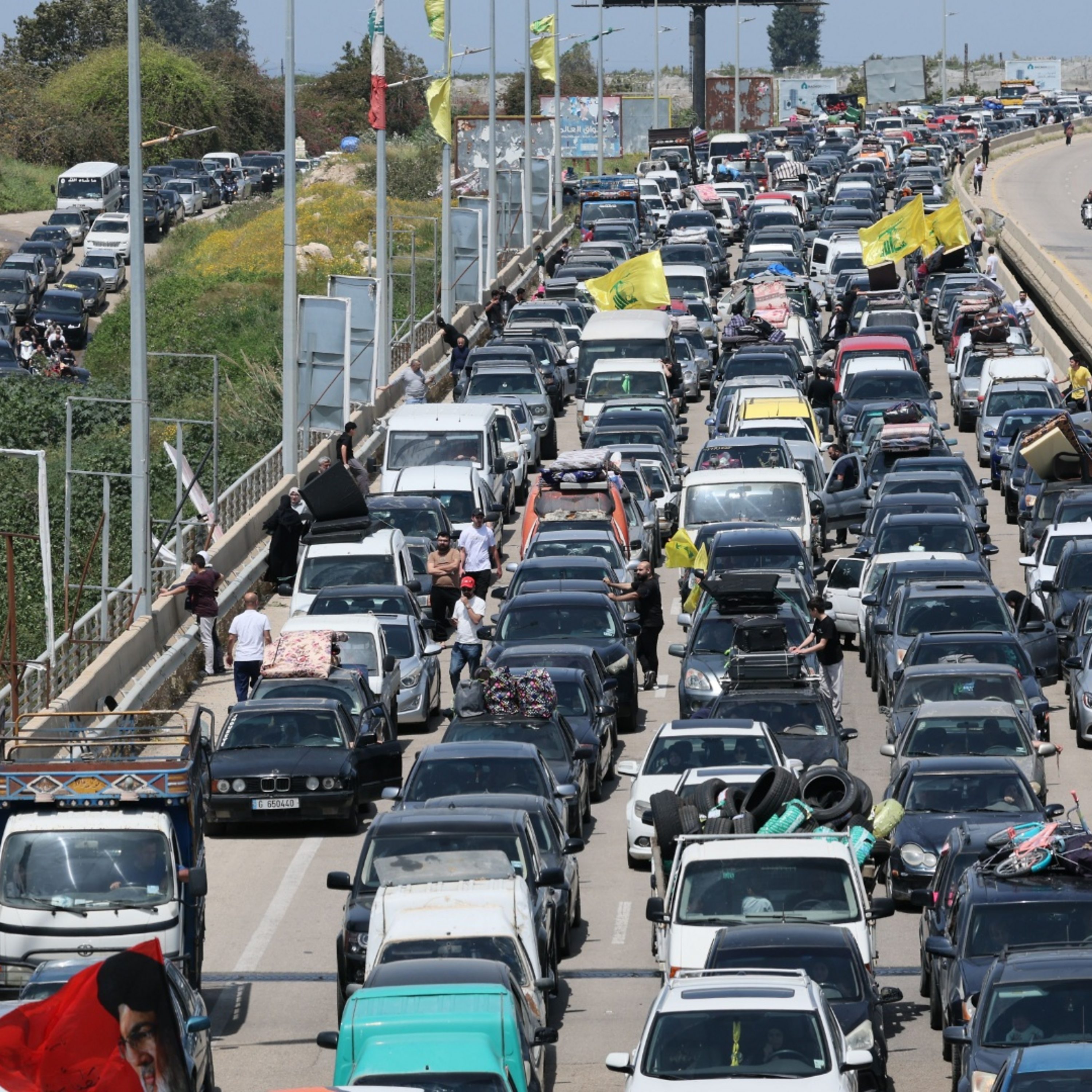
this is the Global News podcast from the BBC World Service. I'm Alex Ritson and at 16 hours GMT on Friday the 17 on the 19th of April, these are our main stories. As a fragile ceasefire in southern Lebanon seems to be holding, the people who fled the fighting between Israel and Hezbollah start returning home. But is it safe? Meanwhile, Lys Doucet meets people in Tehran whose neighborhood has been shattered by the bombing there and the threat posed to the global financial system by artificial intelligence. Also in this podcast, the Pope holds an open air mass for hundreds of thousands of people in the city of Douala in Cameroon and some skepticism of Harry and Meghan in Australia.
- [02:09]
Simon Atkinson
There was an article in one of the papers that accused them of using Australia as an ATM as a cash machine.
- [02:19]
Alex Ritson
A 10 day ceasefire is now in place between Israel and Lebanon following talks between the two in Washington. But the success or not of the truce will depend to a large extent on Hezbollah, the Lebanon based militant group backed by Iran that's been attacking isra. It's already said it has its finger on the trigger in case Israel violates the ceasefire. Just hours into the truce, tens of thousands of People started returning to their homes in southern Lebanon, even though Israel says they could be evacuated again if the fighting resumes.
- [02:53]
Resident/Interviewee
What matters is that we're returning to our village, our hometown, our land. We will not leave our land, no matter what. I don't know if my house is destroyed or not, what happened to it. If it's destroyed, it changes nothing. I will pitch a tent in front front of it and stay there.
- [03:11]
Faisal Islam
It's what everyone wishes for. This is the land where I was born and we want to return at any moment. I left at 8pm and waited in Sidon for four hours until the road opened. Even if it had taken a day or two. The most important thing is that I'm returning.
- [03:26]
Alex Ritson
Our correspondent in Lebanon, Karine Taube, has just arrived in a town in the south of the country.
- [03:32]
Karine Taube
At the moment, I'm standing in Nabatiye. This was a very vibrant city in the south. It's a city famous for its landmarks, but mostly for its big market. This market now has big areas that are completely flattened. All we could see is a very large pile of destruction and rubble. And this scene is pretty much similar to many scenes we've seen across the road. As we moved into the south of Lebanon, we also saw lots of people coming back, returning. Some of them are in trucks that were carrying their belongings and they were making their way back. They know that this could be a very fragile ceasefire, that this is just a 10 day halt in the bombardment.
- [04:26]
Alex Ritson
Yes, Corinne, we can hear a noise behind you, that it sounds like gunfire. What's going on?
- [04:31]
Karine Taube
We don't really know at the moment what's happening, but we have been hearing sporadic kind of gunshots and we don't really understand, and this is probably part of the picture of how fragile the situation is, how super cautious everyone is still, as they come back to see whether this is a place they would be able to live in again. Because we also went to areas that are very close to the border and that at the moment the army is blocking the way to these areas as Israeli soldiers are still occupying parts of it. And those areas remain off limits to the residents. We saw lots of people gathering around the checkpoints or the barriers that were set up by the Lebanese army. One of them told me that his house was just meters away, few meters away, but he couldn't see it. He couldn't really know whether the house was still standing.
- [05:26]
Alex Ritson
Corinne, how is the ceasefire holding up at the moment and is Hezbollah going to abide by it?
- [05:31]
Karine Taube
We're still in the very first hours of the implementation of the ceasefire so far, it seems extremely fragile, but it is holding. We understand also that there is a very different perception of what this ceasefire entails for Hezbollah. It says that basically having areas of Lebanon still under occupation, this gives the people, as it says, the right to resist occupation. So this might, might suggest that there might still be military operations against Israeli soldiers in Lebanon. It also said that it is not happy with what the Israelis are claiming, that the ceasefire fire give them freedom of movement in Lebanon if they perceive any threat from Hezbollah. And Hezbollah said that if there is any targeting of its members, it will also not abide by the ceasefire. So basically, we're here in a very fragile situation. We don't really understand whether there is a common understanding of what's coming next. And everyone is waiting cautiously every hour as it goes by to see if we are just in front of a very fragile halt in hostilities.
- [06:49]
Alex Ritson
Karine Taubay so that's the view from Lebanon. What about Israelis a few hours in, how do they view the ceasefire? Yolande Nell is our correspondent in Jerusalem.
- [07:00]
Resident/Interviewee
This is something that's filling the Israeli media, lots of analysis of it. And there's criticism of the Israeli Prime Minister, Benjamin Netanyahu, particularly from residents of northern Israel, some cabinet members, indicating that they only heard about this ceasefire from President Trump himself from his announcement. We did have the Israeli Prime Minister, Benjamin Netanyahu, putting out a video message last night where he talked about how Israeli forces were going to remain on the ground in southern Lebanon. That's where they've been occupying this wide area. It says it's the creating a security zone there to protect the citizens of northern Israel who endured rocket fire over these past six weeks, including right up just two minutes before the midnight deadline when this ceasefire came into force. And in his message, the Israeli prime minister was saying, that's where we are. We're not leaving so deep inside Lebanese territory. Residents of the north, though, really believe this is some kind of a betrayal from the government. That's what local mayors there have been saying, and they're very disappointed about this ceasefire. They believe that it will not lead to sort of conclusive action against Hezbollah and that the failure in the past to take conclusive action is what has led to these rounds of renewed fighting over the years.
- [08:18]
Alex Ritson
Yoland Nell in Jerusalem to Iran now, where there's less than a week to go until another ceasefire between Iran and the US Expires. The big question for Iranian people is will the bombing resume? The BBC's chief international correspondent, Lis Doucet has made it to the Iranian capital, Tehran. She's seen some of the damage already caused by the Americans and Israelis. Lis is reporting from Iran on the condition that none of her material is used on the BBC's Persian service.
- [08:54]
Lyse Doucet
We've come to this one narrow street in this leafy, seems to be largely residential neighborhood in the heart of Tehran. And in front of us, a huge gaping hole. Whatever stood here before is completely gone. There's just heaps of concrete and twisted metal. And you can hear excavator at work tearing away the rubble of this building. Now, there's obviously sensitivity around these sites. We've had to wait more than an hour as security people kept coming up to us asking whether we had permissions to work. Now that we do, let's try to find out what was here before and what happened that day. There's on the other side of the street. The facades have all been blown out by the impact of these attacks. And one man opening this door.
- [09:49]
Mehran
My name is Mehran.
- [09:50]
Lyse Doucet
And this is your house? What's left of it, yeah. Mehran is just showing us what's left of his home here. Why do you think they attacked here?
- [10:00]
Mehran
I don't know.
- [10:01]
Paul Nga
This always here for normal life.
- [10:03]
Mehran
Women, children and normal here.
- [10:06]
Alex Ritson
Not the army.
- [10:07]
Paul Nga
More than 25 years. I here.
- [10:09]
Lyse Doucet
Were you here that day?
- [10:11]
Paul Nga
No, I was 10 minutes ago.
- [10:13]
Mehran
I'm here.
- [10:14]
Lyse Doucet
You were 10 minutes away. You were here and then 10 minutes later it happened. Yes, but Israel and the United States say they're only attacking military targets. We're hearing the same story from everyone who comes up to us. People who live in another building on this street, people who've known this neighborhood for a long time. They say there were no military people living here. There were no security offices. It's impossible for us to know why this particular building was targeted. Now someone's come up to us. Do you know what happened?
- [10:50]
Resident/Interviewee
I was there. Suddenly hear explosion and come out from the building and see, wow, nothing left.
- [10:58]
Lyse Doucet
It's amazing. You're alive.
- [11:00]
Resident/Interviewee
We escape from the building, come to the street. Everyone just escape the people crowd. That was terrifying.
- [11:07]
Lyse Doucet
President Trump says he's doing this for the people of Iran, to help the people of Iran. What do you say?
- [11:12]
Resident/Interviewee
You can see the help of president to our people. Ruined buildings killed people and children.
- [11:19]
Lyse Doucet
There are now negotiations between the United States and Iran. Do you think a deal can be done and it will be good for the people of Iran?
- [11:27]
Resident/Interviewee
I suppose that diplomacy is better than war. We should do this Diplomacy. One year ago, if President Trump, if the United States care about this, but as JCPOA in 2015, we make a deal with the United States, President Obama, and two years later, three years later, President Trump tore everything and gone left.
- [11:49]
Lyse Doucet
You think the ceasefire will hold?
- [11:51]
Resident/Interviewee
I hope ceasefire will hold if Netanyahu and Israel stood to pity it, but I doubt about it.
- [12:04]
Lyse Doucet
We may not have all the information about why this attack happened, but what is clear is that down a whole stretch of this street, people's homes were destroyed, lives were lost. This is just one building on one street in one city, highlighting the cost of this war to civilians and the risks if this fragile ceasefire collapses.
- [12:32]
Alex Ritson
The BBC's Lyse Doucet. With a ceasefire in place between Israel and Lebanon and a pause in fighting with Iran, some hope that there could now be a deal to end the fighting across the Middle East. President Trump seems optimistic, but can he turn that optimism into. Into a permanent agreement? A question I put to our Middle east analyst, Sebastian Usher.
- [12:54]
Sebastian Usher
Well, the question is, is there substance behind that or not? I mean, sometimes President Trump essentially, through his position, is able to will substance into something where maybe it didn't exist. I mean, I think analysts will wonder how, in the space of just a few days, there could be a move from J.D. vance, the Vice president, who, after leaving the talks in Islamabad, said that the final offer from Washington had been rejected by the Iranians. They've now moved to a position where President Trump is able to say that Iranians have accepted that they will hand over their enriched uranium to the U.S. now, there's been no big kind of official comment from Iranians over this, but in one of the media linked to the Iranian regime, an unnamed official is quoted as saying, that didn't happen. We haven't had those negotiations. It all comes down in the end to how much both sides need this deal and therefore what kind of concessions and how they can finesse it. I think it's more on the side of the President Trump, how much he can finesse it in terms of selling it as a victory, because that's what he's used to from the Iranian side. I think they'll still maintain a harder line. The concessions from them could actually be harder to get.
- [14:01]
Alex Ritson
Briefly, you've watched every conflict in the Middle east going back a very long time. What are the prospects for peace in the Middle east?
- [14:08]
Sebastian Usher
In the whole of the Middle East? I mean, I've been doing this for quite a long time. One reason that I've managed to keep going is I haven't made any really rash predictions. What there is, you know, the cost. People in Lebanon would like to get rid of Hezbollah. People in Rhine would like to get rid of the regime. But what they've seen in the past few weeks is just how heavy that cost is. It's that balance between the two. How much are they willing to go down that line in order to see change? At the moment, I'd say not enough.
- [14:31]
Alex Ritson
Sebastian Ascher still to come in this podcast, climate change prompts the invention of a new word.
- [14:40]
Will Leonardo
In Japan, this word is a kokushobi, and you can do this in Japanese. You can connect Chinese characters together to make a new term, and it connects the characters that mean cruel today. So it's a cruelly hot day.
- [14:59]
Mehran
Your social media feed says, eat more protein. Track your sleep, boost your VO2 max. Wake up in cold plunge. Cleanse yourself of parasites. You're intrigued but confused. So where can you turn? Welcome to Health versus Hype, the show where we take the loudest wellness trends on the Internet and ask the questions only science can answer. What's real, what's exaggerated, and what is completely wrong. I'm Trace Dominguez. Each episode, we show the science behind viral health claims. From high protein diets to cold plunges, detoxing to sleep. Tech obsession. And we talk to the people in the middle of it all, influencers, the curious, but more importantly, doctors and researchers. Not to cancel the trend, not to hype it more, but to understand it. Listen to Health vs Hype with the American Medical association on the iHeartRadio app, Apple Podcasts, or wherever you get your podcasts. Slow the scroll. Start asking better questions.
- [15:57]
Danielle Robay
Hey, this is Danielle Robay, host of Bookmarked by Reese's Book Club, a podcast where great stories, bold women, and irresistible conversations collide. You know, cotton is a part of so many of life's everyday comforts, from what we wear to what we wrap ourselves in. And it's especially present in the quiet, cozy moments, like reading a book you can't put down. Which brings me to our new segment, the Book Nook, where we explore the rituals that make reading feel just right. For me, that means cotton everything. I live in la, it's summer, and even when it's warm, I want to feel wrapped up and relaxed. When I'm home, I curl up with this super soft cotton blanket. It's lightweight and breathable and perfect for long reading stretches. I've got my favorite matching cotton lounge set on, too. It's basically my reading uniform. And I'm nestled on my couch by the window, iced coffee clinking, book in hand. It's truly my ideal reading setup. Thanks to Cotton for bringing this segment to life and reminding us that comfort and style can go hand in hand. Don't forget to check the tag for Cotton. And if you wanna learn more, head
- [17:07]
Bethenny Frankel
to thefabricofarlives.com Bethany Frankel here from Just be with Bethenny Frankel and I am just going to say it. The drinks aisle needs an intervention. Too many bottles and cans, all promising health and wellness. But after a glug you just shrug and you still feel out of sync. Then there's Synergy Kombucha. The real Kombucha. The real deal made the right way for real benefits and real results you can see and feel. I love it. Synergy supports your mind and body through your gut with 9 billion living probiotics in refreshing flavors you will live for. Synergy makes Kombucha with a superior craft fermentation process that delivers delicious taste. And all those probiotics? They're the good bacteria that support your body, mind and even your skin. You're welcome because when your microbiome is imbalance, you're back in sync and back in charge. That is what you get when your Kombucha is made the right way. Don't chase fads. Don't fall for modern soda hype. Choose Standards DM at Synergy Kombucha on Instagram with the code Thereal Kombucha to get a free bottle while supplies last. Synergy the Kombucha with Standards hey, it's
- [18:26]
Ryan Seacrest
Ryan Seacrest for Albertsons and Safeway. Take care of yourself this spring with great savings on all your favorite wellness brand. Now through April 28th. Save $5 when you buy three or more participating wellness items. Shop in store or online for products like centrum silver nexium, 24 hour, Tums, ultra strength or Smoothies tablets and Flonase spray. And save $5 when you buy three or more. Get these deals before they're gone. Offer ends April 28th. Restrictions apply. Offers may vary. Visit albertsons or safeway.com for more details.
- [19:00]
Alex Ritson
This is the Global News Podcast in what could be a significant moment for the planet, scientists say the vital system of Atlantic ocean currents that help regulate the climate could be much closer to collapse than previously predicted, something that would have catastrophic consequences for Europe, Africa and the Americas. My colleague Anna Foster spoke to Tom Rivet Carnack, former political strategist for the United Nations Framework Convention on Climate Change.
- [19:29]
Tom Rivet Carnack
What's called the Atlantic Meridional Overturning Circuit, or amoc, is a major ocean current that carries warm water north across the Atlantic. You can think of it as a conveyor belt for ocean circulation. And crucially, this conveyor has two stable states, a strong mode which we live in now, and a much weaker one that has existed during ice ages. And the concern is that we're pushing it from one state to the other.
- [19:53]
Resident/Interviewee
And if it does go into the weaker mode, it's not just a question of us being colder. It affects all kinds of things, including, quite crucially, agriculture.
- [20:00]
Tom Rivet Carnack
Absolutely. So agriculture in particular could be severely disruptive. The OECD has predicted that half the land used for wheat and maize around the world could become unsuitable. So the impact of that on humanity overall would be devastating. And one of the things that's come out of this report is, is not only that the models that were previously used, now that they have combined real world observations, they can see it's the more pessimistic scenarios that are more likely. And if we did trigger it, the cooling could happen very quickly.
- [20:31]
Alex Ritson
Tom Rivet, Carnac. Some of the world's most senior bankers and financial officials are warning artificial intelligence now poses a threat to the global financial system. They're in Washington for the annual meeting of the International Monetary Fund where discussions have been dominated by the ease of with which a system called Mythos, made by Anthropic, was able to find weaknesses in the most secure banking networks. The Canadian finance minister is Francois Philippe Champagne.
- [21:00]
Lyse Doucet
The issue that we're facing with Antropiq is that it's the unknown, unknown we are not necessarily fully able to assess today what could be the impact. And that's why, you see, this is requiring a lot of attention, so that we have safeguards and we have process in place to make sure that we ensure the resiliency of our financial system.
- [21:20]
Alex Ritson
The governor of the bank of England, Andrew Bailey, says he's also worried the
- [21:24]
Will Leonardo
consequence could be that there is a development of AI, of modeling, which makes it easier to detect existing vulnerabilities in sort of core IT systems. And then obviously, cybercriminals, the bad actors, could seek to exploit them. So we've got to take this very seriously.
- [21:41]
Alex Ritson
Our economics editor, Faisal Islam is at the IMF meeting.
- [21:45]
Faisal Islam
The world's finance ministers and central bankers meeting here in Washington, obviously preoccupied with what's going on in the Strait of Hormuz. But some are arguing there's another issue as important, perhaps more important, which is this new AI model from Anthropic who make Claude it's called Mythos. And the fear is at the highest level of the financial system that this could create vulnerabilities for security for the entire bank banking system. For a long time we've known that the world's most advanced computers, like quantum computers, will be strong enough eventually to, to break Bitcoin, to break the banking system effectively. But this is happening much more quickly than expected. The developers Anthropic say they found major vulnerabilities in every operating system, in every type of web browser. And it's certainly true that finance ministries, bankers, they want to access to this model now to see what it can do is an astonishing example of how technology is advancing so quickly that it's questioning the safety of systems we frankly just totally take for granted. And that could be the seeds of the next crisis.
- [22:55]
Alex Ritson
Faisal Islam Pope Leo has been celebrating mass in Cameroon's economic capital Douala in an open air ceremony attended by hundreds of thousands of people. Many of them spent Thursday night camped outside the city's Japoma stadium to try to get a prime position to see the Pontiff's address. With some waiting in line for more than 24 hours, Pope Leo's 11 day tour of Africa has been overshadowed by a war of words with President Trump who called the pontiff weak on crime and terrible for foreign policy following the Pope's criticism of the U. S Israeli war on Iran. The BBC's Paul Nga is in Douala.
- [23:34]
Paul Nga
I'm standing outside the Chapoma stadium in Cameroon's economic capital Douala, and just behind me are thousands of people who have congregated here to listen to Pope Leo. He's holding a holy Mass here in Douala and there is some sense of eagerness here. We are even told that a good number of people spent the night in this space, on this ground, just to be able to participate in Pope Leo's mass this morning. On Thursday, Pope Leo headed to Bamenda in the restive northwest region, which is the epicenter of the Anglophone armed conflict. There he called for peace and reconciliation and criticized those he termed tyrants and mongers of war. Pope Leo's visit in Cameroon had been highly expected, especially because people felt that it would bring an end to the conflict that has been raging for nearly 10 years. But this city of two, Douala is also symbolic because it is where post electoral violence was happening last year when President Paul Bia was declared winner of the 2025 presidential election ahead of Pope Leo's arrival here, Civil society members have urged him to push for a freedom or liberation of political prisoners who were arrested during that period.
- [24:44]
Alex Ritson
And Pope Leo is finishing his tour in Angola and then Equatorial Guinea. The Duke and Duchess of Sussex, Harry and Meghan are in Australia on a four day tour. The couple are no longer working royals and are visiting the country in a private capacity on a trip that's included visits to charitable causes alongside private money making engagements. Here's the reaction of some people in Australia to the couple's visit.
- [25:10]
Paul Nga
Can I be honest and tell you, I really don't think about them at all.
- [25:14]
Sebastian Usher
They're very much about self promotion.
- [25:17]
Will Leonardo
They'd probably be my least favourite royals, let's put it that way.
- [25:20]
Paul Nga
Honestly, I kind of feel a little sorry for them. I feel like maybe they're just trying to live their lives under heavy scrutiny and speculation.
- [25:28]
Karine Taube
I'm sorry that they left the Royal
- [25:31]
Simon Atkinson
Family, but they went about it the wrong way.
- [25:33]
Alex Ritson
I spoke to Simon Atkinson who's been following the couple on their trip.
- [25:37]
Simon Atkinson
They are here in Sydney. It's the fourth day of their trip and you mentioned those commercial engagements. Let's start with that. I'm standing outside a hotel at the moment in Sydney where the Duchess of Sussex is the star attraction at a weekend retreat for about 300 women. It's a women only event who've paid up to US$2,300 for tickets, which does include a photo with Meghan, by the way. And they're going to have in person conversations. They've been told to leave their phones away so they can live in the moment. And it all seems like very, very exciting and luxurious indeed. But you know, this is one of the things which the Duchess and her husband Prince Harry couldn't do when they're in the Royal Family. But like you say, Alex, they're no longer working royals. So this trip has been a combination of community engagements and causes which they really care about, but also those money making opportunities. We know the Duke gave a speech at a conference yesterday where tickets were also very expensive. It's been quite hard to work out whether he was paid for that or not or whether some other kind of financial arrangement. But these are things, like I say, that they couldn't have done on previous tours. But today they started the day in Bondi here in Sydney and they went to visit victims and survivors of the terrible attack on the Jewish community in December. They've also visited children's hospitals while they've been here. They've done a lot of work around mental health. A lot of the issues which the couple have related to their passion projects, if you like. But it's only four days. They're expected to leave Australia tomorrow and head back to the us, where, of course, they're now based.
- [27:11]
Alex Ritson
Yeah, it is. In the old days, the idea of paying money to have a weekend with a Royal, I mean, it just would never happen. Things have really changed. What are people in Australia making of that?
- [27:23]
Simon Atkinson
I've asked this question to pretty much everyone you know, do you think it's right that they come over here to make money? There's. There was an article in one of the papers that accused them of using Australia as an atm, as a cash machine. The people I've spoken to generally think that's a pretty unfair criticism. They're private citizens now. They have to make a living, is how a few people have put it to me. And this is a way they're doing it. And I think if you look at what they've been doing over the last four days, if we're being very fair to them, the vast majority of their time has been on those engagements with the charities, talking a lot of kids. And they really are in their element in those situations. Situations. But like you say, it is very different to troops of old. And I think because it's had these elements of a Royal tour, going to hospitals, getting deeper into Australia's indigenous culture, the sort of things that we've seen King Charles do when he was here last year, and in fact, the Duke and Duchess when they were here eight years ago, just after they got married. That's kind of why people find it a little bit jarring, I think, that there are these commercial opportunities alongside the more traditional visits.
- [28:20]
Alex Ritson
Simon Atkinson. As more parts of the world grapple with extreme heat as a consequence of climate change, Japan has unveiled a new word for summer days that reach over 40 degrees Celsius. They're to be known as cruelly hot days. Once a rare event, this high temperature is now breached almost every summer in Japan. Our reporter is Will Leonardo.
- [28:43]
Will Leonardo
This word is a kokushobi, and you can do this in Japanese. You can connect Chinese characters together to make a new term. And it connects the characters that mean cruel hot day. So it's a cruelly hot day. And this will now mean days that reach over 40 degrees Celsius, which is becoming far more common in Japan because of climate change, as you mentioned. And this word was kind of. It's announced with a certain amount of fanfare at a press conference this morning by A Japanese government minister in charge of the Japan Meteorological Agency, he said that there was a survey that was put out which had maybe half a million respondents. Other terms that were kind of in the running were things like extremely fiercely hot day, which may be a bit clunky, intensely hot day, and then some less serious suggestions, including covered in sweat day, sauna day, stay at home day, and this is another term that Japan's now using. It's already got three for days that reach over 25 degrees, which is a summer day, 30 degrees, which is the middle of the summer day, and 35 degrees, which is a fiercely hot day. And these terms are used across media and in everyday life. You know, summers are often measured in terms of how hot they are by how many fiercely hot days there have been. And they're often a kind of signal to people to take measures to counter things like heat stroke, which is getting worse in Japan because of climate change. You know, every year hundreds of people are hospitalized because of heat stroke. And while 40 degrees might not seem very hot for some of our listeners in kind of drier climates in Japan, it's fiercely humid and it really is cruel is the right term. A 40 degree day in Japan is very unbearable for many people living there.
- [30:10]
Alex Ritson
And official new words when they happen. That signifies an important thing in Japan, doesn't it?
- [30:17]
Will Leonardo
Well, yes, indeed. I mean, it's kind of. This is a signifier of a way of making sure that people are taking measures against the hotness that comes with extreme climate change. Because last year we saw in Japan, this hottest day is 41.8 degrees Celsius. And these temperatures just didn't exist in that part of the world. You know, 35 is quite normal. It's very, very humid, so it feels a lot hotter. 40 degrees is really something that's come about in the last 10 years or so.
- [30:44]
Alex Ritson
Well, Leonardo. And that's all from us for now. If you want to get in touch, you can email us@globalpodcastbc.co.uk. you can also find us on XBC World Service. Use the hashtag globalnewspod. And don't forget our sister podcast, the Global Story, which goes in depth and beyond the headlines on one big story. This edition of the Global News Podcast was mixed by Ricardo McCarthy and the producer was Richard Hamilton. The editor is Karen Martin. I'm Alex Ritson. Until next time. Goodbye. Daily commute doesn't have to be boring. TikTok brings podcasts, news, highlights, mini learning clips. Ten minutes.
- [31:37]
Sebastian Usher
One new idea.
- [31:38]
Alex Ritson
Turn traffic time into upgrade time. Download TikTok now.