Loading summary
Transcript80 lines
- [00:00]
BBC Podcast Announcer
This BBC podcast is supported by ads outside the uk.
- [00:06]
Schwab/NerdWallet Advertiser
Investing with Schwab is like a hike with endless trails that get you to the same beautiful sunset. Go solo with self directed investing, choose a guide with full service wealth management or take stops along the way. With trading, automated investing and planning for college or retirement. Schwab gives you the map and the gear all in one place. No matter which trails you take, you can invest your way with Schwab. Momentum doesn't appear overnight. It's built, refined, repeated. Puerto Rico has been building it for decades as a U.S. jurisdiction operating under U.S. federal law, regulatory standards and market protections. Here, global companies manufacture life saving medicines, advanced technologies and critical products at scale and with competitive tax incentives designed to support investment and expansion. Companies don't just start here, they grow here. Not culture or business. Culture and business Puerto Rico. It's not what's next, it's where. Visit investpr.org business
- [01:15]
Asma Khalid
hey there. I'm Asma Khalid.
- [01:17]
Tristan Redman
And I'm Tristan Redman and we're here with a bonus episode for you from the Global Story podcast.
- [01:22]
Asma Khalid
The world order is shifting. Old alliances are fraying and new ones are emerging. Some of this turbulence can be traced to decisions made in the United States. But the US Isn't just a cause of the upheaval. Its politics are also a symptom of it.
- [01:39]
Tristan Redman
Every day we focus on one story looking at how America and the world shape each other.
- [01:45]
Asma Khalid
So we hope you enjoy this episode and to find more of our show, just search for the Global Story where wherever you get your BBC podcasts Before
- [01:55]
Tristan Redman
we start, this episode contains upsetting details of children's experiences in war, so please take care while listening.
- [02:03]
Asma Khalid
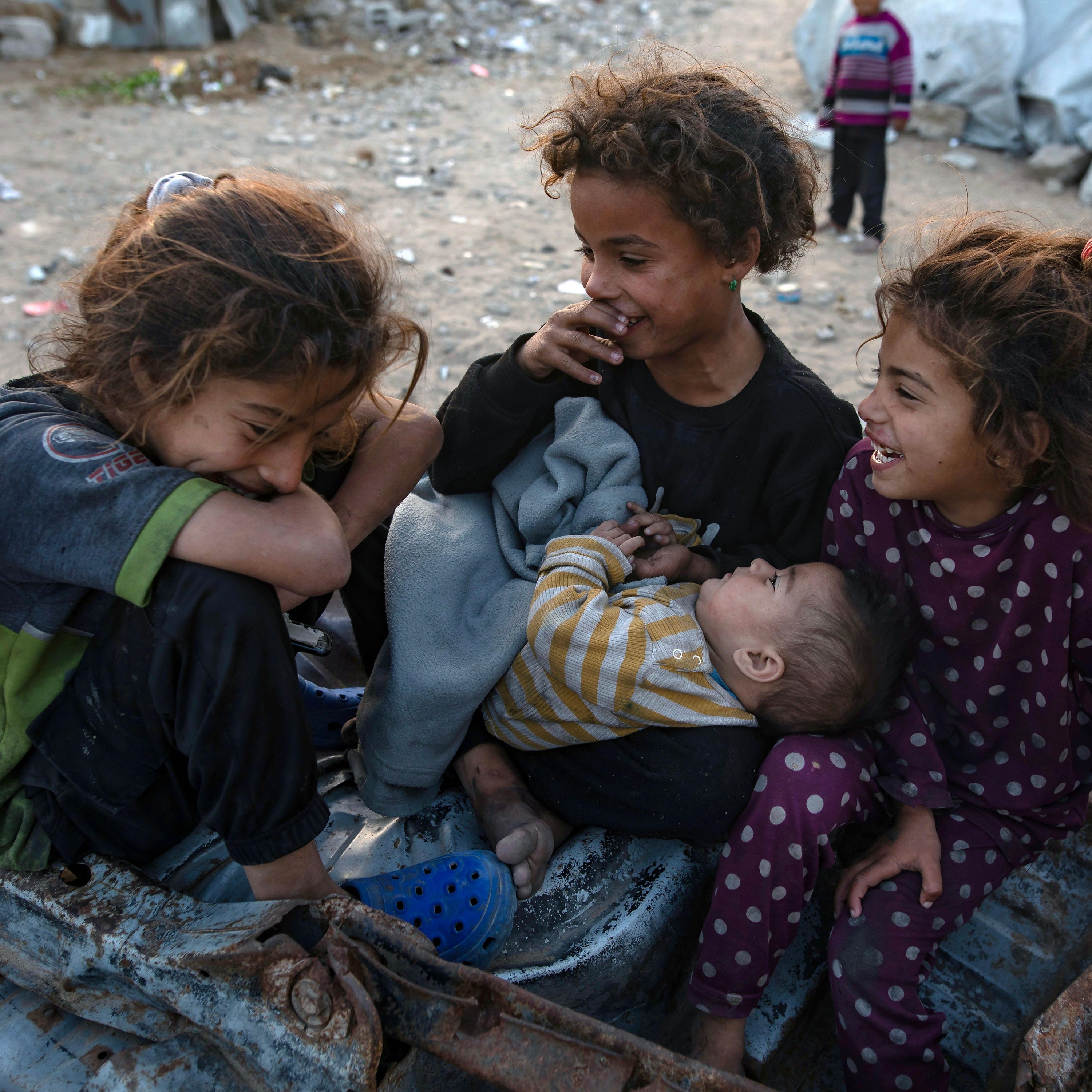
More than 1100 children have been killed or injured in the Middle east in the two weeks since the war in Iran started. That's according to unicef.
- [02:12]
Tristan Redman
Children are often the victims of war, but they're also often the ones that we hear of.
- [02:16]
Asma Khalid
Least for the last four decades, Fergal Keene has been one of the most familiar voices on the BBC report from war zones around the world.
- [02:26]
Tristan Redman
And over the years, he's been profoundly affected by the stories he's heard from children in particular.
- [02:32]
Asma Khalid
Now this spring, he's saying goodbye to the BBC, so we sat down with him to talk through the issue that has stayed with him throughout his career. From the BBC, I'm Asma Khalid.
- [02:43]
Tristan Redman
And I'm Tristan Redman. And today on the Global Story, Fergal Keen on PTSD and and how living through war affects children's brains. Fergal, thank you so much for joining us. Could you introduce yourself for us, please?
- [03:04]
Fergal Keane
Yeah. I'm Fergal Keen. I've been around a long time, feels like forever.
- [03:09]
Asma Khalid
I love that as an introduction.
- [03:11]
Tristan Redman
And I'm doing what in all that time, Fergal?
- [03:14]
Fergal Keane
I've been a foreign correspondent, war correspondent with the BBC for 37 years. Before that I was a reporter in Belfast in Ireland for Irish TV and radio. And before that I was a newspaper reporter, always a reporter.
- [03:29]
Tristan Redman
And what are the stories that you've covered that have really marked you in your career?
- [03:32]
Fergal Keane
I think I was chatting to a friend of mine the other night who'd been there with me and, you know, I think the transition to democracy in South Africa, when I watched over a period of four years, this country moved from the brutality of racial separation, the humiliation inflicted on so many people, especially children. Moving from that to a point where I was standing outside the union buildings in Pretoria in May 1994 and watching Nelson Mandela. I mean, I was just 30 or 40ft away from him, watching him with his hand on his breast, being sworn in as the president of a non racial democratic South Africa. That's the kind of thing you go through and you think, I'll never experience that again. And it's true. You don't, you don't. It's a once in a lifetime experience. Very quickly after that, there was the other major story that marked my career and I think marked my personality and marked my psyche. And that was the genocide in Rwanda where you had as many as 800,000 people killed in the space of 100 days. Underlying inter tribal tensions have again exploded into violence, apparently with thousands dead as rebel forces from the minority Tutsi tribe appear to be fighting the army. Dominated by the majority of Hutus, the Hutu forces pressured Hutu civilians to use machetes, clubs, blunt objects and other weapons to rape, maim and kill their Tutsi neighbors and destroy or steal their property. And many of them killed by people who were their neighbors, you know, killed with clubs, with machetes. And these neighbors egged on by the government who basically taught people to entirely subvert the moral order. In other words, they told them that to kill your neighbour was the right thing to do.
- [05:25]
Tristan Redman
Altogether, it's estimated that more than a million people have been forced from their homes by a campaign of butchery that shows no sign of ending.
- [05:34]
Fergal Keane
They, over many years had pumped propaganda into the population, told them that if they didn't kill the minority, the minority was going to kill them. That's the Tutsi minority who were set upon by a Hutu extremist government. And I witnessed that. And I witnessed the appalling aftermath of the slaughter. The mounds of bodies, the few petrified, traumatized survivors, and listen to their stories and driving around a country during the genocide while it was still going on, and on the one hand, seeing this vast emptiness and the smell of death everywhere you went, and then meeting the Genesad, the people who carried out the killing from ordinary peasant farmers on roadblocks, listening to their rationalizations, to the men who had planned it and given the orders. You don't shift something like that from your consciousness.
- [06:30]
Tristan Redman
We really wanted to speak to you today because you've written this fascinating article for the BBC website about how living through conflicts affects children in the short term and throughout their entire lives. Why did you decide to write that story right now?
- [06:50]
Fergal Keane
I've been sort of covering the conflict in Gaza since the Hamas attack on October 7. And it became clear to me that all of the trauma that I had witnessed being inflicted on children in the previous more than three decades of reporting as a BBC war correspondent, I was seeing it again. Day after day. 12 year old Leanne Khalaf finds comfort in her family. When the bombing starts, my mom calls my brothers and sisters to hug them, she says, and we hold each other's hands. And it kind of moved me to reflect on where we were now in terms of the kind of legislation that would try and protect children, the kind of care that should be available to them, and the consequences, principally the consequences of that kind of daily experience of trauma where you had Hamas and the Israelis battling it out in a largely civilian environment, where you had children suffering because of Israeli blockades, which, you know, made drastic limits on food, which put severe limits on medical care, the destruction of so much of the healthcare system in Israeli attacks, the Israelis say that's because Hamas are hiding in hospitals. But whatever the consequence of these has been to create an environment where children have lived from day to day. So many of them wondering if they were going to wake up the following day. Today there are kids dying in wars in Ukraine, there are kids dying of diseases in Gaza and as I say, many other parts of the world. And they are people mostly they're people who live beyond our concern in the West. It wearied me to see this happening again.
- [08:58]
Asma Khalid
Fergal, what made you realize that there were these untold stories of children, children's stories in particular, that you wanted to tell, that you felt, you know, you ought to tell these stories of children being traumatized by experiencing war.
- [09:16]
Fergal Keane
I think that came from my own childhood. I grew up in, I suppose, what people would call a broken home. And that was a home that was disrupted by alcoholism, where I was traumatized by the presence of my father's alcoholism. And it was an environment where sudden disruption was always possible. Fear was constantly present, tension was constantly present, and where I learned very early to be quiet, not to speak up. You know, I was feeling ashamed because of how alcoholism was affecting my home. And it's a very common thing in the children of addicts or children who experience that kind of severe dysfunction in their home environment. And so I was conscious when I went into journalism of feeling a need and later, as my kind of social conscience, developed a responsibility to tell the stories of those who could not readily find access to media, who could not readily express themselves in a manner that
- [10:25]
Asma Khalid
those were particularly children. You felt?
- [10:27]
Fergal Keane
Yeah, yeah, in a manner that adults would stop and listen to. It's about listening to their stories and allowing them to be told with a very important caveat. And that is, of course, that in the telling of the story, you don't re traumatize the child. And so for nowadays, I will not interview a child without having carefully gone through the ground beforehand with their guardian, hopefully with a mental health practitioner. And when we finish the interview, we always now make sure there is someone there who is in a position to counsel the child and comfort them.
- [11:00]
Tristan Redman
Fergal, in the mid-90s, as you mentioned, you reported from Rwanda, in particular this horrendous genocide where 800,000 people, including children, were massacred. And then around the same time you had your own child. You wrote a quite famous audio essay called Letter to Daniel about your own son.
- [11:24]
Fergal Keane (reading Letter to Daniel)
My dear son, it is six o' clock in the morning on the island of Hong Kong. You are asleep, cradled in my left arm, and I am learning the art of one handed typing. Your mother, more tired yet more happy than I have ever known her, is sound asleep in the room next door. And there is soft quiet in our apartment.
- [11:42]
Tristan Redman
It was first broadcast back in 1996.
- [11:46]
Fergal Keane (reading Letter to Daniel)
Like many foreign correspondents I know, I've lived a life that on occasion has veered close to the edge. War zones, natural disasters, darkness in all its shapes and forms. In a world of insecurity and ambition and ego, it's easy to be drawn in, to take chances with our lives, to believe that what we do and what people say about us is reason enough to gamble with death. Now, looking at your sleeping face inches away from me, listening to your occasional Sigh and gurgle. I wonder how I could ever have thought Glory and prizes and praise, the were sweeter than life. And it's also true that I am pained, perhaps haunted is a better word, by the memory suddenly so vivid now of each suffering child I have come across on my journeys. To tell you the truth, it's nearly too much to bear at this moment to even think of children being hurt and abused and killed. And yet, looking at you, the images come flooding back.
- [12:45]
Tristan Redman
I wonder if you could talk us through. How did this essay come about? And why was it so important for you to write about it?
- [12:51]
Fergal Keane
I wish I could claim the credit for having the idea, but it wasn't my idea.
- [12:55]
Asma Khalid
Whose was it?
- [12:56]
Fergal Keane
It was Tony Grant, a man called Tony Grant, who was the editor of From Our Own Correspondent, this wonderful program on the BBC which is heard all around the world. It's one of our oldest programs. And it does a very simple thing. It says to the correspondent, write what you've experienced. And very unusually sometimes what you felt. You know, we don't express our feelings in the day to day news reporting quite rightly. It's. That's not what we're there for. Tony Grant rang me and he said, look, you've had a kid. Would you write what it's like being a foreign correspondent, having a child in Hong Kong, as I was living then? And I kind of hummed and hawed and I said, well, I'm not sure, you know, is it really what I should be doing? And then he prevailed on me. And I did write it, and I wrote it in one sitting with the kid sitting in one arm and typing with the other hand. And I was absolutely blown away by the beauty of this child. I was just overwhelmed at what he represented, at the possibility of new beginnings. And it brought up memories of the, of the children that I had seen, so many of them who didn't enjoy the protection that my child had in my arms in a nice comfortable apartment in Hong Kong, looking out at the dawn, knowing that his future was going to be one, surrounded by love, care and security. And so it, in writing, it got really. I was very, very churned up because it brought together so many different strands of my experience as a war correspondent over the previous decades.
- [14:37]
Asma Khalid
Frugal. You wrote that letter to your son in the mid-1990s, and that's around the same time period that you were reporting on the Rwandan genocide. And that has been a huge focus of your reporting over the years. And while you were there in the region, you met a 13 year old girl named Valentina who had lost her entire family.
- [15:02]
Fergal Keane (reading Letter to Daniel)
Back in Nyarabuye, the killers had finally finished their work. After four days, they left, believing they'd killed all of their 1,000 Tutsi neighbors. But at the end of this trail, next to the church, badly wounded but still breathing, Valentina lay hidden among the corpses. For days and nights, she lay still, listening to every sound.
- [15:25]
Valentina (Rwandan genocide survivor)
I stayed there for some time over a month. When I tried to get up, I would fall down. I figured that if the killers came, I would pretend to be dead.
- [15:41]
Asma Khalid
Her hand had been cut in half by militiamen, and it got so badly infected that it seemed that she would die. Yet you went back, and in 1997, you found that she had indeed survived. And you interviewed her about what she
- [15:59]
Fergal Keane
had been through in Nyarabuye.
- [16:01]
Fergal Keane (reading Letter to Daniel)
Valentina and the other orphans knew nothing of what was happening in the world beyond. For more than a month, they lived
- [16:09]
Fergal Keane
and slept among the rotting corpses.
- [16:12]
Valentina (Rwandan genocide survivor)
At night, the dogs came. The dogs were coming and eating dead children outside and in the other rooms next to me. Then after some time, one dog came to where I was and started to eat a body. When this happened, I picked up a stone and threw it at the dog, and he got scared and ran away.
- [16:37]
Fergal Keane
So when I first saw Valentina, it was during the genocide, and she was with a handful of other survivors in an abandoned government building. And there were some nurses from the rebel Rwandan Patriotic Front who were trying to help her, but they had no medicine. Her hand was. Was gangrenous, and she also had a big gash in her head from where she'd been macheted. But she did survive. You know, I went back three years later, and Valentina was alive and she was living with her aunt, who had also survived the genocide.
- [17:11]
Asma Khalid
Did that trauma stay with her over the years? I mean, I can't imagine it didn't affect her in some ways over the years.
- [17:17]
Fergal Keane
Yeah, it does. I mean, you know, the expression that I absolutely hate is closure. You don't get closure on an experience like that. And if you witness massacre, if you see your family being butchered, you don't close a door and suddenly it's gone. And she had a dream where her mother came back to her in the dream, you know, and she dreamed of that, of a moment of being reunited with her mother. Of course, that was never going to happen. But, you know, a couple of years after that, Valentina was back in school. She came to London. She met my own kid at my house.
- [18:01]
Asma Khalid
Oh, wow.
- [18:02]
Fergal Keane
Yeah.
- [18:03]
Tristan Redman
When was that fugle that would have
- [18:05]
Fergal Keane
been, I guess maybe 1999 there. Thereabouts.
- [18:09]
Tristan Redman
Okay, so you stayed in touch with her over years?
- [18:11]
Fergal Keane
Yeah, I did, yeah. And she went to school and then she emigrated to the States.
- [18:16]
Tristan Redman
Oh wow.
- [18:17]
Fergal Keane
Where she now lives. But she's made a life and she has kids of her own. The big lesson is that given a chance, the human spirit and especially children are phenomenally resilient. I don't believe that anybody is doomed by what happened to them in their childhood.
- [18:42]
Valentina (Rwandan genocide survivor)
Foreign.
- [18:50]
Ryan Seacrest
Hey, it's Ryan Seacrest for Albertsons and Safeway. Cold weather can wreak havoc on your skin. You don't want to miss out on this month's great savings on all your favorite skincare Essentials now through March 31st. Earn four times points when you purchase participating skincare items like Dove Soap, Dove Body Wash, Dove Beauty Bar, Soft Soap Body Wash and Irish Spring Body Wash. Points can be redeemed later for discounts on groceries or gas. Offer ends March 31. Restrictions apply. Promotions may vary. Visit albertsons or safeway.com for more details.
- [19:21]
Fergal Keane
With Verbal's Last Minute Deals, you can
- [19:23]
Cachava Advertiser
save over $50 on your spring getaway. So whether it's a mountain escape with
- [19:28]
Fergal Keane
friends, a family week at the beach
- [19:30]
Cachava Advertiser
or sightseeing in a new city, there's still time to get great discounts.
- [19:34]
Fergal Keane
Book your next day Now. Average savings $72 select homes only.
- [19:51]
BBC Podcast Announcer
Decisions made in Washington can affect your portfolio every day. But what policy changes should investors be watching? Listen to Washington Wise, an original podcast for investors from Charles Schwab to To hear the stories making news in Washington right now, host Mike Townsend, Charles Schwab's managing director for legislative and Regulatory affairs, takes a non partisan look at the stories that matter most to investors, including policy initiatives for retirement, savings, taxes and trade, inflation concerns, the Federal Reserve and how regulatory developments can affect companies, sectors and even the entire market. Mike and his guests offer their perspective on how policy changes could affect what you do with your portfolio. Download the latest episode and follow@schwab.com WashingtonWise or wherever you listen.
- [20:42]
Schwab/NerdWallet Advertiser
Today's episode is sponsored by NerdWallet's Smart Money Podcast. Personal finance can feel like a pop quiz you didn't study for this podcast is your study guide. On NerdWallet's Smart Money podcast, you'll hear from trusted journalists who explain the why behind major financial decisions. You can you'll get research backed insights and clear pros and cons. Whether you're planning a big purchase or just want to grow your wealth make your next financial move with confidence. Follow NerdWallet's Smart Money podcast on your favorite podcast app,
- [21:15]
Tristan Redman
fergal. You yourself were later diagnosed with ptsd. How and when did you start to recognize that you were also being affected by the conflicts you were reporting on?
- [21:29]
Fergal Keane
So if I'm frank with you, I think I had PTSD from a very early age as a consequence of the environment in which I grew up. And paradoxically, what that did was create in me a need to be in places where that sense of fear, that tension was recreated. Because I was perfectly formed to operate in war zones. I was hyper vigilant from the very earliest age, obviously watching out, you know, am I under threat? Is there a danger to me here? And that makes you very skilled at navigating a place like Rwanda or the streets of Belfast in the middle of rioting. When I came out of Rwanda in 1994, nobody was talking about journalists and PTSD. We went and we got drunk and talked about it in the bar and that was it. And I self medicated with alcohol and, you know, ended up as a fully functioning alcoholic because that is, you know, it's such a common coping mechanism. Anything to take you away from the pain, anything to take you away from that void, which is full of nightmares and bad memories. I kept running and I kept running into conflict zones until I had a pretty big breakdown in about 2008. Went into hospital and was formally diagnosed with complex post traumatic stress disorder as a result of numerous wartime experiences. But you know what? I came out and I was a good boy for a while. I didn't go to the war zones. And then I went back. I mean, that is the definition of insanity. And I went back again and again until I crashed, predictably crashed once more. And then I remember that breakdown, it was about three years ago now. And I remember sitting in the, in a psychiatric hospital at, you know, three in the morning, looking out on the, on the dark and thinking, this is never going to get better. You know, really at the deepest low possible and feeling shame because of what I'd brought on my family. You know, trauma, PTSD doesn't affect just one person. Addiction doesn't affect just one person. It affects all of those who love you, who live in fear about what is going to happen to you. And I was watching a TV program, as you do in the dark hours of the night when you can't go to sleep. And there was an American psychiatrist on it, and he sat down, he was talking to a, a celebrity, and he said, number One, he said life is full of pain. Number two, it's full of uncertainty. And number three, that if you're going to have decent mental health, you've got to work at it every single day of your life. And that's the thing that I came away with. I could have all the help in the world as a grownup, but I absolutely had to take action myself. And what did that involve? Well, it involved continuing therapy, staying out of war zones, and it involved surrounding myself with as much love as I could possibly find. And this goes back to what we were talking about with kids. It's just as important for grownups, you know, to be around people who love you and to give that love back.
- [25:06]
Tristan Redman
You've talked about how difficult it was to stop going back to conflict zones because of its almost kind of compulsive nature of that kind of work. There are so many wars and conflicts happening in the world right now. Places where, you know, children don't have the choice of whether they can be there or not, that they. They are there. Gaza, Ukraine, Sudan. What is the scale of the crisis for children around the world right now? Fergal?
- [25:36]
Fergal Keane
Well, the most recent figure we have is from 2024, and that talks about 520 million children living in conflict zones.
- [25:45]
Asma Khalid
520 million children, an estimated 520 million children are now living in conflict zones.
- [25:52]
Fergal Keane
That's about one in every five children worldwide.
- [25:55]
Asma Khalid
I mean, that's a staggering number, right? One in five, 20% of the world's children. And so that makes me wonder that over the years of you covering conflicts, has the knowledge of how to deal with children in war zones improved? I know you've been talking to experts about how to help children, children who might be suffering from ptsd. These numbers are huge. Has the knowledge base changed?
- [26:22]
Fergal Keane
Yes, the knowledge base has absolutely changed. Remarkable work being done. So, for example, you. You have doctors who have worked with children who went through the Bosnian civil war and the genocide at Srebrenica. And again, they found that a key element was this question of a family stability, of a community stability being created for children once the conflict had ended. I mean, they disagree about a few things, but on this, they're absolutely of one mind, and that is that you can't recover from war trauma if you're living with continuing trauma. But you also have research into children who are living with fears. And I mentioned a while ago the whole question of avoidance, people being terrified of confronting anything that reminded them of what had happened during the war. And so there's a New field of theory. Well, I mean, relatively new field of theory, which encourages children to slowly and carefully try to confront, obviously not death and massacre again, but things like learning to sleep alone, not having to sleep with a parent because that's what they did during the war because they were so consistently terrified. Now, it sounds like a simple thing, but as anybody who's tried to put a child to sleep, who's had a nightmare, a child who hasn't been traumatized will know it's very difficult, but it's a kind of essential part of a child being able to mature, grow up, separate out ultimately from the family.
- [28:01]
Asma Khalid
Frugal. We made an episode yesterday here on the Global story about the deadly strike on an elementary school in southern Iran. As we said here at the outset, UNICEF has reported that more than 1,100 children across the region have been reported injured or killed since this war in Iran broke out just a couple of weeks ago. We look at Gaza meanwhile, which we spoke about earlier. There is a ceasefire on the books, but it is difficult nonetheless to know how children and their families are going to rebuild their lives. How are you reflecting on all of this?
- [28:37]
Fergal Keane
What struck me when I saw the news, along with everybody else, of the airstrikes on Tehran and other Iranian cities was what's it like for the kids underneath that? Because we've established by now in this conversation that it's my preoccupation and I can't speak to any children in Iran at the moment. But I have been able to speak to a young woman who said a phrase to me via an intermediary which just has been going around in my head for the last few days. And she said this war, she said, it has come into our homes, it has come into our families, it has come into our blood, and I don't know when we're going to be able to get rid of it. And she was talking about the fear that is constant. You know this. I've just seen some footage which was sent out to us of the night sky and the sound of bombing and this really eerie sound of dogs barking when they hear the aircraft approaching. And you're thinking to yourself, what's it like to be an adult under it, but to be a child? And who hasn't? Yes, there have been. There were airstrikes, there were attacks on the nuclear installations in an earlier phase of this conflict between Israel, America and Iran. But this kind of bombing in cities is something the vast majority of Iranian children will have had no experience of. And I think it goes back to the entire thread of our conversation where when wars begin, no matter where they are, children are the ones who have least ability to protect themselves. And they're the ones who, under international law, under all the conventions that armed forces are meant to operate by, are the ones who should be most protected. But that just doesn't happen. It never has. And you have to wonder if it ever will.
- [30:32]
Asma Khalid
Well, Fergal, thank you for bringing your insights and all of your years of reporting to us. Really appreciate it.
- [30:38]
Fergal Keane
Thank you.
- [30:46]
Tristan Redman
That was Fergal Keen, who sadly is leaving the BBC this spring after 37 years. And we want to thank Fergal for the incredible, sensitive reporting he's done over all those decades. And we wish him the best of luck for what's next.
- [30:58]
Asma Khalid
We do indeed. Today's episode was produced by Hannah Moore. It was edited by Bridget Hardy and mixed by Travis Evans. Our senior news editor is Chyna Collins. And I'm Asma Khalid.
- [31:09]
Tristan Redman
And I'm Tristan Redman. Thank you very much for listening and we'll see you again tomorrow.
- [31:20]
Cachava Advertiser
Craving the coffee flavor you love, but without the caffeine, Cachava's got you covered with their newest coffee flavor, this all in One nutrition shake delivers bold, authentic flavor crafted from premium decaffeinated Brazilian beans. Quality nutrition shouldn't be complicated. Just two scoops of Cachava's all in One Nutrition Shake and you've got 25 grams of protein, 6 grams of fiber, greens, and so much more. Whether you're craving that coffee taste to kickstart your morning ritual or as a nutrient packed reward to round out your afternoon, Cachava keeps you fueled and satisfied wherever your day takes you. Plus, it actually tastes delicious. No fillers, no nonsense, just the good stuff your body craves. And for the times you feel like switching it up, you've got seven flavors to choose from, all with the highest quality ingredients. Treat yourself to the flavor and nutrition your body craves. Go to kachava.com and use code news. New customers get 15% off their first order. That's K A C-H-A V A.com code news.