Loading summary
Transcript102 lines
- [00:00]
Advertisement Narrator
This BBC podcast is supported by ads outside the uk. Investing with Schwab is like spending a Saturday at a great farmer's market. You can fill your reusable tote with a bit of everything. Maybe you go for some free range self directed investing or perhaps you pick up a few farm fresh trades while you peruse. You can even get help from a dedicated advisor. That's full service wealth management. Mix, match and change your mind whenever you want. Because at Schwab you can invest your way no matter your goals or appetite for investing, Schwab has everything you need all in one place. Visit schwab.com to learn more. Puerto Rico is having a moment of global attention as companies reshore and rethink supply chains. They're choosing a U.S. jurisdiction operating under federal law with competitive tax incentives designed for long term growth, not culture or business. Culture and business Puerto Rico. It's not what's next, it's where. Visit investpr.org business
- [01:03]
Holly Gibbs
this is the Happy Pod from the BBC World Service. I'm Holly Gibbs and in this edition
- [01:14]
Matthew Lewis Carter
it gives dads a real opportunity to spend an extra 5, 10 minutes with their daughters. I'm not saying every single day and in doing so, we're hoping that the conversations that they have along the way, they might not remember the braiding, but they'll remember the conversations the dads behind
- [01:31]
Holly Gibbs
the viral sensation Pints and Ponytails how new research has found a way to convert a common plastic into a drug for Parkinson's disease.
- [01:41]
Professor Stephen Wallace
When you think about plastic, people tend to think of it as this, you know, waste or end of life material that doesn't have any value or any sort of potential potential for further use. But plastic waste is just carbon.
- [01:53]
Holly Gibbs
Plus the return of rhinos to Uganda.
- [01:57]
Dr. James Misinguzi
It's a great day. It's a great season for Uganda. The communities are very excited to see that this species is coming back 43
- [02:05]
Holly Gibbs
years down the road and why getting old is actually good for you. We start with a dad's night out with a twist.
- [02:20]
Matthew Lewis Carter
Welcome to Pints and Ponytails.
- [02:23]
Holly Gibbs
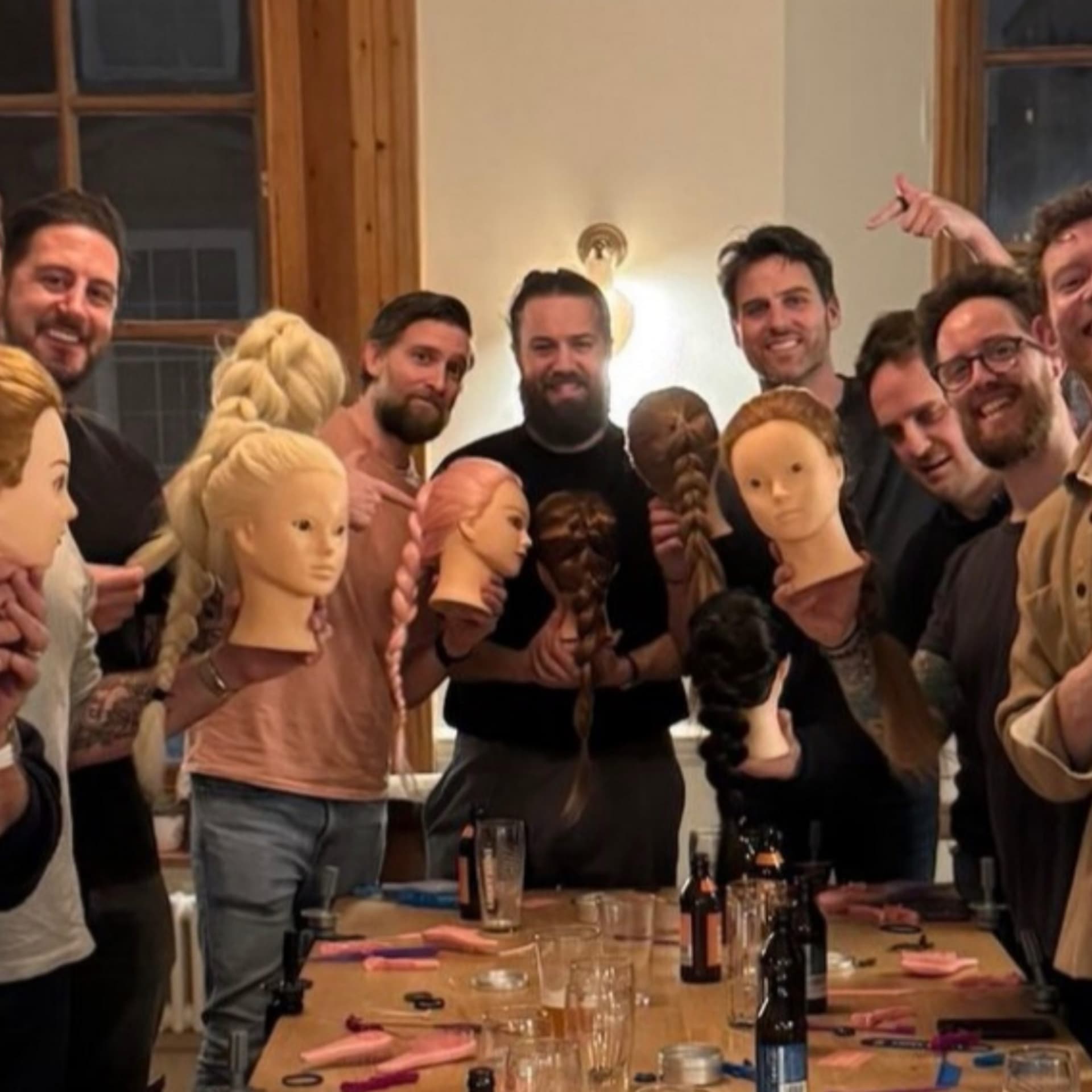
That's Pints and Ponytails, a meeting of dads at the pub learning how to do hair on mannequins. The sessions, however, are much more than just buns and braids. The whole thing was the brainchild of Matthew Lewis Carter and Lawrence Price, who both experienced mental health struggles in the early days of becoming a dad and decided to set up their own podcast and host events such as Pints and Ponytails. When they posted the footage of the event on social media, it encouraged millions of people around the world to get in touch and try it for themselves. I spoke to Matthew and Lawrence.
- [03:00]
Matthew Lewis Carter
It's easy to watch a video of pints and ponytails and just see dads learning to braid their daughter's hair. But there's so much more to it than that. It's traditionally a feminine task that dads want to step up and get involved with. In doing so, it then deepens the conversation that they can have with their daughter. We put up a first event, we got 10 friends together and the Internet just loved it. And we thought, okay, let's, let's do this again, but let's make it bigger. We had 35 dads turn up at the second event. But these dads turned up fully present, fully wanting to learn a skill to establish a deeper connection with their girls. And what we found is there was a nervous energy in the room when the dads first come in. It's quite a strange thing to see when you come into a room full of like 35 mannequins and pints just strapped to the table. It's like the start of a horror film. But after that, the nervous energy slowly started to dissipate.
- [04:02]
Lawrence Price
We wanted to make sure that we were providing a safe space for dads to get together and to learn a new skill that honors their daughters and in doing that, break old stereotypes. We are getting hundreds of men, not just in the UK but globally get in touch because they actively want to be a part of this new progressive approach to fatherhood. So we feel at the moment we've kind of stumbled into something which is a huge honour but a huge responsibility to help facilitate the safe spaces for all those dads to step up.
- [04:34]
Matthew Lewis Carter
We've had messages from Mumbai to Sydney to LA to Guatemala. Like, it's really just like we've had voice notes from dads from. I was listening to one from Ecuador before we jumped on, on this. So I think there's a real thirst for the dads.
- [04:51]
Holly Gibbs
What's the feedback been from fathers who attend these sessions?
- [04:55]
Matthew Lewis Carter
We got a lot of the dads to write a post it note and one of them just said, my daughter always says my hands are too big to do hair, but I can't wait to share the new skills I've learned tomorrow. And there were so many just beautiful messages like that. It really speaks kudos to these dad who turned up to this event. It gives dads a real opportunity to spend an extra 5, 10 minutes with their daughters. I'm not saying every single day. And in doing. So we're hoping that the conversations that they have along the way, look, they might not remember the braiding, but they'll remember the conversations. And I think that's what our goal is here.
- [05:31]
Lawrence Price
Yeah. It's through our actions that the next generation learn. And that's what's been so encouraging for us to see all these dads stepping up and wanting to break old stereotypes. And for us, that's just hugely optimistic about the next generation and the hands they're in.
- [05:42]
Matthew Lewis Carter
Yeah. I think what we also have, we've had a lot of messages from girls and their memories of their dads doing their hair.
- [05:49]
Holly Gibbs
I can relate, no offense to my dad, but when he did my hair, it was awful, bless him. But he would have. He would have benefited from pints of ponytails.
- [05:59]
Professor Stephen Wallace
Yeah.
- [06:00]
Matthew Lewis Carter
And you know what, it's just like the braiding, the hairstyles, they don't have to be perfect. It's so easy to look at the event and think, oh, do you know, we need to be doing lots of different hairstyles. But if we just give them a few of the basic skills, and maybe if mum isn't there one day, or if mum isn't up for the task in the morning, the dads can go, look, it's okay. I've got this today.
- [06:20]
Holly Gibbs
Apart from learning how to do a ponytail, why is it important that things like this exist?
- [06:26]
Lawrence Price
There are so many layers to this, so many reasons. Something we haven't touched upon yet as well is the symbolism of dads stepping into the space that traditionally, stereotypically, has been considered a role of the mother in terms of preparing and styling and doing the daughter's hair. And the symbolism of dad stepping into that space to take that on themselves really does thread into dads stepping up to start to take and pick up more of the invisible load at home as well. So it might start with doing the hair for their daughters, but it will then go on to, you know, many other areas as well. It's a safe space for dads to share their mental health journey since becoming fathers, specifically with other men in the same position as them in a pub environment that they're familiar with. And it is also, crucially, a skill that, again, opens up another door in which dads can connect on a deeper level with their daughters. And 10 minutes a day, here or there, over many weeks, months, and years. I mean, that can completely. That can deepen the relationship with a father and a daughter to a level which they never might have had previously.
- [07:33]
Matthew Lewis Carter
There is a generation of boys now who are coming into the world and they're already being labeled toxic, which, you know, we think is so far from the truth. I don't think boys come into this world being toxic. They come with love and kindness. But I really hope that we can stand there and just, you know, wave a flag and say, there is a group of dads out there. There is a form of masculinity that is so confident within its own masculinity with these feminine traits. And I think that is the sign of a real man, a man that is confident in his ability to have feminine traits and lean into that and teach those findings to his children.
- [08:15]
Holly Gibbs
Matthew Lewis Carter and Lawrence Price. Next to an unexpected solution that could help in the fight against both plastic pollution and Parkinson's disease. Researchers at the University of Edinburgh have found a way to convert a common plastic found in food and drink packaging into a drug, which is regarded as the best way of managing the symptoms of Parkinson's disease. The drug already exists, but this method could have a big impact on the way medicine is made in the future. I caught up with our reporter Lucy Acheson.
- [08:48]
Lucy Acheson
So the drug is called Levodopa and it's the main treatment for Parkinson's disease. It's traditionally made using fossil fuel derived chemicals and obviously that has a huge environmental impact. What the drug does is it essentially helps restore dopamine levels in the brain and that improves the symptoms of Parkinson's, like tremors, stiffness and slow movement. Dopamine is a chemical which is essential for controlling movement. So if you're able to restore it in the brain, then you can really improve the symptoms that people experience.
- [09:17]
Holly Gibbs
And how did the researchers find out that this was possible?
- [09:21]
Lucy Acheson
This uses a new approach which is called engineering biology. It's part of a wider move towards more sustainable and lower energy drug production. The researchers built on their earlier work, which included producing paracetamol from plastic using similar methods. And so what they did was they genetically engineered E. Coli bacteria and they reprogrammed it to help make useful compounds. How this works in practice is essentially the plastic. And specifically here we're talking about polyethylene terephthalate, which is used in food and drink packaging. It's broken down into its chemical blocks and then the bacteria is used to convert those molecules into Levodopa through a series of biological reactions. The whole process takes around 24 hours and it happens at room temperature, so it uses far less energy than typical production methods. Professor Stephen Wallace is from the University of Edinburgh's School of Biological sciences who led the research.
- [10:13]
Professor Stephen Wallace
I think when you think about plastic, people tend to think of it as this waste or end of life material that doesn't have any value or any sort of potential for further use. But plastic waste is just carbon. And we work in my lab in an area of biotechnology called engineering biology, where we can program microbe microbes to do things with carbon. So when we started this project a couple of years ago, we were like, great, could we potentially design a strain of bacteria that could turn plastic waste into something, you know, a bit more than just another plastic bottle or a discarded piece of material? And, yeah, we're really thrilled that we've been able to do it.
- [10:51]
Holly Gibbs
Wow. So what's the reaction been?
- [10:54]
Lucy Acheson
Well, it's been extremely positive on two fronts. So environmentally, around 50 million tonnes of polyethylene terephthalate plastic is produced year much of it becomes waste and it also takes hundreds of years to break down. So this method suggests that plastic waste could actually be repurposed into something valuable, tackling pollution medically. It also offers a more sustainable way to produce essential drugs and it reduces our reliance on fossil fuels. Dr. Becky Jones is from the charity Parkinson's UK.
- [11:26]
Dr. Becky Jones
It's really exciting to see any Parkinson's research, but particularly new and innovative ways of creating the Levodopa drug. Levodopa is needed and used by many people to manage their symptoms. So it's really exciting to see new and innovative ways of using that drug that's helping people live well with Parkinson's for as long as possible.
- [11:50]
Holly Gibbs
So, Lucy, what's next for the drug?
- [11:53]
Lucy Acheson
Professor Wallace and his team are now working with their industry partners to see if this process can be scaled up commercially. If that's successful, it could mean that plastic waste becomes a raw material for medicines and a new industry could emerge, which is bio Upcyc.
- [12:08]
Holly Gibbs
Lucy Acheson to Uganda now, and a conservation milestone. For the first time in more than 40 years, rhinos have returned to the country's Kidepo National Park, a vast expanse of savannah in the remote northeast near the border with South Sudan. Tom Rolls has more details.
- [12:27]
Tom Rolls
The last rhino in Kdepo is thought to have been killed back in 1983, making the species extinct in the wild. In Uganda, poachers, wanting their meat and horns, had exploited political instability to wipe out around 700 of the animals once found in the country's national parks. But now two southern white rhinos have arrived at a new protected sanctuary, the first of eight intended to help re establish a thriving population in the Park. They were moved there from a privately owned ranch which has been breeding rhinos from four it imported from Kenya in 2005. Dr. James Misinguzi is the executive director of the Uganda Wildlife Authority. He says it marks the beginning of a new rhino story for Kadepo.
- [13:14]
Dr. James Misinguzi
It's a great day, it's a great season for Uganda that a species that got wiped out 43 years ago in 1983 has been introduced back into the country. We started with a seed population of six rhinos and we've been able to multiply them 61, thereby having a founder population. Now we have made a decision to introduce them into the wild. So we are taking the Southern White Rhino, eight of them, into Chidepo Valley National Park. We have also started a program to take 20 of them into Ajay Wildlife Reserve.
- [13:55]
Tom Rolls
The rhinos will be monitored by veterinary teams to ensure they adapt to their new home. And Dr. Muzunguzi says they've also taken steps to protect them from poachers, using rangers and remote tracking and getting the support of local people.
- [14:09]
Dr. James Misinguzi
We have sat down with the communities to show them the benefits that are going to our crew as a result of the introduction of these animals. And they have agreed to work with us to protect them. The communities are very excited. The communities are very, very happy to see that this species is coming back 43 years down the road because there are so many benefits that are going to accrue. First of all, jobs. Because as the Uganda government, we have a policy that once we have species introduced and the national park set up and boosted, then we have employment from local communities. We also give back 20% of the revenues collected to the communities to be able to carry out community development programs of their choice.
- [14:50]
Tom Rolls
Jeff Morgan is the founder of Global Conservation, which has been helping to ensure the rhinos will be safe at Kdepo. He says people will also benefit from it becoming a safari destination.
- [15:01]
Jeff Morgan
Uganda has the same level of attractions as Kenya. It just has not been, you know, developed as well. And so really using the tourism as a development tool for humans to have a better life that's exciting for me is to see, you know, I can become a guide. I can open my own lodge, I can have a taxi, I can have a restaurant. All the people around the national park can benefit from that park's protection.
- [15:28]
Tom Rolls
This reintroduction is part of Uganda's National Rhino Conservation Strategy, which aims to restore the animals to all the areas they used to inhabit. And it's hoped they will also help other species by restoring natural ecosystems. Geoff Morgan says he's optimistic.
- [15:44]
Jeff Morgan
My dream is to have them in all the parks soon in Uganda and throughout Africa. What it brings to me is it shows that the places are being protected again so that we can introduce key species like this. Rhino recovery in Uganda is just one great story and we hope for many more. I think what we have to do as a species, our human species, is protect our current national parks, take care of what's Left, the last 10% of our forests and our wildlife species.
- [16:21]
Holly Gibbs
Tom Rolls reporting. Coming up in this podcast, case closed.
- [16:32]
Anna Grayson
Well, I looked in every book I could. I asked people and it wasn't until 15 years later I was in the Natural History Museum and live outside broadcast brought this mineral in and they said, we can't identify it. They then looked at me, said, is it a fake? Could it be a fake?
- [16:48]
Holly Gibbs
How one woman's mysterious rock is now on display in a museum.
- [17:00]
Venmo Advertisement Narrator
Rewards programs are a lot like pop culture. They can be hard to keep up with. But with Venmo's new rewards program, Venmo Stache rewards are so easy because the more you do, the more you get. And you choose the bundle of brands you get cash back at. It's giving fiscal queen, it's giving star, it's giving up to 5% cash back at your favorite brands. Just pick a bundle of your go to spots to shop with your Venmo debit card and earn cash back at them. Do more, get more with Venmo stash. The Venmo MasterCard is issued by the Bancorp Bank NA Venmo Stash Bundle. Terms and exclusions apply. Max $100 cash back per month. See terms at Venmo ME forward slash stash terms.
- [17:45]
Martha Stewart
When Kohler, the global design leader in luxurious kitchen and bath products, came to me and said, martha, we need an ambassador for our timeless, elegant, durable cast iron products. I said, I'm in. Now. Let me see the factory. Weeks later, I was suited up in coveralls and work boots, walking through their Kohler, Wisconsin cast iron foundry. I stood next to the molten iron furnace, saw the hand applying enamel, and touched the gorgeous finished products waiting to be sent out into the world. Since 1883, Kohler cast iron products have been forged and finished by the incredible craftspeople right in Kohler, Wisconsin. I'll tell you, I gained a newfound respect and appreciation for Kohler's cast iron craftsmanship. So now I'm lending my discerning staff of approval to my most beloved Kohler cast iron products for their durability, beauty and timelessness Shop My Kohler Cast Iron favorites curated on Kohler.com bring the warmth, character and enduring style of these timeless products into your kitchens and bathrooms. As the Kohler Cast Iron Ambassador, I say long live Cast Iron.
- [19:07]
Advertisement Narrator
Choiceology, an original podcast from Charles Schwab, is a show about the psychology and economics behind our decisions. Join host Katie Milkman, an award winning behavioral scientist and author of the best selling book how to Change as she shares true stories from Nobel laureates, authors, athletes and everyday people about why we make the choices we do and how to make better ones to help avoid costly mistakes. Listen to choiceology@shwab.com podcast or wherever you listen. Today's episode is sponsored by NerdWallet's Smart Money podcast. Ever Google a money question and end up 12 tabs deep with 12 different answers? This podcast is your shortcut back to clarity. NerdWallet's Smart Money podcast breaks down financial decisions with a team of trusted journalists. They explain the why behind decisions like investing, home buying and choosing credit cards with clear research backed insights. No jargon, no misinformation. Make your next financial move with confidence. Follow NerdWallet's Smart Money podcast on your favorite podcast app.
- [20:18]
Holly Gibbs
Welcome back to the Happy Pod People often joke that getting older means being over the hill or past it, but others prefer to think of themselves as improving with age like a fine wine. Well, new research from Yale University suggests that for some that's actually true. It found that around a third of people over the age of 65 showed improvements in things like memory and problem solving, while more than a quarter had better physical abilities as they got older. The BBC's Laura Foster discussed the findings with Graham Easton, a clinical communications professor at Queen Mary University in London.
- [20:57]
Graham Easton
It was from a large national study in the US of 11,000 participants over 65 and they followed them for 12 years and they looked specifically at two things. One was their cognitive function using things like memory tests and math skills, and the other was the physical function and what they used to measure that was their walking speed, which is quite a good marker that we know in elderly people, things like disability or hospitalization and stuff. They then discovered that when they looked at the individual trajectories of these people over 12 years, they found that 32% had a measurable improvement in cognitive function and 28% had an improvement in their physical function.
- [21:38]
Holly Gibbs
So scientists have noticed these improvements.
- [21:42]
Anna Grayson
Why do they think this happened?
- [21:44]
Graham Easton
Well, what was really interesting is that they also measured the participants beliefs or thoughts or attitudes to ageing using a questionnaire. And they found that those with more positive beliefs about aging were significantly more likely to show improvements both in cognition and in walking speed. And common attitudes can be absorbed from a very young age and become quite strong self talk that can then influence biological and health issues. There've been quite a few studies that suggest there is a significant, if small, effect between the way you think about aging and your health.
- [22:26]
Lucy Acheson
And are people's attitudes shaping their capabilities or are people's capabilities shaping their attitudes, do you think?
- [22:33]
Graham Easton
Because this is an observational study, we can't prove a link Cause and effect the researchers did go to quite a lot of trouble to reduce the chance that it was just down to better functioning people feeling more positive about aging. So at the beginning, they checked their baseline health and functioning, for example, and adjusted for other factors too. And even having done that, they found that still this positivity predicted later improvements in function.
- [23:01]
Holly Gibbs
But not everyone improved with age, sadly.
- [23:03]
Anna Grayson
What could one do in order to
- [23:06]
Holly Gibbs
help ensure they age well?
- [23:08]
Graham Easton
Our genetics are probably the most important factor and then environmental factors and how we look after ourselves, what we eat and so on. Particularly good evidence around the Mediterranean diet and things like positive attitude are probably more about tweaking around the edges of those things.
- [23:23]
Holly Gibbs
Graham Easton. Next, the story of how a mysterious and unidentified mineral from Morocco ended up in the British National History Museum. Anna Grayson, a trained geologist, bought the rock from a roadside store whilst on holiday in the North African country more than 50 years ago. After years of arguments and even claims that it could be fake, it has finally been identified as an Eronite. Anna Grayson spoke to the BBC's Richard Hamilton.
- [23:54]
Anna Grayson
I was pregnant and I was feeling a bit unwell, so I said, could we stop the car? We did buy one of these wonderful mineral stalls they had there. It was mainly full of sparkly stuff, but there was this one blue thing, this big blue chunk, and I went to have a look at it and I knew that I'd seen some tiny fragments of it before I went to look at it and I asked the chap and I said, what is it? And he said, c' est la pix, madame, meaning it's lapis lazuli. I could see immediately it wasn't just the wrong shade of blue, this is more of a Prussian blue. Lapis is a real ultramarine rich blue. So I thought, well, ask a few more questions. Where does it come from? Dans les matagne, madame, Just dans les Montaigne. I wasn't going to get any more information in the mountains in the mountains? Yes, in the mountains. But what was interesting was structures on it because it shines, it's got faces as if it's got a sort of triangular pyramidal look about it. And this structure is called slickensides. And it's formed in faults, geological faults. So in a way this is a fossil earthquake, which makes me think it's come from the Atlas and the main faulted region. I thought, I'm going to buy it anyway. So I did some really hard bargaining. I quite like bargaining in Morocco. And after some time we got the price right.
- [25:05]
Graham Easton
So how did you start to then try and find out exactly what it was?
- [25:09]
Anna Grayson
Well, I looked in every book I could. I asked people, I took it down to the Camborne School of Mines and I in Cornwall, and they looked at it and from the color they thought, oh, that looks like copper. And that turned out to be incorrect. And it wasn't until 15 years later I was in the Natural History Museum and live outside broadcast brought this mineral in. And they said, we can't identify it. They then looked at me, said, is it a fake? Could it be a fake? Because a lot of fakes did come out of Morocco at that time. I said, I'm sure it's not a fake because of the structures on it. And they said, can we keep it for a bit? So they had it for a year and they found that it had properties completely new to science. And it didn't really fall into one of the established mineral categories because it looks like a mineral called an amphibole, but a zeolite, which is usually a lighter color than this, has tiny channels running through the crystals, empty channels that water molecules can get down, but not much else. So it was completely unique. So in 1996 it was decided to announce to the world that it was a brand new mineral. And for some reason it just captured the public imagination. I think the sense of adventure, the romance of Morocco. I think also the fact that a woman had done it. You don't expect women to do that. You didn't then, anyway.
- [26:24]
Holly Gibbs
Anna Grayson speaking to Richard Hamilton. For many of us, coffee is an essential part of our mornings. But the customers of one coffee stall in a park here in London and say they get more than just a beverage from its owner. Dieko Yari, who came to the UK from Iran nine years ago, has been running his store for a year and has already made a huge difference to the local community. Jane McCubbin went along to find out more. We meet a million people in our lives every day.
- [26:57]
Narrator (Jane McCubbin)
But some, some, some you only meet
- [27:01]
Anna Grayson
meet once in a lifetime.
- [27:03]
Park Visitor 1
He's a really good guy. You couldn't ask for a better person.
- [27:07]
Narrator (Jane McCubbin)
Everybody gathers here, everybody chats now everybody loves him. You just realize that this man is just like a little angel. He's so kind. And Dieko is the once in a lifetime.
- [27:20]
Narrator/Interviewer
A year ago, he opened a coffee cart in London's Crane park and quietly, gently, started to change the lives of those he met. And they in turn changed his.
- [27:31]
Park Visitor 2
Nice to see you.
- [27:32]
Narrator/Interviewer
Chat to people here and everyone has a die echo story. You saved Brian from the river.
- [27:38]
Park Visitor 1
Well, Ethel had her eye taken out, put her foot down and disappeared in the water. I jumped in after her. Then Diego stripped down to his underpants and then he got his arms around me legs and pushed me up and two blokes pulled me up in my arms. Fantastic guy. Yes. Does everything for you.
- [27:59]
Narrator/Interviewer
He saved Peter from grief.
- [28:01]
Park Visitor 3
My wife used to come here. She was very disabled and was quite ill. She adopted Diego as a son because his family were in Iran. She called him a son, so he started calling me Dad. I just met so many people here. Dog walkers are brilliant. Sorry, I'm getting a bit emotional.
- [28:23]
Park Visitor 2
Yes, this is Andrea. It was like my mom, you know, all the time, give me advice, you know, sometimes I'm not charging the people. Say, no, you need to charge people, you know.
- [28:32]
Anna Grayson
She was looking out for you.
- [28:34]
Park Visitor 2
Yeah, it's looking after for me. And she was very nice. I really miss her.
- [28:38]
Narrator/Interviewer
He was a pallbearer at Andrea's funeral. And a birthday card from Peter to Diaco reads, son, I am proud to be your stepfather.
- [28:45]
Park Visitor 3
Every time he says, oh, dad, how are you?
- [28:47]
Park Visitor 2
You know, because everyone is a specialist.
- [28:50]
Park Visitor 3
If we lost this caravan for any reason, I'd be absolutely devastated.
- [28:55]
Narrator/Interviewer
Management of the land here has recently changed hands and Diaco fears the future of the coffee cart is uncertain.
- [29:01]
Anna Grayson
We cannot lose him.
- [29:03]
Park Visitor 2
He's so good.
- [29:03]
Anna Grayson
Is everybody worried about that? Everybody is worried about it.
- [29:09]
Narrator/Interviewer
The local authority says they're keen to see him stay and his new friends say they'll do all they can to make that happen. They've already shown him amazing support.
- [29:17]
Narrator (Jane McCubbin)
In February, it was his birthday.
- [29:19]
Park Visitor 2
How are you?
- [29:19]
Narrator (Jane McCubbin)
Sadly, that night, leaving the park, he was assaulted and they took his takings. So I set up a crowdfunder and within about 24 hours, I think we had over a thousand pounds.
- [29:33]
Park Visitor 2
It was a bad experience, but I'm so sorry. No worries. Yeah. Bye now. Thank you so much, my love. Have a lovely day.
- [29:40]
Narrator (Jane McCubbin)
He can now see his value and his worth. And I think that's so important to a human being.
- [29:46]
Park Visitor 2
Harry, come here.
- [29:47]
Narrator (Jane McCubbin)
Because he is so important to us all, you know, this is amazing, you
- [29:53]
Park Visitor 2
know, I can't believe it sometimes, you know, say, wow, like, what a lovely community, you know, and this is lovely for me. Sometimes I think, okay, I'm living in a little bit heaven, you know, hidden place. It's lovely.
- [30:04]
Narrator/Interviewer
It's community.
- [30:05]
Park Visitor 2
Yes.
- [30:06]
Anna Grayson
Love.
- [30:06]
Park Visitor 2
It's love, really, it's love.
- [30:08]
Narrator/Interviewer
You must miss your family dreadfully. But this feels like Pamela, those people
- [30:13]
Park Visitor 2
there, you know, they're sitting there. It's part of my family. I have a lot of mom and dad here, you know, and everyone talking to me, you know, everyone. I'm sad, you know, they're coming and give me a hug, you know, they give me that confidence to be strong. It's going to be a good things happen, you know, just need a little bit of time. We care about each other and that's the point. I don't know, how can I say? Appreciate that.
- [30:34]
Holly Gibbs
Jane McCubbin reporting. And that's all from the Happy Pod for now. We'd love to hear from you. As ever, the address is globalpodcastbc.co.uk. this edition was produced by Rachel Bulkley. The editor is Karen Martin. I'm Holly Gibbs. Until next time, goodbye.
- [31:07]
MIDI Health Advertisement Narrator
This podcast is supported by MIDI Health. Are you in midlife? Feeling dismissed, unheard or just plain tired of the old healthcare system? You're not alone. In fact, even today, 75% of women seeking care for menopause and perimenopause issues are left entirely untreated. But it's time for a change. It's time for miti. Midi's not just a healthcare provider. It's a women's telehealth clinic. Founded and supported by world class leaders in women's health. Their clinicians provide one on one face to face consultations where they truly listen to your unique needs. They offer a full range of holistic, data driven solutions. That isn't one size fits all care. This is care uniquely tailored for you. At midi, you will find that their mission is to help all women thrive in midlife, giving them access to the health care they deserve. Because they believe midlife isn't the middle at all. It is the beginning of your second act. Ready to feel your best and write your second act script? Visit joinmidi.com today to book your personalized insurance covered virtual visit. That's joinmitty.com MIDI the Care Women deserve.