← Global News Podcast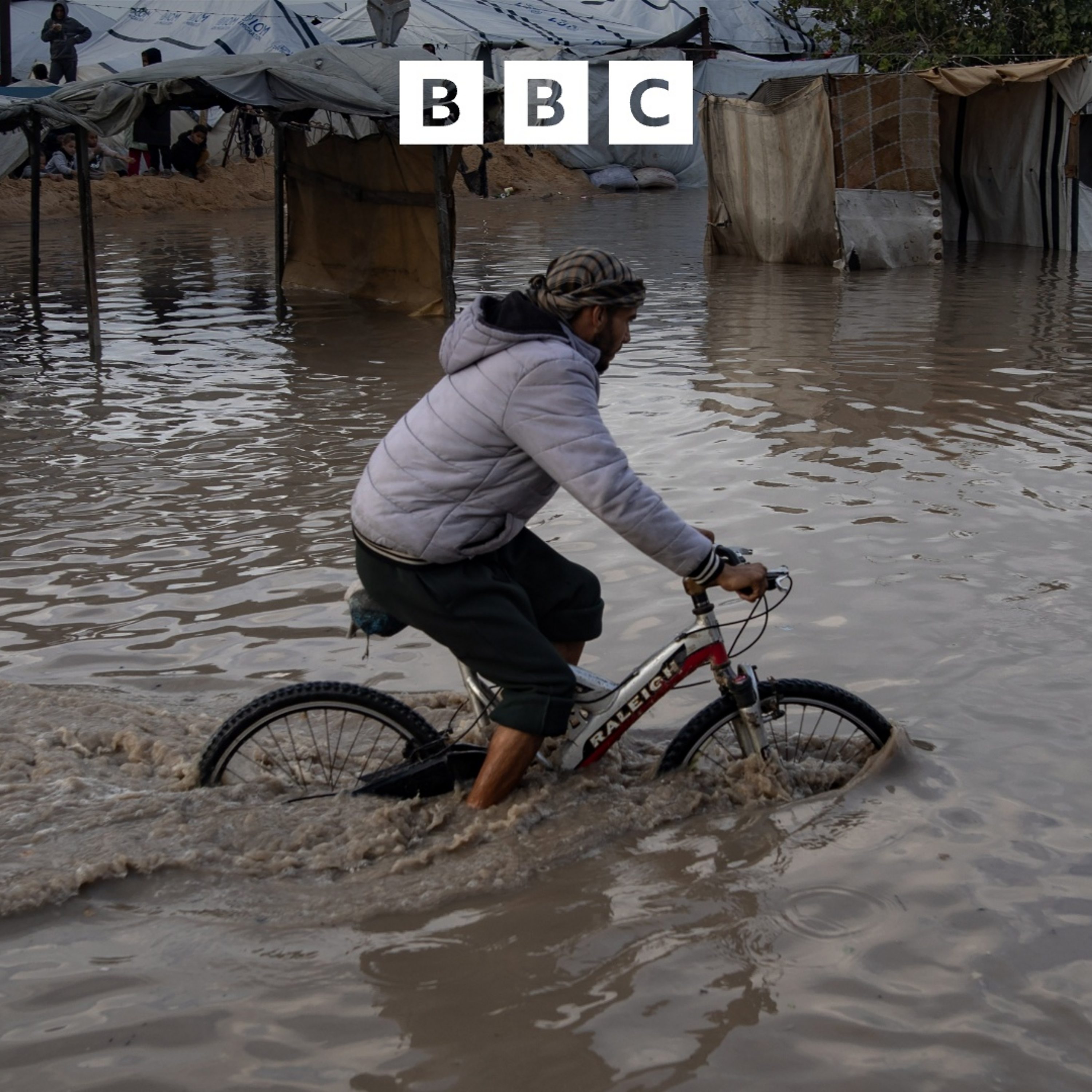
Global News Podcast
Thousands at risk after flooding in Gaza
00:30:38
The UN says 800,000 are at risk from flooding, as crucial aid fails to enter Gaza
Loading summary
Transcript1 lines
- [00:00]
A
This BBC podcast is supported by ads outside the uk. If you've got a move coming up, you really need to look into United Van Lines. The Do It All Moving Specialists With United Van Lines, you don't worry about a thing. You have a dedicated moving coordinator, qualified drivers, and full value protection for your possessions. Compare that to a couple of dudes manhandling your family heirlooms or cramming your things in a container on your driveway. Rather than hope for the best, you deserve a hassle free move. Visit unitedvanlines.com Big moves, small moves all moves Easy Choice Hear that? It's holiday cheer arriving at Ulta Beauty with gifts for everyone on your list. Treat them to fan favorite gift sets from Charlotte Tilbury and Peach and Lily. Go all out with timeless fragrances from ysl, Ariana Grande and Carolina Herrera. And you can never go wrong with an Ulta Beauty gift card. Head to Ulta Beauty for gifts that make the holidays brighter and even more beautiful. Ulta Beauty gifting happens here. This is the Global News podcast from the BBC World Service. I'm Janak jalil and at 16 hours GMT on Friday 12th December, these are our main stories. There are warnings from the UN that 800,000 people are at risk of flooding in Gaza as crucial aid is still not allowed into the devastated territory. An Australian minister accuses Reddit of trying to protect its profits after it launches a legal challenge against the country's landmark social media ban for under 16s. Also in this podcast, we believe this has happened in recent decades, potentially up to the past 200 or so years, but it is happening relatively quickly and it's very exciting for us. We hear how changes in polar bear DNA could help protect the Arctic animals from climate change. At least 12 people have been reported dead or missing as a result of a severe winter storm that has caused widespread flooding in Gaza. The Hamas authorities also say more than a dozen buildings have collapsed and tens of thousands of tents sheltering displaced families have been inundated. The UN is warning that 800,000 people are at risk from flooding even as Israel daily restrictions are preventing aid, including material for shelters and sandbags, from entering Gaza. Two months on from a U S brokered ceasefire, people in Gaza are still waiting for reconstruction to begin. Israel and Hamas blame each other as a Trump administration urges both sides to move forward onto the second stage of the ceasefire deal. Our Middle east correspondent Lucy Williamson reports the Pastor Ghedir's tent in Gaza City is swimming with muddy Winter arrived here hard on the heels of war before houses or lives were rebuilt. Rain streams through gaps in the flimsy canvas shelter Ghedir shares with her husband and six children displaced from their home in Jabalia during the war. We want caravans, we want our homes rebuilt to go back to our houses. We long for concrete to keep us and our children warm. As she speaks to our cameraman in Gaza, Ghedir sweeps a fresh stream of water from the entrance to the tent. Every day I sit and cry for my children. All they think about is water and sweeping and working. It's bitterly cold. We're all coughing, suffering from diseases. Here we are, my family and I, living a life of humiliation. For weeks, Gaza has been stuck in the first phase of the ceasefire deal, as Hamas has retrieved and returned the bodies of hostages from the rubble. Israel insists it won't move forward until all the hostages are back, but one is still missing. Rankvilli was captured during the 7 October Hamas attacks, a police officer recovering from a broken shoulder who went to defend a nearby kibbutz. Vigils are held for him each week across Israel, including in his hometown of Maita, where his parents, Talik and Itzik, shared their anger at Hamas failure to return him. They stole our kids. Orchid stole them. Why they keep him? They know where it is? Absolutely. They just try to hide them or keep them and they play with us. This is what they want. I think they want to keep one. Yeah, they want to keep him. After a few months, years, I don't know to say, okay, we got him, but we want this or this or something else. No, not going to happen. A Hamas official said these allegations were untrue and that Israel was trying to avoid implementing the agreement. Both Israel and Hamas face irreversible concessions in the next stage of the deal. For Hamas handing over weapons for Israel handing over security to an international stabilization force. Both sides, Israel and the Hamas, are sharing the same interests not to move so fast into the second stage. General Israel Ziv is former head of Israel's Military Operations Directorate. Hamas doesn't want to lose control and power, and the Israeli side, for political reasons, also prefer to stay in Gaza, as it is election year and nobody wants to explain their base or the government that they have to withdraw from Gaza. Gaza, still divided between its warring parties, faces a dangerous moment caught between ceasefire and peace. That report by Lucy Williamson well, newly released videos show six Israeli hostages celebrating the Jewish festival of Hanukkah in a tunnel in Gaza, months before their dead bodies were recovered by the Israeli military during an operation last year. One clip shows the hostages carefully lifting and lighting tiny makeshift candles on a menorah made of disposable cups. It's a particularly painful video for Israelis, as our Middle east analyst Sebastian Usher explains. I think this is the one that has struck deepest. I mean, there were a large number of videos that essentially the IDF gave to the families and families have now put out. Hanukkah is about to happen again. The festival of lights. And these images of six hostages, four men, two women in this dark tunnel lighting these candles, you can imagine, have huge symbolic and emotional significance. Their families actually put out a statement saying lighting Hanukkah candles in that dark place captures the essence of a Jewish spirit, light prevailing over darkness. Now, it's been portrayed that this was an attempt by Hamas as a kind of propaganda exercise to show that they weren't being treated so badly. Because you see in other video of the hostages playing backgammon, they're playing cards, et cetera. But it was never put out by Hamas. Perhaps they saw that it would actually have the opposite effect. The six hostages, as far as Israel is concerned, the IDF is concerned, they were murdered by Hamas just days before they were found. Hamas has never accepted that, never agreed to that. But they really have come to symbolize the fate, the suffering of those hostages in Gaza. Sebastian Usher. Dramatic details have emerged about the dangerous mission to extract the Venezuelan opposition leader from where she was hiding in the country, to get her to Norway to accept her Nobel Peace Prize. Maria Corinna Machado says thousands of people have been kidnapped, disappeared, or tortured under what she calls the corrupt regime of Nicolas Maduro. The US Special forces veteran who oversaw the mission to smuggle her out of Venezuela, has been speaking to the BBC about the perils they faced. Brian Stern, who runs Aruba, a company specializing in rescue operations, was speaking to Ione Wells. There was a land component. She was in a house, she was in hiding. She had to get moved from there to a bls, a pickup spot for a boat. And a boat took her from Venezuela right off the coast to a bigger boat. That's the boat that I was on in very rough seas, five to ten foot waves, which is very, very rough seas, especially for these kinds of small boats in pitch black darkness. Rendezvoused at sea, and we transferred Maria from one boat to the next and then drove her very far. If our boat sunk, we were much closer to Venezuela than any other country. For perspective, we were right off the coast. The journey was not fun. It was cold, it was very wet. We were all soaked. These things are complex. It's not Uber. It's not. I will go to the beach and get on the boat and then it will meet me and then it will go and it will be okay. It's not that at all. These things are very dangerous. They're very scary. There are people trying to kill her, people trying to kill us. This is dangerous stuff. There's the land domain, the air domain and the maritime domain. The maritime domain is the most dangerous domain that anyone works in. If I'm driving a boat and I blow an engine, I'm swimming to Venezuela, where we came from, and they'll kill us bad, right? So we used that to our advantage and got her onto land and then from there got her to an airplane and she flew. So in total, it had a land element, two boats. And then further, before flying to Norway, you mentioned, obviously, her high profile. There's been some reporting that there were disguises involved. Was there a need to conceal her identity to protect her during this journey? I don't want to get into specific things that we did because we have other work that needs to happen. It's fair to say that lots of different things were done to mask her physical signature, meaning her face is the big one. And also her digital signature as well. There's a fingerprint that we all have digital. And one of the things that's never covered in press is the biometric threat, right. When you go through customs at Heathrow, right, you just look at the camera. The biometric threat is so real. The Venezuelan intelligence service is extremely sophisticated. Venezuelan has Russian radar. Venezuela has all. All the very sophisticated things that a normal sovereign country. Venezuela is a very wealthy country. Maduro has driven it off a cliff. But that doesn't mean that they don't have resources. They have F16s, they have a navy, they have a coast guard, they have coastal defense. Biometrics being one of the bigger threats that is very hard to defeat. Brian Stern, who organised the operation to smuggle the Venezuelan opposition leader Maria Corinna Machado, out of the country. Australia's social media ban for under 16s introduced this week, is being closely watched by other countries to see how effective it is in protecting children from harmful content. If this trailblazing measure works, many could follow suit. Under the ban, tech companies that failed to stop young Australian users accessing their platforms face fines of millions of dollars. Two teenagers have already challenged the ban in Australia's highest court. Now, the online discussion site Reddit has also filed a lawsuit saying the legislation has serious Implications for privacy and political rights. But the health Minister, Mark Butler, says his government is determined to protect children and to stand up to big Tech. Let's be clear, that should come as no surprise across our history when our governments have taken strong action to protect citizens against highly addictive, highly damaging products. They've usually been challenged in the courts by the companies that profit most from them. But the idea that this is some action by Reddit to protect the political freedoms of young people is a complete crock. Our correspondent in Sydney, Katie Watson, told me more about Reddit's arguments for overturning this ban. Reddit says that the law has some serious privacy and political expression issues and that's why it's wanting to file an application to the High Court. It says there's more effective ways for the Australian government to accomplish our shared goal of protecting youth. It also goes on to say that the law is being applied to Reddit inaccurately. They argue they're a forum primarily for adults. They don't have the traditional social media features that the government has taken issue with. It's never marketed to young people, but wants also to make clear that they're complying with the law. It's not to attempt to avoid compliance that it will still do. It's also not wanting to win over young users for business reasons. All it wants to do is put its perspective as to why it thinks, and I quote, the law is missing the mark on actually protecting young people online. And does it explain or go into detail about what these more efficient ways of ensuring the online safety of young people are, in its opinion? Well, it says that there are more targeted privacy preserving measures. So for example, age assurance at the app level. And that's something other platforms have mentioned. They think that would be easier for consumers, which would also include parents. It would also protect user privacy rather than having to kind of verify ages on every single different platform. So I mean, it's kind of putting suggestions, but I think, you know, the overall view is very much an echoed by their platforms is this blanket approach is something that's just not as efficient as something that's more targeted. And it's not the first High Court challenge, is it? There's also been a case brought by two teenagers. That's right, yeah. Back in November, two teenagers who are backed by the Digital Freedom Project. The main person behind that is a libertarian mp. They are arguing that it's unconstitutional, that it goes against their right to private communication. So there's two High Court challenges. Now, I don't think any of this comes as a surprise to the government. When I spoke to the communications minister last week, she said very clearly that they wouldn't be intimidated by big tech companies. They would fight people with ulterior motives, as Annika Wells, the communications minister, put it. So they're very clear that those who support this ban are wanting to make sure that if it's taken to high court, that they will absolutely put their perspective. And let's just remember this is a law that passed easily last year. It had bipartisan support. Katie Watson Melting sea ice and hotter temperatures have reduced the number of polar bears in the wild. But now there's a glimmer of hope for this threatened species. Changes in polar bear DNA that could help the Arctic animals adapt to warmer climates have been detected. The scientists from the University of East Anglia in England looked at polar bears living in southeast Greenland. It's thought to be the first time a statistically significant link has been found between rising temperatures and changing DNA in a wild mammal species. The lead researcher, Dr. Alice Godden, told us more. What we've actually found is changes in how a small part of the polar bear DNA called jumping genes is being affected by that climate change. And these jumping genes, small mobile parts of our DNA, it's in humans and every animal system and they can copy and paste and move around the genome, inserting randomly, creating mutations that we believe are hopefully helping these polar bears to adapt to some of these harsher climates. This is a fast change. Yes, we believe this has happened in recent decades, potentially up to the past 200 or so years, but it is happening relatively quickly and it's very exciting for us, potentially very exciting for the polar bears in as much as they may survive, rather more than we're expecting. Yes, of course, this is a real window of opportunity for us to investigate polar bear genomes more widely and an opportunity for us to hopefully reduce our carbon emissions to help mitigate some of this climate change that they're facing. So their genomes can hopefully catch up and help their adaptation to really provide an opportunity for this really beautiful species to survive. Yet they're demonstrating, are they an ability to adapt that is a much wider one than just in the the last couple of decades? Yes, potentially. You'd normally think of a polar bear in a very icy cold Arctic tundra, but this population's in a very mountainous, quite plant rich green space, which is really unusual for them. If they don't manage to adapt, they are in real trouble, aren't they? As a species, two thirds of polar bears currently are expected to vanish by 2050, and that's really not that far away, unfortunately. If they are able to adapt, then it would make sense, wouldn't it, to say it's not just happening necessarily among polar bears. It might happen with other species as well. Yeah, of course my research looks at some fish species and we're seeing some similar changes as well in our research in the laboratory. That really is signifying some potential hope. But we still really need to be careful with our own climate change ambitions to help protect all species on earth. Dr. Alice Godden speaking to Justin Webb. Still to come in this podcast, you're only going to make things worse for everyone. We'll tell you about the low budget French video game Clair Obscure that's seen off its bigger American rivals to sweep the game. If you've got a move coming up, you really need to look into United Van Lines, the Do it all moving specialists. With United Van Lines, you don't worry about a thing. You have a dedicated moving coordinator, qualified drivers, and full value protection for your possessions. Compare that to a couple of dudes manhandling your family heirlooms or cramming your things in a container on your driveway. Rather than hope for the best, you deserve a hassle free move. Visit unitedvanlines.com Big moves, small moves all moves easy choice Ulta Beauty's Big Holiday Beauty Sale is back with up to 50% off. Must have gifts Shop irresistible deals like the Shark Beauty Flex Style and Benefit Cosmetics Travel size mascaras with new offers weekly, same day pickup or delivery and our trusted associates. We make holiday shopping effortless. Head into Ulta Beauty today. Ulta Beauty Gifting happens here. This message comes from Greenlight. Ready to start talking to your kids about financial literacy? Meet Greenlight, the debit card and money app that teaches kids and teens how to earn, save, spend wisely and invest. With your guardrails in place. With Greenlight, you can send money to kids quickly, set up chores, automate allowance, and keep an eye on what your kids are spending with real time notifications. Join millions of parents and kids building healthy financial habits together on Greenlight. Get started risk free@greenlight.com iheart owning a home is full of surprises. Some wonderful, some not so much. And when something breaks, it can feel like the whole day unravels. That's why Homeserve exists. For as little as $4.99 a month, you'll always have someone to call a trusted profess ready to help, bringing peace of mind to four and a half million homeowners nationwide. For plans starting at just 499amonth, go to homeserve.com, that's homeserve.com not available everywhere. Most plans range between 499 to 1199amonth. Your first year terms apply on covered repairs. Conflict, nuclear concerns, repression. Iran is often in the news for negative reasons, but it's recently been attracting attention for something very different. Greater social freedoms that Iranians are now enjoying. For instance, the fact that more and more young women are riding motorbikes, although only men can actually get licenses. This is despite the theocracy that still rules the country with an iron grip. Caroline Hawley has been speaking to some Iranians. Our generation really does things differently. It's like we're saying, hey, this is me and I am who I am and you cannot change me. Donya is a 22 year old student and theatre director who can't remember the last time she wore the mandatory hijab, except to get into university. She says Iran's morality police are no longer out on the streets enforcing it. There are still risks, so we speak by text over an encrypted app. We're not using her real name and her words are voiced by a BBC producer. Honestly, I think if they bring back the morality police, they've dug their own grave. So women are increasingly claiming their own freedoms. One eye catching phenomenon has been the growing number of them riding colourful motorbikes, well groomed, hair flowing out from beneath their helmets. One rider was asked recently about how other people on the roads were reacting to her. They shout things like bravo and thank you. She says she hadn't realized how many feminist men there were in Tehran. What we're seeing now is nothing short of what a lot of experts are describing as a cultural revolution. I'm now with Sivas Adalan of BBC Persian and he's been monitoring what's happening on social media. Girls are riding on their motorbikes through a tunnel and they're rapping at the same time. And probably a friend of theirs was sitting in a car filming them. One of many if countless videos that are emerging on social media. Not just motorbikes, but girls in classes and schools and streets and all kinds of private institutions showing off their hair, dancing, singing. Not just in Tehran, but this is happening all over the country. It's three and a bit years since nationwide protests broke out after the death in custody of a young woman, Mahsa Amini, accused of not properly wearing the mandatory hijab. Hundreds of people are reported to have been killed by the security forces. But the spirit of defiance that inspired them wasn't crushed, and that's now on full display against a regime weakened by sanctions and war. It is still fighting back, but mostly now with digital surveillance and against people whose acts of social rebellion are most prominent online. Senam Vakil is director of the Middle east and North Africa program at the think tank Chatham House. This government doesn't perhaps have the legitimacy or the confidence to push back against the demands of the population. But of course, there are many people that languish in jail. Political repression remains high. This is not a wholesale transformation, but an incremental tolerance for social space, A space Donya is determined to take advantage of. This is her singing in a play, and she says more and more women are now taking the lead. That report by Caroline Hawley. An unusual silence in the forests of North Sumatra in Indonesia is worrying wildlife experts and conservationists. They fear that some of the world's rarest apes, the tapanuli orangutans, may have been swept away or crushed by a devastating cyclone two weeks ago that killed more than 900 humans and left hundreds more missing. There are fewer than 800 of the critically endangered tapanuli orangutans. One has been found dead, but it's feared that as many as one in 10 of them could have been killed. Local conservationist Panut Hadis Iswayo says the animals already face severe threats from deforestation. We also believe a number of orangutans were also swept by the landslides because they reside on the forest slopes where they've been forced to relocate, because the lower parts of the hills and slopes have been converted into farm plots and plantations, as well as extractive industries such as gold mines and hydropower plants. Our environment correspondent, Navin Singh Khadkar, spoke to a team on the ground who came across the eerily quiet forests. They were there for humanitarian works, you know, relief in particular. But then when they came across the carcass of this particular orangutan, it's not that they've seen many, this is one. But they thought that, okay, this is it, this is where they are buried. Because people were wondering, where have they gone? No sighting, no sound, nothing. And that's why they were very unhappy also because this person I spoke to was a conservation worker himself in the past, and he used to see those animals coming down and feeding on the fruits. Fruit gardens there. Yes. So it's quite, quite upsetting seeing that. Absolutely. Because there's so few of them left still in the wild. And they've already lost lots of their habitat because of deforestation. Yes. So, you know, the deforestation thing, it's a massive controversy, as you can imagine. It's being investigated now. Scientists told me the major thing they were already worried because a massive, massive slope. This is the bottom, you know, forest, and it's a slope, it's a mountain slope that came down. You see the whole thing, the figures that I'm seeing, they're using satellite images around 7,000 hectares. It's massive. So the entire thing coming down. And that is why there were fears that what happened. Although some locals were telling me, no, there are animals, they have this, you know, sense they can just go away. But primate experts were telling me, no, it's not like that. When I asked them why couldn't they go away? Because locals were saying they have this instinct. So primate experts were telling me no, they actually used the branches and twigs as umbrella and wait for the rains to stop. That's what they do. But in this case, the rains didn't stop. Landslides came instead. And now this carcass in particular has given them a reason to be worried now. Vin Singh Khadka, one of Britain's most popular authors, Joanna Trollope has died at the age of 82. Acclaimed for depicting romance and intrigue in middle class Eng England, she wrote 22 contemporary novels and published 10 historical works under the pseudonym Caroline Harvey, Joanna Trollope's books have been translated into more than two dozen languages. Several were adapted for television. In 1994, on the BBC program Desert Island Discs, she was asked how readers responded to her books. People think of me as a women's writer, but over a third of my letters now come from men, the men are saying, and it's such a relief to read fiction where we are allowed to have feelings too. Because one of the aspects of feminism they found so disconcerting was the capturing of the high emotional ground by women. And of course, women are so wonderfully unafraid to talk about their feelings, that they were on the high ground before the men even realised there was any. Kate Moss is an author and founder of the Women's Prize for Fiction, which Joanna Trollope was also involved in. The thing about Joanna Trollope was she was a very fine writer. She was an incredibly clever woman and she was not sentimental and soppy at all. She wrote about real issues. And the thing that she pioneered was the idea that normal emotions in, for want of a better word, everyday life were the things that underpin everybody's experience. So without paying attention to the small things, the details that actually make people feel happy or sad in the world, then the big stuff doesn't really matter because that's where it comes down to. So she, I think was inspirational. She very much batted back the, as she described it, very patronizing attitudes. She's just a women's writer, right from the choir that came out in 1988. I was working at the publishing company when she came in for this first novel. And I can absolutely remember everybody standing around expecting this woman who would look quite like a lady, who might be coming from a cloister environment, all of these things. And this incredibly glamorous, long, lean, high heeled woman walked in and that was her to a T. That she was a contradiction in many, many ways. But she put her finger on the pulse of ordinary people's lives. She spoke of the changing expectations of women and talked about the difference between, I think, her what people thought she might do when she was a youngster and her children. How important was that shift in her books about the roles that women occupy? Oh, incredibly important because of course, Joanna Trollope, you know, when she started she worked for the Foreign Office, you know, she existed on a big platform, if you like. And she wrote her first books under the name of Caroline Harvey and they were historical romances really. And then it was with the choir in 1988 and then the breakthrough in a way was the rector's wife in 1991. But she mapped the changing world that women lived in, going from the idea that it was quite a radical thing for a middle class woman in particular to have a job to it being an expected, normal thing. She wrote about step families and other people's children. One of her last books, it might have been her last Novel actually in 2020, mum and dad, about what it was for the sandwich generation for us to be looking after children and grandchildren and looking after the older generation. I'm one of those people too. I've been a full time carer for 16, 17 years. So she put the things that actually are happening and she mapped the modern world all the way through the 80s, 90s and the 2000s. Kate Moss speaking to Johnny Diamond. It's known as the Oscars of gaming. And at this year's Game Awards in Los Angeles, a low budget French video game, Clair Expedition 33 swept the board, winning nine prizes including game of the Year. You're only going to make things worse for everyone. Well, made by a small team, Clair Obscure has developed a devoted following since its release in April With President Macron hailing it as a shining example of friendship, audacity and creativity, it's now become the most nominated game in the ceremony's history. Guillaume Broche, who led the team that produced it, said they were beyond surprised by its huge success. The fact that it blew up so much and that it resonated so much with players is like, well above all our expectations. It was not supposed to be this big, but it's so cool. And thank you so much to the players for making it happen because it's really thanks to their passion that we are here today. Our reporter Andrew Rogers told me more about the awards won by Clare Obscure. It was a huge night for that game and interestingly, some of the ones where it didn't ultimately win its nominations were because it was up against itself. So it couldn't win the same category twice. But it really went for those categories that are most sought after game of the year and best narrative and best acting awards as well. So Jennifer English won a best acting award for her work in this game and for people who are familiar with some of the other games she's been in Boulders Gate 3 was one that swept the game awards in the past. So it's had huge success and it's. And it's really this move to more narrative games where you're telling a story and there are some quite deep themes within it. Just explain more why this low budget French company did so well against its big American rivals. I think a big part of it is it feeling quite distinct in the gaming landscape at the moment. You know, as I said, there are some big themes within this game to do with grief. So there's a lot of big topics tackled and a lot of the praise for this game came from the acting and from the music. So it's very, very cinematic feel. And also while the game wasn't built with the biggest budget necessarily, it did have really standout performances within it and that's what seems to have got a lot of the attention and got people talking about it online. Because against a lot of games that can feel quite similar out there in terms of, you know, potentially some of the first person shooters, a lot of the multiplayer games that people are playing and are very, very successful commercially, this one did feel quite different and that's why it got fans in unusual places. As you said, the French president being a, a big fan of it because it felt so distinctly French as well. Andrew Rogers and for more on this story, you can go onto YouTube, search for BBC News, click on the logo. Then choose Podcasts and Global News Podcasts. There's a new story available every day that takes a detailed look at what's going on behind the headlines. And that's all from us for now. But there will be a new edition of the Great Global News Podcast later. If you want to comment on this podcast, you can send us an email. The address is globalpodcastbc.co.uk this edition was produced by Alice Adley. It was mixed by Holly Smith. The editor is Karen Martin. I'm Janet Jalil. Until next time. Goodbye. If you're a maintenance supervisor for a commercial property, you've had to deal with everything from leaky faucets to flickering light bulbs. But nothing's worse than that ancient boiler that's lived in the building since the day it was built 50 years ago. It's enough to make anyone lose their cool. That's where Grainger comes in. With industrial grade products and dependable, fast delivery, Grainger can help with any challenge, from worn out components to everyday necessities. Call clickranger.com or just stop by Ranger for the ones who get it done.