← Global News Podcast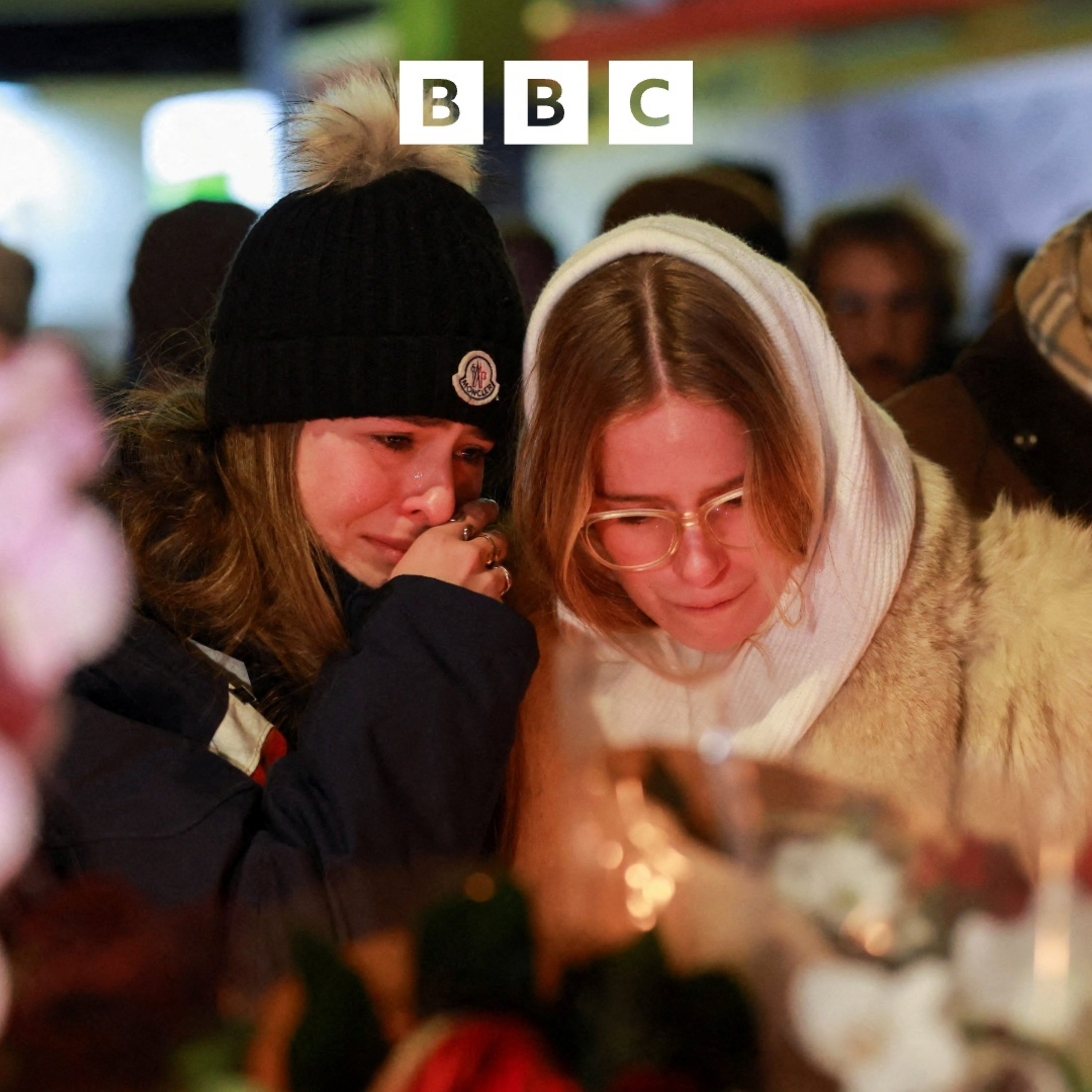
Global News Podcast
Tributes paid to dead and injured after fire at Swiss resort
00:24:58
Hundreds attend vigil in Swiss ski resort after around 40 people die in bar fire
Loading summary
Transcript75 lines
- [00:00]
BBC Announcer
This BBC podcast is supported by ads outside the uk. At the BBC we go further so you see clearer. Through frontline reporting, global stories and local insights, we bring you closer to the world's news as it happens. And it starts with a subscription to BBC.com giving you unlimited articles and videos. Ad free podcasts the BBC News Channel streaming live 24.7/Hi hundreds of acclaimed documentaries subscribe to trusted independent journalism and storytelling from the BBC. Find out more@BBC.com Join.
- [00:38]
Charlotte Gallagher
This is the Global News podcast from the BBC World Service. I'm Charlotte Gallagher and in the early hours of Friday 2nd January, these are our main stories. Hundreds have attended a vigil at a Swiss ski resort after dozens of people were killed in a fire while celebrating the New Year. Colombia's armed forces say they have, in their words, neutralized the main leader of one of the country's most feared criminal gangs. Also in this podcast we look at the debate about whether magic mushrooms should be used to treat mental health problems.
- [01:16]
BBC Announcer
And we feel comfortable there. We enjoy it. We enter a garden, we enter spaces with animals and have similar experiences.
- [01:25]
Charlotte Gallagher
How Virtual Reality is helping injured children in Gaza first, hundreds of people joined a vigil in the Swiss ski resort of Kraum, Montana on Thursday evening after around 40 were killed in a fire at a bar while celebrating the New Year. People prayed and lit candles in memory of the victims. Ilana Shor works in the Constellation Bar. One of his best friends died in the fire. He told us what he saw.
- [01:57]
BBC Announcer
Some friends came, they called me, so.
- [01:58]
Reporter/Interviewer (possibly Pahlab Ghosh or Owen Bennett Jones)
I drove over, I arrived and from.
- [02:01]
BBC Announcer
There everyone was burned. Everyone was screaming, everyone was shouting.
- [02:05]
Reporter/Interviewer (possibly Pahlab Ghosh or Owen Bennett Jones)
They'd been moved from the constellation to.
- [02:08]
BBC Announcer
Bar 1900 and it was crazy. It was like a horror movie. For real. It was a horror movie. I've never seen anything like it in my Life.
- [02:16]
Charlotte Gallagher
At least 115 people were injured, many with severe burns. Dr. Robert Larabaugh is the head of emergency care at Geneva University Hospitals. He told the BBC that injured patients were between 15 and 25 years old and other countries had been asked to help. He was speaking through a translator. They have activated the European Network of Intensive Care for Burnt People. Three people have been sent to Milan. Two people are on their way to go to Germany. Some other injured people are going to go to France, but they had to activate that network with European countries. I've been speaking to our correspondent Sarah Rainsford, who's at the ski resort.
- [02:59]
Sarah Rainsford
I'm just a few meters away from the Constellation Bar, just up the hill a little way. I can See the police tents that have been erected outside it where the forensics teams have been doing their work all day long. There's also a white barrier in front of the bar itself. And a little bit closer to where I am, there's a shrine that has sprung up here where people have been bringing flowers and writing notes in memory of the victims of the fire. And there's candles as well, little candles flickering on the lay by again in memory of those who died. And it is a very sombre place tonight. It's late now, so it's very quiet here, but all day long it has been a town very, very somber. A town which is a resort place. You know, it's a place where people come for ski holidays. It's a place where they come to celebrate the New year. But tonight it's very quiet. There is no party mood here. It's really a place of tragedy and a disaster scene.
- [03:58]
Charlotte Gallagher
And do we know any more on what could have caused this?
- [04:01]
Sarah Rainsford
We don't know for sure. The officials who gave a briefing this afternoon were very careful to say that the investigation was very young, just a few hours old really, and that they are not ruling out anything at the moment. They made it quite clear that this though was an accident. It isn't being treated as any kind of attack, despite reports at the very beginning about explosions. So they're saying, no, this was a fire, it was an accident. What they need to establish now is how and why it started and also to establish whether there were any kind of safety violations by the bar owners themselves. Because many people who lost their lives were down in a basement and there was a fairly narrow entrance and exit point from that basement and lots of people when the fire took hold just couldn't get out of that space. So I think lots of questions about how many people were in the bar, about the safety precautions and also as I say, about what caused it. One theory at the moment is that it may have been a flare inside a bottle that was being used by the waitresses there that possibly set the roof on fire. But that's just a theory now.
- [05:05]
Charlotte Gallagher
And a number of people are in hospital, many with very serious burns, and not all of them are being treated in Switzerland. Some have gone to different countries, haven't they?
- [05:13]
Sarah Rainsford
Yeah, that's right. Because the burns are so serious and because so many people are injured, the authorities here flown people by helicopter to hospitals around Switzerland, but also to other countries. They've been taken to Italy, to Germany and to France. This is a very popular resort with Europe particularly French and Italians. And I understand that those who've been taken to Italy are Italian nationals. But yeah, very, very severe burns, third degree burns, a lot of smoke inhalation and people really coming out of that, those who escape with their lives telling absolutely dreadful stories about their terror, about their panic, and also about what they saw as they fled for their lives. So really, really devastating things that happened here and that people have seen, people have experienced and people have heard in the last few hours.
- [05:58]
Charlotte Gallagher
Sarah Rainsford, Trende Aragua is Venezuela's most powerful and far reaching criminal gang. Now, Colombia's armed forces say they've killed one of its main leaders, known as El Viejo, or the Old Man. He was on the FBI's 10 Most Wanted list and accused of directing the gang's global drug trafficking and financial operations. Our global affairs reporter Mimi Swaby told me more about him.
- [06:24]
Mimi Swaby
In this military and police joint operation, the Colombian armed forces say they neutralized El Viejo. In this case, we can infer this actually means they killed El Viejo. Now, he was the first of the Trend Aragua leaders to appear on the FBI's 10 most wanted list with a pretty hefty $5 million reward on his. Now he is considered the second in command. And him being on this list, according to the FBI, highlights the gang itself, but also the US's aggressiveness to trying to dismantle it.
- [06:55]
Charlotte Gallagher
And why has Donald Trump been focusing on this group? Obviously he's been focusing on targeting a lot of drug cartels recently, but why particularly was this one put on that list? Do we think the Trend Aragua is.
- [07:07]
Mimi Swaby
Designated as a foreign terrorist organization. This is alongside an increasing number of criminal gangs that we've seen the Trump administration target in order to give themselves more or legal power to try and fight them. This one in particular, according to President Trump, is accused of flooding the US with drugs and also incredibly violent crime. And we've seen him kind of use the trend as a scapegoat for lots of crime in general. Lots of the alleged members were targeted in numerous waves of deportations from the US back to Venezuela as well as other countries. And we've also seen it play a central role in the narrative, especially of these deadly strikes on vessels allegedly carrying drugs in both the South Caribbean Sea and as well as the Pacific Ocean. There's very little information or kind of facts we have been given for the trinderague, but there are many others participating, if not participating more in the drug trade within the us.
- [08:04]
Charlotte Gallagher
And I just assume that when leaders of these Gangs are killed, they're replaced pretty quickly.
- [08:10]
Mimi Swaby
El Viejo is protege of the top, top guy of Trentaragua, so someone would.
- [08:15]
Charlotte Gallagher
Probably fill his role.
- [08:16]
Mimi Swaby
However, it's more of a sign and a warning to other gang members that actually, regardless of your status, the US and the FBI in particular in this case, as well as the Colombian armed forces, they are actively looking and hunting down these key figures.
- [08:33]
Charlotte Gallagher
That was Mimi Swaby. A series of new research results indicates that psychedelic drugs could be hugely beneficial in treating a range of mental disorders. These include depression, obsessive compulsive disorder, PTSD and trauma, as well as alcohol and gambling addiction. Doctors say the medicines are promising, but their use outside of authorized clinical trials is dangerous and illegal. This report from our science correspondent, Palab Ghosh.
- [09:04]
Reporter/Interviewer (possibly Pahlab Ghosh or Owen Bennett Jones)
I walk with Ian Roulier along a lake in central London. He tells me he's lived with depression all his adult life.
- [09:12]
Ian Roulier
At my very worst, 12 years ago, everything felt like a mountain, you know, like making a cup of tea, getting out of bed, being able to face work. Basic things were just really impossible to do.
- [09:25]
Reporter/Interviewer (possibly Pahlab Ghosh or Owen Bennett Jones)
Antidepressants didn't seem to help.
- [09:28]
Ian Roulier
I got to a point when I'd had to stop working that I felt that my mental state and its impact on other people made it logical. There was a cold logic to it that if I wasn't around, then I would stop other people around me suffering.
- [09:44]
Reporter/Interviewer (possibly Pahlab Ghosh or Owen Bennett Jones)
How do you mean not around?
- [09:45]
Ian Roulier
If I no longer existed, if I died?
- [09:48]
Reporter/Interviewer (possibly Pahlab Ghosh or Owen Bennett Jones)
Ian told me he noticed an improvement after he took doses of the active ingredient in hallucinogenic or magic mushrooms called psilocybin in a medically supervised clinical trial.
- [10:00]
Ian Roulier
I was able to go into some very dark places and get to the very roots of my depression, and that really helped.
- [10:06]
Reporter/Interviewer (possibly Pahlab Ghosh or Owen Bennett Jones)
Ian, who's co director and co founder of a patient support group for others who've benefited from psychedelic medicines called Saipan, says support and therapy was crucial in his treatment.
- [10:17]
Ian Roulier
It's one of the hardest things I've ever done and it's not fun, it's not enjoyable. But by doing that, by facing the darkest parts of my past, I was able to survive that.
- [10:30]
Reporter/Interviewer (possibly Pahlab Ghosh or Owen Bennett Jones)
Psychedelics effectively reset the brain. The field of psychedelic medicines was pioneered by Professor David Nutt at Imperial College. They put the brain back to a state effectively when you were rather young, before you learned everything you have to learn to become a functioning adult. By resetting the brain, they allow people to break free from these ingrained, deeply learned false beliefs, like I'm a worthless person in depression or I have to wash my hands 150 times to get rid of germs and OCD or I can't stop taking a drug. Those are learnt patterns of thinking that relate to behaviour and psychedelics break those down. Two small trials have suggested psychedelic treatments might also help heavy drinkers reduce their dependency on alcohol. Scientists think it reprograms the brain into not wanting a drink.
- [11:22]
Sarah Rainsford
Please remain very still.
- [11:24]
Reporter/Interviewer (possibly Pahlab Ghosh or Owen Bennett Jones)
Here we go. At a scanner at University College London, researchers monitor the brain activity of a volunteer watching tempting pictures of drinks that would normally trigger uncontrollable cravings. It's part of a new trial of the short acting psychedelic dimethyltryptamine to see what effect it has on the memory and learning centres of heavy drinkers. Dr. Ravi Das is leading the experiment.
- [11:50]
Ian Roulier
The idea that these drugs, these psychedelics, so DMT that we're testing, but also psilocybin, can break down these entrenched pathways in the brain should mean that they can be useful in alcohol use disorder, opiates, even gambling.
- [12:06]
Reporter/Interviewer (possibly Pahlab Ghosh or Owen Bennett Jones)
But these medicines are not available to everyone yet because more research is needed and the research itself takes time to get started because it's so tightly regulated. Although many small scale trials have been promising, regulators want to see the results of much larger trials due out later this year before they even consider relaxing the regulations.
- [12:26]
Professor Oliver Howes / Marcus (depending on context)
I can understand why people are keen and excited, but I think it's really important not to jump ahead of the evidence.
- [12:33]
Reporter/Interviewer (possibly Pahlab Ghosh or Owen Bennett Jones)
Psychiatrists such as Professor Oliver Howes of King's College London point out that psychedelic drugs are illegal and are concerned about the harmful effects of psychedelics if taken without medical supervision.
- [12:46]
Professor Oliver Howes / Marcus (depending on context)
At the moment, the evidence is very early days for many of these substances. So we want more evidence, not hype.
- [12:56]
Reporter/Interviewer (possibly Pahlab Ghosh or Owen Bennett Jones)
So what would you say to those who've seen the hype and want to try it for themselves because they can't get it from a doctor, say you go to a backstreet clinic or a drug dealer.
- [13:05]
Professor Oliver Howes / Marcus (depending on context)
I've seen people that have tried this and I've seen it go badly wrong. So I really strongly advise people not to try and take these substances at home on their own or to use back street clinics, because there are risks and, you know, sometimes people have bad reactions to these.
- [13:25]
Reporter/Interviewer (possibly Pahlab Ghosh or Owen Bennett Jones)
But Ian hopes that if the results of larger trials of the drugs are positive, there's an urgency to make them available to those that most need them.
- [13:33]
Ian Roulier
It's being stifled, really, by bureaucracy, red tape, stigma, etc. And people's lives are being negatively impacted by this. People are losing their lives because there is just no treatment available for them.
- [13:50]
Reporter/Interviewer (possibly Pahlab Ghosh or Owen Bennett Jones)
Those most affected hope that the promising science turns quickly into much needed new treatments that are both safe and effective.
- [13:58]
Charlotte Gallagher
And that was Pahlab Ghosh still to come in this podcast.
- [14:04]
Dr. Kerry Brown
At the moment it's looking like its population will actually halve from today's 1.4 billion, approximately down to about 700 million by the year 2100.
- [14:16]
Charlotte Gallagher
China brings in a new tax on contraceptives as it keeps trying to stop its birth rate falling.
- [14:30]
BBC Announcer
At the BBC we go further so you see clearer. Through frontline reporting, global stories and local insights, we bring you closer to the world's news as it happens. And it starts with a subscription to BBC.com, giving you unlimited articles and videos ad free podcasts, the BBC News channel streaming live 24. 7 plus hundreds of acclaimed documentaries. Subscribe to trusted independent journalism and storytelling from the BBC. Find out more@BBC.com Join.
- [15:04]
Charlotte Gallagher
After more than two years of war in Gaza, the UN children's agency UNICEF estimates that more than 1 million Palestinian children desperately need mental health support. Many have life changing injuries and severe trauma at a time when healthcare services in the territory have largely collapsed. One initiative is having some success in providing temporary relief to young survivors, as Chantal Hartle reports.
- [15:36]
Chantal Hartle
Inside a white tent in Azawaida in central Gaza, 15 year old Salah is fitted with a virtual reality headset. Beside him, four other boys, also wearing the goggles, are experiencing a world far different from their usual surroundings. One reaches out and claps his hands together as if swatting a fly. Another says he can see birds. One boy describes seeing a dog motioning for it to come towards him. By wearing these headsets for a short time, the children take in the sights and sounds of environments such as beaches, gardens and quiet city streets. Sala sustained a head injury after he was shot by a quadcopter drone while playing with friends. After weeks of physiotherapy, he is able to comfortably move his head again and says virtual reality is also helping his recovery.
- [16:35]
BBC Announcer
We feel comfortable there, we enjoy it. We enter a garden, we enter spaces with animals and have similar experiences. It's nice.
- [16:46]
Chantal Hartle
The initiative was developed by Palestinian software engineer Musab Ali. He first noticed a positive response to this type of therapy when he tested it on hospital patients and staff. One patient, 11 year old Shyam, had lost a leg and had stopped speaking, but when she wore the goggles she began to talk. Caregivers say children using the headsets feel calmer, more attentive and occasionally they laugh, a reaction that has become rare. Abdullah Abu Shamal, who runs children's therapy sessions in Gaza, has also seen positive results.
- [17:26]
Sarah Rainsford
The speed of treatment, healing and stabilization using virtual reality techniques has been faster.
- [17:31]
BBC Announcer
Than with conventional therapy. With conventional sessions we usually need about 10 to 12, whereas with virtual reality we can achieve results in just five to seven sessions.
- [17:43]
Chantal Hartle
A number of studies have found that virtual reality can be effective for managing conditions such as anxiety, depression and post traumatic stress disorder. There is a note of caution, though. Medical professionals say it should be used as an additional treatment, not as a replacement to conventional therapy. The team behind Gaza's virtual reality program face many barriers. They've reported difficulties transporting the headsets. Power outages are frequent, so is the noise from ongoing bombardment. Virtual reality may provide children with a short term escape from their war shattered environment. But experts warn that psychological wounds are deepening as mental health services remain scarce.
- [18:28]
Charlotte Gallagher
Chantelle Hartle the one child policy in China, enforced between 1979 and 2016 was very consequential. Without it, the country's population of 1.4 billion would today have been higher by several hundred million. But low birth rates mean that as the population gets older, the workforce gets smaller. China's population is predicted to halve by the end of the century, posing a threat to its continued economic success. This explains why citizens have now begun paying a 13% sales tax on contraceptives in an attempt to boost birth rates. Dr. Kerry Brown, professor of Chinese Studies at King's College London, studies these matters. So given that the one child policy is no longer in place, why is the birth rate still so low?
- [19:18]
Dr. Kerry Brown
There's been a decline in the birth rate for a long time, not necessarily to do with the one child policy. It was a social choice and on the whole people now don't want that burden. They will have one child if they have any child at all. There's also a second factor which is that a large number of women don't marry now in China. They feel that they want to develop their careers or they're marrying later, they're not having children. So that's also a social change that's reflected elsewhere in the world too. And finally, I think just the kind of imbalance between men and women. There's 50 million more men than women and so you have a kind of skewed demography just in gender balance. So all of these things combined mean that the birth rate falling is not a surprise at all.
- [20:07]
Reporter/Interviewer (possibly Pahlab Ghosh or Owen Bennett Jones)
Now, this tax on contraceptives is just one measure. There have been others, like cash bonuses for children even, but they don't seem to be making a lot of difference.
- [20:17]
Dr. Kerry Brown
No, in 2015, they lifted the one child policy or what? They lifted that. They allowed two children, now they allow three. And I'm sure they would allow people to have more. But the issue really is that, as I say, it's expense, but also the government has got very limited tools that it can use beyond fairly significant economic incentives. One country, I think it's Hungary, I believe, allows people who have more than, I think, three or four children to not pay any tax for the rest of their lives. Well, I mean, China could use that measure, although it's very unlikely. Free or cheaper childcare, that's a significant incentive. But social welfare in China generally is not great. Very paradoxically, it's a socialist country, but it looks dimly on state handouts, so it would have to be a pretty considerable financial incentive and one that would. What people trusted would be there long term. Of course, as this is relatively new, they don't know that. And so it's likely they're going to be cautious.
- [21:20]
Reporter/Interviewer (possibly Pahlab Ghosh or Owen Bennett Jones)
You mentioned Hungary, and I think it is fair to say that China is not alone in this, is it? There are many other countries in East Asia, too, that have low birth rates.
- [21:29]
Dr. Kerry Brown
Indeed, Japan has had a low birth rate for over 30 years. Taiwan has, I think, the lowest of all. South Korea has a low birth rate. So it's a very general issue. All of them have chosen different policy tools. All of them, however, have definitely not embraced particularly high levels of immigration. China could use immigration to try and maintain a population level. At the moment, it's looking like its population will actually halve from today's 1.4 billion, approximately down to about 700 million by the year 2100. Could try and liberalize immigration, but that is extremely unlikely. I've heard no policymakers say that they would do that. What they're trying to do is look after an aging population. With robotics, more and more robotics being used. That's a big experiment, a massive social experiment. China is often experimenting like this in ways that, you know, not. Not happening elsewhere. But it's, of course, something. Again, we don't know the outcome in the short term to medium term.
- [22:36]
Charlotte Gallagher
Professor Kerry Brown talking to Owen Bennett Jones. The Czech artist Alphonse Mucha is known for his paintings of graceful, powerful female figures that help the Art Nouveau era. His legacy is protected by the Mucher foundation and Museum, run by the artist's great grandson, Marcus. Our reporter Wendy Urquhart went to Prague to meet him.
- [22:59]
Wendy Urquhart
Alphonse Mucher was born in 1860 in Southern Moravia. But success eluded him in his home country and he eventually moved to Paris. His great grandson Marcus says Mucha's life as a struggling artist in the City of Lights wasn't always easy. But he definitely had a lot of of fun hanging out with the likes of French artist Paul Gauguin.
- [23:20]
Professor Oliver Howes / Marcus (depending on context)
They had parties together. There's a famous photo of Paul Gauguin where somewhere along the way he lost his trousers and he sat down playing a harmonium that is still in the family collection.
- [23:31]
Wendy Urquhart
Alphonse was eking out a living doing illustrations for magazines and books when fate intervened. As Marcus explains, Sarah Bernhard had a.
- [23:40]
Professor Oliver Howes / Marcus (depending on context)
New play, Gismonda, and it wasn't performing at the box office. She thought it was because the poster wasn't any good, so she asked the printers to come up with a new one. Alphonse Mucher came up with a sketch for the poster that became Gismonda, and Sarah Bernhard signed him up on the spot to a six year contract. This was the birth moment of Art Nouveau.
- [24:00]
Wendy Urquhart
Alphonse Mucher became an overnight success. His decorative panels and advertising posters were the talk of the town. His success led to exhibitions all over the world. Then in 1909, he received an offer he couldn't refuse to return to his homeland and design the reception room of the Lord Mayor's hall in Prague. It's an Art Nouveau masterpiece, featuring murals, sculptures, textiles and a central fresco called the Slavic Concord. When Hitler's troops marched on Prague in March 1939 and laid claim to Bohemia and Moravia, Alphonse Mucher's family quickly hid away every piece of his work. As an artist, a Slav nationalist and a Freemason, Alphonse Mucha was targeted, arrested and interrogated by the Nazis within days of the invasion. He was eventually released, but his health never recovered and he died of pneumonia on July 14, 1939.
- [25:00]
Professor Oliver Howes / Marcus (depending on context)
Alphonse was an artist who loved and respected strong women. And the women in his pictures, they're very clearly women whose strength comes from within. They don't rely on a male gaze to give them value, which was quite revolutionary at the end of the 19th century, beginning of the 20th century, construction.
- [25:16]
Wendy Urquhart
Is underway in the grounds of the Savarin palace to create a multi level urban space. And when it's finished, the public will finally be able to see the entire Slav epic series in one place, just as Alphonse Mucha requested nearly a century ago.
- [25:33]
Charlotte Gallagher
That was Wendy Urquhart reporting, and that's all from us for now, but there will be a new edition of of the Global News Podcast later. If you want to comment on this podcast or the topics covered in it, you can send us an email. The address is globalpodcastbc.co.uk you can also find us on X@BBC World Service. Use the hashtag global newspod. This edition was mixed by Pat Sissons and the producers were Alison Davis and Steven Jensen. The editor is Karen Martin. I'm Charlotte Gallagher. Until next time.
- [26:05]
Chantal Hartle
Goodbye. Bye.
- [26:13]
BBC Announcer
At TheBC, we go further so you see Clearer With a subscription to BBC.com you get unlimited articles and videos ad free podcasts, the BBC News channel streaming live 24. 7 plus hundreds of acclaimed documentaries from less than a dollar a week for your first year. Read, watch and listen to trusted independent journalism and storytelling. It all starts with a subscription to BBC.com find out more@BBC.com unlimited.