← Global News Podcast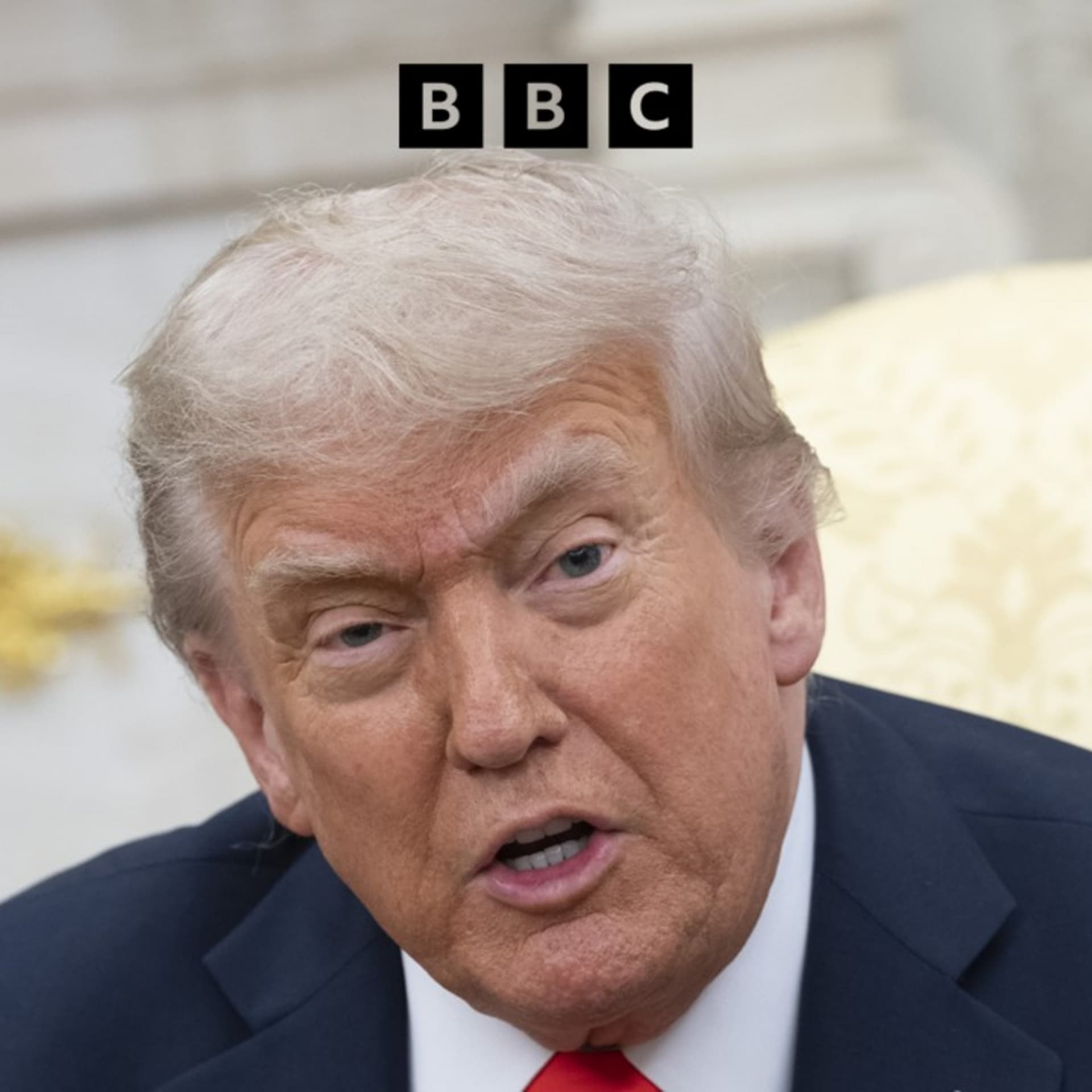
Global News Podcast
Trump tells BBC 'I'm not done with Putin'
00:30:11
In an exclusive interview, Trump says he "trusts almost nobody"
Loading summary
Transcript131 lines
- [00:00]
Nick Miles
This is the global news podcast from the BBC World Service. I'm Nick Miles, and at 13 hours GMT on Tuesday the 15th of July, these are our main stories. After Donald Trump gives Russia 50 days to agree to a ceasefire in Ukraine or face stiff tariffs, he speaks to our chief North America correspondent about President Putin.
- [00:21]
Donald Trump
I'm disappointed in him, but I'm not done with him. But I'm disappointed in him.
- [00:25]
Gary o' Donoghue
Do you trust him?
- [00:26]
Donald Trump
I trust almost nobody, to be honest with you. I'm disappointed that this hasn't been done.
- [00:33]
Nick Miles
We get reaction from Moscow. The Syrian government announces a ceasefire with Druze leaders after deadly clashes with Bedouin tribes. And also in this podcast, we hear from some of the thousands of people abused in Myanmar's scam centers. And if you are a moth, this is what a tomato sounds like. We find out why it matters. We start this edition with an exclusive glimpse into the mind and policies of the US President Donald Trump. Late on Monday, our chief Washington correspondent, Gary o' Donoghue received a phone call from the White House saying the President was ready at short notice for a phone interview. It came at the end of a hugely significant day for American foreign policy. Just hours earlier, President Trump had announced a deal to send more U.S. weapons to Ukraine and given a warning to Vladimir Putin that unless a ceasefire in Ukraine was agreed, agreed within 50 days, then Washington would impose sanctions on Russia and nations that trade with it. So in the light of those developments, Gary o' Donoghue spoke to the president about his attitude to Vladimir Putin and Russia, amongst other subjects. But first, he started on the subject of an assassination attempt on Mr. Trump whilst he was on the election campaign trail almost exactly a year ago.
- [01:58]
Steve Rosenberg
I'm here with the President.
- [01:59]
Gary o' Donoghue
Here you go, Mr. President.
- [02:01]
Donald Trump
Hi, Gary. How are you?
- [02:02]
Gary o' Donoghue
I'm very well, sir. Thank you very much for sparing some time.
- [02:05]
Donald Trump
Good. You covered us very fairly. Appreciate it.
- [02:09]
Gary o' Donoghue
Well, I wanted to ask you briefly about that. To start with, I know it's not a topic you like talking about very much, but I wanted to ask you, the moment you realized what had happened and then the moment you realized you survived, what was your immediate thought, sir?
- [02:26]
Donald Trump
Well, it happened very quickly and I'm not sure I had any conscious thought other than to say that I had to let the people know because I knew they must have thought that it was a disaster. And I could tell by that it was like dead silence and everything. We had 55,000 people and it was dead silence. And so, you know, I assumed that they expected the worst.
- [02:51]
Gary o' Donoghue
Yes.
- [02:52]
Donald Trump
And so I had to let them know I was okay, which is what I did. That's why I tried to get up as quick as possible. They had a stretcher ready to go. I said, no, thank you. I actually had a big argument with them. They wanted me on a stretcher. And I said, nope, yeah, I'm not doing that.
- [03:06]
Gary o' Donoghue
Did it change you? What happened?
- [03:10]
Donald Trump
Well, I like to think about it as little as possible, to be honest. I don't like to think about did it change me, you know, because could have changed a lot of people and I just don't. Do you understand what I'm saying? I don't want to think about it. It's like, I get it, the power of positive thinking, or the power positive non thinking, but. So I don't. I don't like dwelling on it because if, if I did, it would be, you know, might be life changing. I. I don't want it to have to be that. It was a crazy moment. You know, I went on to win the presidency. I don't know if that had anything to do with it, to be honest, but I went on to win the presidency. We're having a great presidency.
- [03:53]
Gary o' Donoghue
One thing I was keen to ask you is these world leaders, they do treat you differently to the way they treated you first time around?
- [04:02]
Donald Trump
Well, I think they think it's maybe not all luck, you know, it's like when you do it twice, it's a big difference. I also think that, you know, over the years they've gotten to know me. This is not an easy crowd to break into, you understand. These are smart people heading up very, very successful, generally countries, you know, they're all Germany and France, Spain and, you know, big countries. And, you know, I've gotten to know them over 30 years, and I think they've come to respect my. Respect me and my decision making.
- [04:41]
Gary o' Donoghue
How do you feel, though, when they're kind of. Obviously, sometimes they're very obvious in their flattery, sometimes over obvious in their flattery.
- [04:50]
Donald Trump
Yeah, well, I think they're just trying to be nice.
- [04:52]
Gary o' Donoghue
You've said you were four times close to a deal with Putin.
- [04:56]
Donald Trump
Yeah, I thought I had a deal four times.
- [05:00]
Gary o' Donoghue
Are you done with him? I mean, I know that sounds a.
- [05:02]
Donald Trump
Simplistic thing, but I'm disappointed in him. But I'm not done with him. But I'm disappointed in him. So we had a deal done four times, and then you go home and you see. Just attacked a nursing home.
- [05:12]
Gary o' Donoghue
Yes.
- [05:13]
Donald Trump
Or something in Kiev. I said, what the hell was that all about?
- [05:17]
Gary o' Donoghue
Do you Trust him?
- [05:21]
Donald Trump
I trust almost nobody, to be honest with you.
- [05:26]
Gary o' Donoghue
So how do you deal with someone you can't trust?
- [05:28]
Donald Trump
Well, it's not a question of that. It's like, I'm disappointed that this hasn't been done. Deal we made last week is amazing. The, you know, the 5%, nobody thought that was possible and it amounts to over a trillion dollars a year on that deal.
- [05:46]
Gary o' Donoghue
You once said that NATO was obsolete.
- [05:49]
Donald Trump
I think NATO is now becoming the opposite of that. I do think it was passed and it was very unfair because the United States paid for almost 100% of it, but now they're paying their own bills and I think that's much better.
- [06:05]
Gary o' Donoghue
And what about the collective defence thing? Do you believe in that still?
- [06:10]
Donald Trump
I do, yeah. I think collective defence is fine.
- [06:14]
Gary o' Donoghue
Can I ask you about Britain, because you're going to having the state visit in September. I know you're looking forward to that.
- [06:20]
Donald Trump
I do, I do. I look forward to it.
- [06:22]
Gary o' Donoghue
And in terms of Britain's sort of role in the world, it sits between the US and Europe. Sometimes it tries to act that mediation role. Do you think it achieves that? Do you think there is this special relationship that British politicians often claim there is with American military?
- [06:40]
Donald Trump
I do. I think one of the problems with NATO is I said we have to fight for them, but will they actually fight for us if we had a war? And I'm not sure I can say, but I will say this, I believe that the UK would fight with us. There's something about it. It's just been so many years and I really think the relationship is just a really great one. I think that they would be with us. I'm not sure that a lot of the other countries would be, which is unfair because we pay far more than anybody else. There's this special relationship we have. Well, look, that's why I made a deal with them and I haven't made a deal. I mean, I've made some other deals, but for the most part, in terms of your competitors and in terms of the European Union, I haven't made a deal, but no, the UK is very special and it's been there for a long time. Yeah, they have been a really true ally.
- [07:38]
Gary o' Donoghue
So may I ask you what would be, looking back, what would be the key for your legacy for you? What do you think would define your legacy, including Americans?
- [07:49]
Donald Trump
I think America is now a great country and it was a dead country one year year ago, and that's been told to me by many leaders of the countries you know, thank you very.
- [08:01]
Gary o' Donoghue
Much for your time, Mr. President.
- [08:03]
Donald Trump
Thank you, Gary. It's a great honor.
- [08:05]
Nick Miles
Let's pick up on some of the Russia related themes of Gary's interview now. Our Russia editor, Steve Rosenberg told me how Moscow has been reacting to the news from Washington. President Putin's spokesman, Dmitry Peskov has held his daily conference call for journalists and commented briefly on Donald Trump's announcement yesterday about arms to Kyiv and possible additional sanctions against Russia. Clearly he didn't want to say very much. He said this that Donald Trump's announcement was a very serious one. Part of it was directly addressed to President Putin. Of course. Mr. Peskov said we need time to analyze what has been said by Washington. If and when President Putin considers it necessary, he will for sure comment on this. Let's wait for Putin's decision to comment himself. So very little there. Now I followed that up with a question to him about Gary's interview and I said, you know, Mr. Peskov, in an interview with the BBC, Donald Trump said he was disappointed with President Putin but wasn't done with him. Would you like to comment on that? He didn't. He said. Please refer to the last thing I said. I'm not saying anymore. This is all I'm going to say on the subject. So clearly the Kremlin is I think a little bit rattled by what Donald Trump announced yesterday. And I think it's likely that at some point we'll hear from President Putin about what he thinks about it. And Steve, I'm seeing on the wise that Russia's deputy foreign minister Sergei Ryabkov given an interview to the TASS news agency saying that Russia rejects ultimatums and yet Russia will be concerned, won't it, about the possibility of secondary sanctions being put on its training partners at that could potentially have an impact. Potentially, yes. But keep in mind those secondary sanctions come with a caveat. They won't be introduced for 50 days. Now 50 days is a long time. A lot can happen. A lot can change in 50 days. We've had previous deadlines set by Donald Trump. Two weeks, for example. This is 50 days. So that gives plenty of time for Moscow and Washington if they want to, to sit down and talk about things. It gives Russia time to come up with counter proposals to Washington and it also gives time for Russia to continue doing what it's doing right now on the battlefield in Eastern Ukraine. You know, from Mr. Dipakov's statements, it's clear Russia will push on with this so called special military operation. Steve Rosenberg in Moscow, Syria's defence minister has announced a ceasefire in the predominantly Druze city of Suwayda after deadly clashes with Bedouin tribes killed about 100 people. He said the move follows agreements with what he called the city's notables and dignitaries. Earlier, Syrian security forces had entered the city to restore calm. Hugo Pechezka reports. This is the first time that Syrian.
- [10:55]
Gary o' Donoghue
Government forces have been deployed to Suaida.
- [10:57]
Nick Miles
Since Islamist led rebels ousted the Assad regime and seized power in December. The violence of the last few days.
- [11:03]
Gary o' Donoghue
Has underscored the challenges the new administration.
- [11:06]
Nick Miles
Led by President Ahmed Al Sharah faces in asserting control over a country that remains deeply fractured.
- [11:13]
Gary o' Donoghue
Minority groups are suspicious of the new.
- [11:15]
Nick Miles
Leaders, and the province of Suwayda has remained largely under the control of Jews, armed groups that have resisted calls to join government forces. Meanwhile, Syrian state media reported fresh Israeli airstrikes on the city of Suaida. Hugo Boshega now if you're ever feeling stressed out and want to let out a sigh or scream, you are not alone. It turns out that plants do something similar. A group of scientists recently learned that some plants make sounds when under stress, and now they've shown the first interaction between these crying out plants and animals. The team found that female moths avoided laying their eggs on nearby plants if they made sounds indicating poor health. Here's our science correspondent, Palab Ghosh. This is a sound Israeli researchers recorded in 2023 of a tomato plant gasping as a result of it being dehydrated. It's normally outside the range of human hearing, but the frequency has been adjusted to allow us to hear it. Their latest research shows that moths respond to the sound. The discovery opens up the possibility of an invisible ecosystem between plants and animals based on the secret sounds they make. Researchers will now investigate the sounds of different plants and whether other species make decisions based on them, such as whether to pollinate, hide inside or eat the plant. They'll also consider whether plants can pass information to each other through sound and crucially act in response, such as conserving their water in drought conditions. Another new area of investigation is whether plants and animals have co evolved the ability to produce and listen to the sounds for their mutual benefit. Palab Ghosh still to come it took me sort of virtually the best part of a day to have sort of.
- [13:09]
Gary o' Donoghue
Three to four hours of my body being scanned. But on a particular day there was.
- [13:13]
Nick Miles
A lot of attention. As you can probably appreciate, we meet the Milestone Man Number 100,000 of the world's biggest human imaging project. Aid workers have described it as One of the biggest human trafficking events in history. The thousands of migrants from around the world, often tricked by the promise of a normal seeming job offer, only then to be forcibly held at scam centers on the border of Myanmar and Thailand. The BBC's Ed Bartler has been to the region to speak to aid workers attempting to rescue them and hear accounts of those now set free.
- [13:55]
Steve Rosenberg
I see a WhatsApp status of my best friend's husband saying there's data entry jobs in Thailand. It was a good offer. So I never thought they're going to scam me and send me to Myanmar.
- [14:09]
Nick Miles
Anna Kaboram from Sri Lanka is one of 8,000 or more trafficked migrants from around the world who recently were released from Myanmar scam centres after being tricked into accepting an apparently normal IT job. She spent 18 months luring people into buying fake cryptocurrency schemes. Failure to scam them led to brutal punishment.
- [14:32]
Steve Rosenberg
We didn't have any option if we didn't do. We are getting beat. We are getting electric shock. It was really traumatic. Still, sometimes I cannot sleep in the night. We were lucky to come back.
- [14:47]
Nick Miles
Judah Tanner is an Australian aid worker and activist who's trying to get the migrant workers freed.
- [14:54]
Gary o' Donoghue
You're looking at over 100,000 people brought into a single area at just a 70km stretch of land, almost untouchable because of sovereign laws. You can't go in and rescue these people. They've found this particular niche area within Myanmar that's controlled by military groups.
- [15:14]
Nick Miles
And then you've got this illegitimate government.
- [15:17]
Gary o' Donoghue
That says that they have no jurisdiction in that region. And so you get this no man's land that has built what we know today as one of the most successful.
- [15:26]
Nick Miles
Criminal enterprises in the world. The forced scamming is built on a system of beatings and worse, according to some of those who've been inside. One informant who asked to remain anonymous showed me this collection of very brutal torture videos. His words are spoken by my translator.
- [15:47]
Steve Rosenberg
They torture as much as they can, but not to die. If a victim die, it's more cost.
- [15:57]
Nick Miles
Have you seen people being killed?
- [16:00]
Steve Rosenberg
Yes, he have seen a Chinese man die.
- [16:05]
Nick Miles
And this is run by Chinese gangsters?
- [16:09]
Steve Rosenberg
Yes. They dare to do everything. Kill the people, rape the girls. If someone touch to their profit or business, they will kill everyone.
- [16:26]
Nick Miles
This is one of those who informants say is profiting from the trade. His name's so Xue Wa and he's the deputy leader of a Karen rebel group called the dkba, which has been specifically implicated alongside the Chinese criminal groups that run the scam centres. Eyewitnesses identified the general visiting compounds where his own soldiers are running security and allegedly carrying out killings. Claims that he brushed aside when I put them to him. Why do all you journalists ask me about these scam centers? Why do they ask all these questions? So he's never had control of any of the migrants. He's saying, I don't commit any crimes. That's why journalists can come and talk to me, because I have nothing to hide. Please, now stop the recording. That report was by Ed Butler. The medical charity Doctors Without Borders says it has found evidence that Ethiopia's federal forces executed three of its staff during the war in the northern region of Tigray. A report issued following the charity's own review of the incident suggests that the three were killed intentionally and at point blank range while facing their attackers. The BBC has contacted the government of Ethiopia for a response to the allegations. Speaking to our senior Africa correspondent Anne Soy, MSF Spain's Director General Raquel Olora demanded accountability.
- [18:02]
Steve Rosenberg
Our colleagues were killed intentionally. They were clearly identified as humanitarian workers. They were clearly identified as MSF workers in a medical mission. They were killed facing their attackers. And other investigations have as well established that there was a convoy of INDF in the roads very close to the place Hercules were found after the killings.
- [18:27]
Nick Miles
Why have you decided to publish the review now?
- [18:30]
Steve Rosenberg
We have been trying for four years to persuade the Ethiopian authorities by engaging with them intently for them to provide an explanation and a clarification of what happened to our colleagues. So far we haven't achieved any concrete results. So we think it's for us, the moment to really make it public and to try to persuade them by other means. We know that it's a very difficult task. What do you hope would be the outcome, the desirable outcome for msf? What we need is an explanation, a clarification of the circumstances as close as possible to the truth. Four years have passed. What we have seen as well is a deterioration, a trend of disregard and targeting of humanitarian workers everywhere across the world. We have seen the numbers in Gaza, we have seen the numbers in South Sudan and in many other places. And what we see now is a trend of impunity, pure impunity, that cannot continue. So we hope that by making this report public, we will force some actors to really take a stance with regards to this problem of impunity.
- [19:28]
Nick Miles
Raquel Ayora from MSF China has been bearing the brunt of the most stringent of Donald Trump's tariffs regime. But now there's a sign that relations could be easing over some key U.S. exports there. The U.S. tech job giant and the world's most valuable company, Nvidia, has been told it can sell advanced artificial intelligence chips there. Again, Washington restricted sales under President Biden and stopped them completely. Earlier this year under Donald Trump, the concern from Washington had been that it didn't want China using the tech for military purposes. So given that, I put it to our business reporter Katie Silver, that this U turn was a bit of a surprise.
- [20:08]
Steve Rosenberg
Chips have actually formed something of a bargaining chip in the relationship and in the negotiations between Beijing and Washington. We have just last week, for instance, seen three companies that make the vast majority of the software that goes into making chip designs being allowed to export again to China. It does seem that on one side you've got China saying give us lower tariffs, we'll give you rare earth, but we also want your chips as well. So it does seem to be forming something of a part of that. And they do seem to have figured in the conversations that we've had and seen in Geneva and London.
- [20:43]
Nick Miles
Washington's concern was always that the chips could be used for military use. There is a caveat to these sales, that they're not going to be the top end.
- [20:54]
Steve Rosenberg
That's right. So the H20 chip was brought about for the Chinese market. It's a slightly downgraded version on the H100 chip that Nvidia has that's available to the rest of the world. It was made for the Chinese market slightly slower, slightly less bandwidth. It was able to be sold there until April. That was when the requirements were made more stringent, according to Nvidia. And what they filed with stock regulators, it was basically because US Officials were worried that China would use these chips to build a supercomputer. So that's what the fear had been.
- [21:27]
Nick Miles
And for Nvidia, which was losing tens of billions of dollars over this, this is extremely good news, isn't it?
- [21:34]
Steve Rosenberg
It is great news for them and it certainly forms a part of a multi stop charm offensive that we've seen from the chief executive, Jensen Huang. So according to a statement, they said that they had visited both Beijing and President Trump in Washington and as part of that they had to agree to a number of concessions and to to really appease President Trump on what his big concerns are. So basically saying that it's going to create jobs, that it's going to strengthen the AI infrastructure, that it's going to onshore manufacturing, which of course is very important for, for President Trump and that ultimately all of this will lead the US to being the global AI hub, the place for AI in the future.
- [22:12]
Nick Miles
Katie Silver. Now, voice recognition software has transformed the way we get help from companies and banks. No need for people on the other end of a phone. A virtual assistant will help you out. Right, well, certainly not in all cases. Voice recognition only goes so far as people with regional or non standard accents know all too well. One company in the UK though now thinks it's cracked the problem. As Will Chalk explains, even within the uk, this is a problem many people from outside the south have. Amy is from Yorkshire in northern England.
- [22:46]
Steve Rosenberg
I constantly have robots that can't understand me. They all sound southern.
- [22:52]
Nick Miles
And this is what happened when a BBC radio presenter in the English city of Derby tried to speak to her own local council's AI helper. Who do we report potholes to? Because we've got a big un outside here.
- [23:05]
Steve Rosenberg
Your message was blocked by our content filter. This may be due to language that appears inappropriate. Sometimes genuine questions get flagged by mistake.
- [23:14]
Nick Miles
Thank you so much and have a great day.
- [23:17]
Steve Rosenberg
Please wait while I process your request.
- [23:19]
Nick Miles
It's actually quite easy to see where this problem's come from though, because AI.
- [23:23]
Steve Rosenberg
Needs to be trained on data and.
- [23:25]
Nick Miles
If that data mainly comes from North American or Southern English speaking sources, AI voices will naturally sound similar. And it's not just an English problem.
- [23:34]
Gary o' Donoghue
We especially work with lots of customers. Many of them are based in Europe or in Asia or even in other.
- [23:41]
Nick Miles
Parts of the world.
- [23:41]
Gary o' Donoghue
And these people tend to have accents.
- [23:43]
Nick Miles
That they're rightfully proud of.
- [23:46]
Steve Rosenberg
Yousef Alami Majati is from London based.
- [23:49]
Nick Miles
AI company Synthesia, who've spent a year.
- [23:52]
Steve Rosenberg
Training in AI on different accents.
- [23:54]
Nick Miles
He uses the example of French accents which when reproduced by AI tend to sound French Canadian. And this is just because the companies building these models tend to be North American companies, companies and they tend to have like data sets that are biased towards the demographics that they're they're in.
- [24:12]
Steve Rosenberg
Synthesia's product is being released in the.
- [24:14]
Nick Miles
Next few weeks and it says it's better at solving the accent problem than some of its US or Chinese rivals. But is it?
- [24:21]
Steve Rosenberg
The BBC's technology editor, Zoe Kleinman has.
- [24:24]
Nick Miles
Been trying it out on Northern Irish accents.
- [24:26]
Steve Rosenberg
I'm going to play you an AI.
- [24:27]
Nick Miles
Clip and a real clip. See if you can spot the difference.
- [24:30]
Steve Rosenberg
Here's the first one.
- [24:31]
Nick Miles
Most visitors know box day as a.
- [24:33]
Steve Rosenberg
Potato pancake, but in some counties like Leitrim and Fermanagh, it's served as dumplings Sounds yummy.
- [24:38]
Nick Miles
Right, and here's the second.
- [24:39]
Steve Rosenberg
Dulse is a salty seaweed snack that.
- [24:42]
Nick Miles
May look unassuming, but we love it. In Northern Ireland, the clip that was.
- [24:46]
Steve Rosenberg
Artificially intelligence generated, the AI clip was the first one.
- [24:50]
Nick Miles
But of course, with all of this comes risk, because the harder they are to spot, the more opportunities AI voice tools offer for scammers and peddlers of misinformation. World Chalk reporting Scientists say they can study our bodies as we age in greater detail than ever before, thanks to more than a billion scans of volunteers. Here in the uk, the world's biggest human imaging project says it has now hit its target of scanning the brains, hearts and other organs of 100,000 people. The 100,000th volunteer to be scanned was Steve. He told the BBC about it. It basically involves me giving up my.
- [25:26]
Gary o' Donoghue
Time for research and it took me.
- [25:30]
Nick Miles
Sort of virtually the best part of a day to have sort of three.
- [25:33]
Gary o' Donoghue
To four hours of my body being scanned because of the day I had and the attention I had by certain members of the media.
- [25:39]
Nick Miles
It was a stop start process.
- [25:41]
Gary o' Donoghue
But it's an amazing experience having a full body scan, the brain scan and ultrasound, to say the least.
- [25:47]
Nick Miles
And you do it. Why, Steve? Why giving back?
- [25:50]
Gary o' Donoghue
I've got grandchildren. It's for future generations.
- [25:54]
Nick Miles
And research is something we all must appreciate because doctors need to make decisions. Professor Rory Collins is the principal investigator and chief executive at UK Biobank. He told us more about how they carried out these studies. It involves magnetic resonance imaging, mri. People may be familiar with that of the brain, of the heart, of the.
- [26:16]
Gary o' Donoghue
Body, low power X ray of the.
- [26:19]
Nick Miles
Bones, the joint body, and also looking.
- [26:22]
Donald Trump
At the, the arteries themselves with carotid ultrasound.
- [26:25]
Nick Miles
And critically, you want to learn how to prevent illness. We've just time to go through two, I think, dementia and obesity. What are you learning about that? Well, what the brain imaging data allows.
- [26:36]
Gary o' Donoghue
You to do is pick up very.
- [26:38]
Nick Miles
Small changes in the brain and you can look at risk factors for developing dementia.
- [26:44]
Gary o' Donoghue
You can look to see how they're associated with those very small changes in.
- [26:48]
Nick Miles
The brain and get much more sensitive information about the determinants of dementia and therefore identify ways to treat and prevent it. With respect to, to obesity, we know that body mass index, which is that measure of your kind of body weight and your height, is a very strong predictor of many diseases, heart disease, stroke, diabetes, cancer. What we found from the body imaging data is that you can actually see very different distribution of fat differences in muscle among people with the same body mass.
- [27:26]
Donald Trump
Index.
- [27:26]
Nick Miles
And those differences are likely to be very relevant to to whether or not you are likely to get disease and therefore provide detailed specific targets for treatments that will prevent the disease. Rory Collins Speaking to the BBC's Nick Robinson. To end this edition, let's return to that late night telephone interview our chief Washington correspondent Gary o' Donohue had with President Donald Trump. Now, often when a world leader does an interview with a news organization, it'll be prearranged for several weeks. So how did this last minute interview come about? Gary has been speaking to my colleague, colleague Amal Rajan. But first, let's hear what Gary had to say to Rob Young, who asked him, did he just ring you up?
- [28:08]
Gary o' Donoghue
Yeah, I mean, I've been for some weeks working some contacts and some channels that I have, particularly because I wanted to speak to him around the anniversary of the attempted assassination because I was there when that happened last July. And to be honest with you, I was asleep last night and the phone woke me up and one of his senior aides said, hi, Gary, the president's on the line for you now. So I. That was that you quickly had to.
- [28:32]
Nick Miles
Do this interview in your pyjamas?
- [28:35]
Gary o' Donoghue
More or less. Yeah. Certainly grabbing a little recorder to record the phone call and gather my thoughts through somewhat bleary eyes, if I may say.
- [28:45]
Nick Miles
Gary, some of our listeners may not know that you're blind. What practical challenge did that present you, given, as you say, you got this call from the president's team relatively out of the blue, actually.
- [28:56]
Gary o' Donoghue
I mean, the detail is kind of tedious in some ways. But when I sort of woke up and I think, I think I accidentally hung up the call to start with, which is not good, is it, when you hang up on the.
- [29:07]
Nick Miles
Yeah, too busy.
- [29:09]
Gary o' Donoghue
Sorry about that. Anyway, they rang back and I ran into my living room and I sat down and I pressed go on a little recorder of mine and I prayed that I had press go and we got the interview. There are some areas I think we could have covered, maybe should have covered, but you do what you can in the time and then they sort of pull it at the end. And although to be fair, he was still talking as they took the phone off.
- [29:33]
Nick Miles
Gary o', Donoghue, our chief Washington correspondent. And that is all from us for now. But there will be a new edition of the Global News podcast later. If you want to comment on this podcast or the topics covered in it, you can send us an email. The address is globalpodcastbc.co.uk. you can also find us on XBCWorldService. Use the hashtag globalnewspod. This edition was mixed by Holly Smith and produced by Tracy Gordon and Alfie Habersham. The editor is Karen Martin. I'm Nick Mars. And until next time, goodbye.