← Global News Podcast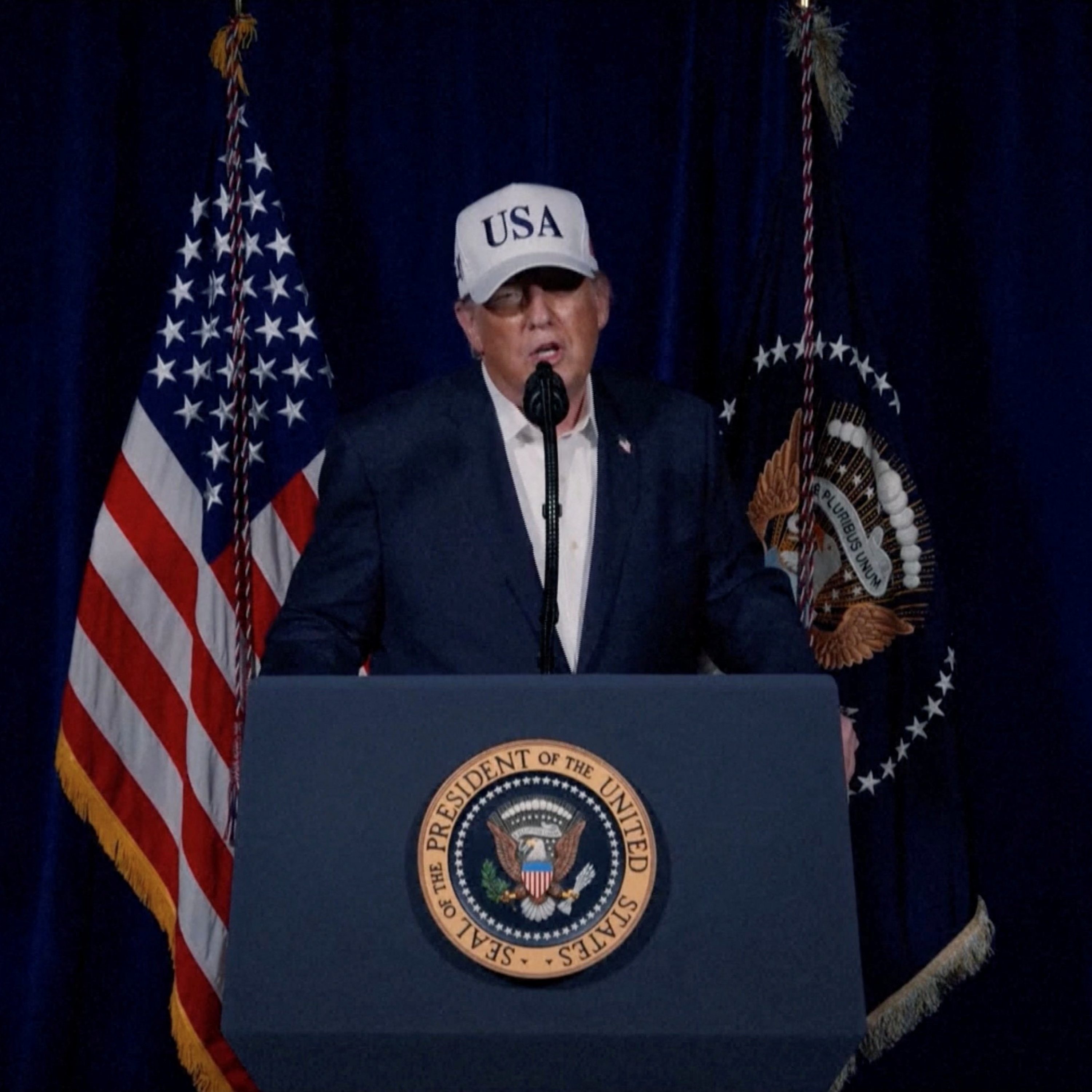
Global News Podcast
Trump warns of more US deaths in Iran war
00:26:06
Iran's retaliatory strikes have killed three US service members
Loading summary
Transcript57 lines
- [00:00]
Schwab Advertiser
This BBC podcast is supported by ads outside the uk. This message comes from Schwab at Schwab. How you invest is your choice, not theirs. That's why when it comes to managing your wealth, Schwab gives you more choices. You can invest and trade on your own plus get advice and more comprehensive wealth solutions to help meet your unique needs. With award winning service, low costs and transparent advice, you can manage your wealth your way at Schwab. Visit schwab.com to learn more.
- [00:34]
Jannatul (BBC Global News Host)
Support is available 247 with VRBoCare.
- [00:38]
Gordon Carrera (Security Analyst)
We're here day or night ready whenever you need help because a great trip starts with the right support.
- [00:50]
Jannatul (BBC Global News Host)
This is the Global News podcast from the BBC World Service. I'm Jannatul and this edition is published in the early hours of Monday 2nd of March the US announces its first military casualty since it began attacking Iran on Saturday. President Trump warns there could be others. Iran has fired hundreds of missiles and drones in response, targeting countries across the Middle east and a key oil route. The price of crude is surging. As a result, the conflict has widened as Israeli military strikes Hezbollah targets in Lebanon. Also in this podcast, the the UK agrees the US can use British bases to attack Iranian missile sites.
- [01:38]
Gordon Carrera (Security Analyst)
The only way to stop the threat is to destroy the missiles at source in their storage depots or the launchers which are used to fire the missiles.
- [01:53]
Jannatul (BBC Global News Host)
President Trump has warned that there will likely be more American military deaths as the US And Israel continue their attacks on Iran. Three US Military service members were killed as Iran carried out retaliatory strikes on American military sites in neighboring Arab states. Deaths were reported across the region as airports, luxury hotels and shopping malls were also hit by Iran. Mr. Trump said the US Israeli military operation would continue until all objectives had been achieved and that it could take up to four weeks. His political opponents have labeled the actions against Iran as illegal, but on Sunday evening, the President released this video to justify them.
- [02:39]
Donald Trump
These actions are right and they are necessary to ensure that Americans will never have to face a radical, bloodthirsty terrorist regime armed with nuclear weapons and lots of threats. For almost 50 years, these wicked extremists have been attacking the United States while chanting the slogan to death to America or death to Israel or both. They are the world's number one state sponsor of terror. We are the world's greatest and most powerful nation so we can do something about what they do. These intolerable threats will not continue any longer. I once again urge the Revolutionary Guard, the Iranian military police, to lay down your arms and receive full immunity or face certain deaths. It will be certain. Death won't be pretty. I call upon all Iranian patriots who yearn for freedom to seize this moment, to be brave, be bold, be heroic, and take back your country. America is with you. I made a promise to you and I fulfilled that promise. The rest will be up to you, but we'll be there to help.
- [03:57]
Jannatul (BBC Global News Host)
Mr. Trump has not addressed the nation directly since the start of the war against Iran on Saturday, but has released this video message as well as another one, and had several telephone interviews with journalists. Senior officials from his administration, including the US Secretary of State Marco Rubio, are due to make their case for the attack on Iran before Congress. On Tuesday, Democratic Senator Chris Murphy spoke to CBS about Mr. Trump.
- [04:24]
Gordon Carrera (Security Analyst)
Americans want him to focus on the crises here at home. Instead, he is busy getting us involved in quagmires overseas that already are becoming deadly to American soldiers. This is a disaster. It is illegal, and the president is obligated under the Constitution to come to Congress and ask for an authorization of military force. He wouldn't get that authorization if he asked for it. Congress wouldn't vote to give him the permission to do it.
- [04:52]
Jannatul (BBC Global News Host)
Our North America correspondent David Willis gave me his take on President Trump's latest comments.
- [04:58]
David Willis (North America Correspondent)
With each American casualty, the pressure grows on Donald Trump to bring about a quick solution to this conflict. And with so many elements of it out of his control, that leaves him in a very uncertain, some might say precarious position. A Reuters poll suggests only one in four Americans approve of this military operation, and so most much depends on how quickly he can pull this off. And today, as you mentioned, he conceded it could take a month or longer to resolve the situation in the Middle East.
- [05:35]
Jannatul (BBC Global News Host)
And what's worrying his critics even more is the fact that he seems to be sending out mixed messages, one moment telling Iranians to rise up, then saying he's open to talks with the regime. And it's still not really clear what his ultimate end game is in Iran.
- [05:49]
David Willis (North America Correspondent)
It is not clear, you're right, what his objectives are here. Is this about regime change or the elimination of Iran's nuclear missile program or destroying Iran's navy? We really don't know for certain, and neither does Congress, which is why we've heard growing calls in recent days for the Trump administration to explain its actions to lawmakers and to give some idea of a likely timetable and define, of course, what constitutes an end game as far as this operation in Iran is concerned. Mr. Trump has issued two video statements, but aside from a couple of brief calls with White House reporters. He has been uncharacteristically silent. He didn't speak with reporters on his journey back to the White House on Air Force One this evening, nor on his return to Washington, D.C. and it has since emerged that administration officials, including the secretary of state, Marco Rubio, have now agreed to brief members of Congress tomorrow. And the U.S. defense Secretary, Pete Hegseth, who's also maintained radio silence up to now, is due to give a press conference tomorrow morning.
- [07:04]
Jannatul (BBC Global News Host)
And another figure who's been pretty silent is J.D. vance, the US vice president. What should we read into that?
- [07:11]
David Willis (North America Correspondent)
Well, that's interesting because Mr. Vance is one who is known to have pushed for a diplomatic solution to the crisis with Iran, one that those in Oman who were playing mediator to these talks between Iran and the United States suggested was within grasping distance before Mr. Trump unleashed, along with the Israelis, this assault on Iran on Saturday. So I suspect we might not be hearing a great deal more from Mr. Vance for the time being. We'll just have to wait and see.
- [07:47]
Jannatul (BBC Global News Host)
David Willis for the first time since the U. S. Israeli strikes began on Saturday, one of Iran's proxies in the region, Hezbollah, has entered the war. It fired rockets and drones at Israel, the first time it's done so since a ceasefire came into effect with Israel nearly a year and a half ago. In return, the Israeli military carried out strikes on Hezbollah strongholds in the Lebanese capital, Beirut, and ordered residents of dozens of villages in southern Lebanon to evacuate. Lena Sinjab in Beirut told us more about the situation there. The explosions that happened in Beirut were very loud, counted almost like around 20 that I've heard from where I'm standing here, the explosions, the attacks shook the city. Everyone woke up. Big lines of civilians fleeing both south of Lebanon and southern Beirut. People are too scared, leaving the memories of the attacks that were launched by Israel last year to cripple Hezbollah, a war that destroyed many of the south of Beir and southern Lebanon. The prime minister issued a statement blaming whoever was behind this is dragging the whole country into a catastrophic situation. Nina Sinjab with more on this, here's our Middle east bureau chief, Joe Floto, who's in Tel Aviv.
- [09:08]
Joe Floto (Middle East Bureau Chief)
Israel's certainly been bracing itself and readying itself for this moment. It's called up around 100,000 reservists. And some of that focus has been on the north. But if you take back a bit of context, Israel and Hezbollah and Lebanon signed a ceasefire deal about 14 months ago. In that intervening period, there's barely been a day in which Israel hasn't struck Hezbollah targets inside Lebanon, much to the annoyance of the Lebanese government and the Lebanese people. Hundreds of people have been killed in those campaigns. And when it came to this new front against Iran, well, the expectation was that a group like Hezbollah that has been backed by, to the tune of billions of dollars by Iran and which is ideologically and religiously close to the Islamic Republic, would not be able to stand on the sidelines and wouldn't be able to just let this war between Iran and Israel go by without responding. And the death of the Ayatollah appears to have been the prompt here. In their statement, they say that he was unjustly martyred, unjustly killed. Interestingly, in the statement, it appears that they're trying to limit their response to this one target near Haifa. Now, the Israeli Defense Forces are not going to limit their response. It appears they have for a while been asking for the opportunity to attack a wider range of targets. And indeed, in the preceding week, they have struck Lebanon several times, attacking the Bekar Valley, which is the the headquarters of Hezbollah, and seeking to degrade their capacity to strike Israel.
- [10:50]
Jannatul (BBC Global News Host)
Joe Floto in Tel Aviv. President Trump has repeatedly urged people in Iran to rise up against their government, despite the huge security forces it still has at its disposal. Security forces that last month did not hesitate to gun down thousands of peaceful protesters. So how likely is it that the people of Iran will once again take to the streets? BBC Persian's Bahman Kalbasi is monitoring the situation there.
- [11:19]
Bahman Kalbasi (BBC Persian)
Clearly, the bombardment, especially in the city of Tehran, is having a major impact both on the military and intelligence targets of the government, but also in daily life of Iranians. We've seen images of a famous hospital in northern Tehran being impacted by bombs that were dropped right next to the building and a residential area, as well as the major broadcasting corporation of the state. And so the reality of the extension of these bombings into the second day and longer obviously will make the life of a lot of millions of Iranians more complicated as it goes on. But also the question of how much of it will impact the forces of the government that were used just under two months ago to suppress the protesters, or will they be targeted in the coming days? One police station in Tehran was famously one that was place of attacking protesters was burned down so by one of these bombs. So that that sort of juxtaposition of what the targets are and how impacts the life of Iranians.
- [12:29]
Jannatul (BBC Global News Host)
Bahman Kalbasi, he also told us there is still very limited Internet access in Iran. Many Iranians outside the country are struggling to contact their relatives, including one woman who's spoken to the BBC. We're not naming her for her own safety. She started by giving us her reaction to this weekend's attacks. Iran.
- [12:51]
Iranian Woman in Turkey (Anonymous Interviewee)
My opinion about what happens in Iran right now, it's a little bit complicated. Well, I'm happy that Khamenei died. Someone that killed many people, tortured a lot of people. I know some people, some of them my friends that were tortured in having prison because of his orders. And I know people that lost their, you know, family members because of this person. And to see him going down and, you know, dying, finally, I'm happy. I'm extremely happy, especially as a minority. I'm even happier because he didn't have the nicest view, the most practical view, when it came to minorities in Iran. And now he's dead. And just like me, my family members and everyone is happy. Although because of this regime, we still don't have any Internet. This is weird because the last time in 12 day war, they didn't turn off the Internet, but now they do so they can have more control over their people. So they are thinking about that more than protecting their own people. They think about killing their people. And it is making me stressful. I cannot talk to my family members. Some of my friends in Turkey helped me and this is a chaos because in some way I'm happy. In the other way, I'm extremely stressed out. My friends here that have family members are stressed out. We don't know what's going to happen to our family members. We don't know the future of Iran. So I only wish the best. And of course, any kind of invasion is not encouraged. I don't like war, of course, but I think this was a necessary intervention to stop the killings. Although we still have some executions, I think this was necessary. But if it goes on too long, I don't think that Iran will come out in one piece.
- [15:05]
Jannatul (BBC Global News Host)
The view of one Iranian woman now living in Turkey. Still to come in this podcast, specific
- [15:13]
Gordon Carrera (Security Analyst)
intelligence came from a combination of Mossad and CIA and perhaps some of the signals intelligence elements that support them. And really the overall campaign is a result of decades of work.
- [15:25]
Jannatul (BBC Global News Host)
An insight into the complex operation that resulted in Israel and the US assassinating Iran's supreme leader.
- [15:40]
Gordon Carrera (Security Analyst)
This episode is brought to you by Intuit. QuickBooks Bill Pay. Growth is the goal, but the paperwork is a trap. If your accounts payable feels like a second job, you're doing it wrong. Enter QuickBooks Bill Pay. Reduce manual data entry automate your approvals and track 1099s in one place. No more chasing signatures, no more spreadsheet headaches. Just control over your cash flow and a back office that actually scales. Automate your accounts payable today@quickbooks.com terms apply. Money Movement services are provided by Intuit Payments, Inc. Licensed as a money Transmitter by the New York State Department of Financial Services. If you're an H Vac technician and
- [16:17]
Rob Watson (Political Correspondent)
a call comes in, Grainger knows that
- [16:19]
Jannatul (BBC Global News Host)
you need a partner that helps you
- [16:20]
Gordon Carrera (Security Analyst)
find the right product fast and hassle free. And you know that when the first problem of the day is a clanking blower motor, there's no need to break a sweat. With Grainger's easy to use website and
- [16:32]
Jannatul (BBC Global News Host)
product details, you're confident you'll soon have
- [16:34]
Gordon Carrera (Security Analyst)
everything humming right along. Call 1-800-GRAINGER Click grainger.com or just stop by Granger for the ones who get it done.
- [16:45]
Schwab Advertiser
This message comes from Schwab At Schwab, how you invest is your choice, not theirs. That's why when it comes to managing your wealth, Schwab gives you more choices. You can invest and trade on your own, plus get advice and more comprehensive wealth solutions to help meet your unique needs. With award winning service, low costs and transparent advice, you can manage your wealth your way at Schwab. Visit schwab.com to learn more.
- [17:12]
Jannatul (BBC Global News Host)
What they are ultimately trying to create is going to replace humans.
- [17:16]
Rob Watson (Political Correspondent)
What it's doing is parboiling the inside of your brain.
- [17:20]
Gordon Carrera (Security Analyst)
This could be a turning point in the history of social media.
- [17:25]
Jannatul (BBC Global News Host)
Welcome to the Interface, the show that
- [17:27]
Iranian Woman in Turkey (Anonymous Interviewee)
explores how tech is rewiring your weekly
- [17:29]
Gordon Carrera (Security Analyst)
and your world coming up next. In our latest episode, we look at the secret meetings at the world's biggest AI summit, the truth about the mystery of a brain melting weapon, and the lawsuit that could shift the future of social Media. Listen on BBC.com or wherever you get your podcasts.
- [17:54]
Jannatul (BBC Global News Host)
The US and Israeli strikes and the Iranian retaliation have sent shockwaves worldwide through sectors from shipping to air travel to oil, amid warnings of rising energy costs and disruption to business, particularly in the Gulf region. When the Asian markets opened on Monday morning, oil prices jumped more than 10%, not just because of the war, but because Iran has told tankers to keep away from a vital shipping route, the Strait of Hormuz, with several ships in the area coming under attack. Around a fifth of the world's oil and gas passes through the Strait of Hormuz in normal times. Our business reporter Nick Marsh in Singapore gave me this update on Oil prices and stock markets.
- [18:38]
Nick Marsh (Business Reporter)
The reason for the big jump is clear. You've got the most crucial choke point for oil tankers in the world, effectively becoming a no go zone overnight. The reason for this easing after that initial spike, not quite as clear, could be traders just taking a breath looking at the fact that the oil market was generally actually quite oversupplied anyway before these latest developments. Other major producers are stepping up their output and that, you know, now we've only got three confirmed attacks on ships. The Iranians seem to be focusing much more on the US bases, not quite as much on the oil tankers in the Strait of Hormuz. In terms of stock markets. Yeah, they're down generally here in Asia. 90% of this oil passing through the Strait of Hormuz goes to Asia. By the way, gold is also up. That's traditionally a safe haven in times of uncertainty, but generally we're not seeing dramatic swings because frankly speaking, the market did know that something like this was possible.
- [19:38]
Jannatul (BBC Global News Host)
And if the sort of freezing of the shipping going through the Strait of Hormuz continues, what would that mean for the global economy?
- [19:46]
Nick Marsh (Business Reporter)
The longer it goes on, the more significant it is. The Strait of Hormuz is very, very important. It's this narrow stretch of sea just south of Iran, north of Oman and the uae. As you say, one in every five barrels of oil consumed globally passes through the Strait of Hormuz. Now, for now, there's no formal blockade preventing tankers from passing through this choke point, but Iran's repeatedly warned vessels not to pass through. Shipping companies, understandably, just don't want to take the risk. We've seen attacks in the past, seen a few attacks, obviously this time round. In the short term, if you're wondering about things like the price of petrol or your energy bills, that's not going to change. But even if other countries do start producing lots more oil, you know, to mitigate this, if this situation continues and this crucial route remains impassable for several days, weeks maybe, that oil can't go anywhere anyway. And that really would have an impact on prices and the whole world's economy. It just really depends how long this goes on for.
- [20:51]
Jannatul (BBC Global News Host)
There's also been major travel disruption in the Middle East.
- [20:54]
Nick Marsh (Business Reporter)
Yeah, absolutely. So Abu Dhabi, Doha and Dubai, those three massive connecting travel hubs, all closing their airspace. That means you've got thousands and thousands of people stranded. Governments around the world are going to look at how to get them out again. Depends on how long this goes on for.
- [21:11]
Jannatul (BBC Global News Host)
Nick Marsh in a joint statement, the UK France and Germany have accused Iran of carrying out indiscriminate and disproportionate strikes on their allies in the Middle East. The leaders of the three European nations say they'll work with the US to stop Iran's revenge attacks, which also threaten their citizens and military personnel in the region. As part of that effort, the British Prime Minister Keir Starmer, who had refused to let the US use British military bases for its attacks on Iran, has said he will now allow America to use them, but only for defensive strikes against Iranian missiles, a move he says is in line with international law.
- [21:51]
Gordon Carrera (Security Analyst)
Our decision that the UK would not be involved with the strikes on Iran was deliberate, not least because we believe that the best way forward for the region and for the world is a negotiated settlement, one in which Iran agrees to give up any aspirations to develop a nuclear weapon. But the only way to stop the threat is to destroy the missiles at source. The United States has requested permission to use British bases for that specific and limited defensive purpose.
- [22:28]
Jannatul (BBC Global News Host)
I asked our political correspondent Rob Watson whether this marked a significant shift given Britain's earlier refusal to allow the US to use its bases for strikes.
- [22:39]
Rob Watson (Political Correspondent)
Yes, it is a significant shift. I mean, up until now the British position has been to really try and distance itself from the operation. But of course, without criticizing, I guess the British government would say that this was an evolution in policy rather than a screeching U turn as some will describe it. And we'll argue, as Sakir Starmer has done in a video, that essentially it's responding to events on the ground and in particular what he called a scorched earth policy by the Iranian regime and that in other words, that missile attacks in the region threatening British civilians, he said, but also threatens UK allies, UK interests and therefore in what he called an act of collective self defense, the US would be allowed to use UK bases for this very specific and limited purpose of targeting missile launchers in Iran.
- [23:34]
Jannatul (BBC Global News Host)
Do we know which bases are likely to be used?
- [23:37]
Gordon Carrera (Security Analyst)
We do.
- [23:38]
Rob Watson (Political Correspondent)
We think there's going to be a base in England called Fairfax and we think there's also going to be the base and San and Diego Garcia, which of course has been in the news because Britain has been trying to arrange a deal with Mauritius to have a long term lease on that base which is seen as absolutely vital. It's in the middle of the Indian Ocean and is currently used by the US and the UK And Keir Starmer
- [24:02]
Jannatul (BBC Global News Host)
very keen to stress that these bases are only going to be used for defensive operations, not any attacks. On Iranian interests because he says the UK has learnt the lessons from the Iraq war more than 20 years ago.
- [24:15]
Rob Watson (Political Correspondent)
Yes, and this is Sakir Starmer being well aware of the skepticism amongst many voters about, Number one, the UK's military partnership with the US and particularly anything involving regime change and attempts to introduce democracy, whether in the Middle east or anywhere else. So this is very much a nod to that. And, and certainly there is quite clearly a divide in the UK and we're seeing that playing out over the last 24 hours with those on the left broadly very critical of the US and Israeli action against Iran and those more on the center and right saying that Britain's position of sort of trying to sit on the fence is pretty reprehensible and that they should get behind water, that the UK should get behind what Israel and the United States are attempting to do. So. So absolutely a very, very divisive issue in this country.
- [25:06]
Jannatul (BBC Global News Host)
Rob Watson and just hours after this announcement, the British Defense Ministry said an Air Force base in Cyprus was targeted by a suspected drone strike. No casualties were reported. More details are emerging about how months after their 12 day war with Iran, Israel and the US were able to assassinate the Ayatollah and around 40 other senior Iranian figures. Former CIA Director General David Petraeus told the BBC that it was a culmination of many years of painstaking intelligence operations.
- [25:41]
Gordon Carrera (Security Analyst)
The specific intelligence this time I suspect came from a combination of Mossad and CIA and perhaps some of the signals intelligence elements that support them as well. And really the overall campaign is a result of decades of work. In fact, when I was the Central Command Commander Back in 2009, we developed the plan to destroy the Iran nuclear program, many features of which are part of this campaign, although obviously the 12 day air campaign used some as well.
- [26:13]
Jannatul (BBC Global News Host)
Our security analyst Gordon Carrera said timing was crucial.
- [26:18]
Gordon Carrera (Security Analyst)
It does look like this was a moment, a window of opportunity that the US and Israel store because they got this intelligence on the whereabouts of the Supreme Leader and knew where some of the other senior leadership figures were. And that explains really that unusual fact of a strike effectively mid morning about 9:45 Iranian time on Saturday morning, rather than the nighttime strike for surprise that you'd normally get because they had this advance notice of where the Supreme Leader would be, which appears by some reports have come from the CIA and belt off this long period of trying to track and understand movements effectively. Then they decided to act on and move a plan into place that they already had to launch the whole campaign based on that initial leadership strike. We know, it would have to be there early because it's going to take a couple of hours for the jets to get from Israel to Tehran or to be in striking distance of Tehran, roughly 90 minutes to two hours. And you need advance warning to make the decision and to put all the other pieces in place to launch the campaign. So it's no good knowing where the Supreme Leader is now. You need to know where he's going to be in a few hours time. And that's clearly something they had and knowledge of other leadership figures at the same time. What does it say about the intelligence penetration? It's massive. I mean, we know that even from last summer's 12 Day War in Operation Midnight Hammer, when they took out the Iranian nuclear program, that they'd been able to identify specific scientists, know where they were and time. And that level of penetration of the Iranian system has been enormous. And some of the reports are there inside the telecom system, they're inside the mobile phone networks, they know who the bodyguards of people are and then are able to watch them, understand their movements and work out where they might be. I mean, what is striking is that of course, Iran saw that last summer and has not been able to close up the vulnerabilities. And they saw it with Ismail Haniya and they've seen it was killed in an IRGC compound. Exactly. And they saw it a few years ago with Mohsen Fakhrizad, who was the head of the Iranian nuclear program, who was taken out on a drive. So they've known for a long time that their top figures are being tracked and they've not been able to deal with that. Now, whether they've failed to close the gaps or whether the US and Israel have been able to find new ways in new methods. But a lot of this, and you can see some hints from Donald Trump's social media post, involves tracking. It's likely to be a combination of maybe some human sources, networks in there, but also the ability to do things like track, track phones, associate with them with people and get inside the system.
- [28:42]
Jannatul (BBC Global News Host)
Gordon Carrera talking to Christian Fraser. And that's all from us for now. If you want to get in touch, you can email us@globalpodcastbc.co.uk this edition of the Global News podcast was mixed by Daniel Fox. The producers were Chantal Hartle and Siobhan Leahy. The editor is Karen Martin. I'm Janet Jalil. Until next time, goodbye.