← Global News Podcast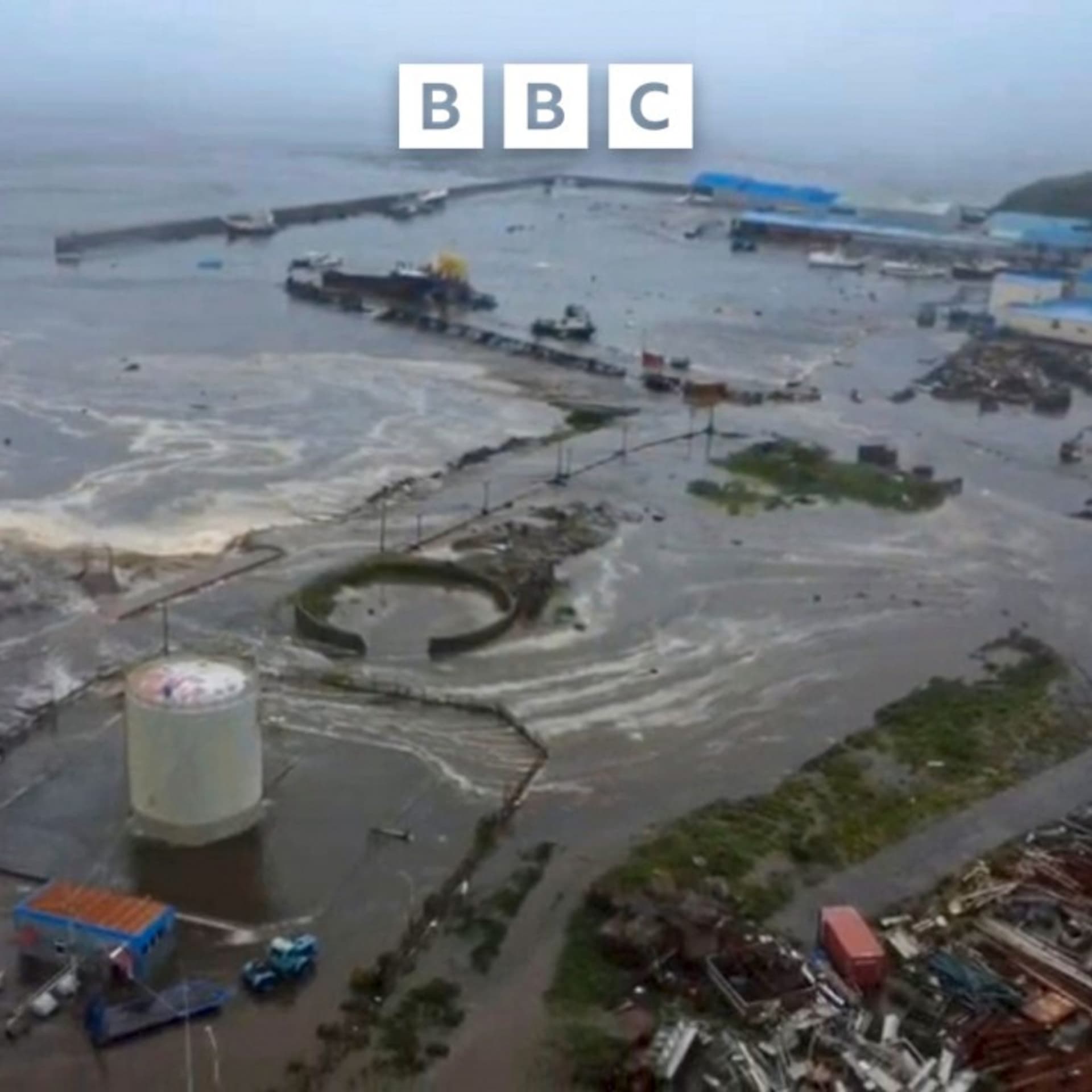
Global News Podcast
Tsunami warnings scaled back across northern Pacific
00:28:57
Tsunami warnings scaled back across northern Pacific after huge quake off eastern Russia
Loading summary
Transcript79 lines
- [00:00]
Narrator
This BBC podcast is supported by ads outside the uk. Lowes knows that more projects mean more tools for a limited time. New and existing Milo's Rewards credit card members can get 12 months special financing on purchases of $299 or more in store and online. Don't wait to get the things you need. Get special financing today. Lowe's we help you Save now through August 27th. Choose 12 months special financing and purchases of $299 or more offer to credit approval and cannot be combined. Minimum monthly payments required. See store@lowe's.com for details.
- [00:38]
Jackie Leonard
This is the Global News Podcast from the BBC World Service. I'm Jackie Leonard and at 13 hours GMT on Wednesday 30th July, these are our main stories. Tsunami warnings have now been downgraded in Hawaii and Japan after a huge earthquake in eastern Russia triggered waves that crossed the Pacific Ocean, and health officials in Gaza say seven more people have starved to death in the last 24 hours. Also in this podcast, Greece seeks to justify its decision to detain all migrants arriving on small boats from North Africa.
- [01:19]
Narrator
We have said clearly that for the next three months we will not accept asylum, so anyone who enters Greek territory knows that they are violating Greek law.
- [01:33]
Jackie Leonard
The earthquake that struck off Russia's far eastern coast at about 11:25am local time on Wednesday was a massive 8.8 magnitude and is one of the most powerful recorded in modern times. It prompted tsunami warnings in countries across the Pacific and led to millions of evacuations. Our Asia Pacific editor, Mickey Bristow has compiled this report, which begins on the coast of Russia's Far East.
- [02:03]
Mickey Bristow
The earthquake was one of the most powerful ever measured. It struck off the coast of the sparsely populated Kamchatka Peninsula in Russia's Far east just before midday local time. It was terrifying for those who experienced it. It triggered tsunami warnings in countries right across the Pacific, in Japan, Indonesia and the United States, even as far away as Peru. The Russian port town of Sevo Kurilsk was quickly submerged in water, with boats moored in the harbour pulled out to sea. Buildings were inundated. Fortunately, residents had already been evacuated. In Japan, tsunami alerts were broadcast on TV and on loudspeakers in public spaces, including this one at a railway station. Two million people were told to evacuate. Thirty flights and rail services were cancelled. Japan regularly experiences earthquakes and tsunamis. The last big one was 14 years ago and has a well developed early warning system. People were told to evacuate elsewhere across the Pacific too. In Hawaii, Randall Collins, the island's emergency management Director advised people to get to safety.
- [03:19]
Narrator
Our number one priority is life safety. And so right now it's an easy thing. Get away from the beaches, get inland and get upward. If you do live in an area that's within a tsunami area, first and foremost, go to a friend's house, go to a neighbor's house, go to your workplace, but go, go inward, inward and upward out of the tsunami area.
- [03:40]
Mickey Bristow
Tourists across Hawaii quickly complied. One, a British holidaymaker on the Big island sought higher ground.
- [03:48]
Randall Collins
We heard about 3 o' clock the earthquake had happened and we started to get alerts through to our phone and also there were sirens going off across the bay. We had alerts on our phone, then the emergency ones come through at 4 hours, 3 hours, 2 hours, 1 hour. We then decided that no, it was time for us to leave and then joined a queue of cars just trying to get to higher ground on the island.
- [04:12]
Mickey Bristow
Higher waves were recorded in various places. They were more than 2 meters high in French Polynesia. But the worst fears don't seem to have been realized. Several hours after the alerts were issued, tsunami warnings were downgraded. This is Stephen Logan, an emergency response official in Hawaii.
- [04:31]
Narrator
Tsunami Warning center has downgraded the forecast from a tsunami warning to a tsunami advisory. The PTWC continues to monitor for more data, to update, to update its forecast and for an all clear that they may issue later on. Those who have evacuated may safely return home based on county assessments and directives.
- [04:50]
Mickey Bristow
The warnings were revised downwards In Japan too. People there are still being told to stay away from the sea.
- [04:57]
Jackie Leonard
That was Mickey Bristow. So what causes earthquakes like the one that's triggered these tsunamis? We've been hearing from scientist Matthew Capucci.
- [05:07]
Matthew Capucci
It's the sixth largest earthquake we have on record anywhere in the world. And really it released the equivalent energy of roughly 1 trillion kg of TNT. Now, the important thing to remember is this is along something called the Kuril Kamchatra Trench, which is a part of the Pacific Ring of Fire, where basically the dense Pacific plate, remember it's dense because it's being crushed by the ocean, is sliding underneath or subducting underneath the OT hot plate. So it's a boundary between two plates. The oceanic Pacific one slides underneath the other. And every year these two plates kind of crunch up against each other by about 3 inches or 77 millimeters, which doesn't sound like much, but imagine you're squeezing two continents together, you're adding an incredible amount of stress and that stress is released in these earthquakes. Now, there are different types of earthquakes. Some are side to side. We call those strike slip. Some are reverse faulting, normal faulting, whatever type. This one was a thrust quake. One plate goes underneath the other and that causes sort of a displacement up and down of the sea floor. And that movement to the sea floor in turn jiggles the water and causes a tsunami. Now the tsunami hasn't really manifested over much of the ocean because you're dispersing all that energy through the entire ocean column. The ocean's like 4 km deep on average. But once you start getting on the continental shelf and towards the beaches, the bathymetry or the shape of the seafloor gets shallower and shallower and shallower and you bottle up and squeeze all that energy into a much narrower column of water and bam, you push a wave ashore and you get that tsunami. It's also important to remember, tsunami waves can be something that come over hours and even longer than that. And so there might be a lengthy duration in between individual rises of water levels. So the first wave isn't always the biggest scientist.
- [06:55]
Jackie Leonard
Matthew Capuchi, Gaza's Hamas run health ministry says seven more people have died of conditions linked to malnutrition over the last 24 hours. The announcement brings the reported number of hunger related deaths since the start of the Gaza war to 151. More than half were children. Sophia Kultorp is from UN Women in Geneva.
- [07:18]
Randall Collins
17,000 pregnant and breastfeeding women are facing acute malnutrition and of course services have collapsed. Those women and children are faced with absolutely nothing. They are delivering their babies without water, without any medical support.
- [07:37]
Jackie Leonard
There's been global reaction to new warnings from UN backed experts that the worst case scenario of famine is now playing out in most of the Gaza Strip. The report by the ipc which which is a global hunger monitoring system, revealed that children are dying from hunger and disease. As Israel continues to restrict aid entering the territory. Our correspondent Amir Nader is in Jerusalem.
- [08:01]
Narrator
We've heard from our sources in Gaza that yesterday around 115 lorries of aid managed to get into the Gaza Strip. Around 109 of those lorries were carrying aid. The other six were for private enterprises, businesses in Gaza. Those six lorries were sort of guarded by gunmen. The other 105 lorries were almost instantly looted as soon as they crossed into Gaza. And that's actually a scenario we're seeing played out almost daily where when trucks are crossing into the Gaza Strip, the sort of desperate crowds of people are jumping onto them, taking that dangerous risk to try and just secure a bag of flour for themselves or for their families. And there are also groups who are more organized who are taking the aid and reselling it on to try and make a profit. So that's the situation in terms of the aid getting in. The humanitarian organizations are saying the only way to avert this situation is to really flood Gaza with aid. So people aren't taking these dangerous risks. The UN's humanitarian agency called OCHA has said that they're noticing there is an easing of the amount of restrictions that Israel is placing on aid getting in. They are getting more approvals to get aid delivered in, but they are also saying that they're still facing impediments and the kind of 100 lorries a day that is getting in should really be up to around 500 if we want to try and reverse this hunger crisis that Gaza is facing.
- [09:26]
Jackie Leonard
Amir Nada well, while Gaza has usually been the focus of attention, there has also been an increase in attacks on Palestinians in the occupied west bank by Jewish settlers. On Monday night, a Palestinian activist, Ouda Hathelin, who helped make the Oscar winning documentary no Other Land, was killed during an attack by settlers. Jewish settlements are illegal under international law, although Israel disputes this and are built on land which Palestinians want for a future state. Earlier this month, two men were killed near the town of Sinjil. One of them was a Palestinian American, Saifullah Musalat. John Donnison reports from there.
- [10:09]
John Donnison
In the dead of night, there's panic as flames engulf the Palestinian village of Burq. Caught on cctv, you can see masked Jewish settlers igniting the fires.
- [10:23]
Narrator
It's getting worse. Yes, absolutely it's getting worse.
- [10:25]
John Donnison
Say Al Kannan is the mayor of Burqa.
- [10:28]
Narrator
People are in their home, sitting in their houses. Why you attack them? Cars sitting in the street, why you burn it, why you come and do all this nonsense? Is this is what you try to prove? This is not going to bring peace for you.
- [10:44]
John Donnison
Here in the Palestinian village of Burqa, you can see that around 40 cars have been completely burnt out. These attacks are happening now really on a daily basis. Property cars being destroyed, olive groves set on fire, livestock poisoned, shootings and Palestinians even being beaten to death. The funeral earlier this month for Saif Allah Musalat, among the latest to be killed. The 20 year old Palestinian American who ran an ice cream shop in Florida had been visiting his family home in Sinjal when he was set upon by Israeli settlers. Well, we've come to the fields now just outside Sinjal. The olive groves in front of me on the hillside. And it's here where Saif Allah Musala was killed. He tried to run, but the settlers chased him with sticks and bars and they beat him to death. Dr. Muertaz Tawafsha discovered the body. He tells me the young man had been beaten to death with sticks and clubs and that he was shocked to see the bruises. At Saif's old school in the west bank, mourners gathered to pay their respects. Afterwards, the young man's father, Kamal, told me he wants answers.
- [12:27]
Narrator
We're in, you know, we're in pain, we're in grief and we want justice, you know, we hope that maybe his sacrifice, you know, will not go in vain, you know, something will change now, you know, and that's what I'm hoping. I'm hoping now something will change. Something will trigger a change.
- [12:57]
John Donnison
No one has been charged with either of the killings. Palestinians say the settlers are allowed to act with impunity, protected by the army and by far right ministers within the Israeli government.
- [13:10]
Narrator
A long life belt. A long life.
- [13:13]
John Donnison
And as the grieving for Saif Ala Musalat continues, the settler violence documented by the United nations has not stopped. It includes attacks on trucks carrying humanitarian aid to Palestinians in Gaza.
- [13:30]
Jackie Leonard
That report by John Donison, still to come.
- [13:36]
Michelle Doherty
I see astronomy as a way of exploring and being able to do that allows us to generate a whole lot of other things, like innovation.
- [13:45]
Jackie Leonard
The UK's first female Astronomer Royal after 350 years, Greece has taken the controversial step of detaining all migrants who arrive on small boats from North Africa and denying everyone the right to apply for asylum. The new migrate, the Immigration Minister has told the BBC it's an emergency measure for three months, initially, after a sudden increase in landings on the Greek island of Crete at the height of tourist season. The European Commission says it's looking into the Greek move. Our correspondent Sarah Rainsford reports from Crete.
- [14:29]
Randall Collins
That giant fan you can hear turning is pointing out towards a group of guards. Guards not in. To a sweltering hot hall where 200 or so migrants and asylum seekers are being detained. It's an old exhibition centre in Crete with adverts still propped against the wall from a tourism fair. Now, this is where everyone who arrives on the island on small boats from Libya is being brought. There are no showers, just a few taps and I see some grubby blankets spread on the floor. Most of them are from Sudan.
- [15:03]
Narrator
Right. These three are Sudan.
- [15:06]
Randall Collins
It's really difficult not being able to speak to any of these boys or the men. We've been told that we can't interview anyone. So I don't know their stories. I have no idea really why they're here. All I know is that they're being held here because Greece has changed the rules and these people no longer have any right to apply for asylum. The new Minister for migration in Greece is Thanos Plevris, a man who describes himself as a hardliner. He told me that locking up all migrants who come from North Africa to Crete is a just response to a recent surge in landings on small boats. Earlier this month, almost 900 people landed in just two days. Without tough measures, the minister says, the situation would have been unmanageable.
- [16:00]
Narrator
It is clear that the country cannot accept such pressure from migration and not react.
- [16:07]
Randall Collins
But just outside Athens, in a parched clearing in the woods, there is a camp where all the arrivals to Crete were eventually brought, both economic migrants and people from places at war like Sudan. We've seen very high metal fences, lots of barbed wire. There are security cameras at the top, and behind them, rows of grey prefabricated huts, some clothes hanging on the railing. Anyone who is brought here is essentially waiting to be deported.
- [16:43]
Narrator
We are living with a prisoner. We couldn't go outside.
- [16:47]
Randall Collins
Somewhere behind the barbed wire is Mustafa, who I managed to contact by phone. In a series of voice and text messages, he told me he was 20 years old and had fled the fighting in Sudan from Libya. He then spent two days at sea, crammed onto a small boat.
- [17:04]
Narrator
We were 38 people on the boat.
- [17:07]
Randall Collins
Like others from his country, Mustafa is now scared he'll be sent back.
- [17:12]
Narrator
I don't have anybody and I don't know anybody because I leave my country because of the war.
- [17:18]
Randall Collins
So my question was for the migration Minister. You now have people from countries that Greece doesn't consider safe, including Sudan, who are locked up, who have no right to ask for asylum. How can that be justified?
- [17:34]
Narrator
I want to be completely honest. We try to have a balance of respect, respect for their rights, but also respect for the rights of the Greek people. We have said clearly that for the next three months, we will not accept asylum. So anyone who enters Greek territory knows that they are violating Greek law.
- [17:52]
Randall Collins
The European Commission told me it is looking into the move by Greece. But the migration minister in Athens really isn't worried. He thinks it's time to get tough and that governments across Europe increasingly agree. So each night, as the sun over Crete turns the sky burnt orange, another group of migrants is loaded onto a passenger ferry heading from the island for a deportation camp. Greece insists that this is A temporary move, a sign of its resolve as traffickers try to a new route. But there is concern about just how easily Europe can discard a basic right. And for migrants like Mustafa, big questions about their future now.
- [18:43]
Jackie Leonard
Sarah Rainsford reporting. There are concerns about the rowing back of environmental protections in Brazil, home to much of the Amazon rainforest, as the country prepares to host the UN COP30 climate summit this year. A UN special rapporteur has told the BBC that a law recently passed by the predominantly conservative Congress will pave the way for more deforestation. Supporters say it's necessary to speed up infrastructure development. Opponents are calling on President Lula, who came to office vowing to restore Brazil's environmental credibility, to veto the bill. Here's our South America correspondent.
- [19:23]
Ione Wells
Ione Wells Essentially at the moment, any big new projects. So infrastructure, energy projects, dams, mines, new highways, need environmental licenses to show that they won't do significant damage to the environment. This new law that lawmakers in Brazil have passed essentially wants to streamline the process for this because at the moment it can sometimes take years for some of these big projects to be approved. Some in particular have raised concerns among some of the UN experts that I've been speaking to in particular about the idea that for some smaller projects, developers would be able to essentially self declare the environmental impact. They worry this could mean that there wouldn't be sort of independent impact assessments of some big projects. They are also worried about a new measure in this bill that would allow the automatic renewal of some licenses if there hadn't been significant changes. This warning comes just months before Brazil is set to host the UN COP30 climate summit. Certainly one of the concerns raised by this panel of UN experts is that this could undermine Brazil's climate leadership if it is being seen to roll back environmental protections at this time.
- [20:36]
Jackie Leonard
That was Ione Wells. South Africa has struggled with power cuts for more than 15 years. Wealthier households have been going off grid for a long time, installing expensive solar systems and their own water supplies within their homes. Now companies are introducing pay as you go backup power systems which allow less affluent communities to do the the BBC's Pumza Filani visited a shopkeeper east of Johannesburg to hear his story.
- [21:05]
Pumza Filani
We're in Krugerstorp, west of Johannesburg. Power cuts have badly affected small businesses. Many of the shops in this area have shut down. I counted three on the drive into this township. We're here to meet with Julia Skewerbiteng who runs a small grocery shop.
- [21:25]
Narrator
It was affecting us directly. The fridges need to run every day if you don't have electricity, you can't even sell the frozen.
- [21:33]
Randall Collins
With stage six load shedding announced, South.
- [21:37]
Pumza Filani
Africa's power crisis grew so severe that in 2023, President Cyril Ramaphosa appointed the country's first electricity minister to try and end the blackouts. And while some progress has been made with poor communities, still face what Eskom now calls load reduction. It's essentially the same cuts with a different name. Julius Solar system is from Witility, a local startup offering pay as you go plans and solar systems built specifically for township businesses and also accessible to lower income households. Vincent Maphosa, a former energy analyst, is one of the founders of of this six year old business.
- [22:20]
Narrator
We had to look at the market across the different segments and start to create products that are fit for purpose and are affordable for that part of the market. Because part of our mission is to make sure that as many homeowners and small businesses have access to power.
- [22:33]
Pumza Filani
Back in Julius shop, the fridge hums steadily. Now customers drop by for sweets, cold drinks and even to charge their phones when the power is out. In another part of town, east of Johannesburg, we visit Benoni to meet Mark Moodley. He made the switch to solar not to save a business, but to save a life. His 81 year old mother, Sajarini, relies on an oxygen machine to breathe.
- [23:00]
Narrator
What was happening is that we're having power cuts and my mom is on an oxygen concentrator and we couldn't do anything else because it was going off for sometimes six hours.
- [23:11]
Pumza Filani
Last year, Sajarini spent three weeks in intensive care. Back then, doctors said she might not survive the year. But the steady power supply has given them more time together.
- [23:22]
Narrator
It's been a lifesaver. Even now with the solar, it adds.
- [23:27]
Pumza Filani
Its value as South Africa's energy crisis drags on. In a country drenched with sunshine, people like Julius and Mark and many others like them who were left out of the solar boom are finding the more afford. Pay as you go has been about taking back control of their daily lives and their future.
- [23:49]
Jackie Leonard
That was Pumza Filani. Here in the uk, the post of Astronomer Royal was created by King Charles II in 1675. The honorary role involves a duty to inform the monarch of astronomical matters. Fast forward to 2025 and a different King Charles and a new Astronomer Royal has been appointed by the government and for the first time, it's a woman. She is Professor Michelle Doherty and she told us how she became interested in astronomy.
- [24:19]
Michelle Doherty
I was about 10 years old and my dad was a civil engineer. Always had lots of different projects going on, and he built his own telescope. I remember he ground the mirror of the telescope and my sister and I helped mix the concrete for the base of the telescope, which, from our perspective, was the most important part of the telescope, of course. But my first view of Jupiter and its four large moons and Saturn and its rings was through my dad's telescope. Got really excited and then just got on with my childhood. And I look back on it now and I think that was probably when it burrowed itself into my head, that this was what I wanted to do.
- [24:55]
Randall Collins
For you and this role. Then I don't know when you first became aware of the Astronomer Royal as a role. There'll be a lot of our listeners who have heard of it, but some who haven't. But what do you think of it as allowing you to do in this particular era?
- [25:09]
Jackie Leonard
We're in.
- [25:09]
Narrator
In.
- [25:09]
Michelle Doherty
So it allows me to engage in a more concrete way with the general public about how exciting astronomy and spaces. I've always liked to engage with people and tell them what I do because I'm really excited about what I do. And so being able to do that as part of my job is really rather important to me. I also want to engage young children and let them know that they can do almost anything they want to do. As a young child in South Africa, I never thought I'd end up doing what I do. But, you know, you say yes to things that might be a bit scary, but you can learn to do them as you take them on. And I think taking chances sometimes pays off. But I want to share my excitement with what astronomers do.
- [25:56]
Randall Collins
And I suppose also it's just interesting to hear. How is your life on Earth affected by your knowledge of astronomy? Do you think it's different having that vantage point and then trying to share that. That with others as you have through your educational work? But now in this role, I think.
- [26:13]
Michelle Doherty
It makes you realize that we're rather small compared to the size of the universe. It always makes me think quite carefully about the kind of lives that we lead and the impact that we have on other people. I see astronomy as a way of exploring. So we're exploring what else is beyond our solar system and in our solar system as well. And being able to do that allows us to generate a whole lot of other things, like innovation. Some of the instruments that we build are then used to innovate in other areas of research. And so the UK economy can gain from that. Improving the amount of children that take up stem subject is something I'm really passionate about as well. And so those are the kind of ideas I have in my mind about what I want to do. I don't have exact clarity yet, but I really want to share my enthusiasm and excitement for what I do.
- [27:10]
Jackie Leonard
Professor Michelle Doherty speaking to Emma Barnett. Black Sabbath fans have been paying their respects to the British heavy metal star Ozzy Osbourne in his home city of Birmingham in the English Midlands. As we record this podcast, the singer's coffin is being driven through the city centre, pausing at the Black Sabbath bridge, which has become a sea of flowers since Ozzy died earlier this month. Among the crowds, our music correspondent Mark Savage.
- [27:38]
Mark Savage
There are thousands of people here. They are blasting out Black Sabbath songs and have been since 8 o' clock this morning. People of all walks of life, all ages, they're covered in Black Sabbath tattoos. They've got tributes to Ozzy, they're holding bouquets of flowers the they want to go and place on this Black Sabbath bench that's just behind me once the cortege passes through.
- [28:02]
Randall Collins
Rest in peace, Aussie, you absolute legend. The Prince of Darkness. Thank you for everything. Thank you for sharing your talent, your kindness, your incredible sense of humor. Fly high, Aussie. It's almost like part.
- [28:18]
Pumza Filani
Part of the family.
- [28:19]
Jackie Leonard
King of hell, Prince.
- [28:22]
Randall Collins
The world feels very strange.
- [28:24]
Pumza Filani
Like Birmingham on the map.
- [28:26]
Randall Collins
Birmingham on the map. Straight up. Straight up.
- [28:29]
Mark Savage
I think that Ozzy Osbourne really means a lot to music fans on one hand, but also to the people of Birmingham. You know, there is no such thing as metal music until they released their debut album in 1970. Songs like Paranoid Iron man, they set the tone, they set the lyrical agenda for a whole genre of music. And we saw that just over three weeks ago when Ozzy played what turned out to be his final ever gig just two and a half miles from here.
- [28:57]
Jackie Leonard
That was Mark Savage in Birmingham. And that's it from us for now. But there will be a new edition of the Global news podcast later. If you would like to comment on this edition or the topics covered in it, you can send us an email. The address is globalpodcast@BBC.co.uk you can also find us on X@BBC World Service, just use the hashtag globalnewspod. This edition was mixed by Alison Purcell Davis and the producer was Ed Horton. The editor is Karen Martin. I'm Jackie Leonard. And until next time, goodbye.
- [29:37]
Narrator
3, 2, 1. And a dream to revolutionize space fl.
- [29:45]
Matthew Capucci
Launch like a rocket and land like an airplane.
- [29:47]
Narrator
It was the first time anybody had ever seen any of that told by the men and women who made it happen. Countless hours developing the procedures we had.
- [29:57]
Jackie Leonard
Trained together for so long.
- [29:59]
Narrator
From the BBC World Service, 13 Minutes presents the Space Shuttle. It was like something being born. This vehicle was saying, I'm alive. Let me go search. For 13 minutes presents the Space Shuttle. Wherever you get your BBC podcasts.