← Global News Podcast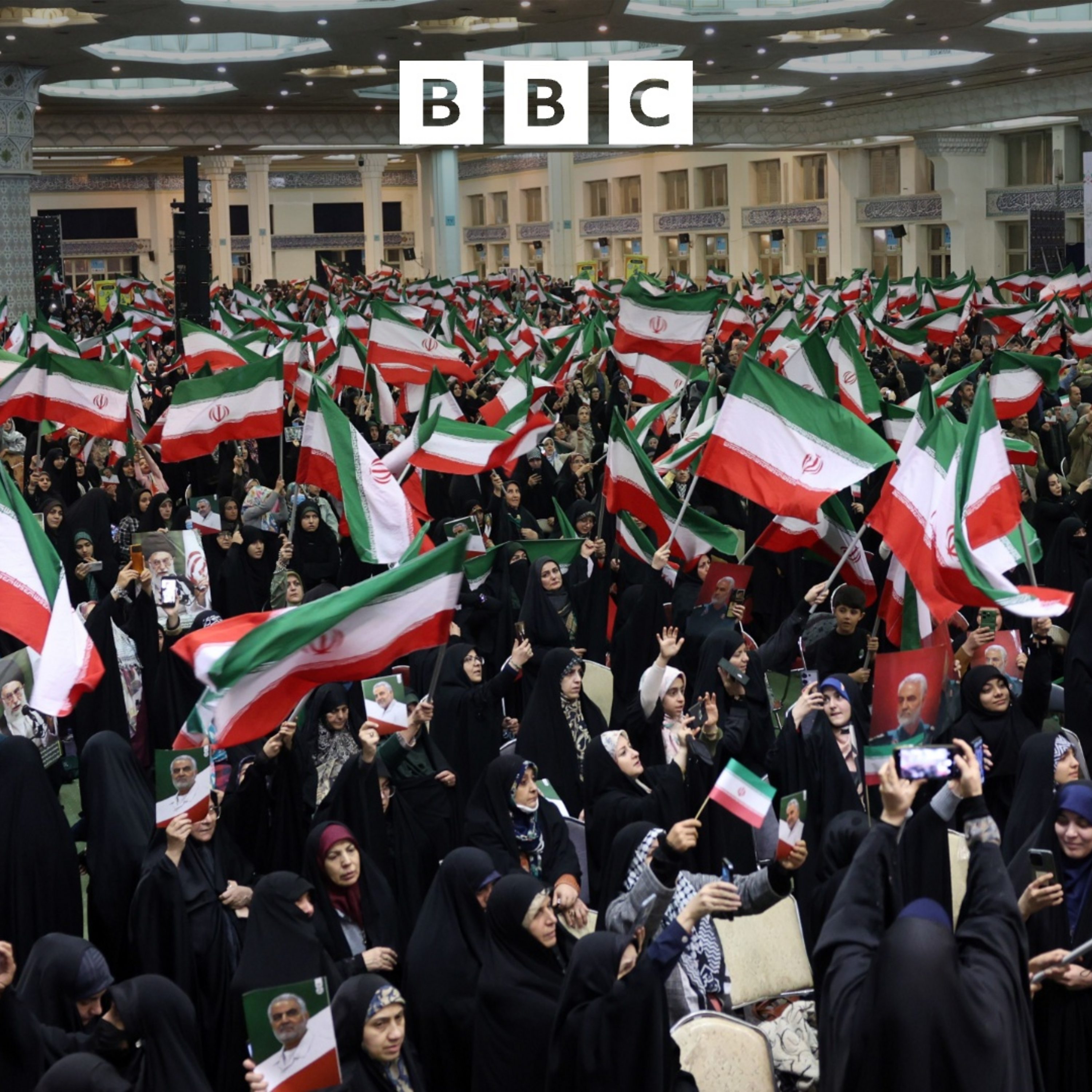
Global News Podcast
US ‘locked and loaded’ to help Iranian protestors
00:29:01
Donald Trump says he'll back Iranian anti-government demonstrators if they're attacked
Loading summary
Transcript1 lines
- [00:00]
A
This BBC podcast is supported by ads outside the uk. At the BBC we go further so you see clearer. Through frontline reporting, global stories and local insights, we bring you closer to the world's news as it happens. And it starts with a subscription to BBC.com giving you unlimited articles and videos. Ad free podcasts the BBC News Channel streaming live 24. 7/Hi hundreds of acclaimed documentaries. Subscribe to trusted independent journalism and storytelling from the BBC. Find out more@BBC.com join you're listening to the Global News podcast from the BBC World Service. Hello, I'm Oliver Conway. We're recording this at 16 hours GMT on Friday 2 January. President Trump warns Iran not to kill peaceful protesters, saying the US Will step in. Swiss officials say the fire that killed 40 people in a bar appears to have been started by sparklers attached to champagne bottles. And what are the chances of ending the war in Ukraine this year? Also in the podcast, why the US President is taking more aspirin than recommended and citizenship is not a reward, it's an entitlement for someone to be able to live a dignified life and for someone to be able to seen as a human being the plight of thousands of stateless people in South Africa. Since Sunday, the authorities in Iran have been struggling to contain protests over the dire state of the economy. The demonstrations, which began among shopkeepers at the Grand Bazaar in the capital Tehran, have now spread to other cities. Yesterday, at least seven people are reported to have been killed in clashes between protesters and the security forces. Today, in an early morning social media post, President Trump weighed in, warning the Iranian authorities not to harm demonstrators. If Iran kills peaceful protesters, the US Will come to their rescue. We are locked and loaded and ready to go, he said. A senior adviser to Iran's supreme leader responded by saying Mr. Trump should know that US interference will lead to chaos across the region. I got the latest from Parham Gobadi of the BBC Persian Service. Zahedan, which is the capital of the most impoverished state in Iran, in southeastern part of Iran, has joined the protest after the Friday prayer. During the previous Protest back in 2022, they staged the longest protest. After the other cities stopped protesting, they continued. So now we can say almost in all four corners of the country the there are protests. Usually it becomes more heated and more intense at night like previous nights. It was the most intense protests we've ever seen throughout the past six days. The difference between this time of protest is that during the woman Life freedom back in 2022, it was mostly about women's rights and anti government protests. But this time many protesters are chanting slogans in favor of Ra Reza Pahlavi, Prince Reza Pahlavi, who is the son of the Shah, the last Shah of Iran and who lives in exile in the United States right now. And of course, America did attack Iran's nuclear facilities last year. What do you make of those comments from Donald Trump? It's quite significant because that was the biggest concern that the Iranian leaders had. Ayatollah Khamenei thanked Iranian people not to take to the street during the 12 Day War because Israelis asked Iranians to go on the street while they were bombing Iran to topple the regime. That did not happen and the government took credit for that as if Iranians are supporting the regime. However, this time as United States president is supporting the protesters. That is the biggest challenge that Iranians Iranian regime has faced in the past almost five decades because if protests inside the country coincide with a foreign attack, it's going to be a huge challenge for Iranian authorities to fight both their own people at home and a foreign invasion or airstrikes from outside. And how are the Iranian authorities responding to that threat? They are threatening back immediately. Ali Laurijani, who is the secretary of the Supreme National Security Council, tweeted, however, this body is the most important body when it comes to security decision making. So his tweet is quite significant. He said that now we know who's behind the protest. We differentiate between the shopkeepers who are protesting and those who are violent actors, as he called them. The most important part is that he said we are going to destroy the interests of the United States. Like in the past, they attacked American bases in the region, once in Qatar, once in the Kurdish part of Iraq. He said that you have to be mindful of your American soldiers in the region. Parham Gobadi from the BBC Persian Service and for more on this story, go to YouTube, search for BBC News, click on the logo, choose Podcasts and Global News Podcast, where we have a new story available every weekday. Donald Trump has also been speaking about his health. The 79 year old was the oldest person ever to be elected U.S. president. And just as with his predecessor, Joe Biden, many say age is catching up with him. David Lewis has the story. I am in perfect health. That's the New Year's message from Donald Trump after a number of dogged questions about his health have refused to go away. And some of the details in his Sit down with us Newspaper, the Wall Street Journal are eye opening. For starters, the Septuagenarian said he'd been taking larger than recommended doses of aspirin for 25 years. They say aspirin is good for thinning out the blood, and I don't want thick blood pouring through my heart. Trump claimed he doesn't want to change his intake. I'm a little superstitious, he admitted. Keeping fit isn't easy. Golf, he likes, but other exercise is dull. Using a treadmill, that's not for him. I just don't like it. It's bad, boring, he adds. And what about photos appearing to show him falling asleep during a public meeting recently? Not so, he counters. Sometimes they'll take a picture of me blinking and they'll catch me with a blink, he insists. And he shut his eyes sometimes because he found it relaxing. He now carries concealer in case his hand got whacked. That comes after a picture showed bruising near his fingers. I have makeup that's, you know, easy to put on. Takes about 10 seconds, he said. He also attempts to clear up the issue of a recent medical visit. He told the paper he underwent a CT scan in October after incorrectly telling reporters it was an mri. Both are medical imaging methods used to diagnose a range of issues. The difference is MRI scans use magnetic fields to snap pictures. A CT uses X rays. This was him on Air Force One. I got an mri. It was perfect. I mean, I gave you the full results. We had an mri and in the machine, you know, the whole thing. Nobody has ever given you reports like I gave you. And if I didn't think it was going to be good either, I would let you know. Negatively, I wouldn't run. I'd do something. But the doctors said some of the best reports for the age, some of the best reports they've ever seen. Well, the positive news for the president is that some of his staff seem to back up his claims. A doctor for Trump, Navy captain Sean Barbarbella, said in a statement that the president was in exceptional health and perfectly suited to execute his duties as commander in Chief. David Lewis Officials in Switzerland say the fire that ripped through a bar during New Year celebrations was probably started by large sparklers attached to champagne bottles. The two French managers of Le Constellation bar in the ski resort of Crans, Montana, are now being interviewed. An estimated 40 people died and 119 were injured, many badly burnt. 113 of the injured have now been identified, including 71 SW Swiss, 14 French and 11 Italian citizens. Investigators warn it could take weeks to identify the dead, but that doing so is an absolute priority. Letitia Brodar has been searching for her son Artur, and spoke to Italian tv. I must find my son, and today I must go through this kind of thing to find him. It's been 30 hours since my son disappeared. 30 hours. 30 hours since I've had no news of my child. So now I'm on social networks. I started it yesterday. I want the photo of my child to be everywhere, just in case, Just in case someone recognizes him, they can call me, contact me. Our correspondent Sarah Rainsford is at the scene. It is very, very sombre still. There is a shrine just a few meters away from the. The bar itself, which is still surrounded by police barricades and also where forensics experts have been doing their work to try to understand how this fire started, how it spread so quickly, and why there were so many people who were injured and killed. But I think really the focus today for many families is still on trying to find out where their children, in many cases are, whether they're alive or whether they are perhaps injured in hospital and haven't been identified. And that is because the fire was so fierce and spread so fast, trapping so many people, that the injuries, the burns are extremely, extremely severe. So officials here have said it will take time, days, possibly weeks to identify some of the bodies. And even for people in hospital, you know, these are people who are, many of them heavily sedated. They've lost everything, all of their documents. And so trying to, to find people, children, teenagers, who were in that bar and who haven't yet made contact with their parents or with their relatives is. Is challenging. And of course, it's agonizing for all of the families who are caught up in that, in that traged, tragic search. Now, the fire spread very quickly. I've seen some pictures purporting to be from, from inside the bar as it happened. What is actually known, there is no definitive version of how this fire started. What there is, is an awful lot of witness testimony. And several people have talked about what was a very common practice in, in La Constellation Bar, which is that when you ordered a bottle of champagne, it came with a, A, a giant sparkler on top. And often it was carried by a waitress on the shoulders of a bar member. And, and that was brought to a table. Now, some of the images and some of the witness statements talk about some of those flares being too close to the ceiling and the ceiling igniting. And certainly the videos that we've seen show a ceiling on fire. And that fire spread very, very fast. And the problem is, particularly the biggest Problem is that that began in a basement and the only way out of the basement was quite a narrow staircase up to the, to the ground level. And when people realized what was happening and tried to get out, there was an immense crush. And the smoke, of course, and the fire, very, very intense. And there must be questions about whether the correct health and safety regulations were met and what this means for the tourism industry in Switzerland. Yes, there are questions. There are, as yet no answers, but certainly there'll be questions about safety measures in the bar, about the number of people who are in the bar, about the escape routes, about whether or not sprinklers or those kinds of fire safety equipment were activated in time. From the pictures that we've seen, it looks like at first, I think a lot of people just didn't realise what was happening or how serious it was until for many of them, it was too late. Sarah Rainsford in the Swiss ski resort of Crom, Montana. Well, as Sarah mentioned, some of the people in the bar didn't appear to realize how quickly the fire would spread. Richard Hagger, president of the UK association of Fire Investigators, has been looking at the images being shared of pyrotechnics inside the bar and gave Lucy Hawkins his insight. These pyrotechnics release tens of thousands of minute particles of metal, all white hot, upwards of 1,000 degrees. And those cascading onto a flammable material will just cause it to ignite as the pictures are showing, and then the fire will just spread across the surface of the, of the material, creating downward thermal radiation, which will heat up further fuel packages within the, in the room, causing further fire spread. Richard, is it possible to tell from everything we know so far just how much time there would have been for all of these young people who were there to try and get out? I mean, how quickly did it go from something catching a light to the whole place being on fire? Well, it's difficult to say at this time because there's just not enough information from the eyewitness accounts. But from some of the pictures where the, the flames are racing across the ceiling, it would, it would bring that atmosphere within that compartment up towards flashover, where a fire transitions from a simple fire on the ceiling to raising the temperature of all the other fuel packages in, in the compartment. That then creates a thermal degradation, breaking down the fuel packages and producing a flammable gas. You can see it looks like smoke, but that instantly ignites and then the flame front just rapidly moves right through the compartment. So all of it is entirely on fire, then it looks like an explosion, but it's not. Once it gets to that stage, they would have literally seconds to get out. Richard Haggar of the UK association of Fire Investigators still to come. And Here we go. 3, 2, 1 and liftoff of Artemis 1. From small steps to giant leaps what can we expect from space exploration in 2026? At the BBC we go further so you see clearer With a subscription to BBC.com you get unlimited articles and videos ad free podcasts, the BBC News channel streaming live 24. 7 plus hundreds of acclaimed documentaries from less than a dollar a week for your first year. Read, watch and listen to trusted independent journalism and storytelling. It all starts with a subscription to BBC.com find out more@BBC.com unlimited. A peace agreement to end the fighting in Ukraine is 90% ready, according to President Zelensky, who in his New Year address said he wants the end of the war, not the end of Ukraine. There are still disagreements over territory, security guarantees and who would control Europe's biggest nuclear power plant, which is currently occupied by Russia. But even if there are deals on these issues, it's still not clear if Russia would be willing to pause the invasion it launched almost four years ago. More from our Ukraine correspondent, James Waterhouse, on when Russia's war in Ukraine will end. There is no shortage of predictions and forecasts. Of course the fighting will one day stop, but the questions of how and when are crucial to Europe's security and Ukraine's future. European figures are giving increasingly dire warnings about the trajectory of Russia's aggression. Kyiv has long made the argument that it is fighting on the continent's behalf and for a peace deal to succeed, that the bloc needs to step up militarily with the weight of America behind it. Otherwise, it claims, Moscow won't stop at Ukraine's borders. To explore what might happen in 2026, it's worth looking at the political patterns and occasional chaos that has occurred during the full scale invasion. So far, it seems the US Led peace efforts to end the war will continue. But the Kremlin is not done fighting, nor is it being incentivized or forced to. Therefore, Kyiv will not stop defending until this cycle changes. More Ukrainian territory will be occupied and cities destroyed. The talks could also be derailed completely. From the moment hundreds of thousands of Russian troops crossed into Ukraine in early 2022, President Zelenskyy's job has been, in essence, to ensure his country isn't forgotten. That hasn't changed. What has is the geopolitical challenge he faces and the fact, Ukraine is gradually losing this war. The decision of the country's president to stay and lead his people once captured the West's attention, and he used it to secure military and financial aid, although not at a rate and scale he's ever been satisfied with. The advent of chapter Trump, however, has seen the Ukrainian narrative shift from securing victory to instead what's called a just peace. In other words, Kyiv wants to avoid defeat as Donald Trump impatiently seeks to end the fighting. The White House wants a peace deal before any ceasefire, and quickly. Ukraine says it wants that too, but one that will last, can be trusted and isn't tantamount to a capitulation to Russia. Volodymyr Zelenskyy isn't just having to argue his country's interests, he's doing so to a US President who's been squeezing his support for him. Zelenskyy's legitimacy as president has been challenged by not just Moscow, but Washington as well. He's having to avoid Donald Trump's wrath over fears he might again pause intelligence sharing, ammunition deliveries or even hash a Russia friendly peace settlement. Kyiv's European allies are especially nervous of this. Having followed and occasionally questioned Volodymyr Zelenskyy at countless summits and press conferences, you notice an occasional use of his poker face. Lest we forget, he was once a primetime entertainer, a comedian, an actor, someone completely at ease on stage and in front of a camera to either mask his true feelings or navigate a tricky question, Zelenskyy will often deploy a wry smile. He did just this on a recent trip to Donald Trump's Mar a Lago club in Florida, when his host said he thought Vladimir Putin wants Ukraine to succeed. The US President was referring to a 20 point peace plan, the latest draft in the ceasefire efforts. In it there are references to economic opportunities. Zelenskyy has agreed to hold elections once the fighting stops and to even pull his troops back from the front line in the embattled Donbas region. If Russia does the same, it might sound like progress. But the existing sticking points around the carving up of territory and what the US is prepared to to prevent Russia from re invading in the future could jeopardise any final deal. Ukraine may have been successful in keeping the US engaged through charm and compromise, but Russia's position remains unmoved of all of the criticisms of the west, failing to learn from history. By June, the conflict would have lasted longer than the First World War. Volodymyr Zelenskyy needs to secure more than continued dialogue to avoid this milestone. James Waterhouse chants of tax the rich. And cheering crowds greeted Zoran Mamdani's official inauguration as the mayor of New York. On Thursday, the 34 year old Democratic socialist was formally sworn in by one of his political idols, Senator Bernie Sanders. I, Zoran Kwame Mandani. I Zahran Kwame Mandani. Do solemnly swear. Do solemnly swear that I will support the Constitution of the United States and that I will faithfully discharge the duties the office of the Mayor of the City of New York. So help me God. So help me God. Mr. Mamdani said it was the beginning of a new era and promised to govern for all New Yorkers. Here's some of his inaugural speech. Some of these mayors achieved more success than others, but they were unified by a shared belief that New York could belong to more than just a privileged few. It could belong to those who operate our subways and rake our parks, those who feed us biryani and beef patties, picanha and pastrami on rai. And they know that this belief could be made true if only government dared to work hardest for those who work harder. So what does this mean for the wider US and the future of left wing politics? There we heard from Jeffrey Mays of the New York Times. If you heard Bernie Sanders, if you heard Alexandria, Ocasio Cortez, even Mamdani, they talked about how he believes his administration and this effort to uplift the values of democratic socialists, which is a strong focus on working people, taxing the wealthy, taxing corporations so that they pay what they believe is their fair share, is going to be a model that could be used across the country, maybe even internationally. And so the question is if you could implement some of those policies here, those policies then likely can be replicated elsewhere. So this is a huge moment for the city. And Bernie Sanders got at that a bit during his speech and Mamdani did as well. I think he has the potential to accomplish some of his goals. Now. I don't know if he can get all of them done because it's a very complex situation. It's going to test his political savvy, to be honest. But for example, there are certain things that he needs help to do. So universal childcare is one of his proposals that is going to have to come probably from funding from the state. And the governor, Kathy Hochul has indicated that she is interested in working with him on developing some sort of universal child care to fund that. They may have to do things like increase the corporate tax. And that's something that many people believe that Governor Hochul might be open to Another of Mamdani's proposals is to make buses in New York City free, but also fast, which that might actually be the hardest part. That too is going to require $800 million in funding to do things like speed up the buses and, you know, new lanes. All those sort of things are going to take money that are going to have to come from the state. I think Mamdani comes in with a tremendous amount of political capital. The big question is going to be how does he wield that? Does he wield that effectively enough to convince enough people that his policies are worthy of being implemented in New York? Jeffrey Mays of the New York Times. Now how important is a birth certificate? Often they're just tucked away in a drawer, never to see the light of day. But without one, it can lead to an uncertain existence. With more than 4 million people around the world described as stateless, thousands of them live in South Africa. And despite being born there, they struggle to prove their nationality and access public services. Our Africa correspondent, Miami Jones went to meet some of the most. Washing cars is the only way to get decent cash and legal one too. 25 year old Arnold is washing a gray car on the back street in the Tembisa township of Johannesburg where he lives. This is one of the few ways he can make a living because he's stateless. He was born in Johannesburg and his father is South African, qualifying him for citizenship here. But when he tried to register for secondary school, he realized he didn't have a birth certificate. Having been abandoned by his parents, he couldn't prove his status. It's a painful thing. You're basically invisible. You don't exist. It's like you're living in shadows, like you don't have a bank account. First of all, you can't apply for a decent job that you can earn a living with. I can handle the pain, but seeing my peers, they are done with school now, I couldn't study further. It's a lot. Depression was once My friend. Arnold is one of at least 10,000 stateless people living in South Africa. There are no official statistics available on stateless people here because they tend to slip through the cracks. So the figures are based on estimates by organizations like the UN's refugee agency, the UNHCR and civil rights organizations. I found out I was stateless at the age of 17. My high school principal called me into her office and told me that I don't have any documents for you and I don't understand how you got into the school. Human rights lawyer and advocate Christy Chitengu used to be stateless herself. She only got South African citizenship three years ago with the help of lawyers who worked pro bono. I was born in Johannesburg, South Africa, to two foreign parents, and at my birth, I was given a handwritten South African birth certificate. I couldn't claim my Zimbabwean citizenship because by that time I was 16 and without any documents to leave the country, I wouldn't be allowed back in. How would you respond to people who say, listen, in South Africa, there are lots of, you know, people who enter the country illegally. We shouldn't reward them by giving their children citizenship at birth? Citizenship is not a reward. It's an entitlement for someone to be able to live a dignified life and for someone to be seen as a human being. And I think if we look at it through that lens, we realize that there's nothing that we lose by recognizing a child who would otherwise not be able to go to primary school, who otherwise would not be able to receive health care. We reached out multiple times to the Home Affairs Department, which handles immigration to South Africa, to find out how they're tackling the issue of statelessness, but got no reply. However, statelessness isn't just an issue here. It's a huge global problem. There's an estimated 4.5 million stateless people around the world, and some say that because many countries don't keep track of stateless people, the figure could be as high as 15 million. Experts believe tackling the problem requires policy changes, including allowing refugees to register their children where they're born and giving mothers the right to pass their nationality to their children. Miami Jones reporting from NASA's Return to the moon for the first time in more than 50 years, which we heard about yesterday on the podcast to the exploration of Mercury. 2026 is set to be a memorable year in space. Our science editor Rebecca Morel has been looking at what's in store. And Here we go. 3, 2, 1. And liftoff of Artemis 1. In 2026, all eyes will be on the moon as NASA launches its Mega rocket for its Artemis 2 mission, returning humans to the moon. For the first time in more than 50 years, four astronauts will have the ride of their lives. They've spent years training for this moment. They'll travel to deep space and fly around the far side of the moon. On their 10 day journey, they'll test all of the systems on their Orion spacecraft and see how the environment of deep space affects the human body. The mission will PAVE the way for a future lunar landing. NASA says the Artemis mission will launch before the end of April this year. We'll also get a close up view of the planet Mercury. The spacecraft is called Bepicolombo. It launched way back in 2017. But after an incredibly long journey, it's about to arrive at its destination. A tiny, mysterious world. Mercury's the innermost planet in our solar system. But until now, it's been little explored. Bepicolombo is about to get into orbit around it. The spacecraft has been built to withstand temperatures of more than 350 degrees Celsius. That's hot enough to melt lead. The mission will study the crater pitted surface and find out exactly what Mercury is made of. And for the first time peer into the planet's interior to reveal what lies at its core. Back on Earth, some of us will get to see a celestial treat this summer. A solar eclipse. In the UK we'll see up to 95% of the sun covered by the moon. But other places, including Spain, will experience the full spectacle. So get your eclipse glasses at the ready. Rebecca Morell, our science editor. And that is all from us for now. But the global news podcast will be back soon. This edition was mixed by David Evans and produced by Rebecca Wood. Our editors, Karen Martin. I'm Oliver Conway. Until next time. Goodbye. At the BBC we go further so you see clearer with a subscription to BBC.com you get unlimited articles and videos ad free podcasts. The BBC News channel streaming live 24. 7 plus hundreds of acclaimed documentaries from less than a dollar a week for your first year. Read, watch and listen to trusted independent journalism and storytelling. It all starts with a subscription to BBC.com find out more@BBC.com unlimited.