← Global News Podcast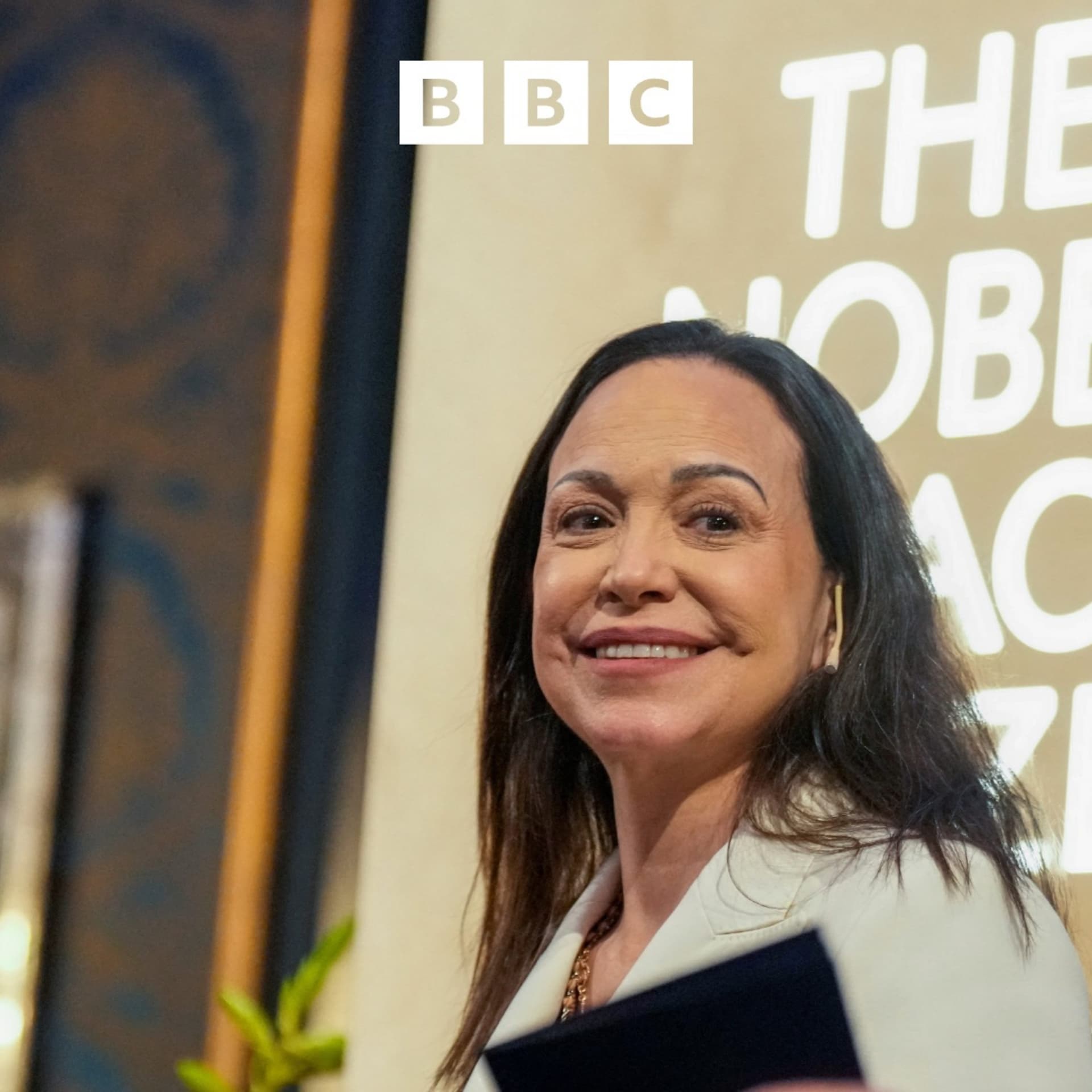
Global News Podcast
Venezuelan opposition leader speaks to BBC
00:29:27
María Machado, Venezuela's Nobel winner, says President Maduro is on his way out
Loading summary
Transcript79 lines
- [00:00]
A
This BBC podcast is supported by ads outside the uk.
- [00:07]
New school year, new routines, and somehow your calendar is already full. When life gets hectic, Caulipower's got your back. We make the food you crave made better for you, like thin and crispy cauliflower crust pizzas, all natural chicken tenders and nostalgic pizza snacks ready in minutes in something the whole family can agree on. Cauliflower is available in freezer aisles nationwide. Visit eatcolipower.com to find a store near you Hear that? It's holiday cheer arriving at Ulta Beauty with gifts for everyone on your list. Treat them to fan favorite gift sets from Charlotte Tilbury and Peach and Lily. Go all out with timeless fragrances from ysl, Ariana Grande and Carolina Herrera. And you can never go wrong with an Ulta Beauty gift card. Head to Ulta Beauty for gifts that make the holidays brighter and even more beautiful. Ulta Beauty gifting happens here.
- [01:05]
You're listening to the Global News Podcast from the BBC World Service.
- [01:11]
Hello, I'm Oliver Conway. We're recording this at 16 hours GMT on Thursday 11th December. The Venezuelan opposition leader Maria Corinna Machado says the Maduro regime is weaker than ever. Survivors of a typhoon in the Philippines are suing oil giant Shell, saying carbon emissions made the storm wor.
- [01:30]
On the children caught up in drug wars in Marseille.
- [01:35]
Also in the podcast.
- [01:40]
US$200 for kilo investigating the trade in endangered species. On Facebook.
- [01:51]
The Venezuelan opposition leader Maria Corinna Machado may not have made it to Norway in time to receive her Nobel Peace Prize, but once she arrived, she wasted no time in calling out the authoritarian leader of Venezuela, Nicolas Maduro. She said his regime was now weaker than ever, partly as a result of the actions of President Trump, who on Wednesday announced the seizure of a tanker off the coast of Venezuela. And she confirmed she'd had us help in getting out of the country where she's been living in hiding because of delays on her journey caused by rough seas. Her prize was collected by her daughter, but but she was given a warm welcome when she finally appeared in Oslo in the early hours of Thursday, her first public appearance in nearly a year. A short while later, she spoke to the BBC.
- [02:35]
B
It certainly has been a very profound sentiment. Suddenly, in a matter of few hours, to be able to see the people I love most on their eyes and touch them and cry together and pray together. And then I had a chance to meet also with hundreds of venison people that are outside the hotel. You must be so proud of your daughter today? Oh, I've been proud of her all her life. And my sons as well. They have taken a really hard part because I had to send them out of the country. They didn't want to leave, but I forced them to go because I couldn't do my job and at the same time, protect them. So, you know, they were the only ones in their classes, at graduation to be without their mother. And she married. I wasn't with her. And my son just married, and I wasn't with him. So it gives me a big sense of guilt. But at the same time, I have so much support from them, and they are the reason why I do it, as well as all of its own children. Were you thinking of those other daughters, those other mothers in Venezuela and around the world who have not had this moment that you've been able to have been separated? Oh, absolutely. Look, the Chavista regime has tried to divide us. What brought our country back together is that we want our families back home. We want our children back home. So I was thinking the mothers of the political prisoners with whom I talk every week. But I know that soon they will have this immense joy that I had Today. I have to ask you about your escape, that you had to wear a wig, a disguise. You went through 10 military checkpoints, a fishing boat to Curacao, a private jet, Miami to Oslo. Venezuela has turned into a nation, a country in which the state applies terrorism. The regime that has control of all institutions has applied state terrorism towards innocent people and committed crimes against humanity. And everybody that dares to speak out to defend any of your basic rights takes a huge risk and probably ends in prison just for posting news about the Nobel Prize. You will get in prison. And if they go looking for you and they don't find you in your house, they will take your family, even children. So they had said that I'm a terrorist, that I have to be in jail for the rest of my life, and they're looking for me. So certainly leaving Venezuela is very, very dangerous. So I just want to say today that I'm here because many men and women risked their lives in order for me to arrive in Oslo. I came here on behalf of millions of anonymous Venezuelan heroes to receive the prize and to take it back to them, because it's theirs. What about the next thing for you, though? Because you know that the Venezuelan government is now calling you a fugitive, that you will be arrested if you go back. Do you intend to go back to Venezuela? Of course I'm going back to Venezuela. The Venezuelan government would have disappeared me if they found me when I was in Venezuela. And I know exactly the risks I'm taking. And what I've said to the Venezuelan people from the beginning is I'm going to be in the place where I am more useful for. For our cause. And until very short time ago, the place where I thought I had to be was Venezuela. The place where I believe I have to be today on behalf of our cause is Oslo.
- [06:44]
A
Venezuelan opposition leader and Nobel Peace Prize winner Maria Corinna Machado talking to Lucy Hawkins. France is battling to control violent drug gangs that are exploiting and even killing children. In the worst affected city, Marseille, the number of teenagers caught up in the drug world has risen sixfold in recent years. President Emmanuel Macron has urged police to treat the multi billion dollar industry in the same way as terrorism. Our correspondent Andrew Harding has been to visit the southern French port.
- [07:19]
Bursts of automatic gunfire filmed from the window of a French apartment block.
- [07:25]
On the street below, rival drug gangs, heavily armed, often just teenagers, are fighting over turf. We're going to kill you all, he says. Night after night, some neighbourhoods in the ancient port city of Marseille are being transformed into war zones.
- [07:45]
Footage of the dead circulating on social media. Victims as young as 14, 15.
- [07:52]
The cumulative effect of all these killings here in Marseille has created what people locally describe as a kind of sicos, a nervous panic, a terror that has gripped the city.
- [08:06]
He's lifting up his vest here, T shirt to show me the scars. He's got a big scar on his back. Yusuf, a gang member, shows me where he was shot by rivals in the last few years. He says the bosses are using young people, paying them next to nothing. It's chaos. I'm heading now to meet a local lawyer, somebody who's been active for years supporting the victims of gangland killings. But in the last week or so, she's become so afraid for her own safety that she's taken a step back. And she's going to talk to us now, but only if we hide her name.
- [08:41]
B
We are all afraid here. Now it's clear that the drugs gangs are in control. I have to protect my family.
- [08:47]
A
We're seeing increasingly youngsters, teenagers, involved in the gangs now.
- [08:53]
B
Yes. So many youngsters are forced into it. They're forced into debt, locked up, made to work, beaten. It's a form of slavery.
- [09:10]
A
In a big convoy, French police drive towards the outskirts of Marseille to an area where the drug gangs are dominant. The aim is to disrupt their trade.
- [09:25]
Okay, we're just running with the French police here around an apartment block they're trying to seal off to make sure that there are no drug dealers here.
- [09:37]
We're in a stairwell now. There are maybe six, seven policemen. They've surrounded one young man. They've got him up against the wall. They're searching him. We understand he's 18 years old. The youngster then begs the police to arrest him so he can escape the gang. They take him away. The French police are making hundreds of arrests like this. But despite the crackdown, they are, it seems, losing the war against a network of people, chaotic gangs that are staffed to some extent by a growing army of brutalized children.
- [10:14]
We've come down into the cellar now.
- [10:18]
Police searching for places where drugs might have been hidden.
- [10:23]
They find cocaine, hashish, traces of a drug industry now worth up to 7 billion euros. Across France. A far right MP, Frank Alisio, talks of the need for a state of emergency.
- [10:38]
And he blames uncontrolled immigration.
- [10:43]
It's the number that's the problem, he says. We're no longer able to integrate, to assimilate.
- [10:51]
But Marseille on the Mediterranean has always been a diverse city, a city of immigrants. The prevailing view here is that they should not be scapegoated, that teenagers running riot here and in other cities are still children, that they need, above all, rescuing from a violent industry bringing terror to their streets.
- [11:14]
Andrew Harding reporting from Marseille. Four years ago, Typhoon Rai battered the Philippines, killing around 400 people and destroying hundreds of thousands of homes. At the time, it was the most powerful storm to ever hit the archipelago. The now victims of the disaster are suing the oil and gas company Shell, accusing it of contributing to climate change and therefore making such weather events more severe.
- [11:40]
I know that we can do something about this. I know that this will be a long journey for us.
- [11:45]
B
This will be a tough journey, but we are here ready to wait and ready to fight.
- [11:52]
I call on Shell to pay. It seems like you want to be the only ones to survive, leaving the poor to be poorer.
- [12:00]
A
I heard more about the case from our business correspondent, Nick Marsh. This is a group of 67 victims of Typhoon Rye, known as Super Typhoon Adet, locally in the Philippines. We're talking exactly four years ago, actually, is when this typhoon formed and caused all the devastation that you mentioned. Their argument is that the science shows that this particular storm would not have been as powerful were it not for climate change. In fact, they say it was twice as powerful due to climate change. And who has contributed to that? Well, the fossil fuel companies, of course, and they have decided to single out Shell and sue them in the United Kingdom, where the company's headquartered, with the aim of getting a significant amount of compound compensation. And ultimately, you know, if you listen to the environmental groups who are backing these claimants, kick off a series of similar lawsuits against other companies in the future. And what does Shell have to say about this? Shell's called the claim baseless. It's pretty clear they're going to be fighting this quite hard in the court. Their argument essentially is that their production of oil and gas didn't contribute to this individual typhoon. I mean, the Philippines does get a lot of powerful typhoons. And that ultimately, Ollie, is what the court will need to be convinced of. Another important claim in this lawsuit is that Shell has known for decades, so since the 1960s, in fact, that burning fossil fuels is the primary driver of human led climate change. But instead, for a long time chose to hide this information and misinformation, inform the public and the wider industry. Now, again, Shell says that's simply not true, that it had any kind of unique knowledge about climate change. It doesn't dispute the fact that burning fossil fuels contributes to climate change. I think that's not up for debate at all. But Shell says that everyone's known this for a long time and the debate has been how to tackle it. And that's been a public one that's been going on for many years, decades even. It's going to be interesting to see, you know, which way the court may be convinced on this or not. Yet scientists say it's difficult to link cause and effect to particular storms in regards to climate change. But what could be the impact of this case? Environmental groups including Greenpeace, they're one of them backing this claim. They're hoping that if it's successful, then they can basically sue other big fossil fuel companies. And you do see these sort of test cases popping up now and again. There is clearly, though, an appetite for a kind of reckoning, you know, when it comes to the oil and gas companies, when it comes to climate change. But, you know, with these very highly legal issues, the devil's in the detail of the specific case and of the specific interpretation of the science. Our Asia business correspondent, Nick Marsh. The illegal trade in wildlife is estimated to be worth up to $20 billion a year. An investigation by BBC News has found body parts of endangered species, including tigers and sharks, being offered for sale on Facebook. The site's owner, Meta, says it doesn't allow the selling of endangered species and removes such content. Britain has strict laws on what animals can be imported? But our reporter Angus Crawford found that companies here in the UK were illegally supplying products like dead seahorses for use in food and traditional medicines. Here's his report.
- [15:27]
A caged tiger roars in pain and fear, bred for its body parts, advertised on Facebook. Imagine a global criminal trade where endangered species can be bought over the phone from Africa.
- [15:45]
So US$200 for kilo.
- [15:49]
To be honest, it makes me sick to my stomach.
- [15:54]
The authorities, though, say they are hitting back here. A video of rare tortoises seized by police in Bangladesh. Footage released by Interpol to mark the global success of Operation Thunder. So there were over 2000 live tarantulas seized during Operation Thunder? Yes, you heard that right. Thousands of tarantulas seized by Border Force in the UK during the initiative in September and October. This is where we keep all our seized exhibits. At a secret location near Heathrow Airport, I'm shown a room full of past seizures. Danny Hewitt from Border Force says organised crime is behind the trade. But some customers here don't even realise what they're doing is illegal. When we see the movement of people and the settlement of communities in the uk, it drives a certain demand for traditional items, medicines, cultural items that may not have been illegal in other parts of the world but are illegal in the uk, a trade increasingly driven by social media.
- [16:57]
Back to the caged tiger. On Facebook, a Chinese seller offers me a tooth for $280. A hand sifts through pangolin scales. Facebook again, the price, $150 for one kilo.
- [17:16]
And a phone call to a man who wants to sell me dead seahorses for use in food or traditional medicine. How much for a kilo?
- [17:28]
There are sellers right here in the uk. I contact one in the north of England and they're happy to sell me a pack.
- [17:40]
I've just picked up my package from a post office box. It only took two days to get here. If I look inside, well, there's three packets full of dead, dried seahorses. Now, selling them to me like this in the uk, that's against the law. Sad to see, isn't it?
- [17:58]
B
I'm just gonna rip along the top.
- [18:00]
A
Here, see if we can. I take the packet to Neil Garrick Maidment, who runs the charity the Seahorse Trust. He identifies several pregnant specimens. This one packet is probably representing 5, 6, maybe 700 seahorses that are dead. I could probably find seahorses in a couple of minutes on Facebook. It's that easy. What do you think of that? Tragic. Absolutely awful. Tragic. One of the reasons I started Facebook was that Mark Zuckerberg explains his vision for Meta, which owns Facebook. I asked the company what it was doing about the trade and in a statement was told we do not allow the sale of endangered species on our platforms and we remove this content as soon as we become aware of it.
- [18:44]
Despite the work of the authorities around the world, our rarest animals remain at risk for sale and just a click away. Angus Crawford and you can hear more on this story on our YouTube channel. Search for BBC News then select Podcast and the Global News Podcast. We we update it every weekday.
- [19:07]
Still to come.
- [19:08]
B
Her emotion just burns through this and it is her last letter and we wouldn't have it if it hadn't been smuggled out.
- [19:16]
A
The final letter, written by Mary Queen of Scots, is revealed to the public.
- [19:28]
Starting a business can be overwhelming. You're juggling multiple roles designer, marketer, logistics.
- [19:35]
B
Manager, all while bringing your vision to life. But for millions of businesses, Shopify is the ultimate partner. Shopify is the commerce platform behind millions of businesses around the world and 10% of all e commerce in the US.
- [19:47]
A
From household names like Mattel and Gymshark to brands just getting started. Build a stunning online store with Shopify's.
- [19:54]
B
Ready to use templates, boost content with.
- [19:56]
A
AI powered product descriptions, page headlines and enhance photography. Marketing is easy with built in tools for email and social media campaigns. Plus Shopify simplifies everything from inventory to shipping and returns. If you're ready to sell, you're ready for Shopify.
- [20:11]
B
Turn your big business idea into With.
- [20:14]
A
Shopify on your side, sign up for your $1 per month trial today at shopify.com try go to shopify.com try shopify.com try.
- [20:28]
If you're a maintenance supervisor for a commercial property, you've had to deal with everything from leaky faucets to flickering light bulbs. But nothing's worse than that ancient boiler that's lived in the building since the day it was built 50 years ago. It's enough to make anyone lose their cool. That's where Grainger comes in. With industrial grade products and dependable, fast delivery, Grainger can help with any challenge, from worn out components to everyday necessities. Call clickgrainger.com or just stop by Grainger for the ones who get it done at the BBC, we go further so you see clearer. With a subscription to BBC.com you get unlimited articles and videos ad free podcasts, the BBC News channel streaming live 24. 7 plus hundreds of acclaimed documentaries from less than a dollar a week for your first year. Read, watch and listen to trusted independent journalism and storytelling. It all starts with a subscription to BBC.com find out more@BBC.com unlimited. If you're a maintenance supervisor for a commercial property, you've had to deal with everything from leaky faucets to flickering light bulbs. But nothing's worse than that ancient boiler that's lived in the building since the day it was built 50 years ago. It's enough to make anyone lose their cool. That's where Grainger comes in. With industrial grade products and dependable, fast delivery, Grainger can help with any challenge, from worn out components to everyday necessities. Call clickgrainger.com or just stop by Grainger for the ones who get it done.
- [22:01]
This is the global news podcast Research has found that living in extreme heat can severely affect children's development A study looked at data collected by the UN Children's agency UNICEF from six mostly African countries. Richard Hamilton has the details. It's long been known that excessive heat affects physical health, but this study shows that children who are regularly exposed to temperatures above 30 degrees Celsius tend to know fewer words, letters and numbers. It suggests that global warming is harming human development at its earliest stages. An average monthly maximum temperature of 32 degrees or more reduces the likelihood that 3 and 4 year olds would be developmentally on track by up to 12%. The lead researcher is Professor Jorge Cuartas from New York University. The significance is that exposure to excessive heat can make it less likely that a child meets basic developmental milestones in.
- [23:07]
B
Literacy and numeracy skills.
- [23:09]
A
We know that even a small impact can cascade into lifelong learning, mental health and development.
- [23:18]
B
So we are really concerned about those.
- [23:20]
A
Impacts early in life and how much that at a population level as well can affect millions of children, especially children who are already experiencing poverty, lack of access to education, lack of access to clean water and sanitation, and also lack of access to other cooling strategies that can help them deal with excessive heat. Professor Cuartas and his colleagues studied data from nearly 20,000 children who'd been surveyed by UNICEF in countries such as Madagascar, Malawi and Sierra Leone. The researchers compared this information with climate records from earlier years in which heat waves had not occurred, making sure that the children came from similar backgrounds to take into account factors that might otherwise distort the study, such as poverty and mother's education. The researchers also found that the effect of heat extended to before birth, as they looked at the impact of temperatures on pregnancy. Given that the planet shows no sign of cooling, the plight of millions of the World's poorest children is only likely to get worse. Richard Hamilton the reality of life in Afghanistan for women and girls is going to be put in the spotlight today by the People's Tribunal for Women of Afghanistan. Although it's not a legal court, it aims to document and expose gender persecution under Taliban rule. Today it'll present its findings after hearing testimony from Afghan women in October. Shahazad Akbar, who previously served as chair of the independent Human Rights Commission in Afghanistan, is one of the organizers.
- [25:00]
B
We heard 22 testimonies in October and we have received evidence and everything points to the worsening human rights situation and particularly women's rights situation in Afghanistan. Women are even banned from seeking a medical education that will allow them to treat other women in a situation where they are not men are not allowed to treat women so women can die from preventable deaths. Girls, girls beyond 11 can't go to school. They are not allowed formally to go to school. So their aspirations, their dreams for the past years have died. Women who are on the verge of graduating from university have been banned from going to university. All aspects of women's rights and freedoms are restricted and women are only allowed essentially to breathe, be at home and care for the male members and female members of the family beyond the four walls of the house. They have no right to a public and social existence.
- [25:51]
A
Are you frustrated that the outside world doesn't make more of these awful things that are happening, doesn't publicize it more, doesn't put more pressure on the Taliban?
- [26:01]
B
Extremely. Because as the situation gets worse, Afghanistan is fading from the public memory outside Afghanistan and Taliban are being normalized. I was talking to young women and girls in Afghanistan who said not only we are being forgotten and abandoned, but also the criminals who are perpetuating all these atrocities against us, all this repression, oppression against us. They're being normalized, they're being welcomed. Taliban were in India recently, you know, being received very warmly there. Germany has allowed Taliban to come and run the consulates in Germany because they want to ensure they can deport Afghans back to Afghanistan. So not only that Afghan women are forgotten, their plight is forgotten, things are getting worse. But also stalwart are being treated like a normal government. And this is a really chilling message to women of Afghanistan.
- [26:46]
A
What would you like to see Western women's groups and women's campaigners do to try to put pressure on their governments not to go down the road you've just described?
- [26:57]
B
This is exactly why we organized the People's Tribunal, because we want people across the world women's groups, youth groups, social justice movements in the west to stand up in solidarity with women of Afghanistan to push their governments not to normalize and not recognize the Taliban unless they change their repressive policies and also to pressure their governments to continue humanitarian aid to Afghanistan, to continue support and asylum and protection for women, human rights defenders, women and men who are lives are at risk because of the Taliban and to continue to push for justice and accountability for Afghanistan so Taliban are actually held accountable in international courts.
- [27:36]
A
Jahar Zayed Akbar talking to Justin Webb the boycott of what is usually one of the world's biggest TV events of the year, the Eurovision Song Contest is growing. Spain, the Netherlands, Ireland and Slovenia have already dropped out because of Israel's involvement. Now Iceland is following suit. Nick Johnson has the details.
- [27:58]
Eurovision is always a big moment in Iceland's TV calendar. The majority of its population consistently tunes in to the annual Grand Final, even when their entries, including this year's by pop duo Vibe, don't deliver the point.
- [28:16]
It puts into sharp focus. Focus the Icelandic state broadcaster's decision to boycott next year's contest. In a statement, RUV said the participation of the Israeli national broadcaster had created disunity among both members of the European Broadcasting Union and the general public. Israel's presence at Eurovision has been an increasing source of tension because of the war in Gaza and concerns about the voting and campaigning processes, including accusations that Israel's government tried to influence the public vote at this year's event. Early this month, broadcasters including the BBC attended an EBU meeting where they were asked to back new rules intended to discourage governments and third parties from organizing such campaigns. BBC News understands that voting to accept those measures was tied to a clause whereby members agreed not to proceed with a vote on Israel's participation. As a result, Spain, Ireland, Slovenia and the Netherlands announced their withdrawal. Next year's Eurovision Song Contest will take place in the Austrian capital, Vienna. Nick Johnson finally to a letter from.
- [29:24]
B
1587 tonight after dinner I have been.
- [29:27]
A
Advised of my sentence. I am to be executed like a criminal at 8 in the morning, the words of Mary, Queen of Scots, written hours before she was beheaded. After being imprisoned for 19 years, she was executed on orders from her cousin, Queen Elizabeth I. Now the whole of her final letter is to go on display at Perth Museum in Scotland. Philippa Gregory is a historian and expert on the Tudors.
- [29:52]
B
It's incredibly important at so many levels. I mean, there are so few letters by Tudor women that survive at all. It talks of her personal feelings which the Tudor women and Tudor people don't generally tend to put in writing, but her emotion just burns through this and it is her last letter and we wouldn't have it if it hadn't been smuggled out. She was, as she says, to be executed as a criminal. She believed that she died as a martyr. And it was the decision of Elizabeth I's government, and probably Elizabeth I, that a fellow queen and a cousin should be killed.
- [30:31]
A
Do you think we have a different view of her? Have we taken a different view of her? And how important, I suppose, is a testimony like this in shaping what we know of these major historic figures?
- [30:42]
B
It's really important as a testimony because it tells us what she thought of herself. I mean, we do know more of her than the Elizabethan propaganda and then the subsequent Victorian propaganda, because the Victorian historians were very keen on Elizabeth I and tended to build this reputation of Mary Queen of Scots as a rather frivolous French alien woman who didn't take responsibility for the duty of queenship. Whereas, in fact, what you see from her letter is that she's deeply serious and she understands completely that she is dying for political and religious reasons. And we know from. There's a very, very good biography of her by the historian John Guy, who speaks of her as a serious leader and a serious queen in Scotland who.
- [31:31]
A
Engaged greatly with the work and in very different way, in the way that she's been described. It's very different, isn't it, how she comes?
- [31:37]
B
Well, absolutely. He actually counted the council meeting she attended and showed that she attended more council meetings than any previous monarch. Of course, she did her needle point at the council meetings. So people say, well, she's being completely frivolous and French about it, but, you know, why shouldn't she? She's there listening, she's doing her job as a ruler of Scotland.
- [31:59]
A
How shocking is it, I suppose, to read that testimony, those last words, in light of what was happening, Although beheadings were not normal at that time, but they were much more normal than they are these days, certainly in our parts of the world.
- [32:11]
B
Well, you would not expect as a monarch to be beheaded. I mean, that doesn't happen in England until Charles I, two generations after her. And then it is unbelievably shocking. And it's only made legal by the fact that he stood trial in front of a Parliament. She is accused of rebelling against the Queen and trying to raise a revolution against Queen Elizabeth I, which she probably did some part of, but the evidence before the court was almost certainly forged. So it's an extraordinary. An extraordinary death for a woman at the time and for a monarch at.
- [32:46]
A
The time, historian Philippa Gregory.
- [32:51]
And that's all from us for now. But the Global News podcast will be back very soon. This edition was mixed with by Gabriel o' Regan and produced by Alison Davis. Our editors, Karen Martin. I'm Oliver Conway. Until next time. Goodbye.
- [33:10]
If you're a maintenance supervisor for a commercial property, you've had to deal with everything from leaky faucets to flickering light bulbs. But nothing's worse than that ancient boiler that's lived in the building since the day it was built 50 years ago ago. It's enough to make anyone lose their cool. That's where Granger comes in. With industrial grade products and dependable, fast delivery, Granger can help with any challenge, from worn out components to everyday necessities. Call clickgranger. Com or just stop by Granger for the ones who get it done.