← Global News Podcast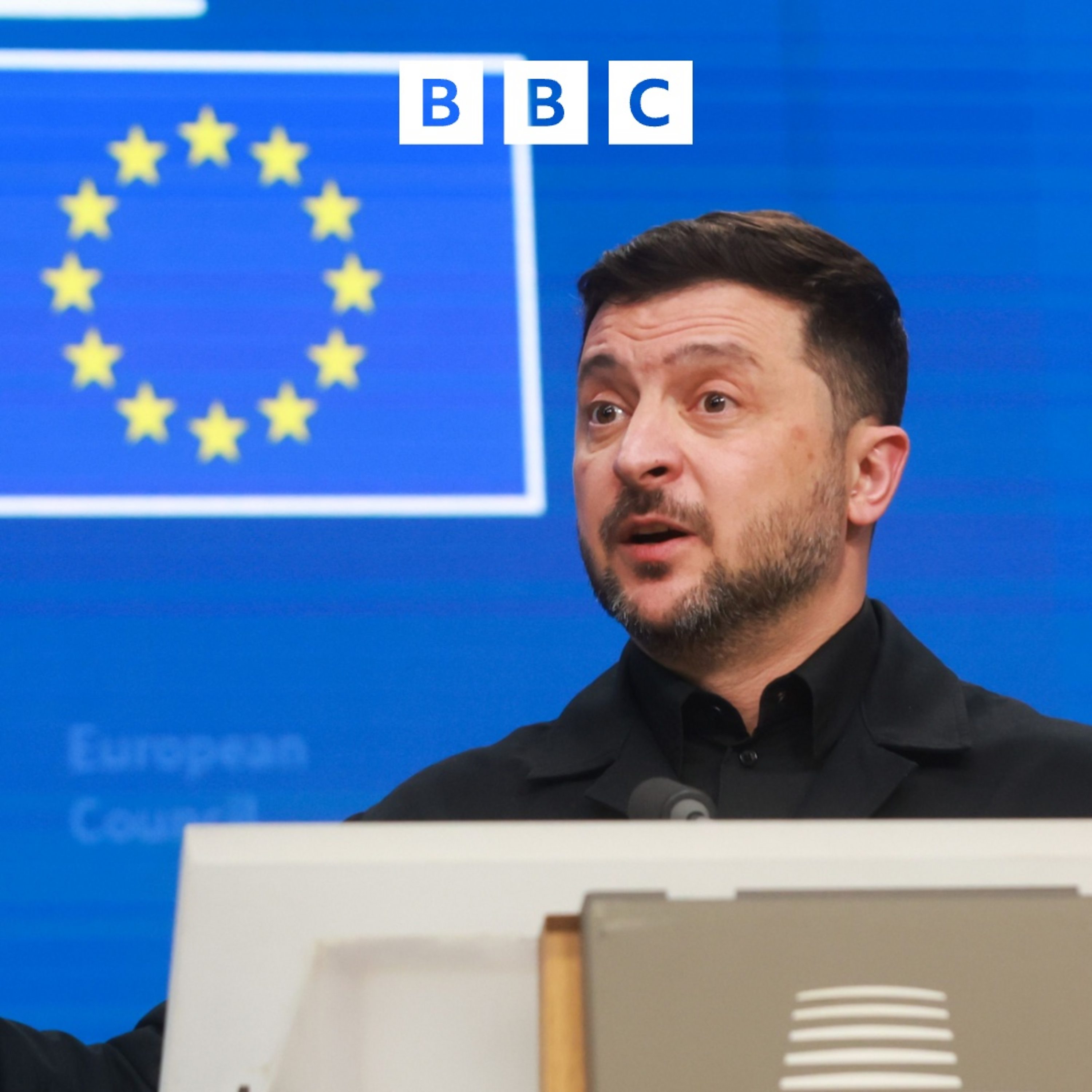
Global News Podcast
Zelensky welcomes EU's $105 billion loan for Ukraine
00:27:46
EU leaders continue to back Ukraine - but fail to agree on using frozen Russian assets
Loading summary
Transcript75 lines
- [00:00]
Alex Ritson
This BBC podcast is supported by ads outside the UK.
- [00:07]
Commercial Advertiser
Ulta Beauty's Big Holiday Beauty Sale is back with up to 50% off. Must have gifts shop irresistible deals like the Shark Beauty Flex Style and Benefit Cosmetics. Travel size mascaras. With new offers weekly, same day pickup or delivery. And our trusted associates, we make holiday shopping effortless. Head into Ulta Beauty today. Ulta Beauty Gifting happens here.
- [00:36]
HomeServe Advertiser
It never happens at a good time. The pipe bursts at midnight. The heater quits on the coldest night. Suddenly you're overwhelmed. That's when home serve is here for $4.99 a month. You're never alone. Just call their 24. 7 hotline and a local pro is on the way. Trusted by millions, Homeserve delivers peace of mind when you need it most. For plans Starting at just $4.99 a month, go to homeserve.com that's homeserve.com not available everywhere. Most plans range between $4.99 to $11.99 a month. Your first year terms apply on covered repairs.
- [01:08]
Pete Ross
This is the Global News podcast from the BBC World Service. I'm Pete Ross and at 1600 GMT on Friday 19th December. These are our main stories. Ukraine's war effort receives a $100 billion boost from the European Union President Putin says Russia is ready to end the conflict in Ukraine, but only on his terms. Bank of Japan raises its interest rates to its highest level in 30 years. Also in this podcast.
- [01:43]
Victoria Gill
So here we are. Come down in a lift. And it takes less than a minute to go down into bedrock.
- [01:50]
Pete Ross
400 metres down inside Finland's deep underground facility, where spent nuclear fuel will be locked away for thousands of years. We begin with Ukraine, whose president, Volodymyr Zelensky, has welcomed a decision by the European Union to give Kyiv a $100 billion loan. He said it would strengthen Ukraine's ability to resist Russia. EU politicians made the pledge after talks that went on until the early hours of Friday, but they failed to agree on a plan to use frozen Russian assets to back the loan to Ukraine. Belgium host has always opposed the use of these assets on the basis that most are being held in a Brussels based clearinghouse, leaving them legally exposed to any Russian retaliation. The European Council President, Antonio Costa, said the agreement sent a clear message that Europe's support for Kyiv would not falter.
- [02:47]
Alex Ritson
As a matter of urgency, we will provide a loan backed by the European Union budget. This will address the urgent financial needs of Ukraine and Ukraine will only repay.
- [03:02]
Pete Ross
This loan once Russia pays reparations Oleksandr Moreshko is the chair of the Foreign Affairs Committee in the Ukrainian Parliament and a member of Parliament for President Zelenskyy's Servants of the People Party. This is his reaction to the deal. For us it's important to receive Russian frozen sovereign essence.
- [03:21]
Vitaly Shevchenko
This money should be given to the victim of the aggression as a reparation. So it's we continue to hope, we.
- [03:28]
Pete Ross
Continue to fight, but at the same time we understand that this decision is.
- [03:32]
James Waterhouse
A kind of compromise right now.
- [03:34]
Pete Ross
And we don't care much about the source of this money because for this year, for next year, we desperately need this money to enhance our defense capabilities. And I would like to quote one.
- [03:47]
Vitaly Shevchenko
Of German politicians who said that this.
- [03:50]
Pete Ross
Money is the best investment in the Europe security. So was this a compromise or did Ukraine get the money it needed regardless of where it came from? Alex Ritson spoke to our correspondent James Waterhouse, who's in Brussels.
- [04:03]
James Waterhouse
If you look at it in the sense of a round figure, it is what Ukraine wanted. This was always a proposal that was agreed by the EU to prop up Ukraine over the next two years. And that proposal was 90 billion euros. And Kyiv is hoping that other allies like the UK and Canada will plug the rest of an estimated 135 billion euro hole in its national budget. So in essence, if you consider that it's the money they wanted alone, they will unlikely ever have to repay given the chances of Russia paying reparations in the medium to long term future. As you heard there, it allows Ukraine to keep functioning. But I know what you're getting at. I mean there is a more concerning barometer for Ukraine where the donors, its most immediate donors, its neighbours, are clearly more divided on how and even whether to help Ukraine as Russia's invasion continues.
- [05:02]
Alex Ritson
Yes, because this deal only happened because certain nations managed to negotiate their own way out of them.
- [05:09]
James Waterhouse
Yes, I mean it was a punchy minority that have changed the course of how this was expected to go. Clearly Belgium was not exercising brinkmanship. I mean, but the weaver, the Prime Minister was clearly under domestic pressure to not cave. There were concerns here that, that Brussels would be liable to repay Russia. And given how this is, you know, currently illegal under, under international law to raid frozen assets in this way. And then you have, you know, the more Russian friendly countries like Hungary, like Slovakia, like Czechia now, where there's a now populist government, you know, they have removed themselves completely from this loan for Ukraine because they have been completely reluctant to give Kyiv more money. So I think Volodymyr Zelenskyy knows that Europe is increasingly divided on how to help him. But he has the money he wants and now he can once again pivot to these continued US led peace efforts and crucially, to trying to keep Washington on side in that endeavor. He can now pivot to trying to secure security guarantees and trying to work out just how a peace deal can be conjured up, one that Kyiv can believe in.
- [06:29]
Pete Ross
James Waterhouse, who is speaking to Alex Ritson. Just Hours after the EU's decision, Russia's President Putin used his annual end of the year television press conference to claim that Ukraine is losing on the battlefield and retreating. Mr. Putin showed no sign that he was willing to compromise on his war aims, despite President Donald Trump's push for a deal to end the conflict by Christmas. The Russian president said the EU's plan to funnel frozen Russian assets to Ukraine was daylight robbery and he blamed the EU for starting the war.
- [07:01]
Alex Ritson
It's you who are waging a war against us, not us. You are waging a war against us with the hands of the Ukrainian neo Nazis. We are ready to stop that fighting immediately, provided that Russia's security is provided in mid term and long run and we're ready to cooperate with you.
- [07:21]
Pete Ross
Vitaly Shevchenko is Russia editor for BBC monitoring. He explained what President Putin said about the EU's decision to continue funding Ukraine.
- [07:29]
Vitaly Shevchenko
I'm sure he was pleased to see that the EU had failed to use frozen Russian money to help Ukraine. So essentially what we're talking about is money borrowed by European nations to help Ukraine. And there's a big difference. And it's one of those messages that he used at today's presser to say that, look, despite the West's efforts to attack Russia, Russia is winning. Not only did he accuse the EU of waging a war against Russia, he also accused Ukraine of starting this war that's been going on for so many years. And that's a key message in his event because the message is that Russia is not willing to compromise at all. Yet again, he spoke about the so called root causes of this crisis. And whenever anyone from the Kremlin uses that phrase, of course it means that Russia is keen to achieve the original objectives of attacking Ukraine. That hasn't changed at all.
- [08:46]
Alex Ritson
And in response to a question from our colleague Steve Rosenberg, heavy praise for.
- [08:53]
Vitaly Shevchenko
President Trump, which is not really surprising these days. Alex. In the past, of course, America was Russia's enemy number one. That has changed after Donald Trump was reelected. It's Europe that has taken that place. The presenter, one of the two presenters of this event, asked Vladimir Putin about Donald Trump's lawsuit against the BBC. And Vladimir Putin, initially he said, oh, it's a family affair. Let them sort it out between themselves. And then he said, well, of course, Donald Trump is right. And the Russian president also spoke at length about how the west is trying to bring Russia down, how the west disrespects Russia. And he kept addressing our correspondent Steve Rosenberg. But Vladimir Putin said, as long as you respect us and our interests, we are ready to work with you.
- [09:53]
Pete Ross
Vitaly Shevchenko, who is speaking with Alex Ritson. For more on Ukraine and what the extra EU money will mean for the country, you can go on YouTube and search for BBC News. TikTok has reached a deal to sell its operation in the United States, allowing the country's 170 million registered users to continue using the app. If the deal clears the requisite regulatory hurdles, it brings to an end years of efforts by Washington to force Chinese company ByteDance to sell its US operations over national security concerns. Our technology editor is Zoe Kleinman.
- [10:28]
Zoe Kleinman
This feels like it's been going on for such a long time, doesn't it? And actually that's because it has. I think we're looking at nearly a year now of are they or aren't they going to sell TikTok? Is it or is it not going to be banned in the U.S. so today we've heard the news that ByteDance, that's the Chinese company that owns TikTok, is selling 80% of U.S. assets to a combination of people, three investors, Oracle, Silverlux and MGX, which is actually based in Abu Dhabi. And there will also be some involvement from ByteDance's affiliates of ByteDance's investors. And ByteDance itself will keep 20% of the assets as well. So lots of people involved in this new deal, seven members on a board who will have to be mostly American. US people's data. US TikTok user data is going to be stored locally in the US and it will also be used to drive that algorithm, which means that hopefully, I think the plan is that us TikTok users will see content that hasn't been manipulated elsewhere, which of course is one of the big fears about this platform. You know, whether or not there's any Chinese involvement in what American people are seeing.
- [11:35]
Alex Ritson
Still some Chinese ownership though, as you say, and of course it's still part of a wider Chinese owned platform. Does it really lessen the security concerns?
- [11:43]
Zoe Kleinman
So TikTok would dispute that it's Chinese owned. It says it has global investors and, you know, it would definitely put up a fight, I think, and challenge that assumption. That said, it is very clear that ByteDance is a Chinese company and all that goes along with that. There has been so much talk about the security issues. Of course, that was behind the whole idea of banning it in the first place, which was brought in by the previous US president, Joe Biden. It is still banned on official government devices in several countries, including the US and also here in the uk. We'll have to see whether this deal is enough to appease that. I think that would be a big signal from the White House, wouldn't it, if they said, okay, you know, TikTok is now allowed back on government devices again. It's going to take some time, of course, for this to all happen, but I think those who had those concerns are going to say, well actually we haven't really seen any evidence that anything's changed as of yet. And TikTok of course would say that it had already been fragmenting US user data and, and keeping it separate precisely to try to allay these fears. So I think in terms of, is it the silver bullet? Is, is TikTok suddenly forgiven? We'll have to wait and see.
- [12:55]
Pete Ross
Sawy Clayman talking to Alex Ritson. How do you safely dispose of radioactive nuclear waste? That's the tough environmental problem facing many countries looking to scale up nuclear power operations. Finland is already further ahead than most. Last year it became the first country in the world to finish a deep underground facility where spent nuclear fuel will be locked away for thousands of years. Our science correspondent Victoria Gill has been to the site to discover how the process works.
- [13:28]
Victoria Gill
As we drive northwest from Helsinki, what strikes me about the scenery, apart from lots of trees, is dense gray rock. Some of the main road is cut through the granite. It's beneath that dense bedrock that some of the most hazardous material produced by humanity, highly radioactive spent nuclear fuel, will be buried in a place called Onkolo, which is where we're headed.
- [13:50]
Alex Ritson
Disposal holes are are drilled in the.
- [13:52]
Victoria Gill
Tunnels using a purpose built boring machine at ground level. Above the tunnels is a visitor's centre with an exhibition explaining the whole containment and permanent disposal process. In that time when we started, we were not the first in the world. Sana Mustonen is a geologist and project manager for Posiva, the company that operates Onkolo. How has Finland got here before anybody else did? Well, that's a good question. It's maybe we are stubborn or whatever, but gradually other countries have had their own Problems. And we are now the first ones in the world.
- [14:26]
Alex Ritson
After this, all tunnels and shafts leading to it will be closed.
- [14:31]
Victoria Gill
More than 400 meters beneath our feet is a network of tunnels and underground facilities spanning an area of about 2 square kilometers that will be the final destination for waste from Finland's two nuclear power plants. So you are with the helmets and your safety gear, all of you. And then we can go on the ground. I'd been expecting a long drive down the five kilometre corkscrew access tunnel. Instead we're taking the lift and I am very keen to press the -433 button. Oh, yes, please, can we. Oh, I can feel my ears popping. Yeah, you can feel the temperature changing. So here we are. I was expecting it to feel a little bit more dramatic than it did. You come down in a lift. And it takes less than a minute to go down into bedrock. 400 meters down. So far, about 10 kilometers of tunneling has been completed here. But it's only the start. The plan over the next hundred years is to keep digging as the site fills up with waste with about 40 kilometers of new tunnels, planned space for more than 3,000 canisters of nuclear fuel. Tunnel is three and a half meters wide, four and a half meters in height and some little bit more than 300 meters long. We put the canisters into the deposition holes and there will be bentonite in the holes as well. Bentonite's like a clay. Bentonite clay, exactly. And then this whole tunnel is filled with the bentonite clay and the end block is casted into the beginning of the tunnel. And then everything will be safe there. A tunnel dug 400 meters down in the rock. There are holes dug in that tunnel. The canisters are shielded in two layers of metal. Then there's a layer of clay. Then the whole tunnel is filled with clay and then plugged. Mankind has never made anything that's lasted that long, I suppose. How can you be confident that once your canisters are of spent waste are down here, they are isolated, gone. We can essentially plug the hole and forget about them. My confidence lies there, that there is decades of research done for this system. So we know exactly what our bedrock is like and we know what kind of waste we have. Feel pretty confident that this is a secure place to lock away hazardous nuclear waste. Yes, we are, as we are sure of that.
- [16:58]
Pete Ross
That report by Victoria Gill. Still to come in this podcast, we've.
- [17:05]
Dr. Jennifer Millard
Discovered metals, carbon monoxide, other strange chemicals. It's been a wonderful, wonderful study for astronomy.
- [17:14]
Pete Ross
We settle the debate gripping the Internet is 3i atlas a comet or an alien spaceship.
- [17:29]
Commercial Advertiser
Every holiday shopper's got a list. But Ross shoppers? You've got a mission like a gift run that turns into a disco, snow globe, throw pillows and PJs for the whole family.
- [17:37]
Victoria Gill
Dog included.
- [17:38]
Commercial Advertiser
At Ross, Holiday magic isn't about spending more. It's about giving more for less. Ross, work your magic.
- [17:45]
Victoria Gill
Hi, I'm Cindy Crawford, and I'm the founder of meaningful beauty. When Dr. Sabah and I decided to do a skincare line together, he said.
- [17:53]
Commercial Advertiser
To me, we are going to give.
- [17:54]
Victoria Gill
Women meaningful, meaningful beauty. And I said, that's exactly right. We want to give women meaningful beauty. Which means each and every product is meaningful. It has a reason to exist. It's efficacious. You're going to get results, and then you just go out and live your life. Meaningful Beauty confidence is beautiful. Learn more@meaningful beauty.com.
- [18:18]
Commercial Advertiser
Celebrate this holiday season with Stella Rosa Wines the perfect partner to make your holiday celebrations even more special. Mixing Old world Italian craftsmansh with modern style, Stella Rosa offers bold, juicy wines that fit your lifestyle. From the big family dinner to a chill night with the crew, our semi sweet, semi sparkling wines bring the good vibes to every table. Imagine the rich, fruity notes of Stella Rosa black paired with a savory baked ham, or the crisp taste of Stella Rosa Prosecco alongside a warm slice of fresh apple pie. Stella Rosa isn't just wine, it's a whole mood, turning basic dinners into memories you'll actually want to post about. With over 25 unique and refreshing flavors to choose from, there's a Stella Rosa wine for everyone at the table. So gather your friends and family, grab your glass and your bottles of Stella Rosa to make this holiday season even more memorable. Let's toast to living life a little sweeter with Stella rosa wines. Must be 21 plus. Please celebrate responsibly.
- [19:18]
HomeServe Advertiser
Owning a home is full of surprises. Some wonderful, some not so much. And when something breaks, it can feel like the whole day unravels. That's why HomeServe exists. For as little as $4.99 a month, you'll always have someone to call a trusted professional ready to help, bringing peace of mind to four and a half million homeowners nationwide. For plans starting at just $4.99 a month, go to HomeServe.com that's HomeServe.com not available everywhere. Most plans range between $4.99 to $11.99 a month. Your first year terms apply on Covered repairs.
- [19:52]
Pete Ross
This is the global news podcast for anyone who's taken out a personal loan or has a mortgage. You won't need telling how annoying high interest rates are, but it's not an experience they're used to. In Japan, where for decades interest rates have been hovering around zero or even below zero. The aim was to stimulate the economy, which for many years stagnated. But now the bank of Japan has raised its interest rate to its highest level in 30 years, putting it up by a quarter of a percentage point to 0.75%. Our business correspondent Nick Marsh told Alex Ritson. What's going on?
- [20:28]
Nick Marsh
Interest rates doesn't sound like the most thrilling subject, does it, Alex? But they are very important, and basically you keep interest rates low in order to encourage borrowing, make it cheap, encourage spending, get the economy going, investment and all that, and you make them high to discourage that and therefore the will discourage inflation and keep prices low or lower. In Japan, they have been very, very low for a long, long time. And the reason is because Japan's economy has been struggling. It's had poor growth, so the rates have been low to try and encourage people to borrow money, hire people. There's staff shortages in Japan all the time, not much immigration as well. And it's been below, below 1%. It still is below 1%. When you think about the UK, US, other places, traditionally it's been around 10, what, 3, 4, 5%. It's even gone down into negative interest rates in Japan, which is like free money, basically. It's incredible. And now the bank of Japan, though, has decided to increase its rates, and that's the highest it's been since 1995.
- [21:29]
Alex Ritson
Why now?
- [21:30]
Nick Marsh
Because of inflation, pretty much. So even though Japan's economy has been struggling and stagnating, food prices, energy prices have been going up, the cost of living has been going up. So by increasing interest rates, it's basically saying to people, okay, it's going to be a bit harder to spend your money, but maybe a bit more attractive to save your money, as these prices are high and maybe dampen down those costs.
- [21:53]
Pete Ross
It's been nearly two weeks since fighting broke out again between Thai and Cambodian forces over a disputed border. Efforts to broker a ceasefire, even by President Trump, have made little progress. The Thai army, which is much bigger and better equipped than Cambodia's, is slowly gaining ground, while its air force continues to bomb targets across the border. The Cambodian government says it wants to return to the ceasefire signed in July. Our Southeast Asia correspondent Jonathan Head reported last week from Thailand. Now he's been to see the effects of the conflict on the Cambodian side of the border.
- [22:35]
Alex Ritson
Along the forested ridge marking Cambodia's northern border with Thailand, fierce gun battles have continued for a second week as each army tries to gain control of a few hilltops. The fighting is harder than it was the first time in July, the cost to both sides higher, but especially in the ranks of the Cambodian army. Dr. Sachan Raksami, an anaesthetist who's been transferred from Phnom Penh to to a provincial hospital to treat the wounded soldiers, showed me images on his phone of some of the terrible injuries he's encountered. His hands shake and his eyes are rimmed with tears. I've never seen anything like this in my life, he says.
- [23:23]
Victoria Gill
We need a real peace, okay? You can speak to the world that we need a real peace, not the war.
- [23:31]
Alex Ritson
In one corner, the young wife of a soldier whose arm has been amputated sits smiling to encourage him. In another, the soldier with a shattered leg bandaged up to the thigh, recalls how he was injured last weekend as Thai forces surged forward. They just kept firing, he said, shells landing in my trench until one exploded close to me. I don't remember much else. Cambodia doesn't publish its military casualties, but the Thais estimate at least 500 of its soldiers have been killed. This time on the Thai side, the toll is just 21, starkly illustrating the imbalance of forces between the two armies. Thailand's air force has been able to fly unopposed over Cambodia, bombing targets at will. Right, we're standing now looking at a yawning gap on a high bridge over this river. The gap is probably 20, 30 meters. This was the result of bombs dropped by Thai F16 fighters over the weekend. This twisted metal shattered concrete, and far below us we can see the river. The Thais say that was to stop Cambodia from reinforcing its military units that are on the other side of the bridge. And these kinds of attacks on big infrastructure suggests this is now much more than just a limited border war. Back in July, President Trump successfully brokered a ceasefire using the threat of tariffs. But attitudes in Thailand have hardened after a political crisis. It blames on Cambodian interference and the laying of landmines during the last ceasef, which maimed several of its soldiers. Last week, Prime Minister Anutin Chaw Wirakun rejected a second attempt by the US President to intervene. Cambodia's leaders, in particular the veteran strongman Hun Sen, have a big responsibility for igniting this conflict. Cambodians have mostly rallied around the flag and Blamed Thailand, but they are paying a very heavy price for it now.
- [25:47]
Pete Ross
To sport or perhaps entertainment. On Friday, in the US city of Miami, a former world heavyweight boxing champion will take on a YouTube personality who is now himself a fighter. The match has attracted particular attention because of what many boxing experts say is a potentially dangerous mismatch between the Olympic gold medalist Anthony Joshua, who at 36, some might say could be past his prime, and 28 year old Internet influencer Jake Paul, who only took up boxing seriously a few years ago. Despite the reservations of some, Jake, Jake Paul claims he'll win the fight.
- [26:23]
Alex Ritson
In terms of boxing, I'm a better boxer than aj, which is like hilarious.
- [26:28]
Pete Ross
To state, but he's got two left feet, he's stiff.
- [26:31]
Alex Ritson
If I was his coach, I'd put him in a dance class first before trying to box.
- [26:36]
Pete Ross
Here's our boxing correspondent Steve Bunce talking to my colleague Amal Rajan.
- [26:40]
Alex Ritson
For Jake Paul, there's an awful lot in it. Jake Paul truly believes that Anthony Joshua is not right.
- [26:47]
HomeServe Advertiser
He's finished.
- [26:48]
Alex Ritson
He's taken too many hard fights. Jake Paul believes he can leapfrog literally hundreds of heavyweights. There are 1500 heavyweights in the world and Jake Paul's trying to jump from about position 1100 to position number seven. He's the one that's taking the giant risk. Now here's the real sort of nub here. Does Jake Paul truly believe that Anthony Joshua is shot to pieces and he's fragile, or is he just taking a massive gamble on going down, as we say, on his shield, blazing, throwing shots and getting some respect and still pocketing a fortune?
- [27:25]
Nick Marsh
And just to be clear, Steve, I.
- [27:26]
Alex Ritson
Want to put to you directly the argument of the traditionalists who say that Anthony Joshua is fighting someone, as they would cast it, who's essentially a YouTuber. And the discrepancy in their height and in their weight violates some fundamental principle of boxing and boxers should fight boxers. What do you say to that traditionalist argument? We've had crazier, we've had sillier, we've had more insulting fights in the past when the men haven't shared as much money. We've had bigger mismatches in the past. This is just the latest in a long line. It's become a long line now of fights between not traditional style boxers and other boxers. It's just the business. It's not the boxing apocalypse, people.
- [28:10]
Pete Ross
Steve Bunce. A mysterious object from outside our solar system is heading towards its closest point to earth, known as Comet 3i Atlas it's traveling at more than 200,000 kilometers per hour. Dr. Jennifer Millard is an astronomer and presenter of the awesome Astronomy Podcast.
- [28:28]
Dr. Jennifer Millard
It is exactly its closest approach to Earth today. So not too close. We don't have to worry about it hitting us. It's going to be a little under two times the distance between the Earth and the sun, but it is as close as it's going to get to our planet. And as everyone's been studying it with telescopes on the ground in space, even orbiters, and we've seen the Mars rovers onto it, we've discovered metals, carbon monoxide, other strange chemicals. We've seen tails develop in slightly unusual motion as it's near the Sun. It's been a wonderful, wonderful study for astronomy.
- [29:05]
Alex Ritson
So are you with the Internet consensus that this is an alien spaceship, or are you with some of those scientists who've been suggesting it's just a comet?
- [29:15]
Dr. Jennifer Millard
I am on the side of the comet a hundred percent. And that is because although we have detected some unusual signatures, nothing is completely unexplainable. So if we really did think that it had a chance of being an alien spacecraft, astronomers would be jumping for joy. It is one of the biggest questions at the minute facing astronomy. Are we alone? But unfortunately, this three eye atlas is not going to be the thing that answers that question. It is absolutely a comet, just an alien one.
- [29:43]
Alex Ritson
It is very, very, very old, isn't it?
- [29:46]
Victoria Gill
Yes.
- [29:47]
Dr. Jennifer Millard
We believe that it could be 7 billion years old, even older. We think it comes from a place in our galaxy that we call the thick disc. So if you imagine our spiral galaxy is flat and thin like two fried eggs back to back, or you put those fried eggs in a burger bun and it's kind of light and fluffy. That burger burn is what we call the thick disc. And it's where we find old stars in our galaxy. And based on its trajectory and its great speed, that's where we think it's come from. So older than our solar system.
- [30:17]
Alex Ritson
One more question. It's definitely not Santa, is it?
- [30:20]
Dr. Jennifer Millard
It is definitely not Santa. It's been traveling far too fast for Santa. I mean, Rudolph already has to do an awful lot of work to get around the world. And in order to kind of have the speeds that it has moving through the solar system, I try to think how many carrots he'd have to eat.
- [30:38]
Pete Ross
Dr. Jennifer Millard talking to Alex Ritson. And that's all from us for now. But there'll be a new edition of the Global News Podcast later if you want to comment on this podcast or the topics covered in it, you can send us an email. The address is globalpodcast@BBC.co.uk you can also find us on X@BBC World Service. Use the hashtag globalnewspod. This edition was mixed by Rebecca Miller and the producer was Richard Hamilton. The editor is Karen Martin. I'm Pete Ross. Until next time. Goodbye.
- [31:20]
Commercial Advertiser
Indulge in holiday cravings with the nutrition you need from Cachava's all in One Whole Body Shake. It's 25 grams of protein, 6 grams of fiber, greens and so much more.
- [31:30]
Victoria Gill
Try their newest flavors like the limited.
- [31:33]
Commercial Advertiser
Edition Chocolate Mint with Kachava. You're getting the highest quality ingredients, no fillers, no nonsense. Holiday nutrition has never been this easy or delicious. Go to Kachava K-A C-H-A-V-A.com and use code NEWS for 15% off.