Loading summary
Transcript234 lines
- [00:01]
A
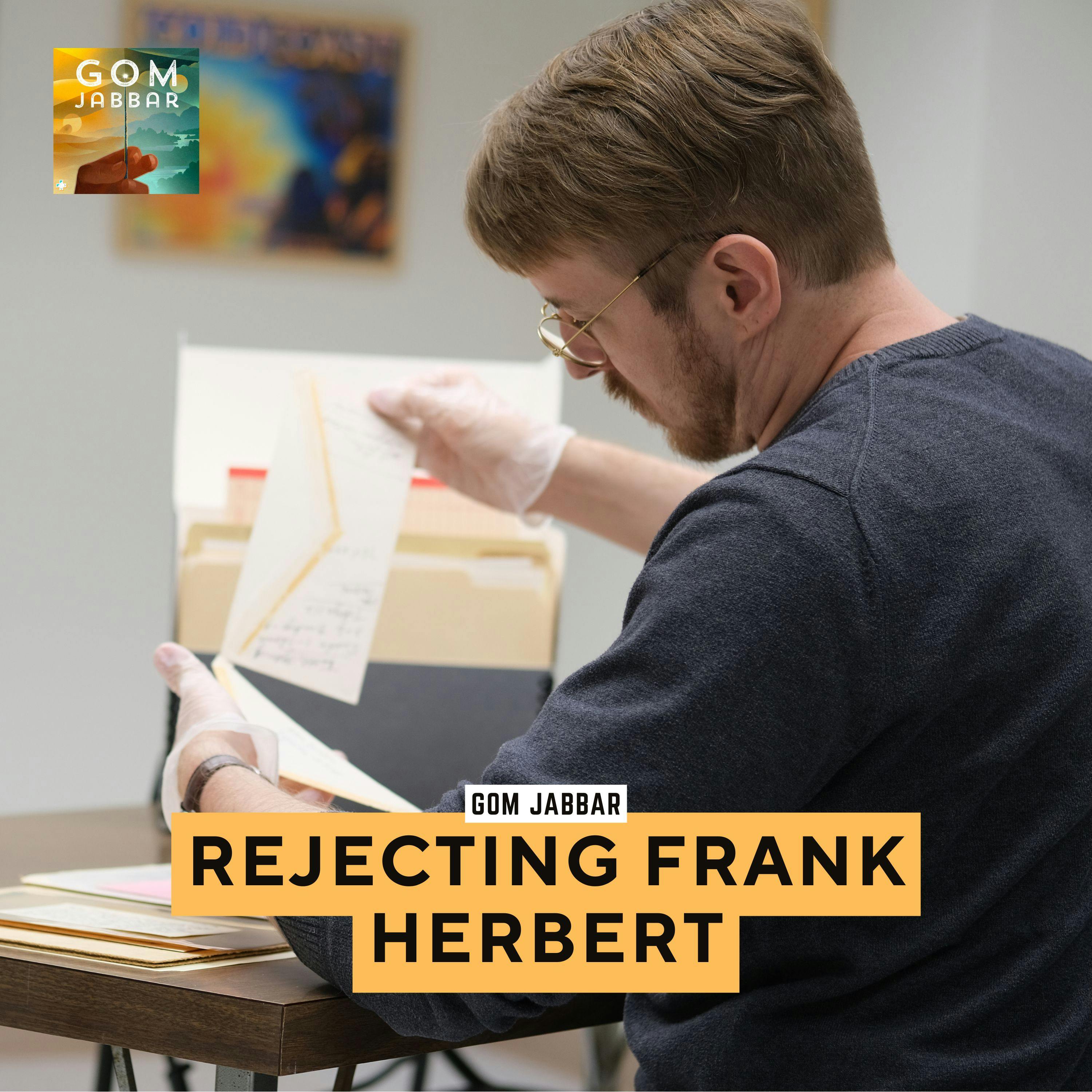
Okay, I'm on the Cal State Fullerton campus now and walking to where I'm going to be meeting our friends. God, this music is so cheerful. I'm nervous. I'm really nervous. It's a beautiful campus. The weather's nice. I've got a cup of coffee. In April 2025, I made a really special trip out to Fullerton, California. I was there on the invitation of Patricia Prestinari, the archivist and special collections librarian at Pollock Library. To say that I was excited about this trip would be a massive understatement. I was literally having dreams about this stuff last night. I'm worried I'm going to find too much. I'm worried I'm going to find too little. And I'm so excited. I'm so hopeful. But I'm also really nervous because it feels like there's a lot riding on this. I don't know what, but that's how it feels. All right, here we go. Patricia is a huge Dune fan, and she had reached out to us earlier this year after finding the podcast. She had told us that she worked at the university and then made us an offer that we couldn't turn down. Hi. Hi.
- [01:24]
B
Right on time.
- [01:25]
A
Hi, my name is Leo.
- [01:27]
B
Leo, so good to meet you.
- [01:28]
A
Nice to meet you in person, Patricia. I'm so, so glad I got your name right. As it turns out, I wasn't the only one excited and nervous about this visit.
- [01:37]
B
I was just running a little bit late because I was having this really bizarre dream that I was in Berkeley on the campus, digitizing a collection. Weirdest, most random.
- [01:50]
A
The archivist dreams.
- [01:51]
B
Wandering around the streets of Berkeley, I couldn't find the Bancroft. It was the weirdest thing.
- [01:55]
A
Setting aside for a second the hilarious coincidence of both of us dreaming about this visit, Patricia was so helpful and kind during this process. She led me to a small, nondescript room in the library with a couple of simple desks, a couple of simple chairs set up in the middle, and off to the side was what I came here for. A cart stacked to the brim with a bunch of plain looking labeled archival boxes. Seeing those boxes brought my anxiety right back to the present moment. This whole morning I've been kind of managing my expectations because, like, on some level I'm like, oh, maybe there's going to be so much stuff. I don't have time to get through it all. Then the other side is like, maybe it'll all just be very, like, surface, level stuff. And so I'm not sure. How do you Feel about those expectations.
- [02:45]
B
I think you're going to like what you see.
- [02:47]
A
Okay. Before I could get to work, I had to take care of some formalities. Patricia guided me to an iPad, where I had to fill out a short legal form saying I wouldn't mess anything up. And of course, I had to don white archival gloves to wear while handling all of the materials in the various boxes.
- [03:06]
B
We have to do our sort of process.
- [03:09]
A
Yeah, yeah.
- [03:10]
B
I would appreciate it if you would just fill this out.
- [03:14]
A
Of course. Happy to.
- [03:16]
B
You know, and the description of your visit can be brief. You're looking at the Frank Herbert papers.
- [03:23]
A
I'd be spending the day here in this room at Pollock Library, alongside our producer Luna, digging through the university's Frank Herbert Papers collection, an archive created by Willis McNeilly of everything related to his friend Frank Herbert and the Dune franchise. Among this collection was early drafts of the books with Frank's own handwritten notes scribbled in the margins. There were original letters between Frank and legendary Sci Fi magazine editor John Campbell Jr. Debating Paul's prescient abilities. Even the actual contents of Frank's wallet were archived in these boxes. I was blown away by the breadth of the materials and the access Patricia had given us. As a Dune fan, I was in awe and a little bit starstruck, holding original drafts written by such a legendary author. And as a podcast producer, I was nearly vibrating at the possibilities. Some of the information we dug up has never been published online. Even the most hardcore Dune fans have likely never seen most of these documents or know what we learned from them. And now we'd have the chance to reveal these incredible insights into the history of Frank Herbert and the creation of Dune on our podcast. And that's exactly what we're going to do on this series. Welcome to the Fullerton Archives. As Luna and I sat down and began digging through the records, one thing became very clear. Right There was so much to get through, more than we could possibly hope to capture, analyze, and absorb in a single day. I mean, even just the boxes of Frank's research notes was too much. Some of the archives that we will absolutely not have time to go through all of is like, there's an A to Z series of folders of his research files, some stuff that might have ended up in Dune, a lot of stuff that almost certainly didn't because he was writing other books as well. This morning, I was outlining two terrible possibilities. One, there was not a lot of substance to things, and two, there was too much substance to things. And this is Very much the latter. Where I'm like, oh, there is a lot of stuff.
- [06:03]
B
Okay, I'm glad it's the latter.
- [06:05]
A
Of course, it didn't help that Luna and I just couldn't help ourselves. We were geeking out about every little thing, and it was hard to avoid the temptation to pause and read every single document. I'm just too curious for my own good. I'm like, I probably don't need to look at this folder, but what if. Oh, what is this folder? Biographical information. Also Frank Herbert. Okay. Oh, the smallest card. Very cute. San Francisco Examiner. Oh, my God, these documents are so cool. Just little pieces of history. There were so many nuggets of juicy information that I only had a few minutes to skim through and take photos of before moving on. The goal was to capture as many of these records as we could in the eight or so hours that we had during this visit. I was a kid in a candy shop and all the candy was laced with spice melange. It seems like initially Leto and Ganima were three at the beginning of the book. And then he changed it, so there's just every time the number three is mentioned, it's crossed out and changed with five. What if Odrade is Teg's daughter handwritten on the back of his page? What?
- [07:27]
B
This is the juice I came for.
- [07:29]
A
What? My God. Can you imagine how different children of Dune would have been if Leto and Ganima were three year old toddlers? Details like these flew by as we flipped through pages and pages of notes, letters, manuscripts, and articles. Over the course of this series, Abu and I are going to be revealing, analyzing and theorizing about all of the fun details we've uncovered as we slowly begin to process the more than 900 photographs Luna and I took. For example, did you know that Frank had no real plans set in stone for a seventh book when he sent Chapter House Dune off to his publisher? Oh, shit. Yeah. This is about Heretics, I guess. Or Chapterhouse. I just mailed the sixth one to the publishers. It's called Chapter House Dune. Will it go further? I don't know. I don't have a seventh in mind. What? I don't have a seventh in mind. Now, maybe some of you super fans knew that, but here's something we can guarantee you don't know. Frank received many letters from fans over the years, and one that we found waxed poetic about how hot Frank Herbert was. The Frank Herbert thirst was real. You are a beautiful man.
- [08:50]
B
You have written a beautiful book. No doubt you are aware of this and often have this awareness confirmed by other people. But frankly, I don't extend a compliment for your sake. It gives me a lot of personal pleasure to say what I say, and I've decided not to deny that pleasure to myself.
- [09:07]
A
Wow.
- [09:08]
B
Explaining why they wrote the letter. I guess I love the boldness.
- [09:12]
A
They're like, frank, you're hot. And I'm not going to apologize for feeling that way. Patricia was incredibly helpful as we worked through the day, checking in on us and rushing out to grab even more boxes from the archives when we fell down a new rabbit hole. Now she is a die hard Dune fan and has such respect for the archives. There were a number of times throughout the day where she geeked out with us about some fun details we found. Despite the fact that she knows these records better than anyone, it was clear she was excited that we were so excited. The energy in the room was contagious.
- [09:51]
B
I'm just remembering all the other things I wanted to show you. Oh, my God, they stopped the Moving Sands article.
- [09:56]
A
Yeah, he. That was never published, too, wasn't it?
- [09:59]
B
It was never published, but you know about it.
- [10:01]
A
Okay, so you already know about it, but it was. But it was never. Do you have it?
- [10:03]
B
So there's a folder of. Yeah, there's a draft of the article and some pamphlets from the area of when he was working on it. And he always says that that's. He has said in the past that that inspired setting, that sort of story on the desert planet.
- [10:19]
A
The famous beginning of it. Yeah. When he was. That would be so cool. In addition to the Frank Herbert Papers collection, McNelly also established the McNelly Collection, all about his own iconic Dune project, the beloved Dune Encyclopedia. There are dozens of letters between McNelly and the various writers who contributed to the Dune Encyclopedia, hashing out not only the details of Dune lore, but also the practical issues of freelance work. Yeah. Right now, the thing that I'm scanning is conversations with Victoria Shoshe, who is talking about how they should go about compensating the various authors. Enclosed is a check for $48 representing payment for your essay on the baliset written for The Dune Encyclopedia. 48 buckaroos that pays for some baliset maintenance. $258. Bene Gesserit history. I mean, this is. Yeah, so, I mean, a dollar was like a million, billion dollars back then, I think. As part of our Fullerton Archives series, we'll be releasing episodes we're calling the Lost Entries. Focused on something incredible that dawned on me as I flipped through these letters, there are a bunch of entries that were cut from the encyclopedia. At the time of recording this, we've only had a chance to closely examine half of over 200 original manuscripts. These entries were never published and can't be found anywhere online. And thanks to Patricia's generosity, we have the chance to share them with the world exclusively on this show. I actually talked at length about the Dune Encyclopedia with Patricia. We ended up chatting a lot about how the encyclopedia is no longer in print, thanks to legal action by Brian Herbert and the Herbert estate. And this was when Patricia dropped a bombshell.
- [12:24]
B
Willis McNelly owns the copyright to the Dune Encyclopedia. The Herbert estate does not. But anyhow, I started doing a little bit of digging and trying to find this. Trying to find a family member that will respond to my messages, which might end up being a grandchild or something like that.
- [12:39]
A
Yeah.
- [12:41]
B
But I contacted the Herbert estate and told them I was a representative from the Fullerton. We've been in touch with them over the years. So they, you know, they know who we are and that we were interested in republishing the Dune Encyclopedia and the. Did they have any licensing rights to it or agreements about the Dune and psychiatry? And if so, is there a process that I could submit to get approval, knowing that they don't have the copyright?
- [13:16]
A
Right, right.
- [13:17]
B
But still just wanting to.
- [13:19]
A
Yeah. Check the boxes. That's right, folks. Patricia is on a mission to try to get the Dune Encyclopedia back in print. How incredible would that be? Now, of course, there are some very tall legal and logistical hurdles to overcome before that even becomes a possibility, but I made it clear to Patricia that Gom Jabbar would help the endeavor however we can. I mean, there's even a world where we release a Dune Encyclopedia 2.0 with new and updated entries. Anyway, sorry, sorry. I'm getting ahead of myself. Did I mention the nerdiness in the room was contagious? Oh, and that's another folder done. So this is the Frank Herbert papers and correspondence folder. And that is done. All right, so we're going to put that here. After a long and fruitful day spent at the library, Luna and I threw away our sweaty, sweaty gloves and said our goodbyes to Patricia. Awesome. Well, thank you so much. It was such a pleasure. Seriously, it's okay. No, no, no.
- [14:23]
B
They feel warmer than mine. Really?
- [14:26]
A
I've been sweating all day. It's great. All right, Patricia. Have a wonderful day. Thanks again. Dream come true. As I left campus and made my way back to the car, I was still buzzing with excitement, I felt like I had both drowned myself in Dune information and also barely somehow scratched the surface. For now, the work was done and I was going to enjoy the rest of my visit to sunny, beautiful California. But I knew that as soon as I got back to New York, Abu Luna and I had a monumental undertaking ahead of us, and honestly, I couldn't wait to get started. Well, I'm going to sign off there and hopefully this audio is usable. It would be such a pain in the ass if it wasn't, but it's fine. It happens. Whatever happens, happens. After the break, Abu and I are going to dive in to the many rejection letters Frank Herbert received in his attempts to get Dune published and other fascinating correspondence we found in the archives from those early years. Stay tuned. We'll be right back.
- [15:39]
B
Eczema isn't always obvious, but it's real, and so is the relief from Evglis. After an initial dosing phase, about 4 in 10 people taking EVGLIS achieved Itria relief and clear or almost clear skin at 16 weeks, and most of those people maintain skin that's still more clear at one year, with monthly dosing.
- [15:57]
A
EVGLIS Lubricizumab LBKZ, a 250mg per 2ml injection, is a prescription medicine used to treat adults and children 12 years of age and older who weigh at least 88 pounds or 40 kilograms with moderate to severe eczema, also called atopic dermatitis, that is not well controlled with prescription therapies used on the skin or topicals, or who cannot use topical therapies. EBGLIS can be used with or without topical corticosteroids. Don't use if you're allergic to ebglis. Allergic reactions can occur that can be severe Eye problems Problems can occur. Tell your doctor if you have new or worsening eye problems. You should not receive a live vaccine when treated with Epglis. Before starting Epglis, tell your doctor if you have a parasitic infection searching for real relief?
- [16:31]
B
Ask your doctor about epglis and visit epgliss.lily.com or call 1-800-lilyrx or 1-800-545-5979.
- [16:39]
A
Abercrombie is an official fashion partner of the NFL and I'm CeeDee Lamb, wide receiver for the Dallas Cowboys. You know I'm here for Abercrombie's Cowboys gear. That's not a question, but I need a whole wardrobe to go with it. No shade to the guys, but I'm Used to having the best tunnel fits this season, Abercrombie has me covered. Shop NFL by Abercrombie in the app, online and in store. Welcome back, everybody. Oh my gosh. I'm so excited to talk about all this.
- [17:13]
C
Oh, my God.
- [17:15]
A
Hey, Abu. Hello. Welcome to the episode.
- [17:17]
C
Glad to finally be on the episode. I was actually there silently the whole time in the first half, folks. Don't you think? I wasn't there.
- [17:26]
A
We're going to put in breathing sounds the whole time.
- [17:30]
C
Just a quiet sip of my water bottle at one point, you know.
- [17:36]
A
Yeah, he was, he was there the whole time. That's true. Telling me when I said things the wrong way. It was very fun. Welcome back, everybody. Let's get into some of the materials I uncovered during my little trip to the Fullerton archives. And let's start with one of the most useful documents. I would say, broadly, the documents fall into a couple of different camps. There's like the extremely niche one off things, but then there are some of these, like organizational documents.
- [18:03]
C
Right, right.
- [18:04]
A
So one of the things we found is a timeline of the many rejections that Frank Herbert received, which I have to imagine he spent many a night sipping fine Italian wines looking at that list of rejections, just going, you fucking people were wrong.
- [18:21]
C
You fucking uppity New York publishers.
- [18:27]
A
Oh my God, it's such a journey. Clearly it was such a journey to publish Dune. And as a reminder for everybody, Dune originally ran in serialized form in analog magazine from 1963 to 1965 before it was kind of collected into a single bound book.
- [18:47]
C
Right.
- [18:48]
A
And it's during those years, 1963 to 1965, that Frank was shopping the book around to more than a dozen publishers, receiving rejection letter after rejection letter.
- [18:59]
C
Yeah, yeah. And we're going to be unpacking those today. So in the, in the archives, you found many of the original rejection letters that either Frank received or Frank's literary agent received from publishers, basically detailing why they didn't publish Dune, what issues they had with the story and why they were going to say no to this one and pass. And so we're going to talk about it because we literally got our hands on some of these original letters. And we're also just going to go through the sort of Overall timeline of 1963 to 1965, this two year period in which Frank is doing his best to try and sell Dune, to get it published into a book. So actually I mentioned literary agent we should bring in. There's going to be a couple of key characters we're going to talk about today from the history here, and probably one of the most important is a guy named Lerton Blessingam. And Lerton is a literary agent who originally sort of found success in his career in 1943 when he was representing Rosemary Taylor in the publication of her bestseller Chicken Every Sunday, which I've never heard of and I've never read, but perhaps some of you out there have.
- [20:16]
A
A lot of Chicken Every Sunday fans.
- [20:18]
C
Yeah, if you're a Chicken Every Sunday fan, throw a chicken in the chat. Throw a chicken emoji out there. Apparently from my research, I learned that this best selling novel was later turned into a movie. So that's sort of where Lerton's career kicked off and where he established himself in his name. And over the course of his career, Lerton actually represented a number of science fiction writers. Robert A. Henlein for one, William F. Nolan, a couple of others. But for our purposes today, all we really need to know is that Lerton Blessingam is Frank's literary agent at this time when he is trying to get Dune published. And we're going to be talking about Lerton a lot because his name will come up in many of the letters that we will be referencing today. Many of the letters that you Leo, uncovered in the archives.
- [21:06]
A
Indeed. So let's begin on the timeline by noting three rejections from the New York based publisher Doubleday over the course of 1963 to 1964. To start off in a letter between Lerton and Doubleday editor Timothy Sides. Selds. Selds Sides.
- [21:29]
C
I think that's an L. What is.
- [21:30]
A
Is that? Okay, Selds. So this letter between Lerton and Doubleday editor Timothy Seldz is dated for July 12, 1963. And Timothy, Timmy writes that he can offer a contract for Dune. Oh, if. Big if. Big if here. Okay. If Frank is willing to make some revisions to the opening 50 to 75 pages. Okay, here's the quote. This is much too slow and too filled with detail and there is much too much of the philosophical aspect of life, period.
- [22:10]
C
Okay, Quote Timothy Seldes said, dumb it.
- [22:14]
A
Down, it down, speed up the beginning action. Boobies maybe. I don't know. Everyone's like, sit down, Timothy. It's funny though, because that is also broadly people's complaints about reading Dune. They're like, yeah, first part, slow.
- [22:28]
C
Yes. This will become a theme. Yeah.
- [22:30]
A
Now, Timothy also wanted Frank to reduce the overall size of the book. So Dune was clocking in at an estimated like 90,000 words. And Timothy wanted him to cut that down to like 75 to 80,000.
- [22:43]
C
Wow.
- [22:44]
A
Yeah, easy. Just get rid of like a ninth of the book, right? It's such a. I mean, it's such a bloated text after all. So full of details and philosophy.
- [22:54]
C
That whole incredible, detailed, tense Battle of Arrakeen chapter you wrote. Just cut that shit, bro.
- [23:01]
A
Get it out of here. What do you have moral beliefs? Get those out of there. That'll. That'll. Instead of the 5,000 words right there. It's easy. Naturally, those are some pretty big asks. In a follow up letter dated August 28, 1963, a little bit later, Timothy writes to inform Lerton that at the end of the day, Doubleday won't be offering a contract for Dune because he still has issues with the density of this story. Here's the quote. Oh, and also, I'm seeing a pattern in Timothy's verbiage here.
- [23:34]
C
Yes, I am too. See if you can catch it, dear listener.
- [23:36]
A
See if you can catch it. Quote. I still find that there is much too much difficulty in beginning the book. In fact, I recommend to you the adding up of unfamiliar terminology in the first ten pages. End quote. Timothy clearly doesn't like books with details or that take their time. He's just, you know, he wants it right into the action.
- [24:00]
C
Right. Look, we're dogging Timothy because it's fun and we don't know him. RIP presumably. I don't know. I doubt Timothy's still around, but it's fair. I do feel his criticism is fair on our very own book clubs. On this podcast, we've talked about how those, like, first hundred pages of Dune for the uninitiated, are incredibly dense and incredibly confusing and are often the place where people go, nope, this is not for me. I'm so confused and so lost. I'm dipping out.
- [24:32]
A
Yeah.
- [24:33]
C
So to Timothy's credit, he is picking up on some of these issues of the density in the beginning of the book. And he wants, you know, his feedback for Frank is, give me another revision here. Tighten up the opening, make it easier and more digestible to understand for somebody coming into this genre. So I do think that's absolutely fair. And I wonder if this is one of the first times Frank is receiving feedback to create a terminology. We often on this podcast reference the terminology at the end of the book. Right. There's a whole section at the end of the book that defines many of the confusing terms in Dune. I wonder if Timothy is one of the first places Frank thought of that idea because of this feedback.
- [25:14]
A
Yeah, it's Certainly possible. And you're right. I think Timothy's touching on some truth here. He is much too much reliant on his much too much vocabulary.
- [25:24]
C
The whole letter is filled with much too much. It's his go to phrase, much too much is everywhere.
- [25:29]
A
Also, I did confirm he passed away in 2015.
- [25:31]
C
Okay, RIP Timothy.
- [25:33]
A
The third rejection here is dated January 20, 1964. And we don't have a copy of that letter, but the note in the timeline document simply states, quote, rejects book. Finds it confusing and irritating. And it's incredible. I mean, I imagine at that point the irritation is that Frank's just ignoring the feedback. Like Frank's like, yeah, yeah, yeah. No, yeah, yeah.
- [25:56]
C
It's unclear if that, if that third letter is actually still from Timothy or a different editor at Doubleday. You don't have a hard copy of that third letter. Yeah, but yeah, that's Doubleday for you. Three rejections from this New York based publisher for Dune.
- [26:11]
A
Yeah.
- [26:12]
C
So Frank not off to a sterling start trying to get this book published and already receiving some really pointed criticism. Following that, the timeline document, this primary document that we're working off of today, lists a number of other rejections that quickly come after the early double date ones. So dated December 12, 1963. There's reference to a letter from Lerton in which apparently Lerton tells Frank that the publishers Simon and Schuster, Scribner's, Putnam and Berkeley have all rejected Dune and will not be publishing it. Tough. Look, those are some big names.
- [26:54]
A
Yeah, those are some big names. I also, I just looked it up because I wasn't sure Doubleday published Bram Stoker's Dracula. They published the first Isaac Asimov novel. They had some science fiction books in the 1950s. So it makes sense why these would be some of the first publishers that Frank is going to.
- [27:12]
C
Right.
- [27:12]
A
And I think famously within the story of Dune, he ends up at Chilton. And this is not the first choice. So we're going through the first choices now in this timeline we're approaching.
- [27:24]
C
That's why it's the big names. Right? Simon and Schuster, totally.
- [27:28]
A
Putnam.
- [27:29]
C
Yeah. Doubleday, like as you well know, Leo foundation by Asimov is not confusing or irritating in the slightest.
- [27:36]
A
Nice. Full of boobies. Full of just 100 pages. Well described. It's so simple, so easy. Be more like Asimov. Frank, come on.
- [27:47]
C
So let's talk about January 1964 here. I want to pause from the rejection letters for a bit because it's clear that by January 1964, after receiving a number of rejection Letters from what sounds like Frank and Lerton's sort of ideal picks. Right. They started with the big ones they wanted to hit first, the ones they thought they had the best chances with. After getting rejected by those, it's clear that by January 1964, Frank is hard at work making revisions. He's taking this feedback into account, and he's trying to shape the story that we all know as Dune into something that is easier to sell to publishers that will get the damn thing published on paper. And we have a couple of letters that we uncovered from January that we want to share some details from, because I think they're important to kind of paint this picture of the journey of getting Dune published.
- [28:39]
A
Yeah, yeah.
- [28:40]
C
So the first one is a letter dated for January 8, 1964, to John Campbell Jr. The legendary SCI Fi magazine editor. And in this letter, Frank and John are clearly talking about some various edits that Campbell has given to Frank because remember, it's still running in Analog as well, the magazine that John Campbell Jr. Is in charge of at this time. So Campbell is also offering feedback and edits as Frank is is shaping and reshaping the story. They of course, also talk about word count and the length of the story, which clearly becomes a sticking point in trying to get this damn thing published.
- [29:20]
A
Yeah.
- [29:20]
C
And Frank ends this letter to John Campbell actually praising John Schnher's art. Quote, frequently I have to ask myself if the artist was actually illustrating the story his work accompanied. Not so with John Schoenherer. His December cover caught with tremendous power. The beauty of the Dune mood I struggled so hard to create. End quote.
- [29:46]
A
Interesting. Yeah.
- [29:47]
C
And that name might be familiar to folks. We have talked about John Shuner before because he's responsible for some of the first edition covers. He will go on to actually create some of the early edition covers when Dune does get published as a single novel. But here Frank is talking about the art that John is creating for the Analog serialized publication of the book. So we're starting to see some interesting through lines here. There's some feedback that Frank is receiving. A lot of this feedback is around word count, length, brevity, and the density of the book. Some clear through lines.
- [30:22]
A
Now, moving on, we have a letter to Lerton dated January 29, 1964. This is Frank nerding out about ESP, but then he moves on to proper business talk. Frank can never be focused.
- [30:37]
C
Yeah, it's funny, a lot of the letters get into like really nerdy Sci Fi nonsense. Yeah, it's clear that he's Just nerding out with his collaborators a lot. And then, yeah, then he gets down to business.
- [30:47]
A
Proof that I would very much enjoy to have like a glass of whiskey or a glass of wine with Frank by a fire. Just nerding out and like, talking about all sorts of things. So after a quick chat about esp, he moves on to business. Quote, what now? Friend agent received the Celtaz note this morning and cannot decipher his chicken tracks at the bottom. The typed text appears clear enough. However, I'll begin revisions for Campbell next week. These include bringing Alias back from the dead. End quote. Insane. I think during our Road to Dune coverage, we were talking about how in his original version of the story, Alia Atreides, Paul's sister, is killed. And just thinking about how much that would change the events of Dune, Messiah and Children of Dune. It's almost unrecognizable. But John Campbell suggested keeping Alia alive, right? So very, very cool. Bringing Alya back from the dead. It's incredible.
- [31:55]
C
Yeah, it's cool to see that even as the story's being published in Analog, Frank is like, making it and revising it and receiving feedback from Campbell and changing huge things like not killing Alia Atreides. It's also, I will say Avian in the chat said, ooh, Frank being. This reads as a bit spicy to me, right? The sell this letter, which we just talked about the double day rejections, right, From Celtics Timothy Frank definitely, like, annoyed or at least not happy about it, which is understandable, right? Like you're hoping that, like, you published Asimov publish me and they, they turn you down because it's too confusing and dense. So it's funny that Frank being a little sassy here. The tone to me is at least clear that he's annoyed.
- [32:45]
A
Yeah, he got sassy sometimes. It was fun. I mean, did you think he planned for these letters to be so available in an archive years ago?
- [32:54]
C
Definitely not. Yeah.
- [32:56]
A
Fascinating.
- [32:57]
C
Very cool.
- [32:57]
A
Well, we have a little bit more to share, but before we do, we're going to take another quick break, so don't go anywhere. Dear listener, when we're back, we've got to talk about Harcourt. When did making plans get this complicated? It's time to streamline with WhatsApp, the secure messaging app that brings the whole group together. Use polls to settle dinner plans, send event invites and pin messages so no one forgets mom 60th and never miss a meme or milestone. All protected with end to end encryption. It's time for WhatsApp message privately with everyone. Learn more@WhatsApp.com this episode is brought to you by State Farm.
- [33:42]
B
Checking off the boxes on your to do list is a great feeling. And when it comes to checking off coverage, a State Farm agent can help you choose an option that's right for you. Whether you prefer talking in person, on the phone, or using the award winning app, it's nice knowing you have help finding coverage that best practice fits your needs. Like a good neighbor, State Farm is there.
- [34:07]
C
All right, folks, welcome back. Yeah, let's continue talking about this journey that Frank and Lurton and the story of Dune undergoes before it finally gets published. Continuing on and returning to our main document that we're working with today, this timeline document that lays out the rejections. Next up, we're told that in March 1964, Lerton receives a lengthy rejection letter from Harcourt, Brayson World Incorporated. And this letter, we have a copy of it. We found it in the records. Begins with an absolutely legendary note. The letter starts by saying, it is just possible that we may be making the mistake of the decade in declining Dune by Frank Herbert.
- [34:55]
A
Incredible.
- [34:56]
C
End quote.
- [34:57]
A
I've seen that quote around on the Internet. It's genuinely one of the most incredible little quotes, especially considering the annals of history. How things wrapped up, how things turned out. It's so good. The mistake of a decade by declining Dune.
- [35:13]
C
Truly incredible.
- [35:16]
A
Now, it's not all negative. The Harcourt editor does praise Frank's great writing and the imagination of the universe. But still, there are reservations, right? Here's another quote. There are a number of very slow spots. Mr. Herbert seems willing to indulge his characters through some eventually warying conversations. End quote. Which, like, okay, Fucking which ones, dude. Okay, I don't mean to sound defensive. I'm getting defensive. But still, I'm like, oh, come on, that's some of the best stuff, is the characters, the interpersonal, whatever. That's fair. Slow spots. Again, we're seeing a theme here in the criticisms. The editor is also concerned by the length of the manuscript.
- [36:03]
C
Oh, are you?
- [36:05]
A
Yeah. Are you fair? And actually, here's some cool insight into the publishing business. Also, just an interesting look into history because they talk specific dollar amounts, which is always fascinating to look back on in the year 2025. Here's the quote. Even if prudently cut, it would amount to a huge book that in the science fiction market would require a retail price of $8 or more. That introduces a circular problem. A limited market, a high retail price that further limits the market and the reappraisal on a somewhat reduced first printing and a subsequent rise in the retail price because of a reduced first printing. End quote. Mmm.
- [36:52]
C
Very cool.
- [36:53]
A
So cool. And really a stark reminder about. In this era of getting Dune published, the world of science fiction was very young and it was very popular. Like, this is the point at which sci fi was very laser gun, Zapp, Brannigan, saving the damsel. It was all. It was kind of considered gutter writing. It wasn't really considered, like, literature. And although these days sci fi is treated as serious literature, there were fans of sci fi, people who loved and read sci fi saying, no, no, it belongs in a gutter. Sci fi is meant for just, like, having a good time, y'. All. Yeah. Not this, like, serious, weighty, slow pondering stuff.
- [37:36]
C
Honestly, it makes me think of some of the. The romantasy conversations happening today.
- [37:41]
A
Yeah.
- [37:42]
C
Around that sub genre. Or how people will belittle, like, oh, this is just like a TikTok book. Chick lit for TikTok girlies.
- [37:50]
A
Yeah.
- [37:51]
C
And just like not taking a legitimate genre of storytelling seriously, it reminds me a lot of that.
- [37:57]
A
Yeah. I think that broadly, when you're looking at genres this way, it's fascinating to see how things change over time. And actually, McNally was a big part of that change. There was an east coast movement toward sci fi as literature. And on the West Coast, a big part of that was McNeely, which is very cool.
- [38:13]
C
Yeah. I also really appreciated that this hardcore editor laid out a very clear business reason for why they're rejecting Dune.
- [38:21]
A
True.
- [38:22]
C
Right? Like, yes, there were some criticisms of the book, but it's clear that the editor enjoyed Frank's writing and the universe that Frank created. But ultimately it came down to the economics of it all. How are we going to get a book that's this big published and sold to what is at this time a very limited market? Like the editor writes in the letter. And again, I totally get it. As much of a Dune fan as I am and as defensive as I get reading these letters, I. I do find myself siding with the editors where I'm like, the reasonable business decision here is to go, are we going to make our money back on this? Is this a certifiable hit? And if it's not, is the risk worth it? And it's clear for a lot of folks, the business risk just wasn't worth it.
- [39:12]
A
So for some perspective, as we're recording this episode, we have live chat. And Viv just shared that adjusted for inflation, a retail price of $8 is about $81 today.
- [39:28]
C
Holy shit.
- [39:29]
A
Yeah, Abu, I agree. I think this publisher is making a good point.
- [39:34]
C
Right? Are you going to make your money back on such an expensive book?
- [39:39]
A
That's crazy. That's an insane thing to think about.
- [39:42]
C
Yeah.
- [39:43]
A
So, yeah, you're saying I have a long book. It's challenging. It's going to be a relatively small print. Means about $81. Is this gonna sell? And the answer, of course, is no. Especially in an era when people are criticizing the Nintendo Switch 2 for being fucking $400. It's such a good console. Get over it. Jesus, I got so much distance out of my Nintendo Switch 1. It's fine. It's worth it.
- [40:09]
C
God, just wait for a Black Friday thing. Anyway, there's no good games out yet. Okay, moving on from hardcore, the document then lists a number of other rejections. So to quickly go through them, we don't have our hands on these specific letters. There's just little notes in this document summarizing why the rejection came in. So first up, there's a note about a letter from Lerton on April 17, 1964, where he basically reports that Morrow has rejected them. The publishing house Morrow. This is then followed up by another letter from Lerton reporting that the New American Library has rejected them. That letter came in on August 13, 1964. Again, we don't have a copy of this New American Library rejection letter, but the summary document, the timeline document, simply states, quote, imaginative and provocative, but issues too clear cut and old fashioned, end quote.
- [41:08]
A
Huh.
- [41:08]
C
I guess that's the summary of why New American Library didn't want to print Dune.
- [41:13]
A
Okay, sure, sure. I feel like too clear cut is not really the wording I would use to describe Dune.
- [41:21]
C
But yeah, I'm not sure which manuscript.
- [41:23]
A
They read, but feels like they didn't get it. Feels like they're like Hero's Journey. Paul's the hero. Too clear cut, old fashioned. Boo.
- [41:33]
C
Boring. Sure, yeah. They thought it was a hero's journey and clearly they missed the whole point. Okay, so then moving on. The next note in the document is dated October 8, 1964. And the note says that Lerton receives another objection letter, this time from E.P. dutton and company, which it simply summarizes with this quick sentence. Science fiction not right for Dutton. Too big an investment. End quote.
- [42:00]
A
Oh, my God.
- [42:01]
C
So it seems like more business reasons, more sort of sci fi reasons that the book is not being published, that Frank continues to get rejected here.
- [42:12]
A
Yeah.
- [42:12]
C
Okay, next up, there is an undated note in the list here in the timeline document that lists a Rejection from Scribners. And this rejection is summarized as, quote, not unusual enough to be published by them since they don't have regular science fiction. End quote.
- [42:31]
A
Fascinating. Interesting. Okay, yeah, very weird.
- [42:37]
C
The wording there seems not unusual enough.
- [42:40]
A
Like maybe it would need to be an exceptional book and they just don't think it's that. Like it's not a standout of the crowd, enough book to justify publishing outside of their normal genres or something. But even so, very strange. Also, again, does not age well when we look back on the legacy of Dune as a book.
- [43:00]
C
Right. But again, sci fi being another sort of hurdle to overcome here. Scriveners at this time, it sounds like wasn't even regularly publishing science fiction. They didn't have a division for that. And so to pitch them on a dense 90,000 word sci fi story, that's a hard sell. And thus another rejection from Scribner's here.
- [43:26]
A
Well, dear listener, I hope you're ready for more rejections, because we have more rejections. The next is from Dodd, Mead and Company, which is dated November 25, 1964, and the timeline document summarizes it in just four words. And I think there could be some agreement here. Quote, impressive, but too long.
- [43:51]
C
There it is again.
- [43:53]
A
Four letters. Impressive, but too long.
- [43:55]
C
That is shocking.
- [43:55]
A
Okay, I read it again. It is a long book. That's true. And we do have a copy of this letter in full and we can get more into detail. Now, much like the Harcourt letter, the Dodd editor, Alan Klotz Jr. Starts by, you know, praising Frank's imagination, but thought that the book was too long to hold the reader's interest, and in particular was worried about the sales success of the book, hilariously making a nearly prophetic statement about Dune.
- [44:27]
C
I laughed out loud at this.
- [44:29]
A
And dear listener, you might take this as a personal attack, and I think that that's fair. Quote. It is the sort of writing that might attract a cult and go on forever, but we have not had much luck with science fiction, and there is too much of a chance, in our opinion, that this would be lost of its own weight. End quote.
- [44:51]
C
A cult following, indeed.
- [44:52]
A
Cult following, indeed. They said on their dune podcast in 2025. Yeah, Alan Klotz Jr. Might have been tripping on some spice when he wrote that saw a glimpse of the future, but worried about the chance of failure. That's fine. Understood. High risk, high reward. Mistake of the century. Was that what they said? Mistake of the decade.
- [45:14]
C
Mistake of the decade. But truly the century, given where we are now.
- [45:18]
A
Yeah, indeed.
- [45:20]
C
I Find it really interesting, the very clear through lines that we're seeing in all these rejection letters. Right. Again to hit on these points. It's too long. Frank, cut it down. We can't publish a fucking tome. It's too dense and confusing. Frank, can you clarify? What do all of these exotic and brown sounding words mean? What's a jihad, bro? I don't know what that means.
- [45:44]
A
Yeah.
- [45:45]
C
People are asking for definitions. People are asking Frank to cut it down. And ultimately people are weighing the business decision. Can we sell a sci fi story of this length, of this complexity into a relatively niche market where sci fi still isn't respected as a genre in this day and age?
- [46:03]
A
Right.
- [46:03]
C
Those seem to be like the three sticking points right now as we are going through 1964 and getting rejection letter after rejection letter. Those are the challenges that Frank is overcoming. And having to go back and revise and revisit the original text to mold it into something that someone will actually say yes to. I find that really fascinating.
- [46:25]
A
It's so cool. I think the broader trends in literature become more visible when we're seeing all these letters and we're seeing those sorts of specific notes. Like readers today still have some of these complaints, of course, but the fact that it is business decisions. Fascinating and very different today. Right. The number of Sanderson books that are like 1500 pages long. And you're like, whoa, all right. Long books.
- [46:49]
C
Although long books still much higher chance of getting rejected.
- [46:53]
A
That's true.
- [46:53]
C
That's why most books are float in that like three to four hundred page novel, novel size length.
- [46:59]
A
That's true.
- [46:59]
C
There is like an ideal length to aim for, for sure.
- [47:01]
A
Yeah. Although it turns out as a reader, it's much less about the length of the book and the way that the language is handled.
- [47:07]
C
Right. Go figure.
- [47:08]
A
You fly through certain page counts depending on the nature of the language. For sure.
- [47:12]
C
Length is such a silly measurement of it's dumb value. You know. Same with video games. You know, we keep making video game analogies, but like, I hate it when people are like, ugh, I'm only going to get 30 hours of game time out of this game. Not worth it. And like, yeah, but is it the best 30 hours you're ever going to have in a game this year? Because then it's fucking worth it. Play Expedition 33, you dumbass.
- [47:37]
A
I knew it was about that. That's so funny. Yeah, yeah. It's a good point. Now, as we get closer to the approval of Dune's publication and the reason we're here Today we have a note at the bottom of the timeline document that states that this list of rejections is not comprehensive. And Lerton has records of rejection letters from Ballantyne and Avon and numerous other publishers. It is so clear, looking at this document, looking at all these different pieces of the archive, that getting a science fiction book published in the 1960s was no easy task. Right. Again, that label of science fiction was something to overcome. Not a benefit, not just a demarcation of, like, what genre, what aisle in the bookstore you're going to be in, but actually a mark against you and against your viability as a consumer product.
- [48:33]
C
Totally.
- [48:33]
A
And ultimately, you know, Lerton took on a monumental challenge with Dune, clearly believed in it enough to stick with it, stick with Frank. One of the biggest sticking points truly, was just the length of the book. And the note at the bottom of the timeline document states, quote, he talked to editors who did not want Dune submitted to them because of its length, end quote.
- [48:56]
C
Right.
- [48:57]
A
And that's it. Just very simple.
- [48:59]
C
We're not going to swipe right unless you're under 80,000 words. You got to be six foot tall. I need. You have to have a job in finance, and your book has to be 80,000 words words, or, alas, don't even publish if you don't hit those metrics.
- [49:13]
A
Swiping left. Swipe left, left, left. Dune, left.
- [49:19]
C
Again. Interesting. Interesting to see the hurdles that Frank has to overcome here. But, you know, let's finally reach the end of the story, because as we know, we literally wouldn't be here today if this didn't happen. Dune does eventually get published, thank God. And it gets published by Chilton Books.
- [49:36]
A
Yeah.
- [49:37]
C
The final entry here in the timeline document that lays out the history of Dune's publication summarizes a letter from the Chilton editor, sterling Lanier, on January 13, 1965. This journey started in 63. And here we are almost two years later in 65. And the summary states, quote, I've been after you and this book for two months. End quote.
- [50:03]
A
Wow.
- [50:03]
C
Which is actually how Lanier ends that letter.
- [50:05]
A
Pretty good.
- [50:06]
C
Now, we were able to actually uncover this letter in the archives. We have the whole thing, and it's fascinating. There's a couple of interesting themes to pick apart here in the letter from Chilton from the editor, Sterling Lanier. Folks, if you don't have a drinking habit, take a shot. Every time we bring up the issue of word count, because, alas, it still comes up here in Lanyard's letter as well. He has notes for Frank Regarding the length of the book and trying to cut it down, quote, I frankly admire this work so much that I dread cutting any of it. Still, I have many questions and I feel that much material added for serialization and analogs readers can profitably go, end quote. Okay, tighten it up, Frank. Yeah, Tighten those screws. Get it smaller. If we're going to publish it as a book, you don't need all that extra fluff that was in there for the magazine. Fair. I get it.
- [51:05]
A
Right. Yeah. It's a different type of publication. It's not a serialized magazine. You know, you're not stretching it out. This is going to be something people hold in their hands, they put in their bag, they're bringing it around with them. Figure out how to get it down.
- [51:18]
C
Yeah, absolutely. A fair note, in my opinion. The letter then goes on. Lanier goes on to explain in his mind what the release strategy should be for Dune. He wants to release it as a single book. He doesn't want to release it in parts. Part one, Part two, anything like that. One volume. And he wants to get it to print as quickly as conceivably possible so that he can send review copies out to non sci fi reviewers out there.
- [51:44]
A
Huge.
- [51:45]
C
Lanier specifically wants to get these copies to non sci fi reviewers, quote, in the hope of showing some of the chartered blockheads who consider themselves literary dictators what really superb writing and good sci fi can be.
- [52:01]
A
Oh, my God.
- [52:02]
C
And quote, drop Mike. Editor of the year, Sterling Lanier, baby.
- [52:08]
A
Yeah, Sterling. Say it louder for the people in the back. That's so good. What good sci fi can be is also, again, acknowledging what it is and what people think it is. But in defiance of that, read this book. It's so fucking good. Yeah, that's huge.
- [52:23]
C
It's so cool. And I really like the release strategy there too. We're not just gonna send it to the typical folks who are always reviewing sci fi. Let's broaden it out. Let's take a risk. That's a risk, right? Because you risk people writing that it's garbage because they don't like people might already not like sci fi. So you send it to someone who doesn't like sci fi and you get a bad review. That's a huge risk to take. Yeah, but clearly it's a strategy that.
- [52:47]
A
Your Metacritic score on the 1975 version of metacritic.com goes down.
- [52:54]
C
Definitely a risky release strategy, in my opinion. Not the safe route to go that you imagine a bigger publisher like Simon and Schuster or Doubleday would do with a Story like this bolt. Lanier. God damn it. Okay?
- [53:07]
A
He got.
- [53:08]
C
He goes on in the letter. He goes on in this letter to actually kind of change his mind. Like, while he's writing the letter, it's clear he, like, kind of changes his mind because he's like, well, actually, Frank, I might later on, as we work on this together, ask you to add some materials to the book after those initial cuts to get some of the Analog fluff out are made, which is really cute. Like, it's very clear in the tone of this letter that Lanier is fucking hyped that he's in touch with Frank Herbert, that he may get to publish this book. And he just can't wait to start sending his notes back and forth and start collaborating with Frank in an attempt to get this monumental book published. It's cute. I thought the tone of this letter was, like, very giddy, very excited, and very nerdy. Lanyard can't wait to get into the details of it.
- [54:00]
A
Yeah, he's a real one. I feel like Lanyard would get along with us in our community as well. Just like, huge hyped fan of Dune. He's like. He just wants to be in the.
- [54:09]
C
Room, you know, having honorary Kwisatz Haderach level patron, you know?
- [54:12]
A
Yeah, for sure. For sure. Now, a package dated to January 19, 1965, contained Lanier's detailed notes along with an excited and apologetic letter. That's great. Quote. You'd think I hated your work instead of delighting in it, but it is full of unanswered questions and also needs tightening to appear as one coherent volume. End quote. Great note, great note. This is a different. You got two covers and the books in between. This is not like an Analog magazine publication. And again, he's just emphasizing. He's like, I'm making. I'm giving suggestions, but I fucking love everything you're doing, Frank. You're a star. He also writes that he wants to call the book Dune rather than Dune World. Whoa, great suggestion. Lanier, man. Dune World. What a title.
- [55:11]
C
That would have been something.
- [55:12]
A
Yeah. Which is, by the way, the name. It was published in Analog magazine, so. In Analog magazine, it was published as Dune World. And then I think the Prophet were the kind of. The two initial publications. So he wants it to be Dune rather than Dune World.
- [55:25]
C
Right. Drop the.
- [55:25]
A
The.
- [55:26]
C
It's punchier.
- [55:27]
A
Drop the. Yeah, drop the word. So, no, we're no longer the Facebook. It's Facebook. And now it's Dune. Actually, drop the N. Now it's just Dune. He also Plans to reach out to John Schoenher for the art.
- [55:43]
C
Nice.
- [55:43]
A
Which is again, great. Great choice.
- [55:46]
C
What a great choice.
- [55:46]
A
Yeah, dude. Sterling Lanier like crafting so much of the book that we come to know and love.
- [55:52]
C
Right.
- [55:53]
A
He ends the letter by emphasizing the value of moving quickly to print and reiterating his excitement and commitment. Quote, I am going to push this one hard and the quicker I get it back, the quicker I can start PR and review mailings. End quote. Our guy is ready to go chomping at the bit. He's a force ready to carry this book to its down its golden path. Honestly, Sterling Lanier, the hero dude, needed truly amazing.
- [56:27]
C
Very cute. Very cute. And honestly, I want to give credit where credit is due. You folks have heard me many times on this podcast say, both in praise and in criticism, that everybody needs an editor. Frank Herbert needed an editor in some of the later books, in my opinion, a stronger editor. You need someone like Sterling Lanier. You need feedback from people like John Campbell Jr. To help shape your story and to get out of your own head. Right. Because Frank thinks he's writing the best 90,000 word novel ever written and someone has to tell him to say, yo, the first 50 pages are too much. Can you reel it in?
- [57:02]
A
Yeah.
- [57:02]
C
Hey, this is way too much fluff here. Can you cut this? You need that feedback in order to get out of your own head. And in my opinion, like, that sort of collaboration is what creates some of the best output. And really, Lanier seems like he genuinely loved the story, was a huge fan of. Of Frank's work here, and was excited to be that soundboard for Frank to offer his thoughts and ideas and feedback to help shape and publish a great story.
- [57:31]
A
Yeah, no, a thousand percent. And ultimately Alia would have died if not for this sort of feedback.
- [57:37]
C
Exactly, exactly.
- [57:38]
A
It's super important and it's true. I think we look at. I also know that Frank wasn't in a bubble when we talk about the connections he made, the people who were in his orbit. It takes a village to make a kind of incredible work of art. Like, yes, you need to have the writing chops, the brilliance of Frank in the way that he handles language, but it's everything else that goes into it as well.
- [58:02]
C
Yeah. And again, that's not to take away anything from Frank's original work. Right. Frank created an amazing story and it took the work of editors and collaborators to turn it into a legendary story. Right. It's the thing that elevated it beyond what it originally was. And I personally am a Big proponent of that. Anyway, we've done it. We've reached the end of this timeline. We've gone through this incredible journey, rejection after rejection after rejection, until finally our boy Sterling comes in from Chilton Books and we get this damn thing published. We do. I will say, I'll tease this. We have a ton of Chilton records from the archives that are related to the publication of the book. There's like early drafts and notes back and forth, and there's even like a table of contents and an early glossary. And there's a ton of things that we frankly don't have time to get into. In today's episode. Today we really wanted to just focus on this journey of getting Dune published and all the amazing letters we uncovered along the way. But we'll talk certainly be talking more about the documents related to Chilton and some of these early versions of Dune and in future episodes of this series, for sure. But for today at least, we've made it to the end of our journey. We got Dune published, baby.
- [59:25]
A
We got it published. Now to wait 40 years and then to start a podcast all about Dune. Yeah, what an incredible journey. And I'm so glad to finally have cracked open this container of all of the information that we've sort of been like, sorting through over the last few months. When I say that it has been hundreds of hours of work, it's not an exaggeration, but there's so much good stuff here and I'm so excited to bring more of it to you all. Certainly so very cool. Glad to be on this wild ride with all of you.
- [59:56]
C
Indeed. All right, folks, that's where we'll wrap it up today. But of course, before we let you go, as always, a couple of very, very quick reminders. The two best ways to support this show and help us continue to do this kind of work. To put the hours in and to reveal exclusive stuff like this is to become a patron@patreon.com gomjabbar and to check out our Dune themed swag on our merch store, gomjabbarshot.com both of those links and more are in the show notes below. So check it out. Help us continue to do this type of work.
- [60:30]
A
And we're going to be adding specific things from the archive to our patron page for only patrons. So if you want the full access to everything that is the way to do means the world to us, that kind of support.
- [60:43]
C
And as a last note, if you're interested in taking a look at any of the documents that we referenced today, any of the letters that we quoted from today, we will be posting them on our Patreon. So alongside this episode releasing, you can go and take a look at our sources yourself and read some of these cool letters from Sterling or the rejection letters from Dodd. Maybe you can decipher Celtus chicken scratch at the bottom of that one letter. It is quite hard to read. So check those out on Patreon if you're interested.
- [61:15]
A
And of course we love to hear from you. So email us@gomjabarpodcastmail.com if you have questions about what we found, any specifics, let us know. Send us your thoughts, your feedback, your questions, pictures of your cute pets, just about anything you want to send our way. We respond eventually. A couple of years maybe.
- [61:32]
C
Hell yeah.
- [61:33]
A
You know, so if you listen, if you don't consider time, it's right away probably. I don't know. Gom Jabbar podcastmail.com Send us an email. We're gonna, we're actually gonna print all of your emails and put them in the Gom Jabbara archives collection. That'll go.
- [61:52]
C
Careful what you write.
- [61:53]
A
Library one day. Yeah, careful what you write. If you, if you say that our podcast episodes are too long, well, people are going to be complaining about you in 50 years.
- [62:02]
C
That's right. That's right. Don't tell us to cut this down.
- [62:04]
A
We won't.
- [62:05]
C
We'll record as long as we want to. Don't fucking tell me to cut this down.
- [62:10]
A
Piece of shit. Fuck you. Well, friends, there is no real ending. It's just the place where you stop the recording. But this podcast is always one step beyond logic. So help spread the word of Muad'dib and leave us a review on Apple Podcasts and Spotify and be sure to check out the other shows on the Lore Party podcast network on loreparty.com you can also follow us on Twitter and Instagram. Instagram Lore Underscore Party. Thank you so much for listening. And remember, whoever controls the podcast controls the universe. We'll see you on the Golden Path. That's the sound of the fully electric Audi Q6E Tron and the quiet confidence of ultra smooth handling. The elevated interior reminds you this is more than an ev. This is electric performance redefined.