← GoodFellows: Conversations on Economics, History & Geopolitics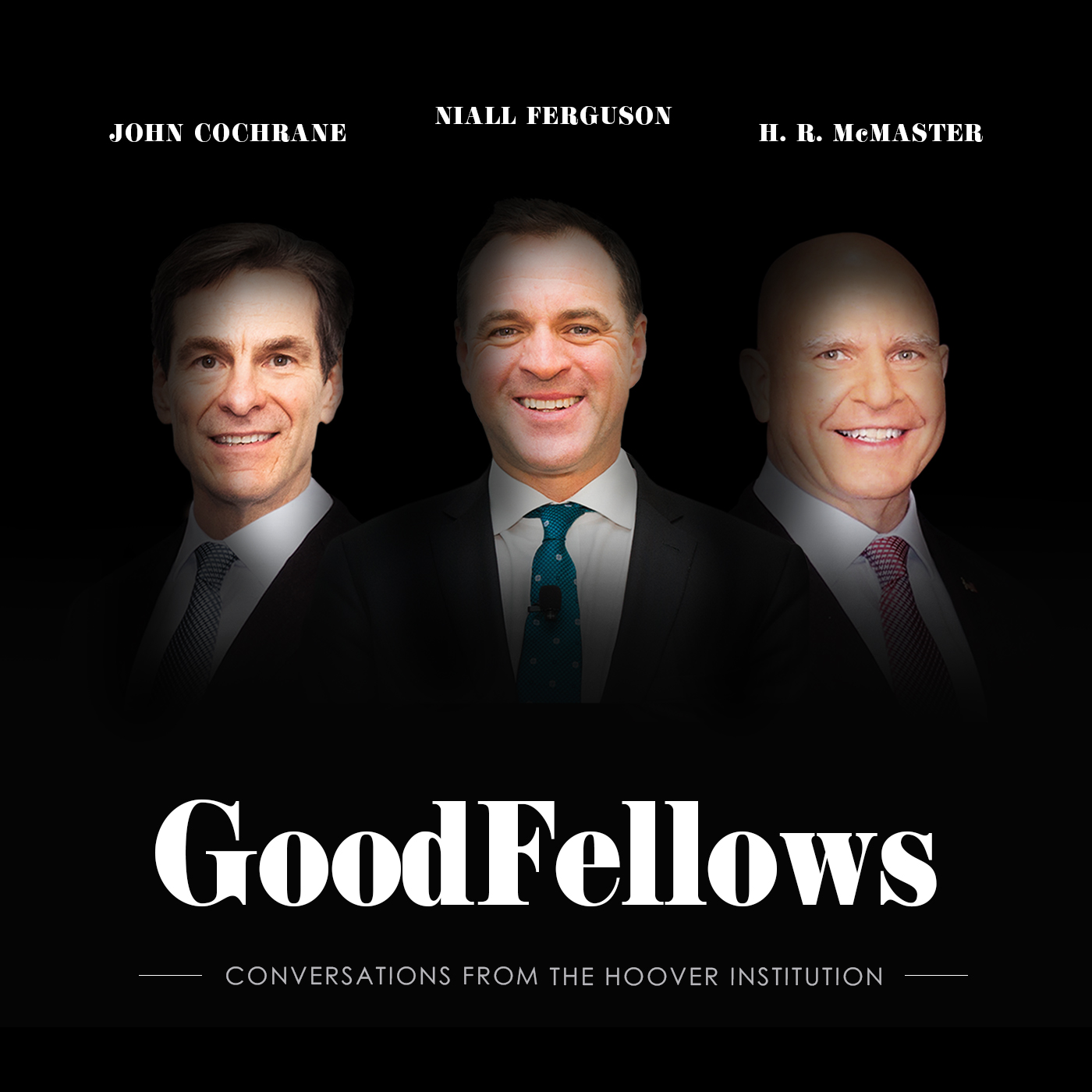
GoodFellows: Conversations on Economics, History & Geopolitics
Who’s Going To Win The Future? Dan Wang on China’s Engineers vs. America’s Lawyers | GoodFellows | Hoover Institution
01:07:33
Loading summary
Transcript101 lines
- [00:00]
A
Foreign It's Wednesday, October 1, 2025. And welcome back to Goodfellows, a Hoover Institution broadcast examining social, economic, political and geopolitical concerns. I'm Bill Whelan. I'm a Hoover Distinguished Policy Fellow. I'll be your moderator today. Begin with a little sad news for you. We don't have our full complement of Goodfellows today. John Cochran is trekking around Europe as we record. He might jump on the show, he might not. We will see. John, we miss you. Hope to get you back on the show soon, but we're going to make do with our two remaining fellows who are more than capable of carrying the show. And those good fellows would be the historian Sir Neil Ferguson and former Presidential national security advisor, Lieutenant General H.R. mcMaster. Neil and H.R. in addition to their many accolades and honors are Hoover Senior Fellows. John gentlemen, good to see you. Hope all is well in your worlds. And today we have two segments for you. But first, we're going to turn our attention to China. The timing here is appropriate. Today is October 1st. This is National Day in China, which is the annual observation of the founding in 1949 of the People's Republic of China. And we have a very good guest today to talk about all things China. And that is Hoover Research Fellow Dan Wong. Dan is a historian and analyst to China's technology and development. More importantly, he is the author of the New York Times bestseller Breakneck China's Quest to Engineer the Future. Dan, welcome to Goodfellows.
- [01:24]
B
It's great to be here.
- [01:26]
A
So question for you, if I may dumb down your book for you a little bit. The premise is simply this. You have two great powers in a competition right now. The powers have their similarities, but they have one big difference. You contend that China is a society based on engineering. The United States is a society based on litigation. So two questions for you, Dan. Is there any way the United States can be more like China, be more about engineering? And as you look at these two countries, which one is better designed to win the future? The one that builds or the one that litigates?
- [01:55]
B
Well, at a first approximation, I think you want to be a country that is able to build something at all, because it really feels like the United States has been stuck in ember for much of the 1960s onwards. I was taking the train down from New York to D.C. a couple of weeks ago to try to speak at the Abundance Conference. And the Accela train is all fine and good and a little bit wobbly. But then while I was on the train, I saw that there's going to be a new class of acceletrains. And I got really excited. That was the headline I read into the article. The new acceletrains will be 11 minutes slower getting into Washington D.C. than the present generation of trains. And so this is where I find it really strange that at a first approximation, we may be moving slower year by year, decade by decade. And for the most part, the Chinese are not. They have been engaged in this vast construction spasm of new bridges and highways and high speed rail and subways, coal plants, nuclear plants, you name it. And so that is, I think, a pretty good thing to have. And so I think that who's going to win the future? I think that is going to be. It's never going to be one country that is going to be ahead over a very long period of time. I think that the further ahead a country is, the more mistakes I will commit out of some degree of hubris. I was living in China between 2020 and, well, between 2017 to 2023. And in 2020, I observed that Xi Jinping was feeling like he was at the top of his game. China was able to control Covid, and Trump's America was unable to control Covid. And this is when he decided to smash a lot of real estate developers, smash a lot of tech companies. And they made a lot of mistakes on that basis. And my view is that whoever is going to. Going to feel the need really to catch up, whoever is ahead is going to make a lot of mistakes.
- [03:52]
C
Hey, Dan, if I could pick up on it, first of all, hey, congratulations on a great book and thank you for writing it, because I think you're providing us with kind of the impetus to get our act together and start sprinting. It's a long competition, but if we don't sprint right now, I think we are already behind. But do you think that the party still has that same degree of confidence that you saw in 2020? I remember, like the last meeting we had with President Trump at the end of a long day during his visit in 2017 with Li Kishang, you know, and he didn't want to meet with the guy and. But Lee Kushan went into this long soliloquy about, hey, you guys are finished, right? We're going to be the leaders in everything, in all sorts of advanced manufacturing. Maybe you can sell us some, you know, pork bellies and soybeans and, and maybe a little bit of energy. I mean, that was kind of the, you know, the, the message behind what he was saying, which President Trump then just listened for a little bit and just got up and left, which I was glad to see. But are they as confident after Covid, after the crackdown on the tech sector and after so many of the kind of the own goals that they've scored on the real estate sector? Have they created vulnerabilities in their race to surpass us? And is there confidence diminishing in your view at this stage?
- [05:04]
B
I guess one thing has not changed, which is that America is still trying to sell the soybeans and it has not been very successful at selling all of the soybeans to China right now. I think that China made a lot of mistakes, made a lot of own goals, as you say, HR exactly right. That they smashed that. What they have triggered is an imploding property sector which is kind of slow rolling and still going on. They've raised youth unemployment in part because of the crackdown in tech companies which were employing a lot of youths, for example, as tutors and English teachers. And so this, they created a lot of mistakes. And I remember, you know, I left China at the start of 2023. I went to become a fellow at the Yale Law School, Tai China Center. And the narrative at that time, at the start of 2023 was that autocracy is weak, it is on its knees and democracies are strong. And what I remember was that America had MRNA, America had ChatGPT, and China did not. The war in Ukraine was going badly. Then for Russia, it looked like it stalemated. And that was another sign of success for democracies writ large. I think that in turn produced America to have some degree of hubris. It overplayed its hand, perhaps in various ways. And right now China is trying to catch up. China is trying to be friendly towards Jack Ma and all the other tech titans again. It is trying to resuscitate its economy in a big way. And so this is part of the dynamic that I think will always observe. The winner will always make mistakes and the loser will try harder and harder to catch up.
- [06:39]
D
Dan, congratulations on the book. It's a deserved hit. I want to ask something that hasn't come up yet, and that's the kind of underlying demographic trend in China which has turned out to be much worse than people thought even five years ago, certainly 10 years ago. So that, you know, the UN middle projection is for China's population to fall by half by the end of the century. There's a very striking decline in fertility going on, which it's hard to imagine reversing. Itself, certainly because of any government policy. And one has a sense that the younger Chinese are reluctant to marry, reluctant to have kids, are fundamentally pessimistic about the future. How does one reconcile that underlying social reality with your story of a great engineering power that's unstoppably going to outbuild America?
- [07:47]
B
Yeah, I think that demography is definitely one of China's big challenges. But over the longer term, right now, the slope of the demographic decline, the curve is not very steep. The population started properly shrinking in 2022 and right now it is losing something like a few hundred thousand or a few million people a year. And I think that is a problem. Not for the next 10 years, not for the next 20 years. It is more really going to bite in the next 30 years when the labor force really starts to contract in a bigger way. But as your fellow countryman has said, Neil, in the long run we're all dead. And what matters is that we have to get through the short run first. And what I see in the short run, just over the last 10 years, I moved to China at the start of 2017 essentially to cover made in China 2025 and all of these big industrial projects that the Chinese really wanted to master. And I would say that 10 years after Made in China 2025, I would say it's been broadly pretty successful that take a look at segment after segment, whether that's clean technologies, whether that's solar electric vehicles, industrial robotics, consumer drones, you name it. Aside from semiconductors and aviation, China has been going for the most part from strength to strength. Let's take a look at America. While China's been growing stronger, most American apex manufacturers have not done well. If we take a look at Boeing on aviation, intel on chips, Detroit and even Tesla has been suffering for quite a while now. And so the demographics decline is real. But you don't need a very large number of people in order to have a functional high tech sector. The global employment for semiconductors, chips is not much more than a few million people. Arguably it is only a few hundred thousand people actually work in the fabs. And China will have 700 million people. That's still plenty of people. Most of them will be pretty old. But you know, I think that is going to be enough of a kernel of a labor force there to be pretty competitive.
- [09:50]
C
Yeah, and if I could pick up on that, it's a pity that John Cochran's not here so you can watch us fight with him about economic statecraft and versus, you know, free trade and so forth. But so what is your prescription in terms of, you know, what are the top things we have to do to compete effectively? And, and could you maybe address what we debate here oftentimes, which is really how to counter China's weaponization of its status mercantilist model against us? I think we would probably all agree we don't want to try to replicate the Chinese status system, but we have to protect ourselves, right, against, against various unfair trade and economic practices such as theft of intellectual property, industrial espionage, overcapacity, overproduction and dumping to, to drive competitors out of markets, unequal access to markets. I mean, the list goes on, right? So what, what, how, how, how do we do it? How do we, how do we sprint, catch up and maintain and grow competitive advantage over this system? That's kind of incompatible, right, with our as, as far as I see it, our free market economic system.
- [10:55]
B
Yeah, well, glad John's not here because then we can, we can really make our views on industrial policy heard. So my feeling, hr, is that to the extent that the Chinese are successful in all sorts of technologies, we don't have to copy them wholesale, but let's study them, let's understand what exactly has been going. Right. Something that I would say was a giant Chinese success was that unlike Japan, which mostly exported its own products, China has been pretty open, relatively speaking, to foreign companies in some selected high technology areas to do a lot of work, train a lot of its workers and export their goods. Instead, if you were buying a Sony walkman in the 1980s or some sort of memory chip from the Japanese chip makers in the 70s or 80s, that was almost entirely a Japanese value add. Whereas China is very well known for mostly assembling German, American, Japanese components into something like the iPhone, adding only Chinese labor into the mix and then exporting that product. China has also the platform for exporting Tesla vehicles and you know, a million and one other types of goods that are substantially foreign owned. And China was really welcoming towards American investment in particular, again in some selected areas. And I think that there should be some debate about whether there could be some Chinese leadership in, let's say, something like solar or something like electric vehicle batteries to try to train American workers to do the same to them, is what I'm trying to say. If they accomplish something through a forced technology transfer, why don't we do it to them? If they accomplish something through industrial subsidies, why don't we do it to them? Which is why I think it was particularly disastrous to humiliate a lot of South Korean workers in Georgia, put many of them in chains. All of them had visas to work in the United States. And then to do that to an allied power to try to. While sending a lot of engineers to build American products in the future. I think that that is not the right approach to really try to make things better.
- [13:06]
C
Yeah, Speaking of own goals. Yeah, definitely. That was our own goal, for sure.
- [13:10]
D
Yeah. Okay, let me jump in with one other idea that we haven't touched on. You know, litigation lawyers. These are easy things to be nasty about, especially if you're not a lawyer yourself. And I've certainly said, and in the past, the US no longer has the rule of law, it has the rule of lawyers. So I'm guilty of this. On the other hand, the rule of law is something that the US has compared with China, where you have, at best, rule by law. And. And that is a law that the party stands above. And that, of course, is part of the reason that China needs capital controls, because a lot of Chinese money would get out of China if it could, if only to diversify away from a system that doesn't of rule of law. And that is what makes not only the US but the Anglosphere generally attractive. So, Dan, can you imagine a future in which China's institutions are sufficiently advanced that they no longer need capital controls because the money no longer wants to get out?
- [14:18]
B
I suspect that the money will always want to get out. And I think that, you know, we take a look at the top ranks of the Communist Party still. So many sons and daughters of the Politburo would love to send their kids to Stanford University, get an education, perhaps grant a green card, and maybe even naturalize in the US for their own good. Many Chinese have wanted to depart from China for a very long time. This is a trend that has been in place for arguably centuries and especially over the last several years in which I've observed that many rich people have tried to move their money to Singapore, the uk, the us, Et cetera. Many creative types are going to. Are tired of the censorship. They've moved to Northern Thailand where they are able to smoke drugs that are legal in the state of California. And they are just really tired of the sort of restrictions that they have to face. And there are many Chinese migrants that have flown to Ecuador where they don't need a visa to try to walk across the border through the Darien Gap. And that is quite astonishing as well. So I think that there always will be some degree of emigration and flight out of China, but that doesn't mean that the country can make do very well because you don't need a very large labor force in order to be globally dominant in something like semiconductors or something like aviation or all sorts of industries. So here's the scenario that I'm really afraid of, which is that I don't think that China will replace America writ large as the global superpower, that it won't be a copy one for one. China will never be, I think, a military superpower with so many bases around the world. It will never be a financial superpower, in part because of capital controls. It will never be a cultural diplomatic superpower, because engineers aren't very good at speaking or creating cultural products. But I think they will achieve advancement in success in the narrow field of advanced manufacturing production. And that on its own, could be pretty bad for destabilizing the West. I think that there's 12 million manufacturing workers employed in the United States, and I could well see that halving over something like the next decade as the US Continues to lose its experience in something like industrial robotics or electric vehicles. And I think that will not do good things for the economy. I think that will not do good things for our politics. And already we're seeing Chinese industrialization really biting the German exporters in particular. And that's not going very well for them. And I fear that for the United states.
- [17:01]
A
And in 1960, John Kennedy ran on the missile gap, the idea that the United States had fallen behind the Soviets on nuclear technology. What if in 2028, a candidate runs on the idea of an engineering gap, that we are losing this competition with China? They have more engineers. We need to create more engineers. Very simp challenge. America's colleges produce more engineers. But here, America has a problem, Dan. Four in ten eighth graders in the United States are not competent at math. And you cannot be a good engineer if you can't do well at math. So my question, Dan, Is there something to be gained out of looking at the Chinese education system and seeing how they do the pipeline in terms of getting math into the system and then producing engineers?
- [17:39]
B
Pluses and minuses. They really train math. They really train engineering. What they don't train much of is critical thinking. I think that's very much by design. They don't love it when people write critical essays. They don't teach debate in the way that a lot of American schools really prize. So I think that is, over the longer term, going to be a crimp that's going to put a crimp in some of the progress that they can do. If they just have a lot of people doing science and engineering, on the other hand, I just wish that the US could have a few more presidents or at least members of the of Congress that are trained in some degree of engineering. So out of 100 senators, 54 of them went to law school. One of them have had any STEM training. There's only been two American presidents who were engineers. One of them is a portrait right behind you, Bill. Herbert Hoover, as well as Jimmy Carter, who is an engineering officer and a submarine.
- [18:35]
A
It didn't work out too well for either of those guys.
- [18:37]
B
But no, they had pretty dismal political instincts that produced thumping electoral defeat. And so they didn't have the right instincts. But I just wish for there to be a little bit more pluralism within the elites, and I certainly wish for there to be more algebra in the classes and there should be more math teachers and there should be just more love of science, more love of technology, all sorts of different things that people are exposed to from an earlier age, rather than debate class so that you can get into Yale Law School or something.
- [19:06]
C
Hey, Dan, just a. To pick up on an earlier point you made about China not displacing the United States in certain areas, but they do have obviously these global initiatives, right? The Global Development Initiative, the Global Security Initiative, and maybe the scariest of all, the Global Civilization Initiative. How do you evaluate their success or relative failure in these initiatives and what are they trying to achieve overall? What does China want to do if it's not to completely displace the U.S. what do they want to achieve in terms of the party's leadership?
- [19:40]
B
Yeah, well, here's where Neil earlier mentioned rule by law. And I remember spending a fruitless morning trying to understand the difference, as Xi Jinping outlines, between rule by law, socialist rule by law, and socialist rule by law with Chinese characteristics. And they are just really good at coming up with these sort of mouthfuls like global Civilization initiative. What in the world does that mean? Let's figure that out.
- [20:05]
C
The community of shared destiny. Right. For all mankind. I mean, that's beautiful, isn't it?
- [20:10]
B
Yeah, well, yeah. And what about Win Win Cooperation? You know, that's so. I mean, some of their slogans work. I mean, a socialist market economy with Chinese characteristics is just kind of hilarious, I think. So, you know, let's do something like that. But I'm still pretty struck by the relative underperformance of Chinese diplomats. And you guys will have more views about this, but I think the, you know, what was really striking was that you Know, earlier this summer, a few months ago, there was a brief but fatal border skirmish between Thailand and Cambodia. Right. And what I was really struck by was that this conflict wasn't mediated by Washington, D.C. it wasn't mediated by Beijing. It was mediated by Malaysia. And it seems like, you know, there's plenty of, you know, people even, especially the neighbors of China, that do not trust China. And I don't see that reversing very easily anytime soon. And I think that what China wants is at least dominance of its near neighbors. I mean, Taiwan is a certainty. They absolutely want that. And maybe what they want is for folks in the Philippines to regularly go to China and kowtow for the Emperor's pleasure. And that might be pretty bad. But. HR what do you think about Chinese diplomats? Are they. Are they winning or is the global. How's the Global Civilization Initiative going?
- [21:31]
C
Yeah, I don't think it's going well at all. And I think this is where we're missing opportunities, you know, and, and, you know, of course, Chinese diplomats, among other things, are afraid of the party leadership. So my, my encounters with them have always been just the reading off of cards, you know, And I mean, you can't get them to crack a smile. You know, you can't get to get off script at all. I mean, I'm thinking my main interlocutor was Young Jinxi. The only. The other. The other. The one person actually who I felt like I could have a real conversation with was Liu He. And then, of course, he's. He's out of the picture now. So. So I think there's a great deal of. Of pressure on them to conform, you know, to this kind of Xi Jinping thought and, and the effect that Wan Huning has had, you know, on, on all of these people with this convoluted, you know, Xi Jinping thought, which is really unintelligible. So I think a lot of it is their fear of making a mistake makes them ineffective interlocutors or ineffective, as you mentioned, in Mediating in a Crisis, for example.
- [22:34]
D
And that also illustrates that it's not engineers right at the top running the People's Republic of China. And I think it's important to go back to something Dan said earlier about the hubris of 2020. When I was writing my last book, Doom, I concluded very skeptically that China would do as well as Xi Jinping thought it would in 2020. And I think that's been vindicated. But five years on, I think I agree with you about one important point, Dan. If you look at what Noah Smith calls the electric tech stack. If you look at the ways in which China has raced up the value chain, you're right. Made in China 2025 has been a resounding success. And so I give you that things now look, in fact, better for Xi Jinping than they did when I was writing Doom. And correspondingly, the US doesn't seem to have a great answer to Chinese dominance, in particularly electricity generation. I mean, the most dramatic chart you can show right now is the one showing the massive increase in Chinese electrification.
- [23:46]
C
There'S been, which is related to the AI tech stack as well and everything. And industrial manufacturing. Absolutely, Neil.
- [23:55]
D
So here's my question, Dan. Where's the succession plan for Xi Jinping? Because the one thing that no number of engineers can solve is how an autocracy handles the succession problem. And there, it seems to me, a vulnerability has been created by the extension of Xi's term in office. How do you think about politics at the very top? Because rumors swirl about that very subject, and it seems like a key vulnerability that takes us back to the rule of law, constitutional governance, and institutions that China lacks.
- [24:29]
B
Yeah, well, I think that it is absolutely one of the great vulnerabilities of China, and there's absolutely no way around it that Xi, by centralizing power in his own person, such that he can be emperor at his pleasure, and failing to designate a successor, because one cannot possibly designate a successor in authoritarian systems, that is just too difficult to do. There is no broad solution to the succession problem in the authoritarian system. So that's just kind of not possible. And so I think that is going to be a source of giant risk to the system. And I think China is also a country that I call a Leninist technocracy with grand opera characteristics. So they are Leninist because obviously they are ruled by a bunch of a cadre of revolutionaries that see itself to be heaving the population into modernity by hook or by crook. They are broadly technocratic. I think we can't take a look at how straight their trains are or how good their bridges are and not understand it as a broadly technocratic place which is able to. To do plenty of good reforms, but then there is always something of the Wagnerian entrance into Valhalla. And I know, Neil, you're an opera fan, so you understand this reference, but they just have a sense of the apocalyptic, a sense of the theatrical about themselves, and it is really easy for them to veer into some sort of apocalyptic thinking, some sort of manifesting eschaton or Something So that is absolutely one of these. Just living in China, there is kind of this apocalyptic sense that hangs over a lot of people. And one felt this very acutely over zero Covid, the entirety of which I lived through. You never really know when your office building is going to have some sort of a lockdown. Your home will have some sort of a lockdown. And even if you're an elite in Beijing, an elite within the party state, an elite working at a tech company or a finance company, everyone has something to fear because they're going to come to the finance people, they're going to crack down on some sort of tech company, or they're going to purge your patron inside the military party state, and then your entire network will unravel. And that is always going to be a part of China as well.
- [26:48]
A
So, Dan, we've talked about physical engineering. Let's talk about social engineering for a second. You experience Covid in China, so you know what it's like firsthand to go through lockdowns and tracking apps and so forth. How long can China maintain social engineering? At what point will there be a reckoning? In other words, people can only live under a thumb for a certain point.
- [27:06]
B
Yeah, Well, I think that I would say that broadly speaking, physical engineering, though it has a lot of costs, is mostly pretty positive that it is good to have new bridges for people in Shanghai or wherever else in Guizhou who didn't have subway lines, now they get subway lines and didn't have a lot of parks, now they have a lot of parks. That's pretty positive. And that gives people a sense of optimism for the future. But all of that is weighed down because the fundamental problem with China is that they are not just physical engineers, they're also fundamentally social engineers. And I think it is, you know, we can see evidence of social engineering everywhere. The folks in Tibet as well as Xinjiang, these ethno religious minorities, especially in Xinjiang, who are shunted off into detention camps. I write a lot about the one child policy as well as zero Covid, in which the numbers right there in the names and there's no ambiguity about what these policies could possibly mean. It's a social optimization problem. And I think what these traumas, I think the Communist Party has been extremely effective at visiting traumas at a regular clip of once every generation you could have lived through the Great Leap Forward and then you lived through the Cultural Revolution, then you live through one child policy. There's still that's on one side of the ledger, on the other side of the Ledger are new subway stations and new parks and new cafes and better class of goods that you're able to consume. And you're given, perhaps, if you're an urban elite, two or three apartments that you can, that is given to you by the state, one of which you liquidate. And then you're able to send your kid off to USC and buy her a Mercedes on the side as well. And so I think these things are balances. Something that really helps with zero Covid and the memory of it is alcohol, which plenty of Shanghainese are able to access. And so these are the sort of things that always have to be balanced between a growing standard of life and material aspects as well as economic aspects. Along with this political trauma, I don't think it resolves in any simple way, becomes a deeply personal decision for people about what they ought to do.
- [29:27]
C
Hey, Dan, you know, there's this, that famous Bill Clinton quotation about, you know, hey, China, good luck trying to control the Internet. It's like, you know, nailing Jello to the wall. Now, there's no question China has been trying to crack down on the Internet.
- [29:41]
D
Good luck.
- [29:45]
C
That's sort of like trying to nail Jell O to the wall. But it seems like they've done kind of a good job, you know, at using social media and the Internet to control the population and control the message that is given to the Chinese people about the greatness of the party, what the party's achieving for them, the decadence of the west, how the west trying to keep them down. You know, what are the opportunities that you see to kind of reach the Chinese people and with different sources of information and maybe generate the kinds of relationships that over time might result in an evolution of the nature of the CCP or the government there, such that it ceases its kind of hostility to the west, to representative government, the free market economic system. I mean, what are the prospects for change? And then how do we communicate effectively and engage in. Do our part in the cognitive war that's kind of going on?
- [30:43]
B
Right. Well, first of all, nail cello to the wall. That's a weird image. I've never tried nailing cello to the wall. I'd like to talk to the Clinton speechwriter who came up with that line. Well, let me share a little bit ichar of my experiences of living in China during the first trade war from basically 2018 to 2020. And initially I thought that a lot of Chinese felt comfortable with Trump. He's this sort of a figure that they recognize, this business figure that says Weird stuff. And then they kind of erratic. And Trump had always been saying good things about the Chinese. And every time he talked about top leader Xi Jinping, he would always say, talk about, you know, Xi's great head of hair, a coif of well, pomaded hair. And it was really. It was really only. And people felt comfortable with Trump. You know, Trump seemed to be much meaner towards Germans or Japanese instead. And the. That all really fell apart in 2020 when Trump started calling it, you know, the Conflu or the China virus. People felt very deeply offended by those types of remarks in particular. And a lot of Chinese felt this sense of hostility with things like the China Initiative, all sorts of crazy rhetoric from particular politicians, let's say a member of Congress somewhere to say something really mean that offended them. And I think it is the right approach to say that the grievances that the US has is on the level of the Chinese Communist Party, not on the level of the Chinese people. But I think there is naturally still a lot of admiration that Chinese feel for Americans for being wartime allies and building Tsinghua University with Boxer indemnities and Hollywood and Disney. That is still really, really appealing in all sorts of ways. And I think that Chinese naturally look up to America. And I want America to be the strongest that it can be, to be the best version of itself that it can be, such that the infrastructure does not always feel like it is falling apart absolutely everywhere, especially in New York as well as California, which is the first protocol for a lot of Chinese not to feel like Shanghai is just an obviously better city, which right now it is. But let's not have the difference be so stark and to keep creating the culture and not be super inflammatory. I think all of that would be highly positive.
- [33:09]
D
The danger, of course, Dan, is that one day people look back on your book and say he made just the same mistake that the webs made in the Soviet Union in the 1930s. They looked at all the extraordinary achievements of the planned economy. They were dazzled by everything from Magnitogorsk to the new look Moscow. And then they said, look how many more engineers they graduate here than in Britain. Clearly, the Soviet Union is the future. And my sense is that while it's true that that China's clearly outperformed the Soviet Union economically, has a much more vibrant private sector than it ever did, there is still this sense that the fundamental operating system of one party state is fatally flawed, not least because it denies people the most foundational of liberties. And in particular, it doesn't protect the property rights of those who are successful. My theory is that if the United States actually could sort out its immigration policy and make itself more attractive to talent from Asia rather than less attractive, which is its current strategy, then it really would be pretty hard to beat the U.S. because the U.S. would just always attract the talent in a way that China never can. So I love the book, but I have this sneaking suspicion that it might look very, very different 20 years down the line.
- [34:32]
B
I am sure it will. And as Kane said, in the long run, we're all dead. And as friend of the pod, Stephen Kotkin says, in the short run, we're all dead. So we're all dead no matter what. But let's at least get the short run right and figure out a lot of the things that, frankly, the U.S. should do, which is build more housing, build better mass transit, and fix our manufacturing base as well. That's. That's my call to action for the.
- [34:54]
A
U.S. all right, gentlemen, an exit question, and it's an offbeat one to read. Dan Wong is to understand that he is a world traveler and he looks at food and he uses food as part of his calculations and for the health of a society, the. The progress of society. So all three of you are world travelers. So I'd like to ask you this question. If you were to take me to one place in the world for stellar cuisine, where would you take me? Dan, you go first.
- [35:19]
B
Let's say Tokyo.
- [35:21]
A
Tokyo?
- [35:21]
D
Why?
- [35:22]
B
It has a little bit of the best of a lot of different things. It is, you know, the, the Japanese are able to make even the best Neapolitan pizzas. I feel this is just so unfair that they're. They're able to master even the Italian pizza. US so, Tokyo, low end cuisine, high end cuisine, most amazing food city in the world.
- [35:40]
A
HR where would you be? And don't you dare say Philadelphia. And cheese sticks.
- [35:43]
C
Hey, I, you know, I, I kind of agree with Dan. I mean, it is pretty fantastic in Japan. But hey, in. In the United States, South Philadelphia, you know, I mean, great Italian food. I mean, how could I not say that? I have to say that, you know.
- [35:57]
A
Yeah. Neil, I would note that Dan thinks the best food in the United States is in Austin, Texas, a city you're more than familiar with. Where'd you take me, sir? Neil, where will we go to eat?
- [36:05]
D
Oh, Milan. I'm sorry? The Italians are still better at all of this than everybody, even though better than the French. And I think Milan would. Would beat even Tokyo, though. I share your, your admiration for, for Japan and Japanese cuisine, as do my younger children who are campaigning for a trip to Tokyo, I think mainly to binge on sashimi. So, yeah, I'm just going to raise a, I'm going to raise a glass of, a glass of Barolo to the, to the Italians. They are still the place. They have the culture I most like to eat in, let me put it that way.
- [36:44]
A
Well said.
- [36:45]
C
After a week in Japan with my wife, though, we both agreed that we felt like dolphins when we were leaving because we eat way too much raw fish.
- [36:54]
A
Okay, the book again, it's the New York Times bestseller Breakneck China's Quest to Engineer the Future. Dan, where else can we find you besides your book in the Hoover Institution.
- [37:01]
B
Website, my website, danwan Co.
- [37:05]
A
Okay, great conversation. Thanks for joining us. Come back soon.
- [37:08]
B
Thanks, folks.
- [37:09]
C
Thanks.
- [37:11]
A
Gentlemen, it's on to the B block and let's talk about President Trump, the United nations and a few world affairs. HR you have been there, done that. You don't have the T shirt to show up, but you have a book to show for it. In other words, you helped prepare his remarks when he spoke to the UN General assembly in 2017. Let me read you a passage in what, what Trump said here, and I want to get your thoughts first on the speech. HR Then, Neil, I want to turn to you for a larger question about what is it the United nations does these days? So, hr, here's the quote. What is the purpose of the United Nations? The UN has potential. What they all seem to do is really write a lot of strongly worded letters and then never follow that letter up. It's empty words. And empty words don't solve wars. So. HR Take us in the head of Donald Trump.
- [37:53]
C
Well, you know, he would always say that in 2017, 22 UN's got great potential. You know, and of course, we had Nikki Haley there, did a fantastic job as our ambassador to the UN and was working with Gutierrez, Secretary General Gutierrez on a number of reforms that really didn't get traction. But what President Trump gets is he understands that this idea that we would have this condominium of nations in the post Cold War period and we would all cooperate mainly within international organizations to solve our common problems. He understands that that's not the world we're in. It's a competitive world. And I think what's beneficial about Trump's worldview is that he understands that these international organizations are competitive spaces. Right? There's no prize for membership. You have to compete within them. And especially when you See, the way that the U.N. for example, has dealt with Israel over the years and so forth. Trump doesn't have any illusions about what the UN can do in terms of solving problems. But of course, what we tried to do, and this is in 2017, was to argue against this kind of soft headed cosmopolitanism or what some people call globalism now, but argue for purposeful internationalist approaches to the problems that we're facing. Because the United States can't do it by ourselves. Right. We do have to form these coalitions of like minded nations. And that was a big theme of his speech. And the way that we bridged into that was for President Trump being an advocate for sovereignty, which he is for Americans. It kind of goes with America first. And so we were for strong sovereign nations who respect the sovereignty of other nations and the sovereignty and rights of their own people. Right. And I think that was kind of, that was what was missing from the speech this time. And of course, you know, they had the issues with the escalator and the teleprompter, which had him in a bad mood to begin with. But we had a very similar situation in 2017. I talk about this in the book. I mean, we get into the green room. He had written this line in the speech about, you know, little rocket or not little rocket man at the time. Rocket man, right on, on, on Kim Jong Un. Rocket man is on a suicide mission for himself and for his regime. The United States is ready, willing and able. But Hokage, hopefully this will not be necessary. And I was trying to talk about, hey, Mr. President Lewis, you got a great speech here. If you say the rocket man thing, it's accurate, but you know, that's all that the press is going to cover is the rocket man thing. And so I was just about to really get him to see my way on that, and then he came and said, hey, you're on right now. President Trump, because the Brazilian leader, I guess, wanted to set the record for the shortest UN speech ever. And so he just said, oh, great to be here left. And so anyway, it was chaotic for me there. You know, at the UN it is like, it is like diplomatic speed dating in a lot of ways. But, but, but he got a lot out of that first engagement, I think, with, at the UN General Assembly. But there's some significant differences and those are worth looking at between those two speeches, the 2017 speech and, and, and the most recent speech are. There are some significant differences.
- [41:05]
A
Neil, the United nations is 80 years old. Is it a vibrant, thriving octogenarian or a struggling, declining octogenarian.
- [41:13]
D
I think struggling declining would be putting it politely. Let's not forget the farcical scenes in February, January, February 2022, when the UN Security Council was debating the. The impending aggression of Russia against Ukraine with the Russian ambassador in the chair. I remember my son Thomas asking if we were watching Saturday Night Live. I said, no, this really is the UN Security Council. So I think, I think the UN Is, is broken, and I think it's broken in ways that I guess have been true for a long time. One is that the Security Council tends to be dominated by the vetoes of the permanent members. That's been true for most of its existence. The more profound problem is the way that the General assembly now functions, particularly when it comes to the Middle east, when you can always crank out anti Israel resolutions with almost nobody voting against. I thought Trump's speech this year struck the right tone of scarcely veiled contempt, but if you actually got into the substance of the speech, I agree with you. HR There was some important and interesting differences I was struck by. Not just the claims that he'd settled seven unendable wars in seven months, which I think everybody would agree is a stretch.
- [42:52]
C
Also been working relentlessly stopping the killing in Ukraine. I thought that would be. Of the seven wars that I stopped, I thought that would be the easiest because of my relationship with President Putin, which had always been a good one. I thought that was going to be the easiest one. But, you know, in war, you never know what's going to happen. There are always lots of surprises, both good and bad.
- [43:17]
D
But I think the key point that seems to me to be central to Trump's diplomacy this year is to lean on the Europeans to do more. And a substantial part of the speech was telling the Europeans what they're getting wrong, particularly on the issue of immigration. But, but this, I think, is the key point of, of Trump 2025. He has really forced the Europeans not only to increase their defense spending, but then to take responsibility for the war in Ukraine, which, in effect, Trump has washed his hands off, judging by other things that he said last week. So that seems to me like what's really going on there. And for those listening to the speech, particularly Europeans listening to the speech, that was the real point.
- [44:05]
A
HR o' Neill says the UN Is broken. How would you fix it?
- [44:08]
C
I don't think it's fixable, you know, and the reason it's not fixable, I think, is because you have, as Neil mentioned, a Security Council is just going to be permanently Divided between, you know, between, you know, the Western states and China and Russia, who are authoritarian hostile regimes who have done actually a much better job than we have of competing within the organization. And so many parts of the organization have been co opted, you know, by the Chinese Communist Party, you know, or undermined by the Russians. I mean, the Human Rights Council's a joke, right? And I think President Trump was right to get out of the Human Rights Council during his first term and the Biden administration was wrong to go back in, you know, without trying to exact some, you know, some kind of reforms out of it. You know, UNESCO, I mean, there are many, many other examples of organizations within the UN that could have, could play an important role, but they've been subverted and many of these organizations have been turned against their purpose. So the question is, hey, do you reform or do you create something new? You know, and, and I think at this stage it's time to create some new organizations and you know, coalitions of the willing, whatever term you want to use, like minded countries around issues that can be solved together. And you see this in certain geographic locations. You know, for example, you know, the, the Baltic states and the Nordic states are working very closely together with Poland within the existing framework of NATO. But there's like a subgroup now, you know, that are cooperating even more closely on the shared threat from Russia and how to deter it or to counter it and so forth. So I just think it's time to maybe do some new work, some groundbreak on some new organizations, break grounds of new organizations, then try to reform old ones which are moribund and are subverted.
- [45:56]
A
Okay, I have three items of news I want to quickly get through before we get the lightning round. First one, Neil, Donald Trump has a 20 point plan for peace in Gaza. Will it go anywhere?
- [46:06]
D
Well, I actually thought it was pretty good. And I have to say that the President's Middle Eastern strategy is looking much better at this point than it did five or so months ago. I think that he has shown an ability to get the Arab states back on board with a process that solves the, the crisis and re establishes lines of communication with Israel. So I liked it. Of course Hamas has to accept it, which I don't expect they will, or they'll accept it with so many caveats that it won't be meaningful. But I, I feel like the President's Middle east strategy took a turn for the better. There was a moment just a couple of weeks ago when it seemed as if Israel was destined to take the place of Apartheid, South Africa in the pariah category, shunned by most of the world, with Europeans lining up to recognize the non existent Palestinian state. So I thought this was a good development and it was good to see Prime Minister Netanyahu lining himself up with this, with this plan. HR do you agree?
- [47:27]
C
You know, I do agree and you know, this approach of, of, of, of, of working with Israel, you know, pressuring Israel to, to sign up for something that's acceptable to Israeli leadership and then saying to, to Hamas, you know, hey, this is your last shot. And I mean, I think that's the right approach. And as you alluded to, Neil, it changed the narrative. What was bothering the hell out of me is that there was this tendency to blame the Israelis in Netanyahu for the continuation of the war while Hamas is still holding these hostages. Right. So I think this changed the narrative and it's given Hamas one last chance to avoid destruction, which I think Israel, unless they agree to disarm, unless they agree to provide this space for this yet to be named peace enforcement force to come in and ensure their disarmament and create security space for a new political entity to emerge. I mean, that's all that all sounds good. It's gonna be hard to do, but if Hamas doesn't agree to that, then, you know, then I don't think Israel has an option other than to destroy them. I mean, and, and, and, and I know that sounds tough and, and sad for the Palestinian people. I would like to see more pressure on, on Egypt to, to create a safety valve maybe into the Sinai for this last phase in the Gaza City. That's the one additional thing I think maybe the trauma situation could press. But I agree with you. I think it was the right approach and it shifted the narrative back onto Hamas, which is where it belongs, I think.
- [48:59]
A
HR I want to stick with you. Should the United States sell long range Tomahawk missiles to the Ukraine? If so, how would that change the war? Because if I understand this, you could hit mosque in, out with the Tomahawk, couldn't you?
- [49:10]
C
Yeah, I think we should, you know, and, and, and, and the reason is, you know, Ukraine has already demonstrated the ability to differentiate between targets that are connected to the war effort and military targets and civilian targets while they're on the receiving end, Bill, you know, of indiscriminate attacks on their cities, on schools, on hospitals, on apartment buildings. So this would give them more means, really, more capacity in the area of long range fires in combination with the drones and the capabilities they developed themselves to Strike at the archer. Right. Because you can't defend yourself against all these arrows unless you kill the archer on the other end. And that's what Tomahawks would give them a capability to do.
- [49:51]
A
Neil, did the word Tomahawk come up in any of your conversations when you recently were in Ukraine?
- [49:56]
D
Yes, of course. What Ukraine needs is greater capacity to hit the Russian war machine. They've already taken 38% of Russia's oil refining capacity offline pre Tomahawks. And this is an extremely important development because it means that for the first time since this war began, Ukraine is able to inflict meaningful damage on Russia's war economy. So I think this is good. This is a way, as we've been saying for years, to put real pressure on Vladimir Putin. Only by putting that real pressure on will you get him to negotiate in earnest. And he showed in Alaska that he was not serious about negotiation, much to President Trump's frustration. This is the kind of thing that can really change the calculus.
- [50:42]
A
Okay, final question. HR we are currently striking drug targets in the Caribbean. Should the United States strike within Venezuela?
- [50:50]
C
Well, you know, that's a question for the President, and I hope with consultation with Congress, it would have to be based on Article 2 authorities. Unless he's not going to get approval for Congress to do that, I don't think. And, and, and so they would have to show, like, a direct threat to the United States. Have to be a legal review. It would depend on what the purpose is. Right. I mean, strikes sound really good, but what do they, what do they, what do they really achieve? I think, you know, what you would want to do is evaluate strikes based on the physical effect that they have, but also the psychological and political effect. What you would want is a strike to strengthen opposition against Maduro and weaken Maduro's grip on, on power. When a strike might, and you have to consider this, you know, might allow Maduro to say, hey, look, I'm being attacked by the Yankees, you know, you know, you've got to support me. It might allow him to use Venezuelan nationalism to, to continue his destruction of his own country. So, yeah, I, I would be skeptical about it because I would try to tie it to very, to very clearly defined objectives and also assess kind of the downside of the strikes and then answer the question. Okay, then what, what happens after strike?
- [51:54]
A
Yeah, and that's my question for you, Neil. How would Trump message this, the American people? Because you can already imagine the pushback distraction. You're trying to get away from other problems by Creating another war elsewhere. How would you sell this to the public?
- [52:04]
D
Well, I think he's already been selling it as actions against narco terrorists. I don't know that. There is enormous public interest in regime change in Venezuela. I would be in favor of that. Have been for years. Can't stand the Maduro regime. And the Maduro regime is just going to get worse. It's not going to get better. It's a criminal racket. But the public, I think, is open to action that punishes drug traffickers. I don't think that's hard to sell. I think the public is also sympathetic to an argument that Stephen Miller and J.D. vance also make that the U.S. should focus on its own hemisphere. I call this the Don Row Doctrine, as opposed to the Monroe Doctrine. And the Donroe Doctrine is attractive to voters who struggle to understand why the US has interests as far afield as Ukraine or Israel or Taiwan for that matter. So there are ways of selling it. But as HR says, it's questionable, really on constitutional grounds that the US should be waging a war against the Venezuelan regime, if that's what it's doing.
- [53:08]
A
Okay, Neil, copyright Dunro Doctrine because you didn't Copyright Cold War 2, and I think you're missing out on royalties here. All right, John. And on the lightning round, HR begin with you, Secretary of War. I have a hard time saying that Secretary of War Pete Hegseth recently gathered hundreds of US Generals and admirals at the Marine Corps Museum in Quantico, Virginia. The reactions this HR ranged from the benign, isn't there a cheaper way to do this? How much is it costing taxpayers? To the obligatory hysterical, my God, our enemy is going to think this is a prelude to war. HR, you wrote about this on your subset. Tell us what the Secretary is up to.
- [53:50]
C
Well, you know, a lot of the message was kind of appropriate in terms of what he wants to achieve. Right. He wants to reverse, you know, what I would call radical dei, which is this idea that the Biden administration was pushing of equality of outcome, rather the quality of opportunity, the pushing. Some of these reified philosophies and various postmodernist critical theories that tell people that you should judge people by their identity category, you know, rather than, you know, rather than their toughness, their courage, their. Their. Their sense of honor, their. Their willingness to sacrifice for the nation and for each other. That's how you evaluate, you know, fellow warriors and, and then. And then also, you know, this, this valorization of victimhood, all that stuff. But the tone of it kind of Bugged me, Bill. It bothered me, you know, because, you know, I mean, you know, I. I think our military does have tremendous military prowess, but we don't need to beat our chest about it, you know, I mean, what we need to do is focus on our competence and our professionalism. I also think some of the language veered into language that could inadvertently encourage indiscriminate use of force, you know, and, And. And. And, you know, I'm all for overmatching the enemy, man. I mean, I used to tell our troopers, I used to quote Ernest Harmon, hey, if it takes a toothpick, use a baseball bat. But I would also then qualify that with, you know, with. Apply firepower, overmatch the enemy, overwhelm the enemy in any combat engagement. Right, because barely winning in battle, that's ugly. You don't want to barely win a battle. But apply firepower with discipline and discrimination, consistent with our professional military ethic and our warrior ethos and our war ethos is critical to combat effectiveness, but it's also what makes war less inhumane and preserves our morality and our ethical approach to combat. That's consistent with Thomas Aquinas and Juice and Bellow theory. So, hey, I didn't like the tone, but a lot of the message was overdue. I just wish that there had been a borderline with the president and with Secretary Hess between partisan politics, criticizing predecessors, former commanders in chief, and the military. Keep that bold line in place, right? And you saw that with the way those. Those professionals were sitting there, you know, just listening, obviously, to their leadership. But, you know, I think there might have been like this. This hope that it would be kind of like a rally, but you're not going to get that from the military. You don't want that, you know, from your military. So that was my biggest concern coming out of it was, you know, the, you know, the, you know, this idea that you could maybe apply for us without, you know, without discrimination. And then. And then also, you know, the. This. This sort of, you know, missed opportunity to emphasize we don't want the military involved in partisan politics. And, and, you know, hey, there are no WOKE generals or admirals that I know. I don't know any of them or generals or admirals, you know, and. And so this was being pushed by the Biden administration. They've already won. They won the election. It's over. So, like, stop trying to think like you're going to weed out people who were bought into the Department of Woke, whatever the hell that was, you know. So, anyway, I feel Better now. Thanks for allowing me to get that out, Bill.
- [57:10]
A
Okay, Neil, let's stick with the War Department. The Pentagon is sending in 200 National Guard troops to Portland, Oregon to quell ICE protest or what the White House calls, quote, premeditated anarchy. Neil, now, are we living in an authoritarian regime?
- [57:24]
D
Well, no, because actually there are good legal precedents for providing protection for government officials who are faced with threats. There's also, I think, a pretty clear problem of policing parts of Portland which appear to be lawless and have been for some years. So I think this is again, something that can be regarded without hysteria as, as reasonable under the, the circumstances. I, I mean, Portland's not the only city with major problems. President Trump's also singled out Chicago and Of course, Washington, D.C. it's pretty hard to make the claim that these are well ruled cities that have the problem of law and order under good local control. So, you know, if you want to defend a chaotic city and a city with high crime rates, go ahead, be my guest. But you won't win many votes that way.
- [58:28]
A
Right, Neil, let me take you back to your home, Leon. Now, a recent Sunday Times poll showed that 60% of Scots backed mass detention and deportation of legal immigrants in the U.K. meanwhile, in Scotland, reforms overtaken. Labor is the country's second most popular party. We've used the phrase a lot on this show. Is this a vibe shift?
- [58:45]
D
Well, Scotland's odd because in many ways, at least a substantial part of Scotland is quite socially conservative with a small C. You can see that from survey data on a whole range of issues. Scotland is not woke. Anybody who's been there wouldn't be too surprised to, to, to hear that. But, but Scotland's politics has been impaired by the rise of, of Scottish nationalism and for years that became the alternative to a Labor establishment with the Conservatives barely able to win more than a dozen seats. What's novel is the sudden appearance of reform as a political force. This is also happening in Wales. It's odd, though, because reform is often seen as a little England party and the waving of the St. George Cross is more common amongst reform supporters than the waving of the Union Jack. What does this tell us? I think it tells us that British politics is in an extraordinary volatile state. Disillusionment with the established parties is now a national phenomenon and people have turned to reform because they've decided that immigration is the key issue. That's, I think, what's going on and it's a UK wide revulsion. The question is, does Nigel Farage, who is a Very English individual. Does he have momentum sufficient to carry him to the next general election? If the election were held tomorrow, he'd win and be prime minister. But we have a long way to go before Keir Starmer has to give him that opportunity. And my bet would be that it will be hard for reform to maintain this kind of momentum until the next general election. And that gives Kemi Badenov's conservatives a chance to begin to recover from the rock bottom that they recently hit.
- [60:42]
C
Right.
- [60:42]
A
HR President Trump recently said that he'd like for the US to re engage with Afghanistan, specifically regaining control of the Bagram Air Base because, and I quote, it's an hour away from where China makes its nuclear weapons. Is this at all realistic?
- [60:55]
C
HR you know, it's not realistic unless you're going to commit a pretty significant number of troops, you know, about a brigade sized force on a continuous basis to secure it. Bagram Air Force would be easy to take, it'd be harder to secure and hold in the longer term because of the mountains that are just adjacent to it. And it would have to really outpost to prevent indirect fire, you know, drones, that kind of, those kind of attacks on, on the, on the base. So it would be, it would be manpower intensive. It's one of the reasons why it closed when President Biden made that disastrous decision to tell the military, hey, shut up in color basically, and I'm giving you a date and the number of troops adhere to that, that, I mean, that really compelled the closing of Bagram Air Force Base and the situation which we evacuated the military before civilians, like when the hell does that ever make sense, you know, and, and we're confined to the evacuation of the Kabul airport. So hey, I, you know, I'm glad he's got that sentiment now. You know, I wish also he had that sentiment, you know, a little bit stronger back in, back in 2020. And, and when he sent Zal Khalilzad there to, to, you know, to negotiate what I think was kind of a surrender document, you know, and, and so anyway, I mean, he's right. It's a strategic location. He's right that the big benefit geostrategically of, of our humiliating, you know, self defeat in Afghanistan was China, to a lesser extent Russia. So, you know, he's right about that sentiment, you know, but it's just not, I don't think, realistic based on, I don't think President Trump was to commit that level of force there.
- [62:29]
A
All right, final question, gentlemen. It's a very quick one. Welcome to Day One in a partial shutdown of the federal government in the United States of America. This is the third time this has happened under Donald Trump's watch. The first one lasted one day, the second one won a record 35 days. I am very cynical on these. I've been following this for 30 years now. These happen habitually. HR how long do you think this will last and do you much care?
- [62:52]
C
I don't really care that much. Bill, I'm asking you, what do you think?
- [62:56]
D
I don't think it lasts too long. I mean if you look at the latest polling, it is sticking to Chuck Schumer like tar, that it's Schumer's shutdown and that means that the payoffs to the Democrats just are negligible at this point. Interestingly, Republican leadership in, in the House and in the Senate is polling more strongly with Republican voters. Democratic leadership in Congress is pulling worse. So I would say the Democrats are a losing wicket here and they're going to throw in the towel real soon.
- [63:30]
A
Neil, why do you think Chuck Schumer is scared? What is motivating him here?
- [63:34]
D
Well, the problem about being a Democrat right now is that you have this vertical, very radical leftist base that has a lot of energy that is going to take the merit of New York and that means that the, the center in the party is under enormous pressure because they know that Democratic socialism is pretty toxic in the rest of the country. And it's suddenly not much more than a year till the midterms. The Democrats have a major problem. I mean it's very, very obvious not only in the polling, but also in just their ability to register voters. If they carry on like this, it's no longer a self self evident that the Republicans lose the House in the traditional way of things in American politics. They may actually hold on unless the Democrats can get their act together. I don't see much sign of it.
- [64:25]
A
Right now in this case. Neil. He is up for reelection in 2028. He has been around Congress for a long time and he fears one thing and that is getting primaried by aoc.
- [64:35]
D
So seems like a highly probable scenario at this point, I must say.
- [64:41]
A
Okay, I don't know. Which would you rather have HR Senator Ocasio Cortez or President Ocasio Cortez?
- [64:47]
C
Hey man, I mean I, I just. Wouldn't it be great, would it be great if our primary system produced people that the vast majority of Americans would kind of like a little bit? You know what I mean? I just think that, you know, this movement to the Polar extremes. You know, I just. I just don't know. I just. We got to get beyond it. We got to get it beyond it. We got to get politicians who get to the politics of addition, you know, that can bring the majority of Americans together to prioritize what we can agree on and to build a better future and to get after kind of the priorities that. That Dan, you know, that Dan has laid out in connection with the competition with China. Right. We got a lot of work to do, you know, and we need leaders who can bring people together and, you know, and strengthen our confidence in who we are as a people and. And confidence in an agenda that's going to build a better future for generations to come. That's the kind of leaders we need.
- [65:39]
A
Gentlemen, great conversation as always. Hope all is going well with you and we'll see you in a couple weeks.
- [65:43]
C
Hey, I got one more thing, Bill.
- [65:44]
A
Oh, go ahead.
- [65:45]
C
Happy birthday to the United States Navy. You know, it's coming up on October 13th, right. You know, and then we've got the Marine Corps birthday coming up on November 20th, and the Marine Corps was founded in a bar in Philadelphia, you know, so. So I just wanted to put that out there. Couple birthday celebrations, coming parades.
- [66:01]
A
Or is that only the province of the Army?
- [66:04]
C
I don't think they're going to get a parade, I guess, but, you know, they got Fleet Week coming up here in San Francisco. The Navy, Marine Corps. That's going to be a fantastic one this year.
- [66:12]
A
The budget shutdown might affect that.
- [66:15]
C
Yeah, it might. Oh, yeah, that'd be terrible. That'd be terrible in terms of, you know, those are big recruiting opportunities because young people get to see, you know, the rewards of service and meet some of these extraordinary young men and women who serve in our Navy and our Marine Corps.
- [66:28]
A
Okay, guys, great show. We gotta run. I'll see you in a couple weeks. That's it for this episode of Goodfellas. Before we leave, though, I do want to make one pitch. We're going to be doing a viewer mailbag show in the near future, so not too early to start thinking about questions for Sir Neil, HR and the truant, John Cochran. You do that by going to our website, hoover.org ask Goodfellows and ask them most anything. Neil, is anything off limits in terms of questions?
- [66:53]
D
Oh, nothing is off limits. I'm an ask me anything kind of guy.
- [66:58]
A
There it is. Ask me anything. Neil Ferguson. All right, gentlemen, on behalf of the Goodfellows, Sunil Ferguson, HR McMaster, John Cochrane, all of us here at the Hoover Institution. We hope you enjoyed the show. Till next time, Take care. Thanks again for watching.
- [67:12]
B
This podcast is a production of the Hoover Institution, where we generate and promote ideas and advancing freedom. For more information about our work, to.
- [67:21]
C
Hear more of our podcasts or view.
- [67:23]
B
Our video content, please visit hoover.org.