← Great Company with Jamie Laing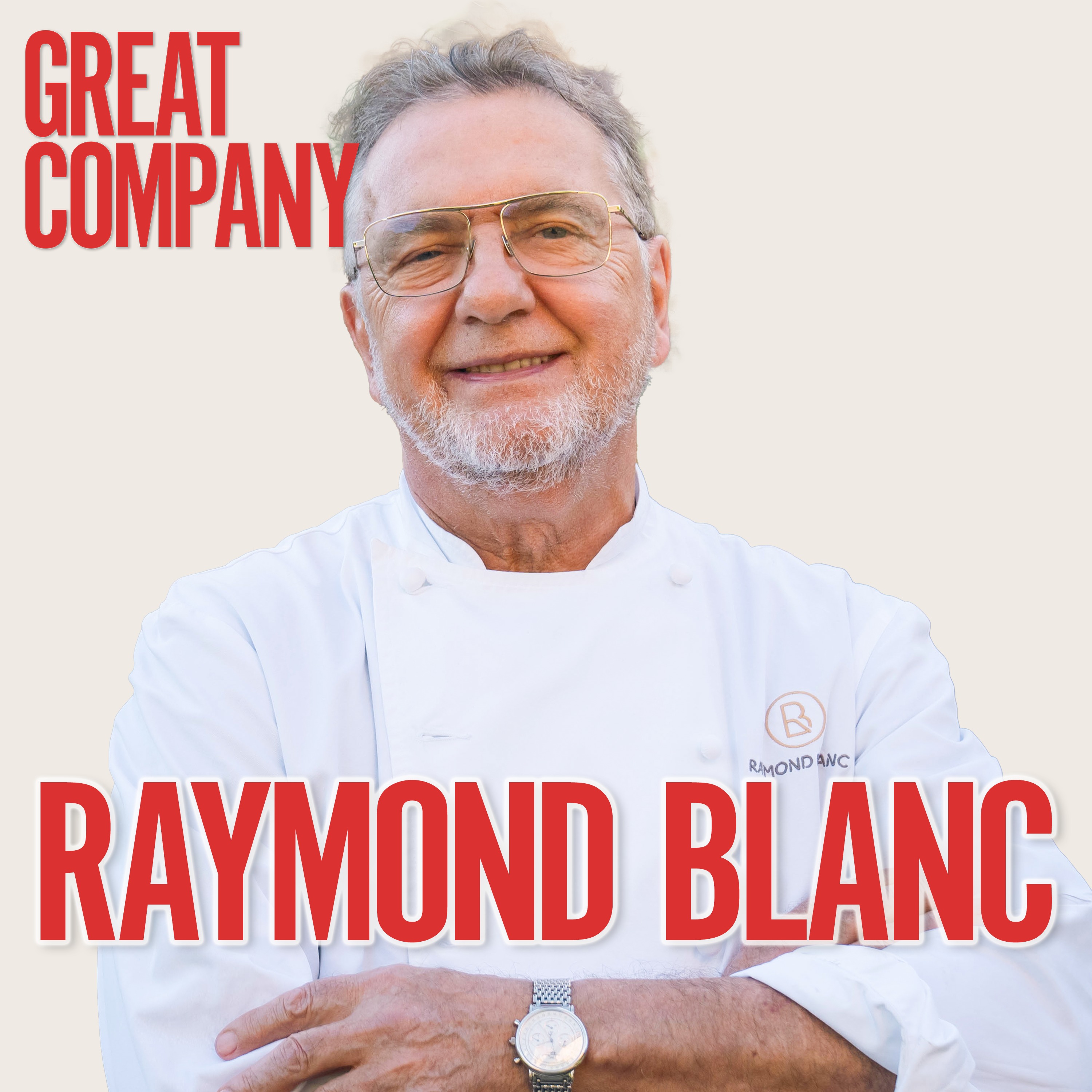
Great Company with Jamie Laing
HE'S MENTORED THE GREATEST CHEFS IN THE WORLD BUT HE'S SELF TAUGHT - THIS IS THE BOLD STORY OF RAYMOND BLANC
01:14:50
Loading summary
Transcript337 lines
- [00:02]
Raymond Blanc
Race the rudders.
- [00:03]
Jamie Laing
Race the sails.
- [00:04]
Raymond Blanc
Race the sails. Captain, an unidentified ship is approaching.
- [00:07]
Jamie Laing
Over.
- [00:08]
Raymond Blanc
Roger, wait. Is that an enterprise sales solution?
- [00:13]
Paige Desorbo
Reach sales professionals, not professional sailors. With LinkedIn ads, you can target the right people by industry, job title and more. We'll even give you a $100 credit on your next campaign. Get started today at LinkedIn.com results, terms and conditions apply.
- [00:30]
Raymond Blanc
G'day, America. It's Tony and Ryan from the Tony.
- [00:33]
Jemima
And Ryan Podcast from Down Under.
- [00:35]
Raymond Blanc
Today we want to talk to you about Boost Mobile, the newest 5G network in the country. These guys are no longer the prepaid wireless company you might remember. They've invested billions into building their own 5G towers across America, transforming the carrier.
- [00:49]
Jemima
Into America's fourth major network alongside the other big dogs.
- [00:54]
Raymond Blanc
Yep, they're challenging the competitors by working harder and smarter, like this amazing new network. They've literally built. The Boost Mobile network together with their roaming partners. Covers 99 of the US population. But 5G speeds not available in all areas. Yep, they have blazing fast Internet and plans for all the latest devices. Visit your nearest Boost mobile store or.
- [01:16]
Unknown
Find them online at boostmobile.com@hotels.com we know some travelers crave sand between their toes. Others want to be poolside with a drink on the way. And more often than not, those two people end up in a relationship with the Hotels.com app. Compare properties side by side across amenities like pool and oceanview. Compromise isn't so bad when you're holding a Mai Tai bio pool with an ocean view. Agreeing that, yeah, this is better than finding sand in awkward places for three days. Book now in the hotels.com app and find your perfect somewhere.
- [01:48]
Jamie Laing
How many discounts does USAA Auto insurance offer?
- [01:51]
Raymond Blanc
Too many to say here. Multi vehicle discount, Safe driver discount, New vehicle discount, Storage discount. How many discounts will you stack up?
- [01:59]
Unknown
Tap the banner or visit us aaa.com autodiscounts restrictions apply.
- [02:07]
Jamie Laing
Hello, everyone. My name is Jamie Laing and this is Great Company. Hey, guys. Well, hello everyone. Welcome back to Great Company.
- [02:18]
Jemima
Welcome back.
- [02:19]
Jamie Laing
Hello, Jemima Producer.
- [02:21]
Jemima
Your voice just then went, hi, guys. And then you went, oh, no, bit lower.
- [02:25]
Jamie Laing
Way too high.
- [02:26]
Jemima
And then. And then we came right down.
- [02:27]
Jamie Laing
And then we came right down. You are the producer. I am the host of the show.
- [02:31]
Jemima
My name is Jamie Gu to Jemima PJ presenter. Jamie PJ I.
- [02:35]
Jamie Laing
By the way, PJ and pj.
- [02:38]
Jemima
PJ Squared. That's what the show will now be called.
- [02:41]
Jamie Laing
What can I tell you about me?
- [02:42]
Jemima
I didn't ask. Okay, well, tell me something about You. Oh. What's your favourite colour?
- [02:48]
Jamie Laing
Turquoise. What's your favorite colour?
- [02:50]
Jemima
Pink.
- [02:51]
Jamie Laing
What kind of pink?
- [02:52]
Jemima
All of them.
- [02:53]
Jamie Laing
You like all the pinks?
- [02:54]
Jemima
Yeah. Do you know what colour my bedroom is? Skin colour? Pink.
- [02:57]
Jamie Laing
Nice. That's a calming color.
- [02:59]
Jemima
I blend in when I'm on a zoom, just reflecting eyes.
- [03:04]
Jamie Laing
Do you hide in your room occasionally when people come in?
- [03:06]
Jemima
Just against the wall? Yeah.
- [03:09]
Jamie Laing
Hey, listen.
- [03:10]
Jemima
Yeah.
- [03:10]
Jamie Laing
I'm really excited for today's episode.
- [03:12]
Jemima
Are you?
- [03:13]
Jamie Laing
Yes. Because this is someone who is like. He was my safe space at university.
- [03:22]
Jemima
Who are we talking about, Jamie?
- [03:23]
Jamie Laing
We're talking about Raymond Blanc.
- [03:24]
Jemima
Yeah. Why did you say. Did you. What, you met him? You went to university with him?
- [03:29]
Jamie Laing
I didn't meet him. He. I used to come back from university from lectures or whatever it was. I used to, to the local Sainsbury's, get food, come back and watch his TV show on the laptop while eating the food. It was like my favorite moment. It made me feel relaxed and calm and chilled and all those different things.
- [03:44]
Jemima
There's something about cooking shows, I think, that does for a lot of people. It's really calming.
- [03:48]
Jamie Laing
It was just brilliant. Every single. So now to finally have this absolute legend coming into the studio to talk to us is really amazing.
- [03:55]
Jemima
He really is a legend. And so French.
- [03:58]
Jamie Laing
So French. And lots of people probably don't know this, but the way that we reach out to our guests, we do it over email. I will reach out over social media. I reached out over social media to Raymond, got a reply straight away, really straight away, saying he'd love to do it, really, which is amazing. So it was a real. This is a real sort of pinch me moment to have the legend Raymond Blanc on our podcast.
- [04:20]
Jemima
I'm excited to see you being so like. I mean, every guest, Jamie, as you can probably imagine, is very excited by, but this one feels like it's a little bit different because, like, it feels like child Jamie is coming out now.
- [04:33]
Jamie Laing
It's so exciting. What do we think he's gonna. Chefs can't sometimes be quite. They're very creative chefs, so maybe they can be a bit adhd, a little bit like me sometimes they're a bit wild in lots of different ways, I think.
- [04:46]
Jemima
Also I think be interesting to talk to him about, like, intenseness. Like, I think to be a chef, you don't, you know, like the hours that you're working are the meal time hours. Like they're really unsociable hours to be working and the kitchens can be very like hot, intense places. Like you're Working to time constantly. And it's an intense space to be. So I'm really fascinated to find out a little bit more about the type of character like to have built, like. And that's my perception of. And anytime I've ever worked in like pubs and stuff, the kitchens have always.
- [05:17]
Jamie Laing
Been like a real hectic space.
- [05:18]
Jemima
Right, Real hectic space, but also full of like wild characters who are like, love, love the thrill. It's like an adrenaline filled space.
- [05:27]
Jamie Laing
And also, Raymond is one of these people who have trained so many incredible chefs from Marco Pierre White to Heston Blumenthal. Like he has trained over 30 Michelin star chefs or something crazy like that. He's a proper legend in this sort of cuisine. Cuisine space.
- [05:41]
Jemima
But he's not trained.
- [05:42]
Jamie Laing
He is not trained.
- [05:44]
Jemima
That is mad.
- [05:45]
Jamie Laing
He's also French.
- [05:46]
Jemima
Yes.
- [05:46]
Jamie Laing
Even though he's lived here for 40 years in the UK, should we say, come on, Raymond, leave the accent. Stop pretending you're French still.
- [05:53]
Jemima
I mean, to have lived in the UK for like 40 years and still have like a really strong French accent, I love it. That's like something in your bones.
- [06:01]
Jamie Laing
Anyway, we're very excited for this. So before we start the show, remember, you can let us know what you think of the show by getting in touch over email. Great company@jampodproductions.co.uk or you can slide into our DMs on social media, reatcompanypodcast. And if you haven't subscribed to the show, please do, because it would just does us huge wonders.
- [06:19]
Jemima
Also, can I just say, I'm in those inboxes and every single message I love.
- [06:24]
Jamie Laing
Yeah. Jemima really does read all of them. So here we go. You ready for this?
- [06:28]
Jemima
Yes.
- [06:28]
Jamie Laing
Okay. Enjoy this episode. I can't wait. Of Great Company with Raymond Blanc.
- [06:35]
Raymond Blanc
My name is Raymond Blanche and I'm in fantastic company.
- [06:43]
Jamie Laing
When I was at university and I used to finish my lectures or finish work or whatever, it was my safe space at university was watching your program. And I would watch it every day when I came back from university, I promise you.
- [06:59]
Raymond Blanc
So you're telling me you are my hero? Yeah.
- [07:01]
Jamie Laing
Yeah. You're my hero. I am your hero.
- [07:07]
Raymond Blanc
Okay. I can see how it's going to finish. We're all going to love each other very, very much.
- [07:14]
Jamie Laing
That's the idea.
- [07:15]
Raymond Blanc
Yeah. Of course.
- [07:18]
Jamie Laing
Your accent is still very strong.
- [07:21]
Raymond Blanc
It's very strange because. And I don't even understand it myself. I remember way back 20 years ago, my English was better than now. So I don't know exactly what's happening now. My French accent is so strong, I'm trying to reclaim my French accent and I don't understand why. And I hope that during this interview you understand a few wor that what I'm talking about. Okay?
- [07:43]
Jamie Laing
Yeah, but your English is very good.
- [07:44]
Raymond Blanc
Yeah, but I did now that very strong French accent, it's not for marketing reason. Okay. Nothing to do with marketing or know because we all know French language is a. A French accent is a. The girls go, you know that stuff, you know? Yeah. And the boys too as well. So. So now it's just happened. I don't know exactly my French.
- [08:11]
Jamie Laing
My French is pretty good.
- [08:29]
Raymond Blanc
You understood absolutely zero.
- [08:32]
Jamie Laing
Absolutely zero.
- [08:33]
Raymond Blanc
It sounded good. Okay, you look. Yeah, it sounded good.
- [08:36]
Jamie Laing
What was your English like when you arrived in the uk?
- [08:38]
Raymond Blanc
Atrocious. Atrocious. And I remember my first trip in UK and when I first came in England, I decided to test firsthand British gastronomy and I took an English ferry and I ordered. I remember the only thing I could understand on the menu was fish and chips. So sir, please, I would like fish and chips. And he understood. I was very proud of myself. So then the chips came. Fish and chips came in about one minute. It was unbelievable how fast it was. And I could smell it 10ft away. And I started to cough because there was so much vinegar. So much vinegar. Then to my horror, when I saw the plate in front of me, the fish was rectangular and I've never seen a rectangular fish in my life when I was fishing. There's a head, there's a tail, but here it was rectangular. The chips were gray and horrible. Oh my God. I was. I was. And I knew I was about to enter in a country which would be diff. Very different from the one I had known before and was really a frightening time. Especially when you reach Dover. The white.
- [09:50]
Jamie Laing
Yeah, the White cliffs. Yeah.
- [09:51]
Raymond Blanc
And your English absolutely non existent. Because I did eight years of German. Yeah, okay. Because Europe always saw Germany as is going to run the whole world in terms of language.
- [10:03]
Jamie Laing
Yeah.
- [10:04]
Raymond Blanc
Because the economy was strong.
- [10:05]
Jamie Laing
Yeah.
- [10:06]
Raymond Blanc
Okay. So. So my English was very, very poor because it was my second language, my third language. French, German and then English. So nobody could understand a word actually when I first came. Truly. So I want to have a quick look in Gilbert. I loved it very, very much. I remember always when I came in Great Britain first time because I wanted to see London, I wanted to get acquainted with Great Britain. And I spent all my money in about 10 days. I had no money and I really felt, how do I. How am I going to come back to France? And then something marvelous happened. Some. Some young kids came to me. They saw I was really troubled.
- [10:52]
Jamie Laing
You were sleeping on the streets, weren't you? For two days.
- [10:54]
Raymond Blanc
For two days, yeah. I had no money. No money. I just spent it all in England, you know, in clubs and so on, and having fun and realized I didn't have any more cash. And these kids came to me, these English kids, they were about my age and they saw my disarray. I was void. I said, look, what's wrong with you? We can help you. And you know what? They took me in their digs, Their student digs. Yeah. They saw and they raised money. We had parties, like, we had such. I mean, it was such an act of kindness and love and that really warm your heart. Okay. And we had such a good time. And I see them occasionally, you know, because I kept their addresses and they raised the money for me to go back to France. So it was really quite exceptional and very beautiful.
- [11:45]
Jamie Laing
That's amazing because. How old are you then?
- [11:47]
Raymond Blanc
What age there? I was 19 the first time.
- [11:52]
Jamie Laing
Have you always been an adventure? Have you always been? Because that's quite an adventurous thing to do. Just get on the ferry, go to France. I mean, go to London to. To see it and experience it, then spend all your money, be on the street. It feels like you. You were a bit of an explorer.
- [12:06]
Raymond Blanc
I didn't travel very much because obviously my family was a working class family. There was not much money. My papa built his own house with his own hands.
- [12:15]
Jamie Laing
It's amazing.
- [12:16]
Raymond Blanc
Okay, so. So the garden was as a huge space which would grow the food for the whole family. So there was not too much travel. But basically what made me come in. England actually is a very fascinating moment in my life, which changed my life completely. I decided to find my passion and I first became a nurse. I like the idea of becoming a nurse, but I was in a leukemia department And I saw 12 in a year. I saw 12 young people dying. And I couldn't deal with it. I really couldn't deal with it.
- [12:49]
Jamie Laing
What does it make you feel?
- [12:52]
Raymond Blanc
You feel? I saw at least 12 young people dying. And my work was, of course, helping the nurse because you have to learn all the whole craft, the whole knowledge. And my job was really to empty the pots, move the patients away. And I could see these young kids. And of course, as soon as this kid would have a few hair growing up, he thought he was reprieved. So he would go back home and Then come back, died a few months after, so and so at least 12 young people dying. And that's why I've got such huge admiration, okay, for these nurses and these people who give their life. There's so much empathy, so much love. But I didn't like, on the other hand, was a Catholic matrons, okay? And they caught me a few times in a cupboard with the young nurses, you know, so that's a. Well, you need a bit of a side up, you know, when you see so much misery on one hand, you need to compensate.
- [13:50]
Jamie Laing
There needs to be the juxtaposition to the other side.
- [13:53]
Raymond Blanc
Ones were frightening, okay? Really frightening. Anyway, so that's why I stopped. Anyway, how scary were they? Yes. And then I decided, then I decided, okay, I was so lucky because when I decided to be a chef, I was about 20, nearly 20, and I saw an extraordinary restaurant, a terrace of a restaurant in full August in my own city. Besancon place, Victor Hugo. And it was beautiful. It was, you know, the trees were bristling, it was a balmy evening. It was a beautiful moment. Lovers holding hands and saying, I love you forever. Encore. You know, the waiters basically all dressed in purple Bordeaux jacket, silver epaulettes. It was balletic. The matre d'hotel in black ties, carving, flambeing the cape suzette, carving the sea bass, cutting the beautiful trolley which had about 70 different cheese. It was heavenly in that beautiful task. And I said, that's it. I know my life, My life is going to be. I want to be a chef, so I don't want to be the waiter, I want to be a chef who's going to create his beautiful food. But life, as we all know, never happens the way we want to. And what happened is that the day after I asked her an interview with her boss was an old guy with a gray suit, gray eyes, gray everything, okay. But an old boy with Donny told, and I told him, with huge passions, I will be the greatest chefs in the world.
- [15:29]
Jamie Laing
You said that?
- [15:29]
Raymond Blanc
Oh, yeah. I would be the best. I would be the best. You must take me. You must take me. I will be the best.
- [15:36]
Jamie Laing
That's good confidence to have.
- [15:40]
Raymond Blanc
It's good confidence. But basically he didn't see it that way. So effectively he didn't give me a job as a chef. He gave me his job as a cleaner. So on that day. So I said, thank you very much, you've got to start somewhere after all. And I started the cleaner and I became the best cleaner in no time. There was these huge 18th century mirrors. And I would go on a ladder with my paper and my vinegar and I would shine them until there was not a single smear. The toilets were immaculate, the floor was shining. It was like the Galerie de Glace in Versailles. And I was loved because I was a good cleaner. Nobody had to clean up behind me. I was loved by everyone, okay? By all my team, okay? The team, my superiors and so on. Then after I became a wash up, I nearly lost my hands because there was so much harsh chemicals and no gloves. So I stopped that and I became a glass washer up. The best glass washer up. And there was cause a huge breakage. And I cut the breakage by half. I learned a technique of cleaning the glass, okay? And so the glass were clean. The sommelier love me. The boss love me. Because I cut down the breakage by half, okay? And meanwhile, I would taste every single one. Not to get drunk, because a drunk chef is not too good. Yeah, okay. Just to taste the one. And in six months, I knew my Pinot Noir. No, you taste. Oh, yes.
- [17:04]
Jamie Laing
No, Remy.
- [17:07]
Raymond Blanc
From.
- [17:07]
Jamie Laing
From tasting. Sorry, hold on. There's so much to unpack here. Hold on one second. So you learned to understand wine by tasting what you would call like the dregs of the glasses. As in. Yeah, and you could. That's how you learned what the dragons.
- [17:22]
Raymond Blanc
And I didn't drink it to get drunk. It was just tasting the wines. And I would read at night as well. All night. I would read all the great classics about wine, about food, food, love, food history, food, gastronomy, food, religions, food. So I was completely immersed in this world of food, okay? And yes, in six months, I knew most, not all, but most of my. The great classics, okay, Once. And at night. And then I would cook for my friends at night as well. Until 2 or 3 o'clock in the morning. My life was completely taken away by that love of food and food. I didn't see food, just, oh, my little belly. All I earn is for you. That's one part of it. But I always connected food with people. I connected food with an environment, with a design, with. Of course, people matters. Always the most. Okay, so. And. And that was part of it. That was what I just learned was part of it. To be the best cleaner, the best washer up, the best glass washer up. Then I became a waiter. And I became, of course, guess what? The best waiter. Can you say it? The best waiter. And. And I remember because I was so I learned all the carvings, okay. All the flambeing and so on. And I had a great. And you remember good people who have helped you in your life. You had a great. A great Metro hotel. Jean Pierre, amazing man. And he helped me and he gave me the right books to read, you know, and he was helping me in my techniques and so on. It was really wonderful. But what was less wonderful that in that kitchen there was a giant with a very bad temper who was a chef, the executive chef. And he was a 2 meter tall man with mustache which would bristled, you know, his eyes was. And I saw him thumping a few to come me right down to the floor. So it was quite violent. It was really quite frightening, actually.
- [19:20]
Jamie Laing
Yeah.
- [19:21]
Raymond Blanc
And I decided really to tell him basically that his sauces were a bit too heavy. Chefs, can we lighten them up a little bit with a bit of sabayon? Can we use different spices? What about lime leaves? A bit of ginger, a bit of smoke. And I wanted to create a contact, but this is obviously the wrong way. And one day he took a copepod, a kilogram took copepod and full. I saw his eyes darken, his mustache bristled and full force, just put it on my face. That means out. Ambulance came in. Broken jaw and two teeth out. It was out. And there's a great thing, there's always a good thing in a bad. You know, when something bad happened to you, I'm sure most of us will agree, something comes around, something happened. So I was in hospital for about a month and a half. The boss came to see me, told me, ramon, how can you tell the chef he cannot cook? The chef is a creative power of the house. He put a roof over my head. He said this, when you're in hospital, brings a Monet. And of course, I had wire around my face, so it was a monologue. And I couldn't respond to him because he was. But he said to me, young man, I saw you and you have something special. I can tell you, you and I'm a good judge of character. And you will go very far in your life. Wow. And so on that day, what he did, I lost my job. I lost my job. A lot of confidence. And then the worst part of it, I was exiled to Great Britain. So I didn't come like Napoleon on a white horse, trotting about, you know, all. I came with a lot of humility.
- [21:06]
Jamie Laing
Yeah.
- [21:07]
Raymond Blanc
With my little suitcase. But I knew this man never broke the idea that I'm going to touch excellence. And that was always my end in my life, to touch excellence. And that's what I always prompt young people to be curious, to find their passion. Because if you find your passion like you have found yours. I know, like these guys here, cameraman, son, person. Okay. It's a passion. It's a passion. And if you found your passion, you're a very lucky person. But because you're going to many people happy. I'll give you a recipe. Okay. My mom. For remember, a steak, three ingredients. Four ingredients. Steak. Salt, pepper, water.
- [21:53]
Jamie Laing
No. Come on.
- [21:54]
Raymond Blanc
And a tiny bit of butter.
- [21:55]
Jamie Laing
That's it?
- [21:55]
Raymond Blanc
Yeah, that's it. And you have the best three star Michelin family food. Please do it. And I'm.
- [22:01]
Jamie Laing
No way.
- [22:02]
Raymond Blanc
I will give you. Yeah, yeah, absolutely.
- [22:04]
Jamie Laing
Are you serious?
- [22:05]
Raymond Blanc
That's it. Do look at me.
- [22:07]
Jamie Laing
I look at you.
- [22:08]
Raymond Blanc
You're serious. Am I not serious?
- [22:09]
Jamie Laing
You're serious.
- [22:12]
Raymond Blanc
And I give the recipe very simply. So you take two steaks or three steaks, whatever, about 8 ounces or other, sirloin or rump or whatever, you decide. Okay. Pan fried butter. Let the butter form. Only 10 gram per Persona. No richness. 10 gram maximum. Okay. And you melt it down. Then you brown the butter largely. What's happening? Why is it browning? Why is the butter is browning? Tell me.
- [22:42]
Jamie Laing
Well, because you're heating it up and so.
- [22:45]
Raymond Blanc
Yes. Why is it browning?
- [22:46]
Jamie Laing
Because it's. Because it's. What's it called? I know what's happening to it. It's refining. What is it? I'm not a chef, Raymond, yet, but.
- [22:55]
Raymond Blanc
You told me you love food at the very beginning, and now you cannot even tell me what's happening in Basel.
- [23:01]
Jamie Laing
It's. What's it? I know the word, but I can't get. I can't.
- [23:04]
Raymond Blanc
It's a casein of the butter. Okay. It's a solid particle of the butter, the whey of the butter. So you've got 96% fat and you've got 4% of solids. Okay. Which is the whey of the milk. And that browns with a heat at 142 degree, if you really want to know. And then brown hazelnut color. And you can actually smell it. And that is the right time. So you season your steak. Salt, pepper.
- [23:32]
Jamie Laing
Yeah.
- [23:32]
Raymond Blanc
Okay. And then make sure you take the steak out at least two hours out of the fridge before, so it has good to come.
- [23:39]
Jamie Laing
Room temperature.
- [23:40]
Raymond Blanc
Temperature. And then you lay it on this foaming batter. Okay. And you can hear that gorgeous song of the sizzling and the smell of the browning butter. And then the Maillard reaction where there's a slight browning and you are in steak heaven, you know? And then you brown it just for medium, raise three minutes on one side, then turn it around, heat a little bit more heat, because you put a cold surface on the heat, and then three more minutes there on the side. So it's beautiful. Browning on both sides and deglaze with water. And what's happening. That's what's exciting. What's happening. Fat and butter don't mix. You see the butter, fat and water don't mix. You will see the fat will be at the top. But when you create heat, you create an emulsion. The heat creates an emulsion. It completely fuse and homogenize the butter and the forming butter and the water into one. Into the most extraordinary jus that you will love me for it forever. Because it is the best take of your life. And the simplest.
- [24:58]
Jamie Laing
Can I. That's.
- [25:00]
Raymond Blanc
I'll give you the recipe. Please.
- [25:01]
Jamie Laing
Give me the recipe. Please, please. Do you think chefs have to be quite intense and quite mad people?
- [25:05]
Raymond Blanc
No.
- [25:06]
Jamie Laing
No.
- [25:07]
Raymond Blanc
We've got to change that completely.
- [25:08]
Jamie Laing
Really.
- [25:08]
Raymond Blanc
And I will. That. I would like to make a very important point, because I've seen so much violence in kitchens.
- [25:16]
Jamie Laing
Yeah.
- [25:16]
Raymond Blanc
Because I've seen so many terrible programs of chefs completely breaking down a young person in front of camera. And you have millions of morons watching these terrible programs which undermine that kid, which undermines the principle of teaching, which undermine our industry. These people have done so much damage to our industry. You, as a parent, would you send your kid in that environment? Tell me.
- [25:46]
Jamie Laing
No, probably not.
- [25:47]
Raymond Blanc
Exactly. Exactly. So, Manoah, we have worked for 40 years, and that probably, besides the training, we have created an environment which is one of the very best in UK. First, we have 53% of women.
- [26:03]
Jamie Laing
Amazing.
- [26:05]
Raymond Blanc
Okay. In parties, 90%. And it's not about women against men. It's boring. No, no. It's creating an environment that is equal. Which is equal. An environment which supports young people where there's no fear whatsoever. It's all about lear. Learning, growing, working as a team, sharing our knowledge. As soon as you know something. Montpetier. Pass it on. Pass it on. Yeah. Share this.
- [26:32]
Jamie Laing
Share it.
- [26:33]
Raymond Blanc
That enriches you as a manager. Okay. And then you pass it on somebody else. So you create a chain of a. You know, so that we have created an environment, and that took 40 years. And thank you from our lovely Luke Selby, who is working with me as executive director. So he understands my vision. He understands the values. My values. And together we have now created, you know, four days a week, 44 hours a week, three days off, one day to crush, to relax, to let go. And two days to be with your family. If you see my kitchen. Calm, calm. There's a problem, mon petit. Just let's go. Take 10 minutes. Take one day, whatever. Come back. Oh, never do I want that. Never do I want to see that. Never, never, never cease. I want to help to create an industry where you will send your kids to us. Because our industry is extraordinary. It's made of luxury. But not a toxic luxury. No, it's a luxury which is about organic values. We've got 11 gardens, soon to be 14. We have gardening school. Remain Blanc gardening school. Grandmother Blanc Cuckoo School. The first gardening school in New Hollywood Hope. It's a place which is constantly pass on knowledge, empower young people, grow them. And that's what. And I have a team now. It's not my vision anymore. It is. My team owns the vision as much as I do. And that's your success.
- [28:08]
Jamie Laing
Yeah, because it's.
- [28:08]
Raymond Blanc
That's your success.
- [28:09]
Jamie Laing
What you're doing, Raymond, is you're fostering joy from the start of the journey to the plate. So it's joy from the very beginning, from your team who then create the joy, then they bring it to the plate and then everything is just joy. It's not toxic in any way.
- [28:25]
Raymond Blanc
Absolutely. So you about. No, you don't need all this stress, this violence. You don't need it. This horrible words, which completely. I always remember. Always remember that moment when I decided to start cross training. It was maybe 86 and I saw a young chef insulting a young housekeeper. Was passing by bad. He didn't. That young chef didn't know I was there. And I took him. Mon petit, come here. First you're going to apologize to that young lady straight away. Straight away now. Okay. So he was. So he came, he went to apologize. Okay, Say, come back, Moti. Okay, so tomorrow you're going to work with that young lady in the housekeeping and you're going to do the whole day with her. Okay. You're going to work the whole day with her. He was really very coy and so on. I made sure he had 10 bedrooms to be made. And lift the mattresses and turn them around. Every room is like a maidish. Everyone is detailed. There's artwork is totally different. So that young man, when I show you how he came out, okay, his back, he was like a normal.
- [29:46]
Jamie Laing
He was bending over because he back was so sore.
- [29:48]
Raymond Blanc
And he worked that young lady that he had insulted.
- [29:51]
Jamie Laing
Wow. And he realized, he realized the attention to detail, the hard work and respect.
- [29:56]
Raymond Blanc
And the respect, my D is not worse than your migraine. That's why, I mean we created, that's brilliant. We have created so much cross training. So brilliant people can respect the other skills as much as their content skill, as much pr, marketing, hr, you know, maintenance, food, sommelier, chefs, managers. We must be a team. And that's what creates a team, a bond which is so powerful which then the guests feel all that extraordinary energy.
- [30:29]
Jamie Laing
Because they can feel the energy.
- [30:30]
Raymond Blanc
Of course.
- [30:37]
Jamie Laing
The amazing thing is that you were. You had no training and you've had no training. You're completely self taught and you've held two Michelin star restaurant for over 30 years.
- [30:52]
Raymond Blanc
41.
- [30:52]
Jamie Laing
Sorry, my mistake.
- [30:54]
Raymond Blanc
45. Because we got, I must tell you, 45 years.
- [30:57]
Jamie Laing
But that is. And you have never been taught. So. And before we get into that, my question is do you think this makes me natural? Do you think formal training, do you think being trained is important or do you think that learning on the job is far more educational because it feels like you learnt as you grow, can you be trained into becoming the best?
- [31:23]
Raymond Blanc
It's a very good question because I think if you have the best mentor, I think it's important if you have the best mentor who truly is a thoughtful, reflective mentor which takes you by the hand and it is often better because it takes the best part of 15 years. How long it take you to do your job?
- [31:48]
Jamie Laing
Long time, 10 to 15 years.
- [31:50]
Raymond Blanc
Hola chef. A good chef, never mind a Michelin star chefs minimum 10 years to 17 years.
- [31:57]
Jamie Laing
Really?
- [31:57]
Raymond Blanc
Yeah. Because there's so much spatiscrit and all is millions of, of techniques that you have hundreds of thousands of techniques you have to learn.
- [32:09]
Jamie Laing
Did you ever get any prejudice for not having trained?
- [32:12]
Raymond Blanc
I come back to your question because you're right, it's a very good question, important one. And I have mixed feelings. I'll tell you why. Because I miss a manta. I miss a good manta because there's some terrible mentors, people who don't have the skill to pass on knowledge or do it with such autocratic way hard way, you know. And a good mentor has always empathy, has got emotional intelligence, has got care. You know, he wants that young person and this is winning is when you see you growing. That's what I love about teaching is to. And we told if we didn't have any 50 missionary star chefs, would they have none? And dozens of great sommelier, great GM and so on, great housekeepers, top gardeners all over the World.
- [33:07]
Jamie Laing
It's exciting because you've taught Pierre Weitz and Heston Blumenthal and I can give.
- [33:13]
Raymond Blanc
You a whole list of them. Okay.
- [33:15]
Jamie Laing
I mean, you really have. You've taught all these incredible people, amazing chefs. Over 30 Michelin star chefs.
- [33:22]
Raymond Blanc
It says it's been the most beautiful and that maybe if you ask me what is. Because you don't ask me what is my great, greatest, proud.
- [33:33]
Jamie Laing
Yeah. Greatest achievement.
- [33:35]
Raymond Blanc
Achievement is to have taught as a self taught chef. To have passed on so much to these young people who are now these great British chefs who are now among the best in the world. That is amazing. And that's my. To me, that's my being. And I've got so many protege, so many extra. Wherever I go to Hong Kong, China, you know, Southeast Asia, France, I meet them. They're everywhere. It's been a nursery. It's like a nursery, no less. It grows young talent. Why? Because you have values. And I've got to talk to my mom because what my mom gave me, my papa gave me some of the values and my mom gave you many others of the values. Food is an act of love. Okay. Organic values, always. My papa would never use chemicals. Sustainability is crucially important in all what we do. That means beyond the basic things, which is hygiene, sustainability, management of waste, we have zero landfill. If you see the systems we have. I'm the president of Sustainable Restaurant association in Gabuter. I'm a VP of Garden Organic with Prince King Charles. So really involved in all these ultra important things which are going to define what kind of a world we live in into more.
- [35:03]
Jamie Laing
Can I ask this? You spoke about your biggest achievements, which is a beautiful thing about helping so many chefs. What would you say is your biggest failures in your life or your biggest.
- [35:15]
Raymond Blanc
Failure to be humble? No, no, no. I've learned to be humble. And you taught me humility. It took me a long time. It took me about 40 years to be humble. Really? Yes. And it took me 40 years to be able to laugh about myself. And I do. Thank you. And I will do a public statement that I do. Thank you, my British friends to have given me a little bit of their English humor. A little bit. Not very much. Because Frenchmen don't have humor. Really.
- [35:47]
Jamie Laing
So to make fun of yourself.
- [35:49]
Raymond Blanc
Yeah, it's hard, you know, it's very hard to laugh about yourself. Ask a Frenchman to laugh about himself. We take ourselves very seriously.
- [35:56]
Jamie Laing
Yes, you do.
- [35:56]
Raymond Blanc
Okay, so it's difficult, you know, so I'm doing my best, but I'm learning now. When we play at rugby, okay. We normally win. Okay. But if we lose. If we lose, I will take your hand and I say, you have beaten us well. Bravo. Bravo. Bravo. So I know how to equally. Okay, it's an interview. You are interviewing me, but in a normal conversation, I'm the best listener. Listener. If you ask me to listen. And that took me years. Because the French speak at the same time as they listen. Yes. In the radio, you can look at TV program. In family home, you've got seven people. Everyone talk at the same time. So it's a complete mess. It's a complete mess. Nobody understand what the other is saying. And it's. And I get really seriously pissed off. I'm pissed off. Yes. Annoyed because. Because it's a cacophony. It's such a huge toy boy of nose where, you know, imagine you can talk to me as you listen. If we talk together, it's impossible.
- [37:05]
Jamie Laing
It's impossible.
- [37:06]
Raymond Blanc
So that I'm proud. I can listen. I'm a very good listener. That was the hardest thing, actually. To laugh about myself was hard as well.
- [37:15]
Jamie Laing
Being a chef is a really tough industry. It's full of stress, it's full of late nights. You, you know, you said to me before we started that you went to bed at 2am last night. And then you. And then up here doing this, you know, that creates. Sometimes it can create health issues. And you know, you've had your health issues, which is. Do you. Am I right in saying, Raymond, you've had two strokes. Is that fair to say?
- [37:41]
Raymond Blanc
Yeah. It was mostly a bad marriage and also working 16, 18 hours a day. But when you imagine you. When I opened my first business in 1977, England was in a complete disarray. Businesses were crashing. All the big industries were crashing. There was a call when Arthur Scargaard was running around the place and there was strikes. It was three days a week. And I decided, let's open a French restaurant. That's what England needs. Definitely. So. And then, worst moment or you could to open a French restaurant. Okay. And everyone was tracking. So that was, yes, really tough. And I was working 18 hours. I was learning my craft.
- [38:31]
Jamie Laing
18 hours.
- [38:32]
Raymond Blanc
Oh, yes. Every day. Every day. Every day.
- [38:34]
Jamie Laing
Every day.
- [38:34]
Raymond Blanc
Every day. Every day. Six days a week. And Sunday you would have off one day off and you would prepare the orders for the day after. You were aching everywhere. You look like a 50 year old man, although you are 25. Wow. And I never cooked before. Again, you go back into a commercial, you have to cook nothing. No, I cooked Little bits and pieces for my friends. But I was not a cook. Okay. I was not a cook.
- [38:58]
Jamie Laing
But you could taste and you could smell.
- [39:00]
Raymond Blanc
Well, in one year we were just. So what I did was basically when I bought this tiny little cat season, I had no money. Three and a half thousand pounds. I can tell you. We opened three and a half thousand pounds on the wrong side of the road, on the wrong side of the city, between a ladies underwear and Oxfam. And the ladies underwear had nothing to do with agents provocateur. Okay. I can tell you there was lots of wool. Okay. And then Oxfam. Oxfam. Okay. Yeah. So all was wrong, yet they painted the feathers Bleu Blanc rouge. So you knew it was a French restaurant. Wow. Okay. And then, then the kitchen was no isolation. So winter it was freezing. Summer it was 40, 50 degree. Okay. My oven was a 1920 oven with no bottom. And that's where we won our star Michelin. No, this is where we won four apprentice. I remember their name. Marc Periguin, who is still my director after 48 years, is still my director of the Reman Blanc Cougar school. Wow. Go and see that guy. He's full of humor. He's still interested. He's still alive. He's still exciting to pass on knowledge.
- [40:14]
Jamie Laing
You got the Michelin star in that restaurant.
- [40:16]
Raymond Blanc
Yeah, it's the first year we opened. No, not the first year. 77. Late 77. One year and a half with the star Michelin and I never could before and on the cheap, you know, it was a cheap Road and two star Michelin 81, three years after.
- [40:29]
Jamie Laing
That is.
- [40:31]
Raymond Blanc
Yeah.
- [40:32]
Jamie Laing
Unbelievable.
- [40:33]
Raymond Blanc
It is. It is an extraordinary story. Yes, it's.
- [40:36]
Jamie Laing
It's extra, but it's extraordinary.
- [40:37]
Raymond Blanc
That is. And I was not working for missional stars. I'm not a mercenary.
- [40:41]
Jamie Laing
But. No, but can I also ask this because you, you have no training. I'm guessing you don't know how to run a restaurant. You open up a restaurant, that place. Surely every other sort of chef and other people in the country were laughing at you thinking, this isn't going to work. This is no way going to work. There must be a lot of doubt.
- [40:59]
Raymond Blanc
I just cooked, that's all. You didn't care?
- [41:02]
Jamie Laing
No noise.
- [41:03]
Raymond Blanc
I was not working for missionary. Stars are working to touch my own level of excellence with the knowledge that I had. And of course I realized I had lots of fault lines. So I didn't understand sometimes why my souffle were leaking, were not rising as high as possible. My, my pathway Was leaking a little bit. And I to understand. So I bought all the books, but I couldn't understand nothing because they were written by scientists for scientists.
- [41:36]
Jamie Laing
You didn't get it.
- [41:37]
Raymond Blanc
So I went to symposium all across the country. But these people, I couldn't understand because they were talking to each other, but not to chefs. And then one day in Oxford, the Oxford symposium, all the world class biochemist physicians were giving their. Yeah, 20. Yeah. And one old man spoke, Professor Curtie and Professor Ktie bought a small guy a big stomach standing up. I've never seen a stomach like that. Because normally stomach knows there's a force of entropy who carry it down. His stomach was, you know, like that because he's Hungarian, so he's eaten too much foie gras maybe. And his muscle, his stomach became a muscle.
- [42:23]
Jamie Laing
Yeah, it was just one big muscle.
- [42:25]
Raymond Blanc
But what he said, what he said, every word. Understood. And that was one of the happiest moment of my life because I knew this man would help me. And I came when he came, he finished every word. He was able to demystify every chemical word into something I could understand. And then when he came down, said, please, sir, can you become my mentor? I said, oh, m Blanc, you know what? In 30 years of my life, you are the first chef. You asked me, you know, to, to. For chemistry, to help you a little bit, to understand what's happening in your food. And happily, I will come to you happily. And we did a TV program together. He would try, he would walk, he would bicycle from Oxford. It was 85, with bicycle trucks for which is 20 miles right down to Manoir. And we cook together.
- [43:20]
Jamie Laing
That is amazing.
- [43:21]
Raymond Blanc
Sometimes at night, sometimes during the day. And he helped me so much. So I was the first chef to get involved in molecular gastronomy. Bread, bread, flour, water, yeast, salt. And you can make hundreds of breads, thousands of different variations. And when you understand the chemical process of making bread, it's magical. It's absolutely magical. First, the fermentation of the yeast, which is transported, okay, so by moisture and heat. So you can see that piece of dough which starts swelling, growing, you know, then you break it down. So you create a second fermentation. So the bubbles of carbon monoxide get bigger and bigger to the bread and gives flavor. Of course, that gives flavor to the bread and it's magic. And I used to hate chemistry. Chemistry was my pet hate. Then you loved it got connected with food. I completely loved it. And I could explain to my young chefs what was happening. So I was the first chef. And that's to embrace molecular gastronomy, to write a book, to do a TV program. And please look at it on YouTube. You'll be amazed. I will. You are going to become such an extraordinary chef. And then they asked me to be that champion, world class worldwide. And I said no.
- [44:53]
Jamie Laing
Why?
- [44:55]
Raymond Blanc
I tell you why I said no. Because for me, food ha. Is a perfect ensemble of guests, people, friends, children around the table. It's a craftsman who did that glass, the man who made the wine, the vigneron who made the wine, the guy who did the tablecloth, the flowers, the flower lady who made that beautiful, beautiful flowers. It's an ensemble of total perfection. Completely. And nutrition is part of this ensemble. So is physics, and so is science. But if you take any of these, if you take science out of this perfect ensemble, you create a fashion, because that belongs there. And the chef must learn a bit of chemistry so he can control better, you know, his food.
- [45:56]
Jamie Laing
Yeah.
- [45:57]
Raymond Blanc
Okay. So. So. And I said no. That's why I'll be always a poor chef, because I could have been a multi. Multi billionaire. And I said no. And I'm not sorry I said no. And actually, Eston Blumenthal, my wonderful Eston. Oh, what a wonderful man. What a wonderful man. What a bright man. What a curious man. And so much better at chemistry than I am. So he took it over and. And made it an extraordinary success.
- [46:23]
Jamie Laing
Amazing.
- [46:24]
Raymond Blanc
And. And he created his wonderful restaurant, the Fat Duck, a restaurant which still thrives today.
- [46:30]
Jamie Laing
Amazing.
- [46:36]
F
This is Paige Desorbo from Giggly Squad. Boost Mobile is no longer that prepaid wireless company you remember. They've invested billions into building their own 5G towers across America. With Boost Mobile's networks, customers enjoy the speed and service they'd expect from the big three. Plus groundbreaking benefits you'd only get from a true challenger of the industry. Boost Mobile will let you try the network risk free for 30 days. So visit your nearest Boost Mobile store or find us online@boostmobile.com today.
- [47:06]
Paige Desorbo
Does it ever feel like you're a marketing professional just speaking into the void? Well, with LinkedIn ads, you can know you're reaching the right decision makers. You can even target buyers by job title, industry, company seniority skills. Wait, did I say job title yet? Get started today and see how you can avoid the void and reach the right buyers with LinkedIn ads. We'll even give you a $100 credit on your next campaign. Get started at LinkedIn.com results. Terms and conditions apply.
- [47:36]
Unknown
Do you remember the brand that popped up while you were scrolling your social feed. No, but I bet you remember who sponsors your favorite podcast. That's because 74% of listeners recall the brands they hear when listening to podcasts. If you want your business to be top of mind, podcast advertising with Acast is the way to go. Book your campaign today by visiting go.acast.com ads.
- [48:08]
Jamie Laing
The idea for. For excellence and always trying to achieve excellence doesn't matter what you do. You know, in Japanese culture, it doesn't matter what you do. If you. If you are a doctor, if you're an artist, if you're a chef, if you're cleaning the trash from the streets, if you're. Whatever it is, you do it to your best ability always. And you obviously had that from very young, but who drove that into you?
- [48:35]
Raymond Blanc
My father. My father, as a working class, he was highly qualified. He was working on watch, on measuring the hardness of metals, so. With microscopes and so on. And he ended up. He started as a lowly working class and he graduated to be really the top of his department, running 18 people. And he built his own house. And there's a lovely story I will tell you because it was postponed war. France, like England, had lost lot of young people who died, okay? Millions of them. So Jean Hard de Gaulle, you remember him, General?
- [49:16]
Jamie Laing
Come on, more explain.
- [49:17]
Raymond Blanc
Maybe I do. He was a guy who, who fought, who helped to create the resistance in France. He was governor and he was in England. And General de Gaulle became the leader in France for about 20 years. Yes, a great guy, very tall man. And he rose his arm and said, france need children. So my papa said, yes, sir, I will give you. I will give you seven. I will give you. See, that's the way you didn't exist. Okay, young woman? Didn't exist. Okay, I will give you seven children. To you and to France. More General. So then he went to see my mama. Annie said, I am going to give General de Gaulle and France seven children. And my mom looked at him, said, no, Maurice, five. And then he went on to build a house for seven homes, okay. With double plot, with his bare hands. It took him eight years. Yes, it took him eight years. And his house is still beautiful. And that means hard working. I mean, he would work during the factory for the eight hours or so or nine hours. And you saw, then he would, at night, he would build his house in weekends.
- [50:34]
Jamie Laing
And you saw this growing up?
- [50:35]
Raymond Blanc
Oh, yes. Oh, yes, I saw it. Of course I saw it. I was about seven years of age. Okay. And I would help him as well. Okay. Tying the little bits and pieces. So it was amazing.
- [50:46]
Jamie Laing
So that taught you that hard work.
- [50:48]
Raymond Blanc
When you see a young generation now, and I'm not attacking of course a young generation, but these people are so hard working. And he gave me his strong work ethics and details, details, details. And willpower, resilience. All these things he gave me because my God, he was a mighty man.
- [51:10]
Jamie Laing
Do you think a lot of things in life is based on talent or hard work or a mixture of 2?
- [51:16]
Raymond Blanc
Talent, lucky for some who have it. But without of that person, talent will never be enough. Talent will never be enough. Without all the other elements. Curiosity, you know, constantly searching for better. If I do a dish, for example, and if that dish, if I don't care for it, if I don't love that dish enough, that dish will die in front of me because I didn't give it the love, I didn't give it the interest I didn't give. Is constantly reinventing ourselves. Life is all about reinventing ourselves. And if you dish food or if you design a room, it's always look at it, you know, with. Constantly with critical. You've got to be totally self critical. And I'm also happen to be a micro idiot, okay? That means the details and the detail most often makes such a difference. These tiny little details that you add to me excellence. You know, if you take this. Amy's got notes, she's excellent. Is these fine layers, you know, Fine, insignificant. So sunny, they're so thin, they're so light, they fly. And you pile them up lovingly, kindly, with all of your intelligence, with all of your curiosity, with all of your love. And you pile them up upon each other slowly, lovingly. And eventually you have density and you can touch excellence for a few seconds and then you're lucky man. That is excellent for me.
- [52:52]
Jamie Laing
I know exactly what you mean there. I'm. You know, I've realized in my life now that it is. It's those constant 1% that you improve it less constant. It adds up slowly by slowly by slowly. And at the beginning you don't notice it. And. And it feels like a waste of time. It feels like pointless. It feels like why am I doing this? Why am I making sure that that one. But slowly over time, that excellence that you're adding on top of each other actually builds to something much greater than anyone else. And that's what you have to do. Can I ask a question? Do you think your.
- [53:26]
Raymond Blanc
Did your parents have a happy marriage generally? Look, look, big problem here.
- [53:38]
Jamie Laing
Yeah.
- [53:38]
Raymond Blanc
My father was a communist Atheist. He joined the resistance at 18. Not in 1944. In 1941. Okay. He was captured by the Germans, sent in Germany. He escaped. He came back at the resistance to kill as many Germans as he could. Yeah, okay, so tough guy. Tough guy with principles, you know, with a. Okay. And he was an atheist as well. My mother was a guilty Catholic. Wow.
- [54:08]
Jamie Laing
So he's an atheist. He's an atheist and a Catholic coming together.
- [54:10]
Raymond Blanc
So a communist atheist and a Catholic. And a guilty Catholic. That means the first. My mom. Oh, I loved her. I love her. I still love her. I mean, she played such a huge role in my life. The first thing she would look is a newspaper, and she would look at obitaries. Oh, God. She couldn't help it, but she loved people. She loved people. And she gave me also that love, that kindness, that empathy, that respect. Both my father and my mom gave me so many extraordinary values which I pass on to my young team. That's what I do.
- [54:48]
Jamie Laing
Oh, it's. It's amazing to be brought up with, like. With parents like that, who. Who probably were tough at times. For sure, because. Yeah, because there's. Because, Raymond, there's. There is without a doubt, there's no chance, your excellence, because you are one of the sort of godfathers within the world of cuisine.
- [55:07]
Raymond Blanc
Someone's making me a mafia guy.
- [55:09]
Jamie Laing
But you are.
- [55:10]
Raymond Blanc
But you. I didn't read my gun here.
- [55:12]
Jamie Laing
You can't. You can't have excellence that you have without having had an upbringing. True, with toughness, I'm sure, with love and things like that. But it must have been really tough at times as well, because you would have to be excellent in order to make your parents proud.
- [55:27]
Raymond Blanc
Yes, it was tough because, again, because we are working class people. My papa built his own house. He built a huge garden, half of the size of the Manoir Catezon.
- [55:36]
Jamie Laing
Really?
- [55:36]
Raymond Blanc
It was not gardens like in England, with flowers and so on. It was a proper garden. Okay. Which would. And that garden would. With about 70 different vegetables. And this garden would feed the whole family during the whole year. So it was really. So. I used to hate the garden because you watch, my friends were playing football. I was in. In the bloody garden, you know, And. And as a learning. Learning her moving. Oh, yes. I tell you a story. Okay. I was about 8 or 9. It was raining. My father decided to do the garden. And when you decide, you just go, oui, papa. You don't mess around, you know? And then in the middle. So he started to do stuff in the garden. And then suddenly he took a big clump of shiny earth and he. So I was. Remember, I was very tiny. So he just presents this big clump of shiny earth with living things in it and said, raymond, look at it. Okay? So I look at the earth, then smell it. Oh, I started to worry a bit, you know. So I smell the earth with quite a lot of acidity, you know, very acid actually, and then taste it. So I look at him and say, papa, taste it. So he took a big clump of earth and he put it in my mouth. Have you ever eaten earth in your life?
- [57:09]
Jamie Laing
Never.
- [57:10]
Raymond Blanc
You should, okay? You should. Should definitely, because you're going to learn something.
- [57:14]
Jamie Laing
What do you learn?
- [57:15]
Raymond Blanc
But first, the first reaction, it sucks the life out of my mouth all the time. It was gritty, it was horrible. Then you've got all these aromatics, acid, bitter, sour, sweet. It was quite incredible, these successions of extraordinary lengthy flavors. But the acidity was so strong. And I realized that a handful of Earth holds as many micro ingredients as a whole population in the world. So that Earth is that important to our life, okay? To growing food and so on. And of course, when he said, look at it, I understand now. So I told him, okay, Papa, I understand why you make me look at Earth. Because according if it's slightly reddish, there's iron into it. So a lot of vegetables will not be able to grow if it's sticky and gray, okay? It's clay and clay, no root vegetables will grow. I understand all that, but why on earth did you make me taste. That's when I was 14. I dare to confront my papa. That means seven years after. Yeah. And he said, why on earth did you make me taste it? And he said to me, that was a joke. That was understood that my father had a sense of humor, you know, and. But he taught me so much varieties. When we know, for example, if my mom sent me to get potatoes, it would never get potatoes. It would get me rat. I know, it was rissolet, Maris, Pippers, you know, were French fries. French fries day. Great. Benji's was pure potato. Charlotte was salad. Every variety had. So I had such a depth of knowledge of the soil, of the seasonality of the varietal. It would never. We would grow a carrot. It would be. He would do 12 of 10 different carrots to find the best. That's what I do at Le Manoir, or worse. Okay, so there was such a deep knowledge which was given to me. And of course my mom would transform this food. And I remember I used to hate his Garden. Because when I saw it was all over, the vegetables were grown. You had to pick them up, harvest them. Tons of peas to pod, beans to top and tail and give it to your mom. Would preserve these beautiful vegetables. And I remember a treasure moment in my life still. I can smell it. I can see it. I can feel it. It's going. In the cellar, you had hundreds of preserves. Big, big, big glasses, small one. Jams and everything. You had a big barrel of wine, cheap wine, okay. And it would always drip on the beaten earth. And then you have all the layered vegetables off the floor, you know, with. So you had the potatoes, you had the turnips, you had the carrots, you had the beetroots. All the vegetables covered with a jute. And then you had a single dangling light, which barely diffused a tiny little bit of light. So now not for the vegetable, not to germinate. And then I would sit on the top of the stairs, getting used to the smell. And the smell, it was olfactive. It was a still life like I've never seen in my life. You know, it was such a deep connection with all the work I had done as well, what my father had done. And I would sit on the top of the stairs and watch, you know, when your eyes got used to the. To the darkness. So it was such a beautiful moment. And the mushrooms would be hanged, drying on a thread, you know, there was so much.
- [61:06]
Jamie Laing
You could get the smells.
- [61:07]
Raymond Blanc
So that's the kind of life I had. Very rural. Up to 14 were still in the forest. And we're the biggest forest in Europe. So up to 14, I was still in the forest hunting and gathering. Okay. And memories like you've never seen. And I remember once, two. Two particular hunts, which I love. It was one hunting mushroom by smell, like. No, like a truffle pig. Like a neophytic. I was not a pig. You know, a little piggy. Okay. I knew Lax is no phyletic man, you know. And these mushrooms, you could. And you have to go. The wind is through here. And you always go through ponds. And you were hunting by smell. So you were moving from 5 meters at a time. And suddenly the perfume of this mushroom were extraordinary. As good as truffle.
- [62:12]
Jamie Laing
I mean, you could smell that. You could smell it.
- [62:14]
Raymond Blanc
And then you would move. Oh, yes. Oh, yes. My sense of smell, I've been tested by perfumers. I mean, I put myself through crazy. Actually, I did a TV program many years ago because I was the first chef to embrace molecular gastronomy. And also I had A hard Covid, where I nearly passed away.
- [62:31]
Jamie Laing
We're going to talk about all of this. Yeah.
- [62:33]
Raymond Blanc
No, my nose. Thank God, the Lord has spared me. And I still have my sense of smell. Maybe less, 5% or 6 and a half percent.
- [62:42]
Jamie Laing
But your smell is.
- [62:44]
Raymond Blanc
Your smell is still there. Yeah. And taste as well. So I'm looking.
- [62:47]
Jamie Laing
So you could smell these mushrooms and then.
- [62:49]
Raymond Blanc
Yes, and you could smell them. And then you would go towards this smell, which came stronger and stronger. And you move all the moss and you had these mushrooms hiding. Imagine the beauty.
- [63:05]
Jamie Laing
Can I also. We mentioned fall, but when you. You got covered as well, because that must have been pretty scary because you, You. You talk about your sense of smell and things like that, and then you got long. Covid. Covid. And from what I understand, you. You nearly. It was pretty serious. It was close to dying. And then you. And then you've spoken about how you also. It made you lose your memory for a bit.
- [63:31]
Raymond Blanc
Yeah, I was a. I remember particularly a moment when I was in. In Paddington street, you know, by the cafe. And suddenly, Suddenly I knew where I was, but I couldn't connect with anything else. Not the place where I was. Also, I have a flat 200 yards away. I didn't know how to get there. I couldn't connect with my phone. I existed. I felt myself. I could see the street. I could see the name of the street. Yes. I couldn't connect anything with nothing. And it was frightening. It. I lasted about two hours and I didn't dare to ask people. I was so lost. So lost. So that happened quite a number of times and that was really, really scary. Then. Then I had. Yes, all sort of panic attacks as a long Covid. It's. It was really a horrible moment. But then everything came back together.
- [64:31]
Jamie Laing
Oh, Raymond, I'm so sorry.
- [64:33]
Raymond Blanc
But the worst part. Okay, of course, Covid. And the best part.
- [64:37]
Jamie Laing
I love how you're an optimist in these situations.
- [64:39]
Raymond Blanc
Yeah. Like the divorce was really a way to learn about yourself, a way to grow up as a man proper, you know, and put things into a perspective that. I'm not saying I'm a realist. I will never be a realist. I will always be an idealist and a romantic. But I put quite a number of elements of realism into my life, which makes me hopefully a better man than I used to be.
- [65:06]
Jamie Laing
But what was the best and worst.
- [65:07]
Raymond Blanc
About COVID So the worst is, of course, Covid, when suddenly your lungs are 70% completely burned, and then you cough, you cannot breathe. And that's worse. And that came so fast. And then I got this bad Covid, really. And I. And I decided the consultant wanted to put me in the other room. Do you know what the other room is? They put tubes in your lungs, they put you asleep and you unconscious. And half of people die. And then the reminder have got terrible complications. I said, no, if I die, I want to know, okay? And please give me a chance. And I had to fight against them because they wanted to almost bring me by force in this other room where you have every chance of dying and you are unconscious, you know? Yeah. So I said, no, I want to fight. Okay? Let me fight. And my problem, of course, I had little oxygen in my body. And you had the mask. It's horrible. Horrible. The mask is over your face and they push oxygen into your lungs and you cannot breathe and you cannot sleep. But I decided to fight it and also to learn how to meditate. And I learned I escaped through meditation.
- [66:35]
Jamie Laing
Wow.
- [66:36]
Raymond Blanc
And I tried for 20 years to meditate. And it was a total disaster because I went in all sort of great meditation place. I was starting to think of character, of new ideas, new dishes, new bedroom, new gardens, swirls of things. So I could never meditate. But here in that hospital where I knew, I felt that meditating could help me to focus completely on breathing and my loved one. But breathing first, surviving. And your breathing is all scattered. It's hurt when you breathe. And after seven days, one of the nurses, I remember that very consultant, wanted to put me in the other room, look at my chart, and she started to dance around the bed. She was so happy. My oxygen levels were coming back. That means I was being repaired somehow. And then the nurses were extraordinary. The people who bought the food. Remember, I was a former nurse for a year. Okay. So I appreciate it. I've never been. And I must say, for these nurses and these nurses, male and female, and these doctors, what they gave was extraordinary because they were so focused. They were working 15 hours a day. Their kids were being kept somewhere by our families. There was such a spirit of togetherness as a nation. And they work so hard. They were so kind, so supportive. I had one, actually, was singing opera with her mask. Really? Yes. And I did. So I managed to escape. Okay. So I stayed one month and a half, something like that, in this thing. But then after work, come back, voice come back, you go back into it and you forget about. Oh, God, I miss. Miss. I miss that ability, you know, to. So I thank the nurse. And we did create a beautiful party for them with about 200 nurses and doctors at the Manoir to say thank you. Thank you a million thank you.
- [68:55]
Jamie Laing
Well, I, I.
- [68:56]
Raymond Blanc
Those people are extraordinarily amazing.
- [68:58]
Jamie Laing
I want to say thank you to them as well, because it would be. Thank God you're here, Raymond. This has been a real honor for me to talk to you just because firstly, you're, like I said, you were my safe space growing up. And you're just such an amazing storyteller and what I love so much, especially when you talk to people, you talk about like, you know, you have this just obsession with it. And you can feel that on you. The obsession with food, the obsession with life, the obsession with, with finding things out and discovering and building and developing and that's just infectious.
- [69:40]
Raymond Blanc
What I love the most is people, my team or Margaret. Without an extraordinary team, who doesn't own your vision, you aren't. You don't exist. So there's always this element of humility and respect that you must have. And I thank my team who have given me so much, so much all, so much. I love them all. Absolutely.
- [70:04]
Jamie Laing
Oh, Raymond, that's so amazing. We end our conversation with eight quick fire questions. It's very quick. Are you ready for this? This is quick fire. Here we go. What's a saying or phrase that makes you smile or cheers you up?
- [70:20]
Raymond Blanc
It went cats and dog. I never understood what it means. The French say pee is like a cow pee, and then you really understand it's rain. But I mean, Katz and Tishtam are here. That's good. Can you explain that to me? I don't know either. I don't know. I don't know.
- [70:42]
Jamie Laing
Best compliment anyone's ever given you.
- [70:45]
Raymond Blanc
It was a young kid and he just had eaten vanilla ice cream. He was about 5. And he said, monsieur blanc, your vanilla ice cream is so much better than my mom. Yeah. Welcome, children. Equally. There was. I receive, obviously, every day you receive compliment. And I take them on behalf of my team because they do most of the work. Okay, but you receive so many, many compliments.
- [71:19]
Jamie Laing
What scares you most about yourself?
- [71:21]
Raymond Blanc
No, I don't scare myself very much. Truly, I don't. Maybe anxiety. Maybe this element of anxiety. I see little and my. I. I was talking to our CEO not too long ago. He said, raymond, that's our difference. Me, I think of the big thing, and that's among the getting the big. You, you think of the micro, little things. That's our differences.
- [71:47]
Jamie Laing
I can relate to that. I can relate to that. When was the last time you cried.
- [71:54]
Raymond Blanc
Quite a lot because not a lot, but. Oh God, how could I say it? We see a film. Can you cry Situation.
- [72:06]
Jamie Laing
Yeah, it's good to cry.
- [72:08]
Raymond Blanc
Yeah, absolutely. Or, or I think men's first. I could say to you, men's don't cry by the way. But of course they cry and thank God. So there's lot of situation. Seeing a film saying something happening, a young person and there was suddenly a friend who gets really very ill. You know, a good friend of mine, for example, I've got a 91 year old guy who has been with me 40 years. He used to be my best patissier. Claude restaurant. And now this man is sewn out and he just told me I had enough, I want to go. And he was my best friend. So yeah, there heart attach definitely touches you because those people mean something to you.
- [73:00]
Jamie Laing
What's something you can't let go of?
- [73:03]
Raymond Blanc
Maybe I've got, you know, there's a disease. Can you tell me that disease? You know when you always move from one thing to another. Oh, adhd. I think, I think I've got that. I've got that. I've not been diagnosed. I'm not saying I've got it.
- [73:18]
Jamie Laing
I was going to say halfway. I was going to say halfway through. I think you have a touch of adhd.
- [73:25]
Raymond Blanc
And my Natalia, because she's a realist, she's a doctor and a master nutritionist and she saw that straight away into me, whatever it's called. So yes, it's constantly moving from one thing to another because there's so many things, so many things.
- [73:41]
Jamie Laing
I know.
- [73:42]
Raymond Blanc
There's so many ideas who just fall and they're all piling up and they all messed up together and then you have to design them and you forget half of them.
- [73:51]
Jamie Laing
Right, I know. It's like playing that game. Do you know there's an English game called Whack a Mole where you have to hit the things and they pop up.
- [73:56]
Raymond Blanc
Yeah, yeah, yeah.
- [73:57]
Jamie Laing
It's like. So it's like that.
- [73:59]
Raymond Blanc
Here we are.
- [74:01]
Jamie Laing
What's your, what's your guilty pleasure?
- [74:04]
Raymond Blanc
I don't like guilt. To mix guilt with pleasure.
- [74:07]
Jamie Laing
Okay.
- [74:07]
Raymond Blanc
I like to take pleasure as it comes. Full on.
- [74:10]
Jamie Laing
What turns you off?
- [74:12]
Raymond Blanc
Rudeness. People being rude. People being careless.
- [74:17]
Jamie Laing
What turns you on?
- [74:19]
Raymond Blanc
Somebody smiling at me. Not smiling back. It's a good one. I like that. I don't know if it's a good one but. But of course you've got to be careful to whom you're swalling. You have to be careful. It's a dangerous world. But yes, somebody's smiling at you, I think, and you smile back. It's wow.
- [74:38]
Jamie Laing
It's amazing. I'm with you and Raymond, last one. If apart from your restaurants, best place to eat in the world.
- [74:47]
Raymond Blanc
There are many great restaurants, restaurants across the world, but in England, it's extraordinary what's happening. There's an extraordinary revolution, Not a French revolution, but a British revolution, which connects now with the true values of gastronomy. My farmer, my fishmonger, close, close to home. And I know one chef who I believe is really one of the very best chef in the world. Now, it's called Mark Berkshire in a bit north of England and is absolutely amazing. So go and see his restaurant, shake him up. It's refined, there's depth of flavor. You feel well as well. It's not heavy, you know, you don't fall off your chair with a foie. You know, there's a creative force which has simplicity, a complicated simplicity. There's so many, so much beauty in this world.
- [75:44]
Jamie Laing
Amazing.
- [75:44]
Raymond Blanc
So I think is English as well. Mark Berkshire. I remember Raymond Blanc.
- [75:49]
Jamie Laing
Thank you so much. This has been inspiring. This has been everybody.
- [75:52]
Raymond Blanc
Oh, there's another one. He's my chef, definitely. Luke Selby. He trained with me for six years at Le Manoir, then set up his own business. He won about everything and he came back at Le Manor as an executor. And this young man is going to be a great talent for uk.
- [76:12]
Jamie Laing
Love that.
- [76:13]
Raymond Blanc
And we love to see that you're so reductive. Why you say one when you could say actually 10?
- [76:18]
Jamie Laing
I. Listen, I'm sorry, we can talk about loads. Raymond, I just want to say a big thank you. Thank you for being you. Thank you for being inspiring. You're amazing. Thank you for coming on. Great. You've been amazing.
- [76:28]
Raymond Blanc
Thank you. Oh, you're virgin Us.
- [76:35]
Jamie Laing
Wow. What a man.
- [76:36]
Jemima
Was that everything you wanted it to be?
- [76:37]
Jamie Laing
I mean, he is wonder. He's a storyteller. He's wonderful because he kind of goes in all different directions. You try and bring him back to a point and he goes off another one. He's basically cooking like he. When he talks, it's. That's probably how he cooks all over the place, doing lots of different things.
- [76:50]
Jemima
Also, if you are listening. Oh, if you're. You're listening. If you're hearing me and you.
- [76:55]
Jamie Laing
Yeah.
- [76:55]
Jemima
But if you go and check out the YouTube, Raymond had a piece of paper and he kept writing down like, so halfway through, Jamie would ask a question and he'd Just write it down. What was that piece of paper?
- [77:04]
Jamie Laing
I think the piece of paper was this. I think that he. Because his brain works in certain ways, he writes down a point that he wants to come back to because he's going off on different things. Then he'll see it and come back to that point.
- [77:14]
Jemima
Me and you should do that.
- [77:15]
Jamie Laing
I know. Because he goes on these tangents and then he's like, what was I talking about? Oh, it was talking about flowers. And that's what I think he was doing.
- [77:21]
Jemima
I love that.
- [77:22]
Jamie Laing
Yeah, he was doing that. He is. He said at the end. He said that he was. He thinks he's pretty adhd. I can probably confirm that Raymond Blanc is adhd. Yeah.
- [77:31]
Jemima
And also after the recording, we got him to do a little bit of a taste test of Jamie's candy kitten sweets.
- [77:37]
Jamie Laing
Yes. And he said they should be more sour.
- [77:39]
Jemima
And he also brought a plate and was disgusted that Jamie had offered him to eat out of the bag. Was like, put them on a plate. He was like, that's classy.
- [77:46]
Jamie Laing
He was amazing. We want to say huge thank you for everyone who's listening. As always, we love the fact you guys listen to this episode. You can get in touch with us @GreatCompany podcast on Instagram or you can send us an email. Greatcompanyampodproductions. And of course, we're on YouTube as well if you want to go and check us out there.
- [78:01]
Jemima
Indeed. Also, he was so French.
- [78:03]
Jamie Laing
So French. So French. But that's what we love.
- [78:06]
Jemima
We love it.
- [78:08]
Jamie Laing
Okay, guys, listen, we're going to see you next week for another episode of Great Company.
- [78:30]
F
This is Paige Desorbo from Giggly Squad. Boost Mobile is no longer that prepaid wireless company you remember. They've invested billions into building their own 5G towers across America. With Boost Mobile's networks, customers enjoy the speed and service they'd expect from the big three. Plus groundbreaking benefits you'd only get from a true challenger of the index industry. Boost Mobile will let you try the network risk free for 30 days. So visit your nearest Boost Mobile store or find us online@boostmobile.com today@hotels.com, we know.
- [79:01]
Unknown
Some travelers crave an ocean breeze. Others don't want to deal with sand. And oftentimes, those two people end up together. Compare properties side by side to find yourself poolside, oceanside and still in a relationship. Find your perfect somewhere with hotels.com your.
- [79:15]
Paige Desorbo
Customers are scrolling past your social ads, using ad blockers and paying for ad free streaming. But when they're listening to a podcast, they're hearing Acast ads, which are 4.4 times more engaging than with display ads. So if you want real attention, start advertising on podcasts with Acast. Start today@go.acast.com ads.