← Great Company with Jamie Laing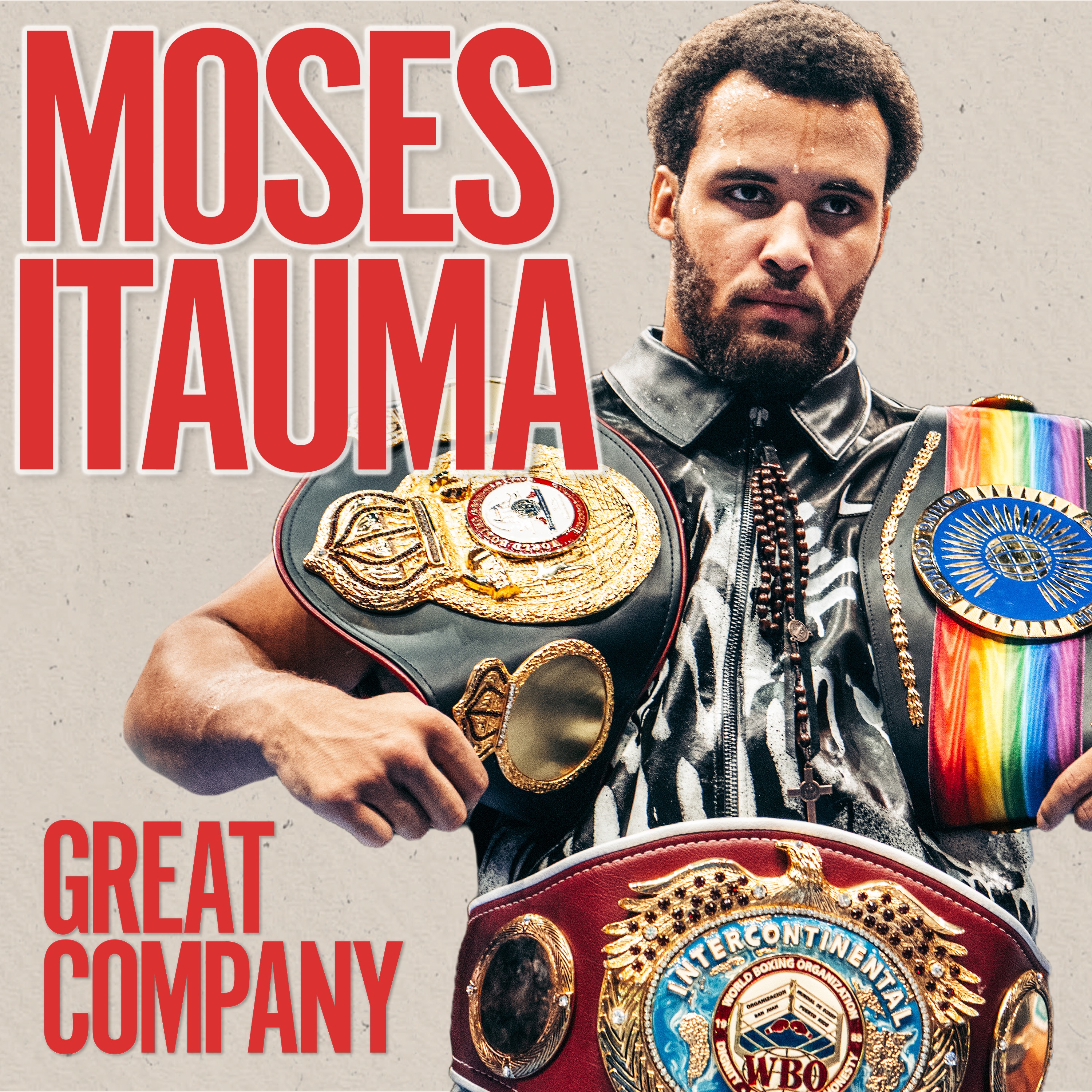
Great Company with Jamie Laing
MOSES ITAUMA: I’m the Future Heavyweight Champion. This is How I’ll Do It
01:02:08
Loading summary
Transcript812 lines
- [00:00]
Moses Atomo
It was inevitable for me to be successful.
- [00:03]
Interviewer
When did you feel that?
- [00:04]
Moses Atomo
I knew when I was a kid, I can't work this hard and not be successful. That mentality, Moses, man, overnight success doesn't just happen overnight.
- [00:14]
Interviewer
You're 12, 13, 14 years old. You haven't experienced that yet. Most kids just go, well, I'm just going to give up.
- [00:19]
Moses Atomo
And I did that at one point. Moses Atomo. I'm in great company.
- [00:24]
Lowe's Advertiser
Your winner, Moses Atarma.
- [00:27]
Interviewer
Your professional career, 13 wins, 11 knockouts. You're top of your game at the moment, man.
- [00:32]
Moses Atomo
Amateur boxing is a sport. Professional boxing is a fight.
- [00:36]
Interviewer
Walking out into the ring for that big fight, do you feel nervous?
- [00:38]
Moses Atomo
I told him to take his glasses off because I wanted to see his eyes. I said, I want to see if it's a wolf or a sheep.
- [00:43]
Interviewer
What did you see?
- [00:44]
Moses Atomo (alternate speaker tag)
He knows what I saw.
- [00:45]
Interviewer
If you were going to call out someone, who would it be? Do you think you'd beat him?
- [00:49]
Moses Atomo
Silly question.
- [00:52]
Interviewer
How important is family to you?
- [00:53]
Moses Atomo (alternate speaker tag)
It's big.
- [00:54]
Moses Atomo
There was nine of us in a two bedroom house. There was rats, there was this, there was that.
- [00:59]
Moses Atomo (alternate speaker tag)
I was a two time national champion,
- [01:00]
Moses Atomo
two time European gold medalist in the world and still ain't got a single penny from boxing.
- [01:05]
Moses Atomo (alternate speaker tag)
I've had two mild concussions and I had one severe one as well.
- [01:08]
Interviewer
Do you worry about that?
- [01:09]
Moses Atomo
It's one of my biggest fears. Also point out all this fame. You can't remember your name. I stopped boxing for like seven, eight months.
- [01:15]
Interviewer
Who did you say in quitting too?
- [01:16]
Moses Atomo
My brother. He saw me with the wrong crowd. He was like, oh, you know, like them people ain't gonna get you nowhere. I said, they ain't got no money. And then he just said, whoa.
- [01:27]
Moses Atomo (alternate speaker tag)
That was actually one of the main
- [01:28]
Moses Atomo
reasons why I kept going.
- [01:32]
Farnoosh Tarabi
Hi, this is Farnoosh Tarabi from so Money with Farnoosh Tarabi. And today I want to talk to you about Boost Mobile. Quick money tip. Stop paying a carrier tax. If your phone bill feels trapped in a pricey plan, this is your sign to unlock savings. Boost Mobile helps you reset your spending. With the $25 Unlimited Forever plan, you can bring your own phone, pay $25 and get unlimited wireless forever. And that simple SW can unlock up to $600 in savings a year. That's money you could put towards paying down debt, investing or something that actually brings you joy. Those savings are based on average annual single line payment of AT&T Verizon and T Mobile customers compared to 12 months on the Boost Mobile Unlimited plan. As of January 2026. For full offer details, visit boostmobile.com
- [02:23]
Lowe's Advertiser
pros Just because something on the job runs out doesn't mean you have to order it on the Lowe's app. My Lowe's Pro Rewards members get free same day delivery on eligible orders over $25. Get the fasteners, hardware or tools you need to keep the job Moving. Order by 2pm and get eligible in stock items delivered right to your job site by 8pm members get more at Lowe's Loyalty program subject to terms and conditions Subject to availability restrictions and terms@lowe's.com
- [02:50]
Moses Atomo
shippingterms subject to change Howdy, howdy ho
- [02:53]
Hayden
and welcome to Fantasy Fan Fellas. I'm Hayden, producer of the Fantasy Fangirls podcast and your resident lover of all things Sanderson.
- [02:59]
Stephen
And I'm Stephen, your Internet goofball. But you can call me the Smash Daddy.
- [03:04]
Hayden
And we are currently deep diving Brandon Sanderson's fantasy epic Mistborn. But here's the catch. Steven here has not read Mistborn before.
- [03:12]
Stephen
That's right.
- [03:13]
Interviewer
Hey hey.
- [03:13]
Stephen
So each week you'll get my unfiltered raw reactions to every single chapter.
- [03:17]
Hayden
And along the way we'll do character deep dives, magic explainers, and Steven will even try to guess what's next. Spoiler alert. He'll be wrong.
- [03:24]
Stephen
Newsflash. I'm never wrong. Episodes come out every Wednesday and you can find Fantasy fanfellas wherever you get your podcasts.
- [03:32]
Moses Atomo
Par le tu francais hablas espanol par l'? Italiano?
- [03:36]
Babbel Advertiser
If you've used Babbel, you would Babbel's conversation based technique teaches you useful words and phrases to get you speaking quickly about the things you actually talk about in the real world. With lessons handcrafted by over 200 language experts and voiced by real native speakers, Babbel is like having a private tutor in your pocket. Start speaking with Babbel today. Get up to 55% off your Babbel subscription right now at babbel.com acast spelled B A B B E L.com acast rules and restrictions may apply
- [04:13]
Interviewer
Guys, welcome back to another episode of Great Company. I cannot tell you how excited I am for this episode. You don't need to be a boxing fan to be a huge admirer of this story. Today, it's Moses Otama.
- [04:29]
Podcast Host Introduction
He is the upcoming British superstar heavyweight boxer. He's currently 13 0, 13 wins, 0 losses. He's had 11 knockouts. This guy is a new breed of boxer. Frank Warren, his manager, has come out and said he's Going to be fighting hopefully this year for a heavyweight championship. So you know the likes of Mike Tyson, Muhammad Ali, Anti Joshua, those big names that have come through heavyweight. This is the new name. He's British, and he's phenomenal. We chat about boxing. We also chat about Moses's life, and he's had a hard life. Lots of different reasons. He's big on family. He's big on loyalty, and we find
- [05:07]
Interviewer
out all about that.
- [05:10]
Podcast Host Introduction
Trust me, this episode is going to knock you out. Okay? Excuse the pun. So get ready for that. Now, before we start, I want to say one quick thing. Okay. If you can click that follow button. That follow button does so many wonders for us. Keeps allowing us to make the show better. It keeps getting. Allowing us to get better guests and keeps making you come back each week because we want to keep making it better and better. Better for you. So if you can click that follow button, it takes one second. It's completely for free. I'll thank you forever.
- [05:37]
Interviewer
All right, here we go.
- [05:38]
Podcast Host Introduction
Enjoy this episode of Great Company with Moses Itama.
- [05:44]
Interviewer
When you go into the ring, what does your mom think? Does she get worried about your dad?
- [05:48]
Moses Atomo (alternate speaker tag)
No, my dad actually says I waste time.
- [05:51]
Moses Atomo
He went to me. I was after, like, one of my fights. He was like, you waste time? I was like.
- [05:57]
Moses Atomo (alternate speaker tag)
I said, dad, what do you mean? He was like, if you can do it in 10 seconds, don't do it. 10 seconds. Don't be wasting time. You are wasting time. I was just like that. It doesn't sound like he's worried.
- [06:13]
Interviewer
Your professional career is 13 wins, 11 knockouts, and eight of those fights I've won in the first round.
- [06:25]
Moses Atomo
I believe that's correct. Yeah.
- [06:27]
Interviewer
So how many. Let's just get. So how many. Do you know how many minutes that you've spent in the ring professionally fighting?
- [06:36]
Moses Atomo
I'm going to take a guess of one hour.
- [06:40]
Interviewer
60 minutes. Yeah, just under 60 minutes. According to Google. That's. What. How much long you spend in the. In the ring professionally having, like.
- [06:47]
Moses Atomo (alternate speaker tag)
I mean, I'm still at the beginning of my career, so it's not a mad thing to.
- [06:50]
Moses Atomo
To say.
- [06:51]
Moses Atomo (alternate speaker tag)
If I was like, a world champion,
- [06:53]
Moses Atomo
been there, done that xyz, then maybe, yeah, but, like, I'm still. I'm still kind of. I'm in the middle stages of my career, actually. Not the beginning. I'm in the middle stages.
- [07:01]
Interviewer
It's crazy times, right?
- [07:03]
Moses Atomo (alternate speaker tag)
I know. You know, when you see it from an outside perspective, it's like, it seems
- [07:08]
Moses Atomo
so great and whatnot.
- [07:10]
Moses Atomo (alternate speaker tag)
It's like See, with me, like, and
- [07:12]
Moses Atomo
obviously my family, they see that I've been boxing since I was 9 years old and how much I've sacrificed and dedicated to this. So it don't really. It doesn't seem like a crazy thing to me and my family, if that makes sense.
- [07:24]
Interviewer
Totally, man. I think that's the big thing about success, right. Which I always find is that most people see the finished product, right? So they see, I know Usain Bolt win the hundred meters. They see David Beckham score the free kick. They see I know Tom Brady throw the touchdown, right. And they think, God, I want to do that. That's what I want to get to. People mostly don't realize the sacrifice. Same building a business. The sacrifice and the graft that goes in, People don't see that.
- [07:50]
Moses Atomo (alternate speaker tag)
No, of course. I think. I don't know if this is a quote or not, and it might be a quote. I might have said it incorrectly, but it's like it takes five years to
- [07:59]
Moses Atomo
become an overnight success. Overnight success doesn't just happen overnight. There's like a. There's like a whole sort of backstory.
- [08:08]
Moses Atomo (alternate speaker tag)
Backstory to it.
- [08:09]
Moses Atomo
Exactly.
- [08:09]
Interviewer
When was it the first time you walked into a gym? 9 years old. Where was it and why did you do it?
- [08:15]
Moses Atomo
So my brother Carol, he was in. He was in a classroom with like four or five boxes or two, three boxes. But the whole school had that four or five boxes at the time. And they kept talking about boxing.
- [08:27]
Moses Atomo (alternate speaker tag)
My brother wanted to get into the chat.
- [08:29]
Moses Atomo
In the boxing chat. They said, why don't you join. Join the gym, Carol. My brother joined the gym, become. Became a national champion. And then like a year later told me that, listen, you ain't doing nothing, so why don't you join the gym as well? So I did. And then, like, I just remember, like, the first couple sessions, I was sick. I threw up.
- [08:50]
Interviewer
This is nine years old.
- [08:51]
Moses Atomo
Yeah.
- [08:52]
Moses Atomo (alternate speaker tag)
I was getting battered.
- [08:53]
Moses Atomo
So I was just like, you know, maybe this boxing thing's not for me.
- [08:58]
Moses Atomo (alternate speaker tag)
And then I started playing football and I got really. I didn't like it being a team sport. I like the fact that if I
- [09:06]
Moses Atomo
lose or if I win, I want it to be my fault. Like in football, you could be the hardest working player on the team and still lose because of your teammates. So I was just like, I said, let me just try out boxing again. And then it was like a love hate relationship since.
- [09:21]
Interviewer
But talk me through that, because that's interesting.
- [09:24]
Podcast Host Introduction
I never really thought of it that way. When.
- [09:26]
Interviewer
When you're in a team Sport. Yeah. You can be the best, but you can still lose. Is it because you, you like being in control of the result?
- [09:33]
Moses Atomo
Exactly. So even like in boxing, like, you know, after a loss, like, so many fighters blame their trainers. Yeah. You're in the driver's seat. You employ your trainers. So if you've lost and that's your fault, you should have changed the trainers. And that's like, you don't.
- [09:53]
Moses Atomo (alternate speaker tag)
A lot of people say, if it
- [09:55]
Moses Atomo
ain't broke, don't fix it. But my, like, counteract to that is don't wait for it to break, to fix it. So if you know that there's an ongoing problem and you're not mentioning it and you're just going to wait until it breaks, it fix to fix it, then obviously when it breaks, then obviously don't complain about the consequences.
- [10:15]
Interviewer
Give me an example of that. Whenever you're in your life, you realize that something wasn't working and you're like, right, well, this needs to change. Because you're right, most people in life don't do that. They wait till something happens, they wait till it breaks to change it.
- [10:26]
Moses Atomo
Yeah.
- [10:27]
Moses Atomo (alternate speaker tag)
So I don't want to, I don't, I don't want to come out and
- [10:30]
Moses Atomo
like, be disrespectful or anything, but there was, there was like a, there was like a time where, because I was with my amateur trainers for like, from the ages of 9 to 18. And, and it's just like amateurs and professionals are just, it's just two completely different sports.
- [10:50]
Moses Atomo (alternate speaker tag)
Like, I would say, I would say
- [10:52]
Moses Atomo
amateur boxing is a sport. Professional boxing is a fight.
- [10:56]
Moses Atomo (alternate speaker tag)
So it's like in amateur boxing, you're not, you're like point scoring, you're trying
- [11:01]
Moses Atomo
to win and trying to win when the judges over.
- [11:04]
Moses Atomo (alternate speaker tag)
Whereas, like, and you got, you got, you got three minutes to, you got
- [11:08]
Moses Atomo
nine minutes to win a fight. Whereas, like in professional boxing, so you've got 36 minutes to like knock the man unconscious, I mean, or like punch him up till he stops. So it's two completely different sports.
- [11:23]
Moses Atomo (alternate speaker tag)
And like, it's just like when I
- [11:24]
Moses Atomo
turn professional, like, I just, I was still trying to box as a professional with my amateur style, and it just, it doesn't work because you can't, you can't sprint a marathon.
- [11:35]
Interviewer
No.
- [11:36]
Moses Atomo
So you had to change everything.
- [11:39]
Moses Atomo (alternate speaker tag)
Exactly. So, and obviously I, I, but I did stay, I stayed with them for
- [11:44]
Moses Atomo
like a year, obviously, knowing, like, knowing this on my mind.
- [11:49]
Moses Atomo (alternate speaker tag)
And I was like, I don't, I
- [11:52]
Moses Atomo
don't want for me to break before I fix it. So I was like, let me fix it before it breaks. And then obviously I moved to the Ben Davidson Performance center, and.
- [12:02]
Moses Atomo (alternate speaker tag)
And, yeah, I mean, I've been doing all right, innit?
- [12:05]
Interviewer
You've been doing more than all right. Your family moved from Slovakia. You arrived in the uk, lived in Kent, three years old.
- [12:15]
Moses Atomo (alternate speaker tag)
I believe that's correct. I don't. I've never actually asked my. My mom or dad when specifically we moved back. I'm just kind of guessing dates from
- [12:22]
Moses Atomo
how old I was in pictures.
- [12:24]
Interviewer
But what are your parents like? Because they must instill, like, something within you. Right.
- [12:28]
Moses Atomo
So my mother, she's a tough European, Eastern European woman with an old. With a very old school mentality.
- [12:36]
Interviewer
What do you mean by that?
- [12:40]
Moses Atomo
I don't know what I'm allowed to say, but she's.
- [12:42]
Moses Atomo (alternate speaker tag)
She's. I just think, you know, like, she has, like. I don't want to be disrespectful to my mum now, man.
- [12:49]
Interviewer
Not at all.
- [12:50]
Moses Atomo (alternate speaker tag)
Can you, like, imagine.
- [12:51]
Moses Atomo
Yeah, yeah. Like, I don't like a paint or like, the wrong picture in your. In your head, but, like, you know, you ever watch the film Rocky?
- [13:00]
Interviewer
Yeah.
- [13:00]
Moses Atomo
And then you got like, the Ivan Drago.
- [13:02]
Interviewer
Yeah.
- [13:03]
Moses Atomo (alternate speaker tag)
Like, imagine, like, my mum coming from that type of family, if that makes sense.
- [13:08]
Interviewer
So she's tough.
- [13:09]
Moses Atomo
Yeah.
- [13:09]
Interviewer
Okay.
- [13:10]
Moses Atomo
And my father is a very, very, very proud Nigerian. Really. Very proud Nigerian.
- [13:15]
Interviewer
So when you have parents like that, do you find there's a lot of. In a good way, a lot of pressure to kind of succeed in something, Right? To. To be. To do good, to be a good person, to represent your family in a good way?
- [13:29]
Moses Atomo (alternate speaker tag)
Of course, like, you know, even, like the.
- [13:33]
Moses Atomo
The mistakes that me and my family have made, like, we kind of, like, wear them even. Like my mother, she's done, like, she sacrificed a lot for us to be in this position.
- [13:45]
Moses Atomo (alternate speaker tag)
That was actually one of the main
- [13:46]
Moses Atomo
reasons why I kept going in boxing. My mother sacrificed a lot. She was very tough.
- [13:52]
Interviewer
And what things did she sacrifice?
- [13:54]
Moses Atomo (alternate speaker tag)
I mean, I'm like, moving that.
- [13:57]
Moses Atomo
If you saw that. The house that my mom grew up in, in the villages of Slovakia, acres and acres and acres of land. Obviously, like my mother's side of her family, it wasn't that rich compared to, like, the Princess or whatnot, but they had, like, a good life. And then she left. She left them Slovakia. So if anybody knows Kent, Luton Road. We moved to Luton Road, and there was, like. I believe it was my uncle, auntie, my two cousins, mum, dad, me, Carol, Samuel. There was nine of us. In a two bedroom house.
- [14:39]
Interviewer
Whoa.
- [14:40]
Moses Atomo
So why did everyone sleep? I don't remember.
- [14:46]
Moses Atomo (alternate speaker tag)
I was a kid. I've never actually sat down and asked, like, asked.
- [14:51]
Interviewer
You never asked questions?
- [14:52]
Moses Atomo
I've never asked the questions. But like, obviously my mom was saying that there was like those rats. There was like, there was this, there was that, there was, there was hole in the. Hole in the ceiling. It's just my mom and she done
- [15:07]
Moses Atomo (alternate speaker tag)
all this because of like an upbringing
- [15:09]
Moses Atomo
that we had in Slovakia. Obviously we was like one of the. Me and my two brothers, we were like the only people of color or some sort of color in the whole of Slovakia. And like, I never went to school there, but my two brothers, they went to school and what was the kind of turning point was like, how my brother got treated in school. So my mom was like, ain't really gonna have much of a future here. So my mom was like, so my dad was like, let's pack our stuff and go to England.
- [15:44]
Interviewer
It's mad to think that a family have to move because of racism.
- [15:49]
Moses Atomo
But you're talking obviously 2005, 2006, where, like.
- [15:55]
Moses Atomo (alternate speaker tag)
Listen, I don't want to say, and I don't, I don't want to overstep
- [15:58]
Moses Atomo
or say anything that I don't. I don't know too much about, but I think there was a slight bit of racism everywhere. So, I mean, no matter. Only in Slovakia, I think if you came here, there was, There was going to be. If he came to the uk, there was going to be some sort of discrimination to a particular group.
- [16:13]
Interviewer
Do you, do you then growing up, did you experience racism?
- [16:16]
Moses Atomo
Not. Not that I can remember. Not that I can remember.
- [16:19]
Moses Atomo (alternate speaker tag)
And that's like why me and my
- [16:21]
Moses Atomo
family, we moved, we moved to England because of like, there is so many different cultures here. Like in Slovakia.
- [16:29]
Moses Atomo (alternate speaker tag)
That's not it.
- [16:30]
Moses Atomo
You're just Slovak or you're not.
- [16:32]
Moses Atomo (alternate speaker tag)
I mean, they don't.
- [16:33]
Moses Atomo
I'm not even.
- [16:34]
Moses Atomo (alternate speaker tag)
I'm not even too sure if Slovak
- [16:35]
Moses Atomo
like their own people,
- [16:38]
Moses Atomo (alternate speaker tag)
but Slovaks are
- [16:39]
Moses Atomo
like very like, known to just like, not like outsiders.
- [16:43]
Interviewer
Yeah.
- [16:43]
Moses Atomo
And obviously my mom's okay, but like everybody else is kind of like visibly you can tell that we're not, we're not from or we've got other backgrounds.
- [17:02]
Interviewer
Are you proud of your heritage?
- [17:04]
Moses Atomo (alternate speaker tag)
Yeah, of course.
- [17:05]
Interviewer
I think that's quite fun. That's interesting though, right? Because.
- [17:09]
Moses Atomo (alternate speaker tag)
Of course, because like the, like, you
- [17:11]
Moses Atomo
are the product of your past experiences. And it's only that obviously I came. I was in Nigeria last week. And like, when I Was when I was just in.
- [17:22]
Moses Atomo (alternate speaker tag)
When I was in Lagos, I was just like. I was thinking, like, I just had, like, a weird feeling where. Even though I haven't.
- [17:28]
Moses Atomo
I've been to Lagos in 2010, but apart from that, like, I haven't been there, I felt.
- [17:34]
Moses Atomo (alternate speaker tag)
I felt like it was a little
- [17:35]
Moses Atomo
bit, like, on my home.
- [17:36]
Interviewer
Oh, you felt it when you were there?
- [17:38]
Moses Atomo
Yeah. And it's like. It's weird because it's weird when you
- [17:41]
Interviewer
get to a place and you go like, this feels like home. But you. You have never been.
- [17:45]
Moses Atomo
Obviously.
- [17:45]
Moses Atomo (alternate speaker tag)
I haven't been there for over 15 years.
- [17:48]
Moses Atomo
So I was just like.
- [17:49]
Moses Atomo (alternate speaker tag)
And then even, like, speaking to the
- [17:50]
Moses Atomo
people, I just felt like, yeah, these are, like. These are like, my people.
- [17:54]
Moses Atomo (alternate speaker tag)
Like, even, like, when I was in
- [17:55]
Moses Atomo
Slovakia, I never really had that. And I spoke to my mom about this, and she was like, yeah, you ain't gonna find happier people than in Nigeria.
- [18:02]
Interviewer
Really?
- [18:03]
Moses Atomo
Yeah. And because obviously my mom has been. When she was younger with obviously my father.
- [18:07]
Interviewer
Yeah.
- [18:07]
Moses Atomo
And she was like. She was like, yeah, you're not gonna find any more happier people than people in Nigeria. And I was like, mom, it felt weird because I went out and I felt like I was at home. And she was like, well, that is your home. That's where your dad's from. And I was just like, I'm a bit annoyed that obviously I know so much about my Slovak background. I didn't know so much about obviously, my Nigerian background because we haven't been there for so. For so long. So why is there, like, such a difference in how I'm trapped in Nigeria than Slovakia? And she's a. She's a obviously family name.
- [18:39]
Moses Atomo (alternate speaker tag)
Rico, you can't compare 200 million to 5 million.
- [18:45]
Moses Atomo
I said, mom, that's not what I'm talking about. I said, nigeria are the king of, like, boxing or king of athletics.
- [18:51]
Moses Atomo (alternate speaker tag)
King of, like, if you look back
- [18:52]
Moses Atomo
at people's heritage, king of, like, king of music, the king of sports.
- [18:59]
Interviewer
I haven't thought of it.
- [19:00]
Moses Atomo (alternate speaker tag)
Like, that is.
- [19:00]
Interviewer
Isn't it?
- [19:01]
Moses Atomo
Exactly.
- [19:01]
Moses Atomo (alternate speaker tag)
Because, like, there's a lot of boxes
- [19:03]
Moses Atomo
that, for example, you got Anthony Joshua, Daniel Dubois, Joe Joyce, me, Okoli, react, Paul Deontay Wilder.
- [19:14]
Moses Atomo (alternate speaker tag)
Like, these are all of Nigerian descent.
- [19:17]
Moses Atomo
Obviously. They say they're British. They say they're American, but these are all of Nigerian descent.
- [19:22]
Moses Atomo (alternate speaker tag)
And it's like, if you look back
- [19:24]
Moses Atomo
in people's history, like, they would have some sort of. Some sort. Exactly.
- [19:29]
Interviewer
And like, I've never thought top of the game as well in music as well.
- [19:33]
Moses Atomo (alternate speaker tag)
Exactly.
- [19:33]
Moses Atomo
Exactly. So.
- [19:35]
Moses Atomo (alternate speaker tag)
And I was like.
- [19:36]
Moses Atomo
When I went to Nigeria, they. They treated me like. Like crazy. Just the love that I got there was crazy.
- [19:45]
Interviewer
As soon as you get off the plane.
- [19:46]
Moses Atomo (alternate speaker tag)
Exactly as soon as I got off
- [19:47]
Moses Atomo
the plane, the security guards, the. They.
- [19:50]
Moses Atomo (alternate speaker tag)
I had.
- [19:50]
Moses Atomo
I had my belts with me. And there was like, are these your belts? And I said, yeah. And then there was like, are you Nigerian? I said, my father was like, we're proud of you. And I was like, you don't even know my story. They don't even.
- [20:02]
Moses Atomo (alternate speaker tag)
They a even ask no questions. They ain't even said none of my
- [20:05]
Moses Atomo
fights, none of my interviews.
- [20:06]
Moses Atomo (alternate speaker tag)
They don't know how I speak or nothing.
- [20:08]
Moses Atomo
They just said, you're doing well.
- [20:09]
Moses Atomo (alternate speaker tag)
You're Nigeria.
- [20:10]
Moses Atomo
We're proud of you.
- [20:11]
Moses Atomo (alternate speaker tag)
I was like, I've been repping Slovakia since I've came out. Like, ain't nobody shook my hand or nothing. Do you know what I mean? So I, I was just like, yeah, this is, this is like the contrast of people. Exactly.
- [20:25]
Moses Atomo
Contrast of.
- [20:26]
Interviewer
Yeah.
- [20:27]
Moses Atomo (alternate speaker tag)
Why?
- [20:28]
Interviewer
Why is that?
- [20:30]
Moses Atomo (alternate speaker tag)
I don't know. I think everybody just gets on with their life in Slovakia.
- [20:33]
Interviewer
Everyone's just individual. They're just focusing on what they're doing.
- [20:36]
Moses Atomo
Literally. Literally. And like, I don't think they care about sports and athletes and music on that.
- [20:43]
Moses Atomo (alternate speaker tag)
Yes.
- [20:43]
Interviewer
So what do they care about?
- [20:44]
Moses Atomo (alternate speaker tag)
I have no idea. Family, innit? They have a big importance of family.
- [20:51]
Interviewer
The big thing about boxing is trash talking. You don't seem to do that that much.
- [20:56]
Moses Atomo
The reason why I don't trust talk is because some people are in boxing to sell tickets. Selling tickets obviously requires entertainment. Entertainment sometimes means trash talking and being somebody that you probably wouldn't be if the cameras are off.
- [21:14]
Moses Atomo (alternate speaker tag)
I mean, don't get me wrong, a lot of.
- [21:16]
Moses Atomo
A lot of boxes just talks smack for the sake of talking smack. Because even an off camera, because it sounds like. No, it's because boxers are egotistical narcissists
- [21:29]
Moses Atomo (alternate speaker tag)
because you have to.
- [21:30]
Moses Atomo
You have to.
- [21:30]
Interviewer
You have to be a psychopath.
- [21:31]
Moses Atomo (alternate speaker tag)
You can't.
- [21:32]
Moses Atomo
You can't go into a boxing ring thinking that this man's better than me. So boxers naturally have some sort of ego.
- [21:41]
Interviewer
Do you have an ego?
- [21:42]
Moses Atomo (alternate speaker tag)
Everybody has an ego.
- [21:43]
Interviewer
I don't know if I have anybody has an ego.
- [21:47]
Moses Atomo (alternate speaker tag)
Egos are good.
- [21:48]
Moses Atomo
Egos are good.
- [21:49]
Moses Atomo (alternate speaker tag)
So people are just in.
- [21:51]
Moses Atomo
In it to sell tickets. And some people might. They might. You know, there might be like a person. Yeah, that's like a level 5 scumbag, but once the cameras are on, he's a level 10 scumbag because he sells tickets. So you get what I mean?
- [22:04]
Moses Atomo (alternate speaker tag)
But so me personally, I haven't been
- [22:09]
Moses Atomo
in boxing to sell tickets.
- [22:10]
Moses Atomo (alternate speaker tag)
I haven't been in boxing to be entertainment.
- [22:12]
Moses Atomo
I've done boxing because I needed to do boxing. I've done boxing because if without boxing, I feel lost, you know, I mean,
- [22:21]
Moses Atomo (alternate speaker tag)
so even when I'm. Even. Even when I'm going abroad. Yeah. I'm always checking if I'm staying in
- [22:25]
Moses Atomo
a hotel and he's a hotel with a gym in it.
- [22:26]
Interviewer
And I mean, you need to have that.
- [22:28]
Moses Atomo
Exactly.
- [22:28]
Moses Atomo (alternate speaker tag)
I need that constant touch of reality.
- [22:30]
Interviewer
I heard that your, you know, your inspiration is kind of Prince Nassim, right?
- [22:34]
Moses Atomo
It wasn't my inspiration. It was one of the. He's one of the first boxers I ever watched and introduced me.
- [22:39]
Interviewer
Fine.
- [22:39]
Moses Atomo (alternate speaker tag)
But just because I like his style doesn't mean I need to be like him.
- [22:42]
Interviewer
Yeah. Because what, What I see with you and I see with your interviews before, it's like, it's. How do I put this? It's like you're there to do business. It's like a killer mentality in a good way. It's like, like sitting across from you. The way that I look is when I used to watch Tyson fight, right, he didn't even want to do this. He just had this intimidation over his opponents. Opponents were. There was a fear to fight him. And I see that within you. Like, I can even sitting across here, I know if you suddenly turned on
- [23:16]
Podcast Host Introduction
me, I feel a bit like, okay,
- [23:18]
Interviewer
I'm in trouble here. Right. But you have that mentality, which is. Right, you, you. It's like laser focused in.
- [23:25]
Moses Atomo (alternate speaker tag)
You know what A bit of credit
- [23:26]
Moses Atomo
needs to go to my brother.
- [23:28]
Moses Atomo (alternate speaker tag)
The reason why I say that. Yeah, the reason why I say that is because sometimes, yeah, like, I might be out or I might be doing something.
- [23:33]
Moses Atomo
Yeah. Some.
- [23:34]
Moses Atomo (alternate speaker tag)
Somebody might pubs or somebody might be doing something where for me, I'm like,
- [23:40]
Moses Atomo
I'm like, I need to like, switch
- [23:42]
Moses Atomo (alternate speaker tag)
this guy's lights off or like, I need to let him know that, like,
- [23:45]
Moses Atomo
to get what I mean.
- [23:46]
Moses Atomo (alternate speaker tag)
But then like, he said that, like, being a boxer just comes with a natural, like, intimidation. And I've been able to like, people seeing me knock someone out.
- [23:55]
Moses Atomo
Yeah. Comes with a natural intimidation.
- [23:57]
Moses Atomo (alternate speaker tag)
So it's like, you don't really need to have to be able to prove the point.
- [24:00]
Moses Atomo
And that's the same with like, Mike Tyson. He's.
- [24:03]
Moses Atomo (alternate speaker tag)
I think, I believe he's got the
- [24:05]
Moses Atomo
most knockouts in three rounds or something like that. Maybe most Most knockouts inside three rounds.
- [24:12]
Moses Atomo (alternate speaker tag)
You don't need to go around intimidating
- [24:14]
Moses Atomo
people because he knows that. I mean, I'm gonna switch your lights off if. If you do. You know, unless, obviously, we're sitting down. We're having a podcast, so I'm kind of forced to speak.
- [24:23]
Moses Atomo (alternate speaker tag)
Like, you can't.
- [24:24]
Moses Atomo
You can't.
- [24:25]
Interviewer
But you don't want to just be here because.
- [24:26]
Moses Atomo (alternate speaker tag)
Exactly, exactly.
- [24:28]
Moses Atomo
So, like, let's say if there's a
- [24:29]
Moses Atomo (alternate speaker tag)
group of people and I don't have
- [24:31]
Moses Atomo
to speak, I don't speak. The reason why I say that is because you don't learn nothing from talking.
- [24:36]
Moses Atomo (alternate speaker tag)
Like, I'm always trying to.
- [24:37]
Moses Atomo
I'm always trying to be, like, listening and trying to, like, game or see the knowledge of what people are saying rather than, like. Like. Because there's some real gangsters don't fight. You know what I mean? So I'm not trying to play something. I'm not even, like, Dillian White, for example, when we came into the face. Face off, I told him to take his glasses off because I wanted to see his eyes. And. And he said, like, oh, you're a woman. Are you trying to see my eyes? I said, I want to see if it's a wolf or a sheep. Because he kept saying, obviously he's a wolf and whatnot. And what did you see? I think me and him both, like, kind of left the interaction knowing that I.
- [25:19]
Moses Atomo (alternate speaker tag)
He knows what I saw.
- [25:21]
Moses Atomo
So that's why it kind of when. When. When we kind of went above separate ways.
- [25:31]
Moses Atomo (alternate speaker tag)
Like, I even.
- [25:32]
Moses Atomo
I. I went to my brother. I was like, I don't think. I don't think, like, listen, he might be, like, on smoke or whatnot outside, but, like. Like, maybe, like in this scenario where boxing, where it's my expertise, I'm like, he ain't saying who he says he is. And that's why. And that's why, like, I kind of.
- [25:51]
Moses Atomo (alternate speaker tag)
That's why I asked him to take
- [25:52]
Moses Atomo
his glasses off because, you know, a lot of people have the glasses on because they hide behind the glasses. And that's why, like, me, unless I'm
- [26:00]
Moses Atomo (alternate speaker tag)
in Nigeria, because it's part of the look. Do.
- [26:02]
Interviewer
I mean, you let people see your eyes?
- [26:05]
Moses Atomo (alternate speaker tag)
I let them see my eyes because, I mean, I don't hide nothing.
- [26:10]
Moses Atomo
I don't try to play or be a role that I'm not.
- [26:12]
Interviewer
Do you think you can win or lose a fight pre fight?
- [26:16]
Moses Atomo (alternate speaker tag)
Yeah, of course. Like I said.
- [26:17]
Moses Atomo
Like I said with Dylan White, I thought I won the fight before I went. So it's even the fact that when I look when in the face off I just, I saw something that I haven't seen in a lot of people's eyes.
- [26:29]
Moses Atomo (alternate speaker tag)
It might have been cuz he's tired,
- [26:30]
Moses Atomo
he's drained the heat or whatnot.
- [26:32]
Moses Atomo (alternate speaker tag)
But like all these factors would have,
- [26:34]
Moses Atomo
would have cost to fight anyway, but it's just like it was just interesting to see in his eyes. Yeah. And like that's why I don't go into face of trying to intimidate someone. I go into face of trying to see or that's trying to see what's in your eyes.
- [26:49]
Interviewer
So I mean, but that's an almost intimidating, without meaning to be intimidating, I'd be like, oh gosh, I don't want
- [26:56]
Moses Atomo (alternate speaker tag)
to look
- [26:59]
Interviewer
for someone who doesn't know what training camp is. Like yeah, talk us through a training camp.
- [27:03]
Moses Atomo (alternate speaker tag)
So training camp can span. Depends on the fight, depends on how active you are.
- [27:07]
Moses Atomo
It can span from 8 weeks to 12 weeks to sometimes 16 weeks. So if you're an active fighter it
- [27:14]
Moses Atomo (alternate speaker tag)
might be just like eight weeks.
- [27:16]
Moses Atomo
You do two weeks of just kind of getting into that base fitness and then, and then from 60, from six weeks out, you start grasping the tactics of whatever fighter you're gonna fight and
- [27:30]
Interviewer
you're basically making the tactics. So you know, if you're finding someone tall or small or heavy headed, you, you're basically working the tactics out to know how to fight that person.
- [27:38]
Moses Atomo
Exactly. So getting engaged off the tactics and this.
- [27:45]
Moses Atomo (alternate speaker tag)
Well, every fighter trains differently.
- [27:47]
Moses Atomo
But I train from Monday to Saturday, I train twice a day apart from Saturday I train once.
- [27:55]
Interviewer
It's tiring.
- [27:57]
Moses Atomo
Oh, very, very tiring. You know what people don't understand as well? Yeah. You know one, one of the like hardest thing about boxing is doing a sport while you're injured.
- [28:06]
Moses Atomo (alternate speaker tag)
Like because the aim of boxing is to injure the other person. So obviously I might pick up an
- [28:12]
Moses Atomo
injury six weeks out and you just
- [28:15]
Moses Atomo (alternate speaker tag)
still go through it and you still
- [28:16]
Moses Atomo
have to go for it. You just have to, just have to obviously maximize your recovery and whatnot, but you still have to go through it.
- [28:23]
Moses Atomo (alternate speaker tag)
So that's why when people are like oh, I didn't, I didn't get no damage in the dillian white fight, I'm
- [28:28]
Moses Atomo
good to go again. You don't see, wow, they don't see what's happening, they don't see the train
- [28:33]
Moses Atomo (alternate speaker tag)
like you think even like people.
- [28:35]
Moses Atomo
Because even the joke is make your fights last a little bit longer. Haha. But like I get annoyed when my fights go one round because then why
- [28:44]
Interviewer
do you make it one round?
- [28:46]
Moses Atomo (alternate speaker tag)
You know what, it's just you don't, you don't play with something like boxing.
- [28:50]
Interviewer
Yeah, agreed.
- [28:51]
Moses Atomo (alternate speaker tag)
It's like I don't, I don't want to like let Dylan White off the leash and then like two layers, I'm the one laid up the floor, you know what I mean?
- [28:57]
Moses Atomo
So when, when the fight with Dylan White got stopped. Yeah, like I went like that. Yeah.
- [29:03]
Moses Atomo (alternate speaker tag)
Because I wanted the referee to like
- [29:04]
Moses Atomo
let it go on because I've been
- [29:07]
Moses Atomo (alternate speaker tag)
in training camp for 14 weeks. I think being in training camp 14 weeks for two minutes,
- [29:14]
Moses Atomo
it's a bit disappointing. But you know, do you get, do
- [29:18]
Interviewer
you get to do the training camp and look, Dillian White is, was meant to be your biggest fight yet. And I think for, for not, for not your, your ride or dies like me, but like for the outer world. That's when people started to go like, who is this Moses Timer? Who is this? Like, that's when I think you went into the wider world of people noticing you training for something like that. Walking out into the ring for that big fight. Do you feel nervous?
- [29:41]
Moses Atomo (alternate speaker tag)
I did, but I'm not going to
- [29:43]
Moses Atomo
tell you why I feel nervous.
- [29:45]
Interviewer
Why?
- [29:45]
Moses Atomo
I might tell you off camera, but
- [29:47]
Moses Atomo (alternate speaker tag)
I ain't going to tell you on camera. Hinted to me, no, I've done something that I don't ever do before my
- [29:54]
Moses Atomo
fights and I was nervous and like.
- [30:00]
Interviewer
Because your routine hadn't gone the same.
- [30:02]
Moses Atomo (alternate speaker tag)
It's not even a routine, it's just the fact that I was like, oh, like sake.
- [30:06]
Moses Atomo
Like I ain't done this ever.
- [30:09]
Moses Atomo (alternate speaker tag)
I was like, how's this going to affect me?
- [30:11]
Moses Atomo
And then, and then.
- [30:13]
Interviewer
Yeah, so you were nervous for that and then you had to stay in the ring for a while.
- [30:17]
Moses Atomo (alternate speaker tag)
Yeah, but I don't mind that. You know the fact cuz Dillian White
- [30:20]
Interviewer
basically didn't come out for a while.
- [30:21]
Moses Atomo (alternate speaker tag)
Do you know the fact is.
- [30:22]
Moses Atomo
Yeah, you know, you know what confidence is? Confidence is preparation. So like I remember, I remember, I
- [30:28]
Moses Atomo (alternate speaker tag)
remember Ralph, he was like, he kind
- [30:30]
Moses Atomo
of is like the organizer sort of thing. He went to me, he said, Moses, like you're the most chilled out person I've ever seen fight week. And I said, ralph, that's because I've just done everything I possibly could this camp to win this fight.
- [30:43]
Moses Atomo (alternate speaker tag)
If I don't go in there and
- [30:44]
Moses Atomo
win this fight, it's not my fault.
- [30:47]
Moses Atomo (alternate speaker tag)
It's just like, I mean it is
- [30:48]
Moses Atomo
my fault, but it's not my control.
- [30:50]
Moses Atomo (alternate speaker tag)
I've done, I've done anything I could.
- [30:52]
Moses Atomo
I've done everything I possibly could to win this fight. So if I go in there and I don't win, God didn't want me to win. Like, I recovered, I trained like everything was the best, tip top. So I was like, if I go in and I don't win, God didn't want me to win.
- [31:07]
Interviewer
Who's been your hardest competitor yet?
- [31:09]
Moses Atomo
Well, none of them were like extremely tough.
- [31:12]
Moses Atomo (alternate speaker tag)
Probably my fight with this kid called
- [31:14]
Moses Atomo
Alois Jr. Who I trained alongside him, now we both trained with Ben Davison. It was probably my hardest fight. After that fight I was in, I was, I had concussion and I was just like, oh, this guy hit so hard. Probably Alois. Alois has been my hardest fight. But by far, like the hardest training camp I've had was for Dillian White. Really? That was just tough.
- [31:38]
Interviewer
That was tough, yeah, but you had to prepare, right?
- [31:40]
Moses Atomo
That was tough. And you know what makes it even worse? My trainer, like, he has this thing where it's like he needs to see me do the rounds. We were sparring so many 10 rounders. It was a joke and it was like, it was like we might, like
- [31:59]
Moses Atomo (alternate speaker tag)
normally in boxing you might ever do like, let's say you're fighting 12 rounds,
- [32:03]
Moses Atomo
you might only ever spar 12 rounds, like once or twice.
- [32:07]
Moses Atomo (alternate speaker tag)
Just because you only need to see
- [32:08]
Moses Atomo
if you can do it or not.
- [32:09]
Moses Atomo (alternate speaker tag)
We don't actually need to do it.
- [32:10]
Moses Atomo
But like he makes it.
- [32:12]
Moses Atomo (alternate speaker tag)
But for Dillian, why?
- [32:13]
Moses Atomo
We were sparring 10 rounds, 10 rounds, 10 rounds, 10 Rounds. And it was just tiring because I had the hand injury, got a groin injury, got the hamstring injury, got the bicep injury. Obviously I can't, I can't, can't be punching properly. I obviously had, my head's hurting. I got about 10 rounds, energy's low because I had to do a high
- [32:34]
Moses Atomo (alternate speaker tag)
intensity interval training the night before.
- [32:37]
Moses Atomo
It's just so many factors and I was just, like I said when I went with Dylan White fight, just kind of knew what was going to happen because I just trained so hard for it.
- [32:46]
Interviewer
The, the big thing in boxing, right?
- [32:48]
Moses Atomo (alternate speaker tag)
Do you know what I used to even do?
- [32:49]
Interviewer
What?
- [32:50]
Moses Atomo
I used to wake up and I used to get my chair and I used to sit outside and eat my porridge in the sun just because I thought the vitamin D would help me with my boxing.
- [33:01]
Interviewer
That 1%.
- [33:02]
Moses Atomo (alternate speaker tag)
It's just that 1%, man. Just that 1%.
- [33:04]
Interviewer
I, I'm big on the 1%. Every single time I say this to my team. The whole time. Any 1% we can do better. Whatever that is sitting outside getting vitamin D, whatever it is, making sure that you I know have a pillowed this
- [33:15]
Moses Atomo
different as my brother he mentioned to me as well this like one thing that stuck with me as well.
- [33:20]
Moses Atomo (alternate speaker tag)
You know, like if, if, like if me and you, yeah.
- [33:22]
Moses Atomo
We're looking straight.
- [33:23]
Interviewer
Yeah.
- [33:24]
Moses Atomo (alternate speaker tag)
And like let's say you turn like
- [33:26]
Moses Atomo
something like just three degrees that way. Like it's not a lot but if you go down the road you're gonna
- [33:34]
Moses Atomo (alternate speaker tag)
see a big difference. It's gonna be like a kilometer or two kilometer. Whereas like that was just a three degree turn for you. And that is exactly like in life.
- [33:43]
Moses Atomo
Like it's the 1% like that it might be like okay, this is a champion. And then like down the road it's like a kilometer ahead and it's like not a champion.
- [33:55]
Interviewer
Can be even less than that. Right.
- [33:57]
Moses Atomo
And you just need to turn just a little bit.
- [34:03]
Farnoosh Tarabi
Hi, this is Farnoosh Tarabi from so Money with Farnoosh Tarabi and today I want to talk to you about Boost Mobile Quick Money Tips. Stop paying a carrier tax. If your phone bill feels trapped in a pricey plan, this is your sign to unlock savings. Boost Mobile helps you reset your spending with the $25 Unlimited Forever plan. You can bring your own phone, pay $25 and get unlimited wireless forever. And that simple switch can unlock up to $600 in savings a year. That's money you could put towards paying down debt, investing or something that actually brings you joy. Those savings are based on average annual single line payment of AT&T Verizon and T Mobile customers compared to 12 months on the Boost Mobile Unlimited plan as of January 2026. For full offer details, visit boostmobile.com there's
- [34:53]
GNC Advertiser
one place for the newest drops in wellness and performance and the biggest sale of the year. It's the drop by gnc curating the best of what's new. Handpicked by the pros who know what works. And right now, get it all. Buy one, get one 50% off during the semi annual LiveWell sale. From crushing workouts to leveling up your nutrition and everything in between, get the best deals on the latest innovations. All the newness is all on sale right now during the LiveWell sale on the drop by GNC shipping, billing, admin, payroll, marketing.
- [35:26]
Stamps.com Advertiser
You're managing all the things, so why waste time sending important documents the old fashioned way? Mail and ship when you want, how you want with stamps.com print postage on demand 24, 7 and schedule pickups from your office or home. Save up to 90% with automated rate shopping. That's why over 1 million small businesses trust stamps.com. go to stamps.com and use code podcast to try stamps.com risk free for 60 days.
- [35:56]
Interviewer
How important is family to you?
- [35:57]
Moses Atomo (alternate speaker tag)
It's big.
- [35:58]
Moses Atomo
It's big.
- [35:58]
Moses Atomo (alternate speaker tag)
And I've. And it's not until I kind of
- [36:01]
Moses Atomo
turned professional and kind of been in the limelight and whatnot. It's like people. Because people said I've changed, but it's not that I've changed. It's just, oh, well, I have changed. It's just the substance of the relationship has become more clear.
- [36:14]
Interviewer
Okay, break this down for me. Why are people saying you've changed?
- [36:17]
Moses Atomo
So, like, for example, you got.
- [36:20]
Moses Atomo (alternate speaker tag)
You got a couple of friends that you kind of talk to, but it's not like, it's not your main priority.
- [36:25]
Interviewer
Agreed.
- [36:26]
Moses Atomo (alternate speaker tag)
When you. When your time and energy is very
- [36:29]
Moses Atomo
limited, them sort of friends just kind of fade off, and they just become just people as you become a memory. And then those people that the relationships you do have substance with become more. Become more kind of in your face.
- [36:50]
Moses Atomo (alternate speaker tag)
Does that make sense or more clear?
- [36:51]
Interviewer
Makes total sense. What you're saying is this. And that's why family becomes important.
- [36:55]
Moses Atomo (alternate speaker tag)
Exactly.
- [36:55]
Interviewer
Because in the nicest way, family is constant. It's always there. It's. It's. It's our blood. Right. So you don't have to have that constant connection back and forward all the time to keep it. They always say that, like, friends are like gardens. You have to water them to make them grow. And with friends, you have to constantly water them. Hey, how are you? What's going on? And you. And you don't have time to constantly do that.
- [37:19]
Moses Atomo (alternate speaker tag)
I don't think that's true.
- [37:21]
Interviewer
Oh, you don't?
- [37:21]
Moses Atomo (alternate speaker tag)
I don't think that's true. Nah. I got this one friend, yeah, Gidz.
- [37:24]
Moses Atomo
He's a funny guy, honestly.
- [37:29]
Moses Atomo (alternate speaker tag)
Yeah. Like, I might not speak to him
- [37:31]
Moses Atomo
for, like, six months, seven months, and
- [37:33]
Moses Atomo (alternate speaker tag)
then, like, he might call me and
- [37:34]
Moses Atomo
answer the phone, and then, like, effing
- [37:37]
Moses Atomo (alternate speaker tag)
and blinding and swearing, but, like, not in a bad way, but he'll be like.
- [37:40]
Moses Atomo
He'll be like, what's happening, you twat?
- [37:43]
Moses Atomo (alternate speaker tag)
You know what I mean? And I'm like, what's going on? And then he'll be like, oh, you're around later. I'm like, yeah. I was like, let's go do something.
- [37:48]
Moses Atomo
I'm like, all right, cool.
- [37:49]
Interviewer
So it doesn't even change.
- [37:50]
Moses Atomo (alternate speaker tag)
It doesn't it? Like. But nothing's changed.
- [37:52]
Interviewer
Cuz he doesn't expect anything.
- [37:53]
Moses Atomo
It doesn't expect.
- [37:54]
Moses Atomo (alternate speaker tag)
And it's like, we would literally, like, it was even one, like, one point. I ain't even spoke to him for like a year.
- [37:59]
Moses Atomo
And then I called him, I was
- [38:00]
Moses Atomo (alternate speaker tag)
like, what are you doing? He was like, I'm in Cyprus.
- [38:02]
Moses Atomo
He's like, why don't you come out?
- [38:04]
Moses Atomo (alternate speaker tag)
I literally booked my first flight to Cyprus. I mean, so. And then, like, we went out there.
- [38:08]
Moses Atomo
What? I mean, and then I was literally
- [38:12]
Moses Atomo (alternate speaker tag)
saying to him, I was like, in it magic. I ain't spoke to you for a year. And then, like our first interaction, I booked my first flight. I mean, that's brothers, of course. But even like, for example, it was not too long ago, he kept calling me. And this was in training camp for Dillian White. He kept calling me, but I was very busy. If I wasn't training, I was like, traveling to go to recovery places where
- [38:33]
Moses Atomo
I was doing interviews. Xyz.
- [38:34]
Moses Atomo (alternate speaker tag)
And he kept calling me, kept calling me, kept calling me.
- [38:37]
Moses Atomo
And I kept like, not answering because I was busy, didn't have time. I don't.
- [38:40]
Moses Atomo (alternate speaker tag)
Obviously one time on the way home,
- [38:43]
Moses Atomo
I was like, I called him and I wasn't. I wasn't using my phone while driving.
- [38:51]
Interviewer
Just making sure that everyone knows this. Yeah, yeah, yeah, Sounds like you were. But making sure you're being driven. We got it. Okay.
- [38:58]
Moses Atomo (alternate speaker tag)
Yeah, yeah, I was being driven. Yeah, there you go.
- [39:00]
Interviewer
It's probably a better way to pitch it.
- [39:04]
Moses Atomo (alternate speaker tag)
And he went.
- [39:05]
Moses Atomo
And I was just. He went to me, he was like,
- [39:08]
Moses Atomo (alternate speaker tag)
why is it every time I call
- [39:10]
Moses Atomo
you, you're always busy?
- [39:13]
Moses Atomo (alternate speaker tag)
And I said, bruv, like, this is going on.
- [39:16]
Moses Atomo
He was like, no, no, no, I like it.
- [39:17]
Moses Atomo (alternate speaker tag)
If I kept calling you and you
- [39:20]
Moses Atomo
kept answering the phone, I'd be like, why the.
- [39:23]
Moses Atomo (alternate speaker tag)
Why is this guy not doing something? He's in training camp for Dillian White. And I'm like.
- [39:28]
Moses Atomo
And I'm calling him. Every time I call him, he answers the phone.
- [39:30]
Moses Atomo (alternate speaker tag)
I'm like, you know, what is.
- [39:32]
Interviewer
That's a true friend.
- [39:33]
Moses Atomo (alternate speaker tag)
It's so difficult trying to take what he said and trying to put into.
- [39:36]
Interviewer
No, what he's saying. Is this what he's saying? What saying? Which is. That is a true friend. He's saying, I like the fact that you're not picking up my cool. Because if you're picking up my cool, you're not doing what you should be doing, which is training for the fight.
- [39:46]
Moses Atomo
Exactly.
- [39:47]
Interviewer
That is a true friend.
- [39:48]
Moses Atomo (alternate speaker tag)
Oh, no, I Know what's his name, kids?
- [39:52]
Moses Atomo
He's actually a boxer himself. Is he? Yeah. When I. I entered the phone, I entered the phone and I was just. I was like, I was just driving. I was thinking, I said, you know what I said?
- [40:06]
Moses Atomo (alternate speaker tag)
It made me like, look at all
- [40:08]
Moses Atomo
my other relationships different that I have with people.
- [40:11]
Interviewer
In what way?
- [40:12]
Moses Atomo (alternate speaker tag)
Just made me feel like them. People that are like, oh, you've changed because you don't speak to me on xyz. I'm starting to question the reason why they actually speak to me now.
- [40:21]
Interviewer
Do you feel because you've become more successful, your friends expect more from you?
- [40:28]
Moses Atomo (alternate speaker tag)
A lot of my friends that don't
- [40:30]
Moses Atomo
really have that much substance, there's just the kind of. Just faded away.
- [40:35]
Moses Atomo (alternate speaker tag)
And like the people that are just
- [40:37]
Moses Atomo
left, I don't even consider them as friends. I mean.
- [40:41]
Interviewer
And does that, did that upset you to begin with?
- [40:45]
Moses Atomo (alternate speaker tag)
No.
- [40:45]
Interviewer
It's just life.
- [40:46]
Moses Atomo
Nah.
- [40:47]
Moses Atomo (alternate speaker tag)
Is. Do you know what? The train's got to keep moving.
- [40:50]
Interviewer
That's the.
- [40:51]
Moses Atomo (alternate speaker tag)
The train's got to keep moving and
- [40:52]
Interviewer
that mentality, Moses, man.
- [40:54]
Moses Atomo (alternate speaker tag)
The train's got to keep moving.
- [40:55]
Moses Atomo
So wherever. Because I don't know why.
- [40:59]
Moses Atomo (alternate speaker tag)
I've had this, like, kind of this
- [41:00]
Moses Atomo
theory in life since I was a kid that like, I was always. It was inevitable for me to be successful. So it's like, wherever, whether I was with my friends or I wasn't with my friends, the path to success is still going to be. So it's like whether I've lost a friend or whether I've gained a friend, I don't think too much of it because like I said, the train's got to keep moving.
- [41:23]
Interviewer
That's really interesting. When did you feel that? Do you remember the moment?
- [41:28]
Moses Atomo
It wasn't.
- [41:28]
Moses Atomo (alternate speaker tag)
It's not one specific moment. It's just like I knew when I was a kid that, like, I can't
- [41:34]
Moses Atomo
work this hard and not be successful.
- [41:37]
Moses Atomo (alternate speaker tag)
Like, I can't be like, training before
- [41:42]
Moses Atomo
school, after school, not going partying, not going to nothing.
- [41:47]
Moses Atomo (alternate speaker tag)
I can't have been doing all this
- [41:49]
Moses Atomo
and then not become successful.
- [41:51]
Moses Atomo (alternate speaker tag)
I was just like, I always, it's always just kind of in my mind.
- [41:53]
Moses Atomo
I mean.
- [41:54]
Moses Atomo (alternate speaker tag)
And you know, I used to watch.
- [41:55]
Moses Atomo
I used to watch like, like lifestyle videos. I used to watch, like, I just fluid may over to spending that stupid amounts of money. And that, that just used to motivate me. And it's only like, until maybe like
- [42:08]
Moses Atomo (alternate speaker tag)
last year, I kind of realized, like,
- [42:10]
Moses Atomo
I'm not doing this for money anymore.
- [42:11]
Moses Atomo (alternate speaker tag)
Obviously I want to get paid and I need to get paid.
- [42:14]
Moses Atomo
Sure. But the money just, it's like if
- [42:18]
Moses Atomo (alternate speaker tag)
you're doing it for the money now, you got your money, it's no longer
- [42:20]
Moses Atomo
going to excite you, so you're going to stop doing. This thing that you need to do
- [42:26]
Moses Atomo (alternate speaker tag)
for me is that I kind of
- [42:27]
Moses Atomo
have to do boxing. If I don't, I feel. I don't feel. I don't feel good in myself.
- [42:33]
Interviewer
That's an insane mindset. Because what you've nailed there is if, if you're, if your reason for something is money, there's never going to be enough. If your reason for something is because you like cars, there's never gonna be enough cars. You have to do it because it, it gives you that life that you need. And, and a byproduct of it, the boxing is, yeah, you get paid, you pay for your team, pay for your family, pay for yourself, whatever it is, but that's not the reason you're doing something.
- [43:00]
Moses Atomo (alternate speaker tag)
Yeah, at beginning it was.
- [43:03]
Moses Atomo
Sure, of course, at the beginning it was, of course, because that's exciting. Of course, of course. Of course, at the beginning it was. It's just. But it just got to a point
- [43:11]
Moses Atomo (alternate speaker tag)
where, and like I said, like, the
- [43:12]
Moses Atomo
money is obviously a big factor. I won't be doing it for free.
- [43:16]
Moses Atomo (alternate speaker tag)
But if he was to take the money outside of it, I would still be hitting bags. I might be. Not be doing it as seriously as I am now, but I'd still be
- [43:24]
Moses Atomo
doing some sort of training.
- [43:25]
Interviewer
That is amazing.
- [43:26]
Moses Atomo (alternate speaker tag)
So. Yeah, but, you know, like, I can, I can explain is that. Imagine you have a habit of doing
- [43:31]
Moses Atomo
something since you was nine years old.
- [43:32]
Interviewer
Yeah.
- [43:33]
Moses Atomo (alternate speaker tag)
It's going to be hard to get out of that habit in it.
- [43:35]
Interviewer
100.
- [43:35]
Moses Atomo (alternate speaker tag)
So that's like me, that my habits kind of boxing. It's going to be hard to get out of the habit of not, not
- [43:40]
Moses Atomo
being in the, in the gy.
- [43:42]
Interviewer
I want to get into your mindset, right, because, okay, you're, you're 12, 13, 14 years old. It's the time when we start going out, messing around, chasing girls, whatever it is, having like a fun time, you're not doing that. You're, you're in the gym, you're working hard, you wake up early, you're doing everything that your friends aren't doing. And that is, that is what separates greatness from just being good. And good is the evil of great. Right. So how do you. What is that mindset that you're going through at that age? How. Because you. For me, the tricky thing to understand is you haven't experienced that yet, but you're thinking, I am going to experience it because if I keep working hard, I'm going to get that. Most kids just go, well, I'm just going to give up. This is too hard for me.
- [44:22]
Moses Atomo (alternate speaker tag)
And I did. And I did.
- [44:24]
Moses Atomo
At one point, you know, boxing, unless you talk professional, there's not a lot of money in it.
- [44:30]
Moses Atomo (alternate speaker tag)
Like, when I'm hearing some of these contracts that these kids are getting for
- [44:33]
Moses Atomo
football at like 12, 13 years old, I'm like, this is crazy.
- [44:36]
Moses Atomo (alternate speaker tag)
I was like, in boxing and I
- [44:38]
Moses Atomo
was a point where I was, I was a two time national champion, two time European gold medalist and the world amateur champion. I still ain't got a single penny from boxing.
- [44:48]
Interviewer
Not paid anything.
- [44:48]
Moses Atomo
Not paid nothing.
- [44:50]
Moses Atomo (alternate speaker tag)
So then.
- [44:51]
Interviewer
Zero.
- [44:51]
Moses Atomo
Yeah, zero. So I was just like, what am I doing this boxing thing for?
- [44:55]
Moses Atomo (alternate speaker tag)
And by this point as well. Yeah, at this point I've had two mild concussions and I had one severe one as well. And like, I ain't got paid a single penny.
- [45:05]
Moses Atomo
I'm damaging my body. And I ordered. I like, what am I doing this for? So I, I did, I stopped boxing for like a good 7, 8 months.
- [45:14]
Interviewer
What age you.
- [45:17]
Moses Atomo
I believe this was like when I was 16 or something like that. Or something along the lines of that. Sorry. No, this was during COVID So whatever age I was during COVID okay, I was two time national champion, two time European gold medalist. And then I just, I, I just, I stopped. So I stopped boxing because, like I
- [45:34]
Moses Atomo (alternate speaker tag)
said, I've had, I've had concussions left, right, center.
- [45:38]
Moses Atomo
Like I'm, I'm European medalist in xyz.
- [45:42]
Interviewer
And you weren't getting anything back, Nothing.
- [45:45]
Moses Atomo
So I just said, what am I doing this boxing thing for?
- [45:47]
Interviewer
So who'd you say to? Who said, who did you say I'm quitting to?
- [45:49]
Moses Atomo
Oh, this is a conversation that I had with my brother. So he saw me actually with my. In, in the McDonald's with the wrong crowd. And, and then just like, he left
- [46:01]
Moses Atomo (alternate speaker tag)
me to it because at this point,
- [46:03]
Moses Atomo
me and my brother, we wasn't living together.
- [46:05]
Moses Atomo (alternate speaker tag)
And I remember he, he just left me to it.
- [46:07]
Moses Atomo
And then he just, he, he, he messaged me after. He was like, oh, you know, like, them people ain't gonna get you nowhere. And I was like. And then I just called him, I was like, oh, what do you mean? And then we just had a conversation and I just went, ah, but like, boxing this, boxing that. I said, I ain't got no money and this and blah, blah, blah. And then he just said, I tell you what, for every kilometer you run,
- [46:35]
Moses Atomo (alternate speaker tag)
I'll give you a pound. So I was running like 10, 12, 15Ks a day, like, getting this money off my brother.
- [46:43]
Interviewer
Wow.
- [46:43]
Moses Atomo (alternate speaker tag)
And then it's just like, kind of.
- [46:46]
Moses Atomo
Brother went broke,
- [46:49]
Interviewer
man, that's amazing.
- [46:50]
Moses Atomo
But I was fit, and when I
- [46:53]
Moses Atomo (alternate speaker tag)
was like, I was like, I'm fit now, so I might as well get in the gym. So I got back in the gym, and then that year or the next
- [47:00]
Moses Atomo
year, the year after I won the youth Europeans, I stopped them all in the first round. I said, I never heard of this ever.
- [47:11]
Moses Atomo (alternate speaker tag)
And they said, I was like, everybody was raving about me. There's a new powerhouse in. In the uk and then boom. Like, I'm a European champion, and I'm just seeing all these famous people start.
- [47:22]
Moses Atomo
Not famous people, like, famous boxers following me. XYZ people are messaging me.
- [47:26]
Moses Atomo (alternate speaker tag)
When you want to turn pro, then, like, you just let me know and like, are you serious?
- [47:31]
Moses Atomo
And I'm like, Obviously, I was 16, 17. I'm like, I'm starting to get worried now because obviously I don't know who means or whose intentions of what. So obviously, I'm a kid. I don't know nothing.
- [47:44]
Moses Atomo (alternate speaker tag)
And then things happened.
- [47:45]
Moses Atomo
Times went by, and I went to the World Championships at 17. I won the world championships. And I just remember walking out from my last. My last amateur fight, I was like, this doesn't excite me no more. So I was just like, it's time to make the change to professional. So the nonto professional after that, they
- [48:03]
Interviewer
always say the moment. The moment where you're about to give up is the moment that actually, that when you become successful, it kind of collides with the same thing in a way. Because the moment that you. You're about to give up is the moment that you've worked hard, you've had your concurrent, you've done whatever, you've pushed hard, and you're exhaust. You're just like, why am I doing this? And just around the cor is something good's about to happen. And so that's when you have to just keep going. You have to keep pushing through those moments, which is. It's amazing of your brother to do that. That's amazing. What makes you so good?
- [48:33]
Moses Atomo (alternate speaker tag)
Well, every time I get asked this question.
- [48:35]
Moses Atomo
Yeah, just give it to me real.
- [48:37]
Moses Atomo (alternate speaker tag)
Every time I get asked this question, I actually, I never have an answer.
- [48:41]
Moses Atomo
I just never have answer.
- [48:42]
Moses Atomo (alternate speaker tag)
The reason why I say that is
- [48:43]
Moses Atomo
because, like, I don't see myself as, like, anything extraordinary because I've been doing
- [48:52]
Moses Atomo (alternate speaker tag)
it for so long and, like, it's not like, you know, like, you know, is there ever any. Is that a time in your life
- [48:59]
Moses Atomo
here where like, you just might be looking yourself in the mirror and you're like, wow, I need to get in shape.
- [49:04]
Interviewer
Yes, a lot. I have that a lot.
- [49:07]
Moses Atomo (alternate speaker tag)
Exactly.
- [49:07]
Interviewer
Most mornings.
- [49:08]
Moses Atomo (alternate speaker tag)
But you don't. It don't go from, like, you looking good to, like, overnight. Like, I need to get in shape.
- [49:16]
Moses Atomo
It's a constant thing of just, like,
- [49:18]
Moses Atomo (alternate speaker tag)
small things that will get you to that position where then now you're like, I need to get back in shape.
- [49:23]
Interviewer
I totally get that. And it is. It's slowly by slowly by slowly and you. So consistency 100 and consistency and persistency is what creates success without a doubt. Hard work, consistency, persistent. Those are the things nothing else but you. But there must have been a raw talent there because when you're boxing in the Gym and you're 15, you know,
- [49:39]
Moses Atomo
do you know what I was reading?
- [49:42]
Moses Atomo (alternate speaker tag)
Habits. Habits that make a champion.
- [49:44]
Interviewer
Yeah.
- [49:44]
Moses Atomo (alternate speaker tag)
And in one of the, in one of the things it said you need to be present.
- [49:51]
Moses Atomo
And this isn't with just. This isn't with just. This isn't with just like boxing. This is just in life in general, you're always going to be more successful
- [50:02]
Moses Atomo (alternate speaker tag)
or be better at something if you're more present. Like, it's easier to have a conversation
- [50:06]
Moses Atomo
with somebody if they're present. If they're somewhere over there, it's going to be hard to have a conversation with them. So that's the same with boxing. Like, I might be training.
- [50:19]
Moses Atomo (alternate speaker tag)
Let's say I'm a coach and I
- [50:22]
Moses Atomo
got four fighters there and I want to. I want to coach all these four fighters. I'll coach them all the same way, but they're all going to be in different skill levels. Some are present, some are not. And you can see that.
- [50:33]
Moses Atomo (alternate speaker tag)
So I think my ability is.
- [50:35]
Moses Atomo
Because even better, like Ben Davison, he said, like, I'm one of the best listeners in the gym. So obviously, how did.
- [50:42]
Moses Atomo (alternate speaker tag)
Now, like, obviously read that book, thinking
- [50:45]
Moses Atomo
about it, I think it's because I'm present a lot.
- [50:48]
Interviewer
That's interesting because I. I noticed something in our interview. I'm not even kidding when I say something to you. Like, I say, oh, this is what I think, or this is a quote or whatever. Normally the person who I'm chatting to would typically agree, or they would sort of.
- [51:02]
Moses Atomo (alternate speaker tag)
Oh, yeah, maybe there's a few things that, like, I'm like, yeah, yeah, yeah.
- [51:05]
Interviewer
And like, I've seen that with you. And I've seen that with you where you, You. You think you're thinking about it and you go, maybe. I don't think that. Oh, no, that is. That you are. You're listening.
- [51:15]
Moses Atomo
Which is.
- [51:15]
Interviewer
Which is. That's. That's rare. That's exactly what it is.
- [51:18]
Moses Atomo
Thank you very much.
- [51:19]
Moses Atomo (alternate speaker tag)
But Joe is. It's like, see, when I come, like
- [51:21]
Moses Atomo
I'm in front of a camera and whatnot. It's like I need to be present.
- [51:25]
Interviewer
Yeah.
- [51:26]
Moses Atomo (alternate speaker tag)
Let's say we're having a. We have a conversation probably outside.
- [51:29]
Moses Atomo
I said, that's my social battery.
- [51:31]
Moses Atomo (alternate speaker tag)
So, like, limited nowadays because I just
- [51:34]
Moses Atomo
have so many conversations with people.
- [51:36]
Moses Atomo (alternate speaker tag)
So the opportunity to be present is very slim because you can't make everything a priority.
- [51:42]
Moses Atomo
If everything's a priority, then nothing's a priority. So I just want to make sure that it is when I'm. When I'm talking to people where something is of substance that I am. I am. I am present.
- [51:58]
Interviewer
Big thing in boxing. Is the pay a big thing?
- [52:00]
Moses Atomo
Yeah, of course.
- [52:01]
Interviewer
So how much is a.
- [52:02]
Moses Atomo
It varies. It varies. I mean, obviously I'm not gonna disclose
- [52:05]
Moses Atomo (alternate speaker tag)
how much I own, but a boxer, it depends. It depends, like, on what level if
- [52:11]
Interviewer
Auntie Joshua is going to fight someone. What is anti Joshua being paid?
- [52:14]
Moses Atomo
Depends on who it is.
- [52:15]
Interviewer
If he's going to fight Tyson Fury. Oh, it's Anti Joshua versus Tyson Fury. What is each fighter going to be taking home?
- [52:23]
Moses Atomo
Obviously, I wouldn't know the specifics, but obviously from my knowledge in boxing, I'd probably say probably nine figures each. It's a lot. It's a lot of money. Yeah, of course.
- [52:34]
Moses Atomo (alternate speaker tag)
Or if it. I'll probably say eight figures high, eight figures low.
- [52:39]
Moses Atomo
Nine figures. That's a lot. Yeah, yeah. So boxing kind of depends. Depends on not only because you might. You might be the best boxer in the world and still make no money because, like, you're not interested. Boxing is the only sport where it's like outside of your sport, you still have to kind of pay attention to. So, for example, footballer, if you're the best footballer in the world, you're gonna be getting paid millions.
- [53:02]
Interviewer
Correct.
- [53:03]
Moses Atomo
As in boxing, if you might be the best boxer in the world, but if you can't speak properly or if you are not interested enough, people ain't gonna care. They'd rather go watch Jake Paul. I mean, so.
- [53:16]
Interviewer
Wow, that's.
- [53:18]
Moses Atomo
So it just depends on.
- [53:19]
Interviewer
It's not always. That's it. It's not always just about raw talent. It's about the whole pitch. It's about who you are, how you speak, what you represent, how you hold yourself, your talent. It's everything. Where football is basically just talent.
- [53:32]
Moses Atomo
Exactly. Like, they don't need to speak to the public.
- [53:35]
Moses Atomo (alternate speaker tag)
I was like, or they don't need
- [53:36]
Moses Atomo
to sell a football game because the team sells it for them.
- [53:39]
Moses Atomo (alternate speaker tag)
So you don't. You don't go nine times a turn. Like, people wouldn't go to watch Modric,
- [53:45]
Moses Atomo
they would go to watch Real Madrid.
- [53:46]
Interviewer
Wow.
- [53:47]
Moses Atomo (alternate speaker tag)
Whereas, like, in boxing, it's like people don't go, oh, I'm going to go
- [53:50]
Moses Atomo
watch a boxing fight. No, going to go watch the two people. But who are the two people? If they're not interested, we won't watch them.
- [53:56]
Moses Atomo (alternate speaker tag)
So it's like the highest, like, kind of.
- [53:59]
Moses Atomo
I think Jake Paul's creeping up there
- [54:02]
Moses Atomo (alternate speaker tag)
with like, the highest pay per view
- [54:03]
Moses Atomo
numbers and he ain't even like a legitimate boxer.
- [54:06]
Interviewer
What do you think of the Jake Paul Tyson fight?
- [54:10]
Moses Atomo
I actually didn't watch it. I didn't watch it.
- [54:12]
Moses Atomo (alternate speaker tag)
But I like, I. I like Jake Paul.
- [54:14]
Moses Atomo
I think he's good for boxing, though.
- [54:15]
Interviewer
Yeah. Because he brings eyeballs.
- [54:17]
Moses Atomo
He brings eyeballs. He brings a different fan base.
- [54:19]
Interviewer
So would you fight him?
- [54:21]
Moses Atomo
Probably not.
- [54:23]
Interviewer
Do you think you'd beat him? So that's a no.
- [54:35]
Moses Atomo
No.
- [54:36]
Moses Atomo (alternate speaker tag)
I like Jay Paul.
- [54:37]
Moses Atomo
I think. I think he's good and I think he's funny as well.
- [54:39]
Interviewer
I don't think he's going to come knocking on your door anytime soon. I mean, I think Moses, come on. It wouldn't even be a match.
- [54:46]
Moses Atomo (alternate speaker tag)
No one else who boxes is calling out YouTube fighters.
- [54:50]
Moses Atomo
It's a bit cringe, you know?
- [54:52]
Moses Atomo (alternate speaker tag)
Bit cringe. If Jake Paul was to offer a
- [54:55]
Moses Atomo
fight to somebody and you accept it, it's different. But you know, when boxers go looking for a fight, so I don't know
- [55:00]
Moses Atomo (alternate speaker tag)
why, for me, I feel.
- [55:02]
Moses Atomo
It feels a bit cringe.
- [55:03]
Interviewer
If you were going to call out someone, who would it be?
- [55:05]
Moses Atomo (alternate speaker tag)
I don't call people out, but if there was a fight that I would
- [55:08]
Moses Atomo
love to have had, next would obviously be for the heavyweight championship of the world. But unfortunately I need to get some rounds in, so I need someone that's durable. But the thing is, I'm 20 years old. I still got. I still got a lot. I still got a lot of time. Like, you think I'm 20 years old and I'm only 13 fights in. Anthony Joshua's 20, no, 36, and he's only had 25 fights.
- [55:35]
Interviewer
That's crazy.
- [55:36]
Moses Atomo
I mean, 26.
- [55:36]
Moses Atomo (alternate speaker tag)
No, he's had 28 fights, I believe.
- [55:38]
Interviewer
What is it? Because it's important to protect. Because you're going into a fight.
- [55:43]
Moses Atomo
Right.
- [55:44]
Interviewer
I mean, we spoke about concussions and everything. That is a nature of the sport.
- [55:48]
Moses Atomo
Right.
- [55:48]
Moses Atomo (alternate speaker tag)
You need, you need rest from the training camp. You need to rest from the media.
- [55:52]
Moses Atomo
Use a lot.
- [55:54]
Interviewer
We're friends.
- [55:57]
Moses Atomo (alternate speaker tag)
We need the rest from the training. The media, obviously, a lot of recovery
- [56:03]
Moses Atomo
for the brain, for the injuries.
- [56:06]
Interviewer
Do you get brain scans?
- [56:08]
Moses Atomo
Yeah, you have to get a brain scan every year, but brain scan don't
- [56:11]
Interviewer
pick up the CTE concussion thing, right?
- [56:14]
Moses Atomo
Yeah, but it doesn't. It only, I think it only picks up, like, the function of the brain doesn't actually pick up the damage of the brain. I believe it's something along the lines of that. So it's like, it won't pick up, like, the wear and tear on the brain. It was just, it'll just pick up if the brain is working.
- [56:30]
Interviewer
Do you, do you worry about that?
- [56:32]
Moses Atomo
Yeah, of course. It's one of my biggest fears.
- [56:34]
Interviewer
Is it?
- [56:34]
Moses Atomo
Yeah, it's one of my biggest fears. Like, what's the whole point of having all this money? What's the point? I want this fame. You can't remember your name. Like, it's very scary.
- [56:46]
Interviewer
Do you think about legacy at all?
- [56:48]
Moses Atomo
Not anymore. No.
- [56:49]
Interviewer
Really?
- [56:50]
Moses Atomo
No.
- [56:51]
Interviewer
So you're doing, you don't think about legacy. You don't. You're just doing it because this is what makes you breathe. This is what gives you life.
- [56:59]
Moses Atomo
I just, I just, I just enjoy doing it, actually. I don't enjoy doing it. I, I, I have to do it because I don't feel okay myself if I don't.
- [57:09]
Moses Atomo (alternate speaker tag)
And then it just kind of leads
- [57:10]
Moses Atomo
me to where I am now.
- [57:12]
Moses Atomo (alternate speaker tag)
I mean, you know what the thing is. Yeah. You know, like legacy.
- [57:15]
Moses Atomo
Yeah. You know, how do you, do you have stuff in your house. Yeah. That you just keep. For the sake of keeping. You just want to throw it away, but you just can't keep it. Exactly.
- [57:25]
Moses Atomo (alternate speaker tag)
I feel like that's like, if you
- [57:26]
Moses Atomo
keep looking back at your legacy, there's just stuff that you'd wish you'd rather changed or you just want to throw away, but you can't because it's just always there. So, like, that's why I was just like, I'm like, instead of trying to, like, looking back in, I don't look back in, like, my legacy or I don't want to look back in my legacy and be like, ah, I had a good career, whatnot. I'd rather want to take things from what I've done and try to install it so that in other people rather than appreciating it, if that makes sense. But maybe I'm 20 years old, maybe I'm just thinking of it from an immature mind.
- [58:04]
Interviewer
But you want to be heavyweight champion of the world?
- [58:06]
Moses Atomo
Of course. But not because of being heavyweight champion of the world. Because of what being heavyweight champion of the world brings.
- [58:13]
Interviewer
And you know you're gonna be heavyweight
- [58:14]
Moses Atomo
champion of the world, I believe.
- [58:20]
Farnoosh Tarabi
Hi, this is Farnoosh Tarabi from so Money with Farnoosh Tarabi and today I want to talk to you about Boost Mobile Quick Money tip Stop paying a carrier tax if your phone bill feels trapped in a pricey plan, this is your sign to unlock savings. Boost Mobile helps you reset your spending with the $25 Unlimited Forever plan. You can bring your own phone, pay $25 and get unlimited wireless forever. And that simple switch can unlock up to $600 in saving year. That's money you could put towards paying down debt, investing or something that actually brings you joy. Those savings are based on average annual single line payment of AT&T, Verizon and T Mobile customers compared to 12 months on the Boost Mobile Unlimited plan as of January 2026. For full offer details, visit boostmobile.com there's
- [59:10]
GNC Advertiser
one place for the newest drops in wellness and performance and the biggest sale of the year. It's the Drop by gnc. Curating the best of what's new, handpicked by the pros who know what works. And right now, get it all. Buy one, get one 50% off during the semi annual LiveWell sale. From crushing workouts to leveling up your nutrition and everything in between, get the best deals on the latest innovations. All the newness is all on sale right now during the LiveWell sale on the drop by GNC.
- [59:44]
Interviewer
I I can't take this. I had the best conversation with you man. Oh I really appreciate everything like like the biggest fan of you and what you do but then also being like and I, I hope this is not meant to be patronizing being at such a young age but such a sort of wise head on you. It's like a true inspiration to younger kids. Do you know what I'm excited for? To me walk you out at your next fight. That's what I'm excited for man.
- [60:12]
Moses Atomo
So now I was mad for my
- [60:14]
Moses Atomo (alternate speaker tag)
last fight in Saudi Arabia.
- [60:16]
Moses Atomo
My brother said he's just like names all these Rappers. I was like, oh, they all want to walk you out. And I said, get my brother Samuel. I said, get him on the belts and let's go. Like I said, kind of when I walk, when I want to walk out, I want to walk out with the people that are behind me enough. I believe that the people that got always my best interest at heart, it's always going to be my family. Not saying I might not ever walk you out, but I'm just saying there's a very slim chance, I think you're
- [60:48]
Interviewer
going to say all these rappers and everyone's going to be messing you and you're going to say, I want my brother, Jamie Moses. Man, I appreciate it. I listen, I know, I know how tough you work, how all these things and how hard you train. So I appreciate all this time. We like to end in quick fire. Eight questions. Are you ready for this? With someone who likes to think this is going to be a tricky one.
- [61:11]
Moses Atomo
I was going to say, man, I'll be quick fire.
- [61:13]
Interviewer
That's all right, man. I got all the time in the world, so don't worry about me. I just worry about you.
- [61:15]
Moses Atomo
I've got training at Free, so.
- [61:17]
Interviewer
Okay, so we got three hours. That's good. What's the saying or phrase that makes you smile or cheers you up?
- [61:25]
Moses Atomo (alternate speaker tag)
Give way, Give way. He's not one know that there's only Nigeria.
- [61:29]
Moses Atomo
Some. My security guard that I had. So, like, obviously I said I wanted to go to a toilet.
- [61:34]
Interviewer
Yeah.
- [61:34]
Moses Atomo
He said, okay, no problem. Nigeria is hectic and like, he's moving
- [61:37]
Moses Atomo (alternate speaker tag)
people out the way.
- [61:38]
Moses Atomo
Yeah. And then there's one.
- [61:40]
Moses Atomo (alternate speaker tag)
There was just one guy just there
- [61:41]
Moses Atomo
on his phone minding his business.
- [61:43]
Moses Atomo (alternate speaker tag)
The security guard gave an elbow to his chest. He went, oh, yeah, Give way. And the guy's doing nothing, minding his own business. I just started laughing. So every time. Some, like, every time he said, give way.
- [61:55]
Moses Atomo
You like it.
- [61:56]
Moses Atomo (alternate speaker tag)
I just started laughing because I just pictured this one kid. It's like he ain't even a big fella either. He just had a house or mind his own business and just go. Just went back.
- [62:04]
Interviewer
I like that. Best compliment anyone's ever given you.
- [62:09]
Moses Atomo (alternate speaker tag)
Best compliment I ever got is I'd say there's.
- [62:11]
Moses Atomo
There's two. There was two.
- [62:13]
Moses Atomo (alternate speaker tag)
There was my trainer, Ben Davidson.
- [62:15]
Moses Atomo
He.
- [62:16]
Moses Atomo (alternate speaker tag)
I asked him a question.
- [62:17]
Moses Atomo
I said to.
- [62:18]
Moses Atomo (alternate speaker tag)
If you have a. If you'd have a street fight and you can pick three people to back
- [62:22]
Moses Atomo
you, who would you choose? And he said. Or he said, Jon Jones, Francis Ngannou and Derek Chisora. And then he changed Derek Chisora to Mike Tyson. And then he said.
- [62:33]
Moses Atomo (alternate speaker tag)
Then he said, and you as well.
- [62:35]
Moses Atomo
And I was just like, ah, I like that one. That's probably.
- [62:38]
Moses Atomo (alternate speaker tag)
I don't know why.
- [62:39]
Interviewer
That's good. What scares you most about yourself?
- [62:44]
Moses Atomo
My impulsiveness.
- [62:46]
Moses Atomo (alternate speaker tag)
Really?
- [62:46]
Moses Atomo
Yeah.
- [62:46]
Interviewer
You're impulsive.
- [62:47]
Moses Atomo
Yeah. I mean, the type of person to be sitting there on the sofa and then just book a quick trip to France. Really? It's happened. It's happening tomorrow.
- [62:57]
Interviewer
Really? You're impulsive.
- [62:58]
Moses Atomo
Very impulsive.
- [62:59]
Interviewer
But you're measured as well. Because you're thoughtful, you think, but you're also impulsive.
- [63:05]
Moses Atomo
Yeah.
- [63:06]
Interviewer
Big one for you. When was the last time you cried?
- [63:08]
Moses Atomo
The last time I cried would have been on the Titanic.
- [63:12]
Interviewer
Full.
- [63:13]
Moses Atomo
I'm joking. I'm joking.
- [63:14]
Moses Atomo (alternate speaker tag)
I don't know. I don't know.
- [63:16]
Moses Atomo
I don't know.
- [63:16]
Interviewer
I bet you cried at that.
- [63:17]
Moses Atomo (alternate speaker tag)
No, honestly, I don't know.
- [63:20]
Moses Atomo
I don't know. It was the last time my cr.
- [63:21]
Interviewer
What's something you can't let go of?
- [63:23]
Moses Atomo (alternate speaker tag)
My childhood. And the reason why I say my
- [63:26]
Moses Atomo
childhood is because I'm living what I wanted to do as a kid. So I obviously can't let go of that little dream that that little boy had. Man.
- [63:36]
Interviewer
Do you think that little kid. You seeing where you are now? Man, do you think he.
- [63:43]
Moses Atomo (alternate speaker tag)
The thing is, I always knew it was going to happen, but I didn't
- [63:45]
Moses Atomo
think it was going to happen so soon.
- [63:47]
Interviewer
But that's what comes with dedication, persistency, consistency, everything. What's your guilty pleasure?
- [63:53]
Moses Atomo
I love burgers.
- [63:54]
Interviewer
You like burgers?
- [63:55]
Moses Atomo
I love burgers.
- [63:57]
Interviewer
Like a smash burger.
- [63:59]
Moses Atomo
Do you know what I found out
- [64:00]
Moses Atomo (alternate speaker tag)
about the other day?
- [64:01]
Interviewer
What?
- [64:01]
Moses Atomo
Shake Shack.
- [64:03]
Interviewer
You found that out? Sorry, you found it out?
- [64:05]
Moses Atomo (alternate speaker tag)
The other day I went to Dubai and at the airport in Gatwick.
- [64:11]
Interviewer
Good.
- [64:11]
Moses Atomo (alternate speaker tag)
They. Everything was shut.
- [64:13]
Moses Atomo
The only thing that was open was Shake Shack and I had a Shake Shack burger. And I was like, oh, my God,
- [64:19]
Moses Atomo (alternate speaker tag)
have I only found out about this?
- [64:21]
Moses Atomo
And now I'm just driving around London
- [64:22]
Moses Atomo (alternate speaker tag)
trying to find out a Shake Shack.
- [64:25]
Interviewer
Cue the sponsorship.
- [64:27]
Moses Atomo
Get them a sponsor.
- [64:29]
Interviewer
What turns you off?
- [64:31]
Moses Atomo
In a female. Or in. In life, man, Whatever it is, what turns me off. So that's a very broad question. I know I could be more specific.
- [64:41]
Interviewer
I can't. You can pick whatever you want.
- [64:46]
Moses Atomo
I'm going to say something that might not be like. Might not answer your question directly, but, like, I don't like it when I'm trying to, like, be in my own space and people try to, like, kind of come in. Come in.
- [65:01]
Interviewer
Like, you like your own time.
- [65:02]
Moses Atomo
Yeah.
- [65:03]
Interviewer
And when people try and interrupt it.
- [65:04]
Moses Atomo
Yesterday I went out for a bit of food. I went. I went by myself because I wasn't really feeling sociable, so eating my food and that. Oh, Moses. Nice. Me, I should shake his hand. Cool. So who you were here with us by myself. Takes a seat.
- [65:20]
Moses Atomo (alternate speaker tag)
No.
- [65:22]
Moses Atomo
And I'm like. I'm like, okay. Talking, talking, talking, talking, talking. And I'm like, I don't want to be rude. So I just kind of let him stay and still talking to me. Talking. And I'm really unsociable.
- [65:36]
Moses Atomo (alternate speaker tag)
When I'm.
- [65:36]
Moses Atomo
When I'm unsociable, I'm really unsociable. And I was just like.
- [65:41]
Interviewer
You didn't say anything.
- [65:42]
Moses Atomo (alternate speaker tag)
I did.
- [65:43]
Moses Atomo
I said, though. I was like. But when the food came out, I was like, bro, I don't want to be rude, but. And then he was like, I understand. And then just walked off. I was just like, yeah, I'm better than most.
- [65:55]
Interviewer
I get that.
- [65:56]
Moses Atomo (alternate speaker tag)
So, yeah, when I went.
- [65:57]
Moses Atomo
When people just invade my personal space, you know, I don't mind you, when people come, they, like, take a picture
- [66:04]
Moses Atomo (alternate speaker tag)
or they might even, like, ask, what,
- [66:05]
Moses Atomo
one or two questions, but it's just like, when, like, they try to be
- [66:09]
Moses Atomo (alternate speaker tag)
around me the whole day.
- [66:11]
Moses Atomo
Yeah.
- [66:11]
Interviewer
It's like, come on, let's move on. Now I get it. I'll cancel my plans and for the rest. What turns you on?
- [66:21]
Moses Atomo
What turns me on? Obviously. Now, this is obviously a broad question again.
- [66:30]
Moses Atomo (alternate speaker tag)
The sun.
- [66:32]
Moses Atomo
The sun.
- [66:32]
Interviewer
What do you like most about your boxing style?
- [66:34]
Moses Atomo (alternate speaker tag)
It's unique. It's unique because, you know, like, when a fighter comes through, they're always trying
- [66:40]
Moses Atomo
to compare it to someone else.
- [66:42]
Moses Atomo (alternate speaker tag)
So, like, when you describe a fighter, you won't say, oh, he's got fast feet and that he's able to do. He's like, oh, he boxes like Mike Tyson or he's a middleweight. Muhammad Ali. They always try to compare to someone,
- [66:54]
Moses Atomo
but, like, with me, there's.
- [66:58]
Moses Atomo (alternate speaker tag)
The only comparison I ever had was with Mike Tyson.
- [67:00]
Moses Atomo
But it's not because of the boxing styles, because of the success of such a young age.
- [67:06]
Moses Atomo (alternate speaker tag)
They can't compare me to anyone.
- [67:07]
Interviewer
No.
- [67:08]
Moses Atomo
No one.
- [67:08]
Moses Atomo (alternate speaker tag)
So that means I'm unique.
- [67:09]
Moses Atomo
I'm. I'm one of our own. It's like, I'm like. I'm one of the few people that.
- [67:13]
Moses Atomo (alternate speaker tag)
That, like, kind of play mind games with boxing.
- [67:16]
Moses Atomo
You know what I mean? So.
- [67:18]
Moses Atomo (alternate speaker tag)
And, like, I liked.
- [67:19]
Moses Atomo
I like. Now the fact that people are comparing themselves to me, which is. Which is. So I'll probably say a one of around a one of one el Original bonus question.
- [67:31]
Interviewer
Favorite ring walk song that I've had.
- [67:34]
Moses Atomo
Yeah, my last one was good. I Get High by Stars P. And
- [67:38]
Interviewer
when we walk out next, what's it gonna be?
- [67:43]
Moses Atomo
Let me sit my drink.
- [67:47]
Interviewer
Dude, I really appreciate it, man. Thank you so much. Thank you to. Yeah, just. Just keep doing what you're doing. I can't wait to see all the success you're going to get. I'll be running for you all the way.
- [67:55]
Moses Atomo (alternate speaker tag)
I appreciate it.
- [67:56]
Interviewer
Really appreciate it, man. Dude, kidding me. That was freaking great.
- [68:13]
Hayden
Howdy, howdy ho, and welcome to Fantasy Fan Fellas. I'm Hayden, producer of the Fantasy Fan Girls podcast and your resident love of all things Sanderson.
- [68:21]
Stephen
And I'm Stephen, your bookish Internet goofball. But you can call me the Smash Daddy.
- [68:25]
Hayden
And we are currently deep diving Brandon Sanderson's fantasy epic Mistborn. But here's the catch. Steven here has not read Mistborn before.
- [68:34]
Stephen
That's right.
- [68:34]
Moses Atomo
Hey.
- [68:34]
Stephen
Hey. So each week you'll get my unfiltered raw reactions to every single chapter.
- [68:39]
Hayden
And along the way, we'll do character deep dives, magic explainers, and Steven will even try to guess what's next. Spoiler alert. He'll be wrong.
- [68:46]
Stephen
Newsflash, I'm never wrong. Episodes come out every Wednesday, and you can find Fantasy Fan Fellas wherever you get your podcasts.
- [68:55]
Lowe's Advertiser
Going outside is so in. During spring festive Lowe's. For a limited time, get extra big deals on select Holland Pavers. Three for $1 plus save $70 on a char broil performance four burner grill now $179. And chef up shareables for your whole crew. Crew picture perfect patios and good food. Yes, please. Our best lineup is here at Lowe's, valid through 3:30, while supplies last selection varies by location. Paver offer exclusive Alaska and Hawaii.
- [69:23]
GNC Advertiser
There's one place for the newest drops in wellness and performance and the biggest sale of the year. It's the Drop by gnc, curating the best of what's new, handpicked by the pros who know what works. And right now, get it all. Buy one, get one. 50% off during the semiannual LiveWell sale. From crushing workouts to leveling up your nutrition and everything in between, get the best deals on the latest innovations. All the newness is all on sale right now during the LiveWell sale on the drop by GNC.
- [69:53]
1Password Advertiser
A password manager should be the first security purchase. You make for your team. Why? Because compromised passwords are the number one way bad actors attack companies, and small businesses are their favorite targets. But unlike a lot of security challenges, passwords actually have a pretty simple solution. 1Password lets you manage all your business's credentials so you can feel confident that your data stays secure as your company grows. Find out more at 1Password.com specialoffer and start securing every login.