← Green & Red: Podcasts for Scrappy Radicals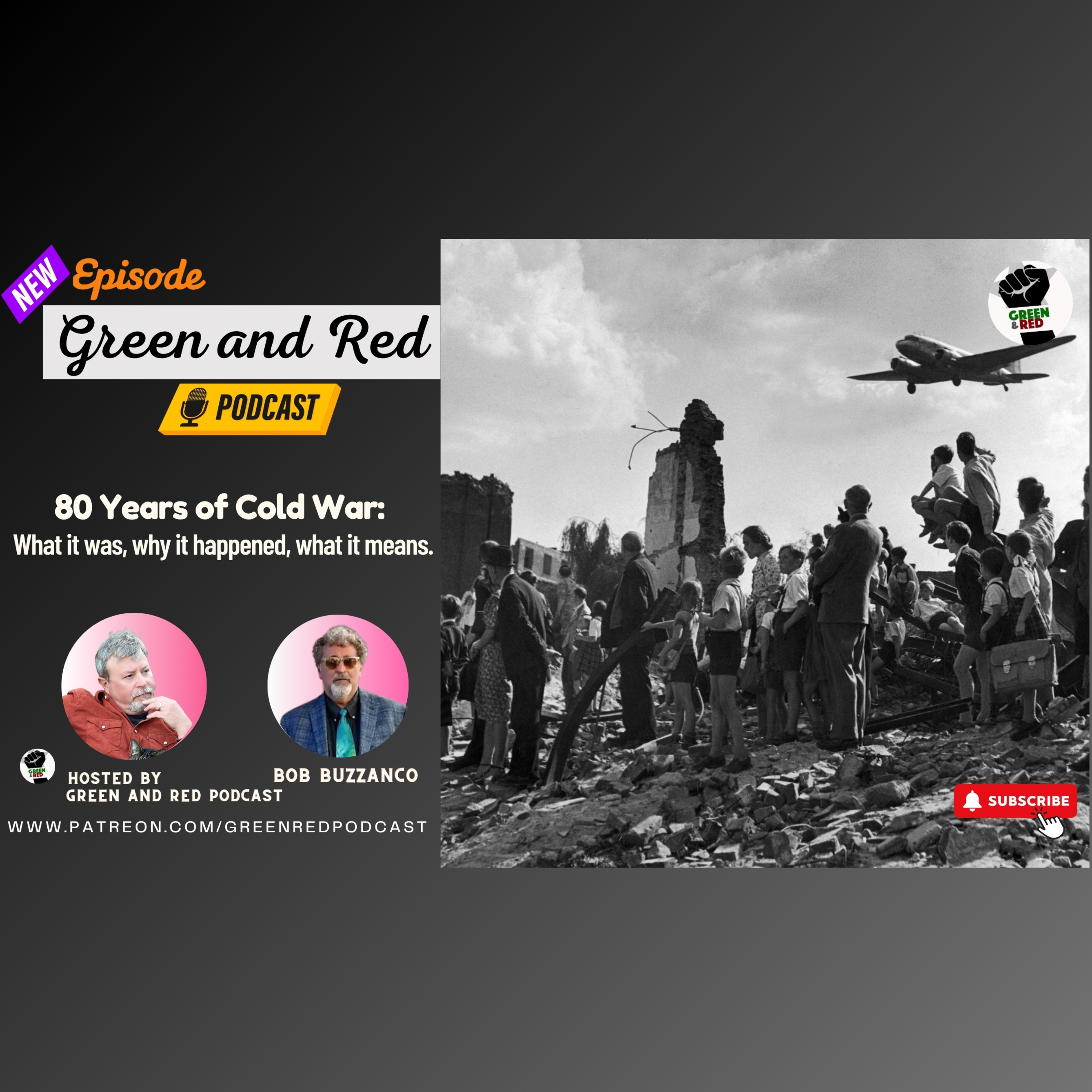
Green & Red: Podcasts for Scrappy Radicals
80 Years of Cold War: What it was, why it happened, what it means. (G&R 440)
00:51:53
Loading summary
Transcript70 lines
- [00:00]
A
Hey there, this is Scott from the Green and Red Podcast. I want to tell you about this great podcast I came across called the False Positive Podcast. It's hosted by these four friends who live in New York and in 2016 they had a radio show they happened to be broadcasting live on the air the evening of November 2016 when Donald Trump had won the election. They were shocked and angry, like many of us, and immediately decided to pivot to a podcast where they could laugh, scream and chat about the latest insanity coming out of the Trump administration. If you like politics, but hate hearing the dress down version, this is a show for you. False positive streams wherever you get your podcasts.
- [00:44]
B
Welcome to Green and Red Scrappy Politics for Scrappy People, a regular podcast on radical environmental and anti capitalist politics. Brought to you by Bob Bozanco and Scott Parkins.
- [00:58]
A
Welcome to the silky smooth sounds of the Green and Red Podcast. I'm your co host in Berkeley, California and as always, I am joined by.
- [01:07]
B
Bob Bozanco in Ohio.
- [01:11]
A
Yeah, and before we get into the episode, I just want to say, because every other podcast in the world is talking about this, I just can't record today without saying we, we finally know the truth that Trump drained Bill Swamp. And I, I don't think the world is ever. We know what that bunker was really for. I'm just going to say that. What the White House bunker is really for. And so I just don't think we're ever gonna really. The world's never gonna be the same again. So I just want to put that out there before we get going.
- [01:41]
B
We always thought the real scandal was Monica Lewinsky.
- [01:44]
A
Yeah.
- [01:44]
B
Nothing.
- [01:45]
A
But instead it's a bunch of old men who, who dote on themselves way too much. All those pictures of Clinton and Trump on the golf course. You know what's really going on at this point.
- [02:00]
B
It's so surreal. You just, I often say, like, you could put like Hunter Thompson and Gorbutt Al in a room full of like mescaline and weed and mushrooms and they could not invent this shit.
- [02:10]
A
Yeah.
- [02:11]
B
Anyway, what we're going to do today is something we've actually been talking about for a while and the year has been weird and so we haven't gotten to it, but we're getting close to the end of the year, so I want to do this now. We do a lot of history shows and sometimes we do anniversary shows and this is like that, but it's not specific. Anniversary show. It's 2025, which means it's the 80th anniversary of the end of World War II and the beginning of the Cold War. And what I wanted to do is just, just bring that back because the kind of decisions and developments that occurred in that era really determine American foreign policy and to some extent American repression and surveillance, to a large extent, actually American repression and surveillance since then and the kinds of stuff, kinds of developments that happened in 1945 and thereafter, I think are still very important today in places like Venezuela or Gaza, of course, and Iran all over. So just want to talk about that 80 years after, certainly not a chronology of it. That would take decades.
- [03:06]
A
Right.
- [03:06]
B
There's actually a new or last year, that was it. Netflix put out like a 10 part series on the Cold War. Somebody did like, I think it was.
- [03:14]
A
I think it was Netflix. I didn't watch it either.
- [03:17]
B
I didn't either. But given what these things are usually like, we could probably do a 10 part series just to correct that or something like that. But at any rate, and as you reminded me, I'd forgotten earlier, last spring, this spring 2025, we did an 80th anniversary of V E Day, because Trump just before that had said that the US Won the war and he took credit for it. And I think one of the big themes when we talked about that day was the role the Soviet Union played in World War II from D Day on. The Soviet Union defeated the Germans in World War II. And I don't think we have to go back and talk about that. But. So the Cold War occurs at the end of World War II. Right. That's the way the timelines do it. Although you know, the roots of the Cold War, you can see before that the decisions drop the atomic bomb, the Manhattan Project itself, the second front. Right. The decision to delay the second front, which led to even many millions of more Red army and Soviet civilian deaths. Right. So that all comes to a head at the end of the war, which officially happens in August with the bombings of Japan. From that point on, what you have is a steady stream of developments that lead to a break, a fracture. And the relationship with the United States and Soviet Union in particular. During the war, the U.S. and Soviet Union were on the same side. They were actually allies, which is why things like the second front, the delay in the second front and keeping the Soviet Union in the dark about the atomic bomb were important when the war ended and the Cold War ended and we could go back to things like Yalta and Pothnia. I'm not going to do that now. So the United States and Soviet Union had working relationship motives of eventi during the war. But it was very clear as the war was coming, coming to an end, that that was going to end very quickly, right? And so the United States began taking measures for the post war world. Now, the narratives you get on that, remember we talked about Dick Cheney a couple weeks ago when he died, and the media narrative is that he was trying to expand democracy, right? That the war was a tragic mistake because he was trying to bring democracy to the Middle east, right? That's the story of the Cold War. Actually, if you read typical narratives about the Cold War, not from the New Left, of course, just your basic narratives, it will say that the US was trying to bring democracy to the world, right? And some of the kind of critical liberals would say they tried and they failed and they ended up making things worse. But. And you have like new Left people like Gabriel, Coco Walker and a lot of people we've talked about here who actually talk about it and I think more full and legitimate terms, right? So the main theme at the end of the war and thereafter is to create a new world so that the United States has hegemony in that world, economic and political in every other way as well, but particularly economic and political, right? And in fact, even before the war was over in 1944, the United States called that meeting, the famous meeting at Bretton woods, to start to devise that post war economic order. And that's why you got the Bretton woods system with the World bank and the IMF and dollar convertibility and the gold standard and all that kind of stuff which was designed to shut out the Soviet Union, right? Now, another really salient fact that can't be stressed enough is that at the end of the war, there was one country that had power above all else, and that was the United States. Right? There we get this, there are two superpowers, which is true, right? But at the end of the war, there's no comparison between the condition of the United States and the condition of the Soviet Union. The United States, the American economy had blown up during the war because of military Keynesianism. The war itself was not fought on American soil. Pearl harbor was the only actual American possession that was attacked during the war. The Soviet Union and the American economy improved dramatically, right? People went to work, factories are running. Soviet Union, on the other hand, had 20, 25 million people killed. Half the Soviet economy was destroyed and about a million farms and factories were damaged beyond repair, badly damaged or destroyed. So at the end of the war, you do have two kind of Powerful countries that represent the different ideologies. Right. The United States, capitalism, the Soviet Union, communism. But it's not an equal, it's not an equilibrium, it's not a balanced power.
- [07:30]
A
Just one of the things that we brought up in that episode back in the spring is that 80% of German casualties in World War II happened on the Eastern front, on the Soviet front, whereas 20% happened on. On the quote, unquote, Western front, right, against the Americans and the British. And that speaks volumes about how much of the actual land war was waged in the. In Soviet territory or Eastern Europe. And the costs of that are, like, remarkably high. And within that context, with everything that you just described.
- [08:03]
B
Yeah. And within that context, it's also important, I think, the American role, and I don't want to downplay it. The United states had about 350,000 people killed. Very tragic. But the American role was principally economic. It was industrial, it was manufacturing. The United States was coming out of a depression, and then the factories get going, and that's really critical. So the Soviet Union had more of a responsibility for actually fighting. The United States, especially early on, was building carriers, it was building ships, it was building tanks, it was building planes, it was making ammunition and all that. The US Played a vital role, but the Soviet Union, clearly. So at the end of the war, the Soviet Union is in pretty bad shape, pretty dire straits. The United States isn't. So the United States, based on these ideas that, like the kind you saw at Bretton woods, is determined now to create this new global order. And, and I'm, like I said, this isn't a strict chronology at all, really. And this is something like I bring up all the time. So a few years later, and I bring this up because George Frost Cannon, very famous diplomat, wrote the sources of Soviet conduct, a long telegram really, setting out the ideology and the doctrine of the Cold War. But in. In, I think, 1948, Cannon, in a paper for the Policy Planning staff, said that. And this is. I think this observation is critical because it really lays out as well as anything the American responsibility for and the American goals, the doctrine of the Cold War, not to protect democracy and all that kind of propaganda, but Kennan said, We have 5% of the world's population, yet we control 50% of the wealth. And our task in the coming years is to devise strategies to maintain this position of disparity. Anybody who's been around me, been in classes, talked to me, watched this podcast, knows, like, that I, I mentioned that quite a bit, right. Because that, like, In a nutshell, I think really describes America's goals. The overriding American purpose in the Cold War. To maintain this position of disparity. The United States has overwhelming economic power. And the real idea is to maintain that right and not. Not to feed the poor, not to rebuild the third World, not to eradicate illnesses or vaccinate children or. Or bring clean water, educate, nothing like that.
- [10:15]
A
It was too many democracy to.
- [10:18]
B
And again, we've talked about this many times too. But it is easy to laugh at them for being so hypocritical and all the bullshit they spew. But in their minds, that's what democracy is, right? It's free markets. It's this. What they consider like economic liberty. So they want to bring capitalism to the entire world. And the Soviet Union clearly stands in the way. The Soviet Union at the end of the war left occupation troops in the places where they were liberating, the places they liberated in Eastern Europe. And that's a vital part of the world. Right. You didn't have phrases like first world, second world, third world at the time, but you had the West, France, England, the United States, Germany before the war. Right. And then you had after that, which was the economic powerhouse that those countries, those Western capitalist countries with heavy industry. And then you had Eastern Europe, which is full of really vital resources, which is really why it's important. Czechoslovakia, Hungary, Yugoslavia, Poland, places like that. Right. And the Soviet Union has control over all that. Now, the United States goal is in a perfect world to liberate that area from the Soviet Union. But realistically, they know that's not going to happen, not immediately. Right. Not soon. So the goal is to contain the Soviet Union, to make sure it stays consolidated in that region, contained in that region. So the Soviet Union has Eastern Europe, and what the United States wants is the rest of the world. And so that's the purpose of the Cold War. And you can see that by 1945, 80 years ago, the main developments, we have things like Truman Doctrine or the Iron Curtain speech or the. What? The reunification of Germany, stuff like that. That's going to occur later, not in 1945, but the Marshall Plan. The Marshall Plan, exactly. That's all being developed. That didn't just come out of the blue. It's not like they went to a meeting, said, what are we going to do? Oh, I have an idea. How about a Marshall Plan? They're thinking about this. And keep in mind, this is really important. The people who were running American foreign policy in 1945 were around 20 years earlier. When at the end of World War I, and they saw what had happened at the end of World War I, the decisions made at Versailles were disastrous. Imposed these massive reparations against Germany and not let it rebuild and then not make any deals on the loans to the British and the French. And so that led to ultimately leads to the crash, the global crash of the late 1920s. Right. And then the emergence of Hitler and National Socialism. So their goal, which is as important as anything else, we can't do that again. We need to find strategy, devise strategies to make sure that doesn't happen again. So like in 1945, there were people in Roosevelt's cabinet, like Henry Morgenthau, most prominently, I believe was Secretary of Treasury at the time, who wanted to destroy Germany like they did at the end of World War I. He called it pastoralization. Cut Germany up into smaller states and then just not let them have any industry whatsoever. That didn't get very far because they had seen what happened at the end of World War I. Plus, you needed a strong Germany, and that's what's important. These guys have this vision of an interconnected world. Like today, what we're seeing with people like Trump and not really even the neoliberals, Trump and his people, I'm not.
- [13:17]
A
Sure what you would call them, the America Firsters.
- [13:19]
B
It's America first, right? But even like the isolationists in the 1930s understood the world was big and over and globally connected. And so that was their idea. We wanted this globally connected war with American hegemony, with American power. We create these institutions like the World bank and imf, which are going to be controlled and dominated by the United States. We create political institutions like the United nations, which, you know, and this is where I said it's still relevant today, Right. What you're seeing today in the United nations where Israel has lost, I don't know what, 60, 70, now 80 votes in the UN about Palestine. Right. They just ignore them or the US vetoes them. Cuba, for the 33rd year in a row, the UN has condemned the embargo of Cuba. And the US either vetoes it or just ignores it. Right. That's the way the UN is supposed to work. That was the way they devised it. Right. I always thought it was hilarious that these right wingers had this thing about the UN and global government, one world government. The United nations was designed to be and always has been an agent of American power. Liberals love to talk about international law, the UN and this and that. UN's doing what it's supposed to do. It hasn't lost its way or anything like that. So all that stuff is going on. And this is part of the long term American project for global power. And it's a project based on American power. And so you see that immediately not just in the period right after the war, 1945, but then going forward, right? So for instance, on the atomic bomb, the United States and Soviet Union started to have discussions on how to internationalize the bomb to have international agencies in control of atomic power, right? That doesn't last long because the United States, remember, has a monopoly on the atomic bomb. In 1945, to this day, the United States is the only country that's ever used a bomb in warfare, right? Actually used one. So the United States, despite some rhetoric and initial plans to create this international control of the bomb fight, finally skips that. They skip out on that and they decide they're going to have this domination, this monopoly which they have until what, 1949 and then 1950, have a hydrogen bomb. As late as 1960, the United States had 20,000 nuclear missiles. And you can check me on this because every time when I first saw these numbers, I didn't believe them either. And this is before the Internet, I'm old, I went and checked them. The United States in 1960, when JFK was talking about the missile gap, right? The United States had 20,000 nuclear missiles and the Soviet had 800, 800 to 20,000.
- [15:52]
A
That's quite the g. That's quite the gap. It's just not what JFK was trying to imply.
- [15:58]
B
And that's. And I think that's an important, a really salient point because this is 15 years after the end of the war. Throughout that entire period, the United States had overwhelming power and overwhelming dominance. You knew that early on, right? So in 19, you know, like in 1946, you have Churchill makes the famous Iron Curtain speech, which is warning, a warning against the threat the Soviet Union poses. So they're flipping this, right? They're saying the Soviet Union is really the enemy. The Soviet Union is really the threat. And even though we don't want to, we have responsibility to keep the Soviet Union bay in order to protect democracy, in order to protect the free world. And it becomes like messianic, right? They use these religious terms like the slave state versus the free. And they invoke religion. And the Soviet Union is atheist, the godless communist, the atheist Bolsheviks. And they portray Lenin and Stalin literally as devils, as Satan. And so they want to maintain this idea for people that the world is a dangerous and scary place. The United States wants world peace, but it can't because the Soviet Union won't let it happen. And so they have a responsibility now to protect the free world against these evil, aggressive, dominant Soviet troops and Soviet leaders.
- [17:04]
A
And that's, that's an, that's a theme post 1991, post the end of the Cold war and the end of the Soviet Union is. The world is a scary place and there's some very bad people out there. And so therefore we need this defense department and this defense industry to protect us.
- [17:22]
B
You need enemies, you must have enemies. 91 is a great example, but it's the same here. The United States and Henry Wallace, who ran as an independent candidate in 1948, is a Republican. Actually he's a liberal Republican, but Henry Wallace said that, and that was the basis of his independent campaign. He said, look, we have overwhelming power. We need to get along with the Soviet Union. There's no point in crashing heads and rushing into another global conflict. We don't need to. And people rejected that. And they rejected it because their goal wasn't world peace or bringing democracy. The goal was economic hegemony, global empire. And that like by 1945, 46, the United States and places like Iran and Greece actually do butt heads with the Soviet Union. And in both cases they end up the Soviet Union backs down. So in Iran, there were occupation troops in Northern Iran in 1945, 1946, and the Soviet Union didn't want to leave. And it's a little more complex than that. But the point was the United States had troops there the Soviets said were not leaving. So the United States essentially through the grapevine, more or less told the Soviet Union, you get out of here and remember we have an atomic bomb. Then it states did not hesitate to use that bomb as a diplomatic weapon. And so the Soviet Union backs down in Iran, right. In Greece, in, in 1945, 46, there was a fascist government there. Like a government of colonels, A bunch of colonels, right? And at the end of the war, Stalin and Churchill sat down to discuss Eastern Europe. And Greece came up and Stalin. And this is installed, this is in Churchill's memoirs. So this is Churchill relating the story. Stalin basically said, greece is on you. He made a list of 90% responsibility and 10% responsibility. So when it came to Greece, 90% of Greece would be under British control and 10% would be under Soviet control. Greece and its fascist government are clearly western associated, but the United States is afraid of what's going on in Greece, because there's a movement there, a revolution against the Greek fascist regime. Right. And that movement includes a significant number of people on the left, socialist and communists, who are very active throughout Europe in the resistance. Right. Our friend Clinton Fernandez brought that up on the last show. Right. If you look at the resistance during World War II in these European countries, like Italy, like Greece, like France and so on, they. And obviously throughout Asia, the left is really important. Those. These communist parties and socialist parties and so forth. Right. So in Greece, this really brutal fascist regime, supported by the United States and the British, traditionally by the British, even more than the U.S. actually, is fighting off this insurgency from the left. And it includes communists, that includes socialists. It includes human rights people and unions and teachers and so on. Right.
- [19:59]
A
Anarchists.
- [20:00]
B
Anarchists, yeah, absolutely. The United States is freaking out because they know the regime doesn't have a lot of popular support. So they contrive the argument that Joe Stalin and the Soviet Union is bankrolling the resistance in Greece. And the United States has to go in there and stop that from happening in 1946 into 1947. Right. In order to preserve democracy in Greece. Now, the reality is, and if you look at the documents, Truman is hearing this from the people on the ground in Greece, diplomatic and consular officials, military officials, if you look at the communication between them and the State Department of Washington or the White House, they're all saying the Soviet Union has nothing to do with this. And they're very clear on that. This is not. Stalin said, that's on you, and he backed out. You don't have to believe Stalin's a good guy or he's a humanitarian or anything like that. He's aware of the limits of his own power. And I think that's the most vital part to understand here. The United States knew it was more powerful than the Soviet Union, and the Soviet Union knew it was far less powerful than the United States and the US Knew. The Soviet Union knew it was weaker, and the Soviet Union knew that the US Knew it was stronger. Everybody's clear on that. But you can't rhetorically say, we want to control Greece. So the argument becomes that Stalin and the communists are trying to take over the government in Greece and Turkey as well. So this leads to one of the major touch points of the early Cold War, the Truman Doctrine. So Truman is discussing this situation in Greece with Arthur Vandenberg, who was the head of the Senate Republican from Michigan, head of the Senate Committee on Foreign Relations. And back in those days, like, this is embarrassing. This is actually My area especially, I could not tell you who the foreign relations chair is right now. I don't think I know. I don't think I know.
- [21:45]
A
I don't think I do either.
- [21:47]
B
In the 40s, they had Jews, these guys. These senators were big. Richard Russell and Vandenberg and Lyndon Johnson and people like that, right? Anyway, Truman said, I want to support Greece. I want to give help to Greece. Now, at the end of World War II, you have economic problems. 1946, there's a strike wave. 1947 is a year of Taft Hartley, right? And so the American people are. The war's ended. They want to come home and take care of things at home, right? And Vandenberg told Truman, you're not going to get that money unless you do something different. You're going to have to. And his words are, you need to scare the hell out of the American people right now. How do you do that? How do you scare the hell out of the American people? You go on TV and you make a televised address and you say that Joe Stalin and the Soviet Union is trying to take over Greece. Attempted subversion by outside powers, I believe was the phrase he used, right? And, oh, Jim Risch from Idaho, you would have given me 100 guesses, and I wouldn't have come up without one. So there's a real giant of American diplomacy, right? Like, that's funny, isn't it, that. That. It wasn't that long ago. Biden wasn't buying at one point. Head of Senate Committee on Foreign Legion. I think John Kerry may have been at one point. It was an area that was like, really important, right? Fulbright, obviously critical, right. But at the time, a big deal. Vandenberg said, you got to scare the hell out of the American people. So Truman does that, and he ends up. That becomes that. That's the genesis of the Truman Doctrine, right? So the United States contrives these morality plays. The big bad Stalin is trying to. And they said the same thing about Iran. Stalin is trying to take over Iran. Stalin backed down. Stalin backed down in Greece, although they had no role to play. Anyway, the net result in Greece was that the regime stayed in power and ended up slaughtering maybe 200, 250,000 people. When we talked the other day again last week, we talked to Clint Fernandez about Indonesia, and after that coup there, they went on a killing spree, right? In Greece, the numbers weren't as big, but you have the same thing. And you can see this throughout Europe, right? The resistance which fought against the Nazis, then becomes the target. The Victims of the empire.
- [23:48]
A
It should be based on whatever I know this from. Studying this stuff for 20 or 25 years is that communists and socialists actually made up the partisan movements in Greece and Italy and Eastern Europe and places like that, partially because if they didn't go underground or back into the woods or into the mountains to fight the Nazis, then the Nazis sent them to concentration camps and it was the liberals who became collaborators with the Nazis. And that's who the Nazis had put into running these countries. And when the Americans and the British came in, they just, like those folks, switched from the Nazis to the Western powers.
- [24:23]
B
That also. That's a good point because it also brings up another one of the main goals. Right. So economic hegemony is the overriding goal. Another very important goal is to contain the democratic, what I would call the democratic left. At the end of the war, little be. Yeah, a little bit. Yeah, yeah. These left parties and these resistance movements, right. They didn't maintain their arms to then try to take over the state. They essentially became part of the political process in France, in Italy, in Greece and elsewhere. And they did quite well. And that really one of the most important stories of the Cold War that you're never going to hear in the traditional narratives. I got this many years ago when I first read Gabriel Coco in. If you are interested in this stuff, you can't. I don't know if you can do better than Coco. He wrote a long time ago. He wrote his writing in the early 70s, but his work stands up. It's just absolutely brilliant. And the theme of Coco and then a lot of other new left people is that the United States role in the Cold War was to contain the left right, not to bring democracy. To make sure, in fact, that those left parties don't achieve democratic success. Like in Italy. I know I've mentioned this on this, on our podcast before. Like in Italy, in the first elections after World War II in 1946, the left parties got a majority of the vote and they formed a coalition government which included communists. Right. That freaked out the United. Because they had won an election fairly. France had a coalition government, a front, a Popular Front government which included socialists. Right. Greece had voted for the left for socialists. The greatest fear that the United States ever had in that area in that particular context, was that these left parties would democratically come to power, because that's what they were doing. So at the same time, the United States is rhetorically saying, we're here to protect democracy. What they're doing in reality is to destroy it. Every chance they get.
- [26:09]
A
And who did the American intelligence apparatus to get to help them to undermine the Italian Popular Front and the French Popular Front?
- [26:17]
B
I thought at first. I didn't know where you were quite going at first. Let me just. Because I know that I know what you're doing. But also I think it's important to point out. And actually they did this to some degree in Italy, but overall it was. American labor is really important in this. So they get American unions to come in. Italy's great, though, because what they do is they create a coalition between the Vatican, the CIA and the Mafia. Yeah. Now, if I say rate those in, like, scales of evil, I don't know if I could do it. The CIA, the Vatican, the Mafia, you just look in the mirror and they're all there. Right, but. And that's the point, Right. The United States is so afraid that these left parties are going to win votes. Right. I don't know. You're old enough to remember that. Like in the 80s, that's terrified the US because the Sandinistas, not long after they came to power, actually had an election and they won. The United States rejected it. And that was the point there, too. So what they're doing is subverting these left democratic movements. At the same time, they're trying to create these economic programs to cement their own economic power.
- [27:16]
A
I just that that's also like a sort of like operating modus of Opera Day. Like anytime there's a democratic election in what is seen as a vital place of vital interest, like Chile, for example, where the left gets elected, then the US works with the military or some intelligence apparatus or whatever, and thinks about how to undermine and throw that person out of power. We've seen that over and over.
- [27:41]
B
Hamas.
- [27:43]
A
Yeah.
- [27:43]
B
Hamas is invented by Netanyahu and others. And Bush. Bush and Bush. Right. That was the idea in 2006. Yeah, yeah, absolutely. So the rhetoric about democracy, and it's just appalling that in mainstream publications and even a lot of historians, that still becomes the narrative, Right. The idea that the United States actually does care about democracy. Right. There's that great song by Bruce Coburn. They call it Democracy. Right. And so what they're doing is they're creating hegemony or imperium or whatever fancy word you want to use under the veneer of creating democratic institutions. And you see this then in that era, so you mentioned earlier the Marshall Plan, which is really important in this, the whole point, like military power is great. Having a lot of weapons and see, that's the thing I think Trump really is like, you know, reversing everything, right? Trump wants this massive military power. At the same time, the United States economically is really faltering, right? And so the United States obviously military power is very important. The United States has monopoly in atomic bomb and they're spending a ton of money on the defense budgets, but they want economic power, right? That becomes, that's far more. And that's why you have things, like I said before, the World bank or the imf. So the United States is using money as a weapon as well. You use money and loans and programs as a way to help your friends and hurt your enemies. So if you want to rebuild or reconstruct or you want to develop your economy, you could go to the World bank or the imf, right? But they're not just going to cut you a check and say, good luck. You have to prove that you're going to use this with private institutions, not state run institutions. You're going to have to be an ally of the United States. You're going to have to vote with the United States and United Nations. You probably going to agree ahead of time. You are going to agree to have time to something called offset arrangements, which guarantee that any money you get will be spent back in those countries. So the United States at the end of Second World War 1945 is looking around, they don't want a repeat of the 1920s, right? The United States, instead of simply giving money to companies at home, right. We're not going to give money to GM and Ford and all these companies who need it, right. Instead of doing that, what the United States does is give aid to Europe. And the Marshall Plan is the biggest program in this context, right? So you give money to Europe and then you say, okay, now you take that money, you purchase goods and services back from the United States and the World bank does this, the IMF does this. Loans do this, right?
- [30:09]
A
Is this. So what I think a question here for many would be is like, how is this different? Because I think there is a difference here between this and like what Trump did just recently with Argentina, where he gave $40 billion to the Argentine government. That's taken money, that's basically taken, given money to buy Argentine beef, right? Taking money away from beef producers in the U.S. is there a difference between what is doing and what the IMF was planning to do back then?
- [30:38]
B
This is all in a World War I too. France, actually in 1919, after the war ended, France was still buying military United States as part of these deals, like American farmers, American ranchers weren't on the ropes, right? He's not doing this to protect them. He would, instead of buying Argentine beef, he would give money to Argentina and tell them to buy beef from Iowa or something like that. So that's what this does. And so what you do is if you're, if I, if you go to the IMF or the War bank and you say, I want to, I need to rebuild my. I need to rebuild the entire transportation system. Our currency is falling out. IMF is there for currency, relieved currency stability. So if you go to them, they might say, yeah, we can help you out. And by the way, I want you to meet these people from Goldman Sachs. Or by the way, this is the head of. It wasn't Citibank at the time, right? United Fruit. United Fruit or. Oh, you need transportation rebuilt. We have these people here called Kelab, Brown Roo or Brown Roo. Yeah. Which is actually real because LBJ is very influential. Yeah, you want to, you need to rebuild your roads. Talk to these people at Brown Root. You want a transportation system, you can talk to these folks from gm, right? You need debt relief here. Talk to these folks from, from Wall street, right? So what it does, it has two purposes, right? It creates this solidarity, this obligation. It's like the mob, right? It creates an obligation. So I loan you money, you're now indebted to me, right? Whether I get that money back isn't even the point. So I may loan you thirty million dollars or a hundred million dollars. That's. First of all, it's not my money. It's public money, right? But that's not even the point. By giving you that money, by loaning you that money, right? So I've developed, I have your allegiance now, loyalty now, right? Which means that going forward in the Cold War, you are going to be open to my businesses, right? So I might say, hey, guys from Coca Cola want to come down. They're thinking about opening a bottling plant, right? These folks from GM want to come down. These folks from OOVCO think there's some nice land there, right? These bankers want to come down. You're going to do that and you're going to shut out anybody who doesn't play that, the game that way, right? So I'm doing that. Then I'm also safeguarding against another economic crash at home like we had in the 1920s, because you're going to take that money and you're going to purchase goods and services, which means that they're going to actually have to produce something, and they're going to have to open factories and keep workers employed and so forth and pay workers. So that's what military keysium isn't just like giving a lot of money to the military. It's bigger than that, actually. So you create these programs, these offset arrangements and things like that. And the United States does that. And it works tremendously well. And a part of it that's also important, I think specifically revolves around what's going on in Germany. The Soviet Union, like I said, as it was liberating Eastern Europe, left occupation troops in that area. And Fidel Castro later said that socialism in Eastern Europe wasn't organic. He said that was Soviet occupation. He's not wrong. But Germany was the key to all that because Germany before the war was as big as any economy. And Germany was cut up into four different zones. And this is one reason. And again, I'm not telling you. I'm not telling you Joe Stalin's a good guy or anything like that. I'm telling you to feel sympathy for him or anything like that. But the point was, as we said at the very beginning, which is keep going back to. Because it's so critical. The Soviet Union suffered, incurred massive losses during the war. 20, 25 million dead, half the economy destroyed, a million farms and factories. 80% of the soldiers killed were by the Red Army. Yet when Germany was divided into four different zones, the Soviet Union got the eastern part, which is the agricultural part, and the United States, France would surrender, right. And Britain got the western zones, which are where industry and coal and raw materials and resources were. Right. And then in 1946 and 47, what the United States did is consolidate those three Western zones. They reunified them. Right. First they went to a common currency. Then they consolidated coal production. And what they did was squeeze the Eastern the Soviet Union out, which creates a great deal of angst by Stalin. Right. And this all gives rise then. First of all, like I said, this isn't a chronology, but I think it's important stuff, right? And this leads to, I think, one of the epic milestones of this entire period, the early Cold War period, which occurred in late 1947. Right. Even though the Soviet Union only had the eastern zone, it did include Berlin in that. Berlin is in the east. So the capital was entirely in the eastern zone in the Soviet zone of occupation. But Berlin itself was cut in half. So West Berlin was actually under Western control. And there was basically a highway that ran from western Germany to. To West Berlin through East Germany. And that's the famous Checkpoint Charlie, right? And that's how supplies were brought in. As the United States is consolidating its control over Germany, Stalin kind of desperate, has to do something, right? So in late 1947, he shut off access to Berlin, closed it down. He said, no more traffic going into West Berlin. So the United States immediately took action, right? Starting the famous Berlin airlift, right? So the United States for a year flew round the clock Operation Vittles, right? They Trump refused Operation Vittles here at home for snap recipients. But they were doing in Germany, right, round the clock sorties, dropping pallets of food and medicine and whatever in West Berlin, right? For a year they did that. And what did the evil aggressive trying to dominate the world, Soviet Union, do while those flights were going into West Berlin?
- [36:12]
A
They didn't shoot them down.
- [36:14]
B
They didn't do anything ultimately. And what happened a year later? Stalin lifted the blockade. I would argue, and this is just my own mind, that the Cold War is over in Europe at that point. The United States succeeded. Containment one, it was over. The Soviet Union had already backed down in Iran before that. 1945, 1946, it had. It had given up on, on Greece by 1945. The Truman Doctrine was developed in 1947. The Marshall Plan to provide aid, as we just pointed out, was 19. And then you have the Berlin airlift, right? So every time there was some kind of major confrontation, the United States succeeded. The Soviet Union withdrew. And about 15, 20 years ago, after the Soviet Union fell apart, a bunch of those archives were finally opened. And a bunch of American groups like the Cold War International History Project, National Security Archive, couldn't recommend either of them more highly. They're amazing resources. They got a lot of Soviet and Eastern European documents. And if you look at those, like in the Soviet Union, they all say the same thing. In 1945, you have people like Gromyko and Debrinen and Molotov saying, look, the United States is way stronger than us. And what they're going to try to do is squeeze us economically. They're not going to use military power. They're going to use their economic strength. They know what's happening, they know what's going on. And they basically said, there's not a whole lot we can do about it. We can't contend with that. So the Soviet Union, even though, you know it has this and everybody's talking about how evil they are, they back down. And at the end of 1948, when Stalin lifted the siege of West Berlin and traffic resumed, it was basically over. At that point, it was very clear at that point the United States might not remove the company called a rollback. We want to roll back the Communist in Eastern Europe. That wasn't serious. That wasn't serious or feasible. You couldn't do that without another war. They were saying, oh, they should have just. People like the patent should have gone into Prague, or Patton should have gone into Berlin, or Patton should have moved into the Soviet Union. The American people were, they just bought four years of war and this wasn't a one year tour. A lot of guys had been in the military, in the army for almost four years. Right. Americans don't have, don't. They don't want. They don't want. They want to get home and they want to start rebuilding their lives. So the idea that the United States was somehow going to fight the war against the Soviet Union, it was still an ally, actually, was preposterous. No one seriously envisioned doing anything like that anyway. So it was very clear then that rollback wasn't feasible, but containment had succeeded. Absolutely. It was very clear the Soviet Union was not going to take any more territory or take control of any more political terror, gain any more political influence in Eastern Europe, which is really, when we talk about the Cold War, that's now. After that, the Cold War spreads and we're not going to spend a lot of time on that. But it does spread in China, which is another case, actually. The Soviet Union backing down even though Mao Zedong is a communist. Right. Mao and Stalin weren't on the best of terms. Right. They saw each other as actually as rivals in the global communist movement. And into 1949, the Soviet Union was actually trying to broker a deal in China between Mao and the Communists and Zhengji and the Guomadong in order to create like a coalition government. And it was very clear by 1949 that Guomag was dying. Their days were numbered. Right. And even with that, Stalin continued to try to do that, to prevent Mao basically from taking control of China. Right. So it spreads that in China and Korea in 1950, and then the various Guatemala and Iran and Indonesia and Venezuela and all those things. Right. So this is, this is a nickel and dime version of all this. But like I said, I think it's important because this occurred at the end of World War II, 80 years ago. And what we're seeing today, I think is still a remnant, though that didn't end. Like, I never believed the Cold war ended in 1990 or 1991 or whatever. The faces and names change. But you still have this need for enemies, this need to invoke these ideas of democracy in order to develop overwhelming economic power. And if you go later in thing into things like the wto, that's what that was about. These transnational organizations in this hemisphere, something like NAFTA or the attempt to make CAP or the Free Trade Area, the Americas. And we're seeing that today. I haven't mentioned the Middle east, but it's around this time that the United States helps invent Israel. At the same time they're inventing. Roughly the same time they're inventing a country in South Vietnam. There's no South Vietnam. The United States made it up. Right. Israel isn't an organic country. It was created by the United Nations. Right. And so what we're seeing today is a product of that era, right. Venezuela. Venezuela had movements for oil nationalization in the 40s and 50s. The United States helped crash.
- [40:54]
A
Yeah. Israel was an idea invented by a bunch of European Jews.
- [40:58]
B
Exactly. That's right. When they talk about who belongs there. Right. Europe's entire political leadership is European born. I'm sorry, Israel's entire leadership is European born. Right. Netanyahu's from Poland, isn't he?
- [41:11]
A
Yeah, exactly.
- [41:13]
B
All of that. And so what you're seeing today with Trump screaming at Venezuela, Right, that's not new. Right. If you go back to 60 years now with Cuba, right, they're doing the same thing. And I got to believe that's the ultimate goal. If they can take down Venezuela, I'm not sure what Trump's current crises are going to do. It may accelerate this attack on Venezuela. I mean, that's probably more likely because that guy only goes in straight ahead. He doesn't have a reverse gear, but.
- [41:42]
A
He doubles down on his double downs.
- [41:44]
B
Double down. Yeah. And then the saber rattling in Iran and Lebanon and Syria where, you know, at the same time Mamdani is a threat to the free world. He's talking to the ex head of isis.
- [41:54]
A
Al Qaeda.
- [41:55]
B
Al Qaeda, I'm sorry. Yeah. So I think we often look at Trump as unique and he's a different kind of cat. But this is also a long term project and it's taken some different paths to be sure. And Trump is different. It's not neoliberal, it's not a traditional. It's certainly not a traditional free trade empire, which is what the United States was trying to do after World War II. The entire goal of the US had always been not to have armies of occupation, but to was. The famous equation was we're going to send in the bankers, not the military. We're going to replace bullets with dollars. Goes back to the early 1900s, right. Trump, who knows what the hell he's thinking, but that program and us clearly used military force. We all know how many interventions involved were involved in this period, right?
- [42:45]
A
He wants to send in the Florida real estate dealers, I think is who he wants.
- [42:48]
B
Well, but Gaza actually like these insane. I want to create like a tourist on gambling resort in Gaza. That's. That's the kind of shit like the IMF and World bank were set up to do.
- [42:58]
A
His ambassador to Turkey and special onboard Assyria, Tom Barrack, who's now implicated in the Epstein files, was like a private equity and real estate developer, longtime supporter of Trump and fundraiser for him.
- [43:09]
B
These guys are what I call the lump and oligarch, the lump and oligarchy. They're not like. Because what the. And the other part that I think is important is that this is a Democratic Party joint. Right. This is by the Democrats. The Democrats had always been the party of finance, they'd been the party of bankers, they'd been the party of global economic development, global financial development. Right. The critics of it were people like Robert Taft, who we talked about many times. Robert Taft was the one worried about the National Security act and National Security State. We talked about that recently when we did the thing on how Hexath wants to change the Department of War. I don't understand. Like Department of Defense was actually much broader than the Department of War, was it? That was a blueprint for global empire. And Trump, yeah, has clearly abandoned that. But also, I think just the basic structure of what we're seeing today has been going for a long time. It was invented by Democrats, by liberals. This was a liberal made in liberal America all over the place. Right? These were liberals who did this. Truman Atchison, Clark Clifford, Bernard Baruch, Robert Lovett, Forrest, all the hotshots of liberal, Liberal hall of Fame kind of thing. And these are the same people who are around Kennedy when he, when he was going to pull out of Vietnam because he was such a dove. But at the same time, it's something we didn't mention. It's also important is that these liberals also created the domestic containment, the national security state at home. McCarthyism, red scares and all of that which we're seeing today. And remember, as bad as Trump is and I, when lefties try to like tone, tam down, oh, Trump isn't that bad. This is all a Democratic thing. No, Trump is that bad, but it is a Democratic thing. If you look at Trump's repression here in the United States, you know, it's bad and it's worse. But the campuses that started with Biden and Gavin Newsom and Kathy Hoke, people like that, ICE Obama.
- [44:55]
A
Josh Shapiro.
- [44:56]
B
Josh Shapiro. ICE Obama overwhelmingly increased the ICE budget. And remember, he was called the deporter in chief until this year, he still had more deportations than Biden. I think this year, Biden's going to take the crown.
- [45:11]
A
But Trump, you mean.
- [45:13]
B
I'm sorry, Trump. Yeah, but I think it's important to understand this is a much bigger thing. This isn't like bad people making bad decisions. Right. It's essentially playing out the way they intended it to. I think currently, what they didn't account for was the fact that there are limits to American power. And I certainly. They could never have accounted for the emergence of China as a global economic power. And that's the biggest fly in this point. And Trump is utterly. He's incapable of doing much. The guy's addled and sociopath and God knows what. I mean, the White House walls must be full of, what, a hundred gallons of ketchup at this point? But he doesn't understand that. And he's clearly, utterly out of his element dealing with China. Absolutely. Yeah. Yeah, it should be.
- [45:58]
A
And he surrounded this, especially for the second term. He's definitely surrounded himself with just sycophants, like people who are just going to do whatever he wants to do. In his mind, at least in the first term, he had brought in, like, real thinkers and people who worked in the world, globally, like Mattis and Kelly and Tillerson. And now he just has Kash Patel, Pete Hegseth. Right.
- [46:22]
B
Pam Bondi.
- [46:22]
A
Pam Bondi, who's just going to do whatever he tells them to do.
- [46:25]
B
Marco Rubio, who's four different positions right now or something. Yeah, no, exactly. Yeah. He had Mattis, he had McMaster, Tillerson, these people. And I don't agree with anything about them, but they understood the world and they did come out of that old world. And something else that's really important, we don't have time to go into, but we've talked about everything. The fall of the Soviet Union was really cataclysmic. I think the world's a much worse off place. Not because I'm pro Soviet or anything like that, because you did have a countervailing force there. Right. And so once the Soviet Union fell apart, the United States could do whatever the hell it wanted. Right. Essentially, parents are out of town and the liquor cabinet's open. Let's go to town. They decided they were going to expand NATO. They were going to. They brought Yeltsin into power and Russia and they create like the WTO and then the no hold barred and it's this kind of atavistic frontier cowboy capitalism. And we're at a, we're at a critical point right now and I don't think there's any way out of it, certainly not with Trump and his people who, you know, going after Venezuela is horrific and appalling, but they could probably do it. But China, like, I don't know, it's. They're clearly delusional on that one. Anyway, this wasn't like a kind of a. The most like teleological linear discussion we've ever had, but I think it's important and it's something we wanted to do. It's been 80 years. We're at a critical point right now. And granted what's happening at home is superseded. Unfortunately, we're not like talking about what's happening in Gaza as much as we were. And even these insane attacks on boats in near Venezuela, in the Pacific right now, like Epstein and all this other crap is like just absorbing all the oxygen out there. But we are in a global crisis.
- [48:07]
A
As well, or let alone we're not talking about things like the climate or environmental crises. There's cop. The conference of parties is going on in Brazil right now. Like we. I did a quick episode on it yesterday, but there's. We're not talking about that. Which is like very catastrophic.
- [48:24]
B
In the early 80s, I, I mentioned George Kennan earlier. Who. Kennan is one of the architects of the American empire. But toward the end he became like, almost like a new left guy. The stuff he was writing about. And in the early 80s he wrote a piece, I Believe in Foreign Affairs, Right. The official organ of the American ruling class, where he said that. And Ken became a really strong advocate of nuclear disarmament, nuclear arms talks and disarmament. But Cannon said the only thing more dangerous to the future of the world than nuclear weapons was this growing environmental crisis. This is in the early 80s. This is before Al Gore was doing whatever movies and documentaries and stuff like that. Right. And that's clearly tied to militarism as well. Right. So, yeah, this stuff is all important. It all ties together.
- [49:12]
A
I've been reading this book, which is one of those Barsamian interviews, Chomsky books, and he says that the climate crises and the potential for nuclear war, the two worst crises that we're facing, right now, and no one's really even doing anything about it either, particularly in with this government. It was like the interview from the first Trump administration, but no one's even thinking about these two things right now.
- [49:34]
B
I hate saying this, I'm actually quite surprised there hasn't been a nuclear exchange, not a big one. But I, I, I'm really surprised that nuclear weapons have not been used, whether they be in Ukraine or India, Palestine, Iran, or, yeah, Afghanistan, wherever. I'm really quite surprised. And, and, and there's not that the control over nuclear weapons ain't what it used to be when the Soviet Union fell apart. You have nuclear weapons all over the place, right? You want a nuke like Oprah, a nuke for you, a nuke for you, a nuke for you. Look under your chair. There's a nuclear weapon there for you. So, anyway, not necessarily a history lesson, more like a history discussion, but I think well worth having. And like I said, we do like to talk about kind of history. We do history shows, obviously, and I think anniversaries are worth mentioning it. In the Cold War, if you were going to do like a real show on the Cold War, it would take 10, 15 episodes. We may still do that someday, you never know. But I just wanted to kind of have this discussion because I think it's worth it. It's useful, right? Totally. And what better way to celebrate the. Are Don and are Trump and Clinton pinned now? Are they engaged?
- [50:36]
A
I think it was more of a fl. I think it was like a tryst. I think it's what we would call a tryst. I'm not sure, but that's what I.
- [50:42]
B
Would call will I see you in September? Or lose you to a summer love. Oh, boy. You couldn't make this. Like I said, man, Hunter Thompson and Morbid Al could not make this shit up, man.
- [50:54]
A
Folks, you're listening to the Silkies Move sounds of the Green, the sweet and sultry sounds of the Green and Red podcast. If you like us, please check us out on Facebook, Instagram, Twitter and Bluesky. If you're watching this on YouTube, hit that subscribe button and. And if you're listening to this on an audio platform, give us a rate and review. It helps us with the algorithms. And if you really like us, check us out@greenredpodcast.org and hit that support button or become a patron@patreon.com greenredpodcast and until then, make trouble, misbehave, and we'll talk to you again soon.
- [51:36]
B
Sam.