← Green & Red: Podcasts for Scrappy Radicals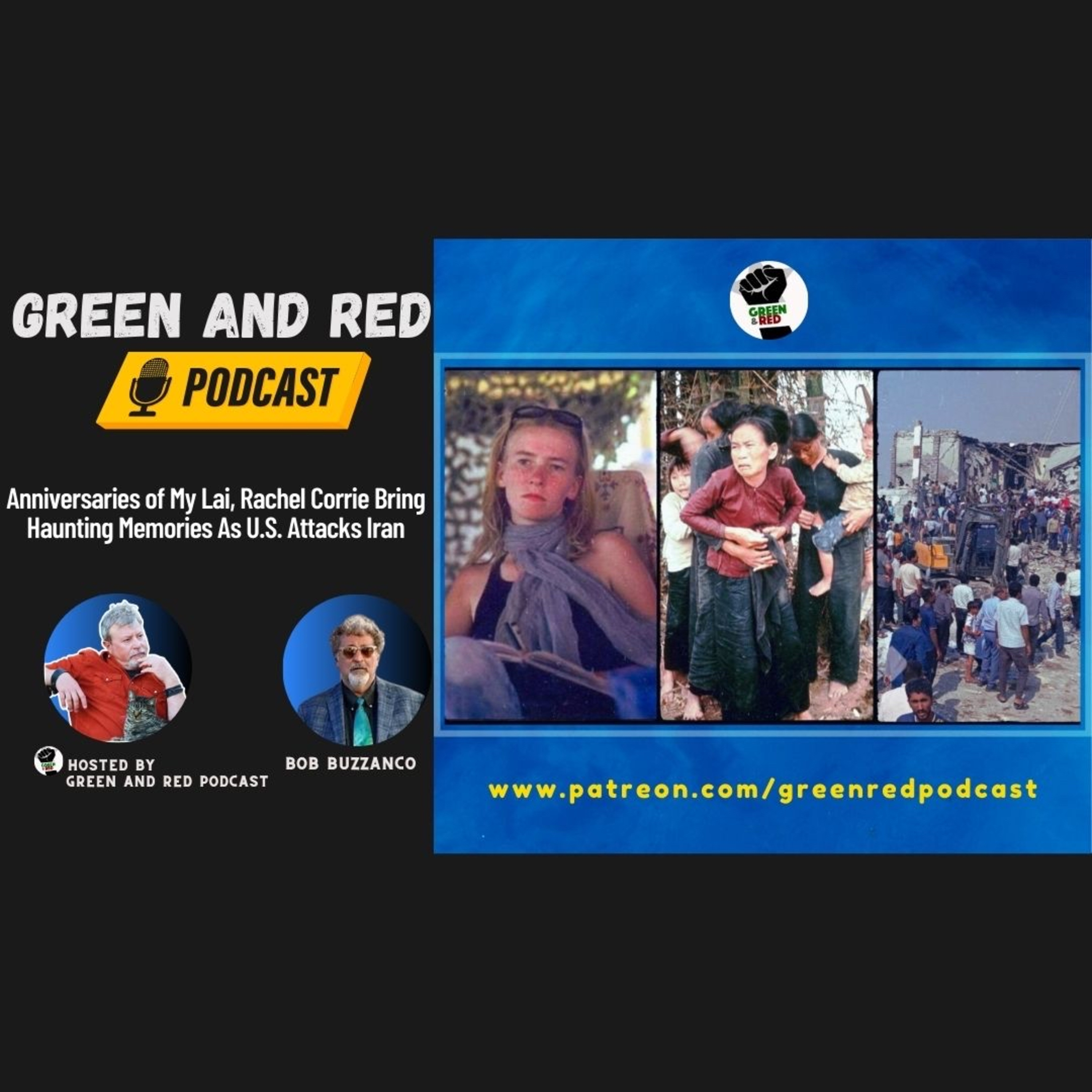
Green & Red: Podcasts for Scrappy Radicals
Anniversaries of My Lai, Rachel Corrie Bring Haunting Memories As U.S. Attacks Iran (G&R 480)
00:35:04
Loading summary
Transcript77 lines
- [00:01]
Scott Parkin
Welcome to Green and Red Scrappy Politics
- [00:03]
Bob Bozanko
for Scrappy People, a regular podcast on radical environmental and anti capitalist politics. Brought to you by Bob Bozanko and Scott Parkins.
- [00:14]
Scott Parkin
Welcome to the Silky Smooth Sounds with Green and Red podcast. I'm your co host Scott Parkin in Berkeley, California, which will be a little bit relevant, something we're going to talk about today, but as always I am joined by Bob Bozanko in the People's
- [00:30]
Bob Bozanko
Republic of Niles, Ohio.
- [00:33]
Scott Parkin
I we're gonna, we're gonna get into some pretty serious stuff today. It's the anniversary of the My Lai massacre. It's also the anniversary of the murder of activist Rachel Corey. We'll get into more about that. But she was killed in 2003 by the Israeli Defense Force. Melee happened it's the 50th anniversary. So melee happened in 1968 in Vietnam. But we're going to be talking about
- [01:00]
Bob Bozanko
US
- [01:03]
Scott Parkin
war atrocities in Vietnam. We're going to be talking about US And Israeli atrocities in the Middle East. Part of this comes in under the, under the shadow of what we've seen in Gaza for the last two and a half some odd years with the mass murder and starvation of lots of people, but a good chunk of them kids. And then also on the opening day of the US Attack on Iran, the US intentionally blew up a girls school in Manab in Iran, killing 175 people, 14 adults and 161 children. So we're going to be talking about those anniversaries in the context of where we're still, that we're still living in as far as like policy by the Israelis in the US Go. But first we're going to start off with a tribute to someone who's recently passed, which is Country Joe McDonald, who was a musician very known from like the 1960s, but up through even now. And he was part of that generation that very much intermingled music and politics. And even though he became a somewhat bigger star, he was out of the free speech movement here in Berkeley. He actually is from Berkeley, grew up in Berkeley. He was also part of the anti Vietnam War movement, is a Vietnam vet. And so we're going to pay a little bit of tribute to Country Joe.
- [02:34]
Bob Bozanko
Yeah, it's actually that song from Woodstock, right. Very famous, became the anthem. Right. The Feel Like I'm Fixing To Die rag was really in many ways my introduction to Vietnam. Even more than like actually studying the war. I heard the music from Woodstock from brothers and sisters and older folks and stuff like that. And when he died it brought back a lot of those memories of that period. Country Joe was also very. He was a vet. He was an active member. Also, let's point out his mother was a member of the Communist Party here
- [03:02]
Scott Parkin
in the Bay Area.
- [03:03]
Bob Bozanko
Here in the. Yeah, Country Joe was also active in bvw, the Vietnam Veterans against the War. And one of the reasons VVAW was obviously against the Vietnam War, they had witnessed it. But one of the, I think, impetus for them was the William Cowley trial. And William Cowley was on trial for war crimes because of what had happened on this date 58 years ago, on the 16th of March in 1968. I think we're familiar with generally with what My Lai was. It was a massacre, a mass murder of unarmed civilians in a place in a village called Sun My, which was in Quang Ngai Province, which was in the central part of the Republic of Vietnam, what we would call South Vietnam at the time. In that area, America's American troops, organized in Charlie Company, which was commanded by Captain Ernest Medina, were doing patrols. They had arrived in Southern Vietnam a few months earlier in December of 1967, which meant that they were there for the Tet offensive, which began in early 1968. They had fought in Quang Nai province during Tet, in My Lai hamlets one through six. So My Lai is this village. There were six hamlets in My Lai which were numbered. The massacre took place in My Lai, four after. Even. Not even after Tet, before Tet, the United States, really, 1965, 66, pretty much quickly after the US sent combat troops into Vietnam, which is also worth thinking about. Right. As Trump talks about that, among a million other things. Right. But the United States was doing what they called very openly search and destroy operations. Search and destroy operations created what they called, again, openly free fire zones, which meant you went into villages and you just destroyed everything in sight, which is obviously a war crime. Right. So again, when we talk about how bad Trump is, let's keep in mind this is how Americans fight war. Right after Tet and after Tet, these search and destroy operations really accelerated because the United States was really in. In pretty dire straits, despite what the post Tet kind of revisionism would say, oh, it was a military victory and Walter Cronkite screwed us over. Whatever. That's just not true at all. So these search and destroy operations were a sign of America's desperation. They planned operations in Sunmi village. Ernest Medina, the commander of Charlie Company, told his soldiers that they were going to go in there on March 16 and he said when they arrived in the village, they would go there later in the morning because the people in the village would be at the market. So the only people who would be left would be vc, Vietcong, the enemy. William Cowley was the leader of the first platoon in Charlie Company. When they arrived in My Lai 4, they assassinated, mutilated, raped, pretty much the entire village. According to American data, they killed 347 people. The Vietnamese estimated that it was over 500. Cali and others rounded up villagers. They killed them with automatic weapons, with grenades, with bayonets. They pushed the village villagers into irrigation ditches and massacred them en masse. They burned homes. They poisoned wells. They slaughtered animals. In a nearby village named Mi k, for between 60 and 150 more were killed. We don't really talk much about that. And My Lai is definitely the best known of these war crimes, but they really were very common in the Vietnam era. We know about Tiger Battalion. A journalist named Nick Turse has written a book called Kill Everything that Moves. If you've done research in Vietnam in the documents, you'll see this. I remember looking at records from really pretty much 1965 on where there would be accounts of this as the massacre was taking place, right as they're just destroying this village and killing everything that moves. A warrant officer named Hugh Thompson was in a helicopter flying overhead. He saw this mass of people, dead people on the ground from the helicopter landed, forced the helicopter down to land next to a ditch which was full of dead bodies. He encountered at that point, William Cowley. Now, Thompson, if there's a hero in the Vietnam era, it's Hugh Thompson, right? Thompson made the helicopter land in between the American soldiers and the remaining. There were still a few Vietnamese villagers who were alive. Thompson put the helicopter down. Cali came over, and there's an account of this that came out during the subsequent court martial. Thompson said, what's going on here, Lieutenant? Callie said, this is my business. Thompson said, what is this? Who are these people? Callie uttered those famous words, just following orders. Thompson says, orders? Whose orders? Callie says, just following. Thompson cuts him off. But these are human beings, unarmed civilians, sir. Callie says, look, Thompson, this is my show. I'm in charge here. It's none of your business. Thompson says, yeah, great job. Kelly says, you better get back in the chopper and mind your own business. Thompson says, you haven't heard the last of this. That would come out later. Thompson returned, reported it to his superiors, compared it. In his initial telling of it, he compared it to what the Nazis would do so. He invoked that immediately. But there was no real investigation at the time. Reports of this one at the chain of command, including to, at the time, Captain Colin Powell. We all know who he is, right? And everybody more or less just pushed it aside. There was no real investigation inside Vietnam. Soldiers knew about it immediately. They called this village Pinkville. And really from March, April 1968 onward, people were all over Vietnam, were talking about this. It was a very open secret. Finally, about a year later, In March of 1969, Ron Ridenauer, who was in Charlie Company in that area, wrote a letter to 30 different congressmen who had voiced their opposition to the war in some way or another describing this massacre. And he uttered those famous words. Something rather dark and bloody had occurred in My Lai. It was still kept under wraps after that. The initial investigation plans for a court martial were still not known to the public until In November of 1969, the very famous journalist Seymour Hersh wrote about it. And at that point, the story and photographs began to come out and the episode was broken open. I believe it was the Cleveland Plain Dealer actually that published the first photos of it. The court martial eventually began in November of 1970. We mentioned Country Joe earlier, VVAW, which had formed a little before that really took this up. And they weren't defending Cali, but essentially what they did. They went around the country saying, cali's a scapegoat. This is standard policy. This is the way we operate. Medina basically had told him, go ahead and kill everything that moves. VAW, in early 1971, had gone around the United States holding what they called Winter Soldier hearings from the Thomas Paine line, the Summer Soldier and the Sunshine Patriot, right, the Winter Soldiers, where hundreds of veterans from Vietnam stood up and recounted things that they had done or seen very similar to what had happened at My Lai during the court martial in November. When it was beginning In November of 1970, Cali insisted that he acted on orders from Ernest Medina. During the court martial, Medina threw him totally under the bus and said, I never told anybody. I told him to protect women and children. In fact, March of 1971, Cali was convicted and sentenced to life after the court martial, as an aside, many years ago, I happened to speak to an attorney who was in. In the prosecution for Cali. And he said that the. The army kind of people in the army wouldn't have anything to do with him because he was prosecuting Cali. They wouldn't sit with him at lunch. They just wanted nothing to do with him because he Was not covering this up. Right.
- [11:11]
Scott Parkin
Thin green, right? Thin green line, right?
- [11:13]
Bob Bozanko
Yeah. Yes. I think Cali had only been in the stockade at Fort Benning for a couple days when Richard Nixon released him and put him under house arrest. The sentence was then changed from life to 20 years, and then the Secretary of Army paroled him in September of 1974. Callie became actually something of a hope, spoke hero to people on the right. I forget who it was. Somebody put out the Ballad of William Cowley, Lieutenant Cowley. Country radio stations especially, would talk about him. So he became seen as a victim or a scapegoat. And he is a scapegoat because Medina, you know, if you believe in the chain of command, Medina was more responsible even than Callie was. Callie was the only person convicted in a massacre in which perhaps 500 people were killed. And everybody knows Callie did not kill 500 people by himself. And yet, when you think back upon it, it's fairly chilling to think of how casually this whole thing was treated. As an aside, PBS did an incredible documentary on this probably in the 80s, probably 40 years ago now. And if I don't know if it's available online or whatever, but it's really worth seeing, there are a couple people in there whose testimony is just haunting. There's an African American soldier named Barnado Simpson, who, after My Lai, was never the same. He had a box of pills from the va. He was just never psychologically the same. And then the end is just horrific because his young son was hit by a car and he said he's cradled him in his arms. He was looking at these Vietnamese villagers who he had killed that day. It's just. It's what happened. We just going through it, right? It's what happened in Daza. Every day it's a version of what's happening in Minneapolis, in Chicago and Burlington, Vermont and la. Every day it's what's happening in Tehran right now. Horrible thing to talk about, but clearly not a lesson learned by really anyone involved.
- [13:16]
Scott Parkin
And just also as an aside, there's a great recently released Netflix documentary about Seymour Hersh's career, which goes pretty deep into how he was actually party to exposing the Matt. The Melee massacre as well. Yeah, highly recommend that.
- [13:33]
Bob Bozanko
And I think even beyond that cover up, which included Colin Powell, can't say that enough. But the fact that VVAW went around the country with these testimonies, with these open public hearings, and then Senator Mark Hatfield, who's Republican from Oregon, read it into the Congressional Record, and the fact that that happened and nobody really acted upon it. That was significant anti war sentiment. And by 1970, 71, the U.S. is certainly drawing down anyway. But it shouldn't be shocking that Trump and whoever gets away with what they get away with, because that's the way it is.
- [14:13]
Scott Parkin
I feel like at this point they don't even try and cover it up. They're just like, no, they're kind of
- [14:17]
Bob Bozanko
bragging about it now.
- [14:18]
Scott Parkin
Yeah, yeah, they're very much. What do you. What are you going to do about it?
- [14:22]
Bob Bozanko
Yeah, they ignore the UN they ignore the International Court of Justice.
- [14:26]
Scott Parkin
They sanction them, actually.
- [14:28]
Bob Bozanko
What's that?
- [14:29]
Scott Parkin
They put sanctions on the International Court.
- [14:31]
Bob Bozanko
Yeah, yeah, yeah. Somebody's killed in the streets and the cabinet secretaries come out and before knowing anything, they say these were terrorists. And then they hide the killers, they take the killers and they give them refuge. We don't even know where the three people who killed good and pretty are.
- [14:46]
Scott Parkin
Right, right.
- [14:46]
Bob Bozanko
It's. But it, this is really in. In the history of the Vietnam War, if you study it at all. And my life is a pretty big episode in it. I think we look back on it, though, and we see it as a watershed moment that helped turn Americans against the war and changed the way America thought and led to more opposition to the war. But I'm not sure as I look on it now that it really did, that Americans are pretty immune to that. And that idea of American exceptionalism, like, our boys don't do that. And that's in many ways the most chilling part in these are kids and they're young. Like I always say, they're like farm kids from Ohio and working class kids from Detroit and kids from rural Alabama all together doing this. And it just shows, like when you get caught up in that frenzy. The night before, Charlie Company had watched porn stag films and gotten drunk and shit like that. And so there were also dozens of rapes and really horrific and atrocities committed against women as well. This is the American way.
- [15:50]
Scott Parkin
And it's the they would have you believe. It's like an anomaly. Whereas this is, like you said, just with Vietnam, from 1965 on, we saw these war crimes happen over and over. The one I always think about is when I was first getting to know you and it came out that Bob Kerry, former senator, former governor of Nebraska, he was a Navy SEAL in Vietnam and he was part of the Phoenix Project and had actually assassinated prisoners, killed prisoners while they were in custody. And it just, I just. That was. The Phoenix Project was a project to dismantle Viet Cong infrastructure in the Mekong Delta and places like that. And it was just like war crime after war crime. And it really, that was an early moment for me to know how this operation happens. And it's what we see over and over. We saw in Iraq, we saw in Afghanistan. Trump Hexa talked, when he was a Fox News host, talked Trump into pardoning people committed of those war atrocities in places like Iraq. We saw that the Israelis, funded and supported by the US do it in Gaza. And now we're seeing it, we're building up towards that with Iran.
- [17:05]
Bob Bozanko
I mean, Trump, I've been thinking about this a lot lately because the way Trump's bragging about destruction in Iran, which is true, the United States is obliterating, pummeling, whatever word you want to use, Iran, and citing that is like evidence that like they won the war in Vietnam because it's a guerrilla war. United States doesn't really. United States had no business, but the US Military did not want to be there. Kennedy and Johnson made those decisions, especially Kennedy. The kind of gauge the standard for success became how many enemies did you kill? The body count. And so the United States there had to just destroy everything in its sight, right?
- [17:41]
Scott Parkin
Anywhere between kill everything that moves.
- [17:42]
Bob Bozanko
Kill everything that moves. The US killed between 2 and 3 million Vietnamese. Now, this is in a country, I forget what the population at the time was. Country this size. The entire country is the size of New Mexico. So it's not very big, 2 to 3 million. Those are not all soldiers, especially because the war was fought south of the 17th parallel for the most part. So the overwhelming majority of people killed were civilians. And the kinds of stuff that happened at me, like I remember and I've said this many times, and you know this right? When I began studying Vietnam, my first idea, my first thought was to write about VVAW and various anti war vets groups in the Vietnam era. And so I conducted over 100 interviews at the time. And I and pretty much all of them told me some kind of story similar to this. Maybe not a village with hundreds of people, people who were like in a helicopter pushing a VC prisoner of war out, going into a village and just slaughtering people, taking people prisoner. And then as they got away from everybody else, just killing him and leaving him to die in a field. So this was the way the war was fought, right?
- [18:46]
Scott Parkin
And there's a term that the Israelis used still using around Gaza, which is called mowing the lawn, which is where they just try to obviously committed a genocide. It's also what the US is starting to use in their term, or they're starting to use that term towards Iran as well, is mowing the law.
- [19:07]
Bob Bozanko
Norman Finkelstein always talks about that whenever he talks about mowing the law. And most Arab scholars do. Yeah, it's, it's a total war which involves civilians. It's modern war up through civilians have always been, you know, attacked. I've heard a statistic years ago and I never followed up. It was before the Internet, so it wasn't that easy. But somebody told me once that before modern wars and I guess World War I's kind of the cutoff like the Civil War is an industrial war. But the Civil War actually did a decent job until the last March, the Union march through the south of avoiding civilians. But From World War I on, the vast majority of people killed were non combatants, whereas before World War I, the majority of people killed were actually soldiers. And that's just crone. We saw that obviously in World War II, right. With the, especially at the end of the war with the bombings, the napalm bombings in places like Dresden and Tokyo and then of course the atomic bombings, the Germans, the death camps. Wars now involve entire society. In Iran they can brag about killing Khomeini and Revolutionary Guard, but already there's no doubt the vast majority of people killed in, in Iran are civilians. And then obviously in Gaza there's, you know, if Israel is admitting to 70,000 dead, I suspect it's at least double or more than that. And there aren't that many Hamas soldiers in all of Palestine. So.
- [20:26]
Scott Parkin
Right. This is clearly Trump told ABC today, maybe yesterday that they went, they had bombed Kharg, which is this oil hub island off the coast of Iran and the Strait of Hormuz. And he's. We went back and bombed it a second time just for fun after they decimated the decimated everyone there. They openly admit their war crim criminality.
- [20:50]
Bob Bozanko
Truman had the good sense to talk about how much he agonized over Hiroshima and Nagasaki and what a difficult decision and how he preyed upon it. Whereas these guys like Hagseth and Trump, they're bragging about their war because they know they're not. Nothing's going to happen. There's no consequence. These international and I know the US is the most powerful country in the world, but the rest of the world collectively could do something about it. And they choose not to, except other
- [21:12]
Scott Parkin
than send their navies in first to the Strait of Hermus.
- [21:15]
Bob Bozanko
Yeah. So right now we're looking at what Spain and Ireland among the Big European countries are. Seem to be a little bit different.
- [21:22]
Scott Parkin
Right. I don't know about Italy too.
- [21:26]
Bob Bozanko
They refuse to assist. Maloney has drawn a line there. But I do think that they're. I don't know if they're allowing Americans to use their airspace and refuel and things like that. There's. But yeah, they're not as bad. And Maloney's been actually pretty outspoken on this. But I think Spain and Ireland really like more legit in that regard.
- [21:44]
Scott Parkin
Right.
- [21:44]
Bob Bozanko
But. And in the Vietnam era, one thing that actually was a mitigating factor was that there the Soviet Union and China were strong. Right. And so the U. S. Did have to be careful about what it did because you had these two countries which were both helping the northern Vietnamese, the Vietnamese Communists. And also the United States had to be wary that if they went too far and we don't really have that, obviously Russia is just in it to get as much profit as I can out of this. And the Chinese are being very slow about this, taking their time to see what happens because essentially when this is over, American power is going to be on the wane and China is just going to pick up the pieces of what's left from a global economy that is being utterly destroyed right now.
- [22:26]
Scott Parkin
It's terrible to say, but it's almost in China's benefit to just let it go on as long as they can.
- [22:32]
Bob Bozanko
Yeah, absolutely.
- [22:34]
Scott Parkin
The only other thing I wanted to touch on this is just that we've touched on the viciousness of the Trump administration. But just to double down on that. Did the double tap on this is is himself has through the since the beginning of the war which has about been gone on for about two weeks now. Is that is they don't one hegseth did away with all of the agencies within the Pentagon which tried to save civilian lives. However, if that worked, however that worked. But he. He abolished all of those when he came in last year. But then he's now talks a lot about rules of engagement and he talks about nation building and things like that and how he doesn't want to do that. And so quote, unquote, he said there's no stupid rules of engagement. There's no nation building quagmire, no democracy building exercise, no politically correct wars. That's a big thing with him too. We fight to win and we don't waste time. Waste time or lives. He also said America, regardless of what international institutions say, is unleashing the most lethal and precise air power campaign in Quagmire. And hegseth has given almost. Seems like. Almost like daily reports to the press and spends a lot of time talking about how we're the best there is and we're going to kill as many people as possible. We're the most lethal. Even though there's a lot of evidence that while they are decimating the Iranian military, they are, they are also not winning this. There's a.
- [24:06]
Bob Bozanko
What's.
- [24:06]
Scott Parkin
Asymmetrical warfare has begun to unfold that the Iranians have been planning for a long time and the US is not coping with it super well. And including closing the Strait of Hormuz and inflicting economic pain on a global.
- [24:20]
Bob Bozanko
They never saw it coming.
- [24:21]
Scott Parkin
Yeah. Which they never saw coming. Although Hexa today said that he did see it coming and they had planned
- [24:26]
Bob Bozanko
for it, but they didn't do anything about it.
- [24:29]
Scott Parkin
They didn't do anything about it. Obviously it hasn't really worked. Whatever they had planned, he called it, I think he called it shaping operations. Right.
- [24:36]
Bob Bozanko
Yeah. But yeah, this is the way if you look at the first Gulf War, where the, even the first Gulf War, right. Where the United States, even before that Clinton was blowing up pharmaceutical buildings. In the first Gulf War, the United States was blowing up water plants. So this is the way the Americans fight war. There's no American exceptionalism on this. Right. So when it comes to seeing what Israel's done, that's not an aberration or anything like that. So this is also the anniversary of another well known activist, another tragedy. And if we talked about Hugh Thompson being a hero. And so I think someone just this other. There, there's another hero to talk about today too.
- [25:15]
Scott Parkin
There's Rachel Corey who was killed, also assassinated 23 years ago in 2003 on March 16 in Gaza, actually in Rafah, a city of the Gaza Strip. She was an American. She was from Olympia, Washington. She'd actually gone to college at Evergreen in Olympia. She was. Hadn't finished school yet. She had taken a year off to actually go to Palestine with the International Solidarity Movement. And while she was in, while she was in Gaza, she was protesting the demolishment of Palestinian houses by Israeli forces which were taking place at the height of what they call the second Intifada. And while she was protesting these demolitions, she put herself in between a Palestinian home and an Israeli armored bulldozer who then crushed her. The bulldozer operator said that he never saw her. She was wearing high visibility gear and they were making a lot of noise. She died and was murdered by the Israeli Defense Forces. And this is also right around this. Is this happens right around the same time that the Bush invades Iraq. It's I think within the same week, actually.
- [26:31]
Bob Bozanko
Yeah.
- [26:31]
Scott Parkin
And so she had been like super active within anti corporate globalization movements. Lots of my friends actually who went to Evergreen and Martin Washington actually knew her. And then she was also involved in anti war stuff. She was actually burnt an American flag at a protest while in Palestine in protest of the. In protest of the invasion of Iraq. But I think with Rachel Corey is that we see we're all very familiar with what the Israelis have done in Gaza since 2023. And a lot of people were pretty familiar with the Israelis did for a long time before that, the Palestinians. But. And when the second intifada happened, it was like it was a pretty brutal repression. A lot of Israeli military activity in Gaza and the West Bank. Rachel Corey had been involved in stuff in both. But this actually just really shows that Israel. It's a little bit of kill everything that moves. And so this is like an unarmed nonviolent protester who's protesting and even use putting her body in the way of their machines. And they just ran her over. And so it's an important anniversary because we're talking about atrocities and very much aligns with. We just talk a lot about US Atrocities and how there is a history of that. We also have a history of Israeli atrocities against Palestinians and their allies. And it's just she's an important figure. And I think it's actually really worth bringing this up, especially in the context of everything that's happening right now, particularly now that the US Atrocities are happening in the Middle east like they were in 2003.
- [28:06]
Bob Bozanko
Also, it's also worth noting that the United States official. Official did nothing about this. And this is recently, in the last few years, you've had, I forget, three or four at least, American citizens killed in Palestine. And the US hasn't done a thing, not even investigated it.
- [28:23]
Scott Parkin
Nine, actually.
- [28:24]
Bob Bozanko
Was it nine? Okay.
- [28:25]
Scott Parkin
It's. It's in the west since the genocide started. 9.
- [28:27]
Bob Bozanko
They don't investigate. They don't investigate murders by ice in the streets that are being videotaped. But it kind of shows where the priorities lie. Also, the bulldozer that ran over and killed Rachel Corey was a John Deere American company. Right. And yeah, nobody cared. No one in the State Department, nothing. I Her. Rich Corey's parents were in Houston, I believe later that year. And they. We had them to speak and they were just such gracious people, just really quite amazing who really just Wanted to end the war and spoke obviously very powerfully about her, but also really centered the Palestinian people and what they were saying. It was really just gut wrenching to see them and to talk to them.
- [29:07]
Scott Parkin
I did.
- [29:08]
Bob Bozanko
What?
- [29:08]
Scott Parkin
There's a. There's an. There's a series of emails that were between Rachel Corey and her mother while she was in Gaza. I was going to read part of one of them. Is that all right? Well, it's a letter she wrote sometime before she died, but she said, I look forward to seeing more and more people willing to resist the direction the world is moving. A direction where our personal experiences are irrelevant, that we are defective, that our communities are not important, that we are powerless, that our future is determined and at the highest levels of humanity is expressed through what we choose to buy at the core. Yeah,
- [29:43]
Bob Bozanko
yeah, yeah. I remember when it happened. It was. If you've ever seen the movie Missing, about an American in Chile in 1973, it's similar, right. The US government doesn't give a shit about its own people. Right. In the interest of these. In the service of these, what they would call bigger interests, whether it be the Pinochet dictatorship or obviously anything Israel does. The United States gives Israel priority over American citizens. Right. And they will cover up Israel's crimes, as we've seen them do time and time again. And the number of Hugh Thompson's and Rachel Corey's there. There actually are people like that out there. You and I have been involved with a lot of them. Right. People who are really powerful and just incredibly brave, but there are far more of these kind of demons out there who don't care. And we're seeing that every day with ice. Right? These are Americans killing their own. So the idea, we often say, oh, if they would deploy Americans, then they'd have to kill their own. They probably would. They probably would.
- [30:39]
Scott Parkin
A lot of them, they joke about it at this point online, so. Yeah, I'm sure they would.
- [30:44]
Bob Bozanko
Yeah. Yeah. That Chicago case, what was it? Five shots, seven holes? So we're up against really malevolent force, which has both immunity and impunity.
- [30:57]
Scott Parkin
I was good. I don't know if you have anything else. I was going to close on a little bit of country, Joe.
- [31:02]
Bob Bozanko
Yeah. I just think what's important we talked about this because we're seeing it right now, and we're likely to see more of it. Almost certainly we're going to see more of it. Israel is now conducting an ethnic cleansing in Lebanon. The United States may be doing the same in Iran. The People crying the crossfire are just there. They just happen to be there. It would be as if a foreign country was pissed off at Trump and began to bomb Berkeley and Ohio, and we'd be caught in the crossfire and nobody would care. That's kind of where we are.
- [31:33]
Scott Parkin
Yeah. Yeah. The sort of veil is just pulled off at this point that in past administrations, I feel like they at least tried to cover up that they were going to do this. The Trump people are just, like, ugly and malevolent and just want to be as brutal and violent as possible.
- [31:53]
Bob Bozanko
Yes. It's like the Roman Empire type of imperialism.
- [31:56]
Scott Parkin
Of course, it's all led by people who never serve themselves.
- [31:59]
Bob Bozanko
No, I know a lot of vats and, oh, my God, do they hate Hagseth. They just. I don't know if they hate anybody. And I suspect even Trump's replaced a lot of. He's fired everybody who knows anything, including in the military. But the sense I get is that even these guys who are Trump's people in the military are shaking their head at all this because they know it's going to turn out badly, you know, and they sure as hell don't respect Hegseth. Can you imagine being like, you've been in the military 30, 40 years, you're a former colonel, you're a general, and you're taking orders from this drunken rapist. So.
- [32:30]
Scott Parkin
Yeah, exactly.
- [32:31]
Bob Bozanko
Who.
- [32:32]
Scott Parkin
It's not even. He's a clown. He even dresses like a clown.
- [32:34]
Bob Bozanko
Oh, he's. Yeah. It's chilling. It's horrible that these. This level of people controls the world, but it's also his comfort. Not comforting. I don't know. It's better that they're idiots because if they were, like, skilled at what they did, that it'd be over. We'd all be in camps right now.
- [32:51]
Scott Parkin
Exactly. I think we're good. I think we should just leave on some country Joe. Yeah. Come on, all of you big strong men. Uncle Sam needs your help again. He's got himself in a terrible jam way yonder down in Vietnam. So put down your books and pick up your gun. We're going to have a one. We're going to have a whole lot of fun. And it's 1, 2, 3, 3, 4. What are we fighting for?
- [33:16]
Bob Bozanko
There's a. Another stanza in there is Come on, Wall street, let's move fast. Your big chances here at last. Or was it let's Come on, Wall street chances here last. Forget that. The last line is, you know, that peace can only be won when we blow them all to kingdom come.
- [33:30]
Scott Parkin
Exactly.
- [33:31]
Bob Bozanko
It's all about the generals, Wall street, the politicians. So Country Joe and people in vvaw when he died, like people in VAW just came out. There was this outpouring of affection and love and really good memories. And there aren't that many of that generation left. And Country Joe was a real one stayed that way, too. We're still doing this to the very end.
- [33:52]
Scott Parkin
Yeah. So you've been listening to the dark ruminations of the Green and Red podcast today, if you like what you hear. And please check us out on Facebook, Instagram, Twitter and Bluesky. If you're watching this on YouTube, give us a. If you're watching this on YouTube, give us a. Hit that subscribe button. If you listen to this on a audio platform, give us a rating review. If you really like us, go to greenandredpodcast.org and hit that support button or become a patron@patreon.com greenredpodcast and we will everybody stay safe, stay strong, misbehave and make lots of trouble. And we'll talk to you guys. Sam.