← Green & Red: Podcasts for Scrappy Radicals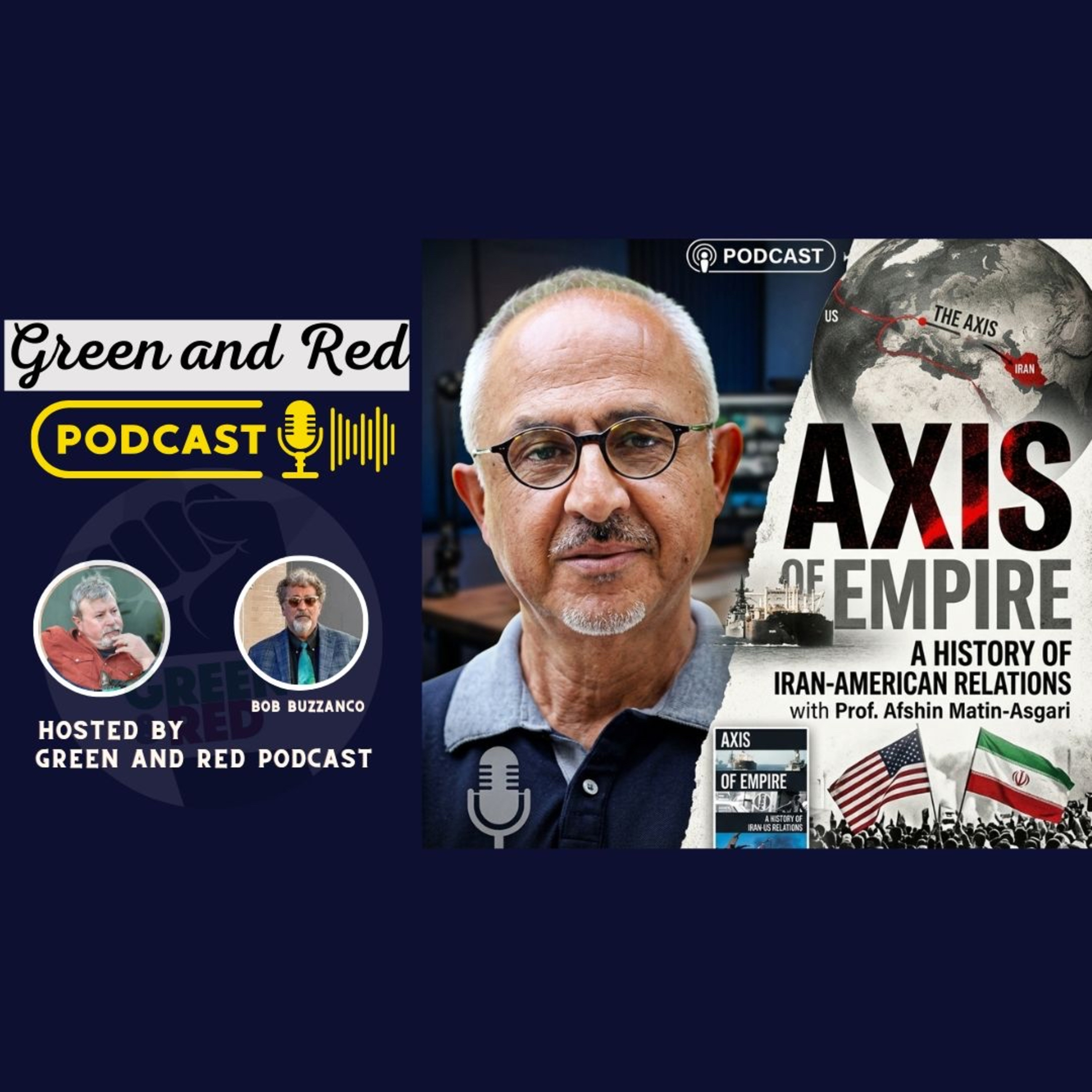
Green & Red: Podcasts for Scrappy Radicals
Axis of Empire: The History of Iran-American Relations w/ Prof. Afshin Matin-Asgari (G&R 476)
01:08:16
Loading summary
Transcript50 lines
- [00:01]
A
Welcome to Green and Red Scrappy Politics for Scrappy People, a regular podcast on radical environmental and anti capitalist politics. Brought to you by Bob Bozanko and Scott Parkins.
- [00:14]
B
Welcome to the silky smooth sounds of the Green and Red podcast. I am your co host Scott Parkin in Berkeley, California. And as always, I am joined by
- [00:24]
C
Bob Bozenko in Ohio.
- [00:27]
B
And today we're going to be doing another Iran show. We posted one last week with Bob and Professor Askander Siddiqui. And today we are talking with Professor Shane Mateen who is a professor at the Cal State Los Angeles and is the author of a new book which is called Axis of A History of Iran US Relationship. And Professor Mateen has, he's written a number of books. He's in the Middle Eastern Studies program at Cal State la. And we're also, it's in a very troubling time in the history of Iran, US Relations as Trump over the weekend launched at the US And Israel launched attacks on Iran and it's a full blown war has broken out. And Professor Mateen, welcome to the Green and Red podcast. I'll say that when we first started talking about booking you, we did not know that we would be talking to you this week. But I'm really glad to have you here. And I just saw in the news today that the Senate has voted down the War Powers Resolution act on Iran. But I'm just wondering if we could first maybe start off with just some of your initial thoughts about what is happening right now in Iran and Persian Gulf area.
- [01:45]
A
Yeah. Thank you, thank you for having me. I really don't know where to start. As you might imagine, all of this is also very personal. I was just, I couldn't talk because the Internet is down. But I have a brother who lives in Iran. He lives on this little island in southern Iran near the famous infamous now Strait of Hormuz. And it's just like 35,000 people, 35 square kilometers. And there's nothing, there's no military significance. But my brother was telling me that they over the past few days they hit a radar that was placed there and then they've been hitting the island. And he was just saying they're hitting us, they're hitting us, we're safe, my family is safe. And this must be the case for a lot of Iranians. I don't know, I hope they're alive. What else can I say? So yeah, this is a very hard times.
- [02:50]
C
It seems like last summer when the US struck for the 12 days, it seemed like Iran was Somewhat caught off guard, but I get the sense it was much better prepared this time.
- [03:02]
A
Yes, definitely. But I think we can talk more about this. My whole sense is, as you mentioned, last summer, the war started like one day after Trump had given them a deadline of negotiations, and the last day after that, they started. Israel invaded, and then the US Joined in. And this time, too, they were supposedly negotiating. And in the meantime, the US Was mobilizing his armada and it was clear that this might happen. And he did, in fact say that, accept our terms or something bad will happen. And he was not bluffing. I don't know if the Iranians, clearly, they're more prepared this time to, what can you say, defend themselves. And I want to say, when I say the Iranians, I make this as a confusing thing. It's good to distinguish between the regime, the Islam, let's say the Islamic Republic, because of. We don't want to identify the regime with the people. That's a whole another aspect of this conversation. But this time, yes, it's now, what, day five. And the way it's progressing is it seems like it's not clear what the agenda of the Trump administration is. It's clear, I think, what the agenda of Israel and Netanyahu is. They've said it for decades, going back to the 90s, and what they want is regime change. Nothing short of if they can bring it down and the consequences don't matter to them. We don't know what Trump wants. He talks contradictory, but I think it's clear to the Islamic Republic that its back is to the wall. So it either somehow resists and survives or it's going to be all over. It seems like their strategy is to hit back as hard as they can, make this costly and hope for some kind of a ceasefire. So maybe we don't. Nobody knows how it might end, what an end game might be. But I personally think they misread the US this time because clearly their negotiations were. Had no intention to go anywhere. It was just, first of all, you're putting literally a gun to somebody's head and saying, negotiate or I shoot you. And I don't know. I don't know what a better alternative for the Islamic Republic was. Perhaps they might have unilaterally done something. Maybe, perhaps they should have just declared, we totally cease our enrichment, which is effectively stopped. So maybe they should have made a case that, okay, we're not going to do this, we're going to stop our ballistic missile program for now. They have 400kg of highly enriched Uranium, which is part of the issue. They might have just given it up because it's clear they're not going to be able to hold on to any of this. Did they? They failed to really understand what the US And Israeli side were doing. It's complicated. There's another controversy that some analysts say in relation to the question of the Supreme Leader. Ayatollah Khamenei was sitting there somewhere with his family, with high ranking military Revolutionary Guard leaders, and they were hit and they were all killed, including his wife's grandchild. And one question is, why didn't they go hide somewhere? Because Israel was saying, we're going to kill you. And now they're saying whoever replaces him, they're going to kill. So whoever. I'm laughing with a nervous laughter. There's no fan of the Ayatollah, but obviously you don't want change in Iran to come by some foreign enemy coming and killing the leader of the country. It would be much better if the people of Iran could have changed their leadership. But some now are saying that he was just staying in place, not caring what would happen to him, maybe to become some kind of a martyr to. Now Shiite communities in different parts of the world are in protest. It's a very chaotic, unpredictable, troubling situation. Ordinary people are dying, their civilians are dying. That school in southern Iran, all besides turn my phone down. So, yeah, this is, this is what we're facing. But I also want to, as you may want to turn back, this is a disaster for Iran, for the whole region. The least is just instability. But I think what's happening is also very important for the US And Trump's idea of just pretty much doing whatever he wants to international. There's no international law. There's nothing. He did this to Venezuela, now it's Iran. And if he is, he's always saying that he's successful no matter what. But if there's any kind of a tangible success here, of course he's going to go after the next target and the next target and next target. Can the president completely disregard the constitution and do whatever the hell he wants to? That's part of the question. Also
- [08:44]
C
in the US Media, it's heavily focused on Israel, obviously, and it presents the story of success. Israel hit this and the US Hit this.
- [08:52]
A
But if you go to other sources,
- [08:54]
C
you'll see something different. And there's obviously this regional context, too, where Saudi and UAE and Dubai have been in the line of fire as well. And Americans don't understand that they're like, why is Iran striking all these other countries? What's that regional context there? Why are these states seen as problematic or even an enemy by Iran?
- [09:20]
A
Yes, that's a good question. Because you look at this and you say Iran is already being attacked by the world's greatest military power and their second regional superpower, Israel. Why would it make more enemies by lashing out at these Gulf states, Saudi Arabia making more enemies even if it survives the Islamic Republic, These are all going to be enemies from now on. But you have to remember that Islamic Republic had said, if you invade us this time, this is not going to be a limited war just between Iran and Israel and the US Everybody, the whole region is going to be involved. If we are going to go on there, we're just going to make this very costly. We're going to stay close. The Strait of Hormuz, where massive amounts of oil pass through, not just Iranian oil, but from the Arab Gulf states and these other neighboring countries, they all have supported US Military effort. The US has bases there. So in a sense, they are involved in this war against Iran. Maybe not directly, but indirectly they're involved. And the Islamic Republic strategy, and they had said that openly, that if, if they attack us, then all of you guys are game. We have to defend ourselves and we hit any targets. They've hit forest places in Dubai and here and there and hotels. And maybe not intentionally. I think even not from a humanitarian perspective, but from a military perspective, it would be better for them if they could hit military targets. But if they miss that and hit a hotel, they would disrupt Kuwait's kind of tourism industry. And they're just trying to ratchet up the cost. And that's. That seems to be their. So they're not just foolishly not endorsing or approving of the regime's military tactics? Personally, I was always against this policy of ballistic missiles enrichment. Beyond that minimum, that is definitely for peaceful programs. And the Islamic Republic argued that these were deterrents, they would deter something like this. Obviously, that policy failed. They were not deterrent. They could not stop this. So I'm not advocating for that. But I can see that given what has happened to them, there's a certain logic to what they're doing. They're not just madly thrashing about.
- [12:10]
C
Let me just. There have also been a couple reports that the other Arab states are upset with the US they're essentially saying they send all their equipment over to protect Israel, to defend Israel, and they abandon us. Is. I'm not getting a lot of that. But I've seen some indications of that, which, if true, drives a wedge between the US and those other Arab states. Is that kind of potentially what Iran is trying to do as well, to expose the fact that the US really only cares about Israel? When you come down to it, yes.
- [12:39]
A
You hear this everywhere, and this is Israel's war. And if you step back like a couple of weeks, all of Iran's neighbors, all of the Gulf states that are being hit, they're all against a war like this breaking out, not necessarily out of goodwill towards the Islamic Republic, but they knew that the result would be chaos and mayhem. They would be drawn into the conflict. Nobody can predict the outcome of this war, so nobody wanted that. Only Israel was recklessly saying, we're going to do this, and they've done it. None of Iran's neighbors wanted this. And I would say even right now, all of them want this to stop as soon as possible because it's not good for them. It's not good for business. This war is not good for business, not in the US it's not good for the stock market. Oil prices are going to go up. It's something that is. There's nothing good or positive in this. The only thing that one can conceive would come out of this is chaos, instability. And now we are hearing that the CIA and Israel are helping and arming and pushing Kurdish organizations to invade for a ground invasion of Iran from the, from across the Iraqi border, the Kurdish area there. And that would definitely make things much worse.
- [14:11]
C
They would.
- [14:12]
A
In Iran, you have these fault lines of regions like Kurdistan next to Iraq, regions like Baluchistan next to Pakistan. And there you have ethnic minorities that are religiously also Sunni, unlike the majority of Iranians, who are Shia. They feel, and rightly being oppressed culturally by the Tehran government and at least part of their population might be prepared to support some kind of foreign intervention. Maybe not thinking about the consequences, you might have something like, I don't think the Kurdish groups are strong enough to, to really pose a serious threat to Iran's military forces, but they could also cause a lot of damage and conflict. And, and again, you have to remember that they're not necessarily having a mandate from Iran's Kurdish population. I'm not saying they have no base there, but if they, any Kurdish organization does anything like this, clearly they're doing this on the behest of US and Israel, no matter what they claim.
- [15:26]
C
Just like 1975 in Iraq when Kissinger pulled aid out and they all got slaughtered.
- [15:31]
A
Yes, this just happened In Syria, the Rojava region, they had a good program, people liked it. I myself was for it. But then, yeah, we know that Israel was involved, the US was involved and now they pulled the plug on them. They go on there.
- [15:48]
B
One of the things I've seen in the news and from an analyst the last couple of days is that since the 90s when Netanyahu has been talking about regime change in Iran, his ideal outcome is a failed state or Balkanization. And how much has Iran been holding together these like Balochistan and Kurdistan and things like that. And how significant has that been? Like, is there like a level of dissent with the Islamic Republic there that would be able to. Where the Israelis and the US would be able to drive a wedge?
- [16:24]
A
No, that's an important question that everybody I interact with is also debating. Yes, clearly from the point of view of Israel is a failed state. Disintegration, chaos, civil war, that's what they're doing in their own neighborhood. And they would love to see that in Iran as well. But one thing is Iran's neighbors don't like that. Nobody would like to be in that condition. This is an Israeli project. How likely that is, I'm not one of the most pessimists about that. Yes, Iran has huge issues with regional ethnic dissatisfaction with its own non ethnic population. Cycle after cycle of protests. Just recently they put down a popular protest. It was not the entire population of the country rising up, but it was significant and it was spread all over the country and they had to kill thousands of people. Nobody knows exactly how many, but it was brutal and it was a repetition of something that had happened in cycles. Now it's happening with growing frequency. Would that, would that turn into a civil war or disintegration? I don't know. It's. It seems that there's some kind of a cleavage between the Islamic Republic, the regime, let's call it, and Iranian civil society. I'm not just talking about the Kurdish areas or the Baluch areas. It seems. This is my sense that people have given up on any kind of change or reform from within because again and again this has been tried and has been repressed. You just live your life, you're facing a government that can't. Highly repressive, has blocked any kind of hope or venue for peaceful change. But it's also incompetent and cannot take care of the basic kind of day to day issues that the economy is runaway, inflation, there's environmental crisis, there have been shortages of water, electricity is anybody's guess. How bad? If the regime totally collapses or is wiped out by foreign intervention, would society also collapse or fall apart? Maybe not necessarily at all. It's that question that the US has faced during its intervention in Iraq, in Afghanistan. And these cases are different. Iran is a larger, perhaps more cohesive kind of a nation. I'm not, again, endorsing or condoning the. There is national oppression in Iran, obviously oppression in the name of Iranian nation. That's the reality. But it's not a country divided so sharply along sectarian lines as Iraq was. And so it's a very different country when compared to Afghanistan. So this is just, again, very hard to predict. But I would say it seems that the cohesion of Iranian society, apart from the state, of course, the state is a very important part of it. If you pull it out of that equation, yes, it's possible that the infrastructure of everyday life would collapse. The state employs millions of people. It provides all kinds of services. If it collapses, all of those would go also. But would that mean that there would be total chaos in a country where people would turn into each other immediately as a civil war? I don't know. It's not a good picture, no matter how you look at it. Even if the regime survives, things are not going to look good. But state collapse or being taken down by outside intervention definitely is going to be a disaster. It's going to make a bad situation much worse. It definitely is not going to. This narrative that Trump puts out there, that we're going to go there, we're going to kill all the bad guys, and there you Iranian people are free. Take your destiny into your own hands and do with it what you want. That's not going to happen.
- [21:03]
C
You mentioned Iraq, and I think that's telling because remember, right before that, the us, Rumsfeld and others were saying, oh, they're going to greet us as liberators and they're going to be throwing flowers at us. And Iran is much bigger. And even if the Iranians have real issues with the regime, I'm pretty sure they're not happy with Israel in the U.S. and if Israel and the U.S. come in, wouldn't there be a revulsion? As bad as the regime is, you don't want the Americans and the Israelis coming in. And so couldn't that lead to after. After the US declared succession, you had what, eight, 10 more years of fighting? Is that likely? It would seem in Iran is even bigger. It's a bigger country.
- [21:44]
A
Yes. I would say yes. There is a voice out there, mostly in the Iranian diaspora in the US Mostly associated with monarchism, and we can talk about that, too. That just assumes that it's a simple thing. The US and or Israel go out there, bomb the hell out of the country, but destroy the Islamic Republic, and then you have an open freeway for everything going back. The clock will be set back to 1979, the monarchy will be restored, and everybody would be happy. That's just a pipe dream that even Trump is not taking seriously. Again and again he's been asked, how do you take the Shah's son as a contender, as an alternative? And he says, okay, he's a good guy, he's one of the many. But it's likely that an alternative would emerge from inside Iran. And I don't even think that the Israelis who are behind Reza Pah' Ahlavi take him that seriously. Is a convenient tool, is a wrecking tool to, to use against the regime. But come on, this is a guy who's, for the past 50 years, has lived in the US has never set foot back on Iran. There's no infrastructure of monarchist support in Iran. This idea that bomb my country to freedom is ridiculous. And the more US and Israel bomb the country I have, I started with we have family members, more than everybody knows, someone in Iran who is fleeing their city. People don't like to be bombed. They're not going to be happy, even if they hate their own government. Nobody likes to be bombed to freedom and liberation. It doesn't work that way. I don't know what kind of a historical precedent seriously it can be thought of that the Japanese didn't like to be bombed to freedom, the Germans didn't like to bomb. I don't know. Or where you can find the people who ask their enemies to come and pound them, to destroy their cities, destroy the government, and then, voila, you're free. That's like a scary pipe dream. Never been the case anywhere.
- [24:08]
B
Yeah, I mean, of course, as we know, Trump doesn't really study his history.
- [24:12]
C
I don't know if we're still using the phrase the Arab street, but in the past, even like as soon as in 1956, one of the things that motivated Eisenhower was that the Arab world would turn against. The entire Arab world would turn against the US Is that a. Is that something that, that the regimes. And even though they're really in control against Saudi ua, Is that something they're thinking about if. Because I would assume the typical Arab citizen is far more pro Iran or anti Israel than the regime is. We've seen the regimes, they're fine with Israel, they'll make deals with them and all that. Is it possible that they're thinking like, okay, if we're associated with the US too closely, then that could come back against us. Is that something they have to think about that, that in their own countries? Because we saw, what was it in Bahrain yesterday? People were storming the embassy and they're significant. I've seen like video of people in Dubai cheering when the hotel was hit.
- [25:04]
A
Yeah, no, I think you're right. I think that sentiment is there and even some kind of sympathy or support for the Islamic Republic no matter what it does to its own people because it does stand up to the US and Israel and it's the only country in the world basically that stands up to these imperialist Zionist bullies. Yeah, people are sympathetic. There's also the, the Muslim religious, the chief actor. And yes, like you said, there have been protests, but I don't think they are strong enough to be a game changer. It would have been good, I think, if they were. Remember that the rolling genocide of the Palestinians just continued for two years and sad to say, but there was nothing that the Arab street could do to reverse it. Yeah, there, I'm not, I don't think one can count that as a factor that would be helping the Islamic Republic. We can see that for whatever. The Islamic Republic is very alone in the war. Nobody, no, no other state is really supporting it. China, Russia, they may have said a few diplomatic things, oh, it's not a good thing. But no, I don't think they can count on any really significant support that changes the equation outside of the country. I think paradoxically a part of Iran's population that were mad as hell with the regime might rally to its support to some extent, at least temporarily because the regime is the only thing that's standing between them and being obliterated by these foreign enemies and is providing the day to day functioning of services that people depend on. Something like that happened after the 12 day war of last summer. There was at least a temporary, no one can say everybody talks about how the Iranian people think or act. I don't. It's a very diverse country. The population is huge and diverse. But there was some kind of a perceptible rallying around the flag after the 12 day war and who knows, we can't predict. But there are like numerous cases I know of people who I'm in touch with who are really the families are worried about staying alive and not being bombed. And so I don't think that would make them very sympathetic to the US Or Israel. Even the ones who used to say, yeah, come bomb us and free us. I've heard those voices too. But when you face the reality of the bomb dropping near your house, then it changes things.
- [27:59]
B
At least what we see on social media, you'll see people saying that it's 10 people at a rally versus like thousands.
- [28:05]
C
We'll circle back because you do have a book here that we want to talk about.
- [28:07]
B
Yeah. And I have a question related to
- [28:09]
A
this,
- [28:11]
B
to current events and the book, which is like we, like I joked about a moment ago, Trump really doesn't know history and Iran in under the Shah, in many ways the relationship was he, I mean, it was a complicated relationship, but in many ways he, he was a US proxy, a US cop on the beat, if you will, in the Middle east or against the Soviets or what have you. And it was like a pretty brutal regime. And I'm just wondering if you could talk a little bit about the relationship between the Shah and the US particularly as we get into the 60s and 70s, we want to talk a little bit about periods that our audience is probably less familiar with.
- [28:52]
A
Everyone who knows anything about that history remembers that turning point, 1953, where the Shah, who had fled the country, was restored to his throne through a CIA engineered coup. Now, the coup also had a complex background. One could say that the CIA intervention tipped the balance of forces and it was designed to play that role. But it was decisive. Without that, no, the Shah had left. Monarchy would have ended right then and there. But the shock came back and in the years that followed, built a very close relationship with the US with successive US administrations all the way down to Carters in the second half of the 1970s. And the relationship changed throughout the years. I was part of a very large. The largest foreign student population in the US were Iranians in the 1970s. There are 50,000 Iranian students here in this country. I was one of them. And there was a very strong anti shah student movement. And I remember one of our slogans always was, the Shah is a US Puppet. Now, I don't think the Shah was. This idea of a puppet could be carried to ridiculous extremes as like someone who picks up the phone every morning and say, tell me what to have for breakfast, what to do. It wasn't that kind of relationship. The Shah was at times, I would say, even more independent or he wanted to think he's more independent. When the oil income increased and the resources that the Shah personally controlled, he was personally in charge of all of that billions of dollars that were pouring in. He had what some observers called a delusion of power. He thought he was like some world power on the order of the old, ancient emperors of Iran. Cyrus the Great, he had that big party for remembering Iran's imperial glories. And he even at times, this is the time in the early 1970s, he had a very tight relationship with the Nixon administration. Nixon and Kissinger had decided, give the Shah everything he wants. And in terms of military hardware, because that would bring back billions of dollars. The oil money was being recycled back to the US through these large military purchases. And they were selling the Shah the infrastructure for nuclear energy that would bring in more billions. And the issue of oil prices was an issue. The Shah, of course, wanted higher prices. The US was facing an energy crisis at some point. So there were some disagreements, there was some criticism of the shah. This is 1970s in the US media, in US Congress, plus the grievances of Iranian students like myself, that this is a repressive regime. There's torture, there's repression. There was some tension in that relationship. But at the end of the day, when the Shah was about to fall, he lost his nerve. And he was going to US and British ambassadors and asking them. I discussed this at some length in my book. He was asking them, have I done anything wrong, in your view, that you want to get rid of me? He was that blond. And in the words of the US Ambassador, he was pathetic. He was asking them, do you really want to overthrow me and why? I've been your friend, I've been your ally. And they would say, no, we don't want to overthrow you. And they didn't want to. There's a myth that has grown that somehow the Qatar presidency undermined the Shah and then overthrew him. And it's a misunderstanding of what really happened. At some point, yes. The last U.S. ambassador to Iran, Sullivan, went to the palace and told the Shah, your Majesty, it's now time to leave, but we can talk about the different periods in this relationship. It's a complicated relationship, but yes, The Shah's regime at all the points during his rule was structurally, militarily, economically, politically, highly dependent on the U.S. and he did at the behest of the U.S. for example, he intervened militarily in the Kingdom of Oman, the very country, and in fact, the very man that is now survived to be the intermediary between Islamic Republic and the us. The Shah saved his behind on the throne and sent troops to fight a indigenous leftist Insurrection. So yeah, he was. This was the Nixon doctrine that have our regional allies do the dirty work of putting down these movements and insurrections that we don't like. And he was happy to oblige in
- [34:13]
C
the US and Iran. $19 billion between 19 and weapons between 1973. 78. I want to ask because this is something else that I think even American leftist or whatever critics really aren't aware of. You mentioned your own role as a student. Right. And we now think of an Islamic revolution. It's an Islamic republican, we think of it. And that became the selling point for the American hatred of Iran. They're a bunch of crazy Muslims. Wasn't that movement originally though, young Mujahideen and others, wasn't that also like heavily left influenced? Weren't there a lot of like student radicals in there who were looking at this? They were Marxists. They were other kinds of political groups who were initially involved in this movement against this revolution. Against. Against the Shah.
- [35:00]
A
Yes, there was. A revolution of the magnitude that happened in Iran is not something that just happens overnight. There was a buildup to it, at least for two years before it happened. And so the revolution happened or succeeded. Although I would argue that when the Shah fell, the Iranian revolution really began. It did not end. If you think of a revolution as state collapse and then a struggle for power to build another post revolutionary state. The second part only began after the Shah fell because his state completely and totally collapsed two years before that. In. During 1977, there was a phase of opposition building against the Shah regime. And the opposition was led by secular elements, civil society members, lawyers, students, journalists, intellectuals, nationalist figures. And ironically, from the perspective of what happened after the revolution, the opposition converged on one demand. They were not asking for the Shah's overthrow. They're asking him to rule as a constitutional monarch. Iran had a constitution according to the which the Shah was not powerless. He has a lot of power, but he had to share it with a democratically elected parliament. And the Shah was refusing to do that. So he refused to compromise with a moderate, liberal, constitutionalist, secular opposition. And during 1978, during the last year then, the opposition grew more intense and revolutionary and radical. And I would say really during the last six months before the shock fell, Khomeini's leadership became paramount. He was in exile in Iraq. He went to Paris. And in the fall of 1978, it was clear that there's a leader who asked for nothing less than the Shah's overthrow. And there was nobody else. The Shah had crushed all and any kind of institutionalized opposition inside the country. So this revolution, I'm simplifying a much more complicated story, but we have to remember that I mentioned this before. What really brought the Shah's regime down was a general strike paralyzing the functioning of his state. And the strike, the most vital part of it was by oil workers. And they did not go on strike because the Ayatollah ordered them to go on strike, nor did any other of the strikers when they went on their strikes. Then Khomeini intervened. And somehow, because he was this figure around whom all opposition groups could coalesce. And his language, his message talked about, basically it was negative in the sense that the Shah must go. And everyone agreed on that. And then he talked about this Islamic Republic which whose content was absolutely unclear. And so once the Shah left, then, as happens in other revolutions, the revolutionary coalition fell apart. And in that revolutionary coalition there was a considerable leftist orientation. I'm not saying that the left had led the revolution and then the revolution was hijacked from them, but I am saying that their presence was significant. And we had two kinds of left. We had a secular left, which itself was complex. And then we had an Islamic left, I think you mentioned in passing the Mujahideen organization and some leftists who were even among the clergy. We had a leftist leader of Kurdish resistance to the Islamic Republic. We had Attollah Talahani who leaned to the left. And in the first year after the Shah fell, there was a very intense power struggle in Iran that who is going to come on top of defining what an Islamic Republic might be? And everything changed. Things were not really going that well for Khomeini's leadership. Part of the country was an armed uprising, particularly Kurdistan, and he could not subdue it because when the Shah left, his army collapsed. I was there myself. People would rush into the barracks and soldiers, people were going out and ordinary people would go in there and everybody was armed. The statistics we have say that something in the order of 300,000 small arms were taken by ordinary people. So you have an armed populace in some places autonomous. And it wasn't going really down easy for the project that. And I have to remember that Kormani also changed his mind at first. His narrative was, once the Shah is gone, I'll go back to the city of Qom and become some sort of like a spiritual leader. I just might give you an advice as to what's right or wrong. And I'm not. We're not with the clergy is not going to Rule the country. That was very specific. By the summer of 1979, he said, I changed my mind. I had made a mistake. And it's necessary for us to have a constitution that invests absolute power in a supreme religious leader, meaning myself. And otherwise we lose everything. And it was clear that his main nemesis was the left that was gaining ground in different ways. The left was not the only part of the opposition, but they were. The Iranian left had divided. One section was supporting the Islamic Republic. This was the pro Soviet to their party. They're trying to, by aligning with Khomeini, drag him closer to the Soviet Union, which was an impossible task. The Soviets had installed the regime in Afghanistan and soon they intervened there. So that was a no go situation. They never understood that. But then there was the other part of the left that was saying no to the Islamic Republic. All of this changed. This is a second part of the story of the revolution with the Iranian hostage crisis or the American hostage crisis. And that was also the beginning of 46, 47 years of enmity between the US and Iran, if you like. Not you, Scott and Robert, but it was the Iranian side that started that, because relations with the US were not that bad. They were not warm and hugging, but they had diplomatic relations. The US diplomats who had stayed in Iran would meet with the highest members of Iran's provisional government. The CIA would meet with members of the provisional government with Khomeini's approval, exchanging information. It all changed. It all changed when the American embassy was taken hostage. And I'm not saying that everything that happened in the following 46 years is because of that event, but that event changed the equation. And. Yeah, and the story, the narrative changed.
- [43:03]
B
One question I have about the different opposition groups within the revolution. Were there military defections? We see military units defect outside of the revolution.
- [43:13]
A
The Shah's military fell apart. And that was when the Carter administration finally decided, and this came very late. They reached the point of saying, okay, let the Shah go. They reached that decision literally weeks before. They told him, okay, now you can leave. Because he had said, what options do I have? Should I stay? Should I go? One faction in the Quadri administration, the Brzezinski faction, was saying, no, stay there and crush opposition with an iron hat. The other faction was saying, no, it's not going to work if you do that. Because the Shah's military was. The soldiers were conscripts. And I met them on the streets. And some of them would refuse to shoot on their fellow Iranians. Why should they do that? And Sometimes they would turn their guns onto their officers. The smarter thinking was no, you can't use the military to crush the revolution. Plus and this was a question that was bluntly asked of the Shah's generals. After the Shah left, the US sent the second in command of US forces in Europe, a general by the name of Heuser, to Tehran to preside over the Iranian armed forces, effectively being Iran's commander in chief of the armed forces. Which Shah Strah and Haizer would ask these generals, okay, if you go out there and kill thousands of people, can you end the general strike and put the country back to work? And they say no, we can kill people but we can't end the strike that has paralyzed the state. And so his answer was also then no, it's pointless. More killing, more repression is not going to work. And so the answer is somehow come to some kind of accommodation with Khomeini's forces. And that's what happened. And the idea was for the Iranian military to remain intact and be transferred to the new post revolutionary regime. Whatever it was, there was a common ground with Khomeini. And this is clear in the communication that we're going back and forth between Washington and Khomeini's camp in Paris, that we have a common ground. And the common ground is anti Communism. You don't like these commies, we don't like them. The Soviets are your real enemy. Yes, maybe the US has to revise its policies, but we could maybe come to some kind of accommodation on the basis of anti communism. But the hope of holding something of the Shah state together collapse. And yes, some soldiers defected. The massive defection significant to Khomeini's side and others either went home or joined different political paramilitary groups.
- [46:26]
C
That period after the revolution is also really interesting because on one hand you have this, these allegations, this story where the United States reaches out to Khomeini and says, hey, keep the hostages until the election's over. We're not quite sure of that, but we are sure that the United States helped encourage Iraq against Iran. So you have this brutal bloody eight year war there where the United States is supporting Iraq against Iran, kills what I think a million people. And within that you have the United States on the side selling weapons to Iran to fund another illegal war in Latin America. How does that figure into all this? Because it's when I used to teach this, the students, their heads would be spinning, they wouldn't believe it. Right? This is like this labyrinth and thing. What do you think that all meant? Because on one hand, you're right, the US And Iran are blood enemies. But at the same time, they're also. They have these back channels working.
- [47:20]
A
Yeah, no, these are all very complex and confusing kind of episodes. If we go back to the Iranians or Khomeini's government, holding the US embassy and its staff hostage took 444 days. And symbolically, they were released on the day that Ronald Reagan was being inaugurated at US President. In other words, also the hostage. The Iran hostage crisis was the most important factor that destroyed Carter's presidency. There are other reasons. Energy crisis. He had other problems. But this was decisive. As you mentioned, as the elections were in fall 1970. When was it? Fall 19. When did the elections take place? 1980.
- [48:11]
C
1980.
- [48:12]
A
Yeah, yeah, 1980. There were reports of the Reagan campaign getting in touch with the Iranians with the understanding that if you wait until Reagan is president, you can get a better deal from us. And this was serious enough to be the topic of a congressional investigation. And as these investigations go, because they took place under the Reagan and Bush presidency, the result was, okay, there's some evidence of that, but it's not conclusive. So it was explained away. But definitely there were those contacts. And it's also in that year, 1980, that Saddam Hussein in Iraq invades Iran. Because this issue of, did the US give the Iraqis a green light? Did it encourage them to invade Iran? I don't think they needed encouragement from the US Saddam Hussein was poised. The conflict with. He had a history of conflict with the shah's regime. And the shah had humbled and humiliated the Iraqis, not Saddam. But people were in charge in Iraq before him, the Baathi regime. And once the Iranian revolution happened, at first Saddam reached out and tried to have some kind of even hopefully good relations with Ayatollah Khomeini. And it was Khomeini who rebuffed him. I wanted to have nothing to do with that. And he asked the Iraqi people to rise up and overthrow Saddam Hussein. If you do that. So I'm putting part of the blame also on Khomeini for the war. If you ask the population of your neighbor to rise up and overthrow the government, if this neighbor has a chance, when you are internationally isolated and you're at odds with the war's superpower, they would invade you. And I've looked at Carter's writings and other evidence, and I don't think the US needed or did push the Iraqis to invade Iran. It didn't tell them not to do, but they weren't sure where this might go because Carter even thought that this might complicate the hostage situation. But then as this war dragged on, initially of all the players, Israel was providing Khomeini with armaments to. There's a certain logic to that. And the U.S. began to gradually gravitate towards supporting Saddam Hussein, but then at some point secretly also reaching out to Tehran to give them some kind of arms in exchange for Iranians helping US hostages in Lebanon and elsewhere being freed. It became complicated. But the logic of both Israeli and US intervention in a way was simple. Their logic was, and Israelis said that, and some U.S. diplomats said this, that arm magic is to keep this war going. We want both sides to lose. So the longer this war goes on, these two regimes are going to bleed each other and we're not going to let either side really win this war outright. And that was when in the beginning when Iraqis seemed to have this huge advantage, then the Israelis were giving Iran arms to resist that. And then when Iranians seemed to be going on the offensive, then the US was helping Saddam Hussein and Saudi Arabia, other neighbors of Iraq were helping Iraq with money, with logistics, with arms. And at the same time the Iran Contra crisis was the Reagan administration secretly reached out to Tehran and this was huge. It almost destroyed Reagan's presidency and he survived somehow. I have a quote in my book which summed up the U.S. policy during the Iran Iraq war and it was this. I'm sorry for the foul language. The sentence was we would have liked them to kick the shit out of each other forever. So that was the policy. That was a simplified version of that horrible situation. And then it flips.
- [52:45]
C
And once you have this kind of rebellion in Afghanistan, isn't it Iran is opposed to Bin Laden, right. They're opposed to the, the Mujahideen in, in, in Pakistan, aren't they?
- [52:57]
A
Yeah, that too. At first, Khomeini, the post revolutionary Iranian regime was sympathetic to any force that was resisting the Soviet backed regime. And then outright Soviet intervention. And it's simple why? It wasn't just Iran. You look at the documents that came out after the fall of the Soviet Union, some of their diplomats were saying we should not do this. If you go and occupy a Muslim country, you start killing Muslims and you are going to turn the whole Islamic world against you. And the Soviets had a large Muslim population also. So they, some of them had a sense of how disastrous this would be. But their leaders were not necessarily the kind of smartest thinkers. Strategically they went into Afghanistan, Brzezinski and other US strategists saw this as an entrapment. They said, we're going to turn it into an Islamic Vietnam for you. And there was popular support for resistance to foreign occupation. And Khomeini was sympathetic to that opposition on the ground. And these are Muslim people who are resisting an atheistic, communistic takeover. But the relationship with the forces on the ground fighting the Red army called themselves the Mujahideen was complicated because soon it became clear that's a US backed project through Pakistan. It's not, I can't say it's interesting, but right now as the Iran US Israeli war is going on, there's a war brewing between Pakistan and Afghanistan because in some ways goes back to the legacy of those years. But Pakistan, at the behest of the US and Israel again was arming the Afghan Mujahideen to turn Afghanistan into a Soviet Vietnam. And it was a very successful project. And so Khomeini's side was not exactly. It could not be sympathetic to a US Israeli project in Afghanistan. And then when it later on in the 1990s when things became more complicated and the Soviets were gone, then Osama bin Laden was part of this network, Al Qaeda, meaning in the network or the base, as in base of operations. And he was, in the beginning he was a US ally. If not, I'm not saying he was a US tool, but he was a US ally. And then he became an independent operator. And relations between Al Qaeda and Tehran were never good in some ways. Now we're moving into the post Khomeini era of US Iran history. And during the 1990s there was some kind of even then convergence of interests. One place they cooperated even was when George W. Bush decided to invade Afghanistan. Iran was supportive and they were quietly cooperating with US invasion. So they were not. Things would change. And this is a kind of a kaleidoscopic kind of shifting characters. It's very complicated.
- [56:24]
B
One question I have about this sort of post Iran Iraq war period, post Khomeini period is it seems like Iraq became very much like a regional player supporting Shia in Iraq, supporting Shia and other places. And I'm wondering, it seems like it becomes very significant as we build up and it's a little bit of what the Gulf states and Israel are like put themselves. It becomes much more adversarial. And I'm wondering, is Tehran how much did they seem to be the player to that the west and that the Western allies in the region really want to go after? It seems like this last, the history of the last 35 years or so has been really building up to this moment that we're at now.
- [57:03]
A
Yes, no, you're right. In the early years of the revolution, part of Khomeini's revolutionary ideology, which I think it was real, they had their own vision of what a revolution might mean in both domestic and foreign policy. And I would say it was a right wing, I would say largely reactionary agenda, but it was in some ways genuinely in defiance of us and Israel. And part of that was at times when Khomeini was in this life and death struggle during the Iran Iraq war against all of Iran's neighbors, he would call for the overthrow of neighboring governments. He would support, of course, Iraqis, Shiite majority population. He wanted them to rise up and perhaps with Iranian help, overthrow the Iraqi government. So Iran was very much for breaking down the order that was in place and backed up by the US And Israel. So it was not a player, it was not going to play their game. And after Khomeini, then gradually the Islamic Republic built alliances with militias outside of its border. Some of them were Shias, not all of them. It built a close alliance with Lebanon's Hezbollah, resisting against Israel constantly and brutally, has invaded and bombarded Lebanon, sometimes going all the way to Beirut. And so there was a homegrown Shiite, but not necessarily always entirely Shi' I, resistance to Israeli aggression in Lebanon. And Hezbollah, an effective military force, is now totally, almost totally decimated by Israel. But it was these. I want to emphasize that actors like Hezbollah, they were not creations of Iran, contrary to the Israeli narratives. They are movements that have an indigenous base and their own agenda. But Iran is really the only country that supported them for its own reasons, not necessarily. Or Hamas in these recent confrontation, or some militias active in Iraq or the Houthis in South Yemen, Sometimes they are cast as the. According to Netanyahu, these are the tentacles of this Iranian octopus. They're not tentacles of Iran. They're movements with their own agenda and base. They happen to coincide. Iran is the only state really, that supports them, so they would welcome their support. And from the Islamic Republic's point of view, having these regional allies would project some kind of power outside of Iranian borders. And again, this was part of Iran's doctrine of deterrence, that if we confront Israel on its borders in southern Lebanon, then we don't have to confront them in Tehran. We should push our defense outward. But at the same time, you could see that from the point of view of the enemies of the Islamic Republic, primarily Israel, but not just Israel. If Iran, that is a revolutionary defined state, is helping arm and support these paramilitary organizations outside of its border, it's a destabilizing factor in the region. And it was. And if it's building kind of ballistic missiles, then can reach not only Israel, but they potentially can threaten all of Iran's neighbors. And if they begin to enrich uranium to the extent that they reach the threshold of bomb building, even if they swear that would never build a bomb, these moves on the part of the Islamic Republic, I think, were perceived as real threats not just by Israel, but by Saudi Arabia, by Iran's other neighbors. And this axis of resistance that Iran has helped build around Israel, Syria, also is another place that Iran heavily intervened to prop up the unpopular, repressive Bashar Assad regime. So it had a significant military presence outside of Iran. The Islamic Republic hoped that all of that might work as a deterrent. But we can see that in the end, it didn't work. It smashed and it did not stop the onslaught from the other side.
- [61:52]
C
I just have one more I could go on. It says, great book. If I were still teaching, I would use this because it's just such a nice, comprehensive overview. But to kind of the current crisis, we're seeing a lot of references now to the agreement, the 2015 Joint Comprehensive did, JCPOA, and not as much to the sanctions. But when Iran entered that agreement, did it see that as an off ramp? That. Because by and large, based on what I've seen from IAE and others, Iran more or less abided by that agreement until Trump abrogated it. How was that seen inside Iran, that agreement? And then just because I always ask, I asked this gander the other day too. What's the role of the sanctions in Iran's domestic political situation?
- [62:37]
A
I'm glad you asked. That's a very important question. Sanctions have been part of the story of the Islamic Republic and the US for 46, 47 years. And the sanctions were designed, openly admitted, to, to hurt the Iranian people to the point that they would rise up and again overthrow the regime. A lot of times U.S. diplomats, and they were open about this. They've said it. So one thing is. And they changed the character of the Islamic Republic. The Islamic Republic developed a resistance economy. It became more of a militarized regime. This whole narrative in domestic and foreign relations became resisting the sanctions. And it did resist them at a heavy cost to the people of Iran for 46 years. And they definitely have had a significant role in damaging the Iranian economy and making life more difficult for Iranian people. Not all of the burden on the people of Iran is because of the sanctions. A lot of it is, I would say, primarily, I would blame the Islamic Republic and its policies for the condition. But sanctions played an important role also. But you're absolutely right that the 2015 Obama deal was quite significant. Netanyahu did everything he could to block that, and that was one time that the Israel lobby in the US Was defeated. They tried really hard to not let that happen. It did happen, and Iran abided by it. Sanctions were eased. They were not completely removed, and Iran was staying within the limits imposed by the International Atomic Energy. The safety that the US and its allies were asking was in place. Comes in Donald Trump during his first term, and he throws it out and he says, I'm going to get a better deal from Iran. And that was exactly Netanyahu's line, again, that Trump basically just implemented. And that really is the background for this war and for this crisis. Had the US Stayed within that agreement, then tensions were easing, and Iran was not developing its nuclear energy program beyond that minimum level. After a few years, they're like, what the heck? We're going to go ahead and enrich beyond that. Which I think was a bad move. It was a mistake. But really, what triggered the main event that triggered the crisis? We're here now. One could say maybe they could have reached some kind of agreement under Biden, but they didn't. So that agreement was in place, and it reduced tensions, it lowered the sanctions, and Iran was staying strictly within limits of having a nuclear program strictly monitored and observe the terms of that agreement, even a few years after the US Abrogated it, until they let it go with whatever calculus they had. I think they were wrong to do that, but they. They're thinking, why should we be bound by an agreement that the US has thrown out the window? And that's important, that's very important that you can say, look, the Iranian side was observing their side of that deal. It's the US that has thrown that into out. And now, no, Trump could not get a better deal from Iran. The better deal is this.
- [66:33]
C
Iran has been subject to more IAEA and international investigations, inspections than any other country, maybe collectively. Man, we could talk forever. We'll have to have you on again. Maybe you and S. Gander together. Be great, but thank you so much. It's really a great overview. Like I said, if I were teaching, it'd be the kind of thing I like, using books like this. And I taught classes in foreign policy for 30 years. So I really appreciate that and thank you so much behind this. I'd like to talk to you about, but given current things, we had to start with that. But I really appreciate it.
- [67:03]
A
Thank you. Thank you. I'm glad I could be here and
- [67:05]
B
talk to you folks. The book is Axis of A history of Iran, U.S. relations by absheen Mateen. Thank you for joining us. Everyone else out there, if you like what you're hearing, please check us out on Facebook, Instagram, Twitter and Bluesky. If you're watching this on YouTube, hit that subscribe button. If you're listening to us on the audio platform, give us a rate and review. And then if you really like us, go to greeningredpodcast.org and hit that support button or become a patron@patreon.com greeting podcast. Professor Mateen, very much, thank you. Appreciate you coming on in this, especially right now.
- [67:42]
A
So thank you. Pleasure was mine.
- [67:45]
B
Yep. Everyone else out there make trouble and misbehave and we'll talk to you again soon.
- [67:55]
A
Sam.