← Green & Red: Podcasts for Scrappy Radicals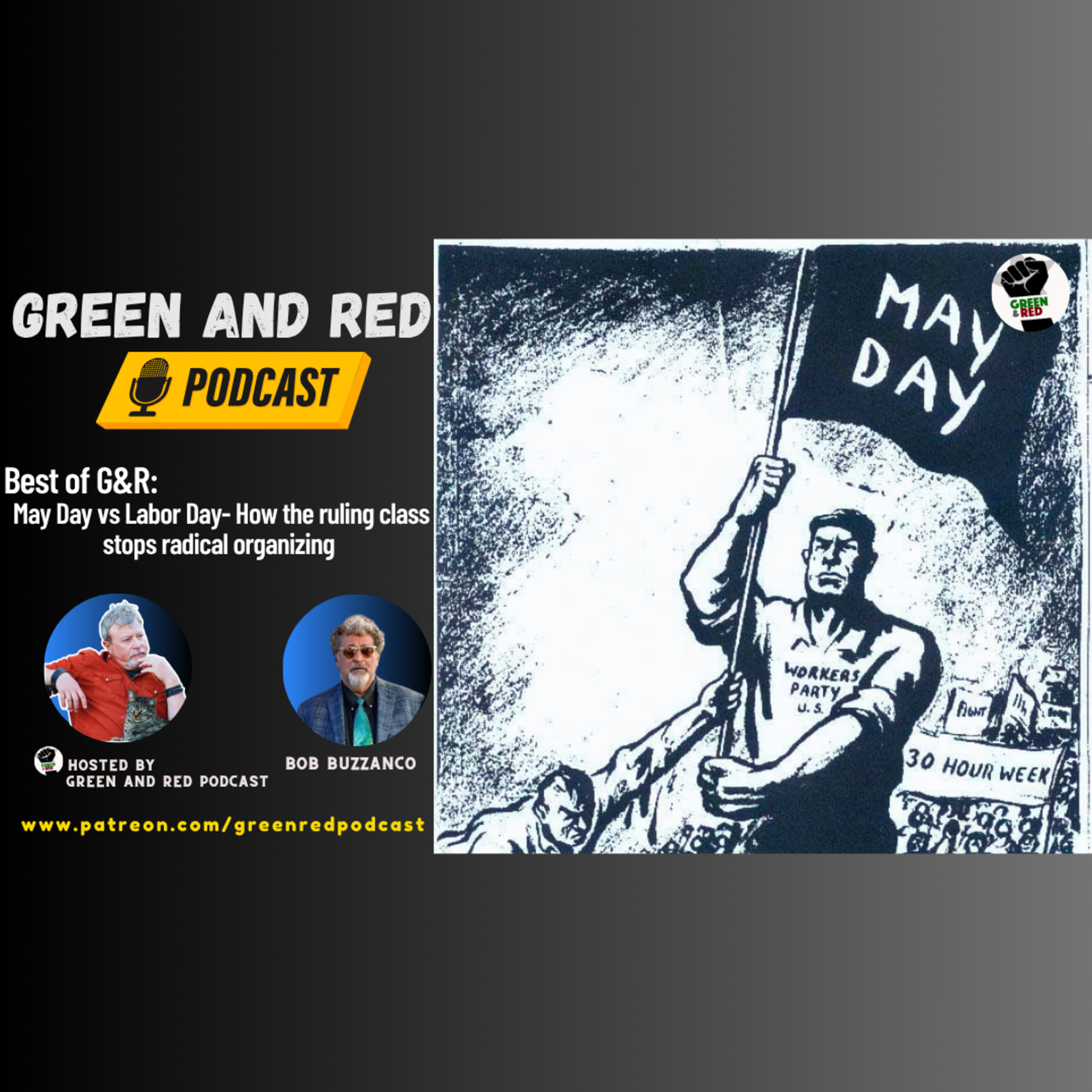
Green & Red: Podcasts for Scrappy Radicals
Best of G&R: May Day vs Labor Day- How the ruling class stops radical organizing (G&R 491)
01:00:36
Loading summary
Transcript96 lines
- [00:00]
A
Welcome to Green and Red Scrappy Politics
- [00:03]
B
for Scrappy People, a regular podcast on radical environmental and anti capitalist politics. Brought to you by Bob Bozanko and Scott Parkins.
- [00:14]
A
Welcome to the silky smooth sounds of the Green and Red podcast. I'm your co host, Scott Parkin in sunny Berkeley, California, on a lovely day known as May Day. And we're excited to be talking to you about Mayday. And as always, I am joined by Bob Bozanko.
- [00:35]
B
I'm in Studio B today and happy Labor Day. And to all of you out there, you know, happy Mayday, Labor Day. And you know, you know what we always say. Thank you, we appreciate it. And please share these and know subscribe on YouTube and we have an email list where you can get all the latest, not just about the podcast, but about things we write and you know, follow us on all the various social media. If you're on like podcasts or Spot, I'm sorry, Apple or Spotify, you can rate and review, which are great because all those things boost up the algorithms and pretty soon we'll be up like, I think we're getting close to a million listeners, so we're almost there. So. And also, you know, last week I mentioned that, you know, we're in talks to create a movie version of Green and Red podcast and it might be
- [01:33]
A
an HBO miniseries that we're in.
- [01:34]
B
Okay. But word on the street and Variety, I read that Coppola is interested in this now and he wants to bring De Niro and Duvall back together again as you and me. So you never know. I mean, I'm gonna talk to Jim Jarmusch next week for kind of the, the film noir version of it, you know, and maybe Adam McKay for the hardcore, you know, kind of political version. So I think, you know, it may be delayed a bit like the many saints of Newark, but I think someday on a TV screen, you're going to see Scott and me, you know, portrayed by some really famous people. And I think we could win Oscars based on what I read about the Oscars the other night, you know, yeah,
- [02:12]
A
it's all just, it's all just a PR campaign and we're really good at that. So.
- [02:16]
B
Yeah.
- [02:18]
A
Also for folks out there. Well, first of all, if you do want to get on our email list, check out, you can find it, the ways to get on it on our website, greenandredpodcast.org, which also has a support button. And if you hit that support button, then you will contribute to this media endeavor, this fantastic media endeavor, which Brings you voices and stories and opinions that you don't hear in other places. So go to greenandredpodcast.org and hit the support button for a one time donation or, or you can become a patron@patreon.com Green and Redpodcast. And we're actually, you know, all joking aside, this is actually a growing group of people, the M19 Brigade. We've actually had two new patrons in the last week and want to thank those folks for joining us and supporting the Green and Red podcast. And with that we can away with our show which is today is May 1, Mayday. And we're going to talk a little bit about the history of Mayday. We're to going, going to talk a little bit about the politics, particularly in the, you know, late 19th century, 20th century, about Mayday. And then we're going to just riff a little bit about the politics of Mayday and how it plays out in politics today. And so with that I'm going to actually let Bob start with a little bit of ancient history of Mayday.
- [03:37]
B
Yeah, this is basically, I love telling this story. So this is basically my excuse to find some kind of nebulous connection to it because it's one that I actually didn't know about myself until long after I became a historian because I don't study this period. But Mayday traditionally is, I think was like a Roman rite to, you know, celebrate the beginning of spring. And it has to do with harvesting and apparently some people call it a fertility rite. So it was always celebrated May Day. And you would create this big pole, you know, put ribbons and sit there and dance around the maypole. And that actually is one of the reasons for one of the big, first big major protest movements in American history. And that occurred in Massachusetts after the Pilgrims arrived. Just a few Years after, in 1625, a guy named Thomas Morton showed up. And Thomas Morton has become one of my favorite historical figures. I call him more playboy than Puritan. Morton began, he was a merchant. He began trading arms and weapons to the Indians and he also began enjoying Indian women, you know, which was forbidden and they were, which alarmed the Puritan leaders because he was being immoral, but also because they were trying to destroy the Indians and take their land, which they would eventually do not much longer in the Pequot Massacre, the Pequot wars, so called Pequot Wars. But Morton and his followers were also very unpuritan in the way they lived their lives. And so he put up the traditional Mayday maypole, which is like an 80 foot tall, phallic figure with festoon, with ribbons and wreaths and attached, you know, kind of as a fertility symbol. And they would dance around it. And the Puritans wrote many days together. They would dance many days together, inviting the Indian women for their consorts, dancing and frisking together like so many fairies or furies. And so these most dismal wretches, the Puritans I think Cawthorn called them, that had created this May Day celebration in this Maypole. And the Puritans hated him because he was rooting this pure society. And so John Winthrop, the governor of Plymouth, had him arrested in 1630 and sent back to England and they burned his house down. So even though that's not the Mayday we're talking about, I think it's a pretty cool story and it's a good example of how the ruling class in America from the. This is in 1630, right? Only 10 years after the Pilgrims arrived, the Puritans arrived in Plymouth. They are, you know, exiling people, burning their houses down for violating these, these codes. And it's not just a moral issue. I mean, this guy was trading with Native Americans, he was making money off of them, he was integrating them into this local market. And so Winthrop and the Puritans would have nothing to do with it. In 1637, Morton wrote a book called the New England Canaan, which denounced the colonial leaders and really admired the Indians, the Native Americans. So he's not quite a North American, De las Casas, you know, who wrote about Columbus who traveled with, you know, the Spanish. But it's kind of cool. And the best part of it, I'll leave it at this, this is just basic excuse for me to talk about Thomas Morton, because I think he's an awesome historical figure, was that at one point he believed that it was difficult to tell who the real wild people were. And he said that in his opinion, it was the Puritans, not the Indians, who were the savages. So if you want to dance around the maypole and have a fertility rights and go for it, and it's a political act, remember that everything is political. The ruling class does not want you dancing and enjoying fertility.
- [07:46]
A
So I feel like the following, you know, four or five hundred years of history has really proven who the real savages of the time were.
- [07:54]
B
Absolutely. And you know, if we really wanted to get into it, there's some stuff going on in England around the same time with like the diggers and the levelers, which is really freaking cool stuff. We should do A show on that sometime because there's this long history, like, you know, the diggers became a, you know, motivation, you know, kind of for the San Francisco crowd. Like the Bay Area left the, you know, the beatniks and stuff. Yeah. And then the levelers are just, like, really cool. They wanted to level society. So anyway, there is this, this maypole, even though it's kind of seen as this pagan ritual, this fertility. Right. Actually did have political meaning. But that's not what we're talking about today, really. We're going into the 1880s when. And the. Well, as you know, it's not Labor Day in the United States, I think, is it the US And Canada who don't celebrate it on this day?
- [08:44]
A
Yeah, pretty much does.
- [08:46]
B
Yeah. Now, in the old days, remember when Eastern European was around, we could have had a green and red Mayday and had like all the tanks and all our armor and armies marching down the street like they did in, you know, the old Soviet Union. Mayday became kind of a holiday to show off, you know, their national military pride.
- [09:03]
A
Trucks with the missiles is what I. Yeah, yeah.
- [09:05]
B
All that kind of stuff. But in reality, in the mayday, even though it's not celebrated in the United States, in many ways it was an American creation from the 1880s. You can give us that lesson. Yep.
- [09:21]
A
So what I'll say, you know, talking about one of our constant themes is the conflict between the rabble and the ruling class is, you know, the 1880s and 1890s were some of the most turbulent political times in U.S. history. And in 1886, Chicago anarchists organized a mass march basically advocating fighting for the eight hour workday. And on May 1, 1886, tens of thousands of unemployed workers marched down the streets of Chicago as part of a nationwide general strike, which is also something you don't see in the US we're seeing that in places like India and Brazil and places where they're fighting some of these very authoritarian governments. But we're not really seeing that happen in the US in a long time.
- [10:16]
B
In 1877, you had seen that there was a national strike in 1877. And that kind of gave impetus to left unions like the Knights of Labor, which was left union obviously in those days. And so Haymarket is kind of a continuation of that. And the ruling class was, you know, not happy with what had happened after the national strike and clearly with the rise of the Knights of Labor, who claimed to have close to a million members.
- [10:46]
A
Right.
- [10:47]
B
And so there's this national movement for an eight hour day there's also a strike going on. I don't want to cut into your thing. I don't know if you were going to mention that, but there's a strike. There was a strike in Chicago at the McCormick Works, which made farm equipment. And they brought scabs in. And it had gotten violent. Right. In late April, early May.
- [11:05]
A
Right. And it resulted in a demonstration on May 4th in Chicago at Haymarket Square, where the police ended up firing on the crowd and killing a number of people. And eight Chicago anarchists were arrested in that. In that melee. I believe some police got killed, but they were arrested for crimes they didn't commit. And four of the eight were hung. One of the martyrs was Albert Parsons, who is the husband of Lucy Parsons, who's actually a noted Texas anarchist. She's from actually East Texas, who is an accomplished anarchist, writer and orator and so on. The history of Mayday, what this leads to is a few Years later, in 1889, the Marxist International Socialist Congress, which met in Paris and had established the Second International, successor to an earlier body which we could talk about someday in the future, called the International Working Men's association, basically declared Mayday a holiday. And part of it was as a tribute to the. To the Haymarket Martyrs. And that's. That's when it, like, that's when it became an official holiday known as International Workers Day.
- [12:44]
B
Well, not in the United States, except
- [12:46]
A
in the United States.
- [12:48]
B
You know, other countries started to. But in the US it was associated obviously with the socialists. So the United States wasn't going to tolerate that. Although among working people there was a radical labor movement in the U.S. you know, I think we've said this before between 1877 and these are kind of arbitrary figures, but not really. 1877 was the year of the National Strike, and 1937 was the year of the little steel strike. And you have a 60 year period there. Is that. Is that 60 years? Yeah, 60 years. No, it's like 37, 50, 37 and 23. No, it's 60, 77 to 37. Anyway, Bob and Scott do math, advanced math, high math. Yeah. I often call that the period of class war because protest and agitation and struggle in the United States doesn't have that kind of clear class character often like you would see in other industrialized countries, Europe and so forth. But in that period, that 60 year period, it's actually this is the period, you know, Haymarket, Homestead, Pullman, Ludlow, Blair Mountain, all the way through Flint and the little steel strikes.
- [14:00]
A
So this is kind of Bloody Harlan? Wasn't that bloody Harlem?
- [14:02]
B
This is the heyday of, you know, often violent, actually, class conflict in the U.S. and, you know, after World War II, you don't really see that because military Keynesianism kind of buy, not necessarily in a bad way, buys off labor and gives them decent wages and things like that. And then, and we can talk about this at the end, then I think identity politics becomes the main character of the left, and they're dealing with issues that are not necessarily class and workplace based. So. And I will offend people when we get to that point. Yeah.
- [14:38]
A
And then one other thing I'll say is that, like I said, the 1880s and 1890s were a very turbulent political period in US history. Very related to radical anarchists, but also very related to very much because of the labor movement. And so in the 1890s was actually in the lead up to the 1896 election, the Congress, and then signed by President Grover Cleveland, actually passed the. What was known as the holiday, the Federal Labor Day holiday, which actually happens in September. There's a couple of different theories around why he passed it, but definitely what was happening in the backdrop to this is that we had, like, the 1894 Pullman strike, when 125,000 workers across 29 railroads walked off the job to protest wage cuts. Right. And so it's also the period of the populists. We're seeing lots of strikes, we're seeing lots of turmoil. And so the theory is that the government was basically trying to quell this political dissent and then also discourage the working class from organizing against their Gilded Age oppressors. There's also thoughts that the idea of Labor Day, of the official Labor Day holiday, that one that's the first Monday of September, came from laborers. Peter McGuire, who is founder of the United Brotherhood of Carpenters and an early AFL American Federation of Labor leader. And then it was also suggested that the central Labor Union in New York actually had a lot to do with the emergence of that. And so there's a couple different theories about it, but it's very clear that part of this was to appease this rowdy labor movement, which was. This is the beginning of what Bob just described.
- [16:46]
B
And it's also a way to create a wedge of cleavage because so many of these major labor agitators in that era weren't native born. This is a period obviously, of great immigration. And so you had a lot of workers coming in, you know, especially early on from, like, Germany who, you know, had this radical tradition later in the 20th century Italians who were heavily, you know, kind of educated in an anarchist tradition. And so, I mean, May Day was a big deal among labor in the late 19th century. There were big ley day celebrations and parties and I don't know if they put up a maypole and danced with the Pequot or anything like that, but it was actually a big deal. And so the other thing that was very clever actually was by saying, well, that's a European holiday, that's a foreign holiday. And you create this wedge between American workers and these native born workers and they were called terrorists. That's not a new term by any means. You see that term used like at Haymarket in 1877, these foreign born terrorists and so on. And so America has its own Labor Day. We're not like those crazy immigrants and those dirty anarchist immigrants, you know, and I mean Bolsheviks, Bolsheviks, Bolsheviks. And that plays into things even as into, you know, like the 1920s with Sacco and Vanzetti, you know, that idea that, you know, white workers were turned against Sacco and Vanzetti because they were Italian anarchists. So this is also really important. And we're seeing this now. I mean, we just did a couple shows on the Amazon strike, right, where you saw kind of cleavages emerge based on non class related factors, you know, whether it be, you know, age and seniority or, you know, and Black Lives Matter came in and was kind of trying to take a role in that. And you know, and it was a disaster. The union just got thrashed. So. But yeah, it's also a way to kind of create this kind of uniquely American holiday and to kind of prize American culture over these Europeans who were coming in out of a guild tradition, out of a tradition of anarchy. It was a way to say the Wobb were unamerican. And this is the same time, remember when the government's going after Wobblies, they're, they're, you know, getting them the rest, that they're killing people like Frank Little and Joe Hill. So it has clear political meaning. Yeah.
- [19:07]
A
And it should be noted that in the, in the legislation that they actually passed is that they were creating this federal holiday, this federal Labor Day, as a tribute to the greatest America, the greatest worker in the world, the American worker.
- [19:20]
B
Yeah, right.
- [19:22]
A
And you know, it's very much like wrapping it in the flag and very much looking to divide, to divide workers against each other, native born versus immigrant, etc.
- [19:32]
B
Yeah, absolutely.
- [19:33]
A
Which is, you know, that is 20, 21 still happens.
- [19:38]
B
Oh yeah. Build that wall.
- [19:41]
A
Build that wall. And, and so moving. Moving forward a little bit. Fast forwarding. In the 1920s, Labor Day became, or May 1 became known as Americanization Day. They continued to try and put a
- [20:01]
B
wedge
- [20:04]
A
in the heart of this more radical labor movement. And so they officially called May 1st Americanization Day, which was a holiday of forced patriotism conceived after the 1976. Excuse me, 1976, 1917, still on the Jimmy Carter kick. 1917, Bolshevik Revolution in Russia. And also dealing with the renewed current of militancy within the American labor movement, like towards the end of World War I, in the late teens and early 20s was when we saw this, a period known as, I believe it was the first Red Scare, where the government, the Department of Justice, the Bureau of Investigation, which later became the Federal Bureau of Investigation, all emerged going after Wobblies, going after radical anarchists, going after radical immigrants, after people who agreed with Lenin and Trotsky and the Bolshevik Revolution. And Americanization Day existed from, you know, continued and, you know, it was known as that from 1921 to 1958, when we get into the McCarthy period, remember
- [21:16]
B
last year we talked to Cal Winslow, There was a general strike in Seattle, a huge general starting in Seattle in 1919. The Bolshevik Revolution was actually looked at as kind of a model. Like, you know, they were very favorable and didn't. Like a Russian ship came in and they were fetid with banquet and vodka and all kinds of stuff like that. So, yeah, that even though it wasn't official, there were certainly significant pockets of labor that continued to celebrate May 1st and to continue to have that radical tradition. And you'll see that when the CIO gets created later, it's going to have significant communist influence. Best organizers were the communists and people on the left and who eventually had to be kind of, you know, removed. So, yeah, there is that. I mean, I think, and we've talked about this before, I do think Americans have a habit. Americans on the left have a habit of romanticizing a lot of this stuff. You know, like every time five people got together and, you know, had a rally, it became like class struggle. And, you know, the reality is the ruling class crushed these movements. But, you know, there was a kind of a widespread and vigorous resistance all over urban areas, places like Haymarket and Pullman and the farmers, the populists, who could be quite radical, coal miners in West Virginia, which was the site of the biggest labor conflict in U.S. history. It was at the time, I think, the second biggest conflict. Right after World War I or something like that. 3,000 army troops.
- [22:53]
A
Yeah, it's the second largest armed insurrection in US History after the Civil War, after the Confederacy.
- [22:59]
B
Yeah, we'll have to see how the Capitol riots stack up to that.
- [23:04]
A
Yeah, exactly.
- [23:06]
B
But it Blair them out there. It was the good guys who were rebelling, so. But yeah, no, there was, I mean, there's this long, like I call it, you know, like I call it the class wars era. For 60 years you had, you know, hardcore resistance. You know, they were like, I mean, what was the Honea massacre? I mean, I could go on and on and on and on, but this stuff is occurring all over the country in industrial areas and agricultural areas. You have ethnic groups like the Italians in the 1920s who are, I mean, Palmer. That's one of the main targets of the Palmer raids. These Italians who are, I mean, these people are arrested, no charges filed, no legal proceedings, and they're just deported or jailed. You know, that's where the first killed. Yeah, and the anarchists are where the phrase no gods, no masters came from. We should have worn our like Mayday appropriate shirts today. I didn't think of that. All right, all right, all right. So. Well, I have my get in, loser, we're seizing the means of production shirt up there, which is covering up a cabinet that has cleaning products in it. So
- [24:15]
A
in 1955, which was at the peak of the anti communist Red scare led by the junior senator from Wisconsin, Ron Johnson. Ron Johnson, I'm sure he's praised to a picture of this person every night.
- [24:34]
B
I actually think the GOP, I think McCarthy might have been embarrassed by Ron Johnson.
- [24:39]
A
Yeah, that's true, but it's very true. But it's the Red Scare that's helmed by. Joseph McCarthy passes a resolution deeming Mayday, Mayday, May 1 as Loyalty Day, which was, you know, to counter the impact of May Day rallies going on around the globe. You know, when we talk about the troops and tanks and missiles and things like that through Red Square and that sort of thing. And it became an actually an official holiday, which means that Eisenhower signed it in 1958 and that's Americanization Day from 1921 to 1958. And then 1958, it becomes loyalty Day. But like Bob was saying, the purpose of Americanization Day and Loyalty Day and even that Federal Labor Day holiday is that the US government had an interest in quashing dissent and cracking down on radical political organizers. And so also when we talk about the various Red scares and there's a number of them, everyone's familiar with the McCarthyite red scare, but there were you know, they go back to the, to the early 20s. We talk about the Palmer Raids, and then kind of post McCarthy era, we see things like COINTELPRO, which we've actually also had shows on where they targeted the New left and the Black Panthers, et cetera. And the purpose is to clamp down on radical dissent, on radical organizing. And that's sort of the message here is that, like, the government and the ruling class are really happy when we have some dissent, but when it gets too radical and they want to move things too far to the left, when it becomes too big, when it becomes undermining of their authority and their power, then they look for ways to quash it. And so we've seen 20 something million people on the streets since the murder of George Floyd. Everything from mutual aid groups to backcountry campaigns against pipelines, to large numbers of people in the street, either against Trump or against the police. Make no mistake, even though they are very clearly going after the right and the people behind the Capitol riots, they're also looking pretty hard at people on the left also.
- [26:52]
B
And another theme we brought up is, and I think people have to understand there's clearly a history of violent repression in the United States, but it's actually pretty, I don't want to say minimal, but it's definitely not as significant as it is in many other places, because the ruling class has countless strategies, so it will send people. We saw that last summer. Right. And I think that's why the ruling class turned on Trump, because it became very destabilizing when violence became kind of the main and first resort, actually, in many of these regards. But something like Mayday is a great example of kind of a non violent approach to containing. When I talk about the Cold War, you're familiar with the policy of containment, which was Kennan's idea about containing the Soviet Union, not letting Communism extend beyond Eastern Europe. But there's containment at home, too. And that containment at home is actually about democracy, because after World War II, you have significant groups, African Americans, probably the best example, but labor as well, who want to extend the American conception of democracy. Women, you know, all these other groups,
- [27:55]
A
women's movements, women's movements.
- [27:56]
B
And so generally that's not done via violence and force. It's done via these kind of more what Gramsci would say, cultural means. Right. And so Labor Day is a key component of that by saying, we're gonna give you your own holiday and we appreciate you, we respect you, we'll honor your work, you're a vital part of American society. But you're not like those May 1st, Labor Day people. Right. And to be fair, I mean, the Eastern Europeans, the Soviet Union, the communist countries, kind of used it for their own purposes, too. I mean, Labor Day, May Day, was not intended to be a show of military force where everybody's in Red Square or wherever, which is, I think, actually a desecration of the original purpose of it as well. But at the same time, I don't want to go off on a huge rant, but there's a difference between the way workers are handled and these socialist or communist countries. And in the United States, to their, you know, there's social welfare programs and things like that. So Labor Day, I would argue, and you know, this is the kind of thing that gets me in trouble with my colleagues is like, I would actually Labor Day, May Day is more genuine, you know, in those socialist places than it is, you know, like, in the United States.
- [29:08]
A
So, I mean, the September federal Labor Day holiday is essentially about beaches and barbecues.
- [29:15]
B
It's about shopping. Yeah. And, yeah. Going to the beach one last time. And. Yeah. It gets commodified. Absolutely. Like most labor things are.
- [29:24]
A
And, you know, it was a different commodification strategy, but, like, even today, like to watch Hulu, right? There's, like, Hulu commercials about supporting, you know, Black Lives Matter movements.
- [29:36]
B
Right.
- [29:36]
A
Which is like, sign up for the Hulu mailing list so you can learn how to, you know, help do things on, you know, on these matters of racial justice, et cetera. And it's the, you know, it's just the 2021 version of the cultural commodification. And this also. Actually, this also brings another point that we wanted to talk about today. Is that another strategy that the ruling class and the liberal class actually have against the left? Because what we're talking about here is just this constant war against the left, against radical organizing, against radical politics, is we also have liberal intellectuals and liberal historians, which also work to undermine even the history of those original Chicago Mayday anarchists. And so what I'm talking about here is there's actually a liberal labor historian, I believe, from the University of Rhode island, who actually tweets quite a bit and blogs and writes quite a bit about how, you know, the anarchists of the 1880s actually destroyed the Knights of Labor. You know, things like that. His name's Eric Loomis. And it's also. It's another strategy, which is they have this liberal intellectual group of people which also just, like, constantly works to, like, hammer on That I don't know. I'm sure you have some thoughts on this, Bob.
- [30:54]
B
Well, yeah, I mean I actually began my historical training as a labor historian at Ohio State with the great Warren Van Tyne. He's a great guy. And so I actually know a little bit about labor history. As my critics would say damn little. But yeah, and there are significant people like Loomis and a good friend of mine, he teaches at Collin College. In fact, Chad Pearson has written extensively as a really good labor historian and he talks about this and I'm on this email list with mostly labor historians where he'll often kind of put this stuff out there. And that's how I found about the Loomis tweet where he just attacked the Wobblies and the anarchists and he attacked Emma Goldman. And there are significant. And the point here is that, you know, you do have radical historians. Absolutely. But you do have this like important cadre of liberal historians who praise like this kind of, you know, the business unionism. I'm being a professor here for a minute, so humor me. In the United States there was a significant element of radicalism in the labor movement. Like the Pullman strike was led by Eugene Debs, who would later be a socialist candidate for president American Railway Union. So you had significant radical elements and significant pockets of radicalism in the labor movement. But then the dominant labor movement beginning in the later 19th and 20th century would be the American Federation of Labor led by Samuel Gompers, which believed in business unionism or unionism, pure and simple, which meant you want higher wages, you want better working conditions, you negotiate that you have a group like the Wobblies which is about resistance at the point of production direct. I think people don't realize during the Alabama union drive recently you don't need to be in a union to go on strike. In fact, it's not uncommon in this era to have a strike in order to get a union. Non unionized people would go on strike in order to have a union recognized. And one of the key things you do when you do get a union, you sign a union contract. And remember Stott Lynn talked about this in like the second show we ever did was essentially you forego your strike, your right to go on strike. So this is one of the things about American labor is not have a radical labor tradition. Right. And until, you know, I guess what like Thatcher, you did see that in things like the British labor movement. And you know, even in France you have, you know, huge numbers of people going out in the streets. The Yellow vest and things like that. You don't really have that in the United States. Last year we had this massive kind of spontaneous uprising, but it wasn't per se about labor issues. Although Covid had a huge part to play in that. Although the economic problem with COVID But getting back to the original point, yeah, you have a significant cadre of these kind of liberal or mainstream historians who are kind of favorably inclined toward labor, but they believe in this kind of AFL kind of liberal notion of labor. You should have unions, they should be recognized. They should be able to negotiate collectively, bargain. But don't go too far. Don't be like the Wobblies, don't be like Emma Goldman, don't be like Debs, don't be like Sakhon Vanzetti. Because the idea there, which you've heard way more than me, is you're hurting the cause. Right? Like America, there's this idea that American public opinion is just waiting there. It's like the defund the police movement, Right? Well, defund the police is turning people off. They don't say anything about the fact that the police are killing multiple people and beating multiple people every day. The focus becomes defund the police. And in that regard, rather than focus on the way that bosses are using these countless strategies, sometimes violent, but more often than not, they go to court, they can use their economic power, they have the media behind them, they can divide workers based on things like ethnic origins. Instead of talking about that, they'll focus on the anarchist, Haymarket. The prelude to Haymarket was this McCormick strike where the National Guard and private militias killed workers, killed strikers. And so Loomis could have said, well, that's the problem. It wasn't the anarchist, it was the fact that McCormick had these goons killing people. And in the same way as today, you could say, well, the problem is that the police keep beating up 73 year old women with dementia and giving a brain bleed to a 75 year old guy and shooting a guy in the back or shooting a 13 year old kid after he dropped a gun or putting your knee on somebody in California, you know, I'd go on and on.
- [35:29]
A
Or Minneapolis.
- [35:30]
B
Yeah, no, well, it just happened in California too.
- [35:33]
A
Oh no, it happened here.
- [35:34]
B
Yeah, yeah, yeah. I mean there's that, you know, they, you know, got hit of a lost consciousness after six minutes, you know, so. And he was what? Public drunkenness, I think or something like that. Right. So you have the extrajudicial killings, but instead of focusing that, you know, liberals don't focus on the police, they focus on the defund, the police movement. And in the same way, you see a lot of that, which is one reason the American labor movement is. Is really, you know, kind of docile compared to what it had been, you know. And it purged those left elements, the cio, for instance, by part of the compact of World War II. Because labor did very well during World War II. They got all these contracts. Well, during the war, they said, we're not going to ask for pay raises stuff. By 1944, there were major strikes, and then you had Taft Hartley. But at the same time, in the 1950s, American workers, that was their heyday, they were paid well. They got enough money, they could buy a house, they could go on vacation, they could send their kids to college. So that was a compact. But the other part of that is getting rid of, like the communist organizers and the CIO and getting rid of elements that might kind of come out of that May 1st tradition rather than that first weekend in September, let's go to the beach and buy stuff at the mall tradition. Yeah.
- [36:48]
A
One thing, and one thing I want to say.
- [36:50]
B
Loomis is a nitwit. Anyway. He compares himself to. People say I'm a Philip Marlowe character. Like, no offense, but if you have to do that to yourself, you're a tool. You know, people say I'm a Tony Soprano character.
- [37:07]
A
Real quick on that, folks. That's on Eric Loomis Twitter bio is how he compares himself to Philip Marlowe.
- [37:12]
B
Just.
- [37:12]
A
That's what we're talking about. Just so you know, because we don't want to put his Twitter account on our show notes because we don't want to elevate the nitwit. But just does you know what we're talking about? One real quick thing too, about, like, this is some of the stuff that we touched on in some of the earlier shows early in our history is this sort of like there's this formula for corporate liberalism. And some of it is this docile labor movement. And. And so people like Eric Loomis when they are, you know, trying to disparage on Emma Goldman or Alexander Berkman or the, you know, the Haymarket Martyrs, is they're actually doing the bidding of the ruling class there. They are undermining. And it's a. It's. It's very much, you know, whatever you feel about Joe Biden and the Democrats, et cetera. This is actually. The Democrats don't like people in the streets. They probably like people in the streets less than the Republicans. And so people like Eric Loomis are doing everything they can to communicate to whatever audience they have is like being in the streets actually is bad. Right? You help destroy the Knights of Labor. We just need to kind of play this kind of bigger three dimensional chess with the, with the ruling class, because we're actually accepted into it. And C. Wright Miltz actually wrote about some of the, like the big labor leaders, et cetera, the union bosses being like they're, they're part of the formula.
- [38:31]
B
Well, I mean, just last year, Hoffa, Trumka and Weingarten were all on Trump's reopening committee for Covid. So, yeah, there, there are, and there are pockets of very radical labor. And that's why we like talking to Mike Elk, who, who covers all of this stuff. We had Joe Allen on last year. So there have been, you know, there have been offshoots, like the teams are a democratic union. So you have, even within unions, you have these, these elements. But you know, the important issue here is how the ruling class, all these countless strategies that are not always violent. I mean, violence in the United States is probably less than in many places, you know, because it doesn't need it and has these kind of cultural ways to do that. And it has, you know, intellectuals are important. I mean, look at the people, you know, you see, who are the kind of experts on, on CNN or on these TV shows or in the newspapers. You know, I used to, in the old days, I used to do a lot more media. And I remember I got called once by the McNeil lair or the subsequent thing to talk, and they kind of did like a mini interview ahead of time. And I knew I wasn't going to be on because I didn't tell them what they wanted to hear. And then of course, Michael Beschloss was on that night, who's a blockhead, you
- [39:45]
A
know, a liberal blockhead at that.
- [39:47]
B
Liberal blockhead. And that's what they want. They want liberal blockheads. So Loomis is great, right? People who will go in there and say, you know, you know, it's the anarchist fault, you know, it's not the police fault that they raided this peaceful rally and, you know, attack people. It's not the police fault that they beat people up on the line on the, you know, it's not the police's fault that they're favoring private businesses and protecting scabs. Right. Lake Homestead was violent. The union opened fire and killed a bunch of scabs on Pinkertons on barges and basically even More than violence, what happened at Homestead was that the courts intervened. They said they put injunctions into place where you couldn't strike, where you had to protect these scavs from coming in. And then they created a blacklist in the steel industry. So anybody who participated in the union at Homestead never worked again in the industry. And that's still true. I mean, I know people in Ohio who went on strike and when those mills shut down, had a hell of a time finding another job because they were known as union agitators. And this is in like the 20th century, you know, late 20th century. So, I mean, it's just important to remember this tradition of. And it speaks to so many other things. It's bigger, I think, than a labor issue. It talks about just kind of the way the left in the United States is designed and created. You know, a couple weeks ago, when, I mean, Maxine Waters, I'm not a fan, let's just leave it at that. You know, she's never really done anything. And she goes to Minnesota and says, you know, we need to get into the streets. And you know, she almost, it's almost like it's her version of burn, baby, burn. Right? Which is a stupid freaking thing to say because do you know, I mean, as a, as a person who's been in the streets way more than I have, do you give a rat's ass what Maxine Waters says? Do people in the streets even know who she is? Right. But it gives the right this ammunition, you know, because she's just like this loudmouth agitator in their version of the story.
- [41:52]
A
And so I'm sure repeated on Fox News.
- [41:55]
B
Oh, it was all over the place.
- [41:56]
A
24 hours.
- [41:57]
B
It was all over the place. Yeah, Non stop. They want her to resign, all this kind of, of stuff. But for the most part, people in the streets kind of do their own thing and they're, and they're smarter than that. But, you know, that's kind of the same issues that are, that are, you know, come out of Mayday. Right. You know, how are you supposed to protest who's, who is a legitimate dissenter and who isn't? And the state gets to decide all that. You know, like you're not legit, but the, you know, the people holding banners who get a permit to hold a banner at the street corner are, or,
- [42:30]
A
or, or Whole Foods, who, who drops the banner over their entrance?
- [42:34]
B
Yeah.
- [42:35]
A
I mean, and just to be really clear what we're, and this is, you know, something that we've been talking about a lot lately. Is like in many ways, corporate America is to the left of some of these, like, left institutions. And, and it's including, including like, you know, huge parts of the labor movement. And so it's, it's just like a thing to note. And so if we're to the right of Coca Cola and Delta and Whole Foods, which is owned by Amazon, then we need to reassess our position on the spectrum.
- [43:11]
B
Well, I think the very first, not
- [43:13]
A
you and I, I think we're a pretty good bot, but other entities out
- [43:17]
B
there, which I've gone through a rigorous self criticism. Kim Bao, the Vietnamese called it. And I, yeah, I think I'm, I am now theoretically flawless. So. But no, I think in the very,
- [43:29]
A
you know, people remark that to me
- [43:31]
B
often about you, I'm theoretically flawless. Thanks. I work hard at it, you know, and the humility is a big part of that. The first show we ever did, when we introduced the podcast, I think we specifically brought up the Georgia voting issue. This is in early February 20, 2020. Again, showing how prescient we are. We are like so far ahead of the loop on all these issues, you know, but at the time, I think
- [43:55]
A
it's why we're in the top 10% of all podcasts.
- [43:58]
B
Right. And that's why Coppola is talking to
- [44:00]
A
us about a film Joe Rogan should watch the fuck out.
- [44:04]
B
That's right. We're coming after. And Pod Save America too. We're coming after both of you. No, but I remember at the time we were talking about like, Stacey Abrams. I'm not going to criticize her at all. She's, she's done really fantastic, great stuff. I mean, she flipped Georgia, which is really quite a feat. But at the same time, that's been done. That's a political movement and she's a politician, wants to be governor, which is fine, but that's been done, absent any kind of real street action, direct action, protest, sit ins and what we recently saw and we did a show on it, I think is a really good example of that. Everybody knew. I mean, the GOP in Georgia has been suppressing votes for a long time. The fact that they could not win the election for Trump speaks volumes about the fact that Trump lost. Because if Georgia can't steal an election, nobody can. And so they're undergoing these really brutal new voter voting laws. The worst of which, which the media isn't covering, which to me I think is the most terrifying, is that they would give the state legislature power over the elections commissions to certify elections so, you know, a Republican could lose 70 to 30 and the state legislature could, you know, designate that person as the winner. And that's been done absent, you know, any kind of really street action. You know, they could have been barricading, you know, areas going into the state House. They could have been occupying the offices of Raffensperger, the Secretary of state of Republican legislatures. They did a little bit of Delta air lunch, but they could have gone heavy going after like Coca Cola and Delta and you know, the Atlanta Braves and things like that.
- [45:47]
A
A 10,000 person march to the streets of Atlanta would have had a huge impact. Even permitted, it would have had a huge impact.
- [45:55]
B
And people love to use the civil rights movement as a framework. I mean, Martin Luther King wasn't signing move on petitions. They were violating the line, getting arrested every time they went out. And so, you know, absent that kind. And there's a real fear there that we don't want to be perceived as being too radical. And intellectuals like Loomis, we know, we mentioned Michael Beschloss, Roy Teixeira and the center for American Progress. You know, Neera Tanden, crowd, Thomas Burns, Adsol. You just read the op ed page of any paper, you know, and these
- [46:28]
A
are the intellectual wings of the Rahm Emanuels of the world. Just to put that out there, who's part of the big problem? Big problem.
- [46:35]
B
What's funny is I used to get way more media increase back. I mean, there's kind of a renaissance resistance today. But I used to go on TV way more in the old days. I mean, I was not too long ago, I was on TV and talking about North Korea when Trump was saber rattling. What was funny is they were doing a call in poll. Do you think the United States and North Korea are going to go to war or should go to war or whatever? And I kind of was proud of myself because after my interview, the majority of people in Houston, Texas said, no, North Korea is not a threat. We have these majorities. And if I was looking at some polling today about Biden, who and may I point this out, and I'm not a Joe Biden fan, but absent Medicare for all, which is a huge issue, what you're looking at right now is essentially a Bernie Sanders presidency. And I'm not saying that to praise Biden, I'm saying that to say that that furor that Jacobin induced obsession and hysteria to the extent of everything else about Bernie Sanders, really, I think we see now, and you and I had talked about it while they were doing it, was really just a huge diversion of resources and time and energy from things like street action. Right. But, you know, labor. We've done some shows on this. The Collin College professors who've been fired. Right. Just on a whim. And so the spirit of Mayday and the spirit of Haymarket is still very much alive. And we've shifted away from that idea on the left of class struggle. And now this is where I get trouble. You don't have to. We don't have to go in this direction. It's like, I think it's been replaced by this new focus on, like, identity and, you know, Twitter wars and going after somebody for writing a tweet when she was 17 years old and using that against her later in life. And I don't know, like, James Carville, not one of my favorite people, wrote an article the other day which I thought was actually pretty much spot on about wokeness. And we've talked a lot about that. Like, woke capitalism is a real thing. And the problem with that. And we kind of, you know, people always accuse me of being pro corporate. And my point is that, you know, absent a real resistance that, you know, they're doing an important job. I mean, somebody had to step up and make say to Trump, you're not going to be president anymore. And it was Wall street because they called all those protests off on November 4th. And somebody had this go to the state of Georgia to say, there will be consequences if you, if you do this. And it was Delta and American and United and Citibank and all these other, you know, companies.
- [49:19]
A
And. And now we're seeing stories about how, you know, there are regular zoom calls with, you know, corporate leaders about how they are. I mean, they're kind of framing as like, we're going to cut off money to both parties. But the real money spigot that's being cut off is to the Republicans and to the far right, craziest.
- [49:38]
B
You know, by all accounts, they're serious, because I figured by now they'd be back to their old ways, but they are still pushing this. I mean, Trump really was like the golden gift to people who blew it. They spent four years shrieking in terror, Trump is a fascist. There's going to be a coup. You know, they were on the Paul dead end street. And the reality is that, you know, these people in the ruling class and that was what you and I were telling people. Chill out. It's going to be okay. You know, if you're gonna fucking have a coup, you better have the military and Wall street and the corporate elite behind you, and those were Trump's biggest enemies, you know, and unfortunately, I mean, I'm not gonna, you know, like, I'm glad they're there. I'm glad they're doing it, because absent street action, you know, street resistance or the Democratic Party. Right. That's kind of what we're getting. And in Georgia, you know, in the spirit of Mayday, I really wish people would have gotten, like, really, you know, out there and agitated, you know.
- [50:40]
A
Yeah. I just want to say this one thing is that organizing in communities is happening. Like radical organizing in communities is happening. And after George Floyd, after the shooting in Kenosha and then after Kyle Rittenhouse shooting two protesters in Kenosha, I mean, we saw, we saw a real left moment, like 25 million people in the streets, the NBA teams striking things of that nature. And what the intervention was from the ruling class was Obama convincing NBA players to not strike. It was the nonprofit industrial complex, which is in some ways just the arm of, of the Democrats and the ruling class, basically putting a lid on what was potentially going to be a lot more street actions in November. What the Democrats and the ruling class didn't want was November post election to look like June. And that's what they work towards. And so when all of those nonprofit organizations, labor unions, these milquetoast labor unions were all part of the, you know, let's respond. If Trump stages a coup, which now we know is a little bit. It was just like a little. It was smoke and mirrors. And so they, they work to shut that down. Like there's legit street action happening. You know, when, when tens of thousands of people are in the streets of Louisville, Kentucky, after the murder of Breonna Taylor, going after the Louisville police, right. People getting charged with felonies, state legislatures, who are Democrats, legislators get. Who are Democrats in Kentucky getting charged with felonies. Like that, that sort of thing was like, that's pretty important. You know, the, the sort of conflict that it was like, you know, this non lethal conflict going on at the streets of Portland all the second half of last year, like, really important stuff. And the Democrats and who are, you know, a mouthpiece of the ruling class, shut that shit down.
- [52:40]
B
Yeah. And that's what I, and I don't
- [52:43]
A
want to disparage organizers because I think this is just a lesson for organizers to take as we build, as we continue to organize and build our movements. This is like you, if not lost, this is actually a sign of you winning, but you just need to be A little bit more aware of who your opponent is. It's not necessarily Trump.
- [52:59]
B
Yeah. And I think there's a huge difference too between let's say the FL CIO or the United Mine Workers president and Helen Yost and Diane Wilson and Brian Paris and who are doing just amazing stuff. I mean, yeah, the ruling class would much rather have you studying Robin d' Angelo or Ibram Kendi or Michael Eric Dyson, then Cornel west or looking at the Black Agenda Report website or something like that. So they have this facility. And I think anybody in academia who's been on the left has felt this. I know you don't have the same academic credibility, you don't have the same intellectual credibility. So the media would much rather talk to Michael Beschloss or Robert Dallek or Doris Kearns Goodwin, who is my particular bete noir, you know, rather than people who. And I mean, we've talked at length about this too. That's one of our beefs about the New York left. Right. They have their own cadre of in house intellectuals who they privilege and most of whom come from a fairly small radius of Brooklyn. And so there are people, I mean, there are people in community colleges all over the country who are doing amazing work and nobody ever hears about them, nobody knows about them, you know, and, and they write stuff and they say stuff and like six months later somebody from New York or writer say the exact same thing and be, be acclaimed as some kind of hero or genius when in fact it's out there. So there is clearly, I mean, long winded point to what you said. Is there, there, there are people out there doing really good stuff who are doing really radical stuff. And you know, I was struck the other day, Carville wrote a piece of, you know, about, you know, kind of the problems of woke politics. And you know, I have to say I agree, but pretty much all of it, you know, or most of it, because there is this tendency, I love this phrase, faculty lounge politics, where this has seeped into the left to a fairly significant degree, where they're having, you know, these large debates over, you know, pronouns and language and, you know, the prioritizing certain issues over the other. I'm not taking a position on any of these particular things, but like, my only point would be like, let's say J.K. rowling. I'm not defending her at all. But the point is, you know, J.K. rowling is not on the list of the really important things I think that are out there. The problems that we have out there I mean, she's not the big. If she were the biggest enemy we had or the biggest problem we had, we'd be, we'd be, we'd won the lottery, you know. And so I think a lot of people focus on that or they get hung up like, you know, I think, you know, Carville had a point. People talk about communities of color, which sounds like kind of a hoity toity phrase instead of like he's like, they're neighborhoods. Right. I mean, I've said many times, you know, come to Youngstown with me and go into working class area and tell these people they have white privilege, you know, because white privilege implies everybody, you know, has this. And they get very upset over phrases like that. And you know, Trump's people, there's clearly a racist element. Absolutely. You can't deny that. But a big part of that is this anti elitism and that's part of the ruling class's plan. Instead of Mayday, we have Labor Day is, I think it's a continuation of that. But stuff's going on. The Amazon strike didn't turn out well, but you have the strike now, the coal strike in Alabama, which is the union bosses negotiated settlement and the rank and file turned it down. So that's going to be on. You know, you did have, I think, you know, some labor action in getting the all star game moved from Georgia, which I think was useful. So, you know, but, but historically I think it's important to understand why some people on the left talk about Mayday. It's more than a pagan holiday, or if you're Catholic, it's actually the month of the blessed Mother Mary. You know, Mayday, as if you're Catholic is celebrating. It's more than that. It's actually a holiday to celebrate radical labor resistance. And it's created out of a time when anarchists and socialists really were important in the labor movement. And class struggle was a real thing. Violent class struggle was a real thing. And it wasn't just one sided from the top down. So, you know, if you're, you know, thank those guys and women from Blair Mountain and from Ludlow and from Bisbee and all those other places. Bloody Harlan, Bloody Harlan and Pullman and
- [57:36]
A
Homestead, which our closing outro today is going to be a little tune from Bloody Harlan, Florence Reese, which side are you on? Yeah. And you know, today is May Day. Today is probably a lot, you know, there's probably a lot of people there. There are a lot of people in the streets today, whether they're for migrant rights or labor or any capitalist. And so we also want to just pay tribute to those folks because, you know, there's some places where I'm sure the Mayday parade is going to get violent because the police don't like people in the streets. But you've been listening to the Green and red podcast and talking about Mayday and the politics of Mayday. This was a really important and good conversation we just had. And if you want to continue to learn more about the green and red podcast, check us out on Facebook, Instagram and Twitter. You can watch this episode and many other episodes on YouTube and just hit that subscribe button to help us out and then donate to us on our website gunnarray podcast and hit that support button or become a patron at green@patreon.com greenradpodcast and so here is the original which side are you on? By Florence Reese.
- [58:53]
B
Happy mayday to everybody and hasta la Victoria siempre.
- [58:58]
A
Happy mayday, comrades.
- [59:00]
C
Come all you poor workers good and YouTube you I'll tell how the good old union has come in here to dwell. Which side are you on? Which side are you on? We're starting our good battle we know we're sure to win because we've got the gun thugs looking very thin. Which side are you on? Which side are you on? If you go to Harlan county, there is no neutral there. You'll either be a union man or a thug for J.H. blair. Which side are you on? Which side are you on? They say they have to guard us to educate their child. Their children live in luxury Children almost wild. Which side are you on? Which side are you on? Gentlemen, can you stand it? Oh, tell me how you can. Will you be a gun thug or will you be a man? Which side are you on? Which side are you on? My daddy was a miner Memories now in the air and sun he'll be with you fellow workers till every battle's won. Which side are you on? Which side are you on?