← Green & Red: Podcasts for Scrappy Radicals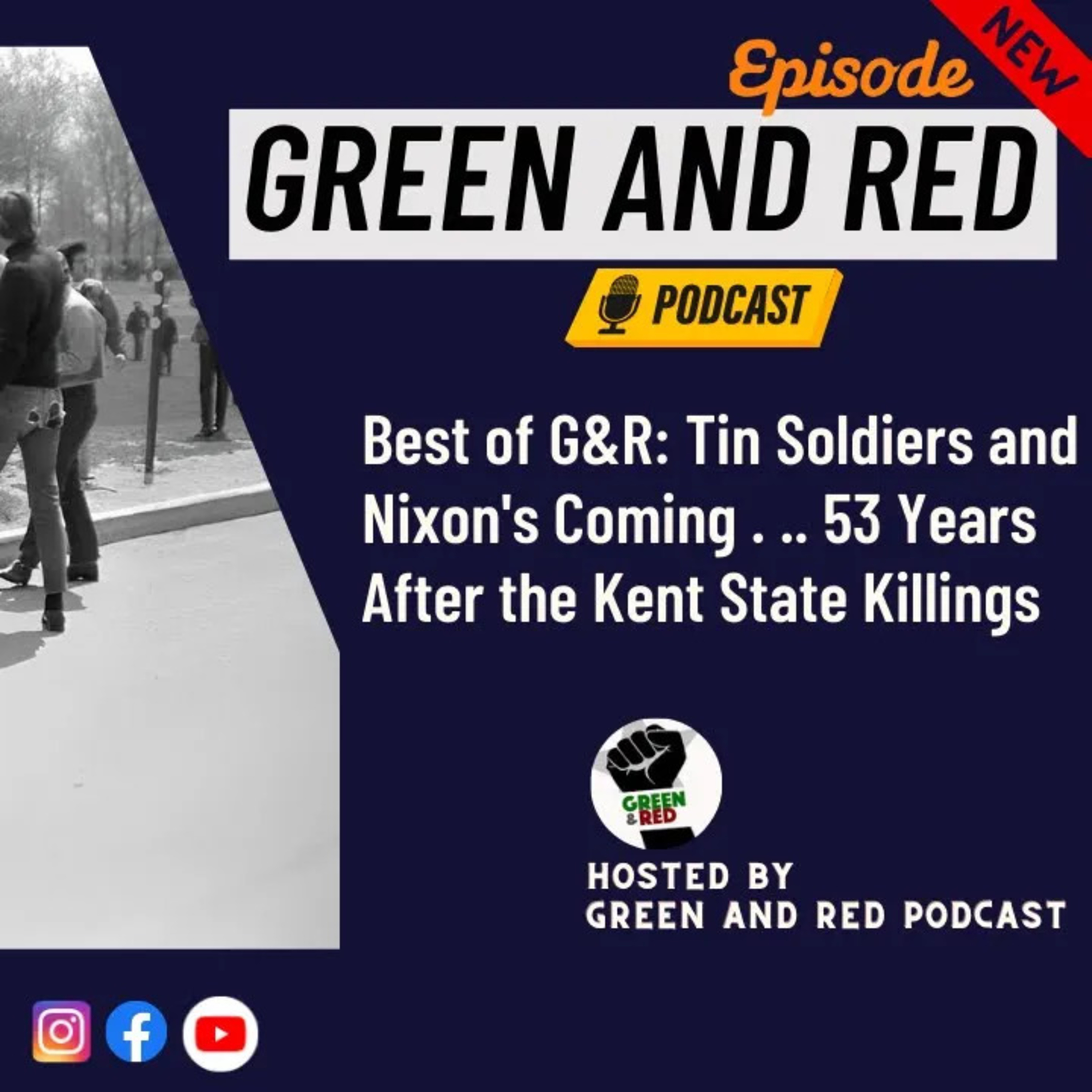
Green & Red: Podcasts for Scrappy Radicals
Best of G&R: Tin Soldiers and Nixon's Coming . . . 56 Years After the Kent State Killings (G&R 492)
00:57:24
Loading summary
Transcript82 lines
- [00:02]
A
Welcome to Green and Red Scrappy Politics for Scrappy People, a regular podcast on radical environmental and anti capitalist politics. Brought to you by Bob Bozanko and Scott Parkins.
- [00:16]
B
Hello tried and true listeners. This is Scott Parkin, your co host of Green and Red podcast. And today we have a very special episode. Today is the 50th anniversary of Kent State in Kent, Ohio, where four students at the Nani war protests were killed by the Ohio National Guard. Today we'll be talking about that. I am joined by my co host Bob Bazenko, who is a professor of history at the University of Houston. He's author of Masters of War in Vietnam and the Transformation of American Life. And we're really looking forward to talking about this. We've been prepping for this episode a lot, Bob.
- [01:06]
A
Thanks, Scott. Yeah, I'm here actually in Ohio. If I got in my car right now, I'd probably be at Kent state in about 40, 45 minutes tops. So if you grow up around here, this is part of our kind of cultural heritage. Everybody knows about Kent State. We've all been there. I had a lot of friends who went to school there and I visited them. And so it's the 50th anniversary of it right now, which is getting a lot of publicity in this area, probably nationally actually. And given what's going on right now in America, we saw these really horrendous sites this week of these really frightening kind of gutless worms in places like Michigan trying to storm the state house with guns and you know, nothing was done to them. Whereas, you know, students in Kent, Ohio were shot, gunned down and indiscriminate fire by the National Guard. So it's timely as well as being historically important. The story of Kent State actually begins far away in Phnom Penh, Cambodia. This was kind of the precipitant for it. Cambodia had been a neutral country in the Vietnam War and its leader, Prince Noram Sihanouk, had tried to remain neutral as much as possible. But the Northern Vietnamese were using parts of Cambodia for the Ho Chi Minh Trail to get supplies into the south. And they also used the port at Sihanoukville as an arms depot. The United States had been putting pressure on Sihanouk for a long time to stop any kind of movement through Cambodia for the Democratic Republic of Vietnam and its forces. And Sihanouk didn't want to get involved. So In March of 1970, the United States engineered a coup and installed a right wing politician, a client named Lon Knoll, in power. And what that did was give them now a green light to do something that Nixon and others had wanted to do for a long time, and that was to go after a group called cosvan, C O S V N, which was an acronym for the Central Office. I'm sorry, the. Yeah. Central Office of South Vietnam, according to Americans. And Nixon was obsessed with. With this, as well as the Commander in Chief of the Pacific forces, Admiral John McCain. This was also his pet project. Nixon and McCain were convinced that Kosvan was kind of what they called a bamboo Pentagon. This was the brain center for all Vietnamese operations. And for years they had been trying to find Cosmon because they believed that this was the way that the North. Van Nguyen Zapp and Van Van Dong and the rest of them were coordinating the war in the south for the Viet Cong, for the People's Liberation army and for the PAV and the main army.
- [04:15]
B
And so this is where, like, Nixon was alleging that there were like, Viet Cong bases in Cambodia.
- [04:21]
A
Well, more than bases. I mean, this big physical headquarter. Right.
- [04:25]
B
Ah, okay.
- [04:26]
A
I mean, it was like. No, they thought it was a. Like the Pentagon. It was. They made with their frame of reference, the Pentagon. And they've been targeting for a decade. I mean, there were clearly operations going on out of Cambodia, but it was literally guys in thatched huts who were constantly on the run because from the mid-60s on, they were getting targeted, they were getting bombed. There were B52 attacks, but the US like, they thought the whole war thought you could just attack one big thing. It's like World War II. They were fighting, you know, we can just attack one thing, you know, and McCain was really big on this. In 1965, nearly 400 warplanes attempted to wipe out Koswa. No effect, because the command could run, it could get out of the way. B52 attacks daily. And so by now that. Now that with Sihanouk out of the way and Lon Nolan power, they could finally go after this central office of South Vietnam. That was their fantasy. And so on April 30, Nixon went on TV that night to announce what he called an incursion, if not an invasion of Cambodia, to go after the central office of South Vietnam. And he uttered those famous words. If, when the chips are down, the world's most powerful nation, the United States of America, acts like a pitiful, helpless giant. The forces of totalitarianism and anarchy will threaten free nations and free institutions throughout the world. Nixon had run as a peace candidate, peace with honor. He had actually withdrawn about 200,000 troops. But now he was expanding the war into another country with ground troops.
- [06:02]
B
And so was this, you know, we hear a lot about, like, Nixon and Kissinger's sort of, like, grand strategies to kind of take, take an offensive, an offense away from the North Vietnamese. And so was this sort of part of that grand strategy or they just do this sort of haphazardly? Because when I think about, like, what, what the Trump administration would do is they would do it and then like, oh, yeah, maybe that was a bad idea or, or whatever, but, like, was this a little bit more planned?
- [06:35]
A
Well, yeah, I mean, they've been thinking about it for five, six years. I mean, Johnson, McKay, I mean, but it was haphazard in a sense. It didn't exist. You know, really bad intelligence. They're, you know, they, the Vietnamese Communists had operatives everywhere. I mean, they had them in the, in the government of South Vietnam. So. But the idea that you could go in there and just destroy, like, some kind of infrastructure and, you know, decapitate the Vietnamese was ridiculous. So in that regard, it was a Trump, like, operation.
- [07:02]
B
Yeah.
- [07:04]
A
And, you know, found that out very quickly, you know, and then the effect at home was catastrophic. I mean, it just, you know, campuses especially erupted the next day because they've been told, you know, Nixon, remember, campaign is the peace candidate. Peace with honor. A secret plan to end the war. And he had withdrawn troops part of it, too. And there are a couple different ideas about this. You know, one is like Frank Snapp, who was a CIA agent, called it the decent interval. Like, the US Knew it was going to lose, but it wanted some time to kind of in between. 1968 was also a year of a massive economic calamity. Speaking of contemporary times. So it was clear by 1968, the US wasn't going to win war in Vietnam. The Tet offensive in this massive gold imbalance of payments crisis made that clear to the ruling class. But Nixon wanted some time in between to kind of make it look like he fought. And I think also part of it was they knew they were going to lose and they wanted to destroy the other side as much as possible and make it impossible for them to rebuild. But the impact was catastrophic. Nixon kind of knew that as he prepared the speech, he was talking to his daughter, Julie Nixon. Eisenhower now, who was a senior at Smith College, and he said, it's possible that the campuses are really going to blow up after this speech. So he anticipated that public opinion actually supported the invasion. And that's a whole other story. But outside Of Tet actually there was generally decent support for the Vietnam War. This idea that they were undermined at home is another myth. But students at over 1300 campuses went out the next day. Starting on May 1st, 536 campuses were shut down completely. 51 never came back. They closed for the semester in California. The governor of California, I'm sure you know who that is.
- [09:02]
B
Ronald Reagan.
- [09:02]
A
Ronald Reagan shut down the entire state university system. Pennsylvania did the same. Students went out all over. And in Ohio, they went out at Ohio State, Ohio University. But the place that everybody would come to know would be at Kent State. Kent is a working class community not far from Cleveland and Youngstown and Akron and Canton. So this is part of the industrial Mahoning Valley, the mid industrial Midwest at the time. Kent State's a different place. It's not Berkeley, it's not Columbia, it's not Ann Arbor, it's working class kids. There had not been a big tradition there of political protest of any more Protestants. It wasn't a bunch of elite students. These are, you know, kind of middle class, working class students. On May 1st they held a vigil and they got together and made plans to have a big. That was the same, the calendar runs the same as this year. May 1st was a Friday, May 4th was a Monday, which is the same as this year. That night police went out to these students having a vigil. Peaceful, vigilant. They had words. And the mayor declared a state of emergency and asked the governor, James Rhodes, to send help. Rhodes is a well known person in Ohio political history. He served as governor four terms. He had two terms. He was, you know, there was a two term limit but then I don't know if they changed the rules. I don't remember. He just, he served another two years, two terms after that. Hardcore right wing, you know, really kind of reactionary guy. He was also running in the Republican primary for the Senate in the spring of 1970 against the incumbent Robert Taft, who compared to Rhodes was more moderate for sure.
- [10:56]
B
Is that Robert Taft who is known as Mr. Republican or is that his son?
- [10:59]
A
No, that was his son. That was his son. The Taft family. You know, I don't think there are any Taft's right now in state government in Ohio. But if not, that's probably the first time in you know, a century this is William Howard Taft, Robert Taft. So you know, it's like they're like the Kennedys of Ohio. And, and Rhodes was running to the right of Taft in the primary.
- [11:23]
B
So one thing, it's almost like reading and prepping for this is that on Kent State, there had actually been an anti war campaign for about a year trying to get the ROTC off campus, which also sort of like played into this as well, Right?
- [11:37]
A
Yeah. And that was a target everywhere. When the decade began, you know, when John Kennedy was president, There were over 200,000 college students were enrolled in ROTC programs. It was mandatory. Some places, like Ohio State, I think was mandatory.
- [11:52]
B
Texas A and M, where my family went.
- [11:54]
A
Yeah, yeah.
- [11:55]
B
Everyone had to do rotc.
- [11:56]
A
Yeah, no, I think they did Ohio State, too. And by the end of the decade, it was a third of that. It was like around 70,000. And yeah, that had been a target all over, but I mean, it wasn't, you know. Well, as we'll see, it became far more than that. Yeah, there had been campaigns to get rid of ROTC all over, and Kent State did have that. But I mean, again, it's not like Columbia, it's not like Berkeley, it's not like Ann Arbor, you know, Penn, anything like that. It's a commuter school. You know, on the weekends, everybody gets back home. So it's very different in that regard. There are a couple works on working class colleges via anti war protests at working class colleges. And it's a different dynamic at a lot of these places. The cops. There was a real class distinction. I mean, like, at a place like Columbia or Berkeley, the cops kind of saw these elite college kids and they kind of enjoyed going in there and messing with them or even, you know, beating them up or whatever. So. The, you know, I can't say it was a little bit different. So anyway, they asked Rhodes for help. On. On May 2, Rhodes mobilized the National Guard and sent them to Kent State. The students were holding a vigil that night. There are ROTC all over the place. There are rumors all over the place. The National Guard arrived in Kentucky. ROTC was a frequent target. When the National Guard arrived, the ROTC building was on fire and it burned down. The next day, Rhodes gave an unhinged press conference. And I think we're gonna play part of that. We're gonna play some clips from it. He went to Kent. He was at the. I think the firehouse in Kent State. And he went into press conference where he went into some really ugly invective about the students. Words that, you know, are kind of now mentioned in pretty much every book about this. I think Scott's gonna play a bit of it.
- [14:03]
B
Are you ready?
- [14:04]
A
Yeah, sure. We're, I think.
- [14:06]
B
Let me know if it works.
- [14:08]
C
The city of Kent Space League, probably the most vicious form of campus oriented violence yet perpetrated by dissident groups and their allies in the state of Ohio. For this reason, most of the dissident groups have operated within the campus. This has moved over where they have threatened and intimidated merchants and people of this community. Now it ceases to be a problem of the colleges in Ohio. This now is the problem of the state of Ohio. And I want to assure you that we're going to employ every force of law that we have under our authority not only to get to the bottom of the situation here at Kent, on the campus, in the city. And we have asked the complete cooperation of the district attorney of the federal government because federal supplies were burned and destroyed in the ROTC building. And these people, after we can find them, after a complete investigation will be turned over to the federal government. Government. We've asked the county prosecutor for a complete and comprehensive investigation. And there are some people now out on probation that there has been a strong word to the fact that they have participated in this. Now we're going to put a stop to this for this reason. The same group that we're dealing with here today, and there's three or four of them, they only have one thing in mind that is to destroy higher education in Ohio. And if they continue this and continue what they're doing, they're going to reach their goal for the simple reason that you cannot continue to set fires to buildings that are worth 5 and 10 million dollars because you cannot get replacement from the high General assembly. And last night I think that we have seen all forms of violence, the worst. And when they start taking over communities, this is when we're going to use every part of the law enforcement age of Ohio to drive them out of Kent. We're going to make two recommendations to high General Assembly. Now we've had this at Miami, in Oxford, Ohio, also at Ohio State University. And we had 32 police officers injured and a couple very severe. We have these same groups going from one campus to the other and to use a university state supported by the taxpayer have as a sanctuary. And in this they make definite plans of burning, destroying and throwing rocks at police and at the National Guard and the highway patrol. We're asking the legislature that any person
- [16:50]
B
pause it really quick throwing a rock. It's, it's actually really, it's really interesting similarities today where they talk about like small group of people who go from place to place sort of like agitating this thing because that is like something like even like doing like anti fossil fuel, anti pipeline work is like when the CEOs talk about the people who are resisting the Dakota Access Pipeline or the Bayou Bridge Pipeline. It's always like the same group of people who just travel from place to place causing trouble and agitating. It's interesting how that never really changes.
- [17:21]
A
Yeah, no, and the rumors. There were wild rumors floating all around Kent, which were kind of typical. If you've even looked at documents, you know, from the White House, you know they're communists, right. There are outsiders. These aren't Kent students who would never do that. They're gonna put LSD in the water supply. You've got, you know, it's weird, they have like, you know, Hell's Angels and Black Panthers there at the same time. You know, stuff like that.
- [17:47]
B
There was one story about an anti war protester given an apple to a National Guardsman and they were told not to eat it because they were injecting LSD in the apple like they did back East.
- [17:58]
A
No. Right. It's this incredible alarmism and this idea to, you know, attach it to some kind of broader conspiracy because, you know, good students would never do that. So
- [18:10]
B
God bless our vast left wing conspiracy.
- [18:13]
A
Yeah. If we were half the size of what they claim we are. But you know, when he says the most vicious form of campus oriented violence, you know, and you know, there were no, no one was ever arrested even for burning down the ROTC building.
- [18:34]
B
Right.
- [18:34]
A
So, and there, you know, there were people from outside the community on campus, but ROTC buildings were targeted everywhere. So, you know, it would be almost kind of an I am Spartacus moment, I think, if they tried to figure out who did it, you know, because there were countless numbers of people, you know, who were really kind of fed up with that whole thing.
- [18:58]
B
Sure.
- [18:59]
C
Brick or stone at a law enforcement agency, Ohio sheriff, policeman, highway patrol, National Guard becomes a felony. And secondly, we're going to ask for legislation that any person in the administrative side or as a student, if these people are convicted, whether it's a misdemeanor or felony, participating in a riot, they're automatically dismissed. There's no hearing, no recourse, and they cannot enter another state university in the state of Ohio. We are going to eradicate the problem. We're not going to treat the symptoms. And as long as this continues, higher education Ohio is in jeopardy. And that they continue to give permissive consent, they will destroy higher education in this state. And I would like for. We were very fortunate last night. We had 700, 700 National Guard in this area on the trucker strike. Had they not been here, there would have been 14 or 15 other burnouts. And I'm talking about buildings. And it was just through the good fortune that the other incident is happening parallel with this and that we had here the county prosecutor, the mayor, the chief of police and the, and the fire chief and every law enforcement agency here have been very cohesive in this. And I want to congratulate all of them. They've done a great job. Everybody here, the city attorney, everybody here, the judicial system, all of them have done a good job here, but they're limited. There has to be some way of getting some subsidy for these people to fight. And these people just move from one campus to the other and terrorize a community. They're worse than the Brown Shirt and the communist element. And also the Knight Riders and the vigilantes are the worst type of people that we harbor in America. And I want to say that they're not going to take over a campus. And the campus now is going to be part of the county and the state of Oregon, Ohio. There's no sanctuary for these people to burn buildings down. Private citizens of business in the community then run into a sanctuary. It's over with in Ohio.
- [21:14]
B
It's like a proto Fox News going on there with James Rhodes.
- [21:18]
A
Yeah, and that's generally kind of the money quote, right? They're worse than the Brown Shirts and communists. The Night Riders and the vigilantes are the worst type of people we harbor in America. And then I think that we're up against the strongest, well trained, militant, revolutionary group that has ever assembled in America. So I mean, obviously it's incredibly hyperbolic, it's alarmist, it's fear mongering of the worst type. And you know, ironically, the students on May 3, on that Sunday went to campus to start like kind of cleaning up. You know, they were kind of like just, you know, it was cathartic, you know, whatever, kind of try to ratchet down the emotions. So even though they went down there to help clean up, you know, after the events of May 2nd and the fire at the ROTC and you know, they, when the National Guard showed up, that was provocative. And so yeah, there were clearly skirmishes where people were throwing, you know, bottles and stuff and yelling and screaming at them, always at a distance. So on May 3rd on that Sunday the mayor declared a curfew. However, at 8pm that night, students showed up for another vigil and the National Guard used tear gas to disperse them. They went to another part of campus where they had a sit in, the Guard began physically forcing them back and even bayoneted some of them. So tensions were high. The next day was May 4, which was the day that the students had planned on May 1 to have a larger rally that was supposed to be held at noon that morning. University officials went out with 12,000 leaflets saying that had been canceled. They, you know, they sent the National Guard out. The students told the National Guard essentially to go fuck themselves. They, you know, they gave an order to disperse, and the students rejected it. And so the Guard started using tear gas. You've probably seen the photos. The wind was blowing the other way. These National Guard, I mean, they're working class people. You know, they had been. It had been a busy spring. They had been at a tornado. There was a tornado or some kind of natural disaster. About a month before that, there had been. Rhodes alluded to a trucker strike.
- [23:38]
B
And I read that actually in the trucker strike, that the people were. Snipers were shooting at the National Guard, like sniping at them.
- [23:46]
A
Yeah, I mean, truckers are far more badass than college students. Yeah, exactly. Yeah. It's a far more dangerous situation than. And then. And, you know, by, you know, you can imagine what the state of the national guard is in 1970 also. I mean, you know, like I said, ROTC had been kind of ravaged. So you're dealing with kind of, you know, 10 soldiers. Right. That's where we got the line from, you know, so when they. When they launched the tear gas, the wind was blowing, it came back in their direction. And, you know, they. They wore gas masks. Some students were getting the tear gas canisters and lobbing them back. It was pretty ugly. Then the National Guard started marching on, you know, kind of trying to disperse them, kind of, you know, kind of very aggressively. They didn't know the campus. The students simply went another direction. The Guard found itself. They kind of laid siege to themselves. They marched toward an area that was fenced in. And so they had to turn around and come back. And that's when, around 12:30 in the afternoon, things broke loose. A sergeant in the Guard fired a pistol into the crowd. And then. The numbers vary. The official Data says that 67 shots were fired in 13 seconds. Reporters, including New York Times reported, said that the shooting lasted for over a minute. They could. They found evidence of 67 rounds of ammunition. Who knows how long the Volley went on? 29 of the 77 guard admitted to firing their weapons. And this is the rough part, right? Four people were killed and nine were injured. It's hard to talk about this, you know, the people killed. And then mentioning names was. There's a woman, Sandy Lee scheuer, who was 20. She was not participating in the protest. She was walking to class and she was shot from a distance of 390ft away by an M1. Allison Krause, who's probably the best known. She was an honor student at Kent State. She was shot from 330ft away. Her sister Laurel is a pretty well known peace and justice activist who along with Bill Kunstler's daughter formed a kind of a Truth and justice commission on Kent State. And very active. She'll be there at Kent state for the 50th anniversary. Jeffrey Miller, who was protesting and he was friends with Sandy Scheuer and Alison Krause, he was the closest. He was shot from 265ft away. You've seen that famous photo that won the Pulitzer Prize. There was a 14 year old runaway on campus that day and she's kneeling and shrieking. And that was Jeff Miller. And then maybe the most ironic was Bill Schroeder, William Schroeder. He was going to class, he was caught in the crossfire. He was an RLTC scholarship winner and he was killed from a range of 382ft. So, you know, in the immediate aftermath, actually people blamed the students. There was a national poll, 58% blame the students. Rhodes actually picked up momentum and almost defeated Taft in the, in the primary. The students were shot all from, you know, these vast distances. And so the idea that, you know, they had it coming, they were throwing rocks as utterly absurd. You know, you'd have to have, I don't even know if you have major league baseball players arm would be able to throw a rock 382ft. So it had turned ugly. And this was really terrifying. You know, the war had come home. These are middle class white kids. You know, I'm Pretty sure all 13 of the students shot were. And you know, it kind of showed that the ruling class will destroy whoever gets in its way or whoever they even think gets in its way. You know, Nixon had called them bums who were blowing up the campuses and offered no sympathy. It was very much like Trump, right? No words of sympathy. Spiro Agnew said the killings were predictable and that the campus protesters were part of a psychotic and criminal element in the society. J. Edgar Hoover, you know, if you don't know who he is, look him up.
- [28:19]
B
Very sensitive figure in American history.
- [28:22]
A
He said that he told one of those Women killed was nothing but a whore anyway. So this is the way they responded to. And, you know, I, I, I, like I said, this is part of our kind of cultural heritage in this area. And it's still, you know, people get angry. I mean, they're still. I've seen people argue. I've argued over it. So there was this real kind of smear campaign going on. But what it did was really kind of blow up America. The next day at Ohio State, Ohio State shut down for the rest of the semester. A high street, which is the main place in Ohio State, was just filled with students. I know, people who were part of the Ohio State strike. The famous football coach, Woody Hayes, went out to high street to try to get. Because a lot of football players were participating to try to drag them out. So, you know, the campuses kind of blew up after that. And there was this, one of the scarier moments, actually, and I think contemporary American history, there was this real fear that, you know, if they could send the National Guard out to shoot students at Kent State, then who knows, you know, what they were capable of doing that following week, weekend on May 9, there were, on a Saturday, kind of an impromptu protest. Over 100,000 people went to D.C. nixon decided to show he was a person of the people, and he went out to talk to them late at night,
- [29:48]
B
and he said, it's the famous Lincoln Memorial visit.
- [29:51]
A
Yeah, the famous Lincoln Memorial. And he talked about football and he, you know, he was just rambling. Protests and violence continued. There are also a couple people there who came to be, you know, are better known now. One of the students at Kent State on May 4 was Chrissy Hind, who would go on to form the Pretenders. She was really good friends with Jeff Miller. Another was Gerald Casall, who helped form Devo. Devo is a Kent State band. The term devolution came out of what they saw on May 4th. And D' Lo was good friend, or, I'm sorry, Casal was good friends with both Jeff Miller and Alison Krause and Chrissy Einstein. Revolution was actually about Kent State. So, you know, and they've talked about it a lot since then. It's, you know, what happened, you know, especially what's going on today, I think is really critical. Another thing, one thing I want to say about that, and then we can kind of broaden this to talk about some other things because this kind of gets lost. But on May 14, there was another shooting on campus that most people don't really hear much about, and that was at Jackson State College. At the time, in Mississippi, which was a historically black university, it's now Jackson State University, Historically Black College. There had been increasing friction in Jackson, Mississippi among the students and law enforcement. Not surprisingly, there were claims again that black students were throwing rocks and all that kind of stuff. And then a rumor spread around campus that a local politician named Charles Evers, whose brother had been Medgar Evers, who had been killed by the Klan in 1962. There had been rumors that Charles Evers and his wife had been killed. And so a lot of students went out into the street, a dump truck was set on fire, probably not by a Jackson State student. The police were called in. The students responded by throwing stuff at them. And they opened fire and over 400 bullets were fired into one of the halls and they killed a junior at Jackson State and a high school senior who was visiting at the time. And in both of these places, I think it's worth noting, the story was the same, that a sniper had opened fire. It's like, you know, when cops always say, well, he was reaching in his waistband. That's kind of like they teach you in cop 101, say was. Well, the sniper story was in the 70s. There was always a sniper.
- [32:26]
B
The unofficial class at the police academy.
- [32:28]
A
Right, right. And so off the books. Right, right. And so Jackson State didn't get anywhere near the notice of Kent State. But, you know, it was kind of part of that, that mood. But I think the, the juxtaposition is important because it shows, you know, that, you know, obviously Jackson State you have this long history of racial violence in the south in Mississippi, but in the north, in Ohio, you know, you know, the guard opened fire on, you know, white middle class, working class kids and people supported it. Rhodes political fortunes improved. 58% of the people in the poll blame the students. So the state has an incredible ability to use not just violence, but also then get the public to support what they do. So, you know, By May of 1970, the United States was in a wider war now in Cambodia, which would, you know, if you want to take it further out, that's what created the Khmer Rouge. The Khmer Rouge was this small splinter group until the coup and the American invasion. That's what made the Khmer Rouge become credible because they could, they could, you know, hold this mantle of anti Americanism now and imposed law and noel. And at home the country was, you know, probably as frazzled as it had been. And you know, whenever and you know, even nowadays when people talk about it's bad right now, I mean, there's no way you can polish this. But it's not. You know, there are other times in American history, and I think that that period, like, from like, 1968 to 1970 is kind of like that. It was. It was pretty scary.
- [34:10]
B
Yeah. You know, it's interesting, you know, talking about the sort of, like, public opinion around Kent State. 58% blame the students. I think 11% blame the National Guard. But, you know, just doing some reading the last couple days on this. Just, like, the attitude in Kent about the students after the shooting was. Is just, like, amazing. Like, they were, like, kind of proud that it happened. Like, four down, many more to go. One guy was quoted as saying is like, I wish they'd shot all of them. And the reporter who asked him about said, three of your sons are at the march. He's like, well, if they were there, they deserved whatever they got. And it's just like, that's the sort of like, you know, we talk a lot today about, you know, Trump's 30% or 40% or whatever, and how they're just, like, kind of fed this sort of, like, rhetoric, and they just buy it hook, line and sinker, and that's why these idiots are storming state capitals with guns. But, like, you know, this is just like, that's just a continuation of what we've already. What we've seen for a long, long time. Centuries.
- [35:21]
A
That's so important to say that you brought that up because, you know, there is this sense of, like, don't normalize Trump or. Or we've never seen anything like this before. And I've seen liberals putting memes out, you know, like, celebrating Reagan. And, you know, remember Reagan in Berkeley said, if there's going to be a bloodbath, let it begin here, you know, at People's Park. So, yeah, I mean, this, you know, I mean, I'm not Pollyannish or optimistic, but the level of resistance today is far exceeds anything that was going on in the 60s and 70s, you know, so. But no, I mean, Trump fall. I mean, Trump is crude and vulgar. Although, you know, like, listen to Rhodes speech there. That's a Trump speech. Yeah. You know, they're the blonde shirts and they're blowing these bumps, blowing up campuses and, you know, and J. Edgar Hoover. I mean, you know, Trump is a rookie compared to Hoover.
- [36:20]
B
Rhodes talking about students who get caught committing a felony. There'll be no, like, trial. There'll just be. Yeah. Like, no judicial process. Like, what if they just happened to. I mean, it sounds like at least two of the students who were shot just happened to be passing by and they were caught in a crossfire. So legally, if people were caught in a crossfire, they get kicked off campus. Cause they're too close to a situation.
- [36:39]
A
Well, one of them was an ROTC student. He was on ROTC scholarship. No, Rhodes actually tinkered with declaring martial law. And I don't know who talked about it that, you know, for the whole state. But no, I mean, I think that's. That is important because, you know, what we're seeing today is horrendous and terrifying. Right. But it's not. This is America, you know, And I think we're seeing this veneer, this bullshit about American exceptionalism. It's. Is finally, you know, kind of being falling away. A lot of people who bought into it before no longer, you know, are starting to see it's just not there. Right. You know, when you have, you know, u hauls with 60 corpses in them in New York City, I mean, that's. That's a third world country. That's a failed state.
- [37:28]
B
Mass graves.
- [37:30]
A
Yeah, yeah. And so, but. But stuff like this, you know, you know, obviously, you know, it's certainly feasible that a governor would send a guard out to shoot people. You know, like refusing to go to the meat processing plant or whatever.
- [37:47]
B
I mean, to be honest, I mean, I think finding the U Hauls decomposing with the composing bodies next to funeral homes because they don't have any places, I think there's gonna be a drop in the bucket to what we hear from, like, that's New York. So that's gonna be like a really. There's a lot of media focus there, but sooner or later we're gonna start hearing way worse stories coming out of, like, the Southern states or the Midwest. I mean, I think this is just the beginning.
- [38:11]
A
Yeah. You know, if you look at the data, especially like in Georgia, 80% of the people hospitalized with COVID are black. So Kemp can open up the economy because, you know, there are black people dying, right? Yeah, but no, I think it is. And you know, we certainly hope that the National Guard isn't sent out and it doesn't start shooting. But, you know, I don't think today that you would have 58% of the people blaming the protesters and, you know, defending the guard. I don't think that would happen any longer. People now know too much and that kind of. And actually, Trump's a big reason for that. Right. That rejection of authority, you know, because that's the whole basis of his political existence. But this idea, I mean, the rhetoric and the strategies are there, right? Outside agitators, elitist students, you know, I mean, you know, they didn't use the phrase coastal elites like Trump did in 2016, but that's exactly who they were talking about. And if you ever read Pounce from like, Berkeley or Columbia especially, I mean, these are working class cops who are kind of like getting off on bashing the heads of these, like, you know, uppity liberal, smart ass, condescending kids.
- [39:26]
B
Rich kids.
- [39:27]
A
Yeah, it's kind of understanding. I mean, I don't approve of it, but you kind of see where they're coming from. And it's just like when people, you know, Trump's, you know, attack on elitism, which I think is like, I don't think the liberals understand that. I don't think they get how big that was and remains, you know, and I think they've dismissed it and they, I mean, there's clearly, it's racist. There's a lot of shit going on. But that hatred of elitists, of people who look down on you, who think they're better than you, who tell you what to do, who would rather listen to Tom Hanks and Oprah Winfrey, you know, that's a big deal. And it was in the seven in 1970 as well. You know, these college professors. Right. I mean, I don't have it in here, but there's a lot of talk by Rhodes and newspaper editors and op EDS about the professors at Kent State. Professors all over the country who are, you know, like, poisoning these young people's minds, these no good liberal professors.
- [40:22]
B
One of the quotes I saw from a Kent resident was like, let's start with the students and then work our way up to the faculty.
- [40:28]
A
Yeah. And in fact, you know, in that, in that press conference, Rose does mention faculty. You know, we're gonna, you know, they're, they're, they're at risk, too. We'll get rid of them as well. No hearings, no recourse, nothing, you know, and they can't go to school or teach anywhere else in Ohio. And, you know, I mean, I know a lot of people at the time who just left school. People in grad school working on college degrees, things. They just left, you know, know. From Ohio State. From Ohio U. Ohio used to be, you know, a fairly affluent state with a decent higher education system. And now Ohio is basically a red state. The amount of money spent on, you know, education is very low. It's kind of remarkable that the governor has actually handled Covid Quite, quite effectively compared to most places. Very effectively. But, you know, it's just been wiped out by deindustrialization. And so, you know, the kind of ideas that Rhodes expressed are not out of the tradition of this state. You know, there was this brief, you know, in a sense, a golden era when the senators were, you know, Howard Metzlebaum and John Glenn, who were both actually quite liberal, you know, and Dick Celeste was a governor who was a liberal Democrat. So there have been periods, but for the most part, Rhodes, you know, he was governor four times, 16 years as governor. This is the state of Woody Hayes. You know, if there's like a state icon, it's Woody Hayes. What happened at Kent that day. On the other hand, I mean, I've talked to people who were at Ohio State, you know, in May, who said, you know, Woody Hayes was actually just grabbing kids. You know, I'm saying, get out of here. You're gonna get hurt. So there was more than that going on. But, yeah, I mean, most people said, yeah, you know, the kids had it coming. They shouldn't have been out there. And the guards were. You know, their lives were at risk because they were getting rocks thrown at them. And, you know, I point out that these kids were 300 and some feet away who were killed, you know, and the guard didn't know what they were. They didn't know anything about Kent State. They shouldn't have been there. They were a provocative force in the first place, you know, and that whole thing about there were 15 businesses going to be burned down and all that.
- [42:46]
B
The other thing that Rhodes said was that the ROTC building was like a 5 or $10 million building.
- [42:52]
A
It was an old building.
- [42:53]
B
It was an old field hospital that didn't get sent to the Pacific. And it was basically wooden and fallen down.
- [42:58]
A
It was an old wooden building, yeah. That's preposterous, of course. No, it was an old building.
- [43:03]
B
The other thing I did read is the students actually did have a hard time getting the fire started to burn it down.
- [43:08]
A
Oh, really?
- [43:08]
B
Yeah, it was multiple attempts before it actually happened.
- [43:11]
A
Oh, I'm surprised. I figured it would have gone up with like, you know, of a flick, you know, flame, because it was. It was an old, Right. Rickety building. I mean, I've been to Kent State and there's. I mean, there's still a battle for it. It took forever just to get a style, you know, a plaque put up. And I believe there's a dorm now at one of the spots where I can't remember what exactly happened. But there was a big fight over, over that. I mean, obviously the people who run Kent State would rather downplay it, but that's not possible anymore.
- [43:43]
B
How do people in Northeast Ohio feel about it now?
- [43:47]
A
Well, I mean, younger people, not so much. You know, I grew up, I've mentioned this before, in a different kind of house. You know, my dad was a union president. My dad opposed the Vietnam War. And so they always thought that was insane. You know, I think it scared them. You know, I have older, you know, who were going, going away at the time, and so they were appalled by it and terrified by it. But I also know people who, you know, blame the students and you know, my sister went to Kent State and those kids should have never been out there. So if you talk to older folks, I think, you know, there would still probably be, you know, I don't know if it'd be 58%, but I would still think that a of them would still, you know, you know, kind of give you this revisionist history that they were snipers or they were shooting or
- [44:39]
B
they somehow were Molotovs.
- [44:41]
A
Yeah, yeah. I mean, and we're talking about, you know, we're talking about M1s versus, you know, throwing tear gas canisters back at the guard. So.
- [44:51]
B
And some rocks and bottles.
- [44:53]
A
Yeah. And who knows how much. But yeah, it's. And you know, like I said, and there's, I mean, you can look at the pictures, you know, they're all over the Internet. There's, there's a gap. There's never a face to face conferen take. I mean, yes, you know, whatever it was in Michigan, you know, these, these insane people are literally like in the face of these cops who were wearing, the cops are wearing masks. But these people aren't right. And nothing happened. You know, they didn't do anything about it. Whereas it kent from like, you know, 100 yards away, 100 meters away, they started shooting. And you know, and that's clearly there's, there's a whole issue that stands by itself. You know, if you, if you're defending the interests of the states, you can get away with anything. And if you're questioning the interests of the states, then, you know, you're literally risking your life. You know, if that had been Black Lives Matter activists or, you know, if the people at Standing Rock had fired, you know, or aimed guns at the guard or if you, on one of your environmental actions, you know, you know, somehow posed some kind of threat, they'd gun you all down, you know, without Thinking twice about it.
- [45:58]
B
Oh yeah, well, I will say, I will say this, that one thing the police have done since Kent State is they have moved into, they're more militarized, but they're, they're way more prone to use these like non lethal weapons. And so you see like rubber bullets, beanbag guns and like, you know, pepper spray capsules and things like that. So that they're not just firing live ammo into these things into crowds, but like how long are they going to, I mean, and they've spent a lot of money on that too. They like get you know, cuts from the Pentagon budget for that. But it's, it's, they're, they're way worse. It's a, it's a much more militarized force because we've gotten bigger, like you said, we've gotten bigger popular opinions against them on many things and, and we're more effective. I mean, I actually feel like shutting down 1300 campuses. I wish we could do that right now. But like there is as far as like tactics go, we're effective in a lot of ways that they don't expect.
- [47:05]
A
Well, you know, it's going to be interesting. I'm a professor and you know, got an email yesterday that University of Houston, the Texas schools are planning on going back face to face in the fall. It's only April. We have no idea, you know, what the, what the trajectory of COVID is going to be. But we were not consulted, you know, obviously about this. Nobody cares what the faculty says and Faculty Senate is an absolute joke anyway. But you know, and the reason they've given, of course they mentioned football. Right. It's Texas, you know that Texas A and M, the chancellor at A and M mentioned we will have football games. But you know, these universities operate on this corporate model now, hand to mouth. So they need that tuition money and again in January. But you know, I teach in rooms with 300 students and after class is over, it's a pigsty. And you know, low wage workers come in. They're subcontractors too. The university shifted away from like actually employing them to getting them from services. So they're not giving them benefits or anything like that. And they're cleaning up after 300 filthy kids and then they have to clean the bathrooms and they clean the dorms and you have frat houses and dorms and there was no thought given it. So my point here is that I'm wondering what's going to happen on campus in fall if these students are going to say, hey, you Guys are putting us at risk. And I have colleagues who are older, they've had health issues. So it's going to be interesting. I think you could see probably not 1300 campuses closing, but I really think you could see a resurgence of student activism as well. Because, you know, I mean, this was kind of the vibe in the late 60s. People were fed up. You know, I mean, it's easy to kind of look at the state and the violence the state, you know, inflicted on Cambodia, on Vietnam, on Kent State.
- [48:58]
B
But we were actually already starting to see a wave of, like, student activism around labor issues before the. Before the pandemic as well. Like, we've had UC strike organizers on the show before. And so, like, that is. I actually feel like with Wildcats and there's like, sort of like, you know, protest for, like, health, safety and things like that that we're seeing that, you know, that it's not that far away. I do want to say real quick, folks, that you're listening to Scott Parkin and Bob Bazenko on Green and Red. And you can follow us on Twitter, Instagram, Facebook. We are growing in those areas. And you will learn a lot more about what we talk about if you follow us on those social media channels. If you want to become a patron, you can come to patreon.com greenredpodcast and then we also now have a way for folks to take donations, or, excuse me, not take donations. Give donations. We take the donations. And I'll be sharing that URL soon on our. On our social media channels as well.
- [50:15]
A
Yeah, Let me just say one thing, too. And, you know, if you listen to us, we've actually covered, like, a few themes really kind of extensively. So, you know, we've had five or six shows on Covid. Right. We've had public health officials and activists and people from Italy, where Scott and I are doing kind of a history of liberalism. We've had several activists on Scott Crow, Jasmine Arauho, and Lisa Fifthian and Jake Conroy. So, you know, within, you know, Green and Red podcast, there are these subsets which are really useful. And, you know, I mean, one of the things that I think is important is to give you not just like, information or something to be angry about, but also some practical ideas about what you can do. And there's a lot of stuff that we've talked about with some really awesome people. I mean, Scott Crowen, Lisa Fifthian are really, you know, longtime activist Jay Conroy. And then you have Jasmine. The stuff they're doing in Southern solidarity is really inspiring. And, you know, anybody anywhere can do these kinds of things. And we're gonna. We'll talk to labor people. You know, we want to talk to people from Amazon and, you know, wherever. So there's also a lot of practical education to be had here as well. I just want to kind of throw that in for ourselves, you know, blurb ourselves, because I do think that there's a lot of podcasts out there and it's hard to be different. But I genuinely think that we are. You know, I don't know. One other thing, and I don't want to go into this too much, is that, you know, I think Kent State is one part of a much, much larger movement, the Vietnam anti war movement. And, you know, I think it's worth looking into that too. We can't spend a lot of time on it here, but, you know, there were millions of people participating in some way or other to resist the war in Vietnam. And it started small with students. You know, in 1964, you started to have teachings on campuses. The first rally sponsored by SDS in 1965 had about 25,000 people, which thrilled them because they thought they'd be lucky to get a few hundred. And then, you know, you started to have these much bigger demonstrations like the march on the Pentagon and the mobilization and the moratorium. And it wasn't just students and hippies and all that was, you know, by the time you have the moratorium and mobilization, you're seeing people in suits and, you know, middle aged people, men and women.
- [52:48]
B
Vietnam vets, you know.
- [52:50]
A
Yeah, Vietnam vets. Oh, huge. I actually studied that quite, quite, quite closely. That was, you know, the VVA Veterans against the War was considered the second most dangerous group in America after the Black Panthers by Hoover and the FBI. They knew how to use guns, which terrified the government. And so, I mean, I think that's important to remember, too. It's, you know, it was a large, broad based movement, and I'm not gonna get into debate on how effective it was or anything like that. But people did go out and did what they could. And that's the thing, whether it's Mayday or some kind of protest, especially under. In the time of coronavirus, you do what you can and you don't have to try to be heroic. It may be calling up a friend and talking about what's going on, you know, trying to talk somebody. My crusade in Ohio lately has been trying to tell people not to vote for Trump. I don't care if you vote. Just, you know, just don't vote for Trump.
- [53:51]
B
So, and the other, the other, the other piece of the sort of, like, resistance, if you don't want to go on the streets, is you can donate to, like, groups resisting the bosses. There's lots of resources out there and also lots of groups doing mutual aid in their community.
- [54:06]
A
Yeah, mutual aid. And mutual aid. I mean, there's. There's this idea of distance, but mutual aid work is probably. You're less likely to get beaten up. But yeah, donate food. Just find out if there's a mutual group, mutual aid group in your area. But yeah, and that's important. I mean, saving people lives is incredibly important, as we're seeing right now, because you have a government that had no interest in that.
- [54:30]
B
So I feel like we're getting to the end of our time here. Do you have any last words you want to say about Kent State as we wrap it up?
- [54:39]
A
I just think it's important to remember it. There's something to be said for historical memory. I'm not really sure there are lessons to be learned from it, but what we talked about at the beginning I think might be the most important thing. We're living in very dark times, but we have before. And as horrific as Donald Trump is, and I don't even want to imagine another four more years of this, but it's not unique. This is what America is. And I'm not saying that as a way to encourage you to go out and hate America. That's up to you. But be aware of what it is and don't romanticize certain parts of the past or. Trump is not a monster. He can be taken on. And I think that's. If there's anything that comes out of this, you can take these people on, and they need to be challenged, you know, as much as possible. And Kent State was a tragedy, and let's hope that that doesn't happen again. But sadly, it's likely. The state uses violence all the time. I mean, that's what they're doing right now. These COVID deaths are deaths of state violence to a large degree, right? Yep.
- [55:51]
B
All right, folks, you've been listening to Green and Red. Today is the 50th anniversary of the. The killing of the students at Kent State. Thanks for joining us. Follow us on Twitter, Instagram and Facebook. Become a patron@patreon.com Green Red Podcast. Go forth, stay safe, and raise a lot of hell.