← Green & Red: Podcasts for Scrappy Radicals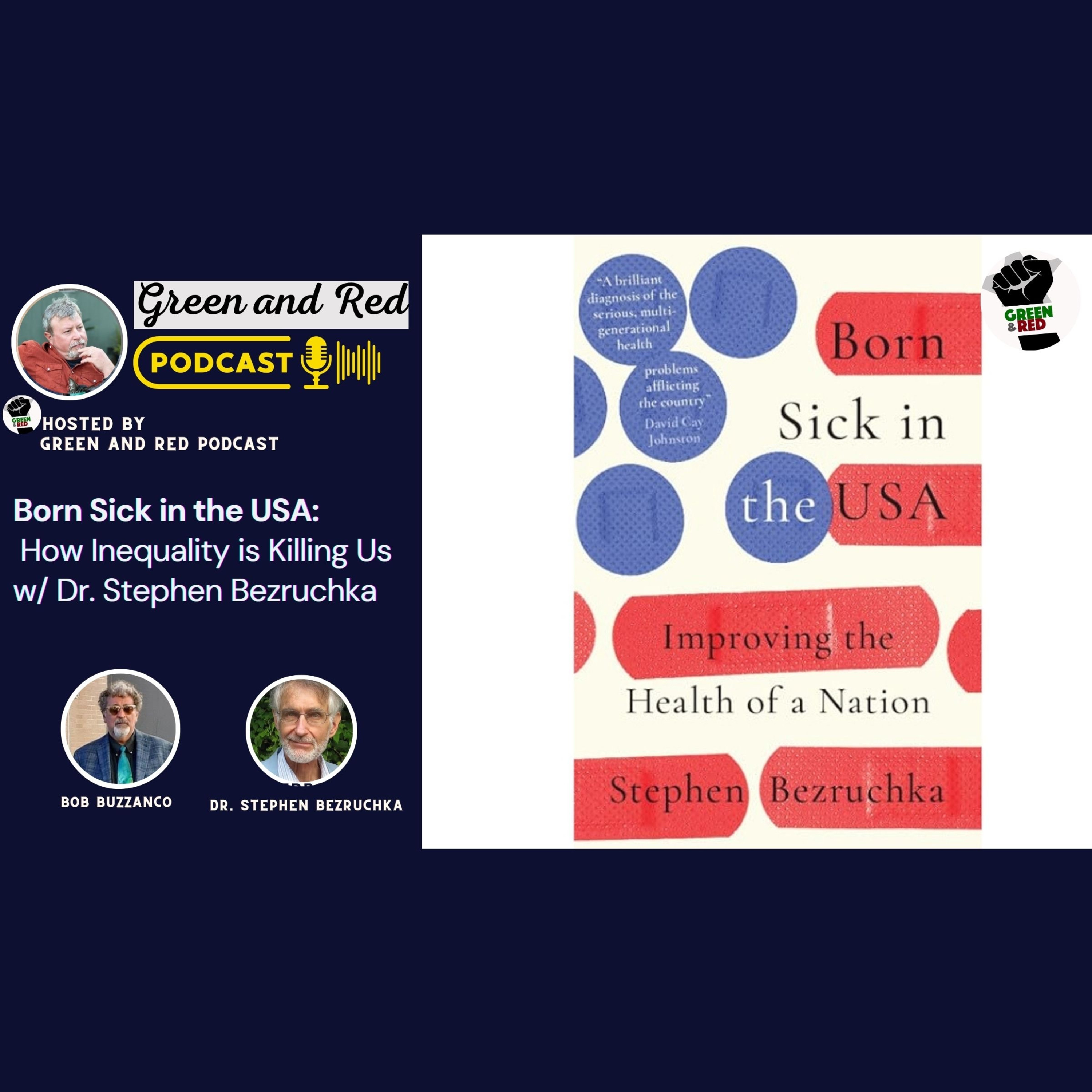
Green & Red: Podcasts for Scrappy Radicals
Born Sick in the USA: How Inequality is Killing Us w/ Dr. Stephen Bezruchka (G&R 468)
00:53:30
Loading summary
Transcript66 lines
- [00:01]
A
Welcome to Green and Red Scrappy Politics for Scrappy People, a regular podcast on radical environmental and anti capitalist politics. Brought to you by Bob Bozanko and Scott Parkins.
- [00:14]
B
Welcome to the silky smooth sounds of the Green and Red Podcast. I'm your co host Scott Parkin in Berkeley, California. And as always, I am joined by
- [00:24]
C
Papa Zanco in Niles, Ohio.
- [00:27]
B
And today we are privileged to have our return guest, Dr. Steven Bezruchka, who has a new book out called Born Sick in the usa. Excuse me, Bob has a copy of it right there. He's also the author of Inequality kills us all, Covid 19's health lessons for the world. Dr. Bez Ruchka is an associate teaching professor emeritus in the Department of Health Systems and Population, Population Health at the University of Washington. Dr. Bezruczka, welcome to the Green and Red Podcast. Welcome back to the Green and Red Podcast.
- [01:00]
A
Thank you very much for having me.
- [01:02]
B
Yep. And this is always a topical issue to talk about. So it's good that we have you coming back. Americans are in have worse health now than many other wealthy nations. So a lot of it's related to inequality and policy, basically shaping people's well being from birth. And so maybe just to kick off, could you, and this is a thesis of your book, could you just start off by telling us how public policy and economic inequality are really leaving a sicker leading us to a sicker population.
- [01:38]
A
So that raises the question, what produces health or the lack of illness or however you want to look at it. And if you spend a lot of money on healthcare, the United States in 2024 spent $5.3 trillion. That's 18% of our total economy on medical care. Then we think medical care is really important for producing health. And that amount is roughly half of the total expenditure worldwide on health care. And yet if we take measures of health, such as how long you live, various mortality rates, what diseases we have, we have more than people in all the other rich countries and a considerable number of poorer ones. And so because we're so focused on health care, we don't look at what might really be producing health, which relates to two basic concepts in the book. One is the amount of income inequality in a society really is critically important for its health because with high inequality, it distracts us from what needs to be done. And the other part is early life. That is roughly half of your health sitting there was programmed between conception and your second birthday. And so healthier countries privilege that period in a variety of ways. We're one of two countries in the world that don't give a working woman who's pregnant paid time off after she has her baby. The other one is Papua New Guinea. About eight states have a 12 week paid maternity leave program. And 12 weeks is at the lowest end of what all the other rich countries do. So because we have such an expensive and profitable healthcare system, it distracts us from looking at what really produces health.
- [03:50]
C
Half is spent on the first year of life, half of our health expenses.
- [03:54]
A
Roughly half of our health as adults is programmed, is determined. Sorry, yeah, we spend, there's two halves in there. One is we spend half of the world's health care bill and the other is the first thousand days after consumption. Conception is when roughly half of your health as an adult is determined program however you want to put it.
- [04:21]
C
And so a lot of that would then be based on like prenatal care or taking care of children after they're born. What accounts for that huge drop off after that? As you pointed out this, the US spends half. Half the world's have, it has half the world's expenses, medical expenses, has all this massive technology, it has this massive economy. Why does it fall apart then that
- [04:41]
A
there's an assumption there that health care produces health and if you ask somebody do you want health or health care, they're confused. Yeah, we, our language doesn't serve us because we talk about accessing health, paying for health, getting health, insuring health. All those refer to healthcare. And so because of our. We conflate the two terms in our language, we automatically assume it is that healthcare produces health. Healthcare is an important part of producing health, but only a minor part. For example, a study I mention in the book looks at how much healthcare in the United States ideally could avert mortality. Came from my alma mater, medical school, Stanford. And they came up with a figure of about 10% of mortality outcomes can be impacted by health care. That leaves 90%. That something else matters more.
- [05:50]
C
Let me just follow because one thing that I found really interesting, you talk a lot about kind of the economy and economics. So you mentioned things like concentrated wealth, the decline of unions, the emergence of private, the rise of private equity. How do all these kind of, I would call them structural economic factors fit in to the way we live our lives, to how healthy we are?
- [06:11]
A
We're a very highly stressed country because all of this inequality that you refer to changes our biology, that is stresses. I'm, I'm here in Seattle and suppose the big earthquake came where I'm sitting right now. There was a Minor earthquake in 1980 and the Walls rattled and things like that, but it wasn't very severe. But if the big one came, the big earthquake, I'd have to get out of this. Get out of this place so the building doesn't crash upon me. And how do I do that? My heart beats faster, I breathe faster, I stop digesting lunch. And if I'm lucky, I'm. I this acute stress, I get out of the building, it doesn't collapse on me, and then I recover. I heave a sigh of relief and say I survived. But what if you are constantly under stress, worrying about right now, what's happening to the SNAP benefits, what's happening to Medicaid reductions, what's happening to all these tariffs, increasing the price I have to pay? That's chronic stress. That's there all the time. And if we increase our stress hormones all the time, it creates a lot of what biologists call inflammation in our cells and organs that can lead to heart attacks and cancers and all the usual things we die of. And by any survey, the United States is one of the most stressed countries in the world. Now, stress is a relatively soft measure as a, as an emergency doctor. The easiest diagnosis I could make in the ER was that somebody was dead. Hard to fake. And we collect these mortality rates and we can aggregate them and use those as measures of health. There's no such measure for stress. There is in a sense, because the stress hormones are deposited in your growing hair shaft. And if we took samples of your hair and assayed them for our stress hormones over time, we at least have a biomarker of the amounts of stress we have. And when you do this in a research study, say for somebody age 50, 59, a man having a heart attack, and you find the stress levels are increasing and boom, he gets a clot in the coronary artery. So it all hangs together. That is health is produced by being able to mount a stress response when you need it and being able to turn it off and not being stressed by everything else that's going on today in society. Yeah, I think if hard to do. Yeah. Hair samples on people in Minneapolis St. Paul, there'd be a good example. My wife has a friend who lives there, and nobody's people were afraid to go outside
- [09:25]
B
when on the same. Along with this topic on stress, the economic factors, like being worried about paying the rent, being able to buy food, being able to be able to afford to go to a doctor. And so I get your point that we're one by studies saying that we're one of the most stressed countries in the world. How do we compare compared to other countries in the global north in particular, where they have some version of socialized medicine and socialized like living and that sort of thing.
- [09:56]
A
Let's look at happiness. There's another soft measure. You ask somebody how happy they are and you put that on a scale or something like that. The happiest countries, there's a world happiness report that comes out every year, and the happiest countries are always in Scandinavia. And we're down about 20th or so, 25th or so in the ranking of countries by happiness. Again, using happiness rather than stress as a measure of how we are. Remember, our Declaration of Independence entitles us to life. And I'm arguing it's it's only a short one. It doesn't say it has to be a long life liberty, but that's an illusion since we house almost a quarter of the world's prisoners and then entitles us to pursue happiness. And we're pursuing it with a vengeance and falling further and further behind. So what about the happier countries? Just to stop. So happiness, we're pursuing happiness. Let me ask you, how many times today have you been told to have a nice day,
- [11:13]
C
have a nice day? Scott?
- [11:14]
B
Yeah, a couple. A couple.
- [11:19]
A
Wonder, did we say this every time we encountered everybody 30 or 40, 30 years ago, we weren't being told to have a nice day every time we encountered somebody because we were having more nice days then. And being told to have a nice day really isn't really working if we look at the world happiness surveys. So the Scandinavian countries, they first of all have less inequality. They support early life. Sweden spends more money on more government money on the first year of life than in any subsequent year. How do they do that? Paid parental leave, housing support, transport, all sorts of family support that we don't have. And we in the United States, where do we spend our government money on early life? It's in the later teenage years, at a much lower level than the Scandinavian countries, to pay for remedial actions because we didn't spend it early, so why do we spend it later? We have a whole business of taking care of problems in teenagehood. And I teach at the University of Washington, and I've been teaching this course, the Health of Populations for going on 25 years. And so I can have a sense of how my students are doing. And they're much more stressed than before, and they have many more mental problems than before. Remember, chapter seven in the book is titled Is America Driving you crazy? The evidence is that we have more mental illness than all the other rich countries, than all the other countries. Okay, I have to backtrack a little bit. Heart mental illness is another soft marker, just like happiness and stress. But there's a lot of studies out there trying to address how much mental illness is in a country. Best studies were published a few years ago. I talk in the book about the grand rounds I presented with the country Emma Erica with Paul Chianovsky and that was based on a long standing study interview going into households and about 20 countries and spending a long time interviewing them to get a sense of how much mental illness there was. And they came up showing that we had the most mental illness in the United States and also the most treatment. So that's a paradox. If treating mental illness worked, you'd think we'd have less of it. So there are all these paradox is about how what really impacts us is not what we think it is. Medical care doesn't do what we think it does. Treating mental illness doesn't. Spending on remedial actions in later life doesn't work. It's a sick society. And I took the title from Bruce Springsteen's song Born in the usa, adding sick to that, because by the time we're born, the die has been cast for our poor life, for our poor health.
- [14:52]
C
Continue on this kind of the importance of these early years. Is this a product? It's probably many things, but is it a product like the healthcare system actual, like prenatal care? Is it about access to immunizations, which is clearly decreasing diet? Is it cognitive like learning to read? What? Why should a. Why could a country as big and has this. You keep talking about the sense of exceptionalism, which I was really intrigued by. How can you know a country with this economy have these really negative markers? Is it diet? Is it cognitive development? Is it healthcare? What causes this?
- [15:26]
A
So you brought up prenatal care to begin with. As a doctor, I thought prenatal care was really important. But the studies again show much less important than we think. What does prenatal care mean? You go to a doctor, they assess your pregnancy and tell you to take your vitamins and come back for another for another assessment. Again, the studies don't show a big impact, partly because who can access prenatal care? The poor can't. In the United States, the poor do poorly and they start doing poorly at the time they're conceived. What does that, how does that play out in a stressed poor woman? And you might agree that poorer people are More stressed than richer folk. The stress the woman, the pregnant woman feels releases stress hormones into her bloodstream that cross the placenta into the fetus. And that stress, the fetus senses the stress and it is, it decides, not cognitively as we would think, but the body met the fetal mechanisms. Say, boy, there's a lot of stress out there. I better hurry up and develop my organs and I might have to pop out early to do what I'm here to do. From an evolutionary perspective, we have only one role in life and that is to reproduce. Right? We don't want the species to die out. So stress programs the fetus to compromise its development. Be born at low birth weight because it wasn't in the womb for long enough. That is be born preterm and yet be able to survive to reproduce in the teens and twenties and thirties and then die young. Because once you've reproduced, hopefully there's. There are some arrangements for child care. So the evolutionary perspective takes the point of view that we may compromise our health to survive, to reproduce. We can make a similar argument, for which I do in the book, for our mental illness. A lot of these things creep in later, depression and so on after we've reproduced. The other factor that's in this book is the studies now show that the stress you're under before you conceive matters at least as much as the stress during that fetal or period or the first two years after being born. Preconception stress really matters. And that makes it a double whammy. With all the stress we have in this country, Parents to be are stressed. That compromises the fetal period and the next few years afterwards, leading to our dying younger and having worse health outcomes. It's not a healthy process.
- [18:50]
B
One thing just listening to this and thinking about it, those in power, and there's politicians and there's like the Republican politicians, I don't really expect them to have any compassion here. Some of the corporate leaders, I also don't expect to have compassion. But like when you're a corporate leader over a healthcare company, for example, are they not recognizing this or are they just like going. All they see is like dollar signs. Are they just going for the profit and they don't care. Like you said, we spend more money on healthcare than so many other countries combined. And yet the quality of life seems to be slipping further and further back. I'm just curious what your thoughts are on if these people work in healthcare, why is there not more compassion?
- [19:32]
A
First of all, we the richest among us, the most powerful among us, the healthiest in the United States. Whoever they are, however they think of themselves are less healthy than people and much less rich people in many other countries, that is. So one way of looking at it is who's the oldest old person at any one time in the world? They're never in the United States.
- [20:05]
B
No. It seems like they're always French or Japanese, I think is the way they're Japanese.
- [20:10]
A
Yeah. The oldest person on record was a woman in France. Calume.
- [20:15]
C
We.
- [20:16]
A
There may be people in other places, but you need birth and death records to really validate that. So here we have these people. There's books out right now on how to be super healthy and do this, consume this, don't do that. People that write those books don't live very long. Presumably they're following their own. Their own advice. Think about so many people who died before reaching a reaching. Before reaching age 65. Steve Jobs who brought us the iPhone. Paul Allen who worked with him. Elvis. Or you can go and name all these people now. Yes, they died of this or that.
- [21:03]
B
Elvis had a lot of fun before he went there.
- [21:06]
A
Okay, okay. I'm just kidding. But they still didn't live long lives. And if two people who. Under age 65 who died in the United States. Can you think of two. You probably know two. If they'd lived in Canada or Australia or France or Germany, only one would have died. In other words, I don't think we deserve this outcome, but we have structured society to produce it. We're killing ourselves and we're not aware of it.
- [21:46]
C
Something here which I think is really striking. You wrote heart disease, stroke, high blood pressure, diabetes, cancer and lung disease are more common among Americans 50 to 74 than among those living in. You have a bunch of countries, many of them, I think most of them are probably European. And I think it's also important, which really seemed counterintuitive to me is you just said it again. People in higher socioeconomic classes here in the US don't have a better lifespan or a better quality of life than just average.
- [22:13]
A
People in other countries tend to be healthier than poor here. There's that gradient always. With a few exceptions, rich people do better than poorer people. But when you compare them with people in other countries, that's not necessarily so.
- [22:31]
C
Is that because these countries have public health systems, they just. There's less stress. Is there.
- [22:36]
A
Above all, they spend money on early life. The government supports early life in many ways. I could. There's a graph in the book of how much of the national income is Commanded by taxes in five countries. And I put United States, Sweden, France, Germany, a couple of other countries. And I use this from Thomas Piketty, the the capital in the 21st century book mentioned his later book called Capital and Ideology. So back. And he tr. He publishing this data starts in 1870 and goes up to 2015. So back in 1870 to about 1900, countries had about 7 or 8% of the income that go to the government for in taxes. 7 or 8%. And what did that pay for a castle for the king, a standing army to protect him and protection of private property, those kinds of things. Then in 1900, the amount of money accruing in taxes to the governments started to rise. And by around 1980 it plateaued at about 30% for the United States and 55% for Sweden. So what did the Swedish government do with all this money which they got in taxes from their people? They supported early life. They have free medical care. You don't have to pay. When you go to higher education, you don't have to pay for it. You even get a living allowance and things like that. We spend our government commanded 30%. What does that go for? Where we spend a trillion dollars on defense and going up to a trillion and a half we spend on Social Security. As for people my age, that doesn't help younger folk. So our. And we. So our expenditures, much less than in healthier countries go for the wrong things. And Americans try to avoid tax as much as they can. The Swedes pay, are happy to pay their taxes because they get a lot in return. So our values are misplaced and we seem to want to support the rich by giving them ever more. The big horrible bill. What did it do? Kept in place the tax cuts back in 2017 and then decreased them even further. Can you think of, can you think of a worse way to kill yourself? That's literally what we're doing. And the problem is nobody's aware of it.
- [25:38]
B
Yeah, it literally put like much more money into ice too. That was part of that budget. Big beautiful bill, big ugly bill or what have you, which that also begs the question, is that they're up, they keep, they always increase the defense budget. We've done like many shows on that. But the place where they seem to be cutting is in the Veterans Administration, which is like healthcare for vets, which is contrary to what they seem to stand for.
- [26:02]
A
Yeah, the Veterans Administration healthcare system is a government run one and it works. But it's. Who knows how much longer it's going to last.
- [26:16]
C
Sometimes I wonder I'm thinking about the money aspect of it too much because there seems to be less of a link than I'd assume. I know Scott and I both lived in Houston and we knew people who worked at Continental or United then. And one of the jokes they had was that we're an insurance company, health insurance company that flies airplanes because insurance was such a huge expenditure, like I think maybe their biggest line item.
- [26:39]
B
Right.
- [26:40]
C
So we're doing all that. It doesn't seem that it really matters that much.
- [26:46]
A
So first of all, you said health insurance.
- [26:49]
C
Yes.
- [26:49]
A
So you committed the health care versus health. Right. We, I said $5.3 trillion we spend on healthcare. About 20 or 30% of that is spent on administrative expenses. How much, how much paperwork is there in, in this system? It's huge. When I, so I no longer play doctor, but when I did, I entered the era of electronic medical records. We used to write on a chart and, and so on. And then you entered information in an electronic record. And the electronic record was designed for billing and it's engineered so that you enter more information that will allow a higher bill to be created. And doctors now go to conferences where they're taught what to do to increase the bill. That's the profit incentive. At the same time, and I see this, I teach medical students and you can see that first of all, they're graduating with 3, $400,000 in debt. They're going to choose high paying specialties, neurosurgery or plastic surgery, rather than family medicine because the pay is higher and they'll be able to pay off their debt sooner. And at the same time, private equity funds are buying up practices. What's a private equity fund? It's something that's not transparent. It's not traded on the stock market. It has, it's where very rich people invest their money so they can make an awful lot more. And they're buying up practices and hospitals. They're closing hospitals in rural areas. We need medical care. It's good at treating illness and injury. And some of it has to be done in a hospital. And if the hospital is a few hundred miles away, boy, it's not going to work.
- [28:57]
C
Where I am right now in Ohio, two hospitals and a rehab center have closed within the last year or two. Yeah, this used to be a heavily industrialized area. It's basically Appalachian now.
- [29:06]
A
Right.
- [29:07]
C
And Southwood is taking over everything else.
- [29:10]
A
Right.
- [29:10]
C
So you don't really have kind of the old, the old fashioned doctor. You go to the family doctor or whatever. Is that driven from these corporations are they making these decisions? So the doctors are just buffeted by all these forces?
- [29:23]
A
In a variety of ways, yes. You're more likely to be seen when you come by a medical assistant, somebody who's got high school and can take your blood pressure, maybe a pa, a physician's assistant. They, you'll be seen by people who work for less and that, that increases profits because of course the bill that's created doesn't reflect the fact that you're seen by a low level practitioner. And now visits are very brief because you can bill more more often. The best medical care systems are based in primary care, that is in non specialty care. I worked for a time in British Columbia, north of where I am in Seattle and I worked as a family doctor there for a while. And people can't go see a specialist and have the government pay unless they're referred by a primary care doctor. That's one way of keeping expenses down. Here in this country you have a cold and you want to go be seen by an infectious disease doctor. That's a real waste of resources and a waste of their time as well. So our system is structured for expensive high level care. It doesn't do much good and but yet costs a lot of money. Now Western European countries and Canada elsewhere the focus is very strongly on primary care. Most of the deliveries in the healthier countries are done by midwives. They're not obstetrician gynecologists. Our cesarean section rate is 30 to 40%. My daughter, my daughter was down in when she was living in LA and was seen at Cedars Sinai, one of the hospitals for the rich and famous. Their cesarean section rate was 50%. Why? Obstetricians don't want to get up at night to deliver. Let's schedule your delivery. Let's intervene with any possibility that something might go wrong. This is not healthy. The World Health Organization suggests that the cesarean section rate should be somewhere around 15%. They're necessary in some situations and not for others. And we have a very high rate of deaths of women in childbirth. Maternal mortality two or three times that of other countries. Now when I was in medical school, and this is interesting, in 1970, 71, March 31, I happen to have kept my notes from that. I had a class called Medicine and Society taught by Professor Count Gibson. And I wrote in my notes in 1951, 53, we had the lowest rate of deaths in Childbirth for Women, 1951. I later verified that in 1966 quite a few other countries had done better. In other words, back in the 1950s we had some of the best outcomes and then we started falling behind. And that's been the picture that is repeated. We could claim some of the best health back in the 1950s and we've just fallen further and further behind. And so I like to get as many speaking points to try and make the point. How far have we fallen behind? So if we take the average of the other rich countries mortality rates and compare them to ours, it is equivalent. The excess deaths that we have in this country is equivalent to two fully loaded passenger jumbo jets crashing every day in this country. It's about 700 people die every day in this country that wouldn't if we had the average health level of the other rich country. Just the average, not the best. And it's something we're totally unaware of. Trying to draw attention to this. I started out in 1996 trying to present this at doctors conferences and I, I realized doctors had no interest in this. They had no, they weren't taught about health. I wasn't except for this one class I mentioned. And their job is treating illness and injury. So then I had to retool what I did to try and capture other audiences. And I really, I've had an amazing variety of experiences from grades five on up. You can present this material to grade five students. I had a public health student who produced a curriculum in Seattle for grade five and pilot tested. It had to be in a private school because the, the public schools are all teaching to the test and they don't teach something that's not on the test. So yes you can. We used to go to high schools again before the teaching to the test and to public high schools. And we would do a reader's theater staging of the health Olympics and you give a Japan T shirt to somebody who crosses the finish line. And then six years later there's the American coming across the finish line and students get it. So we have to, if we want to do something about our dying young, we have to create awareness in as many ways as we can. And part of the book is discussing ways of trying to create awareness. One way would be to make this material on the standardized test that everybody's supposed to take. Suppose your sat, the test you take upon leaving high school. Suppose it had questions about our health compared to that in other countries. Then we'd have to teach it. Suppose to get admitted to medical school, you got to take the medical school admission test. Suppose there were questions there. Suppose for the exams that Doctors have to take to practice. There were questions there. Then we'd start teaching to that. The real big bang would come if we had a State of the Union address that compared those required to compare the state of the American Union with other unions. Suppose the president said my fellow Americans, you die much younger than people in all the other rich countries and a few poorer ones. But that's a small price to pay for all of my tariffs that I'm putting on and making life worse for Nona. Better for you.
- [36:57]
B
I think the lieutenant governor of Texas once said something along those lines during the pandemic that oh God El Dan.
- [37:05]
C
But yeah, I was in Texas. They basically said that Texans would be proud to die earlier because they don't want to disturb the free market in oil prices. That's not made up. They actually did that.
- [37:18]
B
Dan Patrick again.
- [37:19]
A
Yeah, I
- [37:22]
C
one thing that's really interesting because you talk about the health Olympics. So you had in the like 1950s, 60s pretty good record there. Right. In these various categories. The US was and then it starts to decline and obviously the amount of money doesn't. Right. Why do you see. Is it other countries because of their public health systems or whatever catching up or do you see a deterioration? I know anecdotally like now when I go to the doctor basically I used to go to the guy and talk to him. He'd ask me how I was feeling and stuff. Now they just read all the numbers. It's like five minutes this, your sugar's good, your cholesterol could be lower and then boom, you're gone. Yeah. Why do we see this pretty rapid decline from the standard in the 1950s or 60s or whenever early 70s to today it seems to very rapidly shift it.
- [38:09]
A
Our inequality has skyrocketed and again no very little attention to early life. I hate to be a broken record but from 1975 to 2023, $79 trillion was taken from the bottom 90% and transferred to the richest 1%. According to a study from Rand that I, I believe it's in the book. We have a hard problem. We have a problem trying to understand large numbers. How much is $79 trillion? Suppose you know our largest currency is the hundred dollar bill. Suppose we took a stack of freshly minted hundred dollar bills and stacked them tightly to reach 79 trillion. It would go a quarter of the way to the moon. That's how much you and I presume you're not in the top 1% have willingly transferred to the richest 1% and we can't stop Doing that, it seems so. Back in the 1950s, if we look at income gains over the 50s and early 60s, the bottom fifth saw the largest income gains and the richest fifth the smallest. Now the bottom fifth is seeing income declines and the richest fifth the lowest, the highest. Another way of looking at this, that Elizabeth Warren, the senator from Massachusetts, she did a study when she was a Harvard law professor looking at the median middle 2, 2 parent, 2 child family and their income and expenses in 1970 and compared it with the median 2 parent, 2 child family in 2000. She published a book called the Two Income Trap. Back in 1970, one of the parents worked outside the home and one stayed home in 20. In 2000, both parents worked outside the home. When she looked at the 1970 family, they had more money left over after paying for all the rent and medical care and everything else to spend on whatever they wanted to than the 2000 family with both parents working. So somehow we have structured the society again. It's nice to be able to take care of your kid and be home for that. In Sweden, they have a very generous paid parental leave program. It's mandatory to take almost two years leave at full pay. And then in your child's third year you can put your child in a Swedish government run daycare center that's free and you have to have an advanced degree to work in daycare. In Sweden they just have their public health policies pull the levers that really impact our health. What does public health do in this country? They're struggling to tell you to get your immunizations. They're still telling you to eat right and exercise. Those aren't bad ideas, but they should be telling you to get political and realize we have to change the structure in this country and public health departments do not want to touch them. It's politically uncharted ground. Now I'm trying to do something here, just getting our school of public health to address these issues. That's if it's not taught, it's not going to be done.
- [42:09]
B
That was one of the things I appreciated about your last chapter in the book, maybe chapter 10, that you actually talk a lot about how people can do things to take on some of these structural, some of the structural violence. I really appreciated that. Could you say a little bit more about that?
- [42:28]
A
In general, I tell I do this with my students. Do something you enjoy because if you don't enjoy it, you won't do it for long. Do something you have skills at and do something that doesn't require you to get paid to do because nobody right now. There's no job category in this country to make this country healthy. I'm pretty good at teaching, writing and talking and, and so I do that. I enjoy do that, doing that. I'm not very good at organizing institutions. I created the Population health forum in 1997 and we went to schools and all that sort of stuff. But that wasn't my strong suit. I did join, I joined the board of Washington Positions for Social Responsibility. And so I'm a part of a, an organization that does this and I created an economic and equity health task force. And I'm trying to get the national organization to recognize that a social responsibility for doctors is to try and make the country healthy. But they're stuck on the net on the anti nuclear, which is a good idea. And it's, but it's. I'm working to try get them to take on this additional responsibility. So one of the things that's really important is to try different things and see what works. When I, when I do a talk, I try to see what's the audience response. Did I say something that made them laugh? Did I say something that made them tear up a little bit? And did I say something that made them think? Taylor Molly said, changing your mind is one of the best ways of discovering whether you still have one or not. So how do you get people to change their minds? Or how do you get people to believe something is true? But a quarter of Americans or actually higher, think the sun goes around the earth. Search and you'll find that those are pretty high beliefs. The United States have some of the highest beliefs of people, people thinking evolution was a hoax. There is no such thing as evolution. So I was once in a grade eight class, as I mentioned, a private school, and it was actually where Bill and Melinda Gates sent their kids. And I was talking about some of these ideas and I realized students weren't following. And so I stopped and I said, how do you come to believe something is true? Silence. You know how uncomfortable silence is. It's easy to break. I stayed the silence. Finally, a boy raised his hand and he said, if our parents tell us when we're very young, if our teachers and friends reinforce it, and if we've experienced it, then we know it to be true. Early life exposure, reinforcement and experience. Here's the hard part. How do we experience the health of the United States? You've got to trust mortality figures that are collected by others. And that's hard to gain. That's the real difficulty. It needs to be Built into the educational process. You need to see how the mortality rates are calculated. When I was a, I think I mentioned the easiest diagnosis I could make was somebody was dead. I fell. Loaded down death certificate that was aggregated with the birth certificate. Allow the allowing these figures to be mortality rates to be collect to be determined. And that's. You got to trust that procedure. And if you ask the question is this, is it wrong that we die younger than people in so many other countries? You will not find contrary evidence.
- [46:51]
C
Last question. Clearly I think a lot of Americans aren't really happy with the medical system, the healthcare health system, whatever you want to call it. We saw that not to comment on actually murdering a healthcare CEO, but a lot of people understood that to me that was what was important. A lot of people. Oh yeah, right. And you now in the last several months I've even seen like Marjorie Taylor Greene, who nobody would peg for a progressive, complaining about the cost of healthcare and actually defending like Obamacare. Do you sense that there are people now who are more ready to do something? Is what's. You've been following this closely for decades now. Do you sense things are like irrevocably broken or is there a movement now to actually start to fix this?
- [47:37]
A
Oh, I think there's a huge movement. The presidential approval ratings are tanking. People don't like the way the country is going. Medicare for all is at least a speaking point. All the other rich countries have universal health care without having to pay anything for access. The important thing to recognize is if we had universal health care, it wouldn't make much of a difference. I hate to keep making this point because it's really important to recognize that health care and health are very distinctive things. In 1960. Excuse me, excuse me. In 1965, when Medicare, that is health care for people over age 65 came into into law and action, a study looked at. Sorry, a study looked at what were the mortality benefits in the next 10 years. They couldn't find any. All they found was less out of pocket payment. The other rich countries all have universal health care. They instituted it because they thought it might help decrease inequalities in health outcomes. And they found it didn't make much difference. So then they had to look elsewhere. Decreasing inequality, support for early life, all of those kinds of things. So that's a tough thing to make people. We shouldn't have universal health care, a focus on primary care. We should have hospitals regionally distributed. Our health is right now about the same as Cuba's and we've been strangling Cuba for. Since 1962 with all the embargoes, and things are getting worse. Right now in Cuba, medical education is decentralized. So they have, I think, 12 provinces. Every medical. Every province has a medical school. The doctors go there, they stay and work there. The care, the hospital type care facilities are all pretty evenly distributed. And they even have elam, a school for foreigners to come and get educated in Cuba. And there's actually a few Americans there because it's free. You get a stipend and you don't, you know, graduate with half a million dollars in debt. So Cuba is an example of. People talk of health systems, and Cuba, I think, presents an example of a systematic approach to health. Healthcare, as I pointed out, being decentralized, all sorts of supports for various parts of life until very recently, good food distribution and everything else. It really is a system designed to produce good health. And we had a class on Latin American health last week. And one of the points about Cuba, most countries have a large racial health gap. African Americans in this country do much worse than we gringos. And gringos in Cuba, the difference is very small. Afro Cubans and white Cubans don't have very different mortality rates. I think that's partly because the health system is working there and we don't have one. We can learn from Cuba.
- [51:25]
C
I was there a few years ago, and the people across the street, there's just a working class family and their kid was in medical school. And it would be hard to imagine somebody from similar socioeconomic background here in the US Sending a kid off to medical school.
- [51:39]
A
Yeah, very important point. I went there and I think it was 2017 after a student of mine went there and he said, don't go on a tour or anything. Just go there and travel around. And. And we were so taken care of. People would stay in their home and they'd call ahead to arrange for us to stay in somebody else's home somewhere else. It was an amazing experience that way.
- [52:04]
B
Yep. I'm gonna wrap it there. I think we're at our time. Really appreciate you coming on with us today, Dr. Bezruchka. Got the book here. It even looks like a Springsteen album cover.
- [52:17]
C
Springsteen.
- [52:18]
B
Yeah, it looks like a Springsteen album cover. I was gonna say when you said that earlier.
- [52:21]
A
Yeah.
- [52:23]
B
Folks, you've been listening to the Green and Red podcast. Please check us out at Facebook, Instagram, Twitter, and Blue Sky. If you're watching this on YouTube, hit the subscribe button. If you're listening to this on audio platform give us a rate review. And if you really like us, go to greenandredpodcast. And hit that support button or become a patron@patreon.com GreenRedPodcast it's been great talking with you today. Really appreciate you coming back on. And we'll put the, we'll put in the show notes, the link to the book where people can get it, too. So I think it's an important thing to be reading right now.
- [52:53]
A
Thank you for having me. Yep.
- [52:55]
B
Everybody else out there make trouble and misbehave and we'll talk to you again soon.
- [52:58]
A
Yes, Sam.