← Green & Red: Podcasts for Scrappy Radicals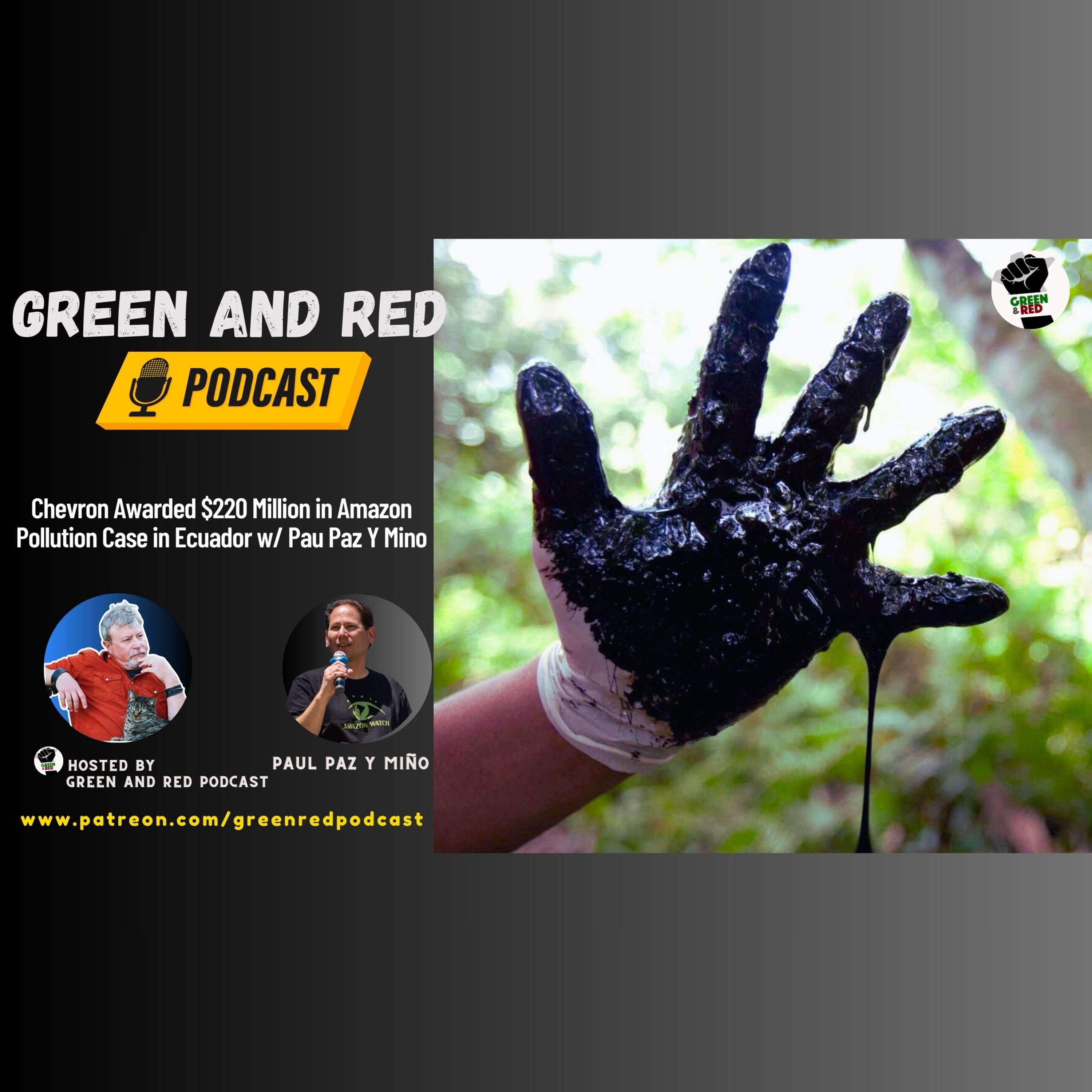
Green & Red: Podcasts for Scrappy Radicals
Chevron Awarded $220 Million in Amazon Pollution Case in Ecuador w/ Paul Paz y Mino (G&R 447)
00:38:34
Loading summary
Transcript51 lines
- [00:01]
A
Welcome to Green and Red Scrappy Politics for Scrappy People, a regular podcast on radical environmental and anti capitalist politics. Brought to you by Bob Bozanko and Scott Parkins.
- [00:14]
B
Welcome to the silky Smooth Sounds the Green and Red Podcast. I'm your co host Scott Parkin in Berkeley, California today. Bob is out of the office today, if you will, but we're going to be talking about a topic which we've covered in the past and then like somewhat relevant. We've done a lot more shows on Latin America lately with the sort of escalating conflict that's going on in the Caribbean and around Venezuela. And this is somewhat related to that. And so we're going to be today, we're going to be talking about the news that came out this week about Ecuador being ordered to pay the oil company Chevron $220 million. It was a coming out of the Permanent Court of Arbitration in the Hague. We've also talked about the ISDS system. We're going to talk about that some today too. But joining me today is my friend and comrade Paul Pozamino, who is the deputy director at Amazon Watch. Paul has also volunteered as a Columbia country specialist for Amnesty International. Paul's lived and worked in Chiapas, Quito, Ecuador, promoting human rights and community development, working directly with indigenous communities. And then he has worked on the Chevron campaign and case for a long time which we're going to talk about and talked on the Green and Red podcast about that before. Paul, welcome to the Green and Red podcast.
- [01:38]
A
Yeah, it's great to be back. I wish it were because of good news but it's good to be back regardless.
- [01:44]
B
Yeah. And maybe we can, there's been some, there's some news that's been coming out about this in the US Media. It's only really, I've only really seen it progressive media. But could you maybe actually just start off with telling what was the ruling this week that went in Chevron's favor?
- [02:01]
A
Yeah. First my, I try to choose my how I frame this carefully because it's been used for many years by Chevron to spin it as if it was were a court decision. And when people say ruling, judgment, decision, it sounds, oh, these were judges in a court that was presented evidence, reviewed possibly by a jury and then they throw in the hake as if, oh, this is significant. This is not a ruling. Right. This is an award by three paid arbiters who are usually corporate lawyers who have been hired by under the auspices of the CA of the Hague through the Permanent Court of Arbitration to mediate essentially a dispute between countries and corporations. They're paid to issue a decision. They issue an award, I should say, or not. And they've been getting paid on this case for many years because it's. It was filed like 10 years ago. They issued their award finally, and it. The award was that, to put it bluntly, the government of Ecuador needs to pay Chevron 220 million for the privilege of being poisoned deliberately by them for decades. That's really what it is. The people of Ecuador are paying 220 million, or ostensibly would pay it. And the reason that the award was handed down is that Chevron successfully argued in front of these paid arbiters that the government of Ecuador didn't protect Chevron from being sued by its own people for its deliberate contamination when it operated there. And the government of Ecuador at the time, in the early 1990s, signed a very corrupt $40 million agreement with then Texaco, saying that it would not pursue Texaco for its environmental destruction there. And they thought, great, we've got this paper. That's all we need. It did not insulate them from a civil lawsuit. And of course, Chevron lost a civil lawsuit in 2011, affirmed by the Supreme Court in 2013. And that is the suit that Chevron then went back to this arbitration.
- [04:16]
B
And that was for like 9 billion 8 or 9 billion dollars.
- [04:19]
A
Yeah, 9.5 billion. At this point, we're talking probably over 12 with interest because they haven't paid it since 2013. And it's really important that people understand fundamentally this award in no way invalidates or stops that $9.5 billion judgment. That is a judgment issued by the courts of Ecuador, firmed by the Supreme Court and the Constitutional Court, and even the Supreme Court of Canada for enforcement purposes looked at that and said, this can be sought for enforcement in our country, Chevron. And that's why this is such a long way of explaining. I don't like to call it a judgment or a decision because Chevron wants the international press and the global community to see. To think these are judges who invalidated that $9.5 billion judgment. And it's obviously much more complicated than that, and it's important to get to the truth of it.
- [05:18]
B
And so this award is awarded in the Permanent Court of Arbitration through the ISDS system. Could you actually talk about the isds? Tell us what isds, for starters.
- [05:33]
A
International State Dispute Settlement System. So basically, it's a mechanism by which corporations assert their power over local communities and especially smaller countries that don't have the might to fight back against massive global corporations like Chevron. There have been some really in depth and smart pieces written about how the ISDS is fundamentally flawed. Public Citizens is a great source for that. Actually John Oliver did a great story on it years ago about how tobacco industry was forcing African countries to pull anti smoking ads using the ISDS to threaten them and their GDP was less than some of these corporations had. They couldn't fight back. So it's used consistently to advance corporate power and that's exactly what Chevron did here. It took a lot longer than it normally would and hopefully we'll get into the detail. Chevron didn't win by far everything it wanted even through this flawed process. But it's notoriously pro corporate and undemocratic and essentially counter to what we think of as a justice system.
- [06:46]
B
And in 2018 I think I read that the complaint was first filed in 2009 but the arbitrators declared that the 9.5 judgment was fraudulent finding that the Ecuadorian courts has treated Chevron unfairly. And they're trying to cut not just Chevron but the court and the Hague is the panel of arbiters and the Hague is trying to come across like there somehow have some sort of like legal jurisdiction here.
- [07:15]
A
Yeah, exactly. So they this all hinges on Chevron concocted a bogus story to try to undermine the judgment in Ecuador which was based mostly on Chevron's own evidence. So just to recap, this was the second suit brought. The first one was Texaco. It was eight years fighting Texaco in New York. At the end they won initially and then on appeal Texaco won and the judge determined that the case should be moved to Ecuador. Texaco had fought for years to move it to Ecuador saying we will respect whatever decision the Ecuadorian courts come from. Situation Ecuador changed. They couldn't buy the courts the way they had expected they could. Started again as Chevron in 2008. More years go by. 22001 finally there's a judgment issued and then it gets affirmed by the Supreme Court. And that's the nine and a half billion that we're talking about. Right. But on the eve of that decision, Chevron knew it was going to lose. The evidence is overwhelming against them and it's still there. Like you can go see the contamination that they admitted worse, admitted to deliberately causing. Right. Billions of gallons of toxic waste. It's clearly theirs. They admitted to it. But before that judgment was affirmed they went and brought this action before the isds and they also filed a RICO suit in the United States. That's the famous case that led to Stephen Donzinger being losing his license and everything that happened to him. But one of the key issues here was that I was at a hearing for the appeal of the RICO case and one of the US Judges actually pushed a Chevron and said why are you pursuing this action? And one in front of the isds at the same time. You normally wouldn't do that. You would take your case to wherever you felt like it was the proper venue to, to defend yourself and see what the decision is. And he said it looks clearly to me like you're forum shopping. What if you get an answer here that's different than the answer you get there? How are you going to reconcile that? Of course that was turned out that was really show the US Appeals Appellate Court was going to uphold what Kaplan said anyway. But it was an interesting point because it laid bare. Yeah. Chevron's strategy was do everything they can to stop the wheels of justice because the evidence against them is so overwhelming. And in this case they said to the tribunal, ultimately they wanted the tribunal to come in and say that the entire case was a fraud. That Ecuador should cover any liability that Chevron has anywhere in the world if they are able to enforce their judgment. They tried to say that Ecuador owed intellectual property damages. They tried to get Ecuador to pay the legal costs that they incurred in trying to get Steven Donzinger thrown into jail for contempt of court just a couple years ago. And the case in Ecuador ended in 20. So they put everything in there and they tried to get billions of dollars. And it is pretty significant that they came out with this pittance. As far as Chevron's world is determined is seeing $220 million is next to nothing. They've spent billions of dollars fighting to pay not to spend billions of dollars to clean up.
- [10:48]
B
And they initially asked for. They were seeking like 3 billion right.
- [10:52]
A
Through this they were seeking rebillion. And then the new president of BOA in Ecuador, right wing president, very. He's a Trump fan. He went to the inauguration. He announced sometime last year that he was setting aside $2 billion in the budget because he expected to have to pay this award. So that was the first indication that we got of problems because when I say we Amazon watch the movement fighting for justice in Ecuador, he there hadn't been a final obviously hadn't been a final award set but that he was signaling to them, unlike previous administrations, that they were likely to respect the award. Every administration prior had denied it. And in fact, one of the interesting things about Ecuadorian politics is there have been referendums the last few years on some key, important, key or international issues and national issues. Most famously, they just voted to reject the idea of allowing US Military bases on Ecuadorian soil. But one of the other elements in these referendums was should Ecuador participate and have the isds be part of all treaties that they have and agreements they have with corporations? And that was rejected, resounded. The people of Ecuador, they see how flawed this system is. They don't want to participate in it. They know that it's fundamentally racist and it's helping U.S. corporations. Naboa, of course, is running counter to that. So he now is saying his government is trying to spin this to say they are the ones who skillfully reduced the award from that first 3 billion to then 2. And rumors were it was 880 million. And now we see the final 220 million and they're saying that the 220 million they're trying to hang around the neck of Correa. We're going to have to pay this. This is the damages that Correa did to Ecuador. Just another thing that they can throw at Correa.
- [12:50]
B
And then Korea being the, the genuine leftist president. Past president.
- [12:54]
A
Exactly. And Correa was the. Actually, there are a couple of important things about Correa. Right. One, he was in office, I think, for 10 years, longest that there's been a president of Ecuador consistently in my lifetime. He, he was the only president to visit and see firsthand the contamination in the Amazon. He launched a campaign called the Dirty Hands Campaign, targeting Chevron to try to force them to pay. And he, his government allowed, essentially did not interfere in the trial. And the trial went on for eight years. So that was pretty significant. And that was the blow to Chevron. That was when they realized, oh, they're likely to have a final decision in Ecuador and it's not going to go well for us, so we better come up with a backup plan. And this ISDS award was one of the backup plans.
- [13:40]
B
So what is the Naboa government saying about this award of 220 million, which is much lower than obviously he expected because he put 2 billion in the budget and much lower than. It's still a travesty and an injustice. But what is their response to those? Yeah, they're like, oh, we'll just pay you a billion dollars just in good.
- [14:01]
A
Faith or right there. Like they're, like I said, mentioned, they're trying to spin it as we are the smart government, because we're, we were able to negotiate it down and they're spinning it as a victory. They're saying they're celebrating it as a reduction because of their skill legally. And also that 220 there, as I said, they're trying to say that's all the fault of Rafael Korean. So they are publicly accepting essentially that their own courts, they're saying, participated in a fraud. So they're throwing their judicial system under the bus, which is no surprise because there's been a lot of conflict between the executive and the judiciary in Ecuador. And what's frustrating about this and what we heard from udapt, for example, which is the organization of communities affected by Chevron Texaco, is that it's, it's super offensive to them because in actuality, it's a defeat for justice. Right. They have been for three decades, more than three decades, living in the contamination. They haven't been recovered. They haven't. Their communities haven't been supported. They still have contaminated drinking water. And yet their own tax dollars are going to go to pay this 220 million to Chevron and they get nothing out of it. Now, one significant thing that they have done is they immediately filed, I guess you would call it an injunction, or they're seeking an injunction to seize those $220 million the moment Ecuador plans to send them to Chevron. Because key here, and this is why I mentioned that it doesn't invalidate the judgment. Any Chevron assets in Ecuador over under $9.5 billion belong to the communities who successfully sued and won. And Chevron doesn't have any there, so they haven't gotten paid. But if the government of Ecuador says, here's an account, it's the 220 million that's going to Chevron, they should be able to seize them. And if they did, they could start getting healthcare support. They could get additional support for clean waters and clean water. And instrumentally, it could fund a reinvigorated enforcement campaign to sue, to pay the, get the rest of the judgment funded in another country. Because outside of the United States, Chevron could be sued anywhere in the world they have assets to get to pay that 9 and $9.5 billion judgment. But it's a significant effort to be able to do that. And it means years of fighting and a lot of lawyers. So they don't have the funds to do that.
- [16:45]
B
Speaking of the affected communities, how many people are we talking about?
- [16:50]
A
So the area that Chevron contaminated was about the size of Manhattan, and there are about 30,000 people that were living there and have lived there over the course of the time. Many of them are non indigenous, they're farmer communities, Ladinos, mixed race people that moved there over the years. There are multiple indigenous communities, however, that have lived there. Kofan, Sokopay, Warani, many communities affected by them. So both indigenous and non indigenous. And there are a lot of community people that have moved there over the course of the last 30 years. So unfortunately a huge portion of them are still living in areas where the contamination leeches daily into their drinking water. And what Chevron did is they dug thousands of oil waste pits. And instead the key issue here is when you drill for crude, you extract foundation waters prior to that are laced with carcinogens and the normal practice is put them in a storage tank and re inject them into the earth. What Texaco did is decide, hey, if we skip that step, we could save about $3 a barrel. So instead they just dug pits into the earth. Almost a thousand dumped what really is hundreds of billions of gallons of toxic waste over the course of decades. And then when it rains, which it does almost every day in the rainforest, the water travels through because it's heavier than the foundation water travels through. It goes through a system of gooseneck pipes that they put in and just runs off into the local groundwater. And so it goes right into the streams and it's still doing that. I've been talking about this case for 18 years, just myself, and every single time, the same day I talk about it, this contaminated water is leaking into the rivers where these communities live. And that's a tragedy.
- [18:41]
B
And Texaco started there in 1964 and ran it to the early 90s. Right?
- [18:46]
A
The first oil company to drill for oil in the Amazon, Texaco. And so they went in there earlier, they started their operations in 64 and they left in 1992. And when they left, they left almost a thousand waste pits there. Now Petro Ecuador took over. The state oil company took over in 92 and they continued the same system. So they polluted on top of what Texaco did. Of course, that doesn't negate what Texaco did. They're still responsible for that, but Petro Ecuador is responsible for subsequent pollution. And then over time they did invest and update the system. So there is still oil drilling happening in the Northern Ecuadorian Amazon. They now do have filth, have storage tanks and they do reinject the water. That doesn't mean that it's clean. It's still causing harm to indigenous communities. And the environment, all of the operations there, in my opinion, should be shut down. But at least they're not operating the way Texaco did. What Texaco did is, even by the standards of oil companies, was atrocious. And in Texaco, in Texas, Texaco knew not to operate that way. But the underlying crux of all of this is a deep rooted environmental racism. And in Ecuador they knew they could get away with it and no one was going to hold them to account. So they, in full view of the Ecuadorian government and the people, systematically poisoned them for decades. That's why this award is so atrocious as well. Because imagine after all that being given a $220 million bonus for having polluted and poisoned. And of course Chevron has the money to clean up. They have profited billions and billions of dollars since they left in 1992. They could have taken the right path a long time ago, invested, and maybe today they would actually be drilling in Ecuador. But of course they took the other route. Another interesting point though is even though they're not drilling there, they are refining oil from that location all the time. So California is the top destination for Ecuador's oil and more than half of it comes here and a good percentage of that is refined in El Segundo in Los Angeles, Chevron's refinery there, and some of it in Richmond. So they're still profiting off of oil drilling in the Amazon even though they're not the actual ones drilling it.
- [21:10]
B
Yeah, it's just, it's mind boggling. And then they just. And part of their argument also I did a little work on that campaign back in the early 2010s, but one of the. They also argue that they are not responsible for what Texaco did, even though the company in 2001 or whatever that was.
- [21:28]
A
Yeah, that I love, that's one of my favorite ones is that was Texaco nuts ever. And like you merged and you're still even using that brand. If you go to San Francisco, you can go down by Mission Bay, I think, and there's a Chevron and a Texaco station across the street from one another. It's the same company, but that just shows you the, the frankly the bullshit that they try to spew to escape accountability and the fact that anyone listens. Look, we're in 2025. There's a lot of ridiculous things that are said now by the US Government. It almost is like they were ahead of the curve saying stuff like that 10, 20, 30 years ago now it seems.
- [22:07]
B
Early fake news, right?
- [22:09]
A
Totally.
- [22:10]
B
One question I have around the panel is that obviously Chevron had lawyers in there arguing for this or filing the complaint. Was there also like a defense or people pushing back? Was it the Ecuadorian government or was it the other, other parties?
- [22:26]
A
One of the things that makes the isds so unfair and undemocratic is the affected communities were not even allowed to be in the room. They couldn't participate at all. So Ecuador hired their own lawyers and Chevron hired their own lawyers and the, I believe the firm of Sword and Kissel. No, I'm forgetting the name of the firm that they hired was different than Gibson Dunn. Gibson Dunn and Crutcher was the firm that led the RICO case. And then Chevron hired a different firm.
- [22:55]
B
For also the Greenpeace case.
- [22:56]
A
And the Greenpeace case. Yeah they're like the most notorious but they're not there. It's important to know they're not the only ones. I think it was King and Spalding. King and Spalding, they were the firm that took the, took the arbitration case and they honestly I'm wondering how pissed off Chevron is with King and Spalding because they wanted this award to essentially invalidate the Ecuadorian judgment, which it did not. They wanted the award to make Ecuador pay anything that Chevron would future potentially have to pay. So up to nine and a half billion. They wanted it to indemnify Chevron for any future enforcement actions anywhere in the world. And they wanted it to say that the indigenous plaintiffs acted illegally by suing them. It did not do any of those things. So what's important to remember is like it, they lost a lot. They didn't prevent this open ended indemnity obligation. They, it reinforced limits on what basically were on speculative damages. So meaning say in the future the Ecuadorians are able to go after Chevron somewhere else. As I mentioned, this decision is many years old already. There's been more damage done since then. Potentially Chevron's on the hook for that too because it didn't clean up when it was supposed to. Ecuador issues a decision in 2011 and Chevron says f you we're going to, they said we're going to fight till hell freezes over and then we're going to fight it out on the ice. So everything that's happened since then, they should be responsible for that plus interest plus future damages. This decision or this award didn't prevent any of that. So it's significant that King and Spalding didn't deliver the win that Chevron was hoping and it's In a way, it's not surprising that they didn't because the case that they had was so flawed. The crux of the case that they brought to the ISDS was that the Ecuadorian judgment was procured from via fraud because the judgment they claim was ghostwritten by the plaintiffs and their key fact witness that they presented to argue that is the same one that they brought for the RICO case in New York, Alberto Guerra, who admitted during the course of these ISDS proceedings on the stand that he lied for Chevron, that he was paid hundreds of thousands of dollars by from Chevron at the time and that he had no physical evidence of the claims that he made, that he helped ghost write the judgment. So it was blown out of the water actually during the proceedings. But because they are so biased and so in support of Chevron, they couldn't turn it, overturn it immediately completely. But it is telling that they reduced it, like I said, to $220 million. That's part of the reason.
- [26:01]
B
And who's Albert? Albert Guerrero.
- [26:03]
A
So Alberto Guerra is a disgrace. Former Ecuadorian judge. Ecuador has a process by which during the course of a trial, after two years, a judge has to be replaced. And this case went on for eight years. So at one point early on in the Ecuadorian case, Guerra was the judge presiding over the case. Zambrano was the name of the judge who issued the final judgment in 2011. Guerra and Zambrano knew each other. Guerra claimed that the Ecuadorian plaintiffs and Steven Donziger offered him a bribe to work with Zambrano to ghost write the judgment in their favor. He never provided any proof that not one, that he was actually offered that bribe or two, that he actually ghost wrote the judgment. All the forensic evidence countered everything that he claimed. So even if you didn't look at the fact that he later admitted that he was paid by Chevron to lie for them, the his testimony itself doesn't hold up. But the US courts, specifically Judge Lewis Kaplan, acknowledged in his own decision that Alberto Guerra was a questionable witness. But in this case he was going to take his witness as factual and accept it. And the same thing happened with the tribunal. They also acknowledged that he is not a trustworthy person or a trustworthy witness. But for the purposes of this award, they're going to accept what he had to say. And the thing is, if you take that out, all the other quote, unquote, evidence that Chevron submitted completely falls apart. So he's a key. He's the key to it.
- [27:40]
B
So is Gara's testimony Also what they use to persecute Steven Donsinger.
- [27:47]
A
Yes. That's the basis of which they said that Stephen participated in a fraud. They said he bribed a judge. And the actual claims were things like wire fraud and the rico, the civil RICO suit against them. But it was based on the fact that Alberto Guerra, who as far as we know is still on Chevron's payroll, they bought him a house in Florida. They moved his entire family from Ecuador. This is before it cost a million dollars with the Trump administration to get a visa. But they paid the, they paid whatever they needed to pay at the time to move his whole family there was. And then they coached him for, I think it was over 50 days to testify. And I would.
- [28:25]
B
He probably doesn't have eyes sniffing around him.
- [28:28]
A
Yeah, no, he's. I'm sure he's on the, on the protect list. There's a really good video on YouTube by Zoe. Oh, gosh, why am I forgetting Zoe's name? Zoe is one of the lawyers in the Donziger RICO case and I'll remember her name later. But if you, if I'll send you a link, maybe you could put it somewhere in the notes for the podcast. She does a really fantastic breakdown of G's testimony and why it was absurd on its face. It's worth watching now, just like to.
- [28:56]
B
Shift a little bit. So like Chevron is not allowed to operate in Ecuador, otherwise they're going to have their assets seized. And then they're. But they are they, like you said, they're. They refine Ecuadorian oil. They're also what's been in the news lately is how they have gotten a special license from the Treasury Department to export oil from Venezuela. They have assets on the ground in Venezuela. I guess my first question here would be is Venezuela, I would think would be like somewhat sympathetic to the plight of the folks in Ecuador who've been poisoned by Chevron, Texaco. So is there any possibility of assets being there, seized?
- [29:37]
A
I haven't heard of anyone who's ever even floated the idea of trying to pursue a case in Venezuela. First of all, I don't know how many at the time they weren't operating there or at least as far as I know. So they didn't have assets. Maybe now that they do, it could be under consideration, but they would also need to have significant enough assets to make it worth. I don't know if they have nine and a half billion worth yet. But you're right, they do have the exclusion to operate there and the special. Whatever it is special UF US Authorization, and they're still trying to navigate that to make sure that with what looks like impending war with Venezuela, that Chevron gets to continue operating. It's pretty disgusting on its face, but I'm. I think it's something to really watch closely because we could be looking at a year from now, Chevron getting a massive amount of the oil it refines from Venezuela if It's especially under U.S. complete U.S. control.
- [30:42]
B
Yeah. I was. The tanker that the U.S. seized coming out of Venezuela was bound for China. Some of the news articles I was looking at in prep for this interview is that China has actually pulled back on buying Venezuelan oil and its. Chevron has been making up for the exports for Venezuela's economy.
- [31:00]
A
Oh, that's interesting.
- [31:02]
B
Yeah. I mean, it's interesting. This particular case with what's going on in Ecuador and Naboa being very Trump aligned and with what they're doing in Venezuela and honestly, what they're doing in other parts of the region, Honduras and Colombia and places like that, it's all a very interesting mix. You probably know this better than I do, but Naboa's family was actually implicated in Arco trafficking and. Whereas, like, the accusation is around Venezuela.
- [31:31]
A
Yeah. And that. Like that. Of course, that doesn't matter as long as you're friends with Trump. Right. Nabo has already positioned himself as a fan, so he knows Trump's never going to target him. And if he ever were held to account, he'd probably give him some kind of a pardon or do whatever he could to swan.
- [31:47]
B
Orlando Hernandez just got.
- [31:49]
A
Yeah, exactly. Exactly.
- [31:51]
B
Yeah. Is there. What should we be on the lookout? What should the audience be on the lookout as far as this. The situation with Ecuador with this rule, this award goes.
- [32:03]
A
Yeah. So the key thing is that at this moment, there is still a legal question to be answered whether or not, like I mentioned, the affected communities can seize any or all of that $220 million they have issued the. They've filed the correct paperwork. Their lawyers in Ecuador jumped on it immediately. They obviously saw this coming and now it's going to be a fight in the courts now, just like what we're seeing in the United States. Imagine a little mini Trump in Ecuador. He may just ignore completely what the court said. And just like Trump has been doing in the us, Once that money is gone, it's gone. They're not going to get it back. And I expect it's. Even though this is a valid claim, I don't think anyone is thinking that it has a high probability of succeeding. Like they're going to pay Chevron this money and like I said, they're going to try to pay it and twist it as a victory for their, for the Naboa administration that it was only 220 million. But before that happens, they need to be subjected to international scrutiny. This is, this level of corruption is terrifying, especially not only for people thinking about corporate accountability, but also for local governments doing business with U.S. corporations. Right. That Chevron has shown in this case that they will completely ignore the local laws, attack local judicial systems, make them pay on top of that for the legal fees of having attacked them. So if they go against their own judicial system in Ecuador, other countries should pay attention to that and realize that's going to be part of the cost of doing business if they go into it with Chevron. For example, there's movement within the US Congress to try to encourage the government of Ecuador not to pay this. We have an action on amazonwatch.org just for the global community to send a message to Naboa saying, hey, we're watching. You should not do this. You need to help your people who are harmed by Chevron. It has reinvigorated some international support from groups that are targeting the ISDS on the whole. And it needs to be used as a mechanism, in my view to reinvigorate international effort to sideline and then silence and stop this ISDS system from violating the rights of communities globally. I think there will be opportunities for people to engage on that. There'll be like online actions that groups are doing. I mentioned public citizen before. They've been involved. There is a way to pressure even within the US Government. So like your representatives and your senators should know, I don't support the ISDS system. We should get off of it. We should move away from it as we're all hoping that there's some kind of a blue wave in the midterm elections. Representatives need to know this is one of the issues that should be on the table. And some of the longer standing, more progressive members of Congress have been talking about it consistently for a while, like Jim McGovern. I'm sure they will be positioned to champion efforts to go after the isds if there were ever a story to get people's attention. Did you know that this group of arbiters made the people of Ecuador pay 220 million who were deliberately poisoned by Chevron and Chevron made got a payday out of it. That's, I think that's good branding for showing people the lopsidedness and unfairness of this system.
- [35:34]
B
And we did a show last year like we were talking about before the recording started, with Lisa Sachs, who's at Columbia, who there's talks and studies on this, a lot. It undermines sovereignty, right? Like, yes, it goes after communities which are much weaker than these companies. And then it also just, it undermines national sovereignty. I don't know how, I'm not much of a nationalist, but I still think that, you know, there are some things that are still important. It can undo acts of Congress.
- [36:00]
A
Like, yeah, so it's literally a violation of Ecuador's constitution for Naboa to pay this 220 million. It's completely illegal. He should not be allowed to do it. And again, like in a normal world where people actually respect the rule of law, especially their own laws, you think that the Ecuadorians have a strong case, that communities have a strong case and be able to push that. We'll see how it actually ends up playing out. But key to this issue is if there's one thing that I'd want people listening to remember, is that whenever this does come up, and hopefully it comes up, people understand that this is in no way invalidating the true and impactful and super important judgment that the Ecuadorians won against Chevron. That $9.5 billion is still valid. And it's absolutely one of the biggest court victories against any oil company in the history of the world. This doesn't take that away at all. And it's not a court. It's not. And it's not a judgment. Every judge who has looked at the evidence of what happened in Ecuador has ruled on behalf of the communities, every single one. And we're talking about 18, 20 different judges over the course of the last 30 years.
- [37:17]
B
Right. I'm going to wrap it there, folks. We've been talking with Paul Pozamino with Amazon Watch talking about this. This award that the international panel of arbitrariors in the Hague has awarded to Chevron over communities in Ecuador. If you like what you're hearing, please check us out on Facebook, Instagram and Twitter. If you're watching us on YouTube, hit the subscribe button. If you're listening to this on audio platform give us a rate and review. And if you really like us, please check us out. Greenandredpodcast.org, hit the support button or become a patron. Patreon.com backslash green podcast and Paul, always pleasure to talk to you.
- [38:03]
A
Yeah, thank you.
- [38:04]
B
Yeah, and everybody else out there make trouble and misbehave.
- [38:09]
A
Please, Sam.