← Green & Red: Podcasts for Scrappy Radicals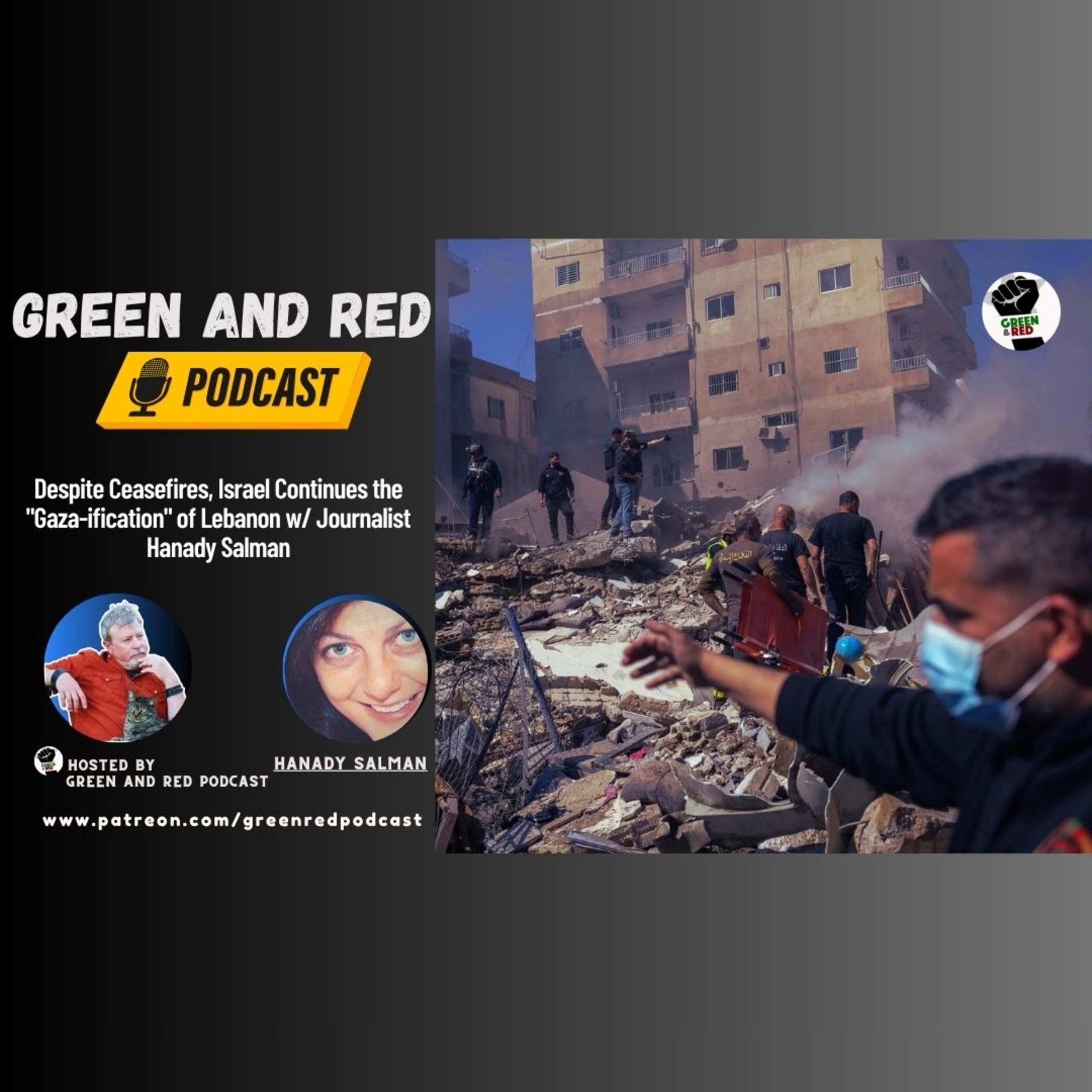
Green & Red: Podcasts for Scrappy Radicals
Despite Ceasefires, Israel Continues the "Gaza-ification" of Lebanon w/ Journalist Hanady Salman (G&R 488)
00:37:43
Loading summary
Transcript61 lines
- [00:01]
A
Welcome to Green and Red Scrappy Politics for Scrappy People, a regular podcast on radical environmental and anti capitalist politics. Brought to you by Bob Bozanko and Scott Parkins.
- [00:14]
B
Welcome to the Green and Red podcast. I'm your co host Scott Parkin in Berkeley, California today. Bob is off on assignment today. We're joined by Hanadi Salman who is a journalist based in Beirut. She's contributed to the book Inside Lebanon. You can see her writings at Joelia and other places. But we're going to talk to her about the war that's been going on in her country. Hanadi, welcome to the Green and Red podcast.
- [00:41]
A
Thank you very much. Thank you for having me.
- [00:44]
B
Yeah, excited to have you here. The war began on March 2 and the Israelis have killed almost 2100 people in Lebanon according to latest figures I looked at before we started, including 165 children. Could you actually maybe. And there's also the Israeli strategy seems to be that they're wanting to annex at least southern Lebanon as some sort of buffer security zone according to them. But I'm just wondering if you could talk a little bit about what is what you're seeing and what's happening on the ground in Beirut.
- [01:17]
A
Do you mean in the political sense or in the military sense?
- [01:22]
B
Let's start with the military since like how the war is affecting people on the streets of Beirut.
- [01:26]
A
Yes, Beirut has been bombed very little since the war started on March 2. However, the streets in Beirut and the houses in Beirut is filled with some 1,200,000 refugees who had to flee the south of Lebanon and the southern suburb of Beirut. So it's a huge number of people to be accommodated in a city that's not prepared to accommodate this number of people. The war in the south has been devastating. Entire villages have been completely destroyed by the Israeli military. Something like what happened in Gaza during this genocide is happening here in Lebanon. Some villages want, the Israelis want to have some villages completely destroyed to make sure that people are not going to go back there and so they, they can occupy them more comfortably. The southern suburb has also been almost completely destroyed. Some neighborhoods in the suburbs have been destroyed and these are not on the border. So they cannot use the same excuse to say that we want to wipe them out because we don't want to have them on our border which are not their borders. Actually it's Palestinian borders. But anyway, so there's a, the Israelis army and probably government have this undeniable uncomprehensible just will to engage in destruction and killing and just wiping out entire families, villages, olive trees, everything that's green and alive wherever they go. And yes, I know that, I studied political science and politically people try to explain that because there's a resistance, because they don't feel secure, because they need the buffer zone, etc. Etc. But I as a person and I witnessed more Israeli wars than a lifetime could take. And we witnessed what happened in Gaza and what's happening in the. And Palestine as a whole. I have no idea, I have no idea how to explain this in political terms, in human terms. This is completely unacceptable and this is evil and, and it keeps going because it's completely, it has complete impunity.
- [04:02]
B
And they, My understanding is that they've, in the 2024 war before there was a ceasefire, which really wasn't a ceasefire, they had been destroying villages and settlement, people on the border, and they've just resumed that and almost they're basically just destroying infrastructure from the border to the river, the, the Latagne River.
- [04:27]
A
So what's happened, what happened basically in, in November 24th with this kind of ceasefire is that the villages that were on the, on the borders were destroyed. Not completely, but they were destroyed because there was a war. And, but during the year and a half that followed, every single effort to go and try to reconstruct those villages by their owners, the houses by their owners, were targeted by the Israeli army. So they would target bulldozers, they would target people who were trying to go back to their houses. They would target. So basically no reconstruction was allowed by military power. And of course, during that year and a half, there were killings, there were intrusions inside the villages, modification of their bases and of some of the features of the villages that are on the border. So not only there's destruction, but also there has been complete forbidding of reconstruction too.
- [05:34]
B
And part of what is, what Israel says is that it's because these are Hezbollah consult areas and they're basically just trying to put an end to Hezbollah. Right? They want them disarmed, they want them dismantled. Is that.
- [05:47]
A
I want them to vanish.
- [05:49]
B
Yeah.
- [05:51]
A
Yes. The Lebanese government also unfortunately, now wants them to Vanish because on the 2nd of March, which is the same day that the war started, the Lebanese government took, made a historical decision and during a ministerial meeting, they announced the military wing of Hezbollah illegal in this country. So now those people have no, they don't have the COVID from their own government, from their own country. So they are illegal. Right. And the timing is very fishy. The timing is not innocent. Those people, whether they're called Hezbollah, whether they're called the Communist Party, whether they're called anything, whatever you want to label them, these people are the people of those villages, the people of this part of Lebanon. These people have been fighting the Israelis, resisting the Israelis, because it's not the same balance of power. The Israelis invade, We defend ourselves. It's not that we're starting wars against the Israelis anyway. These people have been harassed by the Israelis, and you would be maybe surprised, but ever since 1947, ever since they invaded Palestine, and those people will never, ever be able to live in peace in their villages and feeling safe for their kids, for their future, if Israel continues to target them every now and then for whatever reason it can, it can give. Yes, today they are Hezbollah. A few Years ago, before 1982, they were the leftists of Lebanon. But one. One common trait is that these are the people of the south who have been fighting the enemy for very obvious reasons, for being invaded with almost no help from the formal Lebanese authorities. And for me, this is the most obvious thing they should do if they're invaded. They should defend themselves. Now, Israel, the Lebanese government, the United States, Europe and the European Union, they have all the same story to tell. We have to get rid of Hezbollah in order to have peace in the south of Lebanon and in the region. Okay, there was no Hezbollah before 1982. Okay, let's get rid of Hezbollah. Who would guarantee that people would be living safely with Israel on their borders after Hezbollah? I am completely certain that if Hezbollah disappears the second day, there would be a new form of resistance and it would be called, and it would have any whatever political ideology, Islamic, leftist, whatever, because the occupation is the reason for the. For resistance and not vice versa, as the world tries to make us believe
- [08:59]
B
how formidable is the Lebanese government's military? Are they going to join Israel in trying to put an end to Hezbollah?
- [09:08]
A
No. Our chief of the army was asked by the government at some point before the war started to deploy the army in order to take the arms of Hezbollah, to disarm them. Disarm Hezbollah. And he refused. He refused because he knows this would lead to a civil war in Lebanon. Just imagine that the resistance will be fighting the army because the army wants to disarm them. That's for one. For two, they are. Lebanon, unfortunately, is made up of a confessional mixture. And because most of the southern villages are made are. You have. Most of the southerners in Lebanon are Shiites, so.
- [09:55]
B
Right.
- [09:55]
A
And you have Shiites in the Lebanese army. So what would happen then? You will have the army would be splitting or. This is a completely unreasonable decision to make and this is why the Chief of Army did not accept to do it. Now, ever since this man, his name is Rodolphe. I don't know, I'm sorry, I forgot his name is very unpopular in the United States. He was on an official visit in the United States and I don't know why. He had to meet Lindsey Graham. Lindsey Graham asked him, do you consider. No. Do you. What's your opinion about Israel? Do you consider it as a. What kind. How would you describe it? I guess the question was. And. And he said, for us in Lebanon, legally, it's still the enemy. And Lindsey Graham went mad and he left the meaning, the meeting. And then he started this campaign against the Chief of Army. And now there are people demanding for him to be replaced with someone who would be more compliant to American and Israeli demands. So, no, the army. The army and Hezbollah fighting, that would be the end of Lebanon.
- [11:11]
B
Right.
- [11:12]
A
Nothing less.
- [11:13]
B
And so these negotiations that have been happening in the US in Washington D.C. the last couple of days, it's been the Israeli government, the Lebanese government, in the U.S. secretary of State Marco Rubio. But Hezbollah is not invited, which the head of Hezbollah has said that they're futile. How do you negotiate a peace if the main party at war with the Israelis is not part of the talks?
- [11:38]
A
I think that the meeting yesterday between the Lebanese ambassador, the ambassador of this Lebanese government and the ambassador of the Zionist entity in the United States with the very tattooed Secretary of State of the United States. Right. It's just a picture because there have been ever since this government was in place in Lebanon. That's like a. More than a. Yeah, more than a year ago. And the President and the government, they have been pushing towards having some kind of agreement with the Israelis, despite the fact that the Israelis never stopped their war on Lebanon, despite the fact that I believe most Lebanese people are not in favor or sympathetic to having any kind of normalization with the Israelis at this point. And what happened is that the government has been delivering to the US Government all their demands, ignoring their people. One of these demands was announcing that Hezbollah military wing was illegal. And they went and they decided to go to the United States to have a ceasefire, which is very problematic in. In so many senses. We had a ceasefire in 2024 guaranteed by the United States, and it didn't hold. Israel was breaching this ceasefire every single day, whereas Hezbollah had stopped every military action. So they're going back to the United States to ask for the same ceasefire with the same guarantor that did not even want to deliver a year and a half before. Right. The second point is the Israelis. Katz, the Israeli Defense minister, sorry, war Minister, and the Israeli ambassador in the United States both announced, we are not interested in a ceasefire in Lebanon. What we want is the disarmament of Hezbollah and the peace treaty with Lebanon. Normalization. And the Lebanese were saying ceasefire. So they went and they knew that the other party was not going to deliver and that the other party wanted something else. The third point is, okay, the Lebanese part went to the United States to have a deal on ceasefire. How can they deliver? How can they deliver? How can they ask Hezbollah fighters to stop fighting? They have nothing. They have nothing as a card that they can play in order to have their demands met. You see what I mean? For me, it was a total failure. But I think the vicious part of it is there is a first step and a very well wanted process that would find that would eventually lead to some kind of normalization with Lebanon, between Israel and Lebanon, but that would be built on very fake and unstable basis.
- [14:42]
B
It also seems like they, you had said this before, but basically they want to send, they want to turn southern Lebanon, at least southern Lebanon into something similar to Gaza where they occupy it and they just wage a war against the civilian population saying that they're going after Hezbollah.
- [15:00]
A
Exactly. And I Yanni, somehow it's very bizarre that the Lebanese government cannot see that, although it's obvious. And throughout the years we have learned that Israel's always pretended that it needs a security zone to, to protect something, and then the security zone would need another security zone to protect it and then another security zone to protect it. Before the war started. No, between the first ceasefire in November19, November20 and the war started March 2, there were settlers, Israeli settlers, that came to South Lebanon and that were advertising spots of land and advertising them for Jewish families, Zionist, Jewish Zionist families in the United States. Now they're changing the names of the villages in South Lebanon. Israel has never hidden its intentions towards Lebanon, towards Palestine, towards everybody, towards all this, all this part of the world that goes from the Nile to the Euphrates. And that's what Netanyahu said very clearly, clearly in a speech to the United nations during the, during the Gaza massacres. Israel is very frank. I'm sorry to say that somehow. And it knows what they know what they want, they're going towards it, they're doing it in a very wrong manner. They're using force, they're using US money and arms, et cetera, whatever, but they're working for what they think is their own benefit, their own survival. Whereas none of us, I mean not only in Lebanon, except for the resistance in Lebanon and Palestine and Yemen and Iraq, none of us is working on everybody's, let's just like falling apart and yeah, okay, we'll do whatever you want. Okay, we'll do whatever you want. And although this is not leading anywhere, but it keeps amazing me how people can be this much split over such an obvious cause.
- [17:17]
B
Right. How are the other Arab states seem pretty bought in with the US at this point. There's US bases all over the Gulf states and the Syrian government is now pro US and seems to have relations with the Israelis. But how do you see the other Arab states, the Gulf states, Syria, places like that, Iraq falling and particularly around the, it's been in the media a lot about where they are falling with the US Conflict, US Israeli conflict with Iran. But how do you see, is there any difference as, as far as like Israel going into Lebanon with how they see it?
- [17:53]
A
I don't think so. I think that those regimes are very much pro what Israel is doing. For one, the Saudis now are trying, like take the Iranian example, right? So Iran and the United States are having talks in Pakistan and Pakistan is trying to be the mediator between them. And suddenly you see the Saudi regime just transferring inherent amounts of money to the Pakistan government, which makes it in the eyes of Iran completely, I'm sorry. Oh, without any kind, completely losing its credibility vis a vis Iran as a part of this deal. The Saudis also are pressuring, have been pressuring the Lebanese government for the past years, but mostly since this president and his prime minister came to power to go hard on Hezbollah. And they've been threatening, not threaten it, so they have been blackmailing Lebanon unless that, unless the Lebanese government goes hard on Hezbollah, Disarms Hezbollah, etc. They will not, they will not send any kind of AIDS to Lebanon. And Lebanon has been suffering from a huge economic and financial crisis lately. So the Emirates, the Saudis, even Qatar were holding or conditioning any kind of aids that would be delivered to Lebanon to the way to the Lebanese government getting rid of Hezbollah. Right. And then the war started and we didn't even, we didn't get the money and they didn't get rid of Hezbollah. So yes, the Gulf states regimes have a very clear position on that. They see Hezbollah as a, as an extension of Iran, which in my opinion is not true. Of course. Hezbollah and Iran have very close relations of course, Iran helps Hezbollah in many ways. Right. And nobody denies it. Both parties admit it. But Hezbollah does not follow an Iranian agenda. This has been true during. During Hassan Nasrallah, the. The previous Secretary General of Hezbollah. This has been true until today. The Lebanese resistance fighting in Lebanon is fighting because it's under occupation. It's as simple as that. So it so happens that now in, in the 2020s, it's Iran helping resistance. Before that it was Iraq, it was Libya, it was Syria, it was. Now today is the only party that wants to have the resistance in Lebanon. And if I were resistant in Lebanon and this is the only party that would help me in my resistance, of course I will take their help. Let alone that the Hezbollah and Iran have a common ideological ideas. Ideology. Oh, yes.
- [21:05]
B
Last week, when there was a temporary ceasefire was attempted between the US And Iran, one of Iran's demands was that there will also be a ceasefire in Lebanon. And Netanyahu's response was Operation Epic Darkness, where they bombed 100 sites in 10 minutes and killed hundreds of people. The Financial Times said it was one of the deadliest single bombing campaigns in the history of a country.
- [21:32]
A
That's true.
- [21:32]
B
Yeah. And. And I'm. You know how it seems. It seems like Netanyahu wanted to escalate just to prove a point that he was unhappy with the U. S. Iranian ceasefire. But I'm wondering if how what's happened in the last week has shifted. How it has shifted. How shifted? Yeah.
- [21:53]
A
Situation in Lebanon, you mean? Yes, I'm going to tell you. So I'm going to tell you something that I'm not sure about. But it's widely spread in Lebanon, even among journalists and some media outlets. There is a belief that this government was okay with this operation that the Israelis performed in Lebanon on last Wednesday.
- [22:17]
B
Right.
- [22:18]
A
To create pressure on people living in Beirut to have them accept what happened yesterday in the US State Department and to have them accept, to have them being more soft on accepting talks, direct talks between Israelis and Lebanon. Because before that there were very few attacks on Beirut. Right. Mostly the war, the aggressions were in the south and the suburb and in the Beqa Valley in East Lebanon. Right. And people living in Beirut, including myself, we were living somehow a very normal life instead. Except for the bombing we were hearing. Except for if you're concerned or not. But people who are not concerned, they could. They just went on living their lives with nothing changing. Right. So you had to have them engaged in a way to have the. To have the support. If you're going to go meet the Israelis in the middle of a war that the Israelis are waging on your country.
- [23:23]
B
And was the bombing that happened on last Wednesday like the southern suburbs are controlled by Hezbollah? Correct?
- [23:30]
A
What do you mean? No, I'm talking about the top. I mean that the Lebanese government did not mind what happened last Wednesday in order to have some kind of popular support for whatever he was going to do. What happened was atrocious. What happened, it touched everything. It touched every single person in the city because they bombed everywhere. These are places and roads and that everybody would be taking at any point of time in the, during the day. And you have a place in the suburb called Haysulou, that's one of the poorest suburbs neighborhoods in the suburb, which is the poorest place near Beirut. They are still looking for people under the rubber till now, one week later. And there were more than 80 people killed there. Right. So it's not over yet. Okay. As for your questions, I think that Netanyahu, yes, he did want to sabotage the talks between the Americans and the Iranians in Pakistan on that day.
- [24:36]
B
Right.
- [24:37]
A
He also, I think he has a long history. I don't know what he thinks. I'm sorry, he's such a criminal. He could have done it for fun.
- [24:45]
B
Yeah, exactly. He does have a long history of anytime there's negotiations going on, he has a history of sabotaging those with assassination campaigns.
- [24:54]
A
Yeah. So just today it seems that there are reports that the Americans and the Iranians agreed on having a one week ceasefire in Lebanon. That's the week that's left of ceasefire between the United States and Iran. There's a week left. So it seems that they agreed to have one week of ceasefire in Lebanon as a gesture of good will. So now it's. So now the Israelis are saying the Americans want us to stop to have a ceasefire for a week. And then you have all their media, you have channel 12 at some point saying, no, it's not going to happen. And then you have Channel 14 saying, yes, it's going to happen. They will not decide. And even if they agree for a ceasefire based on previous experiences, they can breach it at any point. So maybe, I don't know, I don't trust Trump, I don't trust Netanyahu. But maybe we would have, starting tomorrow, ceasefire for one week in Lebanon. And I would like to say something regards that if it happens, I doubt that they will do it, except in one case, if they do it, if they abide by the ceasefire, that would mean that the resistance is doing A huge great job on the field and there. Because I know for a fact that they have lots of casualties. They have been fighting for like more than a month and a half now, more or less. They haven't been able to control one single village completely with all their arms, with all their warplanes, with all the support that they have, those fighters, God bless them. I don't know how they do it. I don't know what they do. They have this incredible courage and faith and they keep fighting and fighting in order not to let them go into their villages. And that's amazing.
- [26:52]
B
I want to shift it a little bit, but also ask about something you talked about is that some of the stories coming out is the stories. Some of the stories coming out of Gaza was journalists were intentionally targeted by the Israelis. Now we're seeing that with happening in Lebanon, I keep almost daily, every other day I see stories of journalists, both Lebanese journalists and international journalists being killed or wounded in an intentional manner. I'm wondering if you could talk a little bit about the war on journalists that's being waged by the Israelis.
- [27:23]
A
Yes, of course. Journalists are targeted, but in Lebanon they are not yet targeted. Targeted as they were in Gaza, because Lebanon is a country, it's bigger than Gaza geographically. I know for a fact that some of the correspondents who want to go to cover stories in the south, they need to send word ahead of time to the Israelis to make sure that they will not be targeted. The Israelis can do anything at any point. But the biggest tragedy that's happening is not happening with the journeys yet. It's happening with the paramedics.
- [28:02]
B
I was going to ask about that
- [28:03]
A
because it's such a huge. It's incredible because it's the same playbook as AM Gaza. It's incredible. They just use the same playbook. There has been 91 people in the medical field killed since 2 March. 214 injured. And mind you, those people are targeted. They are not just like casualties of other events happening, they are targeted. 108ambulances and medical vehicles have been specifically targeted, killing whomever was inside of them. Six hospitals were bombed, 25 health centers. I don't know what you call them. It's like where you go to get first aid, right?
- [28:53]
B
Medical facilities. Yeah.
- [28:54]
A
Yes, exactly. And Dr. Hassan Abu Sitta, who worked in Gaza during the genocide and who is now working in Lebanon, wrote yesterday on his account on acts saying that one of the targets of Israel that was. That's that happened, I mean, in Gaza and in Lebanon, like This attack that you talked about on Wednesday, last Wednesday, when they hit 100 places at the same time, is to overwhelm medical centers and hospitals and to have a huge number of people. So those hospitals and which happened actually would, with time, be unable to operate properly. So in order to have a bigger. A bigger number of victims every time.
- [29:42]
B
The other thing, the other thing that you're completely clear, the other thing is that what we saw in Gaza, and I would actually say we saw this in a. We've seen this in Iran, too, is that they strike a site, and then when the medical personnel show up, they strike it again. Like the double tap. In the US we call it the double tap.
- [29:59]
A
They love to call it double tap. Yeah, yeah.
- [30:02]
B
And then Israel also claims that it's. What it's doing when it's doing this is. It's targeting, like, Hezbollah infrastructure. Militant infrastructure. That's. Which is also what they said in Gaza.
- [30:13]
A
Yes. And my father is. But the Pope. Israel has been lying about everything for me since ever. But at least for the world. They've been seeing their lies ever since the genocide in Gaza. They're targeting. They targeted Al Shifa Hospital in Gaza, saying that there were Hamas fighters there. And then they went in and they went to the basements and they searched the whole hospital, and there was not one single knife in that hospital. But that was done after the hospital was completely almost destroyed. Yeah. They killed kids and they say Hezbollah. And they kill. And they target hospitals, say Hezbollah. They target cars and they say Hezbollah. They target paramedics and they say Hezbollah. They target, like, Haidawli, the displaced people, and they say Hezbollah. They're targeting every single building in the suburb, and they're saying Hezbollah. Okay. And they're targeting the fields and the crops and the Olive Tre. All of us are Hezbollah. In that case, I think they. I think the Israelis. I don't think there will ever be any kind of coexistence with this entity. It's either us or us.
- [31:34]
B
Right.
- [31:35]
A
This is what Mahmoud Darwish, a great Palestinian poet, wrote. It's either us or us.
- [31:43]
B
I've gotten to the end of the questions I wanted to ask. I just maybe as a sort of final question is our. Go back to the street in Beirut. Are people preparing for a wider attack from the Israelis if they're not getting what they want, like negotiating tables or if they're unhappy with the US And Trump obviously got himself into a war and didn't know how to get himself out, so he's trying to, like, make A deal to get out. And Netanyahu doesn't seem to like that. But is there, like, preparation with people on the street that the Israelis could intensify the violence beyond, like Hezbollah or what have you? Like, even worse than what they did last Wednesday?
- [32:25]
A
What negotiations? No, no, seriously. You mean between the, the meeting between the ambassadors in dc?
- [32:35]
B
Yeah. Or the US Iranian negotiations.
- [32:37]
A
They did not agree on negotiations yet. They did not. They didn't agree on anything, actually. I think that what they wanted was the symbolic picture photography taken of both with the, with both flags next to each other. But there are no plans of negotiations yet. The Israeli demands are clear. Normalization. The Lebanese have not said anything yet. They're saying ceasefire, which is, which is something that they're saying to someone who is not credible, who has failed all their promises. So I don't know, but you're talking about the streets. And I'm thinking that there's one very important point that is part of this war. During previous wars, there was empathy, sympathy and professionalism from the side of the Lebanese media. Was the people. The Lebanese media has been systematically attracted, no, seduced by the Gulf regimes throughout the last three to two years, that they are now covering the war, covering the displaced, as if it was happening, I don't know, on Greenland. We don't have any kind of national feelings. It's as if we don't have any kind of national feelings. It's very bad. And you should know it, because this is what's happening in the United States right now. When the media, mainstream media, is completely biased to the regime, then people are brainwashed people. Yeah, exactly.
- [34:26]
B
And, but very familiar with that.
- [34:28]
A
Yeah. And this is happening here and now with the war going on, so it's even 100 times worse than regular times. So I haven't seen human science side stories in mainstream media in Lebanon, nor. And the Western media for that matter, except for talking to people who are annoyed by the noises that the bombs create. I have seen this kind of stories and this is exactly the phenomenon that has happened with Gaza. I have seen human side stories, faces and names of the victims on social media, but not on mainstream media, not by people who are supposed to be doing their jobs in their countries properly. And that's very unfortunate. And that makes a very big difference in a war because those victims, displaced people who have lost loved ones, they are not. They don't find their sorrows reflected in their national media, let alone their local official regime and states people, I mean, if they are states people, Right.
- [35:37]
B
I'm gonna. I'm gonna end it there. I want to thank you for joining me today to talk about this.
- [35:44]
A
I want to thank you for being interested in my country, and I want to thank you for letting me say things as I feel them. I know sometimes that it's not very professional to have your feelings out, but at this point, sorry.
- [35:59]
B
We're also happy to have you back on again, too, as more things develop.
- [36:02]
A
Oh, yeah. I'd love that. Thank you very much.
- [36:05]
B
Yep. Folks, we've been talking with Hanadi Saman, who's a journalist in Beirut. If you like what you're hearing, please check us out on Facebook, Instagram, Twitter, and Bluesky. If you're watching this on YouTube, give us a hit that subscribe button. If you are listening to us on a audio platform, give us a rate and review. And then if you really like us, go to greenandredpodcast.org and hit that support button or become a patron@patreon.com GreenRedPodcast it's been great talking with you.
- [36:30]
A
Thank you, Scott, very much. Thank you.