← Green & Red: Podcasts for Scrappy Radicals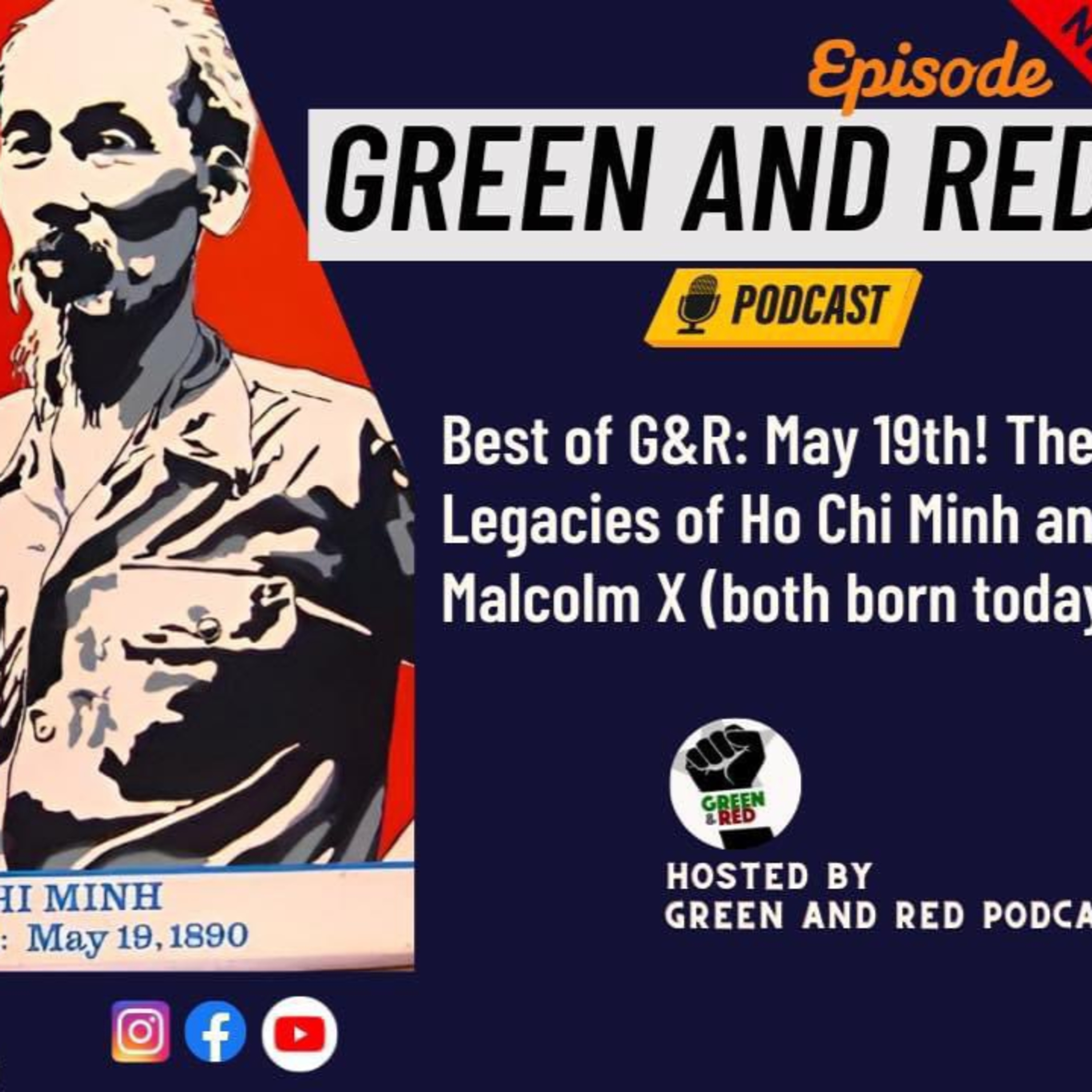
Green & Red: Podcasts for Scrappy Radicals
ENCORE: May 19th! The Legacies of Ho Chi Minh and Malcolm X (both born on May 19)
01:19:10
Loading summary
Transcript82 lines
- [00:01]
Scott Parkin
Welcome to Green and Red Scrappy Politics
- [00:03]
Bob Bozanko
for Scrappy People, a regular podcast on radical environmental and anti capitalist politics. Brought to you by Bob Bozanko and Scott Park.
- [00:25]
Scott Parkin
Hey, everybody, this is Scott Parkin, co host of Green and Red Podcast, reporting from the quarantine. We're still here and we have lots of exciting things going on. We have some exciting shows coming up. But today is May 19th. And so we're excited to focus today on because it is the birthday of two powerful, influential, iconic figures in world history, which is Ho Chi Minh and Malcolm X. And so we're going to be talking about those two revolutionary spirits and the lives they lived. And as always, I'm joined by Bob Bazenko.
- [01:16]
Bob Bozanko
It's good to talk to you again, Scott. And yeah, 130 years ago today, Ho Chi Minh was born, and 95 years ago today was born. And they are absolutely two of the most important figures in revolutionary politics and liberation movements, really inspired countless numbers of people in the later 20th century, especially later second half of the 20th century. And I think they're important to know today. You and I kind of grew up in a generation one removed from Ho and Malcolm. So we were, you know, kind of trained by people and inspired by people who, you know, were directly influenced by them. But now, you know, we're, you know, we're kind of way past that. And so it's important to understand, you know, what that time was like, the period after World War II. You had this period of anti colonial revolutions, liberation movements. And Ho and Malcolm were clearly two of the most important people in that entire era. And they're worth knowing still today.
- [02:24]
Scott Parkin
Yeah. And so I think what we, what we talked about is kind of starting with a little bit of background on each of them and then talking about part of what they contributed to that moment that was in the 20th century of anti colonial revolutionary movements. And then we'll also talk some, and we'll talk about, we'll go into depth on a couple of things there. And then we're also going to talk about their legacy even today. And so I think we were going to start with Ho.
- [02:58]
Bob Bozanko
Yes. As most of you know, I've written a couple books on the Vietnam War. I'm a professor. I teach classes on Vietnam, not Vietnamese history per se, but so I know a little bit about Ho Chi Minh. And, you know, he's been an inspirational figure in my entire life, really. I mean, from the first time I ever started reading about the Vietnamese, the Viet Minh, the National Liberation Front at Ho, you know, I was always kind of moved by the power of his intellect, by his strategic brilliance, and by his, you know, kind of by the way, by his spirit, his revolutionary spirit. Nguyen Singh Khung was born on May 19, 1890, in Nha' an province in Annam. And he would become known to the world later as Ho Tsimin. His dad was a civil servant who was fired because he refused to learn French. He refused to work in Vietnam's French colony. They contrived these charges of like drunkenness and embezzlement. Ho himself was well educated. He went to a French academy in Hue, and after that he left and he became a merchant seaman. He went to London. And then, most important, kind of, in the early period of his life, the most important step was going to Paris in 1917. There was a huge expat community there of East Asians and of course of Vietnamese, because it was a French colony. And there he kind of began his political life in earnest. He had actually been raised by his father to be a nationalist. A very famous French, I'm sorry, very famous Vietnamese poet warrior named Fanboy Chow was friends with his father, and Ho was aware of him. So he was raised in this nationalist spirit. But during World War I, in Paris is where Ho really kind of developed politically. There are always these stories that he actually rented a tuxedo in 1919 and went to Versailles to try to get a meeting with Woodrow Wilson, the American president. Wilson had been talking about ending colonialism and self determination. Wilson didn't mean that to apply to Asia or Africa, anywhere like that. He was talking basically about the Balkans and places like that, Europe. But Ho already had that idea behind him. From there, he became a leading intellectual and a revolutionary. In the 1920s, he went to China where he met Zhou Enlai and Liu Shiqi, who were both really influential in the Chinese Communist Party and in the Chinese revolution. He joined the pcf, the French Communist Party. So Ho was already making this movement toward being a communist, but he also had this nationalism during the Vietnam War. One of the big issues is the Vietnamese revolution. Is it nationalist or is it communist? Well, it's both, right. And a lot of liberals always tried to deny that the communist element of it, which was ridiculous because Ho was founder of the Indochinese Communist Party in China. He went to China and Moscow both in the 30s. He was appointed to organize a league of East Asian Oppressed peoples. So he was very well known already by the 1930s throughout communist circles globally. He went to the Wampoa Military Academy in China, very Famous training ground for revolutionaries, where he was trained by, ironically, Zheng Yuxi and Zhou Enlai, who later become rivals in the. In the. In the Chinese civil war and in China. His. The best known biographer in the early years of Po was a French political scientist named Jean l'. Couture. And I always like this quote, and I use it whenever I talk about Ho, he said. While he was in China, Ho began a practical course in political philosophy and behaved in general in the manner of a secular saint, chopping wood, stopping the barber from beating his wife and feeding the little boy. He played a role that was part Buddha and part Lenin in Finland. And I like that because that became Ho's Persona. For basically the rest of his life. He was Uncle Ho. And if you've ever seen photos of him, I'm sure you have. He's a very frail guy, short, he has a long goatee. And he had developed this Persona. And he didn't have this kind of feared like Stalin. Right? You're afraid of Stalin. Ho was quite opposite. Ho was very kind of beatific. He was a poet, a revolutionary. While he was in China, he developed contacts with people he would work with the rest of his life. Fan Vandong Trong Chen, who became probably his best friend. Van Nguyen Zapp, who was the commander of the Vietnamese military forces for most of the entire revolutionary period. They together formed the ICP, the Indochinese Communist Party. So already by the early 1930s, they're working on national liberation to get the French out of Vietnam and to create a communist society. And their first program, their first platform, appealed to both of those strains. And that's important because that's really going to be the threat of the Vietnamese revolution all the way through the American era. They made an appeal to the oppressed colonies and the exploited working classes. Nationalism and communism. They obviously stress getting rid of the French, but they talk about land redistribution, civil rights, public education and inequality between men and women, which was part of the platform. Later they formed an organization called the Viet Minh, which would be the military grouping, the political and military group that fought against the French all the way through that. There were two main issues, though, on which Ho and many of his comrades kind of had some issues. And I think this is important. And Malcolm, you kind of see kind of something similar too. Initially, Ho wanted to appeal not just to the peasants, but also to middle class and small landowners, petty bourgeois, to create kind of a popular front. And most of his comrades were opposed to that. So ultimately they said that the Viet Minh, the icp, would be the party of the working class. But Ho never really lost that kind of desire to kind of try to reach out and create more of a frontist government. And when you talk about Malcolm, I think we're going to see something similar to that later in his life. At the same time, Ho would often be castigated for kind of being too deliberate and too slow. And in the early 1930s in Vietnam, you started to see these kind of spontaneous actions taking place. And as I was looking at this earlier today, I thought of what's happening today, because right now in the United States, this is what we're seeing. You're seeing kind of wildcats and spontaneous actions and mutual aid, but you're not seeing the kind of leaders, certainly not the Democrats and even organized labor, taking the lead in any of this. And. And this isn't that unusual. Right. So even in a revolutionary moment like you had in the 1930s in Vietnam, Ho was. Was seen as too deliberate. He was actually frequently castigated, sometimes very harshly by other communists for being too deliberate, for being too slow. So you started to see these. These actions, you know, strikes and cement works and rubber plantations and textile mills and. And the French would always kind of react fairly harshly, Right. And so you had a great deal of repression. And that repression tended to really damage the nationalist movement. And it was kind of like. That was Ho's point, right? They're going to come in. But they were always able to kind of work out of that. And the French repression was so harsh that, you know, even though they would kill or more likely imprison nationalist and communist leaders, it also turned the Vietnamese even more harshly against the French. Remember, the Vietnamese have a long history of fighting off foreign invaders, literally for millennia, Chinese and Mongols. And then in the.
- [11:09]
Scott Parkin
There's a great film called Indochine about the French occupation of Indochina. And there's one of the kind of principal characters actually ends up in a French prison, and her sort of like French godmother or her French surrogate mother is really angry about that because she knows, you know, what do people come when they go to those French prisons? They become Viet Minh. That's where they get politicized or that's where they get radicalized. And that's actually a little bit similar to what happens with Malcolm early in his life as well.
- [11:38]
Bob Bozanko
Well, and I think, yeah, Ho and Malcolm both spent time in prison, and that was really vital for them. Ho's interesting because, I mean, it's very kind of labyrinthine, and I'm not going to go into all the details, because it's very complex. But he goes in and out of China throughout the 1930s. And at various points, like he's on the payroll, so like the Kuomintang actually are paying him. And then at various times he's in jail. So just kind of depending on which way the wind blows. In the 30s, because of the popular frontism against Hitler and the Japanese, Fascist Ho kind of has an opening there. And so France moved into a popular front phase to fight against the Nazis, which gave some opening in the colonies as well to some of these groups like the Viet Minh. And they, you know, they ran, they were kind of in a semi legal basis. They ran people on council and stuff like that. And they were able to more openly organize. So this is when you see the real emergence of the people who would be still leading the Vietnamese in the 1960s during the American phase of the war. Fan Mandang, Chongqing, Le Juan, probably most importantly Le Juan and Wando and all of them, you know, throughout the 1960s, these were like kind of the most wanted on the American list, right? These were the guys who were the revolutionaries. Even though this was happening in Vietnam, Ho remained in both China and in the Soviet Union, kind of going in and out. He, he ran into some trouble in both places, especially actually in the Soviet Union, because he wanted the ICP and the Viet Minh to be a Vietnamese movement not under the control of Moscow. And he still believed that it was useful to reach out to kind of peasants who weren't part of the really rich landowning class. So he was often criticized for working with class enemies. But he understood that the crucial element of Vietnamese politics was land. And so that was always like, he went back to that whenever there was some kind of issue. You know, he pointed out that Vietnamese society couldn't be liberated, let alone become communist, until it addressed this problem of land. Because these French landholders and their Vietnamese friends, Vietnamese collaborators, control like massive, huge percentages of Vietnamese land. And so the Vietnamese peasants had almost nothing. And if you look at a lot of the revolutions, that's, that's kind of one of the key things. Like I would often say in class, you know, if you want to determine if something is revolutionary or not, look at their position on land, land reform. Right in the Freedmen's bureau, right after the civil war in the United States, they were going to give land to ex slaves. And that lasted about 18 months. Because, you know, once you start redistributing land, that's kind of, that's kind of how. Almost. How you determine whether you have a socialist revolution or not or what kind of revolution it is or what kind of movement it is, right? If you start taking land away because you're not making loot, you're not making new land, you're taking it. And so that's a big element and that. And pretty much every level of Vietnamese society, except for the collaborators, supports that. You know, it's like today, right? Everybody supports. Huge numbers of Americans today are supporting some kind of national healthcare system, right? But you have the kind of political leaders who are opposed to it or
- [14:53]
Scott Parkin
unemployment or, you know, increased. Improved unemployment benefits, more than just a single $1,200 check.
- [14:59]
Bob Bozanko
Exactly right. And so you have these political leaders, you know, the Democratic Party who are useless and the labor leaders who are pretty much useless, just as mond. Just as much as useless, right? And so you have this mass. Right? And so. But Ho isn't like that. Ho's not Nancy. He's not Nancy Pelosi or Joe Biden at all. Ho's biggest concern is always, you know, kind of what the French reprisal will be. And, you know, he caught hell for it all the time. He was never. He had this kind of international, global reputation as Uncle Ho in Vietnam. I mean, he was often considered kind of a not. Not a sellout, but he went too slow. He was kind of thinking in old ways he wasn't adequately revolutionary and things like that. So, you know, he caught flak all the time among the Vietnamese. Right. Ho also was the beneficiary of a very great fortune. In a lot of cases, Ho had a particular idea, strategic idea, and I don't remember the Viennese phrase for it, but it was essentially called the opportune moment. And you wait for the opportune moment, right? And so he would often, you know, some of his colleagues would say, okay, you know, we need to increase the resistance to the French or, you know, we need to get rid of all these collaborators or whatever. And Ho would often say to wait for the opportune moment. And generally, you know, he was right. He had this really keen understanding of global politics. So When World War II came, he was ready. And, you know, he kind of had a sense of what was going on in France after it fell to the Nazis in May of 1940, and in Japan, and Japan, remember, was trying to create this kind of global. This Asian empire. And Ho understood that Vietnam would eventually be part of that. So even though the French held the Vietnamese Viet Minh, Ho's group, and you Know, with great suspicion. Ho kind of figured that the time was coming. And so they began organizing in the countryside, not in the cities, because it would be a lot easier. And they became, in 1939, officially became a national liberation front. And so national liberation, not class struggle, actually took priority. Because of World War II, the Japanese set their sights on Indochina. And in 1940, Japanese troops landed in Vietnam and began. It was kind of a joint occupation. Actually. The French never formally gave up control of Indochina. But there were Japanese occupation forces there as well, Right amid that, in 1941, Ho came back to Vietnam. Was the first time he had been there in 25 or 30 years he entered Vietnam. And actually that's the point where he becomes Ho Chi Minh. He had used all kinds of nom de guerre before that. Ho Chi Minh means more or less he who enlightens. At one point, he was going by the name Nguyen Ay Kuk, which meant Nguyen the patriot, right? He lived in a cave which he named Karl Marx, next to a river which he named Lenin. And he distributed a newspaper and there were to create the Viet Minh and said, national liberation is our most important issue. He was then again arrested by the Chinese. And the reason I mention that is because I get to read one of Ho's poems, which I really love. While he was also a poet and while he was in prison with the Chinese, he wrote these verses. And I think it says a lot about him. It's cool. Being chained is a luxury to compete for. The chained have somewhere to sleep. The unchained haven't. The state treats me to its rice. I lodge in its palaces. Its guards take turns escorting me. Really, the honor is too great. So Ho kind of mocking his time in prison. He was then let out. And then the Chinese began paying him, which was really crazy. And then things got serious in 1944, 1945, World War II was coming to an end. And then, obviously, with the atomic bombings in 1945, Japan was defeated. So this is kind of a pivotal time for the Viet Minh, right? Because now that Japan has been defeated, Ho and the Viet Minh, who had led the resistance both to the Japanese and to the French, assumed. And they heard rhetoric coming out of people like Franklin Roosevelt about anti colonialism. So they assumed that Vietnam would become a sovereign state, become an independent state. The Viet Minho even gave a statement when the war in the Pacific ended in August of 1945. He said, the Japanese army is crushed. The National Salvation Movement has spread to the whole country. The Viet Minh has millions of members from all social stratagems. Intellectuals, peasants, workers, businessmen, soldiers, and from all nationalities. In the front, our compatriots march side by side without discriminating to age, sex, religion, or fortune. So Ho again, is kind of taking this National Front approach, and then on. And I'm sure many of you are aware of this. On September 2, 1945, he went to Ba Dinh Square in Hanoi with a crowd of maybe 500,000 people, and he issued a Vietnamese Declaration of Independence. And I'm sure you are all aware, you know, how it began. Ho's words that day were, all men are created equal. They are endowed by their creator with certain unalienable rights. Among these are life, liberty, and the pursuit of happiness. Ho cribbed the Vietnamese Declaration of Independence from the American Declaration of Independence. He also allegedly, which is probably likely, wrote letters to Harry Truman trying to explain that even though they had a communist revolution, they wanted to work with the United States. They admired the U.S. they weren't enemies, and the U.S. claimed they never received them or anything like that. As far as the US Was concerned, any movement that had any kind of socialist or communist involvement was an enemy to the US and in 1945, the United States was really adamant about creating kind of a capitalist trade area in Asia. So it wanted the Chinese, which weren't communist yet, and the Japanese to become, you know, kind of bulwarks for capitalism in Asia. Trade with the United States and trade with other areas. So people like Ho Chi Minh were a threat to that. Right. If Vietnamese became communist, then Japan would lose this trading partner. So independence was denied. The French came back in. The US Supported it. And Ho. And I'm not gonna. This is kind of, I think, a good kind of place to take it up to this. Ho, actually, instead of now, the Viet Minh wanted to go to war. They wanted to create a national liberation struggle right there. A group, guerrilla warfare. And Ho backed off. And it's kind of one of. One of his most famous quotes. He said that the era of the white man in Asia is dying out. And I would rather sniff French shit for another five years than eat Chinese shit for another thousand. And so Ho basically said, I'm willing to let the French come back in. We'll have some kind of shared arrangement for power, and then they'll be gone because it's inevitable, and then we can have national independence. So in 1946, Ho and the French signed something called the Fontainebleau Agreement, which kind of was a power sharing agreement. The Viet Minh weren't real happy about it they weren't real happy with Ho Si Minh. And Ho, again, waiting for the opportune moment, kind of understood that even though he had good relations with some of the French commanders, there were others in particular areas who weren't. And in Haiphong, there was a French commander named Debay, who. He hated the Viet Minh. He wasn't in any way cooperative with them. So he decided to crack down on the Viet Minh in Haiphong, which is a port in the kind of northern areas. In the 19. I forget when it was. Richard Nixon mined Haiphong. Serious escalation of the war. So in 1946, in November, debate opened fire on Viet Minh positions. And over the course of the next 24 hours, killed about 6,000 Vietnamese, wounded another 25,000. The Democratic Republic of Vietnam, the state that Ho had issued and created, declared all agreements with the French to be null and void. And the First Indochina War began from that point on. We'll talk about that later, because I think the American period. I think people know a lot more about that. But I wanted to kind of give you those background because I think it's really fascinating. He's in and out of prisons. He's in and out of China and the Soviet Union. He's in and out of hot water with his own comrades and allies in the Indochinese Communist Party and the Vietnam movement. But he always figures a way out. It's a strategic, brilliant, you know, strategic brilliance. He's just always kind of aware of what's happening and thinking way ahead of everybody else. You know, kind of like the old cliche about playing chess while everybody else is playing checkers. And you're going to see that throughout the rest of his life. So that's how up to the first Indochina War and the Americans are about to come in. And so that's kind of a good place to break. And we can talk about Malcolm Little.
- [24:30]
Scott Parkin
One quick question. You know, talking about Ho in and out of prison, traveling around the world. I know at one point he worked as a dishwasher in New York City.
- [24:39]
Bob Bozanko
Yes.
- [24:39]
Scott Parkin
Like, he lived for a period in Paris during the. At the end of World War I, he tried to get Woodrow Wilson to, like, support independence in Vietnam. And so one of the things that's going to come up when we talk about Malcolm is that, you know, he. Malcolm X is that he, like, he traveled internationally once. He kind of, like, moved into a little bit more prominence within the Nation of Islam. And he was, like, big on this idea that, like, he didn't actually change any of his ideas or values, but he broadened his horizons, which actually made him much more of an effective, let's call it advocate. Right. Revolutionary, etc. And so it's an interesting contrast between, like, Ho and Malcolm in that regard.
- [25:23]
Bob Bozanko
Yeah, well, when we first started talking about doing this, I think that was one of the first things we talked about. I mean, Ho was raised, you know, at the foot of his father and people like Feng Boy Chow. So he was raised on this nationalist ideal. And becoming a communist in Paris wasn't very hard either. But he genuinely admired. I mean, that's hard to believe, right, because we grew up in a different era. But, you know, independence figures, people who believed in national liberation kind of admired the United States, you know, until really, really until the Vietnam War, really until, like, the 1960s. So ho, I mean, that kind of when he, you know, used the Declaration of Independence, that was kind of genuine. It wasn't just a ploy. A lot of revolutionary figures until that period looked up to the US as this kind of beacon. And FDR's rhetoric was anti colonial during World War II. And, yeah, he did absolutely broaden what he believed in. Right. And I think if you look at today, I think there's still these similarities. I think most Americans still have this idea of exceptionalism and don't realize how the rest of the world views the United States. And clearly that Ho had a big, really superlative reputation globally. People admired him. Third World people obviously saw him as iconic. Right. US is calling him the new Hitler, which was laughable to everybody else except for some Americans.
- [26:46]
Scott Parkin
Shifting to Malcolm X a little bit because I actually feel like this is touching on a little bit more also where there's some similarities between Ho and Malcolm. But I don't want to. I want to kind of give the background on Malcolm before we go there. Yeah. So, like, Malcolm X is a very known cultural iconic figure, particularly in the US Particularly in black America. He was born Malcolm Little. Kind of prepping for the talk today, I researched through a whole bunch of different things. I've actually. There's a new book out called the Sword and the Shield, which is about the revolutionary lives of Malcolm X and Martin Luther King by Penny Old Joseph, who's a academic at the University of Texas in Austin. Like, kind of three themes. There's multiple themes kind of arose as I was prepping, but like, three that really sort of like, kind of stuck out at me. Stuck out at me is one. Malcolm was seen as black America's prosecuting attorney. He was Often called that. And he. He was called that. I would say the kind of short answer to that is that he promoted a bold struggle against white supremacy as the corollary to a passionate crusade for black dignity. And so that's going to be like, a little bit. That's a very important piece of who Malcolm is. Another is that he's a working class hero. He worked as a day laborer, factory worker, Pullman car worker. He was also, like, a thief and a hustler and a pimp at one point in his life, which landed him in prison. And then really, actually kind of key description that I found was that he was black America's revolutionary truth teller. And that while people in the civil rights movement were using strategic, nonviolent direct action to sort of push envelopes, particularly in the segregationist south, you know, Malcolm was eviscerating sort of like political, historic, cultural sort of totems of white supremacy, basically through, like, powerful rhetoric, speeches, as well as organizing. You know, he once said that whenever a Negro fights for democracy, he's fighting for something he has not got, never had, and never will have. And it's like a kind of really important piece is that, like, there's these American little d Democratic institutions that like, for instance, Martin Luther King and the civil rights movement were actually trying to just, like, sort of like, caress and use this one particular strategy, which is nonviolent direct action. Whereas, like, Malcolm was looking to like, completely discredit and even, like, put an end to any, like, notion that those were meant to work for everyone. And just a little background on Malcolm. Malcolm, basically. Malcolm Hatt was born Malcolm Little, 1925, to Garveyite parents. His parents were followers of Marcus Garvey, who were also. Who also was a sort of black liberationist, black empowerment activist in the 1920s. His father Earl was murdered. Most likely it was ruled as an accident that he said he was hit by a streetcar. But there's also evidence pointing that he was murdered when Malcolm was six. His mother actually had a mental breakdown about six years later when Malcolm was 12 and was institutionalized. And Malcolm ended up living in a series of foster homes. By the 1940s, Malcolm entered, like, sort of life of crime. And he was known as Detroit Red, Ironically, when he was Detroit red in the 1940s in Harlem, and he moved around to a couple different places. He lived in Lansing, Michigan. He lived in Boston, he lived in New York, but he was actually working as a dishwasher in a. Like a. I think, a chicken restaurant in Harlem. And the Person he worked with was known as Chicago Red. And Chicago Red actually became a very popular comedian and actor known as Redd Fox. There's an interesting little sort of overlap there. But Malcolm had a hardscrabble life. I mean, that's kind of the best way to describe it. He not only had a number of these working class jobs, which I kind of mentioned before, but then he also, you know, lived as a drug dealer, a thief, a pimp. In 1946, he was arrested for a series of burglaries and sentenced to 10 years in prison. He served about six of those. And in prison is where he kind of goes through his transformation. And in prison he educated himself, he became a voracious reader. I mean, that's where he got his undergrad and his grad degrees was in prisons in the northeast. And when he as he began to educate himself and sort of believe in this idea of like, you know, radical dignity of black America and black Americans. It's also when he converted to Islam and he had written a letter to Elijah Muhammad, who was the leader of the Nation of Islam. And Muhammad had advised him to renounce his past and humbly bow in prayer to God and promised never to engage in destructive behavior again. It was also in this period where he changed his name from Malcolm Little to Malcolm X. While he's in prison, he's quoted as saying, for me, my ex represented the white slave master name of Little,
- [32:39]
Bob Bozanko
which
- [32:39]
Scott Parkin
some blue eyed devil named Little had imposed upon my paternal forebears. And so once he enters the. Once he gets out of prison, he becomes a minister in the Nation of Islam. And he. That's in 1952. And he is a. Actually very. He's a good organizer and he's a good minister and he's a good. He's a good speaker. And so he actually moved up pretty quickly in the. In the Nation. He started out in Detroit as an assistant minister, but eventually he went to Boston and started the Muslim temple there, the Nation of Islam temple there. And then 1954, he became the minister at temple number seven in Harlem, which he himself rapidly expanding the membership, rapidly expanding the membership of that temple. At that point, the Nation of Islam had really only had presences in Detroit and Chicago. It was very weak. Everyone else until Malcolm got involved in the Nation. I will say that sort of really important piece is that in many ways Harlem is seen as the capital of black America. And so Malcolm is actually able to go and start as a minister there, start temple number seven, and basically became a very influential figure in that community. I'll also say that, like I said, he was a good organizer. He was a very strong organizer. As a person who, you know, that's my craft is organizing. Malcolm basically rapidly expanded the membership of the Nation of Islam through the 1950s and the early 60s. By one estimate from 500 members to 25,000 members. Another estimate is, like, from 1200 to 75,000. And so Malcolm actually met people where they're at. And brought them into the Nation. By speaking to them about survival and the most dangerous struggle for black Americans. Which was the struggle of being part of America's permanent racial underclass. He's also known for inspiring and recruiting Cassius Clay, the boxer, to convert to Islam and became Muhammad Ali. He was a mentor to Louis X, Louis Farrakhan, who's been a more contemporary leader of the Nation of Islam. And he was also a mentor to Wallace Muhammad, who was Elijah Muhammad's son. And actually parted ways with his father over their Malcolm X and Elijah Muhammad's split. He also was a very charismatic speaker. He was a very powerful speaker. He cultivated relations with journalists. And actually developed a Persona as a public intellectual. He debated civil rights figures, you know, white politicians, white intellectuals. And basically became, in many ways, the face of the sort of black radicalism. Which began growing in the 1950s and 1960s.
- [35:52]
Bob Bozanko
When, let me just for a second. He had a famous interview with Mike Wallace before the days of 60 Minutes. Isn't that what kind of made him, like, this genuine national figures and that really, when kind of everything kind of got, like, much bigger, immense, really, it
- [36:07]
Scott Parkin
was a huge shift. It was actually a documentary that came out in 1950.
- [36:10]
Bob Bozanko
Right, right. The hate that hate created or something like that.
- [36:12]
Scott Parkin
Yeah, the hate that hate created. And so he became much more of a public figure with that. But he also. It's very interesting because it actually talks a lot about. In these cities, in these places where these temples have started. He also uses direct action. There was a pretty famous case of Hinton Johnson, who was a Muslim. Who had actually been beaten up. And nearly lost his life to the nypd. Malcolm had organized thousands of people. Where people bussed in from outside of New York. To basically joined this massive protest. Basically going back and forth between the precinct house and the hospital. He did a similar thing in Los Angeles, which actually was one of the things that led to his split with the Nation. But he was very popular with the membership of the Nation. And growing popularity with other black Americans. And then he also got on white America's radar. And it was the sort of face of the black radicals. Say a couple of other things that was like, really sort of like what his. That I put in here because I thought it was actually pretty important for his rhetoric. He said things like, mississippi wasn't in America. Mississippi was America. Right? So, like, the idea that, like, only segregation, only racial violence, only racial hate happens in Mississippi is, like, just a complete falsehood. He said to him, the south was everything south of Canada. Bob's laughing. He said in the south that the symbol of racism were people in white hoods, but everywhere else in the US it was the police uniform. And so he had this single focus on racial justice and radical dignity for black people in America. There's a quote. He also, very much early on, pitted himself as an adversary to the civil rights movement and to Martin Luther King, Jr. In particular. After the 1963. August 1963 March on Washington, he said yesterday, our people used to look upon the American system as an American dream. But the black people today are beginning to realize this is an American nightmare. What is a dream to you is a nightmare to us. And so he basically lays the foundation for what becomes more popular, popularly known as black power in America. And so, like the Black Panthers, even in kind of more contemporary stuff, which I think we're going to talk about later, when we talk about some legacies, is that he really lays the sort of groundwork for that. He becomes the face of this black radical movement. And in a sense, there's like, two movements. There's the civil rights movement, and then there's the kind of movement for black radicalism which becomes more aligned with black power. Excuse me. And then the other thing that he does is this is also when he becomes a sort of international. He becomes an international traveler and quickly morphs into this radical international statesman for black America. You know, he travels around the world, predominantly in Africa, but also in the Middle East. He's most known for his, like, 1964 trip to where he went to the. He went on Hajj to Mecca. But, like, he had also been cultivating contacts in Egypt, Ethiopia, Nigeria, Ghana, Guinea, Sudan, Senegal, Algeria, Morocco and other places. He attended the second meeting of the organization of African Unity in Cairo, when, after he splits with the Nation of Islam, he forms what's called the Organization of Afro American Unity and aligns himself with struggle in the third world, which I think is really important. It's actually also something that's not really talked about. When we talk about the history of Malcolm X, it's a very important piece. He Also gave speeches to huge crowds in England and France. He actually goes to France at one point, speaks to a thousand people, tries to go back three months later, they won't let him in the country. He's also very known for disagreeing with the civil rights movement strategies of nonviolence. He actually thought the civil rights movement were sellouts. And in his opinion, the August 1963 March on Washington was an event choreographed by the Kennedy administration more than anything else. But I think kind of like an important piece here is that he is a big supporter of this sort of, like, racial justice, not just in the US but from America to Africa to Asia. And it's what he sort of promotes. And it's actually one of the things that becomes a threat, not just to the sort of white establishment, but also to. Also to his, you know, Elijah Muhammad, the Nation. I have a clip that was gonna play. Is that cool? Sure, yeah. So this is actually a speech called Message to the Grassroots from Malcolm X. He gave this speech in November 1963, partially as a response to Martin Luther King's speech at the Marsh on Washington. I queued it up to an important part.
- [41:51]
Malcolm X (clip)
That's no revolution. Revolution is based on land. Land is the basis of all independence. Land is the basis of freedom, justice and equality. The white man knows what a revolution is. He knows that the black revolution is worldwide in scope and in nature. The black revolution is sweeping Asia, sweeping Africa. It's rearing its head in Latin America. The Cuban revolution, that's a revolution. They overturned the system. Revolution is in Asia. Revolution is in Africa. And the white man is screaming because he sees revolution in Latin America. How do you think he'll react to you when you learn what a real revolution is? You don't know what a revolution is. If you did, you wouldn't use that word. A revolution is bloody. Revolution is hostile. Revolution knows no compromise. Revolution overturns and destroys everything that gets in its way. And you sitting around here like a. Not all these folks, no matter how much they hate me. No, you need a revolution.
- [43:12]
Scott Parkin
So one of the things that he actually does in that speech is he actually taught. That's where he kind of like, famously talks about the House Negro and the Field Negro and the difference between sort of like the Black Muslim movement and the civil rights movement. And, you know, he does a good bit of sort of like, alienating King and the people, like in Kings, in King's camp. But also there's people in King's camp who, you know, were sort of mentors to King. People Like Bayard Rustin, who also became mentors to Malcolm and, like, sort of like, strongly influenced him. And so it's an interesting contrast. I sometimes, you know, thinking I also sort of. I feel like some of this is just like a. A sort of different perspective between the civil rights movement and the black radical movement. I also feel like there's a class element here. Like, Malcolm actually did a lot of work to organize people in the ghetto. I mean, like I said, he had a hardscrabble life. He's known for turning lots of people in urban black America into the nation, getting, like, former prisoners into the nation. He himself is a former prisoner. Whereas, like, Martin Luther King comes from this more middle class, educated sort of background. The Sword and the Shield book actually makes a point of when Martin Luther King is actually in grad school getting a doctorate. Malcolm X is in grad school in prison. Sort of like also, like, really sort of like, solidifying his, like, his politics. Go ahead.
- [44:45]
Bob Bozanko
And that speech there, you know, I think it's really because we're talking about Ho and Malcolm and he talks about land, right? And which is exactly what Ho Chi Minh's point was in Vietnam land. Right. And so, you know, again, like I said, that's kind of like, if you want to determine how radical or whether something is radical, look at the position on kind of redistribution, Right? Because, you know, liberals don't want to redistribute actual wealth. I don't want to kind of give you a little bit to throw you off. Right. And the other part of that that I think is really important and I know we want to talk about this, is these guys are in the same circles for a good period of time. I mean, in the 1960s, let's say, especially if you went to Cuba or to Vietnam or to Algeria or to South Africa or to Harlem, you would hear people talking about Ho Chi Minh and Malcolm X. The Black Panthers talked about Ho Chi Minh and Malcolm X. You know, so these guys really are part of a global movement. And outside of the United States, people recognize that inside the United States, Malcolm X and Ho were considered, you know, diabolical, demonic, right? But they were really part of this bigger global movement, you know, and it was Arafat and Fidel and Sukarno in Indonesia, Matsudong, Mandela and the ANC in South Africa, Sankara later. So, you know, he's like, really more important than just this national leader for black Americans. There's this global movement, and he's a big part of it all over the world. I mean, when you mentioned going to England, he debated at Oxford and you know, at the end they always have people cheer. He won the debate.
- [46:22]
Scott Parkin
Yeah. He actually saw him in many ways as this sort of international statesman to the global south, to revolutionaries for black America.
- [46:32]
Bob Bozanko
It's a. I mean when Fidel came to New York after the revolution, he met Malcolm. He wanted to meet Malcolm. He specifically requested that. So yeah, I mean, Malcolm X is more than just this kind of black nationalist leader, this almost novelty or curiosity in the United States. This guy's a global leader for liberation, for revolution, much like Ho Chi Minh. Ho Chi Minh's probably. Ho and Fadel I think are probably the most famous in the world. But Malcolm is up there and everybody knows him and well respected, well regarded, you know, by people all over the, you know, basically the non, the non Western world.
- [47:09]
Scott Parkin
I also, I think it's an interesting point that you make about the liberal establishment is that like, you know, Malcolm is more in this sort of like global revolutionary sort of like camp or thought camp anyway where like people in the civil rights movement are definitely much more like collaborative with liberal democratic presence in the 1960s. And like, and like, you know, the struggle in Harlem is as real as the struggle in North Vietnam or South Vietnam as it is in Africa, as it is in the Middle East. And Malcolm actually got himself, you know, like I've been kind of alluding to, he kind of has a split with the Nation of Islam in 1964. And it was over a couple of things. One was that there was a lapd, Los Angeles Police Department raid on a temple that Malcolm founded that led to at least one Muslim being black Muslim in the, in the temple being shot and killed by the police and another one being paralyzed. And Malcolm wanted to like sort of respond in like force to the LAPD and the leadership of the Nation of Islam. But mostly Elijah Muhammad wouldn't let him do that. But then another thing that actually leads to the split is he has some off color comments about jfk, which I was going to actually. He actually has some remarks which weren't recorded. I think they were said in a written interview about the JFK assassination, which is chickens coming home to roost. Never did make me sad. They always made me glad. I actually have another clip that I was going to play. It's a sort of follow. He actually got put on like a 90 day, like do not talk to anyone sort of banned by the Nation. It's when he was still in. And this is his first talk to a reporter after that. So I'm going to play this real
- [48:51]
Malcolm X (interview clip)
quick virtually some months ago with your leader. Is that over? Well, I've been silent for the past 90 days because of some statements I made concerning the President of the United States, which were distorted. They were distorted and. Yes. What did you say, Malcolm? Well, I said the same thing that everybody says, that his assassination was the result of the climate of hate. Only I said the chickens came home to roost. And. Which means the same thing. Climate of hate means that this is. This is the result of something. And when I said chickens coming home the roof, I mean chickens coming home the roost. I said the same thing. But did you did not say that you were glad the president was killed? No, that's what the press said. What would I look like saying that I'm glad the president was killed? Malcolm, this is your first public.
- [49:34]
Scott Parkin
So, you know, that's actually what leads to the sort of split. He becomes like, he becomes this figure that is, you know, he's invited to go meet with Nasser in Egypt and like, the president of Ghana. And at one point. At one point before the end of his life, he's actually invited to join the governments there. And it, like, really sort of, like, leads to collapse of his relationship in the Nation of Islam, which has also been the sort of, like, platform in which he's used to kind of put himself in the prominence. There's also. Malcolm is actually also seen as a figure of, like, great integrity. And it turns out that, you know, the Honorable Elijah Muhammad has, like, sex scandals where he's had. He has, you know, relationships with, like, many young women within the nation, including. I actually read that he has at least, like, six illegitimate children. He had at least six illegitimate children with women. And so, like, Malcolm was also, like, not happy about that as well. And so he leaves the Nation in 1964. But he is basically still this prominent figure and has a lot of people who go with him. It also leads to a. Where he lives this part of his life with just, like, death threats from the Nation of Islam.
- [50:54]
Bob Bozanko
You know, I think that kind of personal element, that respect is actually important in both of these cases, because that was the Ho. I mean, part of it was cultivated, the Uncle Ho image. But Ho was always widely respected within the movement. You know, Ho had breaks, too. In 1956, Trongqian was probably his best friend, and there was a kind of a land redistribution movement, and peasants were upset, and they marched on the capitol and Trongqen sent troops out and Ho removed Trong Chin from power. Even though it was his best friend. So they were both able to kind of see through that and understood what was kind of, you know, important, I think, in the larger construct. But, you know, the Viet Minh, in the Viet Minh's platform and all of their documents talked about equality between men and women. I don't know whether they actually did it, but if you were caught abusing a woman, I believe that could have the death penalty. If you were like, you know, in the Viet Minh, a lot of women fought in the war against the France and against Americans. So I think they both had that kind of understanding that there was this kind of larger world out there. Ho never specifically talked about things like white supremacy, but they clearly both operated in a world where they knew it existed. Ho didn't make the war in Vietnam one of Asians versus Westerners, but a lot of other people did. And so they were both, I think, fighting against the same. The same thing, Right. This kind of global power structure. Malcolm didn't really talk about capitalism, but if you're talking about land and power, that's what you're talking about. And so I think they both, you know, again, kind of fit into that. That same historical period. And they're really critical globally and inspirational to a lot of people. I mean, you know, if you talk to somebody who considered him or herself a revolutionary, 1970, you probably hear both. Both those names come up. Ho Chi Minh and Malcolm X. Oh, yeah, absolutely.
- [52:52]
Scott Parkin
I mean, I feel like when I think about that era, there's a few sort of handful of historical figures which are important. And I feel like those are two. That's two of the top five to me. Right?
- [53:04]
Bob Bozanko
Yeah, Yeah. I mean, Castro and people like that. And I think, you know, when you have people like today who don't remember that era or are really far removed from it and may know a little bit about it, it's kind of hard to understand. You know, that was like those movements had real momentum and real, real power, you know, and it terrified the global ruling class. It really did, because you had these national liberation movements. And I mean, Cuba and Vietnam both essentially defeated the United States, right, in the 1960s and 70s, which is really remarkable. Right. I mean, us coming out of the Cold War had this immense power, Right. And, you know, to use against the SO un. Well, these two Third world liberation movements in Cuba and in Vietnam. And the Cubans always respected the Vietnamese because, I mean, if you go to Cuba, there are all kinds of statues of Ho Chi Minh and there's stuff named after Ho Chi Minh and the Vietnamese. I went to a bookstore in Havana and there was a Vietnamese flag, you know, on the front in the window. The Cubans always said, look, if the Vietnamese hadn't been fighting the Americans, that probably would have been us. The Americans probably would have had troops in Havana. And so they saved us. They really kind of took the blows that we might have gotten otherwise. So there was always a great deal of solidarity.
- [54:16]
Scott Parkin
What's that. What's that great Che quote where it's
- [54:18]
Bob Bozanko
like, what we need many Vietnams. Yeah, right. And I mean, Malcolm spoke out against the Vietnam War. But, you know, and the one thing, because we talked about this about a month or so ago when we talked about Martin Luther King, because you really kind of King fits into these two as well. And, you know, Malcolm was very harsh on King, and we've talked about that too. But King, especially after the Civil and Voting Rights Acts, kind of really starts to move in those directions as well, where he specifically talks about the Vietnam War. And, you know, a lot of people, you know, Malcolm could be very harsh toward King. I believe he actually referred to him as an Uncle Tom on more than one occasion. But King went to jail. King had assassination attempts. You know, he was assassinated, ultimately. So it's a little more complex than Malcolm versus Martin Luther King. I haven't read the Peniel Joseph book yet. I think I've mentioned this on a previous podcast about 20 some years ago or something, James cone wrote a book called Martin and Malcolm in America. And I don't know how similar or different it is from Peniel Joseph, who's an outstanding historian. And cone points out in the very last chapters that they're really kind of converging their ideas by the last year of each of their lives are becoming pretty similar. And I don't know, does Joseph talk about that?
- [55:34]
Scott Parkin
Oh, yeah, that's actually a big theme of. That's a big theme of the book about how they were sort on these parallel tracks like civil rights movement and black radicalism, black nationalism, and, you know, begins to converge. Both of them become like, like, like I said when we were talking about ho is that, like, they both travel internationally. They both begin to have their horizons broadened. Honestly, the book talks some about, like, Malcolm actually beginning to flirt with socialism and how we need alternatives to capitalism to really kind of deal with the legacy of slavery and racism in America, which we, you know, we talked about before that, that King basically identified as a Democratic socialist. It also kind of like when Malcolm splits with the nation, he becomes more open to, like, working with the civil rights movement. He actually sees them. He actually becomes a big advocate of, like, black empowerment and a sort of black voting bloc. It's like, well, if the white people are going to vote on Republicans on one side and Democrats on the other, if we have a solid black voting bloc, we can tip it one way or the other. He becomes a big advocate of, like. Of like, participating in these little d. Democratic American institutions, which he had been pretty critical of before because he didn't ever think they really worked for black America, which is, you know, is pretty true. And that there's this convergence between him and King. There's also a point, you know, he's assassinated in February of 1965. Malcolm is. And Joseph actually talks a little bit about how. How King begins to almost channel Malcolm in his, like, you know, some of his economic justice and then also being critical of the war in Vietnam.
- [57:12]
Bob Bozanko
Yeah, well, I mean, that the movement is. There are two very different movements pointed out. You know, early on in the United States, you have this. This kind of political civil rights movement in the south, right, where it's basically a question of constitutional and human rights. Like, you know, you should be able to. To go to school and ride a bus just by virtue of being born. You can do that in the North. But in the north, it's a real class issue where you have these, you know, kind of ghettos and these people who, you know, living, you know, in substandard housing, they don't get jobs. They're shut out of jobs by unions and by factories. And so it's very different. And King didn't really grasp that until he started to go up to the north, just how. How. What that situation was like. And that's why. Yeah, I love the Malcolm. You know, when Malcolm's observation, you know, when they talk about the South, I think of everything below Canada. And, you know, because King was essentially. That was a Southern movement. That was the Confederacy. That was the old Confederacy that they were trying to kind of drag out of apartheid, and they did it. And I think to King's credit, you know, he really moved beyond that and becomes kind of a class leader in that regard. And, you know, a lot of it is strategic. Much like Ho and his comrades. I mean, Ho caught a lot of hell from people for, you know, being too, you know, ameliorative toward the French. I mean, Even when in 1960, when the NLF was formed and began kind of a war of liberation, Ho was reluctant. Le Zuwan was much bigger in kind of getting that going in the late 50s up to 1960, he was the, the NLF representative. He was a representative to the NLF in the south from the north, he was the Pollard girls representative. But Ho was always kind of a little more careful in that regard. But at the end of the day, they were all revolutionaries. And you know, I think that's true of Malcolm, and I think toward the end of his life it's true of King as well. And you know, and there's something else I think that's important and we can talk about this because nowadays there is a left in America and we need to have like 10 shows on that, right?
- [59:17]
Scott Parkin
But the American left, we've almost had 20 now.
- [59:20]
Bob Bozanko
So, yeah, pretty much on the same thing. But the left in America tends to be focused on America, right? Bernie Sanders, Howie Hawkins, are we gonna vote for this guy or that guy or, you know, whatever? And it's real hard to see this kind of internationalism. And I know the left on which I was raised, and I think you were raised as well, was internationalist. And so, you know, you couldn't have a left program in the United States, a program based on class or liberation, you know, whatever, unless you also oppose colonialism abroad. And I think it's really hard to see that today among a lot of these left mainstream. I mean, it wasn't. I mean, a lot of Democrats, Democratic senators, opposed the Vietnam War, right? Whereas nowadays you can put this gangster thug and try to put him in power in Venezuela. The Democrats are cool with it. You give Netanyahu's terrorist government how many billions of dollars? The Democrats are cool with it. You know, you overthrow government. I mean, Obama overthrew governments in Honduras and Libya. Democrats are cool with it. Hillary Clinton blagged about killing people.
- [60:27]
Scott Parkin
You know, so assassination, assassination, drone assassination programs, Democrat, the Democrats did that, you know, but then also, like, they're cool with like the recent political assassinations around Iranian leaders in Iraq and Iraqi militia is aligned with Iran. Democrats have no problem with that.
- [60:47]
Bob Bozanko
Ilhan Omar voted for an AIPAC based resolution against Iran. Right. And I think that's important. Like, we need to get back to that. I don't see how you can have this left movement unless you also address, I mean, as long as the US is creating this mayhem abroad, that's repressing people at home too, that globalization represses Americans as well. And so you're not going to suddenly get Youngstown and Detroit and Pittsburgh back to where they were unless you really change the world. And I think Malcolm and Ho and A lot of other people, but Ho and Malcolm we're talking about right now, really understood that. They understood these kind of global interconnections. And a lot of people were inspired by that all over in Vietnam, in Harlem, in Havana, in Johannesburg, where. Jakarta. I could go on and on. On Chile, you know, there was this global movement, and I think young folks need to discover that. You need to read about that and learn about it, because, you know, there was a time when the left, I think, had this global momentum, and now we're just kind of isolated, and we're kind of fighting for scraps in our particular little areas here.
- [62:01]
Scott Parkin
Yeah, I mean, I think. I think that's an important point. I feel like when I was. When we were doing any war work, we were very much, like, sort of rooted in that or grounded in that. And I think, you know, that was like, 2003, 2004, and now, like, in 2020, I feel like that sort of, like, thought, you know, that popular thought within even just, like, you know, movement circles, like, people who are hitting the streets and people who are organizing things. It's like, now it's more like, hey, yeah, we're part of the left, and let's get some new legislation that we can get everybody to agree on, like the Green New Deal. And then. And then, like. And we're the left. And I find that, like, deeply problematic. I find it deeply problematic that even, like, outlets, other media outlets who identify as being leftist or socialist are, you know, not, you know, necessarily down with that program of, like, sort of international solidarity. And it's just a few outliers who are often sort of, like, just completely marginalized when they, like, you know, occupy the Venezuelan consulate in D.C. for example, and it's a bunch of old lefties, and it's a bunch of marginalized people who all. And old lefties get marginalized as well.
- [63:16]
Bob Bozanko
Yeah, I mean, you know, several months ago, I don't know, maybe a year ago now, somebody put out a petition in support of Iran when Trump was beginning to, you know, leave the pact. And. And it ended up dying because it didn't denounce the Iranian government enough. Right. And I get it, but, you know, I'm not gonna defend the Iranian government, but I also. I'll sign a petition that says, stay out of Iran. You know, and I think the left has all these kind of purity tests and these kind of requirements. Like, these aren't, you know, I call it the Rosa Parks syndrome. You want your side to be pure, and that's not always Gonna be the case. Right. Not going to defend the Iranian government. I'm not going to defend the Chinese government. But I think it's absurd to blame China for Covid. This blame China stuff is absolute bullshit. Right, Right. Oh, because. Oh, look at their. Of course, I don't care. They're repressive government. That's not the point. You know, as long as you have these distinctions globally, first of all, you can get really cheap labor in these places. Right. I mean, when the United States takes control of a society, then that means you get cheap labor there. Right. I mean, that's why they're doing it. They're doing it for materials and resources and cheap labor and markets and investment. And so that damages the American working class. And I think that's the part that we have to understand. America's role abroad, the role of capitalism, the role of American capitalists abroad damages the American working class. And I think that alone. I mean, if you want to turn into a nationalist crusade for American lefties, then that's the way to do it. But it's there. And that's what these guys were talking about. And this was really a global movement. And I'm getting all fired up now because I haven't thought about this for a long time, you know, and, you know, I came out May 19th for
- [65:00]
Scott Parkin
the M19 movement here, folks.
- [65:02]
Bob Bozanko
That's right, man. We're gonna. Yeah, we're starting the green red M19
- [65:06]
Scott Parkin
cell, but Ohio, Berkeley access.
- [65:10]
Bob Bozanko
Yeah. But, you know, I think both of us were mentored by people who came out of this, you know.
- [65:15]
Scott Parkin
Yeah.
- [65:16]
Bob Bozanko
And so it was really just kind of a part of our foundational, you know, understanding of the left, you know, that there is this global movement. And if people really did great stuff. I mean, you've been to Vietnam. You went to Ho's Mausoleum. Right.
- [65:28]
Scott Parkin
Twice. Twice in a week.
- [65:29]
Bob Bozanko
And I went to Chase in Santa Clara. And I think we both said it was the same thing. It was chilling. It was stunning. We were like. It was overwhelming. Right.
- [65:39]
Scott Parkin
Yeah. Well, I mean, the line was around the block, and it is like this sort of. It's this sort of, like, moment. Moment in my life, Particularly the first time I went. I went back the second time because I had some friends who joined me in Hanoi. But, like, this sort of moment is like. It's this sort of. Like, sometimes I have this moment where it's like these profound things hit me. It's like the sky is falling or something like that. And that's how I felt. Unfortunately, they also move, you through the viewing of Ho very quickly. So you can't actually stop and look. You just have to kind of walk slowly. But it's a powerful moment, I'll say that.
- [66:17]
Bob Bozanko
And Chase Tomb, Santa Clara, which you actually spend more time in. And it's, you know, I grew up Catholic, I was an altar boy. And what I felt in Chase Tomb is what they always said you're supposed to feel in church, but I never did. It was beatific. It was really powerful.
- [66:30]
Scott Parkin
You know, I actually traveled to Argentina and spent most of the time in Buenos Aires, but I also went to Rosario, which is his hometown, where he was born.
- [66:38]
Bob Bozanko
Oh, okay. Yeah.
- [66:39]
Scott Parkin
And then there's like a huge statue of him which is now it's just like a statue in a park. But that was also kind of a profound moment for me as well.
- [66:46]
Bob Bozanko
Well, and you know, the person you share a birthday with, Karl Marx, you know, if you visit his, his tombstone at Highgate, it's the same thing. Yeah. The point there is that there are these, these signal, these signature figures. And who meant more? I mean, Ho wasn't just a Vietnamese, you know, liberator. He would like. Bolivar wasn't just a, you know, a Latin American liberator. He's bigger than that and Fidel was bigger than that. And you know, as Americans, I think, you know, as American lefties, we need to know that.
- [67:13]
Scott Parkin
One of the things I find really interesting about Malcolm is just like kind of, as I was reading and kind of thinking about this, prepping for this episode is that like Malcolm is actually a pretty significant figure in the American left, at least second half the 20th century. And like often I have felt like a lot of those figures are sort of like marginalized or forgotten or they're co opted like kingdom. And it is interesting how like in the 1990s we see Malcolm X become much more mainstream. And there's a lot of pieces of what we've talked about today which are like sort of left out of the story. But like, you know, 1990s, like Autobiography of Malcolm X is actually pretty widely read. It's actually assigned in schools, it's assigned in college, it's in high school, college sort of reading. Spike Lee made a movie called Malcolm X which is actually very popular, starring Denzel Washington. And then he also became very popular through like rap music, rap lyrics, music video, things like that, to the point where they made a US postage stamp at him and of him. And then it's this sort of like kind of framework gets laid for Malcolm. And I actually feel like Some of the current movements around racial justice, around Black Lives Matter, things like that of actually bringing Malcolm back up in the 1990s actually was this. It laid the groundwork for some of the. In a way, he redefined black political culture. And I feel like Malcolm and him becoming more mainstream in the 90s, 30 years after his death, 25 to 30 years after his death, is actually really important. And even though we think he's a neoliberal sellout, it's actually important for, I feel like, for Obama getting elected, as for our first black president. Americans also need to be somewhat accepting of Martin Luther King and Malcolm X's legacies.
- [69:09]
Bob Bozanko
I never knew Malcolm was on a postage stamp. Wow, he's made it right. Ho's legacy is interesting, too, because going past his mausoleum and Ho's testament, he gave orders directions to be be cremated. And he wanted his ashes spread over all of Vietnam to represent the unity of Vietnam, the unification and the party. I mean, by the mid-60s, he was kind of. His health was fading. He died in 1969. His health was fading. And I think the hardliners tended to gain control of power in Hanoi. Now, there's a lot of new scholarship on Vietnam, and we'll talk about this, because it's a totally separate subject, which is kind of saying, oh, Ho was kind of just a figurehead for the last 10 years. That's not true. Hou still had a great deal of influence. Ho and Za both had a great deal of influence. But clearly by the mid-60s, he became very important to Hanoi. And so when he died, instead of, you know, following his wishes and cremating him and, you know, spreading his ashes all over Vietnam, they made him, you know, they put him in this mausoleum, kind of like Lenin in Moscow. Right, right. Which is unfortunate. And then in the 80s, the Vietnamese government really made a turn away from the kind of socialism that Ho had advocated. And, you know, to a large degree, that's because the US reneged on reparations that it promised, and the IMF and the World bank wouldn't give them any money. So they had to kind of do this, you know, kind of like perestroika kind of thing that was happening in Russia that kind of had to create this market economy. And now they're a big American trading partner. I mean, that's the irony, right, that the US In a sense, has kind of won the Vietnam war in the 21st century. If you look at Vietnam today, you know that better than me. But Ho's legacy is also important, I think not just for the Vietnamese, but for all of us, for everybody who wants to kind of make the world a better place. And you know, lefties always get attacked. Oh, you know, leave America. Love it or leave it or, you know. But I think understanding this global role is essential. You, you know, like I said, I always say there's class struggle and anti imperialism are two halves of the same walnut or two halves of the same struggle or whatever you want to say. You have to have them both. And Malcolm X understood that and obviously Ho Chi Minh understood that.
- [71:25]
Scott Parkin
Yeah, absolutely.
- [71:26]
Bob Bozanko
What do you know? So what would you say, like, as we've talked a while here, so what would you say as we kind of fade out? Tell everybody to read Peniel Joseph.
- [71:38]
Scott Parkin
Definitely everyone should read Autobiography of Malcolm X. Yeah, Peniel Joseph. And then, you know, any number of like, biographies on Ho Chi Minh.
- [71:49]
Bob Bozanko
There's a ton of cool stuff on YouTube too. Malcolm's speeches are all over. So that's one really neat thing about more contemporary people. With Ho. I think there is on YouTube there may be a video of the 1945 declaration, but it's in Vietnamese, so I wouldn't know what he's saying. But. And I'm sure there's latter stuff from the 60s with Ho, but really a fascinating guy, brilliant strategist, understood the power of revolution, understood the need for kind of solidarity. And you know, Ho, the Vietnamese would make specific overtures and specific propaganda for black American, American soldiers and they would quote Malcolm X. So like, that was kind of one of their things. They would like, you know, try to kind of address American, black American soldiers in Vietnam and say, you know, this is what King said in that 1967 speech. Right. Why are you fighting in Vietnam against us when you know, your problem is at home with, with, you know, the people who run your country.
- [72:50]
Scott Parkin
Yeah. And just, and just as like a wrap up, you know, Malcolm X was. I mean, he's like, I think his most known saying is by any means necessary, which I actually think is then very much adopted by, you know, there's a new generation of black radicals. And that's. And we've seen, you know, we talk about this like sort of failure leadership of like the legitimate politicians. But like we see these grassroots leaders who I actually do feel like are living out the spirit of, of Malcolm X. Yeah.
- [73:25]
Bob Bozanko
Black Lives Matter. And you know, I mean, I'm sure we both saw last week we were talking about the, in Georgia when the armed Black Panthers there marched down the street where that guy who hasn't been Arrested yet lives. And then there were armed, I don't know if they were Black Panthers, but they were African Americans with weapons escorting a black legislator to the state capitol in Michigan, which has now been shut down by. Because America's a banana republic.
- [73:53]
Scott Parkin
So, yeah, Michigan, definitely.
- [73:55]
Bob Bozanko
Michigan is Michigan, right? Yeah. And I think. And no, no, that's absolutely in the spirit of Malcolm X. And so, yeah, for a lot of people, you know, like we talked to the people from Solidarity, Southern Solidarity in New Orleans who are carrying on that tradition. You know, I think Sky Crow would probably speak to that as well. So, yeah, I think, you know, outside of this mainstream, you know, the CNN and Fox News and all the crap that were kind of force fed, if you look beyond that, you see a lot of people doing really cool stuff. And that's something we've been talking about
- [74:26]
Scott Parkin
for a long time.
- [74:26]
Bob Bozanko
Right. The media loves the spectacle and they don't understand what's really happening. You know, Baldwin, right beneath the pavement, that's where the truth lies. And no one really wants to look there. Right. So now we're going to get a week of Obamagate and more crap about, you know, more revelations about Trump screwing up and everything else. But there's some good shit going on and there are people who are, you know, living in the spirit of Malcolm. One last thing I want to say is, you know, for several generations, the Vietnamese in the United States were vehemently, adamantly, virulently anti communist because most of them, you know, were in some way connected to the Southern Vietnamese. But you have a new, younger generation of Vietnamese and they definitely, they change, right? And so I know a lot of younger Vietnamese students in my class. I teach a whole class on Vietnam. And you know, the most common name in my class is Nguyen. And you know, when I first taught it, like I would, students would come up and say, oh, this isn't anything like what my parents told me. And now I'm getting people who are starting to, like, want to know more about Ho Chi Minh and want to know more about Le Ziwan and want to know more about the Viet Minh and the Viet Cong and really, like, really are embracing that heritage. And you're starting to see more, you know, certainly liberal Vietnamese, but even more militant, you know, Vietnamese Americans now who really, you know, kind of were trying to understand the kind of totality of their background, not just the Southern point of view that they got because of their own particular family heritage or whatever. Anyway, this has been great. May 19th, it's a big day. The May 19th.
- [75:53]
Scott Parkin
May 19th.
- [75:53]
Bob Bozanko
The green and Red. What do we call it? The green and red. May 19 Brigade.
- [75:57]
Scott Parkin
M19. M19.
- [75:58]
Bob Bozanko
M19. Be like one of those Algerian cells in the. In the 60s or 70s or something.
- [76:05]
Scott Parkin
Yeah. Or Latin America or Peruvian or something.
- [76:07]
Malcolm X (interview clip)
Yeah.
- [76:08]
Scott Parkin
Folks, you're listening to the green and red M19 podcast. You can follow us on Facebook, Twitter, Instagram. We've got big game going on these days. We got the dank meme game going on on the.
- [76:25]
Bob Bozanko
Oh, let me cut in once, too. Also check out the Facebook page, because Scott and I have been doing pretty much every day now, right? Kind of a this Day in Radical History kind of thing. We have to give it a formal name, but we. Each day we've been putting something up. It's kind of a this Day in History thing. But it's not the kind of stuff you're gonna get on at this Day in History page. Right. Yeah, we've had some really great stuff. Scott wrote about Jewish resistance against the Nazis in World War II. I wrote a piece about a little thing about.
- [76:54]
Scott Parkin
It was actually German resistance. They weren't even.
- [76:56]
Bob Bozanko
Yeah, yeah, I'm sorry. I wrote a thing about the Pullman strike.
- [77:00]
Scott Parkin
Emma Goldman.
- [77:01]
Bob Bozanko
Emma Goldman, Nakba. So check that out, too. We may not be doing it every day, but we'll have them up there pretty frequently and share everything and tell everybody else to listen to the podcast. And we're closing out on a million listeners right now, I think.
- [77:19]
Scott Parkin
Yeah, something like that. And folks, you know, we do this out of the. Out of our volunteer time and out of the kindness of our donor's heart. And so if you want to become a donor at Green and Red Podcast and help us make better episodes and help promote it far and wide, you can go to patreon.com greenandred podcast and become a patron, or you can go to greenredpodcast.com and we have a donate link there which is going to be up momentarily. It's going to be up very soon. And so just really encourage everyone to support us. We really appreciate it. We really appreciate everyone who's been kind of plugging and listening and, you know, happy birthday to Ho and Malcolm. And we'll talk to you all later.
- [78:12]
Bob Bozanko
Sam.